Primarily a writing exercise, this dream journal-inspired blog is a quiet introspective sojourn into the process that we traverse in going from private dream to public art. I see our dreaming as an internalized mythmaking. As I philosophize and expressively exhibit dreams, both private and public, I encourage and delight in creative language as a way to practice experiential metaphors through a “public dreaming." Writing Theory: Creative Dream Fiction
Showing posts with label film. Show all posts

Monday, 4 November 2013

Emerging Local Creativity: Literature, Music and Art Create Community

Matt Hanson, Calgary Working Group (photo: Drew Anderson)
"I want to work in revelations, not just spin silly tales for money. I want to fish as deep down as possible into my own subconscious in the belief that once that far down, everyone will understand because they are the same that far down."

“All human beings are also dream beings. Dreaming ties all mankind together.”


How did you get involved in trying to start a local media co-op?

I was corresponding with Montreal Media Co-op founder Dru Oja Jay and he expressed a kind of interest in the idea of a local in Calgary. I had been a member of the media co-op for about two years, the national. As I was more active, I was just more interested in what that means to be local. How they operate in Montreal, Halifax, Vancouver and Toronto — how they operate and what that might mean for Calgary. I started to put the word out there and it was very well received by Dru. He basically encouraged me to get together with others and talk about the idea and consider what is independent media in Calgary. Basically what I found is that many people are interested in their own projects, in terms of starting their own papers, but the difference here was that I was interested in connecting that kind of activity with a national co-operative site.

So, what’s set up right now?

Basically right now there is a Calgary Working Group as part of the Media Co-op and that has about 130 members, since 2009. All different kinds of stories have come from that. But in the past two years since I was writing with the Media Co-op, I found not many people contributing to the Calgary Working Group. I was just wondering about where is that understanding in Calgary in terms of this great engine of independent media and this source for people to get involved in media activity. So I went to different people who were involved in co-ops, like co-operative housing, and I talked about the idea and started to get it out there and I posted flyers and things about meeting with people. Initially I got three people that were very actively engaged in promoting and organizing the idea. Those were Melissa Manzone, she’s from Montreal but she lives in Calgary and she has a masters in journalism. Then a journalism student at MRU who has a certificate from SAIT in journalism and he’s still a student, and then another young woman named Chelsea Pratchett, who has done a lot of multimedia work — she has alternativemediayyc.com. Basically the next step was I applied for a small grant through the Arusha Centre, a Take Action Grant, that I received. I just started, DIY, working with Melissa who was editing articles with me, and also doing video interviews with people, and then through Alternative Media YYC I was organizing podcasts as weekly contributions. This small amount of funding is just an encouragement to the people here that might consider the idea of a local media co-op in Calgary.

How so? Would you use that money to pay them?

Yeah. The money has been used to pay contributors. Encouraging people with honorariums. To pay editors. To pay people organizing even. If they’re putting dedication into that, we consider that and we want to value their efforts. It’s a very free grant that I received.

How are decisions made? I come from more traditional media where decisions are made by editors. Who makes decisions in a co-op?

I’m really learning myself because I’m new to the co-operative sphere. But I’ve been really trying to figure out in terms of how the application of the co-operative organization works in relation to this. How we want to organize it is in a way that everybody has a share of the company, the collective. For me, this is really a learning process, in terms of how a co-operative organization works. Part of the funding I received, I’m putting into going to a conference to learn about worker co-operatives in Edmonton. Part of the forward process of this idea is really generating that structure. Right now, we’re at a very initial stage.

Why do it? A response to the media that exists? Do you think the media isn’t doing its job?

I think, to me, there’s that. I don’t want to be too reactive. I think it’s more about having a sense of imagination and taking things into your own hands, and really learning by doing in a way where the kind of media that I want to see is one that doesn’t just tell you about something, but incites you to action. The page is not the end of the matter.

So more of an activist slant.

Yeah, more of a fact that this is part of being more involved. Journalism should be about being involved.


This piece, also published for The Media Co-op, is an excerpt from this week's Your Face Here interview featured in Fast Forward Weekly on October 31
________________
War zone. Huddled under protection of stone, the dusty clamour of steaming trucks file past, carrying explosives, ammunition; the all-potent death of armed men. The sky burns under a 40 degree desert sun, magnifying the light of illusion with the bitter disbelief of guts strewn in the angry heat. The moonlit fox scatters beyond the floodlit path, and I sit, knowing I'm under the eye of a flagrant bomb pattern, patiently scanning the sky for my fate. 
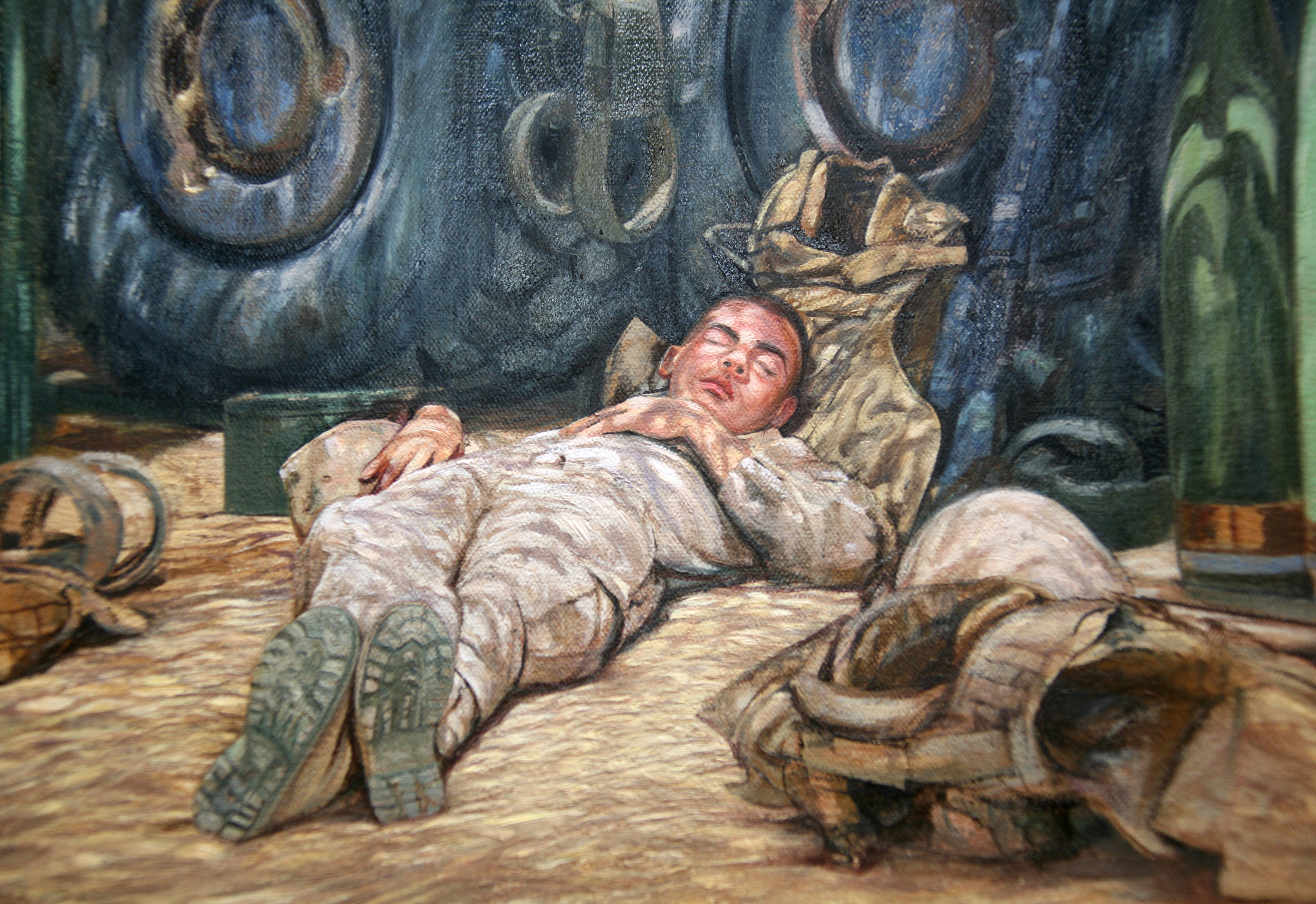
Cpl. Alicia R. Giron
Down the gravelly road, an older man, built strong and lean, walking assuredly through hell's gate. In this valley, the shadow of death casts invisibly, as the omnipotent fear, that cutting vibration that pierces as it electrifies. Every last medieval hell of our wildest imagining is child's play in comparison. The daytime moon fills my mind, obscuring the passion of escape into the dizzying architecture of mythology, roasting in this Middle Eastern world fire.

Collateral Damage by James Miller
The black fly of fire-bomb death squeals past overhead, and I run, sliding my fingers along the desert rock, the stone crumbles into rough sand. My fingers, mysteriously blackened, feel into the stone. A black liquid seethes. Viscous, thick, it's oil. I realize I can't leave. The desert spring overpowers my body in a storm of evil lust. I treasure the root of all fleshly worship in this age of fire as the swarm of madness overcomes, and in a blinding instant, the stone implodes, my hand flits to dust, the Earth gives way to pools of ash, and I sink in the quicksand of eternal war, condemned to modern night. 

On the Impacts of the Iraq War, Read COMMON DREAMS
_____________

For an ecstatic and mesmerizing experience, listen to this album while watching SAMSARA. There are new waves of sound yet to break on the open mind who might stand to listen on these ancient shores.


Delighting Destiny: Selections of our best during a live performance with audience. All proceeds from this album sales will go towards producing future performances and future recordings. Thank you for your continued support.

Monday, 29 April 2013

Sexuality and the Self: A Walk Through Chaplin's Dreamland of Innocence


"Dreamland...Sin creeps in...Trouble begins...Innocence...Getting flighty...Jealousy..." concluding titles in Chaplin's The Kid

The penultimate scene in Chaplin's first feature as an auteur filmmaker brings the viewer into "Dreamland" an alternate world parallel to the slums of old America, where all the principal characters from the film are winged angelic humans, swayed by the ear-whisperings of stereotypical devil sprites prancing about unnoticed. Could Chaplin have been privy to the hermeneutical notion that angels and demons are internalized expressions of our inner nature, mirroring social experience within the self-reflective subconscious, a key to an awakening, which resolves such impacting triumphs as the orphan child reuniting with their birth mother? Could Chaplin's narrative insights on film have preceded psychoanalytic depth by seeing the substance of dream as holistic self-projection, and at the same time, maintains unrivaled importance for transforming the collective psyche? 

Alan Watts is famously known for relaying the following psychological narrative, an interrogative entry into the presence of mind, as it wanders through the imaginative hollows of two overarching conceptions, past and future, and their nexus of alternate psychic fruition in the netherworld of dream. 
"Let's suppose that you were able, every night, to dream any dream you wanted to dream. And that you could, for example, have the power, within one night, to dream 75 years of time, or any length of time you wanted to have. And you would naturally as you began on this adventure of dreams, you would fulfill all your wishes, you would have every kind of pleasure you could conceive. And after several nights of 75 years of total pleasure each, you would say that's pretty great, and now let's have a surprise. Let's have a dream that isn't under control. Where something is going to happen to me that I don't know what it's going to be. And you would dig that and come out of that and say, Wow, that was a close shave wasn't it. And you would get more adventurous and you would make further and further out gambles, and finally you would dream where you are now." 
Like a silent film, dream is also suggestive. The act of play is a prerogative of metaphorical truth, and finally, where chaos is a principle which reveals Self as the All-Self, Alan Watts, reminds us, "The whole nature of the Godhead is to play that he is not. In this idea then, everybody is fundamentally the ultimate reality...God in the sense of being the self, the deep-down-basic whatever it is. And you're all that, only you're pretending you are not." Dreaming is a doorway to a revelation of the nature of self as All, where we confront the play-form of creation as an inner process of personal creativity, as the embodiment of a creative mind. 

While we go about our "waking lives" fully immersed in the, "I am not that" attitude, the nightly vigil of our inborn collective life, our subtle creative instinct, bleeds with singular potency throughout the periphery of waking experience. In dream, we remember who, and what, we are: the stuff of play, Lila, in Sanskrit. There is a story of the seeker who goes to a guru and staring into the face of the holy man, meets only a curious smirk, as the holy man thinks, "Oh! Come off it, Shiva."  
____________
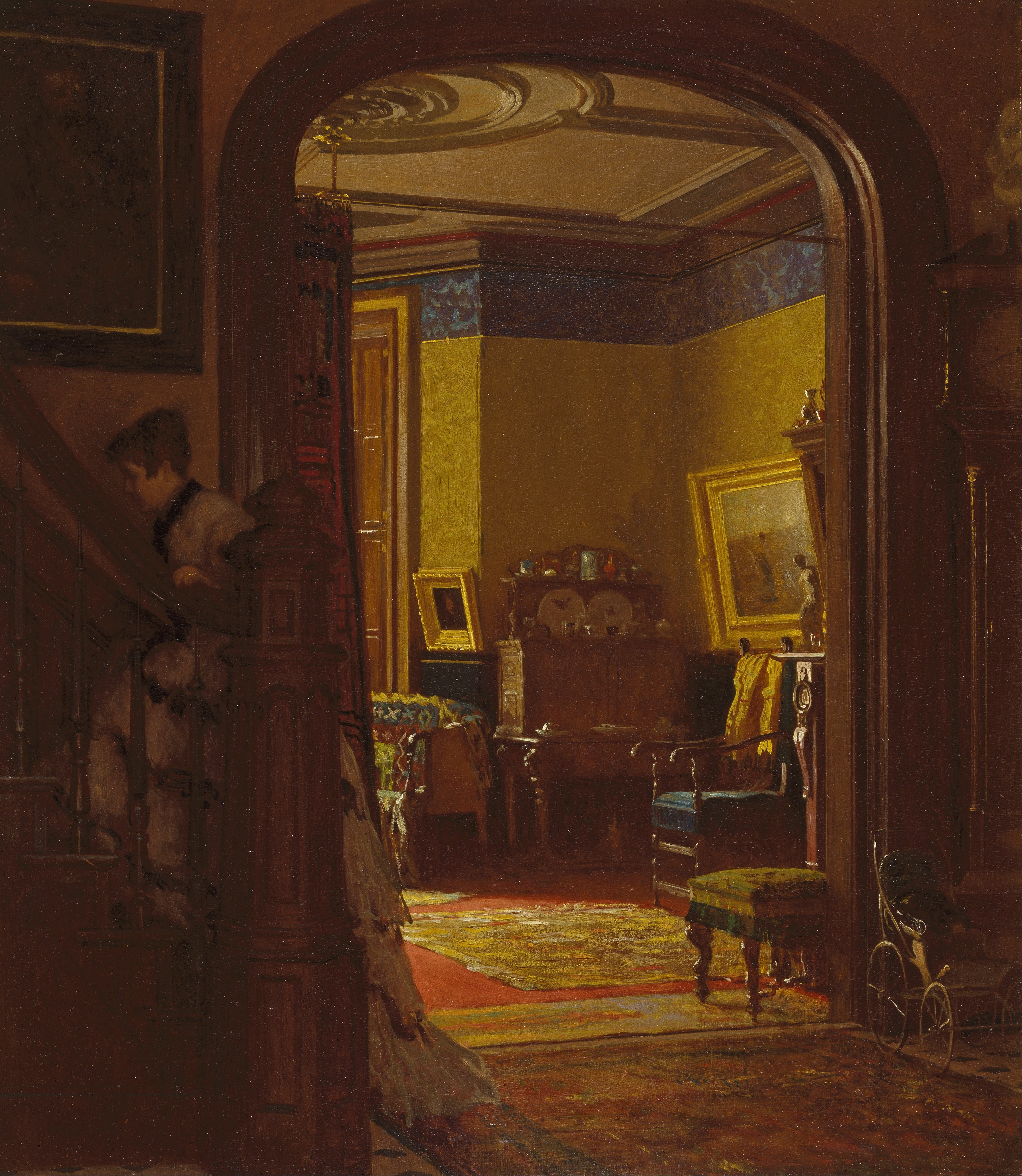
Shadows hang with somber repose. My beloved grandparent’s home is empty. And I’ve been away far too long. The dust has settled. The dining table is hollow with a loveless ardor. I can inhale the loss; the forgotten wealth of life lived once for each other now separated by nightfall and age.

Not at Home by Eastman Johnson
A middle-aged man in a black leather jacket stands outside, waiting. I’m hooked outwards. The sky calls me from the dank lament of the abandoned house now friendly to no one except for the wraiths of Death and Time. Who is the middle-aged man? I know him well, as I’ve known myself reflected in the old western visage of distempered exile.  

Devil Priest (credit: Gary Ashley)
I mount a bicycle along the cracked sidewalk curb. A dilapidated car, in the model once owned by my centenarian grandfather, clanks and sputters downwind. Is that my brother at the helm of a rusted, malign vehicle? I glide toward dawn. 

Automobile by Roman M. Semaschkewitsch
The middle-aged man seats himself blankly at the back of my bicycle. Like a burden to its beast, I carry his apathetic and listless indifference throughout the expansive elaborations of my most grandiose ambitions. 

Dynamism of a Biker by Umberto Boccioni
The map of Asia opens with the clarity of a skyline on a cloudless day. Traversing the backcountry of Vietnam, land of my lifelong love, I veer through incandescent bogs and sunbaked farmland. Natural beauty unending, my eyes turn inward, to visions of aspiration and wonder. To Europe, across Mongolia and the bleary maw of central Asia, I carry the burden of age, of settlement, of thought. Silenced, my mind is repressed with a hidden name.  
___________
The pure darbuka/doumbek track behind the voice sounding is essentially a decision to convey the beat-hop sexuality of modern techno-culture, and more, to welcome the sounds of the Arab-Muslim world through one of their traditional instruments, in coordination with a voice to affirm a re-sexualized Earth-bound society in honour of the Feminine - to move beyond what I have called, "monosexuality" a conception in response to our narrow myopia concerning the spectrum of global sexual expression.


Originally published in Poetic Pinup Revue's February 2012 print issue, "monosexuality" is written in the name of all the victims of a sexually repressed society, that being mostly all of us in the modern world. There is an epidemic of masculine dominance. The feminine perverted and repressed through our culture of rape. The lack of feminine empathy extends to the contemporary human relationship with Earth, as PachaMama, Mother Earth. Our birth-rite is to recognize Her.   

"monosexuality" was also my first published poem. Where poetry is conceived as a feminine art, to hell with the macho patriarchal cultural hegemony that diminishes the authentic creativities of our inborn humanity in favour of entitlement propaganda, figuratively illustrated as the "war on sex". Militarism further exacerbates the repressive/oppressive role that sex, in gender, reproduction, and the act of love, has assumed in our increasingly self-destructive society. As with all dualities, masculinity implies femininity.

Public Observance is essentially steeped in the act of 'people watching' with a keen eye for the social imbalances in play on any given occasion. Especial light is thrown on inter-sexual relativity. Included are the poems, "monosexuality" (Poetic Pinup Revue, 2012) and "Preposterous!" (Steel Bananas).

The piece, "Preposterous" makes a point for the significance of anarchical logic, or irrational meaning, and how the formal context of institutional learning delegitimizes the freedom to imagine beyond the bounds of normative thought and reason. It is at once an elegiac and at once celebratory, marking a flight from the institutional walls of predictable learning, towards the more experimental and risky, adventurous dream-education of self-knowledge.


Monday, 11 March 2013

The Art of Freedom: 2 Years Since Fukushima in the Post-Scientific Era


"The existence of nuclear weapons means we could potentially create a disequilibrium, an imbalance, on the planet and the atmosphere by the launching of some of these systems, some of these systems. There are 27,000 of these systems. This is more than enough to wipe out the whole planet. You also got people working to say, 'you know you gotta save the planet.' Well you're right, we've got to save the planet. And so the whole environmental effort, as laudable and as absolutely critical as it is, can be for absolutely not in the space of hours if these guys actually went at each other." Lt. General Romeo Dallaire (Ret.) Pugwash Canada

Today is the two year anniversary of Fukushima Daiichi disaster. In my previous post, Hatsuyume of Peace, I kicked off a new paradigm in the life of this blog with reference to the apocalyptic transition that nuclear energy essentially means for life on earth. This is an enduring creative metaphor, a source of reflection that begs to be heard and never left in the silent empty ignorance. For, as the unrivalled Persian poet and filmmaker Forugh Farrokhzad said in her landmark film to inspire Iranian New Wave Cinema, a groundbreaking force of thought, emotion and impeccable insight, "There is no shortage of ugliness in the world. If a man closed his eyes to it, there would be even more." Her film, The House is Black is about a leper colony, and the humanization of treatment for a disease that simply requires attention. While the impacts of a nuclear disaster do indeed course through the blood and infect the children of the victims, there is even more recourse to action, to look, and with the kind of remembrance that breathes in the present moment, to see the eyes of the victims as through the eyes of our own children, our own mothers, fathers, and siblings. For there is evidence that it could be forty years or more to clear up the Fukushima disaster, which is the worst of its kind since Chernobyl. The transition of nuclear energy as a weapon, the atom bomb, has essentially moved the world from the era of World War, into an era primarily defined by war over intelligence, the post-cold war era. Vietnam is an example where the government authority of the United States actually never declared war, incapacitating the ability to detonate another atom bomb on a human population in Asia. We are now living in the post-scientific era, and the Age of Reason is long past. Our existence is not defined by scientific knowledge, but of technical know-how.

On an investigative bend, I took the time, as part of the research praxis of a literary arts journal, to go to photographer, Arthur Nishimura's exhibit, "Dream Country" at the largest university in town. In the exhibit, Nishimura creatively interposes landscape photography with prepared or rendered film. I went for the purpose of interviewing others who happened to stroll through the exhibit about the significance of today's anniversary remembrance of Fukushima, not only as a Japanese disaster, but as a world disaster. What do the photos of a globetrotting Japanese nature photographer say about the remembrance of Fukushima? My questions, and my approach to a conscious public as an experimental journalist fell on a silent room. In the last hour of the gallery's opening today, not one person visited Nishimura's exhibit. Instead of heading into abstract philosophic directions regarding the nature of public ignorance, I peered deliberately, patiently and acutely into the breathtaking symbology of a master photographer.


Let me take you through an abbreviated version of the exhibit, and how I related my experience of "seeing" to the memory and lasting impact, and future legacy of Fukushima. Firstly, Nishimura's piece, "The Book of Flatland Dharma - Of Two Religions: Conclusion" (1978) captivated me. It is a juxtaposition of a sacred Japanese temple, as a diptych next to a silo in the Alberta countryside. This struck me first, because Nishimura captures the elegant majesty of mystery and beauty all over the globe, yet Japan and Canada have sacred significance, yet the cultural dissimilarity could not be more clear in the way that aesthetics are a reflection of social expression. Next, in his Homeland Tourist series, "Higashi Honganji Temple (1978) flattened me with its elusive doorway of symbolic insight. The bicycle in the foreground, outside of a sacred temple in the background, emphasizes that while there is a sense of the infinite within us, we are after all impermanent, and as we ride the mundane bicycle of worldly experience to its end, the higher awe of spirituality lives on, with or without us. Finally, while there were others that struck me uncannily, I will leave off with one last one that took even more time to set in than the rest, however after peering into its silvery textures, and its striking imagery, I latched on to a hint of perennial truth. The work, "Pre-dharma Sentience" (1978) in The Flatland Book of Dharma - The Singularities series, a stone lies in the foreground. In the background, an open landscape, with a path leading to the horizon, to nowhere. What this says to me is that, essentially nature, as with our nature, is fundamentally meaningless. Nature, in its raw, open and original forms do not offer the human heart a rest stop on which the mind may imagine and conceive a reason for being. The meaning of no-meaning is the great point of flux in realizing our humanity as vulnerable, fleeting, and if at once emergent with direction, also futile and unimpressive. As Paul Valery said, "God made everything out of nothing, but the nothing shows through."

On my return home, on this unusually warm Canadian winter day, I read a very short Associated Press article buried in Metro Calgary on the legacy of Fukushima. In the article, 'Outlook bleak two years later' a quote read, "Everyone, from bureaucrats to construction giants to tattooed gangsters, is trying to prey on decontamination projects. And the government is looking the other way," said Nakamura, who refused to give his first name out to the press for "fear of retaliation". As I reflected on my train ride home through the downtown corridor, passing above rivers of melting ice and the glare of the profound midwestern sky, where the rich sunlight exposes the midriff of an aging humanity, I had a realization. Being human means taking the responsibility that we have as stewards of the land, as a conscious potential unmatched in the known universe. If we do not take responsibility for being human, then there will soon be no more human beings. We do not write the highest law, and we can not speak the highest truth. 

____________
She sets the stage with a sweeping introduction. In the impeccable garb of a beauty queen in love with life. The public gushes with heart-sleeved pandering. The world is set like a red carpet before her.

Queen by Sten Porse
The musical ambiance, the tone, is grandiose and emergent as the Jonah-swallowing fish of all-conceived breathtaking wonder. Her introduction is the mindful worship of momentary repose, for the elemental truths to seduce all through her sonic dance of grace.

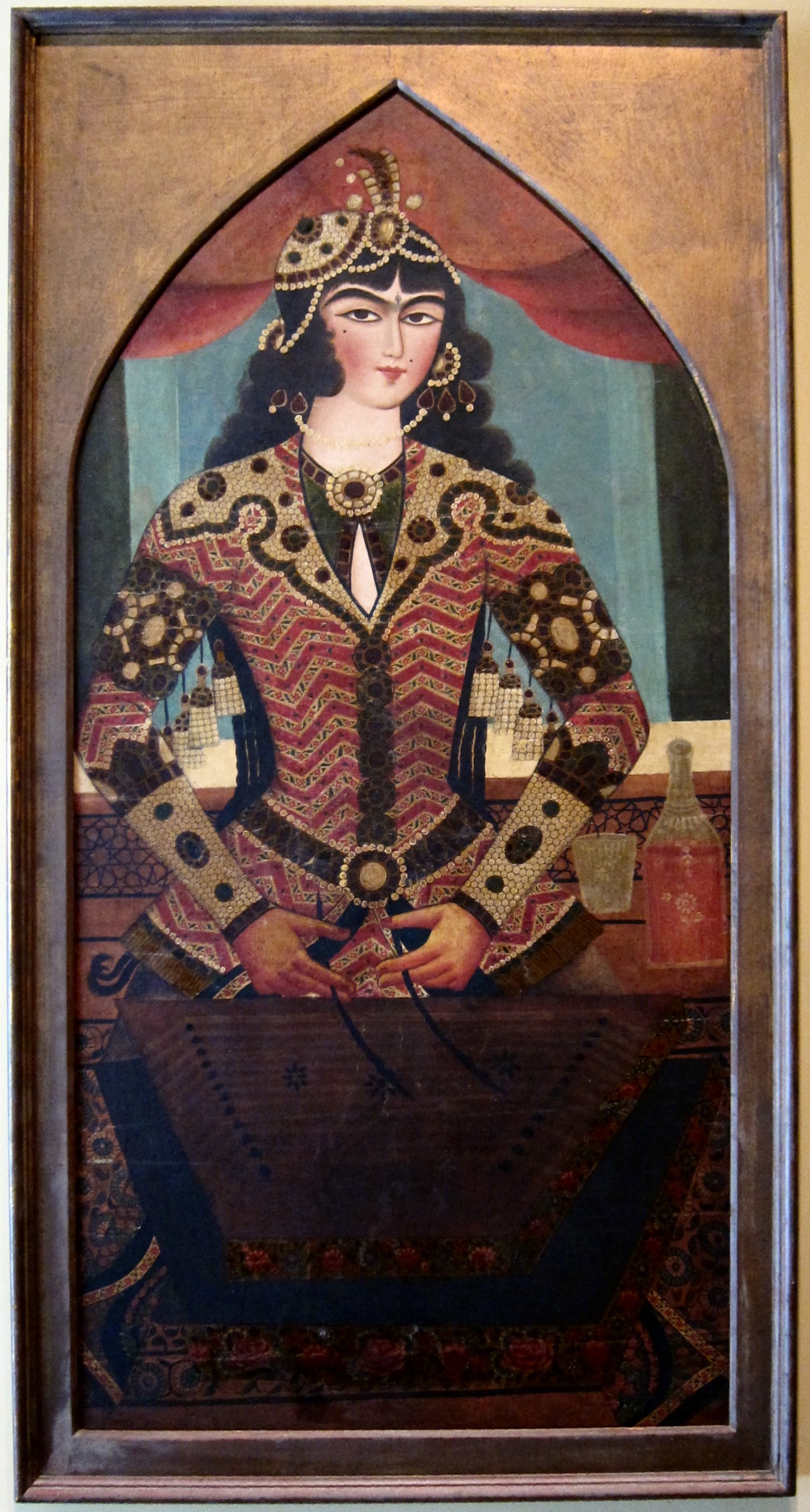
Female Musician by Anonymous
She continues ever on, without me. Frustrated by my own deviance, and in the backwash tunnel of personal failure, I triumph in disaster. The airs of isolation breathe a sad remorse, the regret of guilt itself takes over like an icy bath.

The Ambassadors (detail) by Hans Holbein the Younger
I strain over my broken instrument, and snap its neck in one fell swoop. Not even a ping from the cracked strings are heard in the overarching foment of fanatic bursts and swoons of delight as the mob breathes down the throat of my love the kiss of popular contagion.

Interesting enough, the short dream sketch narrative above, and that described in my last post, where I exhibited a noetic travelogue through Sudan, have coincided with the events of the days to follow. In the previous incident, I had dreamed that I was traveling through Sudan, and had born witness to the social resurgence of positive forward movement. So, on that day, I met and interviewed Emmanuel Jal, as he accepted the Calgary Peace Prize on behalf of all South Sudanese people. Similarly, though without such heavy global precedence, the events within the dream sketch illustrated here preceded a botched concert appearance by none other than myself to accompany my Love onstage.
___________
My first exhibition of an original "sounding" in the internal collaboration of creative music with creative writing. Improbability in Upswing, was published at poeticdiversity: the poetry zine of los angeles in December 2012. In my reading, with relation to the content of this post, I am taking off towards the eye of the sun. The teeming cloud-born sky quakes with the burning rush of human flight. Riding through the energetic outpouring of modern rocket fuel, I feel a beneficiary of similar technologic might that burned the bodies and fuelled the fires of war. Nuclear energy is not far distant, and my body begins to churn with the physical imagination of experiential interdependence, smouldering at the cusp of freedom and death.


To set forth another tradition of self-publishing, every week from now on, as I offer a "sounding" of spoken word and original music, I will release a chapbook of the section from which the "sound poem" derives in the series of collected experimental writings. Enjoy and ponder the experimental imagination through visions of "Aircloudsky".

Tuesday, 22 January 2013

Call of the Sacred River: Pather Panchali and Dreams of Varanasi

Wife

"Let's go to Benares. Don't the orators make lots of money?"

Husband

"We can't go. How can we? This is my ancestral home; how can I leave it?"

Wife

"Why not? You were away eight years before. You left me at my father's and never wrote."

Husband

"Then I did not know you sweet you are."

Wife

"Save your compliments. This is my home, too. But look at it; it's like living in the forest. At night the jackals prowl around. There are no neighbours I can talk to. You are not always here and sometimes I'm so depressed. You won't understand these things. You live in your work. Sometimes you're paid, sometimes not. I had dreams, too, of all the things I would do.

Outside Their Door, An Old Lady Beggar Sings:

"Those who came before are gone / I am left behind, a penniless beggar / Day draws to its close, night's mantle descends / Row me across to the other side"

From the film, Pather Panchali (Song of the Little Road)

The same night I look back to Pather Panchali for a few words of wisdom on the experience of human dreaming, I coincidentally happened on the film, "Beyond" by NYC-based photographers Joey L. and Cale Glendening. The quote in the classic 1955 Bengali film Pather Panchali speaks to the luring effect that the ancient city of Benares commands, also known as Varanasi, one of the oldest continuously inhabited cities in the world. Indeed, it is impressive to see the holy tradition of sadhus depicted in the light of modern photographic excellence. The final scenes in Joey L.'s film are incredibly touching as a young sadhu teaches about how the world is made for peace, and all must be as the sun, seeing all beings as equals and offering the light of wisdom with an exuberant heart to all indiscriminately. Long Live Mother India! 
_________
As the world turns, dreams often fall into the abyss of earthly shadows and solar illumination 

The Jaws of Life by RK
We Are Not Above Extinction by RK
Light On The Little Road by RK
Bridge Under Serene Sky by RK
All Rivers Sacred by RK
__________
and silence, and nothing, and silence,
and how in silent searching , the wandering fades

a trespasser in the popular living happen-stance of  “honest” life,
stopped,
self-betrayed,
to tarry with biblical heat
and white-skinned eyes

paranoiac doom
in the aftermath of domestic civilization
...

calling back to the childless dream
Earth
...

returning from within
the simplest symbolic stare into the beaten human sigh
pointing downwards

upwards

west and east
with the surest of numbered lies,
telling children to fear death and bless the flesh with ungrateful ears, blocked
to the great mystery
that is not
that I am.

excerpts from "that I am silence"


Sunday, 20 January 2013

I Awake in the Name of Django: Romani Jazz and the Dreamer's Embrace


"I'll see you in my dreams / And I'll hold you in my dreams" Gus Kahn's original lyrics

It was in a downtown French bistro where I listened to the hackery of a pseudo-theatrical storytelling musical showcase on the life of Django Reinhardt. I was expecting a real return on a small investment to witness the life of the Romani Jazz legend through his music. I was disappointed to say the least. Genius can never and should never be copied in any way, shape, or form. He made recordings.

I did learn from the storyteller with the gypsy guitar that Django, in fact, means "I awake". One of my favourite films, "Sweet and Lowdown" by Woody Allen features "I'll see you in my dreams" an all-time classic jazz beauty for our time. It speaks numbers with the instrumental ingenuity of the two-fingered guitar player, whose myths struck a chord from my earliest days of musical appreciation. It was especially this Antique FILM which got me hooked on Django! I've been awake ever since! 
__________
I Awake Too Long 
& Photographic Clarity Re-Places My Eyes 
From Dreamscapes Lingering
In His Element by RK
Color of the Horizon by RK
I Am Seen by RK
A Shared Path by RK
Domestic Offerings by RK
___________
“A full expression of Love in mind, heart and wisdom”

“Will the new being have music in Their veins?”

“If marriage of shared blood, the perfect union of musical harmony and universal rhythm will mark the forehead and line the bones of the little one to be”

Raised on the pressure of finger to string
And palm to drum

excerpt from "Spreading Easy Freedom"

Saturday, 12 January 2013

A Battle For Wits: Ray Bradbury and The Illiterate Fires of Modernity

Philosophy and Christian Art by Daniel Huntington
 "I've got to read, I've got to catch up with the remembrance of the past!" Fahrenheit 451 (film)

The principal character, Montag, in the 1966 film adaptation of Ray Bradbury's Fahrenheit 451, by Francois Truffaut, says these lines before he dreams a nightmare. After breaking up a sterile grouping of house guests, who on being exposed to literature become fraught with the anxiety of original thought and complex emotions, his work as a book burner turns into a twisted night haunt. Ray Bradbury, author of the book, may have been alluding to much more than a simple prediction of a neo-Fascist regime burning books as did the Nazis, and other demented social movements throughout history. Note the Ancient Library of Alexandria. How much of our conscious memory collective was turned to cinder and dust. With the influx of new media, we are losing our grip on the greater part of human contact, that with the historical mind, descending with the literature of the ages into the fires of mass ignorance.  
_____________
Waking proof stirs the realms of the collective-creative imagination with inner-brewing mystery. 
Fahrenheit 451 Resurgence by Rusty Kjarvik 
Fire at the End of the Tunnel by Rusty Kjarvik 
Sail into the Flames by Rusty Kjarvik 
The Last House on Earth by Rusty Kjarvik
Broken Chinatown Lamp by Rusty Kjarvik
____________
Kneaded breathless
Behind television predilections

Guessing at the racy night
Caught in a frozen web-tied lesson

To shoot pyrotechnic tides over the urban mind
Digging into a buttressed yurt, cold

excerpt from "One Ambitious Species"


CHECK my latest Sketches of Style publication with Randomly-Accessed-Poetics 


Saturday, 29 December 2012

Van Gogh, Ophidian-Seer of Starlight Medicine

Cafe Terrace at Night by Vincent Van Gogh
"For my part I know nothing with any certainty, but the sight of the stars makes me dream." Vincent Van Gogh
Artists are seers, and so, are truth-seekers. Yet, human experience blurs the line between seeing and seeking. Certainty is flux, and flux is certainty as form is emptiness and emptiness form. The old Taoist adage of dual unity is the perplexing clarity of universal distinction. To the point, and contemporaneously with current societal and ecological trends, human life is further revealed as an innate paradox. Van Gogh continues in his mad method of artistry in saying, "I dream of painting and then I paint my dream."

The wisdom of Van Gogh speaks to my previous post, The Cubism of Unity: Shelley and the Myth of Monogamy where he speaks on God (Unity) and Love (Diversity). "Love many things," he says, "for therein lies the true strength, and whosoever loves much performs much, and can accomplish much, and what is done in love is done well." More simply put, Van Gogh confesses, "But I always think that the best way to know God is to love many things." 

In the beautiful and powerful 1956 film, Lust for Life starring Kirk Douglas, the tormented genius and emotional outcast paints Starry Night, while the narrator speaks: "Sometimes I work on into the night. I'm hardly conscious of myself anymore. The pictures come to me as in a dream with a terrible lucidity." Night and dream are married in a mystical love through the human as artist, animating the spirit of the dream towards a night imbued with the life-giving stars of an empyrean both transcendent and visceral. The dream stirs from the lowest of depths, and reaches towards our greatest heights. We are besieged with an all-consuming, all-cleansing, all-awakening, all-encompassing Mystery.  

Search on this site below for more original interpretations and creative contexts on Van Gogh
____________
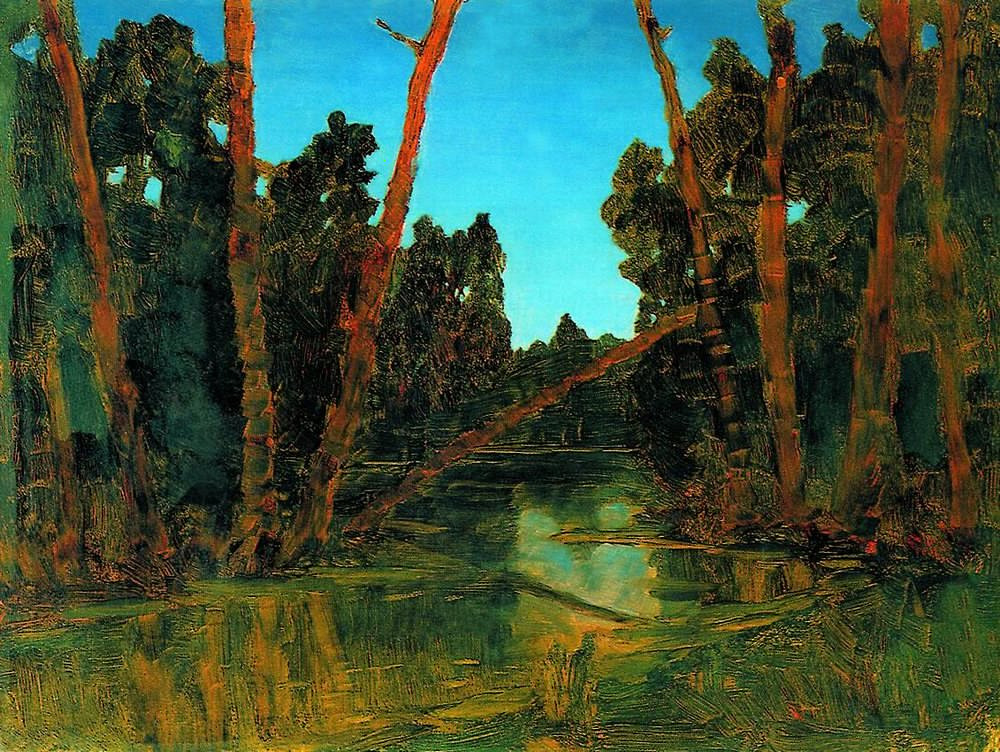
My nature writing blends into an arcane Spanish-language text. The publication circulates among Earth-lovers and wild foodists alike. Together, my readers and I endeavour through a dense thicket of swamp. Community leaders take the helm of a slow-moving canoe, shifting through the bullrush stands and mud vents emitting the hot gaseous fumes of peculiar decomposition. 

Forest Swamp by Arkhip Kuindzhi
A rattlesnake emerges from the rushes as we emerge from the blinding vegetation. On the waters, ready to disembark for a land crawl, a comrade teases and taunts the rattlesnake head. The venomous wisps and hissing instills a deep-set fear straight through my eyes. The rattling spells virulence and ire. Reptilian awe paralyzes my arms and legs as I stare, petrified, watching the snake slither madly towards me. It darts and in a split-second latches onto my arm. My reaction is pure thought. Still as stone, I feel its fangs stick into my blood. 

Old dream interpretation folklore sees a snakebite dream as a positive symbol of regenerative holism. See my recent nature writing publication for Canada's only independent news cooperative. 
__________

To return to primal and distended physical tumult
A chaotic folly
Dreaming in smokeless fires

...
In the post-kingdom English croak
Over bastions and landlocked heights
That furnishes much scheming

A trite & forced inhuman sense
Of belonging
In a war trench

Phase of lunatic civility,
As the prosperous few wade
In proud shores of quicksand

Loss of self,
Ruined foresight vanishing
Into the uncreated past

excerpts from "Horror-story jazz"


Friday, 9 November 2012

The Humours of Sufism in Iranian New Wave Cinema

The prophet Khizr Khan Khwaja by Anonymous
"I know you've been dreaming of me. But don't take it seriously. You know that dawn is when God visits his devotees. And divides the daily bread among them." Spoken by a Sufi Mystic who appears in dream visions in the Iranian film Pari by Dariush Mehrjui

Interestingly, this brilliant film was originally adapted from "Franny and Zooey" by J.D. Salinger without authorization, by iconoclastic and renowned Persian film director, Dariush Mehrjui. The film was adamantly attacked on all sides, by both Salinger's lawyers and Islamic approval. It seems that artists are often at work portraying characters and illustrations of their own internal struggle, where in this film, Pari, a young aspiring theatre actress drowns in pseudo-mystic emotionalism surrounded by a family of intellectuals and artists. Pari (a Persian name meaning "mermaid") finds herself swimming in over her head, a being caught between two worlds, and wishing to unite with her beloved uncle who took his own life. Indeed, the auteur filmmaker, and artists of a higher order conceive the focal point of their internal development, interwoven with an external social conflict, as a kind of dreaming, where it is seen through towards the dawn, beyond both the day of social tension and the night of inner turmoil.

For a great wealth of film reviews on Dariush Mehrjui's extraordinary work visit The Film Sufi
_________

a Fellini-esque mindtrip of character haunts, my feet dragging through superstitious nostalgias and the blind opacity of lost friendships, tragic wants, and open futures.

"Fellini, la Grande Parade" by Jean-Pierre Dalbera
black and white fur, white and black fur, the coloration of his follicles, a childhood escape through naming, and here he is again, in full glory, my dead companion of all things meditative, a leader in the subconscious wave of true surrender to the spiritual laughter of play 

Myojakdo (Painting of Cats and Sparrows) by Byeon Sang-byeok
here he is, I can feel his warmth in that little heart beating patiently between two rib cages of delicate whimsy, and he leads on through the empty darkness, a labyrinth of hollows beckons me forward, through to a sweetening, mental taste
_______
“I saw the trunk,”
Her Hindu elephant from outside
Walks coolly from music’s grand Guest

At the public house,
In the window,
A final flicker before traversing the footboard
loosened with railroad age
           Over the national telephone of spiritual callings
           Abused by electrified tradition
           Stunned in the tingled alcoholic flame
                  In isolated, deserted and abandoned bodies
                          Whose spirits bore a frail passage,
                          engraved in the air of soundless rhyme

A knowing
Ever thoughtless to the strength in pure being,
To grasp coldly into the summer’s beaten plea
           To sustain our musical sharing
           In human heaven’s piercing
                  Through the empty eye holes
                  Peering with my mirrored face of light
                          Radiating, through absolute darkness
                          as a visible cry
                                 To haunt our sacred sanctuary

“That inebriated muse!”
Drinking the words of men into her silent womb,
To fixate her fingers into the cross
           Formed over a chest glorified with Catholic warnings
           To relieve one’s self of the world
           and ask divinity to replace human desire

To become one collective struggling
As a unified presence,
Whose heart remained fixedly sanctified
           Before the death of the Mother and the Father’s bared ghost
                  Pictured as a beacon
                  Blended into our animalistic foresight


Tuesday, 30 October 2012

To Dream in Red is to Uncover the Veil of Consciousness


Judge

"Yesterday, I had a dream – I had a dream about you. You were 40 or 50 years old…and you were happy."

Student

"Do your dreams come true?"

Judge

"It’s been years since I’ve had a really pleasant dream." 

Dialogue between the two principal characters in the classic filmmaking masterpiece "Three Colors: Red" by Krzysztof Kieslowski

Along these lines of artistic development towards a pseudo-scientific theory of colour, the iconic German poet, Goethe, produced a volume entitled, "Theory of Colours". While not being received as proper theoretical discourse by the scientific community, this was Goethe's prideful involution into the realm of human experience beyond the sublimities of intellectual life. 

Should your glance on mornings lovely
Lift to drink the heaven's blue
Or when sun, veiled by sirocco,
Royal red sinks out of view –
Give to Nature praise and honor.
Blithe of heart and sound of eye,
Knowing for the world of colour
Where its broad foundations lie.

— Goethe

(Quoted from Wikipedia article, "Theory of Colours")

Also, see my previous post: Reflection on Zbigniew Preisner's "Silence, Night and Dreams"
_________
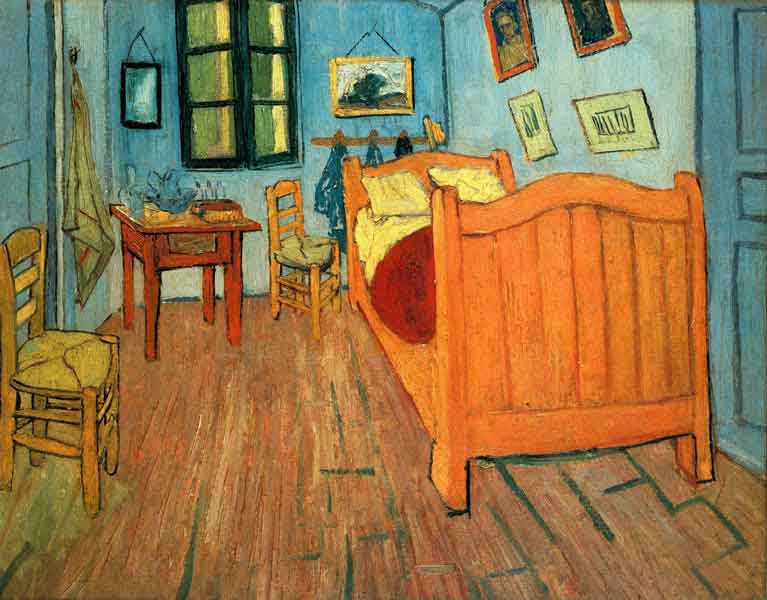
I wake with eyes closed. I won’t open. I can’t look. The bed feels dishearteningly unlike where I know myself to be in my present life, yet strangely familiar to the one bedroom I never wanted to wake in again. It’s my father’s, and stepmother’s.

Bedroom in Arles by Van Gogh
Cat litter sheets and the nauseous sky pelt the window by my ear, as I smell the cheap havoc about in tepid condensation of humidity, a feeling of being too close to home, where abuse reigns on every familial plane, as a tree bespattered with the lifeless trembling of a deadly morning earthquake.

The woman at the window by Jozef Israels
I sink deeper, and the outdoors opens as an unsheathed bronze, polished and brandished for timely wielding about the nascent plain of equal hue, enlightened by the western sun. As a beckoning from Manifest Destiny herself, I trudge through the yonder horizon with a mind for exploratory happiness, in pursuit of the ear and chaff of corn and grain, the dizzying panorama of emptied wilderness, where the Vanishing Indian now only lives as a politically corrected name.

Westward Ho! by Emanuel Leutze
I tip my hat squarely to the north with scythe in hand. I wander through the flooding dusk lit pasture, a son of the mindless hate staring me in the back, now buried in the lightless flat of night’s self-awakening. 

This and two other dream narratives (21st Century Space Race of Sustainable Housing & Mindscapes Interpenetrate Dream with Reality) feature subconscious experience surfacing amid the sensual spheres of daily waking.
_________
The western pathway to slavery lies feebly
over the chasm
         As a vile whore reminds us
         to put grace before prayer

In motionless wonder,
personifying the lush diligence of an ancient society
         Dismembered at the plan of a cursed monotony
               To stare into the black façade
               and feel dreams slip through sleep,
                         In and out

excerpt from "Blind Daemon"