Primarily a writing exercise, this dream journal-inspired blog is a quiet introspective sojourn into the process that we traverse in going from private dream to public art. I see our dreaming as an internalized mythmaking. As I philosophize and expressively exhibit dreams, both private and public, I encourage and delight in creative language as a way to practice experiential metaphors through a “public dreaming." Writing Theory: Creative Dream Fiction
Showing posts with label Reading. Show all posts

Monday, 25 March 2013

Experimental Cave Art: Philosophies in Word, Vision and Sound

Aboriginal Rock Art, Ubirr Art Site, Kakadu National Park, Australia
Photo: Thomas Schoch
When your night becomes day, then that which is dreamed is on earth. Do not be too high-spirited, but go, and go alertly.” Aborigine Saying

In continuity with the theoretical writings on the natural sleep cycle as expansive beyond the twenty-four hour day, and especially beyond the programmatic workaday cycle, it is not only the activity of waking activity that might define the energy experienced by the mind-body based on sleep cycles but the content of dream itself.

For example, we go through cycles of remembrance and forgetting, this is a fundamental attitude of the cosmos, as we see in the natural tendency to the peek-a-boo gameplay in all children. Similarly, as this is reflected in our conscious and unconscious experience of life, so this is true with the content of our dreaming. We will go through periods where dreams are not remembered, and then after a time, will begin to remember again. These periods of remembering the content of dreams ultimately point to an unresolved momentum of energy building up in the psyche as a consequence of either personal or collective unconscious activity that one becomes susceptible to in their daily life.

Until this mode of consciousness is directly confronted and transformed through creative insight and practical application in thought, reflection and in some basis of continuity in consciousness, e.g. imaginative outpourings based on the theme and nature of dreaming, where all suppressed and repressed energies are focused and shifted into full view, the involuntary sleep or unconscious REM will continue to emerge and take shape in the psyche through imagination, emotion, intellect and every exhaustible mode of subtle activity.

Every time a dream is remembered, the remembered content, whether imagery or emotion or otherwise, is part of a string of remembrance leading back to a source of reflection deep within the whole being of both the individual dreamer and the society throughout the entire spectrum of its history, propaganda, knowledge, media, relationships, etc.

Oftentimes, the strength or immediacy of memory, the lucidity of the dream state as it interweaves through the waking mind, forecasts the urgency of attention to the subconscious. For example, I have experienced lately that the instant I am ready to sleep, as fast as I close my eyes, I see the content of my dreaming, the imaginations is teeming with life and energy, needing to be witnessed, calling out over the margins of consciousness.

The only way to resolve the inception of remembered dreaming is to confront the subtle impulse to emote or inspire a certain inborn expression, metaphorically illustrated in the dream itself. When dream and life are subsumed into wholeness, undivided by the normative values of structured time and analytical thought, the subconscious and the conscious merge into a healthful surrender of the cosmic unconscious faculty of Being, as the great mystery of self-awareness. As reads the motto in Athanasius Kircher chiseled over the alchemist's doorway, originally in Latin, it says, "While Sleeping, Watch'. See previous post: Alchemical Poetry of Terence McKenna
_________
Breathtaking hot night. The empty dark dream of memory. Narrow canals, irrigation trenches in the backyard under a pitch-black sky, a starless new moon. The seizure of domesticity; fencing blinds besiege all passage to horizon’s beginning, and a house cat skits through the mud with a silent flit of dusty soil. A chase begins, until I grab the fickle creature by its muzzle, and in the raw and ruddy brown earth, I tangle its fibrous backbone, cracking the living spine with the brute edge of my wrist. The sky clears like a strong exhale, and the ground takes formless cover of the starless sky above. I drift away from a mind to a life as inert as the swift welcome of death.
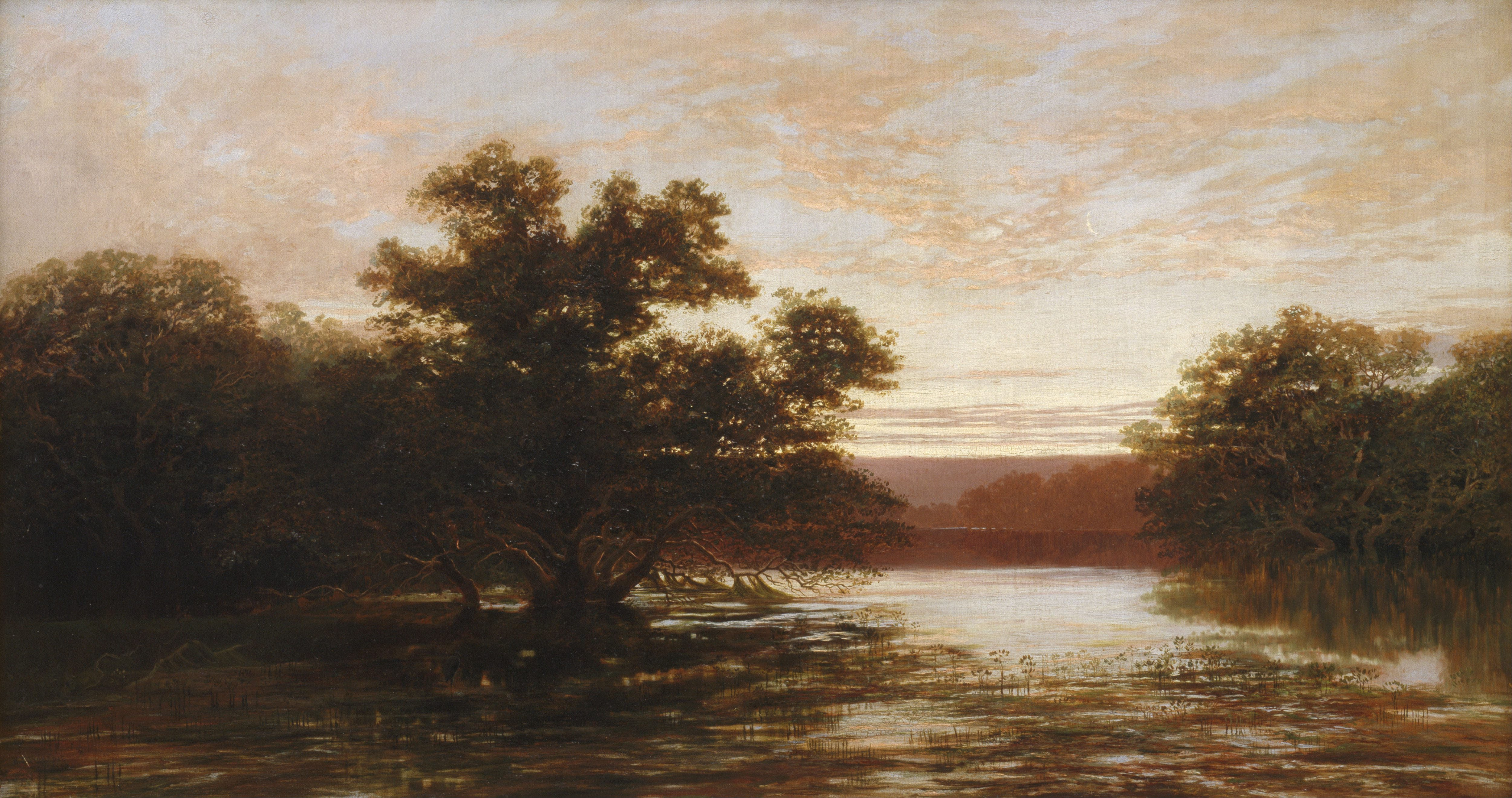
An Australian mangrove, ebb tide by WC Piguenit 
Worshipful room of sweat and lust, the emotive spring of music keeps us swinging to a joyful noise, the urban sound of pain alleviated before closed eyes, staring inward to hear the sight of the muses, invoked by the musician hosts sweltering mad before a small though dedicated crowd of movement. And the headline group enunciates first note with strength unseen; the crowd has since escaped into the bleak, old night. A few straggling local friends stand by the stage, amused and apologetic. One song passes in the silent hollow, a space deemed fit for thousands reduced to pin drop nothingness.

Musical entertainment at the spinet by Johann Heinrich Schönfeld
The emptiness is as palpable as the heartless mind, rounding off pales shots into the murderous pangs of repeated history, the bitter angst of adolescence returning in a white noise of a flushed and ruthless voice, the weird ground rumbles and quakes with burning trust; that a future still opens ahead – full and potent with renewing vigor, to wake again, and live the day from the start, even if our rise coincides with dusk. A silent vision unearths our eternal belonging with grace, and the human community within, where the heart is still in its constant beating, in its rhythmic patience with a more sacred trust.
__________
An elegiac satire on split vein of domesticity, as it unravels and spurns the knowledge-creation of a more unstructured style. The home is the centrepiece of domestic life. Yet, for many thousands of years, there is evidence that we were in fact cave-dwellers. "Caveless" muses on nostalgia for those cavernous days through a reading of "Cave! Home", about a time when petroglyphs and charcoal painting were more important than off-white, beige and any number of dull, and sterile wall aesthetics, and the great-image language of visionary rites were outweighed the significance of antique literature. How can we resurrect the idea of the cave in the context of the modern home, with its womb-like contours and living light that curls throughout our waking minds like breath, and infiltrates our dreams like a warm lover enduring a midnight meditation at our feet?

"Placeless Human Society" is also read here to recognize the dramatic shift from our ancestral pre-history as cave-dwellers of imagination and earth, where suburbia (and its non-subordinate counterpart: the city, for that matter) has essentially uprooted us from this inborn life as a dweller from the earth. On a mass scale, we now dwell on earth abstractly, our imaginations have breathed on, yet the umbilical cord to the womb-cave-home from whence we emerged has long been cut.


"Cave! Home" was published in 3:AM Magazine on September 17, 2012 and is also featured in the most recent chapbook, "Creating in the City" which was released with "When No Stars Appear".

"Placeless Human Society" was published in Outward Link on November 7, 2012. The "Caveless" track release marks the release of the chapbook, "Suburbia to Suburbia: America-Egypt".


Saturday, 12 January 2013

A Battle For Wits: Ray Bradbury and The Illiterate Fires of Modernity

Philosophy and Christian Art by Daniel Huntington
 "I've got to read, I've got to catch up with the remembrance of the past!" Fahrenheit 451 (film)

The principal character, Montag, in the 1966 film adaptation of Ray Bradbury's Fahrenheit 451, by Francois Truffaut, says these lines before he dreams a nightmare. After breaking up a sterile grouping of house guests, who on being exposed to literature become fraught with the anxiety of original thought and complex emotions, his work as a book burner turns into a twisted night haunt. Ray Bradbury, author of the book, may have been alluding to much more than a simple prediction of a neo-Fascist regime burning books as did the Nazis, and other demented social movements throughout history. Note the Ancient Library of Alexandria. How much of our conscious memory collective was turned to cinder and dust. With the influx of new media, we are losing our grip on the greater part of human contact, that with the historical mind, descending with the literature of the ages into the fires of mass ignorance.  
_____________
Waking proof stirs the realms of the collective-creative imagination with inner-brewing mystery. 
Fahrenheit 451 Resurgence by Rusty Kjarvik 
Fire at the End of the Tunnel by Rusty Kjarvik 
Sail into the Flames by Rusty Kjarvik 
The Last House on Earth by Rusty Kjarvik
Broken Chinatown Lamp by Rusty Kjarvik
____________
Kneaded breathless
Behind television predilections

Guessing at the racy night
Caught in a frozen web-tied lesson

To shoot pyrotechnic tides over the urban mind
Digging into a buttressed yurt, cold

excerpt from "One Ambitious Species"


CHECK my latest Sketches of Style publication with Randomly-Accessed-Poetics 


Tuesday, 8 January 2013

The Thinker Who Thinks For One Self: A Reflection on Schopenhauer

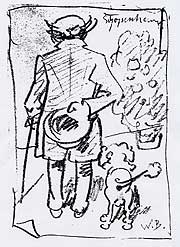
Arthur Schopenhauer caricatured by Wilhelm Busch
"...the greatest amount of erudition, if it has not been elaborated by one's own thought, is worth much less than a far smaller amount that has been well thought over.

...much reading deprives the mind of all elasticity, as a weight continually pressing upon it does a spring, and the most certain means of never having any original thoughts is to take a book in hand at once, at every spare moment. This practice is the reason why scholarship makes most men more unintelligent and stupid than they are by nature.

...he, that is, who thinks for himself, thinks of free will, thinks correctly he has the compass to find out the right way.

...the intellectual acquirement of the self-thinker is like a fine painting, which stands out life-like with accurate light and shade, well-balanced tone, and complete harmony of colour. The intellectual acquirement of the mere scholar, on the contrary, resembles a large palette full of bright colours, systematically arranged indeed, but without harmony, cohesion, and significance.

For the perpetual, the real, in its originality and power, is the natural object of the thinking mind, and is able most easily to move it deeply...In the realm of reality, however beautiful, happy, and cheerful it may happen to be, we move ourselves continuously under the influence of an oppression, which has ceaselessly to be overcome ; while in the realm of thought we are incorporeal spirits...

...how great and how near us is the problem of existence, of this ambiguous, tormented, fleeting, dream-like existence ; so great and so near, that as soon as one is aware of it, all other problems and purposes are overshadowed and hidden by it..." Schopenhauer, On Thinking For Oneself

During the course of writing this blog, from its inception, until tonight, I have been exploring a world of my own making. I have sacrificed a worldly career-seeking existence for a deep exploration into the development of self-motivation, self-learning of thinking for oneself. That being said, while I have risked the mental balance that all face when they dwell profoundly and thoroughly into themselves, I have begun to a feel a feeling of being in the presence of the trackless way, or "the pathless" as Jiddhu Krishnamurti said. To trust the language of dream is a daily struggle to remember the most obscure part of ourselves that the world tells us to deny, forget and leave far behind in the realm of sleep and fantasy. When dreaming begins to encroach on our reality, we become fearful, and as modern people, defensive. The breach of unreason is an affront to all we have been taught. It is the history of our own soul. When the words of great thinkers like Schopenhauer begin to make crucial sense and gain a new sense of pragmatism outside of the allures of becoming privy to an enigmatic philosophic tract, the inner world of one's own making begins with an awakening, illumined by the midnight sun.

See related post: Schopenhauer and the Unconscious Fate of Recurrent Thought
__________
Apocalypse! Apocalypse! We are at bay! The grocery stores are emptying, the streets are empty of cars and the sidewalks are full of an insane humanity. After days of hiding out, I finally emerge from my apartment, bewildered by the blaring sky. A man shouts prophecies from the nearby grocery store entranceway. A crowd of onlookers listen with eager intent. 

Frescoes in the Upper Church of San Francesco in Assisi, southern transept, scene: Apocalypse, Detail by Cimabue
"Fuck you!" I scream at the man. At once, an elderly lady screams back at me, "Fuck you!". I stare at a blinding yellow ring on her finger, absolutely dumbstruck with comic bewilderment. I return to the street side under my apartment building. To sit with a homeless man on his bed of burning fabric. I stare out, deadened by the silence of a lifeless futility creeping into the human domain from the belligerent rage of Earth; her the final hour.
__________
To obviate from this bland mural,
Its strict pull underlies, as a lightning tremor

In the cooled dust collecting raw answers
From the autochthonous matrimony with foreign alliance,

Over the scarred mud-caked plains
Whose agricultural fertility gave way to chemical strife

In the selfish human pandemic,
Lining the hostess and her following with possibility

In the strong-voiced dirge calling back thousands’
Endless anonymity from the last day that rested with holy failure
...
Embracing the nervous mouth of the whole city in one dire expression
To last

excerpts from "Obviation from the BLAND"  


Wednesday, 29 August 2012

A New Settlement for Exotic Settlers

Exotic Settlers


Dear Bloggers, Dreamers and Visitors,

For those of you who have been following my blog thus far (or at least passing by to bear witness), I like to follow a series of excerpts from my experimental writing collection with the gift of a compiled book. Please read and download for your interpretive readings and creative pleasures!


Reception for "Exotic Settlers" to date:

Writing

monosexuality - The Poetic Pinup Revue (February 2012, print)


(1) how in the year of the rabbit, the pure still need things
(2) I drank in the stupor
(3) interpretive direction
(4) where is the mind in life?


Steel Bananas Art Collective (April 2012, Issue #29)


Art

The New Post Literate: A Gallery of Asemic Writing (April 2012)

Eskimo Pie: Sacramento Poetry, Art and Music (July 2012)

scissors and spackle (October 2012, Issue IX)


Thursday, 26 July 2012

Desert Wanderings: Reflection on "The Sheltering Sky" by Paul Bowles


On reading, The Sheltering Sky, Paul Bowles' most well-renowned literary work, I was easily spellbound by the way he writes of the desert. This man knows how to write about the desert. He challenges the very depths of language as a mirage over the ever constant reality of the desert wanderer, struggling to see through the inescapable immensity of emptiness. 

The book began with an allusion to dream in the very beginning. Where the main characters, three wayward American travellers, briefly converse on the topic of their dream before the subject is snuffed out by quick boredom and the shallow heart of extroversion at the dawn of spiritual tourism. The travellers seek to surpass the edge of knowability. Unbeknownst to them, to travel without is to travel within, likewise, to travel within is to travel without. Or, as Joseph Campbell wrote, "where we had thought to travel outward, we shall come to the center of our own existence. And where we had thought to be alone, we shall be with all the world." (Source)

I read this book to ruminate on the presence of my grandfather, stationed in Oran, Algeria in 1943 during WWII. Further, I was moved by the shifting sands of memory, as I reminisced on the fleeting clarity of earthly form, surveying the mysteries of the open Sahara on foot, on horseback, on camel, in SUVs, encamped, stoned, under a moonless sheath of stars, and under a fully electrifying lunar beam, reflecting on the moonscape shapeshifting quality of Saharan life. Now, I read with empathetic interest with the mutuality of a fellow American expatriate, while in colder lands.

The book was written by an author, who was first, a music composer (see my post Dreams That Money Can Buy for reference to a past collaborative work he did with John Cage and Marcel Duchamp), and then, with age, crafted a literary masterpiece. As Tennessee Williams wrote in an introduction to an edition of The Sheltering Sky, in reminding the aspiring literati that Bowles had given his words enough time to "cook" with the experiential maturity of a life lived with his respect to his writing.
_________
On the metro, I open a local paper. Full color imagery comes alive, mostly scandalous female body parts, all the rage staring at you through half-covered nipples. Open the next page and shockwave. The image draws me in, a direct witnessing. I am there in the scene.

The African countryside, in the midst of civil war, green-uniformed soldiers are torn from life and limb in a bloody matter of seconds. I can smell the blood, and unwavering with petrified overwhelming adrenaline heat, I seethe with unearthly stress. Massive antiquated tanks and rebels are on their way to massacre the rest of life in the general vicinity. I flee, sure to grab a sight-affixed rifle.

In the night, stranded in the vile hot foreign country, I sense a wolf is near. Hunting for food, I follow the wild canine, cautious as to not be the followed. As I point my sight in the direction of the unaware, sickly beast, I see a green sniper light through the misty forested pathways. Fearful, I continue on with my hunt, starving. The closer I get to my prey, the more I realize it is a docile, harmless dog. I can’t kill it. With innovative strength and penetrating sight, I turn the tables on my would-be sniper. The mercenary is female. I can’t shoot.

Trashing my weapon, I head down a gated outdoor corridor. An overgrown trench of weeds now marginalizes colonial architecture, rising gothic overhead. The sky is dark grey, almost of sable commitment to the opaque grandeur beyond atmospheric heights, mirrored in the abysmal abandonment of the colonial fringe.

As I pass through the empty corridor, an unmistakable presence begs me to look over my shoulder. Behind me, a full-grown, healthy cheetah of princely step, subtly notices me through the fog haze. A bitter second ensues, I sprint, uneasy into the mangled course of vines and metal.

The cheetah bolts in an instant, as the steam of boiled broth rises from a fired pot. Miraculously, I manage to break out beyond the corridor before the cheetah advances on my unwilling flesh. A fortified military complex is my merciless welcome. Stealthily, I glide through unseen and out onto the open plain. A train station stands, lonely against the outlandish veil of unbridled wilderness air.
________
Hunting
"If you dream of hunting, you will struggle for the unattainable. If you dream that you hunt game and find it, you will overcome obstacles and gain your desires." (iDream)
________
wanderer
navigating through bursts of fire
while swans pull in whispers from far off,
sinking whistles, incantations, coded and brief,
releasing and subsuming the night,
to walk alongside other creatures
whose origins have no life in this world,
ranging across times and spaces
in the vast maze, within perceived eyes,
following a vigor,
sensing hues and grays
figuring, vanishing,
erased across slick thought trains,
to appease the spirit of the land and renew Place

raised from pure desire into a high peacedom
prevailing and spanning beyond Earth
yet encircling the buried heights,
now wasted underneath urban pathways
leading to vanquished lore,
spun with vines
growing and curling
swift with a fluidity of inhuman passion,
to embrace and devour flowering tombs

gathering in the Name,
speaking in raw emotion,
devotees to spontaneity alive with independent, rousing energy,
gaining followers behind faint lines written in dust
saved in the memories and the trust of trickster cults

after every midnight round
to oust the villainous government
from outside neoclassical churches and new age rooms
cast in a shrouded light
that spawns frustrated, annoyed intellect
to gulp down dreams and swallow potion

Friday, 11 May 2012

To Read Is To Possess A Transference


"It is a regular observation that when you talk to an individual and this individual gives you insight into his inner preoccupations, interests, emotions, in other words, hands over his personal complexes, then you get slowly and really really into the situation of a sort of authority, you become a point of reference, you know you are in possession of all the important items in a person's development. Now you see, that creates an emotional relationship to the analyst, and that is what Freud calls the transference which is a central problem of analytic psychology. It is just so as if these people had handed out their whole existence and that can have very peculiar effects upon the individual; either they hate you for it or they love you for it, but you are not indifferent to them."

- Carl Jung, from "Matter of Heart" (Parts 4-5 on YouTube)  
________
A dream that will not drift from memory begins where I stand carefree in an old-fashioned English telephone booth on a paved street corner. There is a usual urban backdrop. The telephone booth curiously extends upwards as upon a ladder to unknown heights, yet I am unmotivated to climb it, especially as I am attacked on all sides! Furious, battered felines of all shapes and sizes, tattered and dusty, some with thick coats and others with scrawny short-haired bodies, skeletal and mangy fiercely claw at me. Their hissing and deviltry is a forewarning to my native sense, as I only barely escape their wrath, fighting them off after an intensely overwhelming standoff. 
________
Cat
“To dream of a cat denotes ill luck, if you do not succeed in killing it or driving it from your sight. If the cat attacks you, you will have enemies who will go to any extreme to blacken your reputation and to cause you loss of property. But if you succeed in banishing it, you will overcome great obstacles and rise in fortune and fame.

If you meet a thin, mean and dirty-looking cat, you will have bad news from the absent. Some friend lies at death’s door, but if you chase it out of sight, your friend will recover after a long and lingering sickness.” (iDream)
________
The willing sink in their seats.
Pure elements rain on the few.
They are felt, inspired.

The air is too hot.
It is dreamed with steam and smoke.
Waking is consumed with the taste of ash.

The Phoenix appears in ultimate silence.

Insects and weather play in hiding.
It is no theft, distraction, or hiding.
yet imbued with meaning.

Blink and you will see.

Monday, 9 April 2012

Read Out Your Trespassing Unconscious


The Role of the Dreamer

“…Zulus called M-kulu-kulu, the first spirit. When first spirit had passed over some of his power and some of his responsibilities to the human being, and the human being had a god-like task to perform in creation, and the extent to which he performed it, he derived his meaning, that’s a very important part of Jung’s thinking.”

“…it sometimes takes half a lifetime to get somewhere in one’s psychological development…psychology has also the aspect of pedagogical methods in the widest sense of the word…it is an education, it something like antique philosophy and not what we understand by a technique, it is something that touches upon the whole of man, and which challenges the whole of man…”


“…my fantasies brought home to me the crucial insight that there are things in the psyche which I do not produce, but which produce themselves and have their own life…All my works, all my creative activity, has come from those initial fantasies and dreams…

C.G. Jung, 1961”


The Natural Laws of Analytical Psychology

“The psychological rule says that when an inner situation is not made conscious, it happens outside, as fate.

That is to say, when the individual remains undivided and does not become conscious of his inner contradictions, the world must perforce act out the conflict and be torn into opposite halves.

C.G. Jung, 1959”

“To me the unconscious was then, was a matrix, a sort of basis of consciousness of a creative nature, namely capable of autonomous acts, autonomous intrusions into consciousness.”

“Consciousness is one factor, and there is another factor equally important that  is the unconscious that can interfere with consciousness any time it pleases…I think I am the only monster in my house, but I must admit that there is another, somebody in that house that can play tricks…”

Founding New Community Dreamwork


“We [Carl Jung and Sigmund Freud] were together every day, and analyzed each other’s dreams.

C.G. Jung, 1961”

“You have to think at the beginning of psychoanalysis it took an enormous amount of moral courage to face these facts which so far had not been considered, or repressed.”

“…our totality is not complete unless we take our human failings into it…they are not only part of me but they are part of every human being, that is to say, it is part of man.”

- from PART 2 of "Matter of Heart" documentary
________________

Narrow corridors in a slim, tall building echo in a top floor with the click of doors shutting and opening in unison. A hand calmly waves me in through the corner of an opening. I glide into a classroom setting and sit down simultaneously watching myself begin to read a poem to an otherwise detached oblong room of students. I am nervous for myself, watching my anxious face peer down onto a sheet of paper. Have I done this before? I smirk as I begin. Images lurch forward into my mind with an effortless cinematic sweep, at once interrogative and charming. The reading ends with confident resolve. I am relieved, with a new sensation of unassuming pride. 
_______________

"To give a reading, or discuss reading, you will cultivate your literary ability." (iDream)
_______________

The wine mildew sunk and spilld caressing the unearthd wizardry of yearnin for the lanky blessd panegyric gong that hung to mine; the meccan youth judged to the spike of a bestial frame, calld to throatsing the burnt fungi of a stinking dungeon, smouldering, and challenge the furtive upbringing of a snaky eyed Jew, bloody as the few ethnic spines that learnd of another god, now say slowly:

“The joke,
of a ghoul
bursting at the weasel

- astringent chimes -

wedgd into a prairie
fanned to the thickbodied beggar
playin a screw for a watch

- except from "Jailed Desire"

Monday, 12 March 2012

Reading Predators on a Street of Arabic


“Reading, something most of us take for granted, can help unlock remarkable powers. Reading builds new connections in the brain, which in turn allow us to use written words as stepping stones to understand other people’s worlds. A good book literally has the power to change you."

Origins of Reading

"Our ability to use our visual areas to immediately know whether that object is prey or predator is actually being recycled for us in order to be automatically recognizing symbols."

Using Nouns as Verbs

"...it's like an evolutionary tool, that's to say it raises levels of attention, it primes the mind for difficulty, and the chances are, that it may be that it leads on to the mind being ready to take different pathways from the obvious one"

Creative Reading

"...I think that reading is a creative act in itself, as writing is, because you are creating something while you're reading it, you are bringing in your own experiences...when you can get into the minds of other characters and see what they're experiencing, it makes you better at empathizing...fiction has made me see things from other people's points of view”

Literacy and Empathy

"So, when we think of reading as purely about literacy, there's obviously another dimension to it, which is empathy."

From BBC Documentary “Why Reading Matters” documentary
________

Kasr al-Aini Street in Cairo, Egypt is primarily a street for government bureaucracy centers and large and lucrative local banks and other big businesses, however there are a good many small juice stands and cafes tucked away, one is called cafe Vienna. 

I find I am living on this street in a quaint little house, feeling something like the way how in Calgary there are random character homes sparsely interwoven in the city core. The insides and the outer wear reminds me of a ramshackle country house. The first time I exit the home, I am immediately met by a shady individual, a rotund young white male, who offers me money in exchange for delivering a package just around the corner at the gas station. Curiously, I take the package and run inside, asking my wife what to do! She vigorously reminds me that I am being foolish so I return the package to the exceptionally inexpressive young man. He takes the package back without question and rounds the bend, after which police storm immediately. 

In the next instance, we are at the house when a roommate is moving in. He is a man with dark complexion not unlike the local Egyptian man, however he seems more American in his mannerisms. He later tells me he is from Hawaii. He is a nice man. One day he helps us receive two amphibians and a fish. I am not sure why we have these creatures, however another smaller man, a caretaker of such amphibians, helps us all to cut them out of a stomach lining packaging. He says to be careful of the one as it spits mini-bullets. I take the creatures, beautiful and exotic to a pet shop, leaving them there. I return to the house only to find my wife is missing, I look all over our property in the dimly polluted urban backyard for any sign of her, staying awake in a candlelit room all night contemplating her loss. I don't feel she is dead, only that I may be in the wrong place. I am without any impetus to look. I simply wait, despite the presence of our Hawaiian roommate who offers to help.

_______

My fingers press into each letter
with a singular stroke
My head figures weightless across shoulder and palm 
holding up my brain box, short-circuiting

“What actually happened?”

“Conversations of new words
led to the experimental consciousness
of language
as a human creation.”

“What else?” 

- excerpt from "What Else?"