Primarily a writing exercise, this dream journal-inspired blog is a quiet introspective sojourn into the process that we traverse in going from private dream to public art. I see our dreaming as an internalized mythmaking. As I philosophize and expressively exhibit dreams, both private and public, I encourage and delight in creative language as a way to practice experiential metaphors through a “public dreaming." Writing Theory: Creative Dream Fiction
Showing posts with label poetry. Show all posts

Monday, 14 October 2013

Fall of the Artist in Transformation: The Moon at Dawn Exhibit

Full Moons and Dawn's Crepescules
"Do we break rules all the time? All the time. Do you stretch the rules, break the rules, all the time, and in the theatre in particular...It's the difference between working against the world we don't want and deciding to work towards the world we do want." David Diamond, Corporations in our Heads: Theatre for Living Tours New Production to Calgary

Two Octobers ago, when the seasonal round turned, the leaves of many pages filled with the love of language. Foresight and impermanence intoned a name: SoJournal. After the first year, this weblog had reached 10,000 lucid pairs of eyes, and now one year later, the lucidity has tripled in the pupils of innumerable dreamers; thousands and thousands of imaginations sparked, eyes opened and minds revealed as the clear movement of subtle knowledge - that supernatural creativity embedded deeply within, slightly beneath the folds of memory, as the enchantment of rain through the glass of consciousness, falling with near-silence, full of potent harmony, of life and renewal. The seasonal cycle returned. 

And so, as I began the creative journey of SoJournal with Cyclical Wordplay - a visual and literary purging from the spiritual gut of language - I now celebrate year two of this virtual space with the sixth artwork representing the collection, Full Moons and Dawn's Crepescules, in a seven-series cycle of visual, literary and musical collections/exhibits/movements. The elaboration of dawning abstraction unveiled as the phases of a moon, coloured as with the foliage of a cosmic fall from space into the mind of humankind; as formed of ethereal dream creations engulfing and erupting with the pangs of a voracious heart. 

So, the above quote is in reference to an assertion from David Diamond's fascinating book, "Theatre for Living" that in order for art to be transformational it must break the rules. In dreaming, we break the rules of identity. Everything is us - and yet we are curiously not - somehow bizarrely connected with the inner world of all that dwell in the subconscious netherworld of Spirit. In my art (visual, literary and musical), I am inclined toward the same effect. Dissolving boundaries is the practice, and the technique is the creation of art that ascends to transcendent heights of unity with the source of creative energy - the instinctual centre, before reason, simply to the joy, wonder and love of creation. 

In, the artwork, Full Moons and Dawn's Crepescules, look through the wintry window light into a charged, otherworldly space where the boundaries of inner and outer dissolve, where the moon cycles around and within our perspective, where we can look through and into a realm of potential, where harmony is interpretive and the veil of beauty and truth is lifted to reveal the nude face of raw creation. As with Present Sound, Silent Space, there is an accompanying collection of written works. For now, read on, through earlier altered states of visual writing below, and into the mergence of Sketches of Style in the form of sound. 
______________
Electro-Acoustic Improvisations
Cyclical Wordplay
Evocations: Cyclical Wordplay
Exotic Settlers

Evocations: Exotic Settlers
district.Columbia
Evocations: district.Columbia
Double-Mirror: Truths of district.Columbia

Sketches of Style
Present Sound, Silent Space
_____________
Sketches of Style is the fourth album in a seven-work cycle of art, writing and music. Experimental, ambient, improvisations through an eclectic blend of world instruments (darbuka, frame drums, xaphoon, shakuhachi) synchronize together with original electronic beat loops conceived on very basic virtual drum pads.

The addition of electronic beats offers a new entrance into sound art that differs from the three albums preceding in this cycle of seven works. Three supporting and leading instrumental tracks are co-intoned together with voicing abstract, improvisational language - as in selections from the written form of Sketches of Style.


Firstly, the bed track of original electronic beats, under the name "Grey Sky Jump" figures well into a mood of autumnal ambience. The orchestration of world percussion added to the repetitive regularity moves the listener through a hypnotic, ambient xaphoon melody. The vocalization, abstract and experimental, gives way to a light, almost humorous, vibration of the incipient curiosity that sparks prior to the experience of absolute wonder, and finally, open-form astonishment at hearing the raw flood of creative instinct that pours boundlessly through every last aspect of our innumerable senses of visceral and noetic perception. 

Visions of Outer Conflict is a five-poem chapbook opening and setting the stage for the Sketches of Style collection with explorative extroversions of the spiralling mind. Through stories of perception into the paradigmatic movement of humankind through themes of diaspora and extinction, the chapbook then ends with Cajoled Spine-Tap, which alludes to a surgical procedure whereby the spine is alleviated of pressure to relieve a debilitating bodily experience. The aspiration is for the chapbook to have a spiritually resonant effect as the procedure, effectively allowing a clarity and relief from the pressures of normalized thought and predictable emotion.  

Tuesday, 24 September 2013

Writing: The Child of Art and Music


"My grandfather Dolmic dreamed that three coffins floated through the door of his brother's house. So, he rode to the next village to investigate, and found his brother, his sister-in-law and their servant girl dead of cholera. The baby, still alive, was sucking at its mother's breast. He built three coffins and arranged the burial, and returned home with the child in his arms. And they say dreams don't come true." Ukrainian Grandmother, Wood Mountain Poems

On May 3 of 2012, Copenhagen welcomed the largest sustainable fashion conference yet seen in the contemporary world. Sustainability and corporate social responsibility are buzzwords in the consumer industry, and are integrated more and more into every sector of the economy. What was once merely one percent of the fashion industry in 2007 – when estimated global sales of the sustainable fashion market were at three billion dollars – would increase exponentially, culminating in the 2012 Copenhagen Fashion Summit with the investment of over one thousand key industry stakeholders. 

One of the largest industries, fashion product lines contribute to the spread of over eight thousand chemicals and twenty five percent of the world’s pesticides into the natural environment. Not only that, most of the environmental impact is made after the consumer has purchased the materials. Yet, sustainable fashion is one growing eco-trend that is challenging the largely unsustainable fashion market by employing alternative textiles with less carbon footprint. 

Organic cotton is effectively transforming one of the most commonly grown crops, and so in doing, is spearheading the eco-fashion movement. Other cellulose materials include hemp and bamboo. Materials, however, are only part of the eco-equation. Renewability and source factor, as does labor conditions. The idea is to create what Rossella Ravagli, Corporate Social and Environmental Responsibility Manager at Gucci, proposed during the 2012 Copenhagen Fashion summit, as a “good compromise between style, quality and new material.”   

Arguably, bamboo fiber is especially capable of meeting the demands of the new eco-fashion market. With an absorptive quality that captures greenhouse gases, bamboo grows in abundance without irrigation or pesticides. As the fastest growing woody plant in the world, bamboo holds a unique place in the fast-paced consumer market. Although, there is controversy regarding bamboo’s claim to fame in the eco-fashion market, as the process required to turn bamboo into wearable fiber, also known as Rayon, is marred with chemical-intensive labor. Yet, relatively speaking, bamboo as a source material for clothing is a more sustainable option than most. 

Yet another alternative textile, hemp, is potentially more eco-friendly than bamboo. Also easily grown, hemp clothing is often a composite of other organic materials. With such diverse uses as building materials, paper, jewelry, and fuel, hemp is largely responsible for complementing the greater trend of sustainable fashion with style. Hemp clothing is often designed with respect to traditional eco-fashion trends, opening interest in ethnic-inspired lines.     

This piece of commercial writing on eco-fashion was originally written for a client in China, and is also published as a blog on The Media Co-op
_____________

dusk fall
full equinox
hell's door
lonely crossroads
still bells
way back
world tree
______________

The week began with the resonant mergence of harmonic mastery still ringing in my ears. A meeting with contemporary legend, Amir Amiri opened my mind to the brilliant challenge of a distant sound's arrival. The shores of my thought curled and folded in a slow tide as I acquired the bittersweet taste of a traditional music's refinement into the beautiful wholeness of world.

The quick hum of the Persian santur danced behind my eyes with the lifted personification of an artist's temptation to unite with the all-breathing life of unity. Yet, nostalgic and principled, remained steadfastly earth-bound to the homely traditions of mother, father, and self. At once, another meeting with the unbound truth stared me in the face through the transfixing metallic song of the HandPan under the voice of LIRON MAN. 

After Man's show, Puertas, at the Calgary International Flamenco Festival, I then met the opening musicians, one of whom, Tamar Llana is featured in the video below. She sings next to her mother, Judith Cohen - an ethnomusicologist with a special focus on Sephardic music - playing the frame drum. The joyous union of ancestry, tradition, and contemporaneity through music led to a revelation of harmony as the voice of continuity, belonging and meaning.


Monday, 2 September 2013

The Art of Nonintervention: Rumi on Syria and Virtual Exhibit


"Last night I had such a wonderful dream. That today, I feel great and satisfied. You said, 'Go, for you are the king!' True and may I be merry and glad! I am drunk without cupbearer and wine! I am King Ghobad without throne and crown!" Rumi, Masnavi

Last night, I performed music for an Afghani community celebration of the legacy of Rumi. It was a clear night. The sun melted over the horizon an incandescent vermillion azure, and a mountain silhouette graced the starlit west. I accompanied  a dear friend, who plays the Persian santur, with 
wind and percussion instruments. The audience was cheerful at hearing our unique musical expression of global community, and our hosts delighted. 

One young woman at the event, born in Canada, proclaimed, "I am from Afghanistan." As the Afghani and Persian language commingled in a unity of mind and understanding, the political discussion turned to musical appreciation. Music is the one common language, they agreed, Persian and Afghani, who speak a common language, are not divided by the bounds of modern nationalism, war and custom, because they share culture, language and music.  

Yet, even in Canada, where a military imperialism curses the blood-stained earth of Afghanistan, the people of that country remain proud and honour the sacred unity of their cultural heritage beyond national boundaries, and into the language of unity, peace and wonder. So, as one proponent of Sufism, Rumi and Peace said in Canada to close the June 6, 2012 podcast on World Democracy Discussion speaking in reference to the Iran-Israel Nuclear Crisis: 
"Rumi was sitting was sitting with his students in his academy and one of his students ran to him and said, 'Rumi, two wise men are fighting, come and do something.' Rumi didn't react. The second student came and said, 'Rumi, two wise men are fighting, they are beating each other, come and do something.' The person soon asked, 'You don't care?' And Rumi answered that if they were wise, they wouldn't fight.'"

URGENT: Citizen Response to Syria
Letter to Alberta Members of Parliament

Dear Alberta Members of Parliament,

I am a citizen of Alberta for over five years. I arrived as a resident of Calgary directly from Cairo, Egypt, where I was a student at the American University of Cairo (2007-2008), and then University of Calgary (2008-2010).

Please recognize my plea to all Members of Parliament not to support military intervention in Syria.

In 2010, I returned to Cairo, Egypt and the Middle East through the Consortium for Peace Studies at the University of Calgary. The Consortium was formed in response to Canada's response to the Iraq War of 2003, which Canada did notparticipate in. What has changed in Canada during these ten years?

It is a well-known fact that the Canada Pension Plan Investment Board (CPPIB) invests in war manufacturing. In effect, the Canadian Federal Government is complicit in war crimes through the investment of such weapons manufacturing as cluster bombs and nuclear arms, in spite of such international agreements as the Global Landmines Treaty and the Nuclear Non-Proliferation Treaty. Due to the fact that our tax and revenue system is inextricably tied to the arms industry, every Canadian is complicit. Why are we furthering our complicity in the deaths of 100,000 and the forced exile of over 2 million Syrians?

Why is the Canadian government demonstrating support for the U.S., who used chemical weapons in Fallujah during the invasion of Iraq, and now purports to protect Syrians and the global community from the very same belligerence?

As Foreign Affairs Minister John Baird says, "we are of one mind" in promoting America's call for an international coalition to intervene in Syria. Prime Minister Stephen Harper warns of the risks involved in not intervening. As a citizen of America and a permanent resident of Canada, I am embarrassed to be from a part of the world that seeks to undermine international order for the sake of economic investment.

Please regard my concern and stand with the British Parliament in denouncing all support for the mounting American military intervention in Syria.

Respectfully,

Matt Hanson


References:

Syria

http://www.ctvnews.ca/canada/is-canada-going-to-war-in-syria-here-s-what-our-military-could-do-1.1431117
http://www.democracynow.org/2013/8/30/headlines#8301
http://www.mediacoop.ca/story/syria-intervention-or-diaspora/16492

CCPIB

http://www.huffingtonpost.ca/amy-macpherson/cpp-war-crimes_b_2487424.html
http://www.cbc.ca/news/business/taxseason/story/2012/12/21/f-rrsp-2013-cpp-portfolio.html
http://www.vivelecanada.ca/article/101709523-cpp-landmine-investments-are-we-breaking-the-global-ban-treaty

General Interest

http://www.mediacoop.ca/story/persian-jews-and-iran-israel-crisis/17264
http://www.ucalgary.ca/md/PARHAD/studentships/student-2010-mhanson.htm

This letter was also posted on The Media Co-op

TAKE ACTION AND CONTACT OFFICES OF YOUR LOCAL GOVERNMENT
 & MORE IMPORTANTLY,
CONTACT OFFICES OF YOUR LOCAL GOVERNMENT AND TAKE ACTION 

EndNote: 

Alberta is not only the economic engine of Canada, it provides the lifeblood of economic energy for much of the world. Globally, Alberta's oil industry is the third largest in the world, behind Saudi Arabia and Venezuela. The U.S. is the largest consumer of Alberta oil. When war is at our doorstep, it is economic investment in energy resources that prop up the debate in the minds of politicians who influence the direction of billions of dollars on a daily basis. Whether from the U.S. or Canada, or elsewhere around the world, we need to remind the Alberta government that their actions, whether to wage war on the Earth (industry) or its people (war), are wrong and obsolete, and must be diverted in providing the means to renewability in energy resources and sustainability in human resources.
____________
northern nights
pastel horizon
Persian-Afghan Rumi
rooted wings
watery spectrums
______________

Education is the lifeblood of our culture. Contemporary miseducation conjures cultural remnants still felt, yet which are now practically nonexistent. As the government slashes the limb of theatre and jazz from the roots of culture - our education - it is the artists, and more accurately, artists' collaborations, that resurrect obsolete forms of creativity. Our art reshapes and polishes the dusty, antique lenses through which other forms of learning, knowledge and truth are remembered and reinvigorated.

This virtual exhibit is interactive, kinetic, visual, aural, and potentially recycles the space and redefines it through an exploration into its space as connected with viewers/participants. The conduit of such activity is the exhibit.

There are three essential aspects to the virtual exhibit before you.

Firstly, the original digital artwork, Mountain Reflection on Cyclical Wordplay is displayed. Below, a listening station plays the album, Compilation Vi An under Mountain Reflection on Cyclical Wordplay.


After listening in and seeing, become the seer of music by using a calligraphy brush and red ink (or creative equivalent) on blank space. Find blank space around you, the unused, neglected, under-appreciated, unassuming areas straddling the bars of existence and nonexistence. Such a space could bet the utilization of your present surroundings, depending on the configurations. However, at the very least, do not draw a blank.  As a participant/viewer, engage with the calligraphy brush and red ink, the acoustic harmonies and naturalistic/vintage aesthetic of the artwork meld to produce an inner ambiance of memory, culture, history, tradition and nature.

Secondly, the original digital artwork, Present Sound, Silent Space is displayed. Through another listening station and a black pen (or creative equivalent) are to be employed. Below, the listening station plays the album, Endangered under Present Sound, Silent Space. As a participant/viewer, engage with the black pen (or creative equivalent).


The melodious electronica beats merge with the technological fragmentation represented in the artwork, instilling a cold, metallic atmosphere of aspiration, impermanence, destruction, chaos defined by 90 degree angles. Virtual attendants to the exhibit are welcome to draw and write on the empty space while listening through the station(s) and using the appropriate material(s) made available.

The visual artworks within the recorded music re-contextualized in this virtual space represent the creativity of local, independent artists as reintroduced a lost branch of independent self-education. The implications draw from a wealth of meaning in relation to institutionalizing (and budget-cutting) culture and education as the final straw in forgetting our even more archaized, unconventional cultural and educational backgrounds.

Monday, 19 August 2013

The Artist of Moloch: Creativity and Capitalism in the New West


“Moloch in whom I dream angels...Dreams! adorations! illuminations! religions! the whole boatload of sensitive bullshit!” from Ginsberg’s Howl, Part II

What is it to be an independent in thought and action, to be an artist of heart and mind, and, most radically, to live within one's means in the New West? I live in a city where my next door neighbour makes over a billion dollars a month. I, personally, don't make money. Or, more accurately, my profits are nearly zero. Yet, I live life fully and exuberantly. On a whim I could splurge on an evening of luxury fine dining with my wife, or rent a car and go to the mountains, or even purchase a new musical instrument and the latest computer hardware. I am not in debt. In fact, the one and only stipulation to entering higher education, was that I not get into debt. I save, and live within my means, although I don't exactly see my money growing as the incessant growth models of Western capitalism would encourage. 

Nonetheless, as a city dweller, and especially in the city wherein I live, considered a global oil capital, the mean streets of capitalism are hawk-eyed and omnipotent on every corner. As an artist, the very ground under my feet is funded by the turning soil of the most destructive earthquake in human history known as the fossil fuel industry. Living the majority of the time through physical self-propulsion as a primary means of transportation balances one's perspective as an outsider of marginal and radical import to the status quo. Energy and economy, in their most fundamental and basic meanings, derive from the physique in relation to the sources of life in the ground (energy) and the way of relating to living exchanges through reciprocity and foresight (economy). Happiness is learned when expense is measured in sweat, growth in a smile and dividends in generosity. 

Daily the innocence of play in the mind of art, creativity and community is buried under the debris of an open-pit mine with lightning swift efficiency. Once aware of the mounting genocidal ecocide inherent in the dominant global energy policy, how can one go on knowing that at the end of the day the artists of the world become mere charade, trick and distraction for the bowling force of industrial belligerence? One of the greatest pearls of wisdom that my grandfather shared with me was what he had learned among his Greek family of early immigrants to Lower East Side Manhattan, New York. "We were poor, but we were happy, because we were together," he repeats like a charm against the malevolent truth of Western life: family separates. So, often, I feel, as a communitarian-individualist independent-ecologist artist-worker radical-traditionalist of the 21st century and of eternity, that my life is the epitome of what Ginsberg describes above, as in Moloch, and dreaming of angels. 

In the next weeks, I will be transitioning the SoJourn(al) site as a supplement to a new web-source exhibiting an ongoing creative non-fiction work that gives breath and voice to original knowledge. Oral storytelling, family tradition, and cultural literacy are waves of realization that have revealed a sliver of moonlight over the oil-dark sea. I see a way, and directed by intuition, the art of living further breathes a channel of oceanic action towards as yet unseen, inner prosperity. Philo of Alexandria, an ancient who fused Jewish and Greek philosophy at the beginning of the first millennium of the common era, is quoted: "Households, cities, countries, and nations have enjoyed great happiness when a single individual has taken heed of the Good and Beautiful. Such people not only liberate themselves; they fill those they meet with a free mind." 
______________

away up
passive aggressive
play waste
science silenced
weary night
______________
The track, "Columbian Map" is derived from the written piece, "Phantom Pages of a Medieval Columbian Map" from the district.Columbia collection of experimental writing. The meaning of the title refers to Columbia, the goddess myth of precolonial America, the ubiquitous feminine divinity of the land itself as seen and heard through Western European eyes. The "Phantom Pages" open an understanding of the land that transcends European representation through the cartographic delusions of "discovery", colonization and settlement.

A narrative art sounding is embedded between guitar and shakuhachi music. The introductory guitar melodies on the track are resonant of Indian Sitar music, yet also merge into influences from West African blues and Middle Eastern Oud playing techniques. The shakuhachi, through its abject dissonance and airy ambience, bridges two instruments from opposite ends of the globe, that through harmony and chaos move the voice to speak, as middle ground, as the remoteness of truth between directional extremes. My approach to the guitar (a quintessential Western instrument) as the embodiment of non-Western sonic influence further melds with my approach to the shakuhachi without any classical training, thus playing it with a Western ear. And so, western instrument with an eastern ear, and eastern instrument with a western ear redirect the two-dimensional cartographic reality of discovery into the 4th dimension of time through sound as narrative, voice and, more, a pure medium of truth.


A collection of five works from the penultimate chapbook from district.Columbia, "Changing our PERSPECTIVE" includes such works as "An Unknown Pleasure of Respect" and "Phantom Pages from a Medieval Columbian Map". With an ahistorical to contemporary thought in light of the current need to shift from an industrial to ecological society, this chapbook addresses that first perspective, or where we stand is the crucial point of change. Perspective, is also history. Until we transcend the dualistic norms of media consumption and direct experience, there is no way to begin again from a new point in history. The junction of the present and the past affix humanity at a crossroads of time. 

Before ascending into the next era of humanity on Earth and traversing the crossroads ahead, each and every last individual will be asked, Who are you and where have you come from? Anishinaabe Elder Dave Courchene wisely advises all people to return to creation, to return to the very beginning of our nature whenever unsure, whenever inundated with a sense of ignorance, confusion, loss. On the path to inner knowledge, light blinds, and the shadows reveal the road home

Monday, 12 August 2013

Nonviolent Dreams of the Mystic Heart: The Sufi Path of Silence


"I have found in every word a certain musical value, a melody in every thought, harmony in every feeling, and I have tried to interpret the same things with clear and simple words to those who used to listen to my music." Hazrat Inayat Khan, The Mysticism of Sound and Music

In the beginning, there was sound, and not only sound - a sound. What was that sound? Was it the sound of one hand clapping? OM? The percussive bang of everything exploding into existence? It was the sound of all sound, the sound from where all originates, the intonation of creation.

In traditional music around the world, percussion precedes music, or more accurately, melody. Percussion is the first sound. From the clacking of bones to the taut skin of the drum, the percussive rhythm announces the beginning of music, and thus art, language and community.

What is the origin of language? Seekers for the origin of language are mystified and further entrenched in mystery by searching through the very device they seek to derive from its source. It is obvious that language originated as sound. It would be only logical to presume that language was derived of music, rhythm and song.

Does music influence language, or more intently, the way we speak and what we say? If music is a prime suspect in the origination of language, then it would not only influence the way we speak and what we say - music will cause us to speak. Yet, speech caused directly by music uses the language of poetry, lament, cries of ecstasy and deep reflection.

Speech caused by music is also self-reflective, sympathetic to the transformative creativity within the subjective life. Imagine, the first sound of the universe - a cry - reverberating throughout time and creation as a lament for the ultimate truth - that beginning ends.

In narrative, beginnings are almost always preceded by an end, giving rise to the potential for beginning anew. Music is a constant affirmation of the cyclic nature of ending and beginning, as sound falls and rises, always with the shadow of silence before, after and throughout. Indeed, great music is often a testament to the musician's play with silence.

Silence teaches of right listening. Music is the result of right listening. Music teaches of right speech. Knowledge is the result of right speech. Knowledge teaches of right action. Enlightenment is the result of right action. Enlightenment teaches of right listening. Silence teaches of right listening. 

In the film, The Way of the Heart, Hazrat Inayat Khan's wisdom is conveyed through his prophecies of music as becoming the future religion of humanity. Inayat Khan taught how all religious and social disputes are founded in the inconsistencies and ambiguities within verbal language. Yet, in music, where profound meaning is clear and immediate, ideas and beliefs are expressed without conflict.  

When speaking is united to the knowledge of music, the silence of listening births a voice of the path. 

Listen to more Dreams of Sufi Music: Mercan Dede
Dream of Shams, Dream of Perhan, Dream of Lover
____________
flightless dragon
memory blast
rash city
silent anger
three ways
urban nature
______________

Created immediately before a Lantern Memorial remembrance for the victims of the bombing of Nagasaki on August 9, the track features a poem published with the University of Texas, El Paso, entitled, "Lugubrious Background Nearing an Electro-Magnetic Haze". The piece, transformed into narrative sound art through the trajectory of experimental music, is essentially about the explosive omnipresence of America juxtaposed with its remoteness. The marginal landscapes of America are the birthplace for one of the the world's greatest questions: atomic energy. The poem, "Lugubrious Background..." begins in the traditional lands of the American Southwest, with its rich history of Original Peoples. That history becomes estranged into small-town marginality by the overwhelming shadow of a towering American presence. Leading finally to the sounds of New York, the sirens of immigration and post-colonial history remove the people further from the true and original history of the land, until, finally, the inside becomes outside, and the electrified modernization of progress displaces connectivity in nature with a sheen of bright lights. The outside has transformed to the inside, and without a way out, people are terminally trapped by misperception and ignorance.

The musical instrumentation on the track, "Lugubrious Background" speaks to another contemporaneous event, namely the 400th year anniversary of the first treaty between Europeans and Native Americans. On the same day as people remembered the bombing of Nagasaki, canoes waded down Hudson River to New York City to meet delegates of the UN to not only celebrate World Indigenous Day, but to remember the beginning of a formal international relationship between Native Americans and European settlers, begun by the Iroquois Confederacy and the Dutch Kingdom. So, the instrumentation on this track, a frame drum (bodhran) and a xaphoon (bamboo sax) speaks to a renewed history of American tradition. The modern frame drumming techniques of North America have spawned an entirely new way of hearing and playing the frame drum. Although using a bodhran, the frame drum is a universal instrument known throughout the Original Traditions of Native Americans across Turtle Island. Similarly, the xaphoon is likened to a refreshed jazz tradition, wherefrom Hawaii a new saxophone was invented only thirty years ago. The sound of the fame drum with a bamboo sax conjures American sentiments from the historical age beyond the contemporary into the imagination of a future where co-existence revives cultural tradition.


The title of the following chapbook, "Truth our Up-Pressing" is a call to evince our oppressive actions, and speak our truth in a humble way. Either through poetry or prose, the human voice is a powerful agent of active creativity in the spirit of life, survival and freedom. "Truth" is here used as a verb, a kind of call to transform our forms of oppression that we often feel entitled to uphold in the name of family honour, and to dismiss that, and in turn, change our language. Therefore, I use "Up-Pressing" instead of "Oppressing" to say go from seeing our oppression as being a burden on others to seeing our oppression as a burden on ourselves. The oppressed oppresses, the oppressive are oppressed. In truth, all are both oppressor and oppressed, and until each and every last human being realizes this, there is no freedom for anyone.


Monday, 5 August 2013

How to Listen to the Land: Raincoast Music and the Eye's Awakening


"Right now is the time when we wake up and start paying attention to what we are actually doing. I've always said we can do whatever we want. The question is what do we want to do. And we need a new definition of progress, you know, toward listening to scientists, and toward elegance and beauty. And so we have to get our philosophy right. What way do we want to go forward? And we need a critical mass of people who care deeply in their hearts about nature." Robert Bateman, Canadian artist from the B.C. coast sponsored by Raincoast Conservation Foundation for an Oil-Free Coast

This past weekend, I headed a block over from my apartment to grab my usual afternoon matcha. As I swung my head around to grab a coffee cup lid, my line of sight was crowded with the most peculiar, and at once familiar, beauty. Frame drums, doumbeks, and instruments of all kind, beautifully hand-crafted in the likelihood of natural aesthetics. The clouds of a waking dream parted as I stepped forward to shake the hand of the drum-maker himself. 

From Vancouver Island, Sylvan Temple Drums boasts specially crafted hand-made local woods just south of the Great Bear Rainforest. At first meeting, the key to my city's grandest music festival was gifted, unceremoniously, and with the sincerity of a true friendship. Before purchasing an absolutely gorgeous alder doumbek, I became privy to the music of such as Alabama Shakes, Thievery Corporation, Cat Empire, Caravan Palace, The Harpoonist and the Axe Murderer, Mamselle, Haram, and on. It was a splendid weekend. The gift of music breathed new life, and as through the wood of our country, the sound reverberated with untouchable magic into my heart and marrow. 

Such as luck would have, the serendipitous vibe of the exchange revealed the marked truth of reciprocity in nature. Human beings are mere messengers, and vessels of light and wisdom, others more naked and bright than the rest. They who are naked and bright are merely known as generous to us more gross souls. And so, in a parable of ancient China, correlative meaning ensues. 

Source: Galen Mongeau
After receiving the great gift, not as from divinity, but from the hands of a fellow man. I was moved to wonder on the spiritual nature of the harvest. In such a world as where the sense of harvest has breached sustainability to egregious excess in exploiting the natural resources of the land, where is the sane harvester of life's great gifts of creation? And from the musical instrument of the trees sings a tale of the potent harmony embedded within the forest, within the land. The land is imbued with the music of life, with the instruments of soul, art and meaning. 

When will we honour right harvesting, as in those who are traditional users of the land since time immemorial, not mere environmentalists, but as local harvesters who depend on the land for their livelihood? Whether it is in the food or the materials, in opening a doorway to family, community and inner fulfillment, our vocation, role and fulfillment is in the land, offering all a place, as a truly honest way of making each our own living. Might we see the hidden inner nature of the Earth as not only our source of physical life, but as our source of grounding and flight, as our source of reciprocal creativity, the inertia of magic and play as the source of harmony itself, as a way to growth, promise, and all our relations?

Learn More about Pipelines:


And the People Protecting Future Generations:
KEEPERS OF THE ATHABASCA

Also, read my Comment on Geist.com on the Energy&Art debates
__________________ 
A pipeline twice the size of a whale. A gargantuan opening, closing the way through into an opaque, unholy void. The brackish filth of water moves as on its own under our quaking boots. And the spill seeps into the metallic soil below. The Earth shrieks, yet her voice is muted under a dense, resin helmet. Deafened by fortunes of squandered wealth, the murderous cold frays the nerves with blinding speed, and then, all there is to do is work.

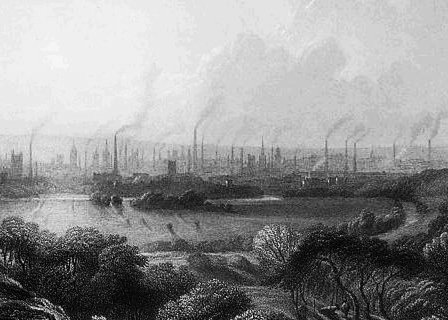
Interior of an Ironworks by Godfrey Sykes 
"Give 'em yr bucket." Our manager removes our defecation pails, to be filled with drinking water for the next hour. The only change of the guards is vomit and an empty stomach. Coffee, whisky and blood. The grisly, noxious sky burns with the weight of an Earth turning on its side, looking out through grey eyes, a globular iris of naked waste. The entombed sky wretches as the darkening muck churns and writhes like a cold snake. What was once soil and groundwater, turned to the tar and feathers of the shamed petro-state of Canada.

Cottonopolis by Edward Goodall 
The pipe gargles and spews rasping smoke, as if it were a choking throat, attempting a last word before immobile onlookers. The brevity of life and death makes us motion-sick. There is a sea of greed, corruption and ignorance below these decks of metal and bone. The quiet break the loudest. And at once, as the gushing oil explodes with a merciless fire from the side of frozen metal, men are trapped behind the void. Wading in the flush of a liquid worse than sewage, the brain nauseates, overwhelmed with the job of planetary death.
______________

In celebration of the filters of raw earth into breathable air. The track "America! America!" is inspired by the forestal creation of a hand-crafted alder doumbek from Vancouver Island, at the cusp of the Great Bear Rainforest, a place that also signifies a cusp of human civilization. So, the sound of the wooden drum, of the local land, is played in conjunction with a Maple Shakuhachi (also indicative of the local country's national tree).


The doumbek and flute seek a passage, of wind and earth, into the waters of being and becoming, towards a sense of grounding (drum) and direction (flute). The vocalization/narrative sounding muses on the exhausting reactionary sense of progress that ensues in the modern world, where people continue to consume and waste, yet there is a lack of listening, and a lack of sheer creation.

The calamity of today is not one of natural resources, it is our state of mind, and as the musical instruments of the natural world teach us, there is much to learn from the shapes and sounds within. As Chuang Tzu said, "What happened was my own collected thought encountered the hidden potential in the wood. From this live encounter came the work that you ascribe to the spirit."


This nine-poem chapbook speaks to the deformed nature of land under the warped perception of consumerist greed and a wholesale corruption of value in life, and unsurprisingly human life. The interludes speak to a frenetic base of experience in the fragmented world of manufactured waste and devastated landscapes that have become the norm, closing our minds and eyes from the truths and repercussions of our noxious way of life.

Through poetry, I affirm and re-encounter all my relations through a sense of the inner community. Creative language inspires an inward journeying to find the root and nature of mind. The place where our whole selves may firmly take root in the most fertile of soil, in the home of universal belonging, and so give back and become one with the self-regulating, self-sustained renewability of life in harmony with all of creation.


Monday, 29 July 2013

Student Action to Global Citizenry: The Voluntary Heart of Community

Optionless from Nora Younis on Vimeo.

"I recall the brutal massacre of Sudanese refugees in Mostafa Mahmoud square in 2005 when security forces violently interfered to dismantle their protests in front of UN Refugees Agency Office resulting in killing dozens of protesters including women, children, and elderly people." Ahmed Awadalla, Cairo-based Global Voices blogger (also published on Daily News Egypt)

Introduction

The focus of my volunteerism is with those who currently experience oppressive marginalization in the inhospitable host country of Egypt, who in 1951 made reservations to refugee rights chartered by the UNHCR Refugee Convention, also known as the Geneva Convention.

El-Wafaa Refugee Culture Centre was founded in 2006 in Ain Shams, a neighborhood in the outskirts of Cairo known for its African migrant population, by a group of committed Darfurian community leaders in order to address challenges within the refugee population in Cairo, with a focus on refugees from Darfur. The mission statement of the El-Wafaa Centre is to alleviate suffering of vulnerable refugee communities in urban areas.

Background

Egypt’s reservations to the UN’s Refugee Convention withhold national responsibility with regard to refugees within their country accessing public relief and humanitarian assistance. There are no refugee camps in Egypt. African peoples seeking asylum in Egypt continue to be unjustly marginalized based on race, ethnicity, religion, etc.

Initiated in July 2006 by local community within the African forced migrant population of Cairo, El-Wafaa Centre was physically founded in September 2006, with the assistance of Student Action for Refugees (STAR), a student-run organization at the American University of Cairo. Then president of STAR, Jennifer Renquist, now a foreign officer with USAID, organized the orientation of new students at El-Wafaa Centre, as well as the donation of books and stationeries to the center’s library, remaining a principal need.

I was introduced to this world in 2007 as a young student of literature and language at the American University of Cairo, after volunteering for STAR as an outreach English teacher. I soon met the director of the Refugee Culture Centre, named “El-Wafaa” (The Fulfillment in English) after teaching an intermediate level English course to an incredibly diverse class of migrants, asylum seekers and refugees from all over Africa.

The director of El-Wafaa, Abdel Rahman Siddiq Hashim, is from Darfur, Sudan, educated at a Sudanese university in English. He is a respected and humble community leader, known by many Cairo-based African refugees as “Teacher”. Abdel Rahman’s activism was far-reaching and all-inclusive, welcoming students into the education center, also serving as a cultural and community resource center, without discriminating ethnicity, religion or politics.

During my initial ten-month stay in Cairo, I became deeply involved in the refugee community beyond the interests of Student Action for Refugees (who soon abandoned and undermined local leadership), including organizing independent classes through the El-Wafaa community, running a food bank and managing library resources. Since then, I have poured over the role of the international community as a last vestige of light for the urban refugees of Cairo. In 2010, I returned to Cairo through a fully funded research endeavor with support from a Peace Studies consortium at the University of Calgary, where from I graduated the same year with a B.A. in the Social Sciences.

Highlights from the 2010 research period in Egypt include directly funding the El-Wafaa Executive Director’s return trip to Sudan to register El-Wafaa in Sudan, as well as with a Darfuri NGO network, to assess the situation of refugees returning home to respective countries of origin after living in Egypt as a refugee. Other successes included a film screening and discussion evening on related issues at the inner city Sudanese-led NGO Tadamon, offering charitable funding to vulnerable women-in-need, engaging Sudanese youth students in a music and culture recording project, and personally meeting and attending a course with Barbara Harrell-Bond, founder of the Refugee Studies Centre at Oxford University, the world’s first institution for the study of refugees.

Through my studies, research, and experiences in activism and fundraising since 2007 to the present, I have concluded that it is truly up to international civil society activists to help community leaders foster educational and cultural activities in their communities. UNHCR and local NGOs in the region have proven insufficient, whether as seen in the outcry of the Mustafa Mahmoud demonstration in 2005, or the current state of life for refugees during the unstable political turmoil in Cairo, today.

Their is a great need to support those who appreciate and enable the sustainable establishment of human rights organizations in Egypt providing proper services to any and all people, with a focus on African refugees.

Demographic


The target demographic of El-Wafaa Refugee Culture Center is any and all residents and migrants of Egypt seeking a safe and inclusive community resource center that specializes in language education services. The target communities are refugees and asylum seekers from African countries who seek to transition from Egypt to resettle in a more hospitable country, or move back home after losing many years of their lives to impoverishment, lack of education and opportunity for employment. Such social challenges are due to many causes, including misinformation and a serious deficiency of awareness regarding the nature of life in potential resettlement countries, as well as in returning to often conflict-ridden countries of origin.

Conclusion

Currently, the El-Wafaa Refugee Culture Center and its concomitant community initiatives are in dire need to generate sustainable activism (both local as well as international) to support the immensely wide gaps unfulfilled by the UNHCR, NGO, and academic, as well as faith-based service providers in Cairo.

On behalf of an international network to support the community vision El-Wafaa, led by the volunteerism of PhD student and Fulbright scholar based in New York City, Thomas Leddy-Cecere and myself, a freelance journalist and human rights advocate currently based in the city of Calgary in western Canada, we petition support.

Currently, the 2013-2014 budget for El-Wafaa Refugee Culture Centre to thrive in Cairo requires 1,280 USD (center rent, office supplies, external programs). Membership fees from refugee communities in Cairo seeking services are not adequate. International networks with preexisting solidarity groups in the U.S. and Canada are integral to the sustainability and overall maintenance of the El-Wafaa Refugee Culture Centre.

Related issues raised by the refugee community in Cairo include accessing micro-credit loans, contacting UNHCR, overcoming crises in housing and basic needs, among other areas of recurrent concern.

Anyone can learn more. If interested, please correspond with mind to the pressing need for immediate action. I would very much like to start a meaningful dialogue on this issue on behalf of an extended engagement with the urban refugee communities of Cairo.


References:

This blog was originally published at VolunteerCenter.com on July 29, 2013
  • Please contact me @ mhanson1717@yahoo.com for a free informational brochure if interested in learning more about my initiative with refugees in Cairo, Egypt
_____________
With the Executive Director of El-Wafaa Refugee Culture Center,  Mr. Abdel Rahman Siddiq of Darfur, Sudan 
Walking Away into the Bright Lights of Cairo
Partnership with the Bangladeshi Community
Global Youth in Cairo Apartment
With Student and Singer from Kordofan 
Twilight of Peace
With Student at St. Andrews Church in Cairo
A Creative Student at Arba Wa Nos Centre
Night Cafe with the Bere People of Sudan
American University in Cairo, Old Campus
Abdel Rahman Siddiq, the Teacher
In Honour of Community
El-Wafaa Refugee Culture Center Logo
With favourite tea-seller, Julia
With student from Central African Republic at Tadamon Centre
Sudanese Teacher Registers Students at the El-Wafaa Refugee Center
Cultural Heritage of Sudan
The Quintessential Meeting Ground, the Sudanese Restaurant
 ____________
From Behaved Freedom to Absolute Nonsense

I go from a behaved freedom to absolute nonsense
            Without friends yet steeped in family love,
I publicly play and proclaim the monetary divide
            In my rich eyes which disguise the poverty
            line’s frozen glare
In Canadian expatriate stench, painstaking
            To be fugitive without mind
            to the loosed volley
Cracking against the one shield fortress of Mattapoisett
            One place of rest made into settlement with guns
            and stolen disaster
Ripped from the bosom of Europe’s scheming
                      English name
            Now massacring the playful
            artistry of our own inborn life

On this impossible continent
            Freely taken from a gamble and faith
In blond-headed angels
            Whose divinity was parted
            by the bald imprisoned hallucinations
Driving out demons with Masonic symbology
            Over the infinite sands of civilization,
            breathed and created out of time
In the sun’s ravishing corner of a universe,
            un-tempted and forever at a loss
                     Between the child’s two eyes
                     closing
On death and the holocaust of our forsaken government
            Laughing at the trees’ roots

When stretched to the bottom of India’s or Africa’s wells
            Ousting up the belief in life as a drunken tragedy
                                    Yet, be not humorless
                                    nor without comic sophistry

In the dance and song
            Come alive by the sexual majesty
                                    In theatre’s delicate ways,

To present the creative being
as one with truth’s bold and upheld music
            Reflecting back in the caged mirror
                                    A creator anew

This poem was featured in my most recent self-published chapbook, Act or Confront


Introducing ContinuuMusic

Musical explorations within continuous evolutionary creativity. Discovering new world fusion - instrumental, improvised music.

"For global community awareness" Vi An said at the TedxYYC event this summer to a packed house of 1500+ audience members, plus a streaming webcast to the entire world, before beginning a ten-minute set with co-creators Bijan Maysamie on Persian Santur, and Matt Hanson on xaphoon and percussion.

The debut concert of the ContinuuMusic trio is intended as a gift to the community. Often performing for charities and private events, ContinuuMusic has raised thousands of dollars for Ten Thousand Villages, Children's Health and Education in Iran, among other meaningful initiatives.

Inspired by their invitation to perform for TedxYYC at the grandest concert hall in Western Canada, ContinuuMusic is looking to sustain their creative efforts well into the future. Vi An is a professional artist of over 18+ years, an award-winning (Betty Mitchell) theatre composer with the Green Fools Theatre and recording artist with over 15 albums and hundreds of collaborative tracks worldwide. Bijan Maysamie is steeped in the classical tradition of Persian music. Originally from Tehran, Bijan is now venturing into fusion music for the first time, and is enthused as ever, at the helm of organzing this debut concert. Matt Hanson is a multi-instrumentalist, whose artistry draws deeply from a musical family with roots in Mediterranean and American intercultural tradition.