Primarily a writing exercise, this dream journal-inspired blog is a quiet introspective sojourn into the process that we traverse in going from private dream to public art. I see our dreaming as an internalized mythmaking. As I philosophize and expressively exhibit dreams, both private and public, I encourage and delight in creative language as a way to practice experiential metaphors through a “public dreaming." Writing Theory: Creative Dream Fiction
Showing posts with label science. Show all posts

Monday, 16 September 2013

For the Love of Humanity: An Essay on the Ecological Auschwitz of Canada

Dostoevsky's notes for chapter 5 of The Brothers Karamazov
"You see, I so love humanity that—would you believe it?—I often dream of forsaking all that I have...I close my eyes and think and dream, and at that moment I feel full of strength to overcome all obstacles." Fyodor Dostoyevsky, The Brothers Karamazov

“It's a scandal,” environmental activist Tzeporah Berman shouted to an encamped crowd at Indian Beach the night before the Healing Walk. Imagine, each and every CEO to all the employees of the oil and gas industry, blatantly raping their mother and profiting obscenely in the act. The Tar Sands scandal has gone viral. The proposed Enbridge Northern Gateway pipeline “is probably the most controversial project in the history of British Colombia other than perhaps Claquoyot Sound logging operations,” said Ben West, Forest Ethics Tar Sands Campaign Director, at a Project Ploughshares event in Calgary on April 27.
It’s been the #1 talked about news story in British Colombia now for two years running. In fact there is a study that was done that shows all the next five stories, in terms of coverage, if you combined all the coverage, still did not get as much coverage as the Enbridge Northern Gateway pipeline in the last two years.
The entire world is a voyeur to the most heinous crime of physical abuse on Earth today. “All fights, all battles for the planet are important, but some are more important than others. And there is no battle on the face of the Earth more important than what’s going on here in Alberta,” Bill McKibben, climate change scientist and founder of 350.org, said for the outdoor press conference immediately prior to the beginning of the Healing Walk. “There are three or four places on planet Earth where there is enough carbon below the soil, that if it gets dug up and burned, then there is no chance that we’ll ever stabilize this planet’s climate, and this is one of them.”

Yet, since 1967, when the first commercial project began to exploit the Athabasca Tar Sands, the crime intensifies to the benefit of a society corrupted by cheap oil across Canada, and around the world. “From the seven pipeline spills in the last five weeks, we know that oil corrodes, and what we’re just beginning to learn is that it’s not just corroding our pipelines,” Berman asserted. “Oil in Canada is corroding our democracy.”

The 4th Annual Healing Walk, attended by about five hundred demonstrators, sent a clear message: local people matter, have voice and are strongly represented across the country and the world. While international activism often necessitates globalization and fossil fuels to wage peace on the Tar Sands, the First Nations in and around Fort McMurray, the Athabasca Chipewyan and Dene peoples, are leading humankind by simply walking, in prayer to the Four Directions. Because of ancient wisdom and the spirit of traditional ceremony and community, industrial traffic slowed to a near halt as far as the eye could see on July 6 around the 14km Syncrude Tailings Loop.

“When I went into that town of Fort McMurray, you know what it reminds me of, it reminds me of going into the town that’s the ecological equivalent of Auschwitz,” Anishinaabe author Winona LaDuke proclaimed during her keynote speech the night before the Healing Walk.
“The town that’s sitting right next to Auschwitz and saying, ‘Hey, we’re good here, you can get a $35 steak, you can get an $18 hamburger and it’s okay.’ There’s something just psychotically wrong with all that.”
LaDuke’s Auschwitz comparison, especially in the light of modern consumer culture, is significant. Another outspoken critic of power politics, Hannah Arendt, had once led a scandal, transforming international dialogue on the perpetrations of Auschwitz into a parable of modern life. Arendt’s notion of the “banality of evil” speaks to the mass consumerism that fuels the current destruction of the planet. Status quo consumer society encourages technology and energy overconsumption. One tier of society justifies through intellectual analysis regarding energy, society and the environment, while most are overwhelmed by the unreasonable complicity of leadership.

Therefore, most people remain ignorant of the fact that their immediate, daily actions cause the very atrocities committed against marginalized people and the environment. Espoused in 1961 during the Eichmann Trial, the philosophy behind Arendt’s “banality of evil” teaches how everyday people perpetrate the greatest crimes of humanity, often more so than their leaders. The idea is slowly gaining acceptance among genocide scholars, such as in Daniel Jonah Goldhagen’s Worse Than War.

“If you breathe air and you drink water, this is about you,” Crystal Lameman, Treaty 6 activist of Beaver Lake Cree Nation, declared at the beginning of the Healing Walk at Crane Lake Park. If the great-grandchildren of Canada look back on the current generation, will they see the current society as people of today see Nazi Germany? As the Jews were liquidated for business purposes, so the Earth and its First Peoples are being bought and sold, and killed in the process, for the liquidation of bitumen tar into petroleum gasoline. Every day, Canadians are told that progress must continue and economic growth must never regress for any sake outside of myopic anthropocentricism and politicized Canadian values.

“On the eve of the NEB hearings for the Enbridge pipeline, when our National Minister of Natural Resources put an open letter to Canadians [in the Globe and Mail], calling anyone who opposed these pipelines a terrorist,” Berman reminded demonstrators camped only fifteen minutes away from Fort McMurray. “Essentially saying that if you express concerns then you are acting against Canada’s national interests, that you are an enemy.” When environmentalists and Aboriginal peoples who oppose pipeline development are deemed terrorists, political-economic rhetoric in Canada begins to look more like that of the Department of National Defence.

Dissuading public debate is typically fascist. The undemocratic nature of the petro-state further supports the colonial Eurocentric project of civilization, where marginalized minorities, such as Indigenous peoples, are meant to suffer the growing pains of modernization. Indeed, modern progress is often underhandedly defined by the achievements of warfare and genocide against marginal ways of life.

The Canadian infrastructure, as with much of the world, is dependent on the continued suffering, and the scandalous crimes, of the continued power imbalances from the colonial past. “We’ve got to feed these people that consume a third of the world’s resources. That requires pretty much constant intervention into other peoples’ territories, whether they’re Dene, Anishnaabe, Cree, or whether they’re in Venezuela,” LaDuke said with a voice of experience and reason at the Healing Walk. “Constant intervention into other peoples’ territories to keep up this level of entitlement.”

Today, there is global complicity in the status quo, in the consumers and beneficiaries of non-renewable energy resources, and its concomitant intergovernmental policies. If Canada survives into the future as a memorable entity, people may look back on the country as yet committers of yet a deeper atrocity, against Earth, and as with a genocidal inclination towards the entire human race.

Will others follow in the example of the First Nations of the Athabasca river basin, whose warnings resound with deep socio-ecological truth? Will Healing Walks spring from the people across the Earth, so that in the name and significance of Mother, the destruction stops and healing starts? Are people around the world willing to stop the destruction and walk for the healing of the Earth, to find a path that slows the destructive course of industry (business) as usual and that offers, not one direction alone, but Four Directions, whole and undivided? When will people begin to pray through movement, action, and participation?

Around the same time that unparalleled innovations in alternative energy came to the fore, there was a great leap in Western consciousness of natural philosophy. Contemporary science is providing the world with unprecedented advances in material technology and innovation. “The last two years, we have seen more advances in clean energy, in renewable energy and technology, than the last twenty years,” said Berman, at the close of her keynote speech at the Healing Walk conference at Indian Beach. “The last two years were the first two years in human history where new investment in electricity generation for renewable energy, for wind, for solar exceeded new investment for electricity in oil, coal, and nuclear combined!” Nonetheless, today there is a greater vacuum of innovation, and that is within the human mind. The current struggle for life on Earth is within each and every human being bridging the great rift between modern life and ancient wisdom.

“I think what has to happen is a change in understanding. It’s not a matter of power, or of muscle or of energy,” the late philosopher Alan Watts said in the documentary, Zen.

It’s a matter of the way in which we understand and feel our own existence, not as strangers in a hostile universe, but as integral parts of that universe, as fruits of the universe, in the same way as an apple is a fruit of a tree we are a fruit of this galaxy, we belong to it, we are something it’s doing, but we don’t feel that.
Similarly, in the name of modern physics, the same basic knowledge that allows for the expansion of physical technology offers renewed integrations between ancient wisdom and modern life. The same way of applied thinking – that might destroy life on Earth when derived from philosophies of conquering nature and ethno-cultural assimilation – would also affirm interconnectedness with all forms of life.

Yet, petro-state fascism muzzles scientific inquiry that affirms rootedness, while ensnaring science with political ideology. “The internationally recognized journal of Nature this year, in an editorial, said ‘It’s time for Canada to set their scientists free,’” Berman, author of This Crazy Time, said at the Healing Walk. Science, as a truly inventive field of human inquiry, would logically presuppose the very undoing of its concurrent technological manifestations.

“The natural environment is treated as if it consisted of separate parts to be exploited by different interest groups. The fragmented view is further extended to society which is split into different nations, races, religions and political groups,” physicist and international best-selling author Fritjof Capra wrote in The Tao of Physics.
The belief that all these fragments – in ourselves, in our environment, and in our society – are really separate can be seen as the essential reason for the present series of social, ecological, and cultural crises. It has alienated us from nature and our fellow human beings. It has brought a grossly unjust distribution of natural resources creating economic and political disorder, an ever-rising wave of violence, both spontaneous and institutionalized, and an ugly, polluted environment in which life has often become physically and mentally unhealthy.
Life is without meaning, not because it is despairing, but because it requires no other meaning than itself. Life itself is significant. Life is self-renewing. Modern human life is more and more devoid of a connection to the sources of life, and so, the mind, and its encouraged symbolic outputs, estranges daily existence from the nature of life. Proactive language (e.g. solutions-oriented media), as with the most advanced scientific thinking, gives voice and agency to ways of life that are self-sufficient, yet still recognize the interdependent nature of life.

The First and Original Peoples of Turtle Island, Aboriginal Peoples of Canada, continue to share the fundamental philosophical similarities with the ecological consciousness of wise, ancient cultures from bygone eras and faraway lands. Understandings that had once triggered a revival of interest in the practical philosophies of interdependence and rootedness are not only springing from Western science itself, but are being voiced by the First Peoples of the Land with greater potency. “Science is important but only if it’s governed and held in check by wisdom, and that wisdom that people have been ignoring for hundreds of years on this continent is finally reasserting itself at exactly the moment when it is most needed,” Bill McKibben said to close his speech only moments before the Healing Walk began.

Bad news is good news. Spotlight triggers response, and, at the end of the day, people think as they please, or, more accurately, as is pleasing. Regardless of what it is called, Oil Sands, or Tar Sands, industry gets the lip service. “I don’t want to squander my energy entirely on being reactive, on being reactive to their craziness. Be clear on where we are going,” LaDuke stressed with grounded intensity. “It’s our choice upon which path to embark. One miikanan [path] is well worn but it’s scorched. The other path, they say, is not well worn but it’s green, and it’s our choice. It’s our choice. That’s what our people said about 800-900 years ago.” The ancient wisdom of the Anishinaabe prophecy for the time of the Seventh Fire shared by Winona LaDuke at the 4th Annual Tar Sands Healing Walk offers all a path, or miikana, to a future that is fresh and green, and very simply, to a future.

Beyond pro- and anti-, beyond reaction and action, there is a beginning; a place, from where all people would begin life renewed. That beginning is the elephant in the room; it is every last man, woman and child. In the name of Mother Earth, the Original Peoples along the Athabasca River, and every Healing Walker: All my relations.


This piece is featured in the current print edition of Dialogue Magazine

(If you would like to have a FREE copy of the issue wherein this piece is printed, please notify the magazine or the author)

Also, read my Spotlight piece, "Tales from the tar sands" in the current September/October print issue of This Magazine in an online exclusive at The Media Co-op.  
_______________
blessed horn
entranced night
korean shades
light buddha
sun hat
_______________
The album "Evocations: district.Columbia" is an experimental narrative sound art exploration into the text of the collection, "district.Columbia" releasing the first single, "New America" to incite the forthcoming album on the inaugural day of Aboriginal Awareness Week in Canada is auspicious and serendipitous in its symbolic import as an album whose narrations were triggered by an inner voice of resistance while in Washington D.C. where I began to dedicate myself to the literary vocation in light of my own personal development in the commission of truth - as in the social justice of 9/11 and Truth and Reconciliation truth commissions - to address political and historical-religious misinformation.

My creative work is in keeping with a lifelong demonstration to voice silenced histories, in honour and recognition of the atrocities committed against first peoples of the land, whose history, while older and more enduring, while land-based and unfathomably rich, is snuffed out by the dominant settler narratives of media and education that continue to ride the oppressive waves of war, colonization and assimilation in the ongoing struggle for american freedom that continues to this day. "Evocations: district.Columbia" is a sounding directly from the heart, unmediated by the delusional independence of exclusive american identity, for an end to the war on freedom


Inspired by the pre-colonial and pre-revolutionist metaphor for America, “Columbia,” a Goddess of Freedom, as an archetypal myth, once proudly personifying poetic optimism through feminine form. Through these writings, I personify the process of mythmaking as a dedication to compassionate awe and voiced protest in the historic confrontation with self and nation. The name Columbia was immortalized immediately before the Revolutionary War in 1775 by Phillis Wheatley, the first African American woman to publish her writing, in her poem, “His Excellency, General Washington.”

Written primarily based on a visit to Washington D.C., this collection is a vocal reclamation. These chronicles present a visitor returning to his home country, where visitation is defined by traversing an international land border. I represent my struggle to reclaim and recognize my unique voice. In these pages, I confront the realization that I am, in certain respects, an inheritor of the American way of life. Regardless, the inheritance is fraught with the psychological complexities of exile.

In this reclamation, I throw off vestigial principles of experience. I attempt to revision a new way of being through the living temperance of the written word, and specifically, my own practice of stream-of-consciousness writing. Such revision includes confronting a natural process of self-awareness, whereby self-expression revolutionizes into an identity with nature as a self-perpetuating source of renewal and life.

Spontaneous word creation, or improvisational writing, is a natural activity of the human mind. There is a power within that endless fount, that when regularly tapped as a spiritual practice, unleashes one’s surroundings with an ever-renewing energy. Such a practice motivates one personally, to interact with one’s immediate environment in dynamic ways. The reason for this effect is because in this practice, which actualizes into a way of being, the present moment becomes central. When the present is cherished with just significance, the mundane begins to breathe with new life.

The practice of improvised writing, in this sense, outlines a processional transformation in throwing off sterile notions of self and environment. district.Columbia begins by defining autonomous interactions between self and environment (as to parallel notions of the “New World” for pre-colonial Europeans and pre-revolutionist Americans) and ends with a declarative pronouncement; to create an openness to uninhibited spontaneity in personal creativity and a diverse awareness in social activity in our public spaces (as to parallel the current fomentation of creative social activity blurring the lines of public and personal art).

Monday, 8 April 2013

Genocide and Extinction: Reflection on "in my dreams" by Mercedes Eng


"Whether this satirical inscription [PERPETUAL PEACE] on a Dutch innkeeper's sign upon which a burial ground was painted had for its object mankind in general, or the rulers of states in particular, who are insatiable of war, or merely the philosophers who dream this sweet dream, it is not for us to decide."  Immanuel Kant, "Perpetual Peace"

When I first read "in my dreams" by Mercedes Eng, on Geist, my heart pounded with the animate high of a synchronous intellect grounded with a feeling of urgency.

This piece illustrates the symbolic intersection of a pipeline as physical obstruction on the body of our Mother, as on our body. And to follow, the incarceration and de-legitimization of those voices and lives whose source of energy derives from a more profound and lasting than those harvested recklessly by government leadership, and the knee-jerk automaton droves of apologists, apathetics, pessimists and belligerent supporters of environmental crime. 

We have traversed the oceans and landscapes with a smothering footprint. In the wake of the wholesale devastation of First Nations communities across the country, it is the entirety of humankind that is next on the list of the entrenched ignorance of those who ignore science, who ignore civil society, and who ignore their own innate sense of empathy for the sake of power politics and saving face. 

When the source of a disease is unknown, for example lung cancer from smoking in the past, the individuals long since die while courts and politicians wade through policies and promotions to effectively prevent further death. Smoking is an especially useful symbol too, because it exhibits a problem with consuming that overrides even the strength of knowledge and law. People still die from smoking, just as we die from ignorance. Besides the individual death of one person, or even the genocide of a specific group, the extinction of our entire species is at hand when we talk about the continued, unabated burning of fossil fuels. 

Ocean acidification is the cause of five major extinctions on planet Earth, and the CO2 levels in our oceans now are rising at an unprecedented rate. See the work of Charlie Veron, the 'godfather' of coral and other scientists. The only way to prevent ocean acidification is to stop burning fossil fuels. Yet this time, we are realizing that we are essentially all one body in this fight to curtail the disease of overconsumption, overexploitation of non-renewable resources, and when it dies, there will be no lawyers or politicians left. In the 20th century, we faced the facts and prepared policies to prevent genocide. In the 21st century, we face the extinction of our species, and we are all at fault. 

Internationally, Canada is now a partisan country, we support other nations on their ventures into say for example, Afghanistan, based on exclusive measures of concern. This reflects within the domestic sphere, where representative leadership in government merely reflects a narrow margin of society. Those who are not aligned to the dominant mode of power are marginalized traumatically.    

We can remember the words of an assassinated democrat echo into the future, "Our children are still taught to respect the violence which reduced a red-skinned people of an earlier culture into a few fragmented groups herded into impoverished reservations.” JFK

To encourage ecocide is to choose extinction. 

Be aware: Oil Man and the Sea, Revolution (Film)350.org, Earthship Biotecture
___________
Struggling lone uphill through the barren rifts and scarred desertification of Judea, I look out from an outcrop towards the Sea of Galilee. Scanning feline eyes growl and hiss in the unkind wilderness of the famed Israelite passage to divine promise. Yet, here where the last suicidal stand of Judaic tradition withheld the Roman tide of enslavement, I grapple.

Tiberias and the Sea of Galilee by Emile Rouargue
The rocky earth tumbles with rolling quakes, as an avalanche of boulders careens beyond a nearby patch of scree. The earth teems with deadly fate, as I climb on, and reach the summit of sacred space.

Mount Tabor by Emile Rouargue
Under a cloudless sky, I phone the United States, to hear the short-toned speech of my elderly grandpop, hunched over a sandwich and remote in the old Jewish-American neighborhood of secular tradition. To my increasing surprise, he had been on the phone, yet with a late dignitary of American war, Ike himself, Dwight D. Eisenhower, the once commander-in-chief of North African forces in WWII, where my old pop first entered active service.

The Bully of the Neighbourhood by John George Brown
Pops welcomes me to cross lines and speak with the former president. Nervously, my voice reaches for sanity and order, with subtle interrogation, I chance a question over the unsettling silence, “What is your favorite book about WWII?” I ask, with An Army At Dawn in mind, as I’m currently in the middle of it. “I don’t much read any book of the kind.” He breathes a deep silent resolve, of little words.
___________
"Repeated Dance of the Fluid Earth" is an experimental narrative that plays off of American colonial history as a body of water, rippling throughout the waves of history. Cultural memory is as fluid as water itself, where consciousness may be revisited with the slightest alteration, leading to an eventual holistic transformation.

"Repeated Dance of the Fluid Earth" utilizes frame drum and shakuhachi together with synth beds to create an ulterior perspective in the retelling of popular history through a gendered and ahistorical mode. This also plays into our ecological history as a species, and how the ability (or inability) to listen to our story, as our voice, is similarly the story of our relationship to ecological knowledge, and how the fluidity of place with regard to land-based settlement is as dramatic in its shape-shifting nature, as the fluidity of place on a sea-based settlement. Simply put, the modern political notion of "settlement" is a myth.

In the era of consumption, we posit a sense of material as objectified by the consumptive attitude: that things are to be consumed, used, manufactured, wasted, eaten, assembled, etc. as opposed to a creative attitude, where all things are in flux. So, with regard to the battered histories of genocide and ecocide, "Repeated Dance of the Fluid Earth" asserts a revivification of the solemn bliss of knowing where we stand.


As the entire collection "Cyclical Wordplay" from which the chapbook, "Visitations" is derived, centres not only on the cyclical wordplay of language itself, but the travelogue of a cyclical journey, tracing the meaning of traveling abroad to returning through domesticity. The selections in "Visitations" recount the final step in that return, where after "A VIsit to L.A." the cyclical resolution leads to a transmigration of values. The final step homeward from a long season abroad, exhibited in experimental narratives, eventually transforms one's relationship to language, place, and meaning. The conclusion is a prelude to welcoming "other" visitations.

"Repeated Dance of the Fluid Earth", featured in "Visitations" was published in the Rusty Nail December 2012 Issue. The release of the "Visitations" chapbook on Scribd, goes together with the release of "Repeated Dance of the Fluid Earth" a spoken word narration on www.menachem.bandcamp.com


Monday, 11 March 2013

The Art of Freedom: 2 Years Since Fukushima in the Post-Scientific Era


"The existence of nuclear weapons means we could potentially create a disequilibrium, an imbalance, on the planet and the atmosphere by the launching of some of these systems, some of these systems. There are 27,000 of these systems. This is more than enough to wipe out the whole planet. You also got people working to say, 'you know you gotta save the planet.' Well you're right, we've got to save the planet. And so the whole environmental effort, as laudable and as absolutely critical as it is, can be for absolutely not in the space of hours if these guys actually went at each other." Lt. General Romeo Dallaire (Ret.) Pugwash Canada

Today is the two year anniversary of Fukushima Daiichi disaster. In my previous post, Hatsuyume of Peace, I kicked off a new paradigm in the life of this blog with reference to the apocalyptic transition that nuclear energy essentially means for life on earth. This is an enduring creative metaphor, a source of reflection that begs to be heard and never left in the silent empty ignorance. For, as the unrivalled Persian poet and filmmaker Forugh Farrokhzad said in her landmark film to inspire Iranian New Wave Cinema, a groundbreaking force of thought, emotion and impeccable insight, "There is no shortage of ugliness in the world. If a man closed his eyes to it, there would be even more." Her film, The House is Black is about a leper colony, and the humanization of treatment for a disease that simply requires attention. While the impacts of a nuclear disaster do indeed course through the blood and infect the children of the victims, there is even more recourse to action, to look, and with the kind of remembrance that breathes in the present moment, to see the eyes of the victims as through the eyes of our own children, our own mothers, fathers, and siblings. For there is evidence that it could be forty years or more to clear up the Fukushima disaster, which is the worst of its kind since Chernobyl. The transition of nuclear energy as a weapon, the atom bomb, has essentially moved the world from the era of World War, into an era primarily defined by war over intelligence, the post-cold war era. Vietnam is an example where the government authority of the United States actually never declared war, incapacitating the ability to detonate another atom bomb on a human population in Asia. We are now living in the post-scientific era, and the Age of Reason is long past. Our existence is not defined by scientific knowledge, but of technical know-how.

On an investigative bend, I took the time, as part of the research praxis of a literary arts journal, to go to photographer, Arthur Nishimura's exhibit, "Dream Country" at the largest university in town. In the exhibit, Nishimura creatively interposes landscape photography with prepared or rendered film. I went for the purpose of interviewing others who happened to stroll through the exhibit about the significance of today's anniversary remembrance of Fukushima, not only as a Japanese disaster, but as a world disaster. What do the photos of a globetrotting Japanese nature photographer say about the remembrance of Fukushima? My questions, and my approach to a conscious public as an experimental journalist fell on a silent room. In the last hour of the gallery's opening today, not one person visited Nishimura's exhibit. Instead of heading into abstract philosophic directions regarding the nature of public ignorance, I peered deliberately, patiently and acutely into the breathtaking symbology of a master photographer.


Let me take you through an abbreviated version of the exhibit, and how I related my experience of "seeing" to the memory and lasting impact, and future legacy of Fukushima. Firstly, Nishimura's piece, "The Book of Flatland Dharma - Of Two Religions: Conclusion" (1978) captivated me. It is a juxtaposition of a sacred Japanese temple, as a diptych next to a silo in the Alberta countryside. This struck me first, because Nishimura captures the elegant majesty of mystery and beauty all over the globe, yet Japan and Canada have sacred significance, yet the cultural dissimilarity could not be more clear in the way that aesthetics are a reflection of social expression. Next, in his Homeland Tourist series, "Higashi Honganji Temple (1978) flattened me with its elusive doorway of symbolic insight. The bicycle in the foreground, outside of a sacred temple in the background, emphasizes that while there is a sense of the infinite within us, we are after all impermanent, and as we ride the mundane bicycle of worldly experience to its end, the higher awe of spirituality lives on, with or without us. Finally, while there were others that struck me uncannily, I will leave off with one last one that took even more time to set in than the rest, however after peering into its silvery textures, and its striking imagery, I latched on to a hint of perennial truth. The work, "Pre-dharma Sentience" (1978) in The Flatland Book of Dharma - The Singularities series, a stone lies in the foreground. In the background, an open landscape, with a path leading to the horizon, to nowhere. What this says to me is that, essentially nature, as with our nature, is fundamentally meaningless. Nature, in its raw, open and original forms do not offer the human heart a rest stop on which the mind may imagine and conceive a reason for being. The meaning of no-meaning is the great point of flux in realizing our humanity as vulnerable, fleeting, and if at once emergent with direction, also futile and unimpressive. As Paul Valery said, "God made everything out of nothing, but the nothing shows through."

On my return home, on this unusually warm Canadian winter day, I read a very short Associated Press article buried in Metro Calgary on the legacy of Fukushima. In the article, 'Outlook bleak two years later' a quote read, "Everyone, from bureaucrats to construction giants to tattooed gangsters, is trying to prey on decontamination projects. And the government is looking the other way," said Nakamura, who refused to give his first name out to the press for "fear of retaliation". As I reflected on my train ride home through the downtown corridor, passing above rivers of melting ice and the glare of the profound midwestern sky, where the rich sunlight exposes the midriff of an aging humanity, I had a realization. Being human means taking the responsibility that we have as stewards of the land, as a conscious potential unmatched in the known universe. If we do not take responsibility for being human, then there will soon be no more human beings. We do not write the highest law, and we can not speak the highest truth. 

____________
She sets the stage with a sweeping introduction. In the impeccable garb of a beauty queen in love with life. The public gushes with heart-sleeved pandering. The world is set like a red carpet before her.

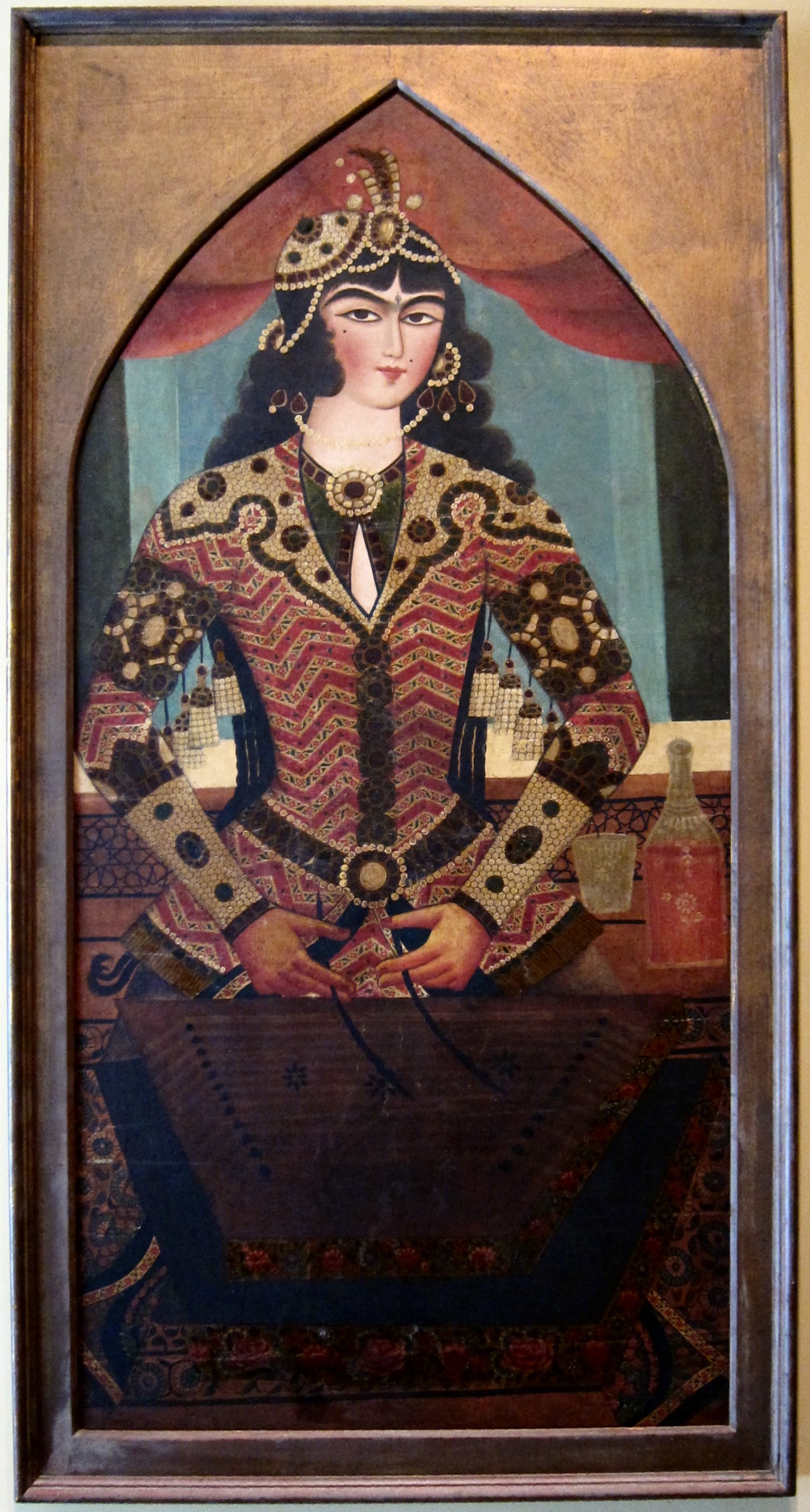
Queen by Sten Porse
The musical ambiance, the tone, is grandiose and emergent as the Jonah-swallowing fish of all-conceived breathtaking wonder. Her introduction is the mindful worship of momentary repose, for the elemental truths to seduce all through her sonic dance of grace.

Female Musician by Anonymous
She continues ever on, without me. Frustrated by my own deviance, and in the backwash tunnel of personal failure, I triumph in disaster. The airs of isolation breathe a sad remorse, the regret of guilt itself takes over like an icy bath.

The Ambassadors (detail) by Hans Holbein the Younger
I strain over my broken instrument, and snap its neck in one fell swoop. Not even a ping from the cracked strings are heard in the overarching foment of fanatic bursts and swoons of delight as the mob breathes down the throat of my love the kiss of popular contagion.

Interesting enough, the short dream sketch narrative above, and that described in my last post, where I exhibited a noetic travelogue through Sudan, have coincided with the events of the days to follow. In the previous incident, I had dreamed that I was traveling through Sudan, and had born witness to the social resurgence of positive forward movement. So, on that day, I met and interviewed Emmanuel Jal, as he accepted the Calgary Peace Prize on behalf of all South Sudanese people. Similarly, though without such heavy global precedence, the events within the dream sketch illustrated here preceded a botched concert appearance by none other than myself to accompany my Love onstage.
___________
My first exhibition of an original "sounding" in the internal collaboration of creative music with creative writing. Improbability in Upswing, was published at poeticdiversity: the poetry zine of los angeles in December 2012. In my reading, with relation to the content of this post, I am taking off towards the eye of the sun. The teeming cloud-born sky quakes with the burning rush of human flight. Riding through the energetic outpouring of modern rocket fuel, I feel a beneficiary of similar technologic might that burned the bodies and fuelled the fires of war. Nuclear energy is not far distant, and my body begins to churn with the physical imagination of experiential interdependence, smouldering at the cusp of freedom and death.


To set forth another tradition of self-publishing, every week from now on, as I offer a "sounding" of spoken word and original music, I will release a chapbook of the section from which the "sound poem" derives in the series of collected experimental writings. Enjoy and ponder the experimental imagination through visions of "Aircloudsky".

Monday, 18 February 2013

The Immortalizing Arts: Contributions by World Music Artist Vi An Diep

Gilgamesh by Samantha from Indonesia
"We have achieved two of the three alchemists' dreams: We have transmuted the elements and learned to fly. Immortality is next." - Max More, On becoming posthuman

The search for immortality is as old as humanity itself. The earliest remnants of human history, namely, the Epic of Gilgamesh, among others, speak of the quest for immortality, to find the fruit or fount of eternal youth is part of the perennial epic that is the myth of Man. 
Anu, Bel, and Ea are whispering (wisdom) into his ear.
Ere thou earnest down from the mountain
Gilgamesh beheld thee in a dream in Uruk
....
Gilgamesh sought to interpret the dream;
Spoke to his mother:
'My mother, during my night
I became strong and moved about among the heroes'
...
Gilgamesh said...Tell me, How didst thou come to dwell (here?) and obtain eternal life among the gods?
...
Build a house, construct a ship; Forsake thy possessions, take heed for thy life! Abandon thy goods, save (thy) life, and bring living seed of every kind into the ship

(Epic of Gilgamesh)
Now, it is interesting the way that modern medicine has adopted the principles of "life extension" to the archaic traditions of humanity in the search for immortality. Life Extension is a medical term used to acknowledge the major advancements in modern medicine which have led to the unprecedented increase of the average human lifespan. The logic is that if the lifespan can be extended by some fifty years or so in the last hundred years, why can't we extend life to virtual permanence. 

What are the implications of human immortality on Earth? What comes to mind for me are a few major points. For one, there will be an excited advantage by the keepers of modern scientific medicine, mainly the West. In many ways, this can be seen as the furthering of an egotism that the Western World and particularly the scientific community has, where they feel they prevail over all forms of life, as the dominant form of knowledge-creation in the world today. It is often ignored how steeped in Western European history our modern science is, and that it does have its immoderate faults. Essentially, modern medicine is best in dealing with immediate physical trauma. When it comes to preventive, and long-term medicine, like "life extension" for example, there is less attention to detail. 

Outside of medicine, there is a biological component. One of the foremost proponents of "biological immortality", professor in the Department of Ecology and Evolutionary Biology at University of California, Irvine, Michael R. Rose, PhD, says in the Immortality Institute documentary Exploring Life Extension, "Most people who work on aging do it from a medical standpoint, which means humans, or if not humans, then certainly mammals, and all these organisms that didn't have an aging process were far-removed from mammals." He went on to give examples in non-mammallian life forms, such as anemones, creosotes, juniper, and others that actually do not age. He continues, "...life can be thought of as being divided into three basic stages...that third phase, which has not really been explored by contemporary biology is what interests me now, late life." 

With regard to the biological component of immortality and life extension, and the medical egotism which counter-inuits the state of the world, it seems that if we do not co-evolve immortally with our Earthly ecology, a spiritualistic sense of medical immortality for humanity would only contribute to the degradation of every source of life that the Earth offers to Man, and which Man exploits obscenely. For example, if we innovate major advances in anti-aging and life extension, we ought to transpose that technology into the natural world, into the life that not only lives on earth (us), but is the life of earth (all forms of life and life-giving). 

Finally, my sense is that in the early epics of oral literature, such works as the Epic of Gilgamesh and Homeric works such as the Iliad, there is a lesson about the human quest for immortality, which is older than our backbone. The lesson is that only in our mortality, do we know our immortality. I would say this is also truer to Max More's reference to the alchemical tradition, where in the philosopher's stone there is a psychological mastery of the principles of physical life, yet it is in the psyche where the most enduring trial is overcome. Only in dying fully conscious and immersed in the ground of immortal intent, are we immortalized, and traditionally so in the words of the great poets, those of enduring words and pronounced voices to carry the names of certain individuals down the halls of human history. 
___________
First step in the thousand-mile journey by Vi An
Flight over the bridge by Vi An
Enlightenment over Peace Bridge by Vi An
Full Moon City by Vi An

First Light of Dusk by Vi An
____________


Vi An has generously agreed to contribute her musical artistry to SoJourn(al) for this exclusive post featuring original photography. This post celebrates her entry in a CBC music contest, Searchlight. Vote for Vi An!

In future posts, I will be featuring original world instrumental music by none other than the Dream Author. My idea is to feature a full-length album of original electro-acoustic improvisations on darbuka, frame drums, shakers, xaphoon, shakuhachi, guitar, harmonic, etc., then leading up to spoken word collaborations with my instrumental creativity to recollect the creative momentum from my experimental writing gallery usually featured at the end of each post. It is my intention to kick off this new paradigmatic focus of musical creativity with a contribution, and to offer space for photographers and musicians alike to contribute in the future.

Happy readings/listenings/viewings!!

Among all artists of One Love, in solidarity.

Sunday, 23 December 2012

The Cubism of Unity: Shelley and the Myth of Monogamy

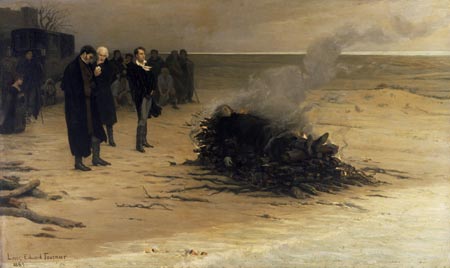
The Funeral of Shelley by Louis Edouard Fournier
   Thy wisdom speaks in me, and bids me dare
Beacon the rocks on which high hearts are wrecked.
I never was attached to that great sect,
Whose doctrine is, that each one should select
Out of the crowd a mistress or a friend,
And all the rest, though fair and wise, commend
To cold oblivion, though it is in the code
Of modern morals, and the beaten road
Which those poor slaves with weary footsteps tread,
Who travel to their home among the dead
By the broad highway of the world, and so,
With one chained friend, perhaps a jealous foe,
The dreariest and the longest journey go.

   True love in this differs from gold and clay,
That to divide is not to take away.
Love is like understanding, that grows bright
Gazing on many truths; 'tis like thy light,
Imagination! which, from earth and sky,
And from the depths of human fantasy,
As from a thousand prisms and mirrors, fills
The Universe with glorious beams, and kills
Error, the worm, with man a sun-like arrow
Of its reverberated lightning. Narrow
The heart that loves, the brain that contemplates,
The life that wears, the spirit that creates
One object, and one form, and builds thereby
A sepulchre for its eternity.

From Shelley's Epipsychidion

The dying words of my great uncle, who would have been 92 this week, were "focus on one thing". I've always had multiple affinities. As a creative person, my mixed mediums, cross-genre, multi-instrumentalism frames of mind spill and interweave throughout different art forms. I often wonder, should I commit to one thing entirely, and from that foundational trunk, branch out into the world of infinite possibility? In my arboreal metaphor, I am a forest. 

I think my great uncle might be proud to look upon one of his favourite of the younger generation, and see that I am not following his advice. For he was an iconoclast himself, through and through. Of the first class of Jews to enrol in university in America, he was proud to transcend the status quo, the social norms and family values of his time and explore the hard-won science of novelty through physics and chemistry. 

Yet, in love, I am elastic enough to disagree with my creative self, and traveling beyond the creative-destructive duality, to see the magnificence of love as an enduring unity. I see only One Love, especially when looking upon the dear face of my beloved wife. 

The late Ravi Shankar exhibited a profound connection to intensive unity in life focus in the documentary Raga, while Lawrence Ferlinghetti espoused the delights of being a multidisciplinary artist in both poetry and painting in his essay, "From The Gone World". To each their own, to each their one, and one to each. 

See related post: Shelley and the Old Man: A Poetics of Wisdom
_________
A forest of brains, pantomime expressionism. The canvas is blank. We stare, of ancient rivalry, to whiplash a brush of paint across the rough, splotchy face of collaboration. The collaborative stare ensues. Our eyes lock under a dark cloud of empty highs and lonely madness. 

Les deux amies by Thorvald Hellesen
A pastel cubism intermingles with pointillist ink. Our minds snatch and hiss at the dizzying array of subdued pigment and hints of future colour. It is group inspiration, retching from the distended bowels of two fiercely separate artists of waste. And in a moment of communal haste, aggression holds the creative fire of my murdering hand, and I impale the throat of my fellow artist, friend and comrade with an ink brush. Our painting is finished, our art begins.
_________
"…in a play…a dream play brings up the soundless deep…in the emptied awareness of emptiness…playing on a dreamscape of silent depth…up from the upbringing…strong with remembrance in the absolute living…living among complicit guests and their following remarks…

...

…in the native dirt…and to speak to the stone…and to speak through our pain…the pain of our individuated backs…grated and remaining uncured with the booming fate of a motionless mountain sky…journeying around the headless round of the tailbone crack…remembering through a numbing moment…

…a memory…lost to the unchained back…still writhing with touched passion…"


excerpts from "Fragmentary Being"

Monday, 13 August 2012

Beyond LSD, Within the Experiment

“The program I was involved was to study the active principles of medicinal plants and one of these medical plants we were studying was Ergot…At the end of the synthesis I was in a very strange psychic situation, a kind of dream world appeared, a kind, a feeling of oneness with the world, a very strange experience which reminded me to some experience I had in childhood.

Sometimes when I was in nature, with the forest and the wood, I had some kind of, I would say, mystical experiences. The feeling of oneness, to be one with nature, the feeling to see now the true aspects of nature, the beauty, and which filled me with happiness.”

- Albert Hoffman

“Could it be that this present, dream-like state was in some way connected with the crystals of LSD that Albert Hoffman was purifying that afternoon. He certainly had not eaten any but his fingers might possibly have brushed against a few traces of the compound. If so, then LSD was a remarkably potent drug. He decided to experiment on himself.”

- Narrator in "The Beyond Within"

Now, listen to Alan Watts on Drugs
________
Dim metallic bursts; silvery orbs bedeck the subdued leather warm of the café tables. Northern Greece, on the western outskirts of Ioannina, the Italian heel clicks in the vibrant waters at the center of the unruly European Earth. The Euro’s devalued to the near-extinction of another ancient peoples, drowned in the eye of the storm, at the height of neo-classical disorder. Ordering a coffee is now rife with the political amalgamation of a dungeon’s dearth. No one’s blinded, caffeinated, nicotine blink minds stutter over the oblivious stupefaction of leadership burned at the seam by the public hulk, dashing their traditional dress of human mockery for a breath of mutual truth. Together with family, we wade in the swampy lighting, in darkness as thick as the Grecian café mark on the silent, burning tongue of lingering potency.

Through a multicolored crest of followers, the warehouse screams with atmospheric delight, a musical haunt for the sacred lives whose energy dreams in smokeless fire. My Love is playing in a professional contemporary Mediterranean music ensemble. A chic audience reclines leisurely over metal chairs. Inside a graffiti’d dome of unfinished concrete, though a stylish rendition of the European artist-squatter paradise. I’m especially proud to see my Love creating wildly refreshing original music within the high standard of such daring quality. A kit drummer with a rig fitting over ten cymbals begins leading a rhythmic introduction of spatial ingenuity, moving the plush sonic stream of consciousness movie of artful belief into the realm of magic. Standing beside the audience, near the well-lit stage, small spotlights injecting funnels of visible dust in the wakeful air, I see her. Gowned in her usual flowing dress, a big explosion of black hair and her glowing skin. I am a martyr of unmade art.
______
Europe
"To dream of travelling in Europe, foretells that you will soon go on a long journey, which will avail you in the knowledge you gain of the manners and customs of foreign people. You will also be enabled to forward your financial standing." (iDream)
______
now transforming
through spiritual marriage
to my near love
whose life casts a benevolent spotlight on my being,
and path
with such wind,
a gusting splash,
refreshing the outer core
that foretells the dead body laughing at me

- excerpt from "society, charities and addictions"

Sunday, 24 June 2012

The Universal Energy of Non-Violent Technology

"In the 1950s the scientists who created the atomic bomb offered a promise, by splitting the atom we could have a limitless supply of electricity that could end pollution and bring peace to the world forever, but after the disaster in Japan, that dream has never looked more like a nightmare."

- Narrator in "The Thorium Dream
_______
A map, from overhead, spells a loose bombing pattern over the destroyed ash of a once proud Western city. The doomsday vibe is instilled pervasively, even from twelve thousand feet. I descend. Hooded, disguised in the female clothing of a conservative Iranian Muslim woman, I defy gravity, bounding over farmyards and plains with ghastly unconcern for my step. American, I daydream momentous bravery in the hook of Ali, the most famous American Muslim. Finally, I arrive to a gathering of young people my age. Crowding around a midday fire, we clumsily fiddle with various instruments. Curiously, I see an old friend. People begin to single me out. “Play this! Play that!” They stammer, belligerent with string and reed instruments sounding off into unbroken landscapes, the sobering spring sky presses coldly on my uncovered scalp. Every instrument I touch is in disrepair. Unable to make a clear sound, I move on to alcohol. 
_______
Ash
"Dreaming of ashes omens woe, and many bitter changes are sure to come to the dreamer. Blasted crops to the farmer. Unsuccessful deals for the trader. Parents will reap the sorrows of wayward children." (iDream)
_______
nervous mule-packed, people's spread,
glum rising, toward peak's,
unearthed sudden, as an island explosion,
tectonic wires flattening,
the disbelieving abortion!

the worshipped spring,
overloaded with unfound substance,
anonymity, in a human non-being,
a wasted mold, singing on the harmonious road,
to the past, when the all-encompassing now,
expressed self to a universal song

archaic, yet everlasting
and then, always gone,
fizzed out in the solar flare

pop flash, grazed heat from the mythological
drumbeat, groundless vibrations,
mounting birthless, made from dark matter,
living only to the taste,
dust on the wordless tongue,
a silence, encased in an echo
never bound,
we, fortunate,
binge on the profound.

- excerpt from "internet current"

Wednesday, 6 June 2012

Training Our Brain to Welcome the Spirit of Dream


"In the altered state of consciousness of people who meditate, we often see theta activity appear. Theta activity is associated with dreams. It is a relaxed state, but something is happening in terms of cognition. It's not easy to maintain theta activity for a long time. It takes a lot of training to do that."

- from "Mystical Brain" by Isabelle Raynaud
________

Meditation with Mahakrishna 

Transcendence transpires. The transpersonal takes effect, dryly in the humid gathering. With rich clothes and frayed seams we sit before the elephant-headed Krishna. Ganesha-Elephant man! Seated before, equally clothed, he prefers to be addressed Mahakrishna. I vanish!

_______
Krishna
"To see Krishna in your dreams, denotes that your greatest joy will be in pursuit of occult knowledge, and you will school yourself to the taunts of friends, and cultivate a philosophical bearing toward life and sorrow." (iDream)
_______
we create

inspired music
unheard by earthly tones       nor human ears
harmonious voices                calling towards a presence

a welcoming home
within the space known as I
an eternal resting place
where through our music we share that space

with peoples     creatures      beings      spirits
places ways times and manifest ideas
through instinct's thoughtful mentation
recognizing all as one
we sing and play an emergent force
calling all forth
from within shells
hardened through travel

- excerpt from "Celestial tONES"


Wednesday, 11 April 2012

Dream Poetry from the Scientific Community

"...in graduate school one of my advisers, I spoke to him one morning, he was doing research on star clusters that have these huge orbits around the center of the galaxy, he said he had a dream the night before where he was one of these galaxies and he was orbiting the center of the galaxy...if you start becoming in your cosmic dream, I want to have those dreams because then you think creatively about what remains to be discovered."

- Neil deGrasse Tyson in "The Poetry of Science" presented by The Richard Dawkins Foundation for Reason and Science on September 28, 2010
____________
I’m climbing the stairs in a long, thin rectangular building. I’ve been trying to follow a friend of mine who is taking a course with a professor of geography. In the college campus, I seek this professor. When I arrive to the group of students situated outside of a classroom at the very top floor of the building, the professor had already left them to an assistant. Curiously, we move out through a glass door and onto the roof. Interestingly enough, we are at a ledge overlooking the plains of Southern Alberta at Head-Smashed-In Buffalo Jump. As we look out towards the horizon, strange mountains have formed, quite unusual to the local terrain. The professor’s voice rings as from above, sounding like a loudspeaker overhead. He tells us about the mountains ahead. They are sparsely topped with fluorescent greens and ruddy earth reds and light browns, forming a seemingly endless carpet of medium-tall peaks at about uniform height draped over with the shadows of roaming clouds. “I have known the endurance in traversing beyond the range.” He speaks to us coldly with matured foresight as to the near impossible natural impasse. As the students begin to clear, my searching eyes see traces of industry. Train tracks appear, passing directly into the heart of the range. 
_________
"A mountain dream is used by the subconscious mind to tell us that we have many obstacles to overcome and they will be large ones and almost insurmountable." (iDream)
_________
spiraled dawn fractured by a scintillation
inspiring madness divine on the cemetery backwall laugh
uprisen as a hand, freakish to the crack of lying dreams
prepared, as spilled ash freezes in a line trembling freer than a rocked flash

“oh god entice this sickness to crash on the empires doorstep
last before the carnage to fall quakes in the morning
with a demonesque call to become the jeering weasel
creaking easily as high distance in fright, and lost”

- excerpt from "Sour Mangrove"

Monday, 12 March 2012

Reading Predators on a Street of Arabic


“Reading, something most of us take for granted, can help unlock remarkable powers. Reading builds new connections in the brain, which in turn allow us to use written words as stepping stones to understand other people’s worlds. A good book literally has the power to change you."

Origins of Reading

"Our ability to use our visual areas to immediately know whether that object is prey or predator is actually being recycled for us in order to be automatically recognizing symbols."

Using Nouns as Verbs

"...it's like an evolutionary tool, that's to say it raises levels of attention, it primes the mind for difficulty, and the chances are, that it may be that it leads on to the mind being ready to take different pathways from the obvious one"

Creative Reading

"...I think that reading is a creative act in itself, as writing is, because you are creating something while you're reading it, you are bringing in your own experiences...when you can get into the minds of other characters and see what they're experiencing, it makes you better at empathizing...fiction has made me see things from other people's points of view”

Literacy and Empathy

"So, when we think of reading as purely about literacy, there's obviously another dimension to it, which is empathy."

From BBC Documentary “Why Reading Matters” documentary
________

Kasr al-Aini Street in Cairo, Egypt is primarily a street for government bureaucracy centers and large and lucrative local banks and other big businesses, however there are a good many small juice stands and cafes tucked away, one is called cafe Vienna. 

I find I am living on this street in a quaint little house, feeling something like the way how in Calgary there are random character homes sparsely interwoven in the city core. The insides and the outer wear reminds me of a ramshackle country house. The first time I exit the home, I am immediately met by a shady individual, a rotund young white male, who offers me money in exchange for delivering a package just around the corner at the gas station. Curiously, I take the package and run inside, asking my wife what to do! She vigorously reminds me that I am being foolish so I return the package to the exceptionally inexpressive young man. He takes the package back without question and rounds the bend, after which police storm immediately. 

In the next instance, we are at the house when a roommate is moving in. He is a man with dark complexion not unlike the local Egyptian man, however he seems more American in his mannerisms. He later tells me he is from Hawaii. He is a nice man. One day he helps us receive two amphibians and a fish. I am not sure why we have these creatures, however another smaller man, a caretaker of such amphibians, helps us all to cut them out of a stomach lining packaging. He says to be careful of the one as it spits mini-bullets. I take the creatures, beautiful and exotic to a pet shop, leaving them there. I return to the house only to find my wife is missing, I look all over our property in the dimly polluted urban backyard for any sign of her, staying awake in a candlelit room all night contemplating her loss. I don't feel she is dead, only that I may be in the wrong place. I am without any impetus to look. I simply wait, despite the presence of our Hawaiian roommate who offers to help.

_______

My fingers press into each letter
with a singular stroke
My head figures weightless across shoulder and palm 
holding up my brain box, short-circuiting

“What actually happened?”

“Conversations of new words
led to the experimental consciousness
of language
as a human creation.”

“What else?” 

- excerpt from "What Else?"

Tuesday, 28 February 2012

As a Child of Light, Embraced by Thoth in Dreamland


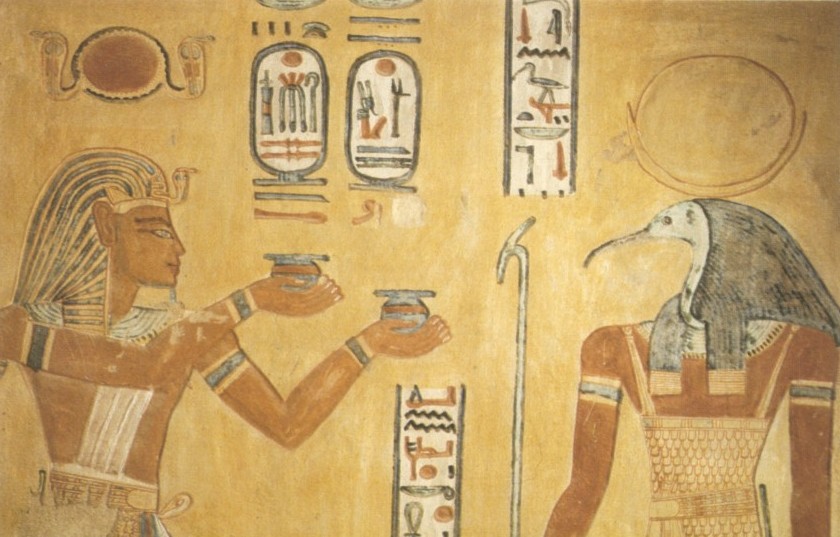
Ramses III. in front of god Thoth in tomb of Khaemwaset, 12th Century BC. by Ancient Egyptian Painter


"Thoth, the Atlantean, at the 26,000 year ago beginning of the Cosmic Cycle now ending, aided in the building of the Great Pyramid and secreted within it records and instruments of the Motherland Mu and Atlantis explaining how the 'Children of Light' dwelt amongst the Ancients and are not as sons of men, except when they are in physical bodies. Thoth incarnated again in the Third Dynasty of Imhotep as architect under King Zoser, was Socrates and Simon Peter among seven incarnations. He knew that all men were essentially Spiritual Beings, for he said, 'Man is a 'star' bound to a body! Man is space born, a Child of the Stars(a Starchild!). Man is a flame bound to a mountain!'"

Source

For More Mysteries: Where the Lines that Divide Science and Myth Intersect 


"Dreamland" refers to the areas in and around Nevada and New Mexico where extraterrestrial mysteries intersect with government security, arcane science and high technology. This is the setting of my dream.
_______


After this series of dreams passed through my consciousness, upon waking, I had intended to discard the activity of recording this night of dream substance, as the sketches of dream memory seemed to be far-fetched, or too far removed from my daily, waking reality. Then, upon waking, I was forwarded the above message from an old friend. I thought this was a sign that I should indeed record this dream.

I seemed to be returning from the West Coast, driving across the United States, when I passed through the Southwest. I feel as though I’ve ended a part of my life where I was deeply embroiled in study. As I traverse beyond the coastal horizon into the desert landscape, I am somehow drawn into one final “course” if you will. I stop in an area of absolute desolation somewhere deep in the deserts of the American Southwest. The only nearby city is way far off beyond the horizon. We are in pure desert. I see a familiar face in a crowd of indiscernible human shapes and activity. Suddenly, though curiously expected, there is a presence above, a directing mysterious light, leading us to raise our arms in recognition. I feel we are being taught something, as my entire body begins radiating with harmless visible electricity. There is a pulse coursing through my limbs with a vibrant white glow.

Suddenly, I find myself, in the state of a child. I perceive myself as a small, minute entity, like a small child version of myself, however, somehow smaller, as my surroundings are proportionately more massive than I’ve ever experienced. I feel as if dropped into the middle of the desert, with only a couple companions, equally disoriented. We begin stumbling through the desert brush in an unknown direction, thoughtless and with a daze of incredulity and stubborn introspection strong enough to leave us careless and at once convinced as to the security of an optimistic fate. As we continue our walk, we soon happen upon an open cliff, leading into a canyon of vegetation and water. This source of life is our destination, we can feel it. As two children, however, we fall headlong down the cliff, without heed to caution or ability to properly maneuver the descent, and find ourselves plunging into the cool stream below. This is refreshing, however disconcerting, as we feel we have lost things of importance. There are beings upon a hillock above us, so we slowly collect ourselves and find our way to the top. We are welcomed by a towering figure, an alien body, whose shape and features remind us of an insect, although this being commands great respect. There is an exasperatingly strong resemblance to the living Thoth, Egyptian God of Knowledge and Writing! We are comforted in the presence of Thoth, and he sees to it that we are taken care of, while being independent as ever to splash about for our things in the water and climb the forested canyon hills.

Now that I reflect, I believe more and more this was the figure of Thoth as we know from Egyptian mythology in the flesh. In the dream, Thoth was of certain humility and held an unassuming air, embracing me and simply allowing my inner Child to explore (with personal neuroses intact) under the beautifully humane security of his nearby presence. 


__________


Watch about another incarnation of THOTH in New York City!
_________

"there's an old saying,

that goes something like;

‘a person that knows their place is a demi-god,

and the place of a person,

is a god,

and the One who has no personality

and is everywhere,

is the God’

a really old saying,

no one knows where from"

- excerpt from "An Old Saying"