Primarily a writing exercise, this dream journal-inspired blog is a quiet introspective sojourn into the process that we traverse in going from private dream to public art. I see our dreaming as an internalized mythmaking. As I philosophize and expressively exhibit dreams, both private and public, I encourage and delight in creative language as a way to practice experiential metaphors through a “public dreaming." Writing Theory: Creative Dream Fiction
Showing posts with label Jewish. Show all posts

Monday, 30 September 2013

Source of New Media: Resonant Lives Harmonize in the West


“What I began by reading, I must finish by acting.” Henry David Thoreau

Where is our all-inclusive local media source, one that is not generic, yet doesn't cater to only one group, one that embraces local lore, custom and myth, one that encourages people who live the story, who are located downtown or in the community, whose lives are on the pulse of the daily, local narrative? They are to tell their story, to emphasize selected statements said by their own voice, and to speak from experience, because good media should begin with experience and end with experience. Good media should not begin with inexperience and end with inexperience. Good local media should reunite with social cause, and ultimately, incite action.

The introduction, history, structure and funding of The Media Co-op is explicitly written out in, Know Your Co-op, a nineteen page document prepared by journalist Dawn Paley in 2007 and self-published by The Dominion editorial collective. What began in 2003 as a newspaper, The Dominion (still circulating nationally), was reincorporated as a multi-stakeholder cooperative in 2007, now known as The Media Co-op.

“The multi-stakeholder is a situation in which you have more than one class of membership within the cooperative and they collaborate together to meet the needs of the different classes of membership,” Peter Hough, Fund Manager of Tenacity Works Fund at the Canadian Worker Co-op Federation told the Calgary Working Group of The Media Co-op. “In a retail store it would be trying to produce good working conditions for the employees but also trying to produce good service and fair prices for the consumer members. And then all of them would share in any surpluses.”

In 2009, the first local of The Media Co-op formed into the Halifax Media Co-op. In the next three years, Vancouver, Toronto and Montreal formed locals (in that order). “Each local has an editorial collective that meets face-to-face to discuss stories and coverage in their cities and surrounding areas,” wrote Dawn Paley, in Know Your Co-op. “The new model has required the creation of a web platform where contributors can upload news, videos, audio and photos, as well as interact through comments, working groups and discussions.”

Cooperative and local media is a process of decentralization, essentially giving media back to its rightful source: the people. In this way, the oft-repeated slogan, “Own Your Media” is The Media Co-op mantra. With stories such as the 2004 Haiti coup d’étatand the Vancouver Olympics, The Media Co-op and its locals transcend corporate media coverage, connect with untapped readership in the Canadian public and have worked with larger media organizations internationally, such as Democracy Now!

Yet, as typical to news media, the bad news is ever-present. As reiterated in Know Your Co-op, Montreal Media Co-op founder Dru Oja Jay, bore the bad news that The Media Co-op could not accept new locals in the 2010 article, How to start a local of The Media Co-op. Due to the overwhelming commitment and the underwhelming budget, The Media Co-op instead encouraged incipient Working Groups. The Calgary Working Group was opened under the direction of Jay in 2010 with top-notch international reportage on the challenges to a national election in Manila, Philippines.

Since then, the Calgary Working Group has received over 120 members with contributions on topics ranging from the G20 Summit to The Alberta League Encouraging Storytelling (TALES), to Environmental Justice, to Café Koi to Young and Future Generations Day. Articles, podcasts, photo essays, editorials and blogs are among the many mediums of cooperative journalism local to Calgary. After a new (and very active) Calgary Working Group contributor corresponded with Jay earlier this year, the momentum shifted. Dialogue on starting a new local of The Media Co-op reopened.

The potential for the Calgary Working Group to become the Calgary Media Co-op is a vision that has since been shared in the local community, and the support is gaining. The Calgary Working Group started meeting with this objective in May of 2013. Besides forming a basis of unity, and establishing an editorial collective, the Calgary Working Group requires sustained and significant contribution in order to shift gears into the full-fledged Calgary Media Co-op.

The initiative is mutually coordinated with The Media Co-op, where all posts contributed to the Calgary Working Group (and in the future the Calgary Media Co-op) will appear as published on The Media Co-op nationally-syndicated, online news source. Stories written by a local, such as the Montreal Media Co-op, also appear as such when published in The Dominion. The Calgary Media Co-op is a vision for local cooperative media, in advocating for the publication of local stories, connecting them to a national community of journalists, activists, communities and leaders.

The basis of unity and editorial collective has been organized successfully since May with core organizational capacity developed with Daniel Rodriguez, a graduate of SAIT Journalism and Melissa Manzone, who holds an M.A. in Journalism from Kingston University (U.K.). Our basis of unity establishes a rational, concerted response to the inadequate agenda of dominant media to address and give voice to local concerns, perspectives and narratives. The unity is also founded on a deep appreciation for journalism as a public base of knowledge where cooperative values are formed, maintained and encouraged.

The editorial collective organizes a weekly program of contribution. Each piece submitted to the collective will be edited by at least two other core or guest editors. Three pieces a week are to be contributed by one regular contributor and two guest contributors. The publication schedule will be organized according to three themes – Uncovered, Alternative and Editorial.

On Monday, the focus will be on misinformation in the dominant news sources. Simply, we ask, “What is the popular news not covering?” The same issue published in dominant newspapers will be assessed and critiqued with regard to the uncovered angles, perspectives and stories. Not only will contributors critique, their articles and/or multimedia pieces will address and give agency to the unvoiced, and unknown, in our community.

On Wednesday, pieces will map alternative press locally, in Calgary, and Alberta. For example, we ask, “What is being voiced by independent media sources, non-English newspapers, podcasts and blogs?”

On Friday, the editorial collective will publish editorials spotlighting special voices from within the community. This new initiative of the Calgary Working Group aspires to convene with the entire political spectrum, including all identities of class, religion, gender, and ethnicity into a refreshingly local forum to reenergize debate, understanding and willpower in the community.

The Calgary Working Group still has a long way to go until the proposed momentum is established, and finally, there is a new local chapter of The Media Co-op in Calgary. According to the latest draft of New Local Policy (pending issue by The Dominion editorial collective), the Calgary Working Group remains in Phase 0 of 5 successive stages until a full-fledged Local can open in Calgary.

First and foremost, what this means is that the Calgary Working Group may not use The Media Co-op name to raise money. All funds currently fostered through the voluntary leadership of media activists involved in developing the Calgary Working Group are nominally channeled through AlternativeMediaYYC.com, an independent media and podcast source for Calgary-based voices. At Phase 0, the Calgary Working Group may not refer to itself as the Calgary Media Co-op. At this initial stage, administrators at the Calgary Working Group helping with site content do not have editor access through working group admin privileges.

Currently, the Calgary Working Group is developing from a working group (Phase 0) to a website working group (Phase 1). In the first stage of the working group’s becoming a local new content is posted weekly, collective membership is stable and meets regularly; collective processes, membership criteria and operating principles are formed; editorial policies are adopted; formal agreement is made with The Media Co-op basis of unity; and lastly, the collective (Calgary Working Group) agrees not to use The Media Co-op name to raise money nor refer to themselves as the Calgary Media Co-op.

At this transition, the working group applies to The Media Co-op Board of Directors (in this case, through Dru Oja Jay). Leaders from this Calgary Working Group initiative are currently organizing a conference call with Dru and The Media Co-op Board of Directors. [To get involved, please contact us via the Calgary Working Group coordinator, Matt Hanson (mhanson1717@yahoo.com).]

______________

In the context of modern literary history, Hungarian-American Jewish newspaperman Joseph Pulitzer set the quality standard for publishing at the turn of the century. Pulitzer, best known for the eponymous award for not only journalism, but also photography, literature, history, poetry, music and drama is attributed with the quote: “The newspaper that is true to its highest mission will concern itself with the things that ought to happen tomorrow, or next month, or next year, and will seek to make what ought to be come to pass.”

Good media begins with the very real ground-level experience of people who are the subject of good stories. The middle ground is where people read and learn. Finally, good media ends when the lives of the people voicing their story are changed as often as the people who learn that story. Good media compels and instills action.

Mediocre or god-awful media begins with inexperience, namely the daily political rhetoric, hearsay, or at best a secondary source. Next, its core value is the repetitive sound of a cash register receiving a dollar and some change for a paper. For the tremendous act of reading is enough for some literati, however news media should be a call to extroversion and community.

Oftentimes, media consumerism ends with apathy, inaction and at best a satiated boredom, and at worst, accepting that life merely boils down to hearsay. More subtly, office-enclosed research on secondary sources so conveniently bolsters today's social (and unsocial) media frenzy; a frenzy that can overwhelm experience into the dull silence of an unprovoked voice in an abyss of unquestioned answers, facts, statistics, records.
"It's as if newspapers have broken their bargain with democracy in turning away from editorial excellence and towards profit, marketing and cost-cutting...fewer of us can turn to our papers and see what we all have in common, or what our common stake might be if we participate in our democracy." (Yesterday’s News, John Miller)
The glossy overdub display of empty space is often filled with meaningless advertisements, meant to convince people that their lives are as empty and meaningless as an unfulfilled consumer niche, such as the newspaper; slowly becoming a dying, trivialized miscellany for the intellectual exploits of the few.

The media less and less provokes action because it never quite does anything for anyone, yet still somehow exists because of the inkling that it could. If only media behaved as it once did before politicized buyouts and delegitimizing advertisements, when a paper was a conduit of experience through which new learning passed to connect, share and welcome all voices to truly and transparently voice an urgent cause to act!

Dominant news sources less and less provoke action, and more and more reveal mere dangers. Is our fear-based culture a result of the classist leadership in dominant sources of media and information in the public sphere, where stories are always politicized according to the dominant agenda? As a result the rhetoric dissuades change, i.e. delegitimizes alternative perspectives. The narrowing national and public debates are also a resultant of the unremitting and domesticized war on [domestic] terror and its repercussions within the consumer identity crisis of the West.

Local media often promotes reliable, ongoing coverage, because people are interested in the longstanding nature of their community. Merely because a story is told does not mean the story itself is over. Ongoing coverage on a topic that immediately concerns people, on which they have daily experience as a default to their local lives, provides opportunities for readers to learn more, gain news perspectives, contact key leaders on the issue, and most importantly, become involved in currents of change.

Dominant papers don't often voice underprivileged perspectives because they are the least marketable consumers. Instinctually, good journalism bolsters weak areas of coverage, not simply profit margins. As Pete Hamill wrote in News Is A Verb, “True accomplishment is marginal to the recognition factor. There is seldom any attention paid to scientists, poets, educators, or archaeologists.” Traditionally, papers lead communities toward mutual solutions and shared vales. Consumer marketing instills myopia and is, finally, beside the point, and decidedly antithetical to providing true information.

The advent of community, as opposed to commercial, journalism can teach citizens of a democracy (and more, a democratically inclined world) how challenging it is to create consensus. Journalists are practitioners of democracy. Their work necessitates service and humility. Community journalism cultivates voluntarism, and promotes education, vision and friendship. An unknowing public spawns a culture of denial, impotence and misinformation. The more a society realizes its source of community, the more its people are independent, thoughtful and generous.


References:

Hamill, Pete. News Is A Verb: Journalism at the End of the Twentieth Century. The Ballantine Publishing Group. New York. 1998. Page 80.

Miller, John. Yesterday’s News: Why Canada’s Daily Newspapers Are Failing Us. Fernwood Publishing. Halifax. 1998. Pages 15-16.

Kennedy, Dan. The Wired City: Reimagining Journalism and Civic Life in the Post-Newspaper Age. University of Massachusetts Press. Amherst & Boston. 2013.

Paley, Dawn. Know Your Co-op. The Media Co-op:http://www.mediacoop.ca/index.php?q=knowyourcoop. Canada. 2011.

Jay, Dru Oja. How to start a new local of the Media Co-op. The Media Co-op:http://www.mediacoop.ca/blog/dru/4378. Canada. 2010.


The article above, Community, Not Commercial, Journalism, was written and published exclusively for The Media Co-op on September 27, 2013. 
_____________
I cross a deep green field. The sky, overcast, rains on a dark earth. Dusk spells weary and wayward bands of lonesome greed. The marijuana burns. I, cold in dank clothing, trail beyond the grey horizon. Smoothly, with a gliding wind, I escape across the open shield. My mind breathes awake. 

Pluie de mai. Pays basque by Darío de Regoyos y Valdés
Cautious, I walk slow. The friend waits, cold, faceless. I unwrap a fabric, revealing the value of our exchange. Sweetgrass fills the air. Moved, life graces. Forlorn and ungraspable, we stretch out to reach the fleeting air. Police siren. The air becomes a noxious haze of suspicion. I fly. 
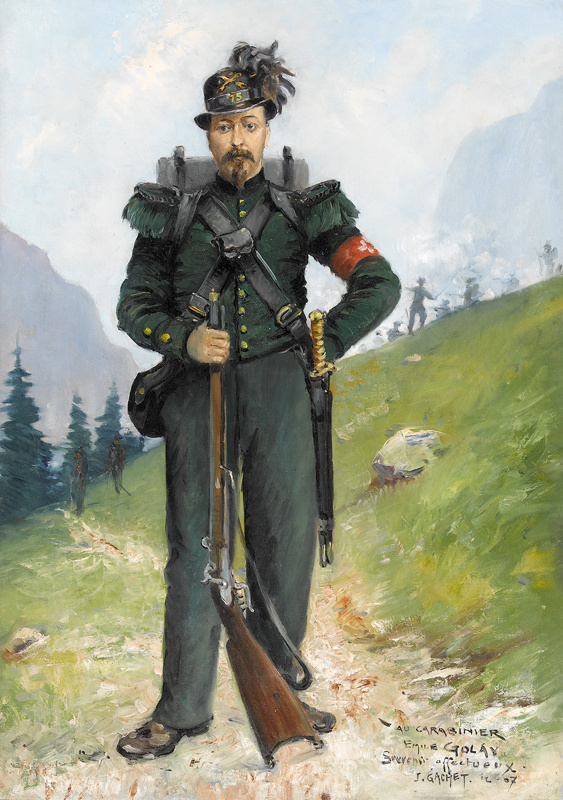
Le carabinier by Jules Gachet
The sweetgrass confiscated. Our lives are in our hands. I look up. Abyss. Black. Open. Dead light fades. Escarpment of the human gargoyle decaying, and erased from the map of heaven. Sharp and hard, the light petrifies, crystallizes and vibrates of the endless spectrum. 
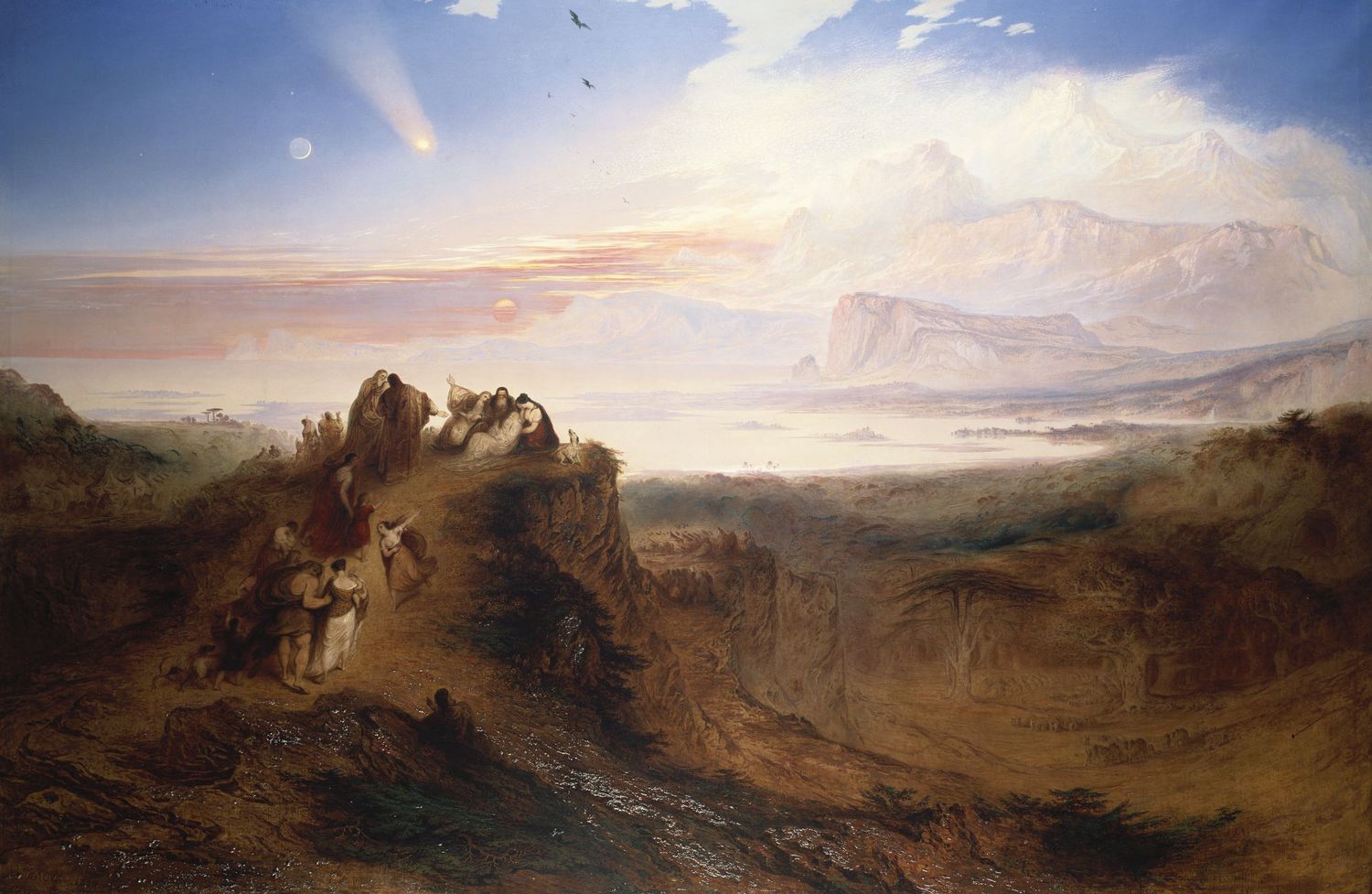
The Eve of the Deluge by John Martin
Galaxies enervate spines, nerves, veins and nodes of wonder; cosmic laughter at the sound of a split gong. Through, I, again, look up. Cobalt azure. Blinding, solar, pure and naked, sky. Cloud obscures. Rain, a memory. Summer passes in the afterglow noon. 
____________
First time in Vancouver, my love and I stayed with our dear friend Buckman Coe. I left early, leaving her to an extraordinary night with rich music and great friendship, and leaving, on my way back home, I played Buckman's first CD on my headphones. The first track, "Give Up The Fright", began "If you must go overseas / If that's where you feel that you ought to be." 

And tears streamed. I shook with the fear of love as I watched my one exit from the bus station and into the west coast cityscape. It was the first step on my way to Cairo, and further and further away from her. "Don't know if it was wishful thinking on her part / For now, this little rogue has got my heart," ends the song, a wishful lament to the ambiguity of human relationship, the lyrics struck so many chords with perfect accuracy. 

Years later, our dear friend's second CD, By The Mountain's Feet, opened with Not So Farfetched, a brilliant rhythmic melody to the course and rush of love - and again, the lyrics spoke with impeccable insight as we schemed our return west, to our Pacific lust of belonging - "This is how the story of you and I begins / And it's not so farfetched..." 

To the resounding continuity of love in our hearts. We grow to return. 

Multimedia Video on Jewish-Chinese Intercultural Music

Jewish and Chinese. The pot boils. Visiting the coast, we accompany a friend staying in the home of Lan Tung and Jonathan Bernard, whose special hospitality warms with musical instruments of a deep and resonant heritage. Their contemporary fusion music of world union reconciles the magic of our hearts with an unspoken quality of communal love - an uncanny similarity to our own strength of heart, soul and mind in the music of our coastal upbringing. 

Tuesday, 24 September 2013

Writing: The Child of Art and Music


"My grandfather Dolmic dreamed that three coffins floated through the door of his brother's house. So, he rode to the next village to investigate, and found his brother, his sister-in-law and their servant girl dead of cholera. The baby, still alive, was sucking at its mother's breast. He built three coffins and arranged the burial, and returned home with the child in his arms. And they say dreams don't come true." Ukrainian Grandmother, Wood Mountain Poems

On May 3 of 2012, Copenhagen welcomed the largest sustainable fashion conference yet seen in the contemporary world. Sustainability and corporate social responsibility are buzzwords in the consumer industry, and are integrated more and more into every sector of the economy. What was once merely one percent of the fashion industry in 2007 – when estimated global sales of the sustainable fashion market were at three billion dollars – would increase exponentially, culminating in the 2012 Copenhagen Fashion Summit with the investment of over one thousand key industry stakeholders. 

One of the largest industries, fashion product lines contribute to the spread of over eight thousand chemicals and twenty five percent of the world’s pesticides into the natural environment. Not only that, most of the environmental impact is made after the consumer has purchased the materials. Yet, sustainable fashion is one growing eco-trend that is challenging the largely unsustainable fashion market by employing alternative textiles with less carbon footprint. 

Organic cotton is effectively transforming one of the most commonly grown crops, and so in doing, is spearheading the eco-fashion movement. Other cellulose materials include hemp and bamboo. Materials, however, are only part of the eco-equation. Renewability and source factor, as does labor conditions. The idea is to create what Rossella Ravagli, Corporate Social and Environmental Responsibility Manager at Gucci, proposed during the 2012 Copenhagen Fashion summit, as a “good compromise between style, quality and new material.”   

Arguably, bamboo fiber is especially capable of meeting the demands of the new eco-fashion market. With an absorptive quality that captures greenhouse gases, bamboo grows in abundance without irrigation or pesticides. As the fastest growing woody plant in the world, bamboo holds a unique place in the fast-paced consumer market. Although, there is controversy regarding bamboo’s claim to fame in the eco-fashion market, as the process required to turn bamboo into wearable fiber, also known as Rayon, is marred with chemical-intensive labor. Yet, relatively speaking, bamboo as a source material for clothing is a more sustainable option than most. 

Yet another alternative textile, hemp, is potentially more eco-friendly than bamboo. Also easily grown, hemp clothing is often a composite of other organic materials. With such diverse uses as building materials, paper, jewelry, and fuel, hemp is largely responsible for complementing the greater trend of sustainable fashion with style. Hemp clothing is often designed with respect to traditional eco-fashion trends, opening interest in ethnic-inspired lines.     

This piece of commercial writing on eco-fashion was originally written for a client in China, and is also published as a blog on The Media Co-op
_____________

dusk fall
full equinox
hell's door
lonely crossroads
still bells
way back
world tree
______________

The week began with the resonant mergence of harmonic mastery still ringing in my ears. A meeting with contemporary legend, Amir Amiri opened my mind to the brilliant challenge of a distant sound's arrival. The shores of my thought curled and folded in a slow tide as I acquired the bittersweet taste of a traditional music's refinement into the beautiful wholeness of world.

The quick hum of the Persian santur danced behind my eyes with the lifted personification of an artist's temptation to unite with the all-breathing life of unity. Yet, nostalgic and principled, remained steadfastly earth-bound to the homely traditions of mother, father, and self. At once, another meeting with the unbound truth stared me in the face through the transfixing metallic song of the HandPan under the voice of LIRON MAN

After Man's show, Puertas, at the Calgary International Flamenco Festival, I then met the opening musicians, one of whom, Tamar Llana is featured in the video below. She sings next to her mother, Judith Cohen - an ethnomusicologist with a special focus on Sephardic music - playing the frame drum. The joyous union of ancestry, tradition, and contemporaneity through music led to a revelation of harmony as the voice of continuity, belonging and meaning.


Saturday, 26 January 2013

Talmud and Dream Interpretation: Thoughts of a Secular-Cultural Jew

Talmud Readers by Adolf Behrman
“Dreams which are not interpreted are like letters which have not been opened.” Talmud

I am a cultural Jew, a secular Jew, an ethnic Jew. As singer Arianne Zuckerman once said, I am "Jew-ish". Yet, I revere the tradition of the Talmud. As far as I know, it is the source of a great wealth of pride in the intellectual strength and heartened closeness to tradition that Jewish people have maintained throughout generations. We have kept our traditions intact because we are flexible. The Talmud is a massive compendium of volumes steeped in argumentation, discussion, rhetoric and criticism on the sacred text of the Torah. The Old Testament is not Old, it is vivified by thousands of years of continuous self-criticical analyses and contemplative thought. The Talmud is the tradition of intellectual meditation on the sacred word. No wonder why dream interpretation is honoured, as the Talmud is one of the oldest forms of imaginative interpretation known in book form. For more in-depth understanding of this quote, see Erich Fromm's work "Forgotten Language."
__________
An old woman sits languorous outside the concert hall entranceway. Her excessive body weight slumps over a barstool with the heaping fatigue of an overworked heart. Yet, in her eye, there is a glint of sound reason, a harmonious vocation towards authentic humanity. I stop for a moment to share a few words with the curious and unseemly woman.

Woman playing a kithara by Anoniem
(Wall painting from Room H of the Villa of P. Fannius Synistor at Boscoreale)
I become so filled with sympathy for her life story. I run out onto the street, looking for a candy that I recently became aware that she enjoys. All I can find is a broken piece of chocolate on a dirty sidewalk. In my nervous frustration, I dust off the candy and walk back into the hallway. As I step cautiously through the alleyway to the concert hall, a man a few years my elder feels he must give a word of advice.

Two women at the street by Ernst Ludwig Kirchner
"There is no sense in your sympathy," he affixes his language to my throat like the strangling inexorability of truth. "I've heard too many racial slurs from the mouths of your likening. You'd like to give back, and yet you cry on a pedestal," he musters an incendiary rage, of darkening complexion under the flickering streetlamp. "How many times have I heard your story, I'm Jewish, so I can empathize," he continues unalloyed. "And when you speak of G-d, I am utterly disgusted."
____________
The Italian connection, un-swayed by the prudent fire of tango nights
       stirring wilderness roosts
                in the back hall of some sterling porch façade
                in the mundane sky of an after-party dimming
                       beside alcoholic whiteout praise
                       and the ruined name.

excerpt from "The ruined name"

Friday, 20 July 2012

Songs of Ascent for the Exile's Shabbat

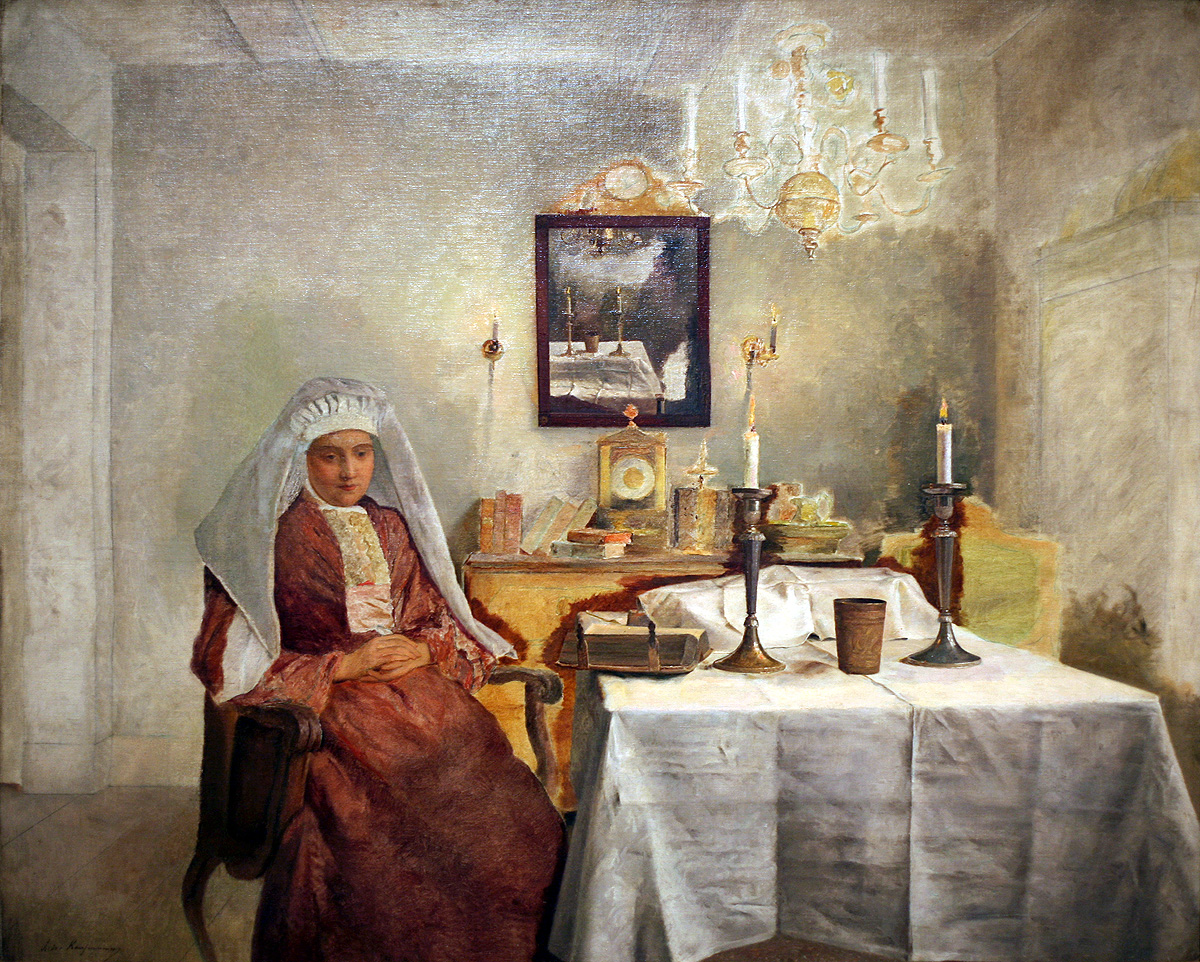
Friday Evening, c. 1920 by Isidor Kaufmann
1. When YAHWEH turned again the captivity of Zion, we were like them that dream

א:  שִׁיר, הַמַּעֲלוֹת
בְּשׁוּב יְהוָה, אֶת-שִׁיבַת צִיּוֹן-- הָיִינוּ, כְּחֹלְמִים.

2. Then was our mouth filled with laughter, and our tongue with singing

ב:  אָז יִמָּלֵא שְׂחוֹק, פִּינוּ-- וּלְשׁוֹנֵנוּ רִנָּה
אָז, יֹאמְרוּ בַגּוֹיִם-- הִגְדִּיל יְהוָה, לַעֲשׂוֹת עִם-אֵלֶּה. 

________
I remember that hill over Muqattam. The overbearing expanse of city, modernity’s rush cascading over the fold of an unclean mind, burning with hot anger in the deep mud of trivial remorse. “They had a plan?” I ask myself, eyeing the inglorious ruins of the once-worshipped architecture still clinging to the life of popular assembly. 

The race of motorcycles and small vans gargle the steaming froth of smog. All spat murderous into the disappearing rain forming high above the human realm. The deserted outskirts, nude with the pang of an outstretched kin, and I am lost, reaching for high ground in the sand-whipped light. Moonless, my fatigued mind craves for recognition in the atmosphere at hand. I am a lone walker on the side of the road. A bus skids past, slows to a halt and I enter into smiling Arab tongues.

The rage and personified haste, the stone labyrinths, the winding path is lifeless with the cold sweat of his following. A professional runner turns and writhes in the pain of want, instilling in me an incisive turning. The wandering hate fills me with unrivalled curiosity and shame. I know no warmth, but for the hunted muscular knife-rent swallowing of friendship cursed along the highway pathways, intermixed with the foul bitterness and acrid taste of inner city air. 

We fall into a hollow stone, and as two locked in the crude horror of warring greed for a brother’s flesh, the wicked stress of rivalry bleeds into our distraught, nascent sanity and heaves it straight over the edge of common reason, to blood and night.

And in the turn of the People’s Spring, a vision unites my fiery cry for wisdom in the heart of our common ancestral history; humanity astir in the colored, feathered breast. A flight into the Eastern European pasture of stars, grazing in the weathered light of a great-grandmother, still kissing the martyred asp of tradition; a Jewish sprite. The elder ways fire in my unskilled mind an art, performative in the midnight trust with an earlier truth. The performance is tonight.

Wading in the molasses mind of patience for the spiritual will of ideation from the ghosts of the numinous beyond, I struggle with answerless freedom in the sordid now. I ready the ingredients. The wasteful strolls and meandering highs screw our minds into wakeful reason, to, with meticulous care, craft an act of such daring import as to quicken the mind and speak the heart. I make a paste, of turmeric base, with white, weakened broth. I will be a death camp victim, with lightless skin and gaunt hue.

Wasting away in the turmoil of ambient talk, I prepare my body, though with fault besieging me with lost and needed objects fading and reappearing sporadically, as to the rhythm of my anxious pulse as I meditate on the gas chamber. I’ve devised the shower faucets to emit a turmeric spray, the walls an exact replica of the infamous Aushwitz, Lodz, and countless others.

As I watch the clock spell a cruel lateness, as speeding on into the infinite daze of eternal death, I’m unable to hasten and prepare myself before my half-hour performance slot is up. About five minutes before my time’s ended, the door inside the dressing room bursts open to the step of Brazilian carnival dancers and Latin fiesta cooks with big rumps and loud mouths, shouting in a haze of upended happiness, a gorge of playful sight ignites my depth of ancestral reminiscence. The act is over before it’s begun.
________
Late
"To dream that you are late for something represents your fear of change and your anxiety about seizing an opportunity. You may feel unready or unworthy in your current circumstances. You may also be conflicted over decisions about your future." (iDream)
________

the dimly lit cougar
a swan and her minions

playing over the blonde heat
some unknown bass record

feet stung blind,
tough grotesque splurge over the glued racket
...
into a silent dysfunctional glare

breathing alone
holed-in

Monday, 2 July 2012

Borges and The Ancestral Mirror of World Literacy


"Childhood passed away and the tigers and my passion for them grew old, but still they are in my dreams. At that submerged, or chaotic level they keep prevailing. And so, as I sleep some dream beguiles and suddenly I know I’m dreaming, then I think: this is a dream, a pure diversion of my will and now that I have unlimited power I am going to cause a tiger.

Oh incompetence, my dreams never manage to breed forth a longed for beast.”

[From “Dreamtigers”]

Narrator

"Borges dream world extended from the house in Palermo to the city around it and out into the endless continuity of the pampas. Here in the open country he discovered another aspect of Argentina’s mythology. The land where his ancestors had fought, the vast sky and the gauchos..." 

From “Jorge Luis Borges: The Mirror Man” 
_______
The dark forest leads under a storm-cast flood of opaque black cloud above the dimly lit cabin, barely in sight. Leaves, burnt by the frozen winds crumple with delicacy under our unforgiving step. Sense-deprived, we share the hollow bitterness of the cold mystery ahead. With Mexican friends, we enter the home of the recluse. Maps of Metis land and the intriguing sizzle of wild game invite us onto the weathered upholstery of inspired comfort. Indrawn, yet tempting, the host’s gaze is untamed, always welcoming. As friends and I sit around the country table, the food begins with due presentation, decadent meats and thick bean dishes melt in a haze of tantalizing scents. Conversation ensues. Drink follows. I’m ridiculed for my lack of Spanish. Dejected, I comb the ghastly wilderness, alone under the silent, new moon. Pitch darkness swallows me in a mutual fight with my emotional vacuum, self-trust extinguished with each step upon the unknown forest ground. I walk until dawn. On my own, I know the comfort of the empty sky, the abandoned railways, and graffiti concrete beside shallow streams. All are mere steps towards the final return, to where I used to be.
_______
Dark

"A dream of the dark is never a good aspected omen as after such a dream you are in danger of losing control of your temper and causing yourself a lot of hardships and losses. If you dream that dark is falling while you are traveling it is an ill omen for any business you try to conduct unless the journey is finished before it gets dark." (iDream)
_______
I revere my Jewish ancestors over the Hebrew G-D,
that is to say:
the personal history and presence of my ancestors are closer to me in bond
and in the formation of my living human identity
than are the laws prescribed in Hebrew society,
for we are of a greater human community

- excerpt from "Jewish ancestors"

Friday, 30 March 2012

I Dream to Honor Our Greek-Jewish Ancestors


It was a dream of mine to share the unique heritage of Jewish-Greek culture in my city. I saw a great opportunity when the film "My Sweet Canary" began their North America tour. An event which links the history with our very own Greek Rembetika band, The Rembetika Hipsters

After extensive correspondence with Roy Sher, filmmaker of "My Sweet Canary" and the Greek Community and Hellenic Society of Calgary, I finally contacted the Rembetika Hipsters band, our local Rembetika music.

Here's what bandleader Allan Baekeland had to say:

"This is a fantastic idea...I'm not sure you're going to get a lot of help from the Greek community. There is a degree of ambivalence and even hostility towards rembetiko music amongst the local Greeks...unsavoury lyrics about drugs and criminal behavior, its Turkish origins, etc...I think we can get a good size audience for such an event in the fall."
______

I am sitting around a table at the Kehila Kedosha Greek Synagogue in Lower East Side Manhattan. This is the last remnants of Greek Jewish culture in the area. I am with my extended Greek Jewish family, dining upon some traditional delights. There is some argument at play. My grandfather stands out among the crowd, somehow dissatisfied. In my reflection, I see the argument revolves around the ancestral name. Did our name change upon immigration? In order to find the answer I travel outside of the synagogue, outside of the city limits to a small hut, in which an American hermit, living out in nature in a small, ramshackle hut often recurs as a returning dream-character. When I arrive to his hut, he greets me graciously. I ask about how to attain filtered water without a filter, after which he points me in the direction of a stream. Unaware, I lead the way and find that his once-densely forested nature hermitage is now interspersed with half-destroyed concrete buildings and functioning industrial office rooms. I enter one of the offices to let people know we are here to understand how to filter water without a filter, they look at me ignorantly and distractedly brush me off. The hermit then leads me to a stream, where the water is rushing clear as a cloudless sky through a gorgeous array of stones. I feel I’ve found what I’ve been after, but there is more, now faded into the forgetfulness of day.  


______

fire light  
widening, the open mountain 
crevasse of grandfather's memory
"God's country west" 
Mt. Rainier
Washington is there 
"is he in you?"