Primarily a writing exercise, this dream journal-inspired blog is a quiet introspective sojourn into the process that we traverse in going from private dream to public art. I see our dreaming as an internalized mythmaking. As I philosophize and expressively exhibit dreams, both private and public, I encourage and delight in creative language as a way to practice experiential metaphors through a “public dreaming." Writing Theory: Creative Dream Fiction
Showing posts with label artist. Show all posts

Monday, 19 August 2013

The Artist of Moloch: Creativity and Capitalism in the New West


“Moloch in whom I dream angels...Dreams! adorations! illuminations! religions! the whole boatload of sensitive bullshit!” from Ginsberg’s Howl, Part II

What is it to be an independent in thought and action, to be an artist of heart and mind, and, most radically, to live within one's means in the New West? I live in a city where my next door neighbour makes over a billion dollars a month. I, personally, don't make money. Or, more accurately, my profits are nearly zero. Yet, I live life fully and exuberantly. On a whim I could splurge on an evening of luxury fine dining with my wife, or rent a car and go to the mountains, or even purchase a new musical instrument and the latest computer hardware. I am not in debt. In fact, the one and only stipulation to entering higher education, was that I not get into debt. I save, and live within my means, although I don't exactly see my money growing as the incessant growth models of Western capitalism would encourage. 

Nonetheless, as a city dweller, and especially in the city wherein I live, considered a global oil capital, the mean streets of capitalism are hawk-eyed and omnipotent on every corner. As an artist, the very ground under my feet is funded by the turning soil of the most destructive earthquake in human history known as the fossil fuel industry. Living the majority of the time through physical self-propulsion as a primary means of transportation balances one's perspective as an outsider of marginal and radical import to the status quo. Energy and economy, in their most fundamental and basic meanings, derive from the physique in relation to the sources of life in the ground (energy) and the way of relating to living exchanges through reciprocity and foresight (economy). Happiness is learned when expense is measured in sweat, growth in a smile and dividends in generosity. 

Daily the innocence of play in the mind of art, creativity and community is buried under the debris of an open-pit mine with lightning swift efficiency. Once aware of the mounting genocidal ecocide inherent in the dominant global energy policy, how can one go on knowing that at the end of the day the artists of the world become mere charade, trick and distraction for the bowling force of industrial belligerence? One of the greatest pearls of wisdom that my grandfather shared with me was what he had learned among his Greek family of early immigrants to Lower East Side Manhattan, New York. "We were poor, but we were happy, because we were together," he repeats like a charm against the malevolent truth of Western life: family separates. So, often, I feel, as a communitarian-individualist independent-ecologist artist-worker radical-traditionalist of the 21st century and of eternity, that my life is the epitome of what Ginsberg describes above, as in Moloch, and dreaming of angels. 

In the next weeks, I will be transitioning the SoJourn(al) site as a supplement to a new web-source exhibiting an ongoing creative non-fiction work that gives breath and voice to original knowledge. Oral storytelling, family tradition, and cultural literacy are waves of realization that have revealed a sliver of moonlight over the oil-dark sea. I see a way, and directed by intuition, the art of living further breathes a channel of oceanic action towards as yet unseen, inner prosperity. Philo of Alexandria, an ancient who fused Jewish and Greek philosophy at the beginning of the first millennium of the common era, is quoted: "Households, cities, countries, and nations have enjoyed great happiness when a single individual has taken heed of the Good and Beautiful. Such people not only liberate themselves; they fill those they meet with a free mind." 
______________

away up
passive aggressive
play waste
science silenced
weary night
______________
The track, "Columbian Map" is derived from the written piece, "Phantom Pages of a Medieval Columbian Map" from the district.Columbia collection of experimental writing. The meaning of the title refers to Columbia, the goddess myth of precolonial America, the ubiquitous feminine divinity of the land itself as seen and heard through Western European eyes. The "Phantom Pages" open an understanding of the land that transcends European representation through the cartographic delusions of "discovery", colonization and settlement.

A narrative art sounding is embedded between guitar and shakuhachi music. The introductory guitar melodies on the track are resonant of Indian Sitar music, yet also merge into influences from West African blues and Middle Eastern Oud playing techniques. The shakuhachi, through its abject dissonance and airy ambience, bridges two instruments from opposite ends of the globe, that through harmony and chaos move the voice to speak, as middle ground, as the remoteness of truth between directional extremes. My approach to the guitar (a quintessential Western instrument) as the embodiment of non-Western sonic influence further melds with my approach to the shakuhachi without any classical training, thus playing it with a Western ear. And so, western instrument with an eastern ear, and eastern instrument with a western ear redirect the two-dimensional cartographic reality of discovery into the 4th dimension of time through sound as narrative, voice and, more, a pure medium of truth.


A collection of five works from the penultimate chapbook from district.Columbia, "Changing our PERSPECTIVE" includes such works as "An Unknown Pleasure of Respect" and "Phantom Pages from a Medieval Columbian Map". With an ahistorical to contemporary thought in light of the current need to shift from an industrial to ecological society, this chapbook addresses that first perspective, or where we stand is the crucial point of change. Perspective, is also history. Until we transcend the dualistic norms of media consumption and direct experience, there is no way to begin again from a new point in history. The junction of the present and the past affix humanity at a crossroads of time. 

Before ascending into the next era of humanity on Earth and traversing the crossroads ahead, each and every last individual will be asked, Who are you and where have you come from? Anishinaabe Elder Dave Courchene wisely advises all people to return to creation, to return to the very beginning of our nature whenever unsure, whenever inundated with a sense of ignorance, confusion, loss. On the path to inner knowledge, light blinds, and the shadows reveal the road home

Saturday, 29 December 2012

Van Gogh, Ophidian-Seer of Starlight Medicine

Cafe Terrace at Night by Vincent Van Gogh
"For my part I know nothing with any certainty, but the sight of the stars makes me dream." Vincent Van Gogh
Artists are seers, and so, are truth-seekers. Yet, human experience blurs the line between seeing and seeking. Certainty is flux, and flux is certainty as form is emptiness and emptiness form. The old Taoist adage of dual unity is the perplexing clarity of universal distinction. To the point, and contemporaneously with current societal and ecological trends, human life is further revealed as an innate paradox. Van Gogh continues in his mad method of artistry in saying, "I dream of painting and then I paint my dream."

The wisdom of Van Gogh speaks to my previous post, The Cubism of Unity: Shelley and the Myth of Monogamy where he speaks on God (Unity) and Love (Diversity). "Love many things," he says, "for therein lies the true strength, and whosoever loves much performs much, and can accomplish much, and what is done in love is done well." More simply put, Van Gogh confesses, "But I always think that the best way to know God is to love many things." 

In the beautiful and powerful 1956 film, Lust for Life starring Kirk Douglas, the tormented genius and emotional outcast paints Starry Night, while the narrator speaks: "Sometimes I work on into the night. I'm hardly conscious of myself anymore. The pictures come to me as in a dream with a terrible lucidity." Night and dream are married in a mystical love through the human as artist, animating the spirit of the dream towards a night imbued with the life-giving stars of an empyrean both transcendent and visceral. The dream stirs from the lowest of depths, and reaches towards our greatest heights. We are besieged with an all-consuming, all-cleansing, all-awakening, all-encompassing Mystery.  

Search on this site below for more original interpretations and creative contexts on Van Gogh
____________
My nature writing blends into an arcane Spanish-language text. The publication circulates among Earth-lovers and wild foodists alike. Together, my readers and I endeavour through a dense thicket of swamp. Community leaders take the helm of a slow-moving canoe, shifting through the bullrush stands and mud vents emitting the hot gaseous fumes of peculiar decomposition. 

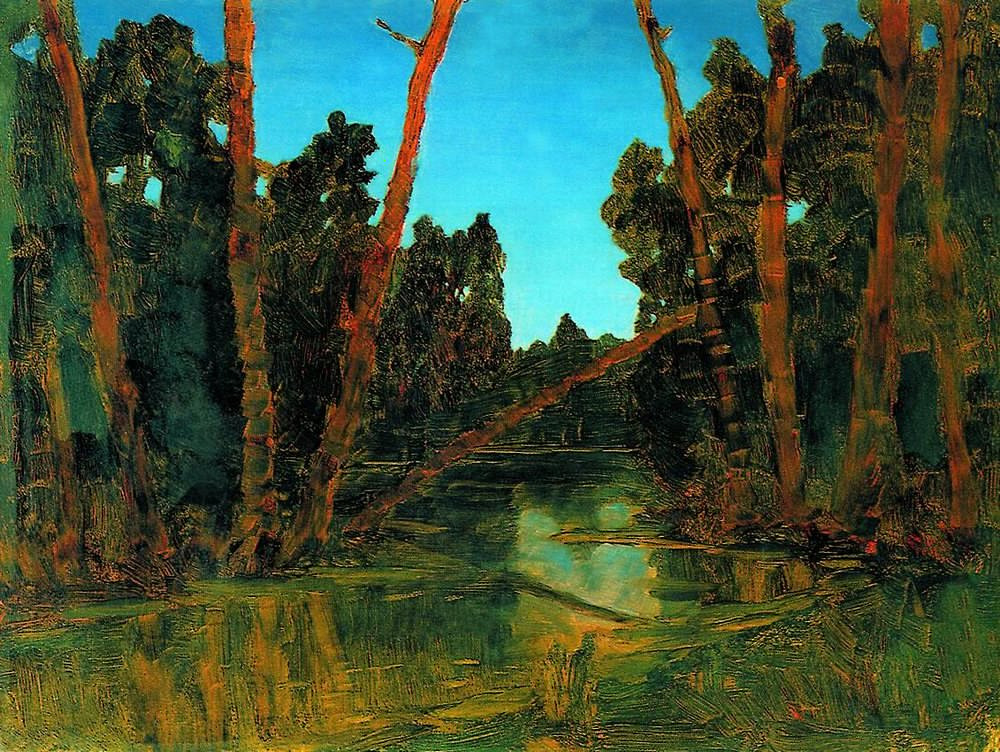
Forest Swamp by Arkhip Kuindzhi
A rattlesnake emerges from the rushes as we emerge from the blinding vegetation. On the waters, ready to disembark for a land crawl, a comrade teases and taunts the rattlesnake head. The venomous wisps and hissing instills a deep-set fear straight through my eyes. The rattling spells virulence and ire. Reptilian awe paralyzes my arms and legs as I stare, petrified, watching the snake slither madly towards me. It darts and in a split-second latches onto my arm. My reaction is pure thought. Still as stone, I feel its fangs stick into my blood. 

Old dream interpretation folklore sees a snakebite dream as a positive symbol of regenerative holism. See my recent nature writing publication for Canada's only independent news cooperative. 
__________

To return to primal and distended physical tumult
A chaotic folly
Dreaming in smokeless fires

...
In the post-kingdom English croak
Over bastions and landlocked heights
That furnishes much scheming

A trite & forced inhuman sense
Of belonging
In a war trench

Phase of lunatic civility,
As the prosperous few wade
In proud shores of quicksand

Loss of self,
Ruined foresight vanishing
Into the uncreated past

excerpts from "Horror-story jazz"


Sunday, 23 December 2012

The Cubism of Unity: Shelley and the Myth of Monogamy

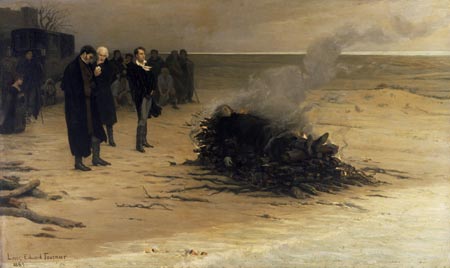
The Funeral of Shelley by Louis Edouard Fournier
   Thy wisdom speaks in me, and bids me dare
Beacon the rocks on which high hearts are wrecked.
I never was attached to that great sect,
Whose doctrine is, that each one should select
Out of the crowd a mistress or a friend,
And all the rest, though fair and wise, commend
To cold oblivion, though it is in the code
Of modern morals, and the beaten road
Which those poor slaves with weary footsteps tread,
Who travel to their home among the dead
By the broad highway of the world, and so,
With one chained friend, perhaps a jealous foe,
The dreariest and the longest journey go.

   True love in this differs from gold and clay,
That to divide is not to take away.
Love is like understanding, that grows bright
Gazing on many truths; 'tis like thy light,
Imagination! which, from earth and sky,
And from the depths of human fantasy,
As from a thousand prisms and mirrors, fills
The Universe with glorious beams, and kills
Error, the worm, with man a sun-like arrow
Of its reverberated lightning. Narrow
The heart that loves, the brain that contemplates,
The life that wears, the spirit that creates
One object, and one form, and builds thereby
A sepulchre for its eternity.

From Shelley's Epipsychidion

The dying words of my great uncle, who would have been 92 this week, were "focus on one thing". I've always had multiple affinities. As a creative person, my mixed mediums, cross-genre, multi-instrumentalism frames of mind spill and interweave throughout different art forms. I often wonder, should I commit to one thing entirely, and from that foundational trunk, branch out into the world of infinite possibility? In my arboreal metaphor, I am a forest. 

I think my great uncle might be proud to look upon one of his favourite of the younger generation, and see that I am not following his advice. For he was an iconoclast himself, through and through. Of the first class of Jews to enrol in university in America, he was proud to transcend the status quo, the social norms and family values of his time and explore the hard-won science of novelty through physics and chemistry. 

Yet, in love, I am elastic enough to disagree with my creative self, and traveling beyond the creative-destructive duality, to see the magnificence of love as an enduring unity. I see only One Love, especially when looking upon the dear face of my beloved wife. 

The late Ravi Shankar exhibited a profound connection to intensive unity in life focus in the documentary Raga, while Lawrence Ferlinghetti espoused the delights of being a multidisciplinary artist in both poetry and painting in his essay, "From The Gone World". To each their own, to each their one, and one to each. 

See related post: Shelley and the Old Man: A Poetics of Wisdom
_________
A forest of brains, pantomime expressionism. The canvas is blank. We stare, of ancient rivalry, to whiplash a brush of paint across the rough, splotchy face of collaboration. The collaborative stare ensues. Our eyes lock under a dark cloud of empty highs and lonely madness. 

Les deux amies by Thorvald Hellesen
A pastel cubism intermingles with pointillist ink. Our minds snatch and hiss at the dizzying array of subdued pigment and hints of future colour. It is group inspiration, retching from the distended bowels of two fiercely separate artists of waste. And in a moment of communal haste, aggression holds the creative fire of my murdering hand, and I impale the throat of my fellow artist, friend and comrade with an ink brush. Our painting is finished, our art begins.
_________
"…in a play…a dream play brings up the soundless deep…in the emptied awareness of emptiness…playing on a dreamscape of silent depth…up from the upbringing…strong with remembrance in the absolute living…living among complicit guests and their following remarks…

...

…in the native dirt…and to speak to the stone…and to speak through our pain…the pain of our individuated backs…grated and remaining uncured with the booming fate of a motionless mountain sky…journeying around the headless round of the tailbone crack…remembering through a numbing moment…

…a memory…lost to the unchained back…still writhing with touched passion…"


excerpts from "Fragmentary Being"

Friday, 23 November 2012

A Taoist Mystic-Musician and the Great Awakening

Painting of Tao Yuanming by Chen Hongshou
"By and by comes the Great Awakening, and then we find out that this life is really a great dream. Fools think they are awake now, and flatter themselves...Confucius and you are both dreams; and I who say you are dreams,—I am but a dream myself. This is a paradox. To-morrow a sage may arise to explain it; but that tomorrow will not be until ten thousand generations have gone by." Musings of a Chinese Mystic: Illusions

Possessed by a conflict of opposites, after reading this quote aloud to my wife, she says, "That is totally how I feel." She was raised in a Vietnamese sect of Shamanic Taoism. One day, a local shaman saw her hands before she left Vietnam for Canada. "You have the hands of an artist," said the shaman. As I watch her hands blend with the strings of her instrument, and hear the mystic bent with staggering heart, wrenched from her music of an emotive immensity so tremendous that I am truly floored every opportunity I have to provide her with a rhythmic touch of our in-gathered loving. Through her music she speaks, "listen, and awaken to the source root of creativity." It takes a well-planted seed to take root in such soil, rich with the wisdom of time and its lessons of patience and anticipation. I respond, "let the spontaneity of life sometimes dry, to await the rain, falling not from our own bodies, but from the intuitive atmosphere of our shared life, that to be patient, is a kind of love."
________

pondering the day by the riverside, my mind blends in the heady fray of sun rope tangling with the cloudy sky in a disarray of dizzying color, the viscera of imagination pokes its protruding skeleton in the vine-skinned pathway beside my water-borne home 


as I traverse further on, through riverine thicket dense with the swamp-like craftiness of bitter greenery, filtering the light through a pockmarked memory of filigree lightning, and I remember the Old Man, a Lao Tzu, of my entrenched longing, with such wisdom as unknown by my youthful pride, he walks with me with undeviating eyes, with mind to each thought that arises between our speech of anticipated mentioning 

Sakyamuni, Lao Tzu and Confucius by Unknown
and then he stops to show me a trick of the fatherland, a stick of wisdom, a bone of intelligence, an awakened look into the material fire of all transparent self-knowing, the crooked daze, the unchallenged light sparking his eyes to follow mine in the unfailing instant of his true magic
________
A law for the ancient mind of cultural struggles
To be heard through fallen webs of prehistory

Erected above the books and pleasure-peaked Goddess of man
Who assailed Her tribes with red nations
...
Claiming to break the mold
With word thievery and undreamt savagery
...
In the earth’s hidden sky of traveled time
And her rested eye

excerpt from "The Modern War Machine and his Italian Wife"

This post is dedicated to my wife, Vi An

Monday, 19 November 2012

Dream, or Intoxication: Nietzsche and the Tradition of the Master Singers

The Ravens (For a poem of Nietzsche) by Margaret Hofheinz-Doring
"...dream and of intoxication, physiological phenomena between which we can observe an opposition corresponding to the one between the Apollonian and the Dionysian. According to the idea of Lucretius, the marvellous divine shapes first stepped out before the mind of man in a dream.* It was in a dream that the great artist saw the delightful anatomy of superhuman existence, and the Greek poet, questioned about the secrets of poetic creativity, would have also recalled his dreams and given an explanation similar to the one Hans Sachs provides in Die Meistersinger.*

My friend, that is precisely the poet’s work—
To figure out his dreams, mark them down.
Believe me, the truest illusion of mankind
Is revealed to him in dreams:
All poetic art and poeticizing
Is nothing but interpreting true dreams.

The beautiful appearance of the world of dreams, in whose creation each man is a complete artist, is the precondition of all plastic art, and also, in fact, as we shall see, an important part of poetry."

Nietzsche, Birth of Tragedy (e-text)

One night I had been tirelessly searching for this very stanza by Hans Sachs, however I'm unable to read German so my stalwart online efforts proved futile. After glossing over Nietzsche's "Birth of Tragedy" a few times within the body of other texts on mythology, psychology, dream and poetry, I have now found a predecessor to Nietzsche, Hans Sachs, embedded in his monumental philosophical work. This is one of my favourite tracts of literature, and yet I've still to read it in its entirety. I continue to draw from this work the kind of lucid understanding of our inner being as it has moved and developed since the first pages of history unto time immemorial. Such an exhibition of prime thought beckons one's mind, as a lure into the opaque night of isolation and longing, yet when nostalgia dissipates the true character of one alone breathes the kind of truth that is our universal whole, a cosmic constancy of holism, triumphant in its lasting mystery. 
_________
The air, invisibly opaque, opaque in its emptiness, invisible in its bodiless humor, I gaze through the sheathed firmament, a room, a body, jacketed in the empty dark. Forcing my eyes to move, I see a slight pitch in the cruel nothingness, a fleck of something in a bruised vacuum of light. Where am I? 

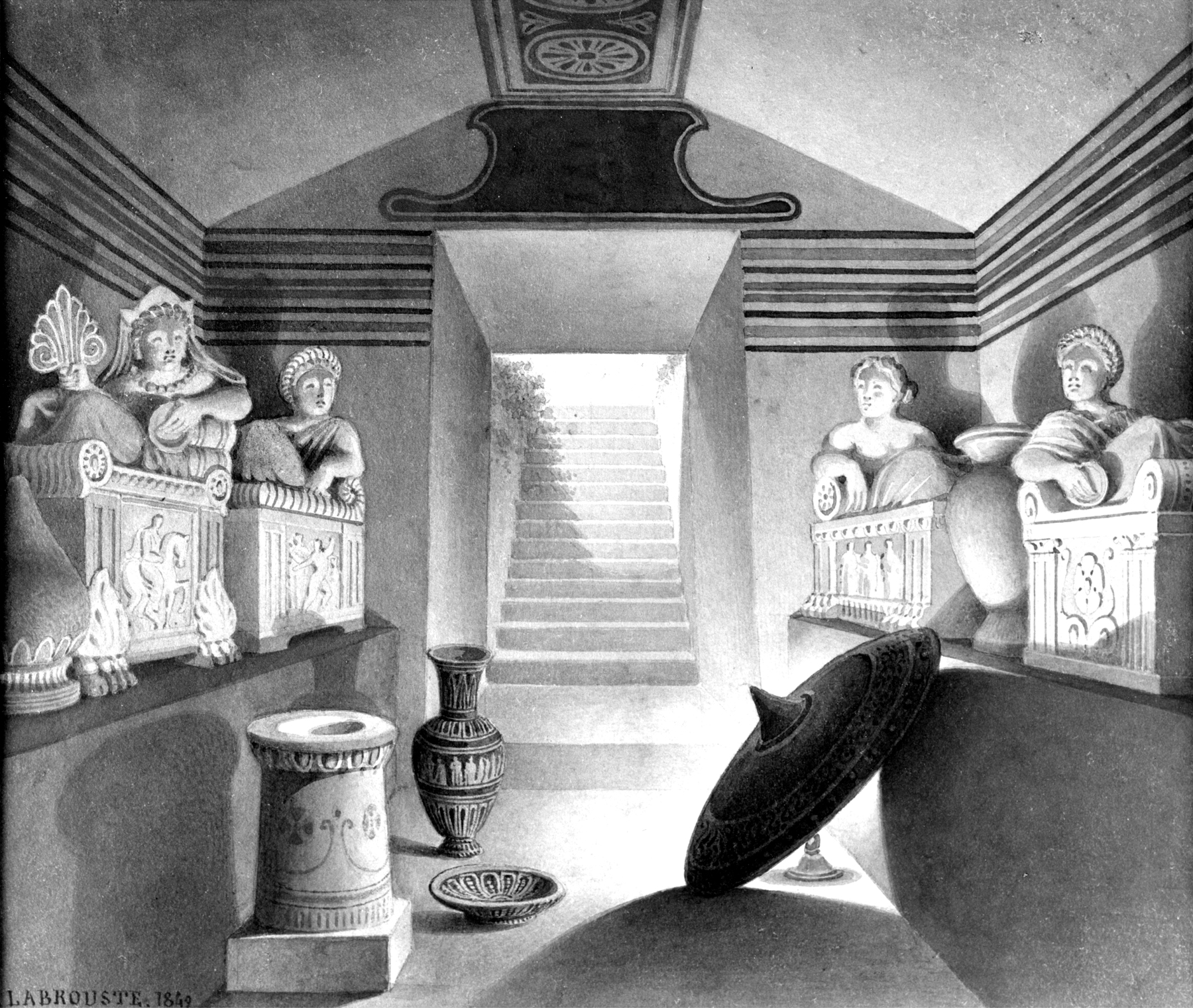
View of an Etruscan Tomb by Henri Labrouste
I am upraised, I am raised above ground, on a bunk, on an old bunk of childhood longing, bedside window staring, the endless bunk of isolated raised up childhood. On my head, a Viking helmet… It’s sheer weight, it’s ridiculous… My arms flail under a body weighed by the lowering ceiling, and a head crowned with a horned and vast slate of crudely nailed metal. 

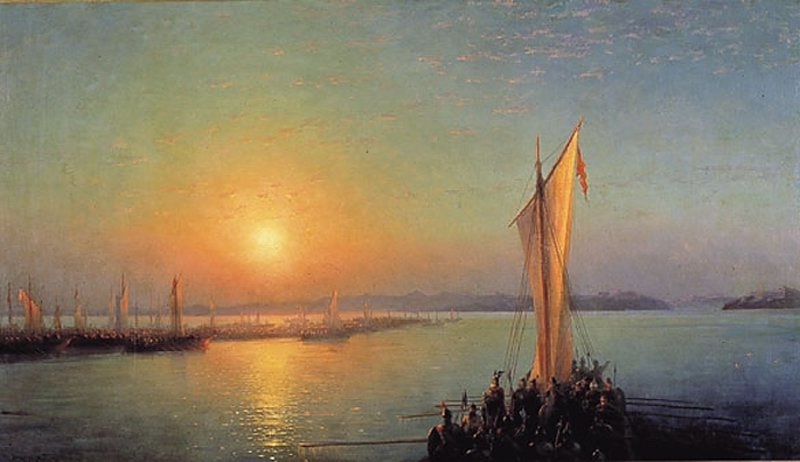
Viking Saga: The path of the Vikings to the Greeks by Айвазовский И.К.
And as I look up, the ceiling, lowering, eyes me back with a staring mushroom, with an elongated stem, a fungal growth, upside-down, to stare at me with its sexual head of strange and auspicious gloom, a vivid flight of the hallucinating noesis, the natural misplaced in a mind-born hell of undone pain, to sleep and writhe, in a landless bed of the upright bunk, swollen helmeted head. 

Winter by Giuseppe Arcimboldo
And at once, I toss the disfiguring crown over the edge! It dings off the edge of a television perched on a dresser, and the reverberation is near-unending, an unnatural sound emits, and sends my unconscious flesh storming at the gate. 
_________
One proud, unseemly yet everlasting hoary wind
Escaping into the breathless fold of a storm-brought love
Escalating above the tumult of grounded trees
Lowered to rest in the silent play of her touch
With Mother Nature in lust at the American shoulder-sculpted God

President of inveterate honor
Failing to maintain true gaze
Into the outpouring blind Persian mystic call

Excerpt from "Untrained Timeless Tuning" [featured on Poydras Review]


Friday, 9 November 2012

The Humours of Sufism in Iranian New Wave Cinema

The prophet Khizr Khan Khwaja by Anonymous
"I know you've been dreaming of me. But don't take it seriously. You know that dawn is when God visits his devotees. And divides the daily bread among them." Spoken by a Sufi Mystic who appears in dream visions in the Iranian film Pari by Dariush Mehrjui

Interestingly, this brilliant film was originally adapted from "Franny and Zooey" by J.D. Salinger without authorization, by iconoclastic and renowned Persian film director, Dariush Mehrjui. The film was adamantly attacked on all sides, by both Salinger's lawyers and Islamic approval. It seems that artists are often at work portraying characters and illustrations of their own internal struggle, where in this film, Pari, a young aspiring theatre actress drowns in pseudo-mystic emotionalism surrounded by a family of intellectuals and artists. Pari (a Persian name meaning "mermaid") finds herself swimming in over her head, a being caught between two worlds, and wishing to unite with her beloved uncle who took his own life. Indeed, the auteur filmmaker, and artists of a higher order conceive the focal point of their internal development, interwoven with an external social conflict, as a kind of dreaming, where it is seen through towards the dawn, beyond both the day of social tension and the night of inner turmoil.

For a great wealth of film reviews on Dariush Mehrjui's extraordinary work visit The Film Sufi
_________

a Fellini-esque mindtrip of character haunts, my feet dragging through superstitious nostalgias and the blind opacity of lost friendships, tragic wants, and open futures.

"Fellini, la Grande Parade" by Jean-Pierre Dalbera
black and white fur, white and black fur, the coloration of his follicles, a childhood escape through naming, and here he is again, in full glory, my dead companion of all things meditative, a leader in the subconscious wave of true surrender to the spiritual laughter of play 

Myojakdo (Painting of Cats and Sparrows) by Byeon Sang-byeok
here he is, I can feel his warmth in that little heart beating patiently between two rib cages of delicate whimsy, and he leads on through the empty darkness, a labyrinth of hollows beckons me forward, through to a sweetening, mental taste
_______
“I saw the trunk,”
Her Hindu elephant from outside
Walks coolly from music’s grand Guest

At the public house,
In the window,
A final flicker before traversing the footboard
loosened with railroad age
           Over the national telephone of spiritual callings
           Abused by electrified tradition
           Stunned in the tingled alcoholic flame
                  In isolated, deserted and abandoned bodies
                          Whose spirits bore a frail passage,
                          engraved in the air of soundless rhyme

A knowing
Ever thoughtless to the strength in pure being,
To grasp coldly into the summer’s beaten plea
           To sustain our musical sharing
           In human heaven’s piercing
                  Through the empty eye holes
                  Peering with my mirrored face of light
                          Radiating, through absolute darkness
                          as a visible cry
                                 To haunt our sacred sanctuary

“That inebriated muse!”
Drinking the words of men into her silent womb,
To fixate her fingers into the cross
           Formed over a chest glorified with Catholic warnings
           To relieve one’s self of the world
           and ask divinity to replace human desire

To become one collective struggling
As a unified presence,
Whose heart remained fixedly sanctified
           Before the death of the Mother and the Father’s bared ghost
                  Pictured as a beacon
                  Blended into our animalistic foresight