Primarily a writing exercise, this dream journal-inspired blog is a quiet introspective sojourn into the process that we traverse in going from private dream to public art. I see our dreaming as an internalized mythmaking. As I philosophize and expressively exhibit dreams, both private and public, I encourage and delight in creative language as a way to practice experiential metaphors through a “public dreaming." Writing Theory: Creative Dream Fiction
Showing posts with label Persian. Show all posts

Tuesday, 24 September 2013

Writing: The Child of Art and Music


"My grandfather Dolmic dreamed that three coffins floated through the door of his brother's house. So, he rode to the next village to investigate, and found his brother, his sister-in-law and their servant girl dead of cholera. The baby, still alive, was sucking at its mother's breast. He built three coffins and arranged the burial, and returned home with the child in his arms. And they say dreams don't come true." Ukrainian Grandmother, Wood Mountain Poems

On May 3 of 2012, Copenhagen welcomed the largest sustainable fashion conference yet seen in the contemporary world. Sustainability and corporate social responsibility are buzzwords in the consumer industry, and are integrated more and more into every sector of the economy. What was once merely one percent of the fashion industry in 2007 – when estimated global sales of the sustainable fashion market were at three billion dollars – would increase exponentially, culminating in the 2012 Copenhagen Fashion Summit with the investment of over one thousand key industry stakeholders. 

One of the largest industries, fashion product lines contribute to the spread of over eight thousand chemicals and twenty five percent of the world’s pesticides into the natural environment. Not only that, most of the environmental impact is made after the consumer has purchased the materials. Yet, sustainable fashion is one growing eco-trend that is challenging the largely unsustainable fashion market by employing alternative textiles with less carbon footprint. 

Organic cotton is effectively transforming one of the most commonly grown crops, and so in doing, is spearheading the eco-fashion movement. Other cellulose materials include hemp and bamboo. Materials, however, are only part of the eco-equation. Renewability and source factor, as does labor conditions. The idea is to create what Rossella Ravagli, Corporate Social and Environmental Responsibility Manager at Gucci, proposed during the 2012 Copenhagen Fashion summit, as a “good compromise between style, quality and new material.”   

Arguably, bamboo fiber is especially capable of meeting the demands of the new eco-fashion market. With an absorptive quality that captures greenhouse gases, bamboo grows in abundance without irrigation or pesticides. As the fastest growing woody plant in the world, bamboo holds a unique place in the fast-paced consumer market. Although, there is controversy regarding bamboo’s claim to fame in the eco-fashion market, as the process required to turn bamboo into wearable fiber, also known as Rayon, is marred with chemical-intensive labor. Yet, relatively speaking, bamboo as a source material for clothing is a more sustainable option than most. 

Yet another alternative textile, hemp, is potentially more eco-friendly than bamboo. Also easily grown, hemp clothing is often a composite of other organic materials. With such diverse uses as building materials, paper, jewelry, and fuel, hemp is largely responsible for complementing the greater trend of sustainable fashion with style. Hemp clothing is often designed with respect to traditional eco-fashion trends, opening interest in ethnic-inspired lines.     

This piece of commercial writing on eco-fashion was originally written for a client in China, and is also published as a blog on The Media Co-op
_____________

dusk fall
full equinox
hell's door
lonely crossroads
still bells
way back
world tree
______________

The week began with the resonant mergence of harmonic mastery still ringing in my ears. A meeting with contemporary legend, Amir Amiri opened my mind to the brilliant challenge of a distant sound's arrival. The shores of my thought curled and folded in a slow tide as I acquired the bittersweet taste of a traditional music's refinement into the beautiful wholeness of world.

The quick hum of the Persian santur danced behind my eyes with the lifted personification of an artist's temptation to unite with the all-breathing life of unity. Yet, nostalgic and principled, remained steadfastly earth-bound to the homely traditions of mother, father, and self. At once, another meeting with the unbound truth stared me in the face through the transfixing metallic song of the HandPan under the voice of LIRON MAN. 

After Man's show, Puertas, at the Calgary International Flamenco Festival, I then met the opening musicians, one of whom, Tamar Llana is featured in the video below. She sings next to her mother, Judith Cohen - an ethnomusicologist with a special focus on Sephardic music - playing the frame drum. The joyous union of ancestry, tradition, and contemporaneity through music led to a revelation of harmony as the voice of continuity, belonging and meaning.


Monday, 2 September 2013

The Art of Nonintervention: Rumi on Syria and Virtual Exhibit


"Last night I had such a wonderful dream. That today, I feel great and satisfied. You said, 'Go, for you are the king!' True and may I be merry and glad! I am drunk without cupbearer and wine! I am King Ghobad without throne and crown!" Rumi, Masnavi

Last night, I performed music for an Afghani community celebration of the legacy of Rumi. It was a clear night. The sun melted over the horizon an incandescent vermillion azure, and a mountain silhouette graced the starlit west. I accompanied  a dear friend, who plays the Persian santur, with 
wind and percussion instruments. The audience was cheerful at hearing our unique musical expression of global community, and our hosts delighted. 

One young woman at the event, born in Canada, proclaimed, "I am from Afghanistan." As the Afghani and Persian language commingled in a unity of mind and understanding, the political discussion turned to musical appreciation. Music is the one common language, they agreed, Persian and Afghani, who speak a common language, are not divided by the bounds of modern nationalism, war and custom, because they share culture, language and music.  

Yet, even in Canada, where a military imperialism curses the blood-stained earth of Afghanistan, the people of that country remain proud and honour the sacred unity of their cultural heritage beyond national boundaries, and into the language of unity, peace and wonder. So, as one proponent of Sufism, Rumi and Peace said in Canada to close the June 6, 2012 podcast on World Democracy Discussion speaking in reference to the Iran-Israel Nuclear Crisis: 
"Rumi was sitting was sitting with his students in his academy and one of his students ran to him and said, 'Rumi, two wise men are fighting, come and do something.' Rumi didn't react. The second student came and said, 'Rumi, two wise men are fighting, they are beating each other, come and do something.' The person soon asked, 'You don't care?' And Rumi answered that if they were wise, they wouldn't fight.'"

URGENT: Citizen Response to Syria
Letter to Alberta Members of Parliament

Dear Alberta Members of Parliament,

I am a citizen of Alberta for over five years. I arrived as a resident of Calgary directly from Cairo, Egypt, where I was a student at the American University of Cairo (2007-2008), and then University of Calgary (2008-2010).

Please recognize my plea to all Members of Parliament not to support military intervention in Syria.

In 2010, I returned to Cairo, Egypt and the Middle East through the Consortium for Peace Studies at the University of Calgary. The Consortium was formed in response to Canada's response to the Iraq War of 2003, which Canada did notparticipate in. What has changed in Canada during these ten years?

It is a well-known fact that the Canada Pension Plan Investment Board (CPPIB) invests in war manufacturing. In effect, the Canadian Federal Government is complicit in war crimes through the investment of such weapons manufacturing as cluster bombs and nuclear arms, in spite of such international agreements as the Global Landmines Treaty and the Nuclear Non-Proliferation Treaty. Due to the fact that our tax and revenue system is inextricably tied to the arms industry, every Canadian is complicit. Why are we furthering our complicity in the deaths of 100,000 and the forced exile of over 2 million Syrians?

Why is the Canadian government demonstrating support for the U.S., who used chemical weapons in Fallujah during the invasion of Iraq, and now purports to protect Syrians and the global community from the very same belligerence?

As Foreign Affairs Minister John Baird says, "we are of one mind" in promoting America's call for an international coalition to intervene in Syria. Prime Minister Stephen Harper warns of the risks involved in not intervening. As a citizen of America and a permanent resident of Canada, I am embarrassed to be from a part of the world that seeks to undermine international order for the sake of economic investment.

Please regard my concern and stand with the British Parliament in denouncing all support for the mounting American military intervention in Syria.

Respectfully,

Matt Hanson


References:

Syria

http://www.ctvnews.ca/canada/is-canada-going-to-war-in-syria-here-s-what-our-military-could-do-1.1431117
http://www.democracynow.org/2013/8/30/headlines#8301
http://www.mediacoop.ca/story/syria-intervention-or-diaspora/16492

CCPIB

http://www.huffingtonpost.ca/amy-macpherson/cpp-war-crimes_b_2487424.html
http://www.cbc.ca/news/business/taxseason/story/2012/12/21/f-rrsp-2013-cpp-portfolio.html
http://www.vivelecanada.ca/article/101709523-cpp-landmine-investments-are-we-breaking-the-global-ban-treaty

General Interest

http://www.mediacoop.ca/story/persian-jews-and-iran-israel-crisis/17264
http://www.ucalgary.ca/md/PARHAD/studentships/student-2010-mhanson.htm

This letter was also posted on The Media Co-op

TAKE ACTION AND CONTACT OFFICES OF YOUR LOCAL GOVERNMENT
 & MORE IMPORTANTLY,
CONTACT OFFICES OF YOUR LOCAL GOVERNMENT AND TAKE ACTION 

EndNote: 

Alberta is not only the economic engine of Canada, it provides the lifeblood of economic energy for much of the world. Globally, Alberta's oil industry is the third largest in the world, behind Saudi Arabia and Venezuela. The U.S. is the largest consumer of Alberta oil. When war is at our doorstep, it is economic investment in energy resources that prop up the debate in the minds of politicians who influence the direction of billions of dollars on a daily basis. Whether from the U.S. or Canada, or elsewhere around the world, we need to remind the Alberta government that their actions, whether to wage war on the Earth (industry) or its people (war), are wrong and obsolete, and must be diverted in providing the means to renewability in energy resources and sustainability in human resources.
____________
northern nights
pastel horizon
Persian-Afghan Rumi
rooted wings
watery spectrums
______________

Education is the lifeblood of our culture. Contemporary miseducation conjures cultural remnants still felt, yet which are now practically nonexistent. As the government slashes the limb of theatre and jazz from the roots of culture - our education - it is the artists, and more accurately, artists' collaborations, that resurrect obsolete forms of creativity. Our art reshapes and polishes the dusty, antique lenses through which other forms of learning, knowledge and truth are remembered and reinvigorated.

This virtual exhibit is interactive, kinetic, visual, aural, and potentially recycles the space and redefines it through an exploration into its space as connected with viewers/participants. The conduit of such activity is the exhibit.

There are three essential aspects to the virtual exhibit before you.

Firstly, the original digital artwork, Mountain Reflection on Cyclical Wordplay is displayed. Below, a listening station plays the album, Compilation Vi An under Mountain Reflection on Cyclical Wordplay.


After listening in and seeing, become the seer of music by using a calligraphy brush and red ink (or creative equivalent) on blank space. Find blank space around you, the unused, neglected, under-appreciated, unassuming areas straddling the bars of existence and nonexistence. Such a space could bet the utilization of your present surroundings, depending on the configurations. However, at the very least, do not draw a blank.  As a participant/viewer, engage with the calligraphy brush and red ink, the acoustic harmonies and naturalistic/vintage aesthetic of the artwork meld to produce an inner ambiance of memory, culture, history, tradition and nature.

Secondly, the original digital artwork, Present Sound, Silent Space is displayed. Through another listening station and a black pen (or creative equivalent) are to be employed. Below, the listening station plays the album, Endangered under Present Sound, Silent Space. As a participant/viewer, engage with the black pen (or creative equivalent).


The melodious electronica beats merge with the technological fragmentation represented in the artwork, instilling a cold, metallic atmosphere of aspiration, impermanence, destruction, chaos defined by 90 degree angles. Virtual attendants to the exhibit are welcome to draw and write on the empty space while listening through the station(s) and using the appropriate material(s) made available.

The visual artworks within the recorded music re-contextualized in this virtual space represent the creativity of local, independent artists as reintroduced a lost branch of independent self-education. The implications draw from a wealth of meaning in relation to institutionalizing (and budget-cutting) culture and education as the final straw in forgetting our even more archaized, unconventional cultural and educational backgrounds.

Monday, 27 May 2013

Persian Jewry and the Art of Peace: A Sound Vision of Coexistence


Why think thus O men of piety
I have returned to sobriety
I am neither a Moslem nor a Hindu
I am not Christian, Zoroastrian, nor Jew

I am neither of the West nor the East
Not of the ocean, nor an earthly beast
I am neither a natural wonder
Nor from the stars yonder
...
My place is the no-place
My image is without face
Neither of body nor the soul
I am of the Divine Whole.

I eliminated duality with joyous laughter
Saw the unity of here and the hereafter
Unity is what I sing, unity is what I speak
Unity is what I know, unity is what I seek
...
Beloved Master, Shams-e Tabrizi
In this world with Love I’m so drunk
The path of Love isn’t easy
I am shipwrecked and must be sunk.

Rumi, translated by Shahriar Shahriari

Judeo-Persian Literature: HERE and HERE and HERE
__________
CALGARY - This year, the Persian New Year (Nowruz) on March 20, marked another day of global significance: the ten-year anniversary since the American invasion of Iraq. The hotbed issue, still on the map, is WMD (Weapons of Mass Destruction), the bane of nuclear energy. The decade of remembrance also reflects European Union sanctions imposed on the Iranian economy. While Iran is a signatory of the Non-Proliferation Treaty (NPT), which implies non-proliferation, disarmament and the right to peacefully use nuclear technology, the potential use of nuclear weapons by the Iranian government is crux of the diplomatic standstill.

In a visiting lecture to the University of Calgary, Dr. Alan Dowty, Professor Emeritus and expert on Israeli politics from the University of Notre Dame, pointed out that Iran-Israel nuclear aggression in the Middle East has the potential to end the Non-Proliferation Treaty. “Canada has foregone the right to use nuclear weapons, so they have an interest in non-proliferation. Israel would join [the NPT] if the Arab-Israel conflict were resolved.” Dr. Dowty told The Media Co-op. “There is actually no way to conduct polls in Iran, so there is no recent social science research and no way to know what percentage of support base the Iranian government has.” In today’s world of globalized democracy and worldwide communications, public support, or lack thereof, is among the most consequential paths toward conflict resolution, and therefore, the greatest threat to government hegemony.

In 2006, 67% of Israelis believed in an attack from Iran was certain. In 2009, the poll fluctuated dramatically, where 79% did not think Iran would attack Israel. A poll published in the leading Israeli newspaper Haaretz confirmed that now only 27% of Jewish Israelis support an attack on Iranian nuclear facilities. “In 2009 the poll shifted dramatically but the polls themselves are hardly reliable for consistency. A different wording in the question could change answers by 20%. At the time, in the top positions of military defense represented in the Israeli government, the opinion was that an attack on Iran is implausible,” Dr. Dowty said in an interview with The Media Co-op after his recent March 18 lecture at UofC.

Diplomatic negotiations taper out as talks enter into a “full fuel cycle” right to enrich uranium. The line between nuclear facilities for energy purposes and military purposes is based on a thin margin of uranium enrichment. The Iranian government has converted 40% of the uranium enriched to the 20% level (the most threatening part of the existing stockpile) to an oxide for medical use, limiting their weapon capacity. “They blinked, they are aware they're being watched closely,” Dr. Dowty closed his lecture. “Are they serious? We'll know in the next few weeks. We'll see though, I said this last year.”

Originally published by Al-Monitor, Jerusalem Post seconds the investigation on Iran’s diverted nuclear energy resources. The article closes remarking, “With inflation and unemployment soaring and the value of the Iranian currency halved since a year ago, the vast majority of Iranians have tightened their belts to celebrate Iran's new year - or Nowruz, the nation's most important holiday.”

The Jewish Holocaust underlies much of the political negotiations on the topic of nuclear war between Israel and Iran. The Holocaust is part of Israeli policy. Netanyahu once compared the Allied failure to bomb the train lines to Auschwitz in WWII to the current standstill with Iran. Israeli politicians often compare Ahmedinjad to Hitler, an infamous Holocaust-denier. “The truth is that a nuclear-armed Iran is an existential threat of the State of Israel,” Israeli Prime Minister Netanyahu said during his 2012 Holocaust Remembrance Day speech on April 18.

Last month, Canadian Minister of Foreign Affairs John Baird made his way through an unprecedented tour into the countries to speak with political allies regarding “extremists” and “radicals” in the Middle East, specifically Jordan, which is receiving nearly half a million refugees from Syria, Iran’s ally in the Middle East. “I’m fascinated by the Arab world,” Baird is quoted in The Globe and Mail, before boarding a plane to become the first Canadian foreign minister to visit Iraq in 37 years. Yet, in Canada, the Iranian community continues to pursue a pluralistic vision of the Middle East and its emigrants both in the public and private sphere.

Recent Canadian immigrant and former history professor and senior researcher at the University of Tehran, Calgary resident Manijeh Rabieie shared with The Media Co-opabout her work. “Beginning from 2000-2003, I began to conduct research in Jewish communities, looking into their civil centers, their synagogues, their schools. I have prepared 70 articles and a book on the Jews in Iran. The government in Iran denied publication of all my work related to Jews.” The story of the Jews in Iran reflects a widely misinterpreted theme in Middle East affairs regarding religious identity, ethnicity and political rhetoric. “Jews and Christians are traditionally protected in Islamic law. Though the Jewish community has to lay low,” Dr. Alan Dowty confirmed with The Media Co-op. Dr. Dowty had once tried to attain a visa to Iran to conduct social science research as a visiting scholar. He was barred due to his extended residence in Israel.

“The Jewish community in Iran has lived in Iran for over 2500 years. Judaism is at the root of ancient culture and religion in Iranian history. Every culture in Iranian history was influenced by Jewish history. In a sense, we are all Jews,” Manijeh Rabieie told The Media Co-op. “Their schools and hospitals are segregated. Under the current Muslim government they are subject to many forms of abuse. Although there is currently a Jewish MP in Iran, the Jewish community can not take part in politics.” The presence of Jews in Iran precedes Muslim and Arab culture. Political rhetoric naming the Israel-Iran crisis as a religious conflict undermines the underlying social fabric of the Middle East.

Manijeh Rabieie plans to publish a paper to educate the public regarding the historic relationship between Persians and Jews as one people, and how this is related to peace. Rabieie said to The Media Co-op, “The conflict in Iran between the Jewish community and the government is not based on foreign policy with Israel, it's an internal problem within the society based on living under the oppressive government. The government sees all Jews as Zionists. This is not true. Iranian Jews are as Iranian as anyone else in the country, it is their culture, it's there home, that's why they remain.”

A deeper understanding of the Iranian society as a whole reveals more about the current Western paradigm and how the West views Iranians and Muslims of the Middle East, than it does about Iran itself. Recent winner of the Shaughnessy Cohen Prize for Political Writing, Calgary-based author and journalist Marcello Di Cintio spoke withThe Media Co-op on Iran, Nowruz and how the West continues to demonize Muslim culture. “Rhetoric on Iran has gone way up around the world. The nuclear program and Israel's fear promotes scary talk not backed up by facts,” Marcello Di Cintio said. “I think when we shut down embassies in Iran, it's more to do with standing in solidarity with Israel position. My biggest problem is this a symbolic action. ‘Now you can't get a visa to visit your family?’ That's ridiculous. Closing the embassy, is that our way of bringing down the regime? It's a symbolic action that has consequences on people that have done nothing wrong, that's what bothers me. I don't think people understand Iranians in Iran.”

Last month, Marcello Di Cintio wrote a short post on his website, Elsewhere, regarding his reflection with a local book club after revisiting his 2006 book, Poets and Pahelvans: A Journey into the Heart of Iran for Nowruz. Much of the content echoed what Marcello Di Cintio remarked for The Media Co-op. “There's a vast canyon between government policy and actual life. When we make decisions what does that actually mean for people who do not live in suits?” said Di Cintio. “Sanctions are not going to change things. To me, those are symbolic. You think the West hates Ahmedinijad? Iranians hate him more. It's the job of the journalists to report on government policy, and to report what the politicians are saying. They don't have time on the ground. I'm attempting to fill the void.” The Persian New Year, Nowruz, the biggest holiday in Iran, is still a non-Islamic celebration. Nowruz predates Islam.

"It’s a public holiday in parts of the Middle East, Central Asia and Europe. Thanks to global migration it’s now celebrated worldwide…It’s a non-denominational holiday…It predates modern politics, modern states and the squabbling that comes with them. This is a secular holiday…You might hear a lot about Iran in the next twelve months, its leaders, its politics, its policies, its threats, how the world reacts to them. Hey you may watch a popular film like Argo and decide that all Persians are barbaric and archaic and evil enemies of the West. Well, if you really want to get to know the culture of Iran, Persian culture that is, the literature, the family values, the poetry, the positivity, the progressive sides, and the romance, then get to know Nowruz…Here’s hoping for a peaceful and positive period for all.” Jian Ghomeshi broadcasted on CBC on March 20.
As Persian New Year also celebrates the vernal equinox, coincidentally the Jewish spring holiday of Purim commemorates the story of Esther, a Jewish woman who married King Ahasuerus of Persia. Canadian politics, throughout most of the 20th century, reveals a history as anomalous from the present as a Jewish marriage to the Persian head of state is to the world of today.

In 2003, more people took to the streets in Calgary to protest the American invasion of Iraq than any public demonstration since World War Two. A fully community-funded organization at the University of Calgary known as the Consortium for Peace Studies was founded based on popular opposition to the war in Iraq. “If the Iranian people want to change the Iranian government or their situation, that's their prerogative, but if they want to change it simply because foreign powers are making their life miserable, then I don't think that's legitimate. That's just war by another means,” said George Melnyk, director of the Consortium for Peace Studies to The Media Co-op. “I would like to see Canada develop a balance where we have more neutrality, where we're not always looking at military solutions, not always taking a strong stand to support the Untied States or Britain in whatever kind of military actions they want to take. I'd like us to have another aspect to our lives which has been completely lost.”

Professor Melnyk recently published a paper entitled, Canada and Afghanistan - Peacemaking as Counterinsurgency Warfare, a Conflict in Terms. In this paper, Professor Melnyk outlines the paradoxical rhetoric of militarism together with propaganda related to national self-image in Canada. "Because Canada refused to participate in that war [in Iraq], it has been argued that it felt compelled to offer its services in Afghanistan," writes Melnyk. As Canada adopts new policies that effectively change the image of the country, the political leadership in the West (of both the world and of Canada) overrides traditional democracy. “The Canadian government, by being involved militarily in Afghanistan, of which I am critical, see Iran as the enemy. That's what happens in war, you define an enemy,” Melnyk told The Media Co-op.

Canadians are faced with new decisions and choices as government becomes increasingly self-serving and exclusive in both its military partisanship abroad and political representation domestically. “What we have is a Federal Government based in Calgary, and very powerful in Alberta. And it is pro-military, and anti-environmental. These guys are now reflecting more of the West, between Saskatchewan, B.C. and Alberta are totally energy related,” said Melnyk to The Media Co-op. “The more anti-environmental it is, the more pro-military it becomes, they are part of the same package.”

The Consortium for Peace Studies awarded the 2013 Dr. Arthur Clark Research Fellowship in Global Citizenship to sustainable housing expert Jorg Ostrowski, for a project that focuses on development in Iran called A New Silk Road of Peace. “We have a completely different approach than the Harper government. Our approach is not to get involved in this debate, this political debate between Israel and Iran. Our position is to support those people who are building people-to-people relationships,” Professor Melnyk told The Media Co-op.

Recognition for the great wealth of intercultural heritage is an increasingly important area for growth and discussion as civil society moves forward in organizational solidarity. “It is so critical to counter western threats of war with Iran. Together, as a human family with a team of visionary professionals, we can build unity and demonstrate collaboration, explore other lands and respect their traditions, seek education and understand other perspectives, work for common security and build a lasting peace, for all species and our common environment and world heritage,” Ostrowski shared with The Media Co-op via email.

Still, with all of the activism in Canada to facilitate social stability in Iran, for democratic diplomacy in the Middle East, and lasting peace, there are countless who continue to suffer unjustly in Iran. As residents of Canada, active in working towards greater democracy and justice, the focus remains ever on the plight of innocent civilians. While the Canadian government works towards the proposed resolution of the greater evil, i.e. nuclear conflict, the gap between civil society and government widens due to the growing pertinence of foreign policy. It is becoming more and more clear to Canadian residents that with every government measure to protect Canada and other Western nations, including Israel, from a nuclear conflict, the costs of war by another means begin to show its ugly face.


"Persian Jews and the Iran-Israel Crisis: Canadian Civil Society Works Toward A New Year of Peace and Understanding" previously appeared on The Media Co-op
___________
ruins of ruins by RK
the entrance is the exit by RK
dan tien sky by RK
old world taste by RK
belly of the ultra modern beast by RK
_____________
"turning over the ashes of the Unnamed" is a piece commemorating the Indigenous struggles of Latin America. Initially, the writing process is based on experiences in Yucatec Maya communities. Recently,  the sounding was recorded while following the tragic cycle of intermittent, and ultimately, futile justice in Guatemala to reconcile its genocidal history. The track is featured on the Sound-Art EP "Evocations: Exotic Settlers"

In nearly every traveller's experience, the settlements of (un)civilization often provide an impermanent, temporal space even for the most autonomous of vagabonds. Especially in my experience, the piano has been a portal through which my sojourning meets the firm legs of tradition. In this union, both the ephemeral and everlasting are bonded under a greater mystery of the always passing, transient truth, elevating us to a higher sense of travel as mutually relative to the foundational ground of human tradition. Memory and history seed the pangs of movement with the brilliant emanations of creative ingenuity and inspired reflection.

So, in this track, imagine the traveller, or "exotic settler" chancing upon a piano under the weary heel of an empty horizon ahead, and the spiralling beauty of tradition below. "turning over the ashes of the Unnamed" is featured in the new self-published chapbook, "The Deceived Plane"


"The Deceived Plane" is a six poem chapbook on themes of social failure, the unsustainable psyche of Western Man, devolving at an insuperable pace through the mire of good intentions.

Beginning with personal irreconcilable defeatism in the breakdown of the Western family, towards a psyche of madness and the unwilling expansion of selfish ego into greater realities of the imagination, spirit and creativity.

Yet, each of the six poems reveals and awakes the deleterious mind of foul vanity with a brushstroke of unitive spirituality. The wake of greed pulls back in a tidal rush of release, and so these poems offer the ingredients of a raft on which to traverse the open oceanic beyond.


Friday, 9 November 2012

The Humours of Sufism in Iranian New Wave Cinema

The prophet Khizr Khan Khwaja by Anonymous
"I know you've been dreaming of me. But don't take it seriously. You know that dawn is when God visits his devotees. And divides the daily bread among them." Spoken by a Sufi Mystic who appears in dream visions in the Iranian film Pari by Dariush Mehrjui

Interestingly, this brilliant film was originally adapted from "Franny and Zooey" by J.D. Salinger without authorization, by iconoclastic and renowned Persian film director, Dariush Mehrjui. The film was adamantly attacked on all sides, by both Salinger's lawyers and Islamic approval. It seems that artists are often at work portraying characters and illustrations of their own internal struggle, where in this film, Pari, a young aspiring theatre actress drowns in pseudo-mystic emotionalism surrounded by a family of intellectuals and artists. Pari (a Persian name meaning "mermaid") finds herself swimming in over her head, a being caught between two worlds, and wishing to unite with her beloved uncle who took his own life. Indeed, the auteur filmmaker, and artists of a higher order conceive the focal point of their internal development, interwoven with an external social conflict, as a kind of dreaming, where it is seen through towards the dawn, beyond both the day of social tension and the night of inner turmoil.

For a great wealth of film reviews on Dariush Mehrjui's extraordinary work visit The Film Sufi
_________

a Fellini-esque mindtrip of character haunts, my feet dragging through superstitious nostalgias and the blind opacity of lost friendships, tragic wants, and open futures.

"Fellini, la Grande Parade" by Jean-Pierre Dalbera
black and white fur, white and black fur, the coloration of his follicles, a childhood escape through naming, and here he is again, in full glory, my dead companion of all things meditative, a leader in the subconscious wave of true surrender to the spiritual laughter of play 

Myojakdo (Painting of Cats and Sparrows) by Byeon Sang-byeok
here he is, I can feel his warmth in that little heart beating patiently between two rib cages of delicate whimsy, and he leads on through the empty darkness, a labyrinth of hollows beckons me forward, through to a sweetening, mental taste
_______
“I saw the trunk,”
Her Hindu elephant from outside
Walks coolly from music’s grand Guest

At the public house,
In the window,
A final flicker before traversing the footboard
loosened with railroad age
           Over the national telephone of spiritual callings
           Abused by electrified tradition
           Stunned in the tingled alcoholic flame
                  In isolated, deserted and abandoned bodies
                          Whose spirits bore a frail passage,
                          engraved in the air of soundless rhyme

A knowing
Ever thoughtless to the strength in pure being,
To grasp coldly into the summer’s beaten plea
           To sustain our musical sharing
           In human heaven’s piercing
                  Through the empty eye holes
                  Peering with my mirrored face of light
                          Radiating, through absolute darkness
                          as a visible cry
                                 To haunt our sacred sanctuary

“That inebriated muse!”
Drinking the words of men into her silent womb,
To fixate her fingers into the cross
           Formed over a chest glorified with Catholic warnings
           To relieve one’s self of the world
           and ask divinity to replace human desire

To become one collective struggling
As a unified presence,
Whose heart remained fixedly sanctified
           Before the death of the Mother and the Father’s bared ghost
                  Pictured as a beacon
                  Blended into our animalistic foresight


Monday, 24 September 2012

Persian Mysteries and the Immortality Rites of Zoroaster

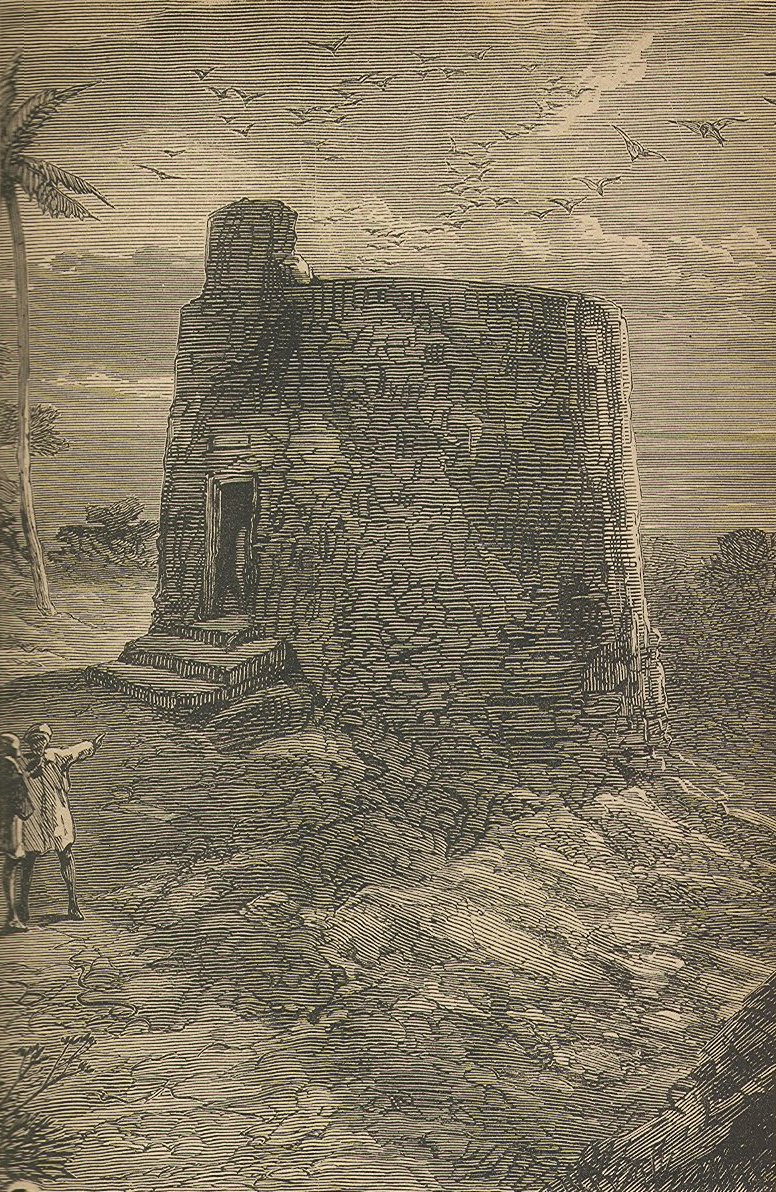
Tower of Silence (Dakhma), Mumbai by Cornelius Brown
“…never age and never die, never decay and never rot, ever living and increasing, being master of its own wish: when the dead will rise, life and immortality come, and the world be restored to its wish.” 

Yasht 19.2.11. James Darmesteter, The Zend-Avesta, Part II, The Sirozahs,Yashts and Nyayis; Sacred Books of the East, Vol. XXIII (Oxford, 1883), p.290
__________

It is 12th century Persia, the continental-temporal mirror image of 21st century Canada. After a lesson on the estate, I a youth of educable age, begin to row across a placid lake with my father. The day is warm, with cool breezes flushing our skin in a mixed haze of natural praise and remorse for the end days of summering. My father, a muscular, bearded intimidation of manhood, speaks with the grazing lurch of intense commanding. As we row, in separate crafts, the waters turn rapid. In that moment, he begins testing me on my learned material. 


The oral literature of the day is mind-bending and terse in its memorable strings of morality, geography and spirituality. I’m able to recall various characters and events, and as I extrapolate, the waters toss and turn unexpectedly. At my wavering voice, my father’s eyes brim with the frosted fire of dark Persian mirth. Yet, as soon as I veer into future’s allusions, spouting the literary names and waves of later centuries unheard, a fire burns in his eyes of serious intent to quiet my youth’s wandering. As he reaches out to grab me into his craft and row back ashore to the consistent presence of historic symmetry, we are both swallowed by the apparition of a waterfall along the other shore, pouring us downward with the turbulent waters in a vein of undone chronology and placeless imagination. 

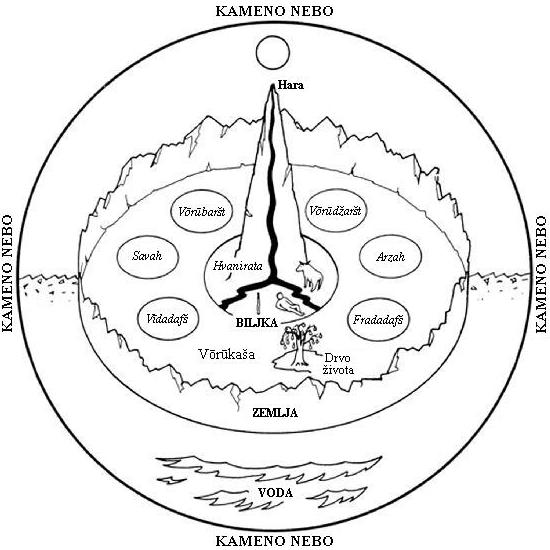
World According to Avesta by Orijentolog
I call out the names of literary history upwards along the upended future. Until the 21st century’s own dawning, my mind, feckless among the archaic forms of Iranianization, is unceasing in its deliberations on the foreshadowed youth of humanity. I turn and writhe with ancestral might into the sheer unknowable mists. My father has since disappeared, and in that silence I begin to know my name.  
_________
Driving out demons with Masonic symbology
         Over the infinite sands of civilization,
         breathed and created out of time
In the sun’s ravishing corner of a universe,
         un-tempted and forever at a loss
                Between the child’s two eyes
                closing
On death and the holocaust of our forsaken government
         Laughing at the trees’ roots


When stretched to the bottom of India’s or Africa’s wells
         Ousting up the belief in life as a drunken tragedy
                              Yet, be not humourless
                              nor without comic sophistry


In the dance and song
         Come alive by the sexual majesty
                              In theatre’s delicate ways,


To present the creative being
as one with truth’s bold and upheld music
         Reflecting back in the caged mirror
                              A creator anew

- excerpt from "From Behaved Freedom to Absolute Nonsense"