Primarily a writing exercise, this dream journal-inspired blog is a quiet introspective sojourn into the process that we traverse in going from private dream to public art. I see our dreaming as an internalized mythmaking. As I philosophize and expressively exhibit dreams, both private and public, I encourage and delight in creative language as a way to practice experiential metaphors through a “public dreaming." Writing Theory: Creative Dream Fiction
Showing posts with label poet. Show all posts

Tuesday, 24 December 2013

Anaïs Nin and the Secret Self: From Blindness to the Mountaintop


Henry Miller

In the last few years one sees quite a few either writings about you or quotations from you about dreams and the dream life and I feel that they haven't really understood what you mean about this. I don't think you want people to be living in a dream state while conscious, do you?

Anaïs Nin

No.

HM

But you mean that dream has its uses, its effectiveness in life afterwards.

AN

No, I meant something else, I meant that what we could arrive at a state where what we dream at night would be the blueprint for what we wish to fulfill, or to reach, and if we understand the dream then we know what the secret self is and then this secret self we can fulfill.


Anaïs Nin, whose literary renown is most prolifically exampled in her posthumously published diary writing, is also respected and admired for her role in encouraging and stimulating the work of Henry Miller. Her opening preface to the Tropic of Cancer, Miller's first book, is one of the most incisively written dedications to the literary spirit that I have ever read. Her quotations on dream, are poignant in their truth and magical in their realism, vibrant in their imagination and open in their accessibility. 

Similarly as with Carl Jung, both Nin and Miller drew liberally from interpretations between Western psychoanalysis and the traditional religious learning, thought and practice of Hindu, Buddhist and Taoist cultures. As highly creative minds, who lived richly balanced in heart and mind, stood for a conscientious human being, who through developing thorough self-awareness comes naturally to be a part of compassionate change in the creative universe. 

“Dreams pass into the reality of action. From the actions stems the dream again; and this interdependence produces the highest form of living,” said Nin, in a comment that affirms the dream psychology of Jung, who considered the dream life, or the life of the imagination, of the mind and of creativity as more real, meaning a more direct form, or manifestation, of experience, than the life lived through the senses. Thus, Nin determines, “Dreams are necessary to life.” 

Indeed, Nin would press ever on into conceiving the dream life as integral to meaning, to holism and self-truth. She asserts, “Our life is composed greatly from dreams, from the unconscious, and they must be brought into connection with action. They must be woven together.” Further, one might add that when woven together, the dreamer, as artist-visionary-thinker-writer, becomes the seer, as in the mystic of unmediated experience, of eternal unity in the present, of enlightenment in non-being. 

Eventually, dreams are life, as life is certainly made of dream, and that we are the substance of dream, as the subtle nature of perception, meaning, truth and self-knowing. In reaching the transformation of necessity to becoming, in the paradigm shift of dream action fulfilled in daily living, is for Nin, a miraculous occurrence, likened to the rare and precious goal of enlightenment. She reminds, “The dream was always running ahead of me. To catch up, to live for a moment in unison with it, that was the miracle.”
_________
Night in the forest, like soot and anger, under a flattening sky. I fell from Paradise into History in the moment of a sting, the lunging insect-antennae, electric, lunged into my paranoid flesh. Hooked under the stark and opaque canopy, obscuring starlight into the bitter and directionless flood of need, anxiety and hope. I sprang from the petrified mud to the swaying vegetable maw of a blind quake, a wild charge.

Georges Lacombe, La forêt au sol rouge
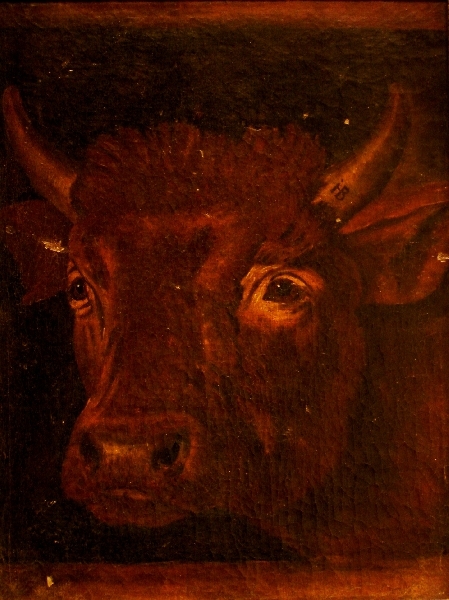
Extinction moved in the sad, ghastly wave of moonlight over frostbitten leaves. Bone-white spears upended my eyes, as I dodged a full-grown bull. Adrenaline-shocked, I sped, scanning the immobile trunks, weighing the Earth down with inhuman strength. And the soil broke in a jarring flash of bestial rage, as another bull, of sturdy, muscular build, spun me around, my heart waning of life.

Bull's head, painting by Johann Heinrich Baumann
I tore through the endless nothing. Then, one bull split my body from the waist up the gut. Marching on my hands, stomping and cracking bone with its merciless strength, adrenaline rushed and spilled out into the open air as I climbed back to my feet, nearly wasted by the crushing jeer. Countless bulls encircled, as I fled, bleeding, the pain yet to reach my brain, grabbing for low-hanging anything, my stomach burning, my feet turning to knee-splitting daggers and brain-flushing mush.

Animals in a Landscape (aka Painting with Bulls) by Franz Marc
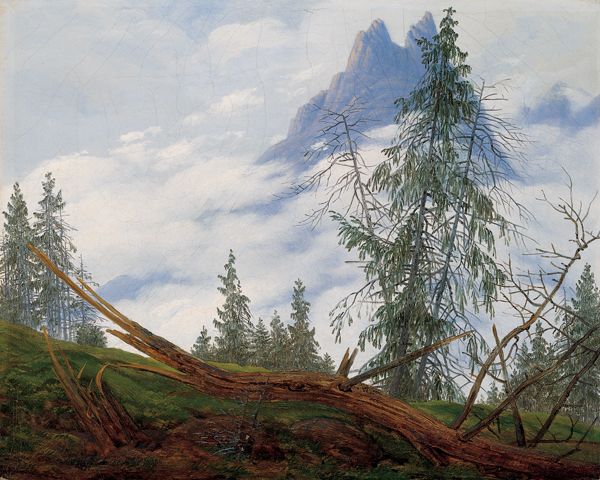
Pit against an escalating fever and white with near-mortalizing blood loss, I fainted under the powerless impression of my death, only steps from the forest edge, still besieged under the sightless underground forest of the human Earth. A single house stood at the edge of a rock face, and I was carried to its door. From a window fogged with subzero condensation, I could make out the moonlit peak, and with every second that my mind ascended, my body shrank with fear, and I gasped for each breath as my last.

Mountain Peak with Drifting Clouds by Caspar David Friedrich
Staring at the summit, and then was enshrouded by cloud-cover, my eyes closed, I stole beyond the body, and time, beyond death and need, beyond blood and truth, beyond the waves of human flesh that rode on this belligerent tidal sway of hope and tragedy, to summit the Everest flight of dream, and survive through this tyrannical flood of mortal reality.
__________

Monday, 19 November 2012

Dream, or Intoxication: Nietzsche and the Tradition of the Master Singers

The Ravens (For a poem of Nietzsche) by Margaret Hofheinz-Doring
"...dream and of intoxication, physiological phenomena between which we can observe an opposition corresponding to the one between the Apollonian and the Dionysian. According to the idea of Lucretius, the marvellous divine shapes first stepped out before the mind of man in a dream.* It was in a dream that the great artist saw the delightful anatomy of superhuman existence, and the Greek poet, questioned about the secrets of poetic creativity, would have also recalled his dreams and given an explanation similar to the one Hans Sachs provides in Die Meistersinger.*

My friend, that is precisely the poet’s work—
To figure out his dreams, mark them down.
Believe me, the truest illusion of mankind
Is revealed to him in dreams:
All poetic art and poeticizing
Is nothing but interpreting true dreams.

The beautiful appearance of the world of dreams, in whose creation each man is a complete artist, is the precondition of all plastic art, and also, in fact, as we shall see, an important part of poetry."

Nietzsche, Birth of Tragedy (e-text)

One night I had been tirelessly searching for this very stanza by Hans Sachs, however I'm unable to read German so my stalwart online efforts proved futile. After glossing over Nietzsche's "Birth of Tragedy" a few times within the body of other texts on mythology, psychology, dream and poetry, I have now found a predecessor to Nietzsche, Hans Sachs, embedded in his monumental philosophical work. This is one of my favourite tracts of literature, and yet I've still to read it in its entirety. I continue to draw from this work the kind of lucid understanding of our inner being as it has moved and developed since the first pages of history unto time immemorial. Such an exhibition of prime thought beckons one's mind, as a lure into the opaque night of isolation and longing, yet when nostalgia dissipates the true character of one alone breathes the kind of truth that is our universal whole, a cosmic constancy of holism, triumphant in its lasting mystery. 
_________
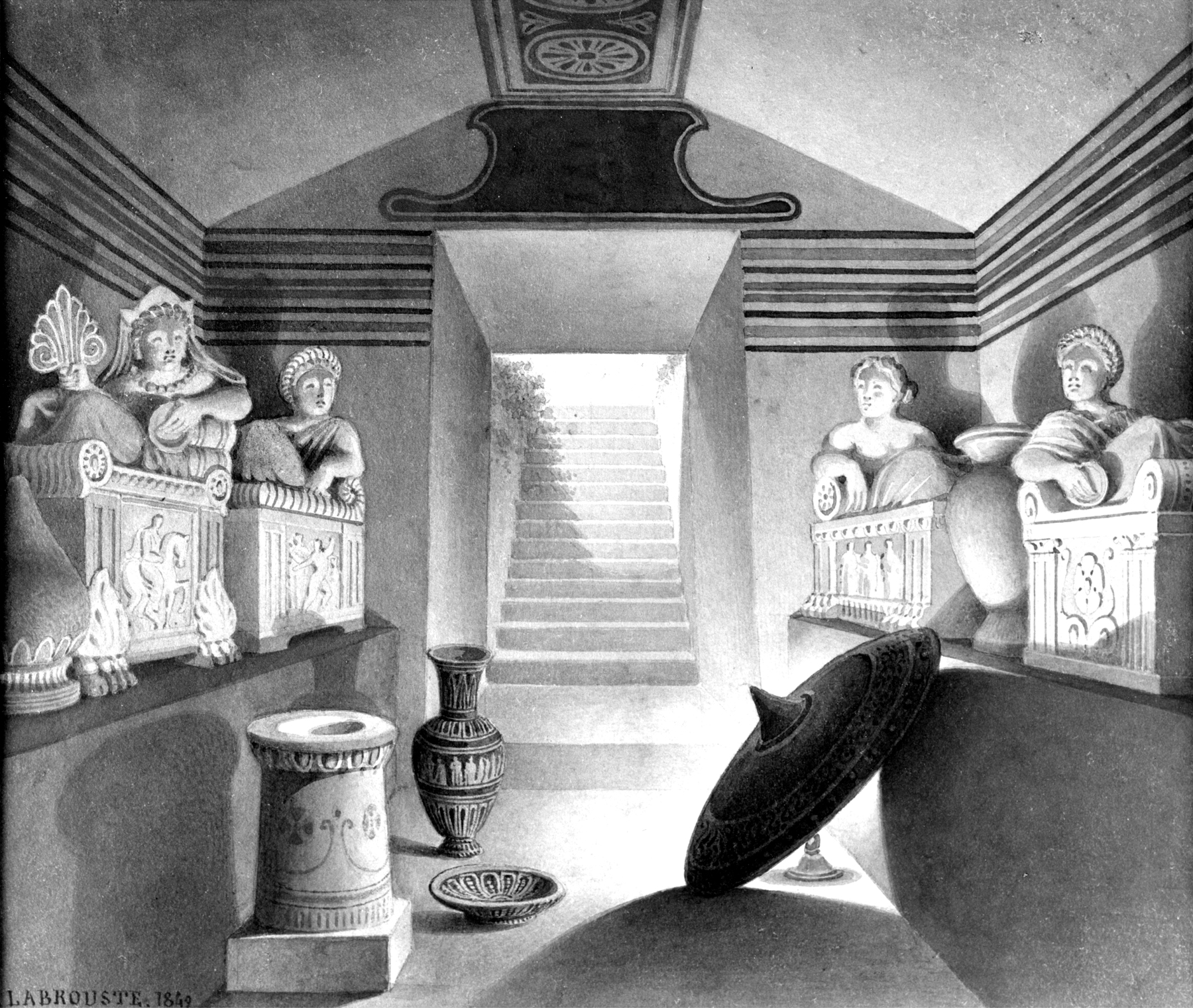
The air, invisibly opaque, opaque in its emptiness, invisible in its bodiless humor, I gaze through the sheathed firmament, a room, a body, jacketed in the empty dark. Forcing my eyes to move, I see a slight pitch in the cruel nothingness, a fleck of something in a bruised vacuum of light. Where am I? 

View of an Etruscan Tomb by Henri Labrouste
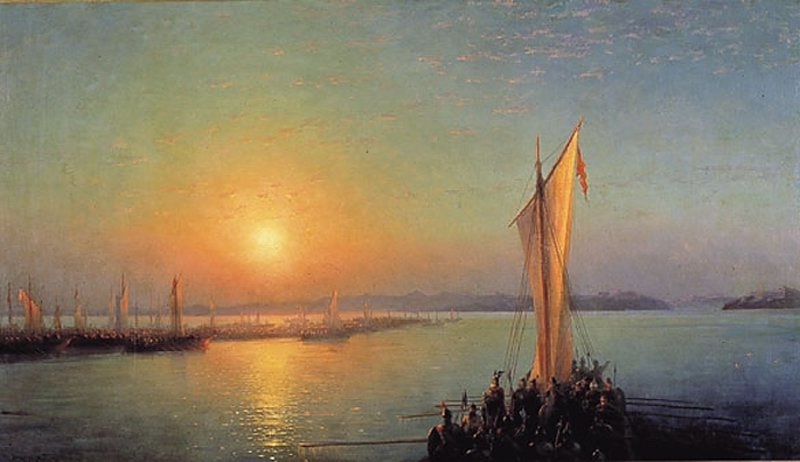
I am upraised, I am raised above ground, on a bunk, on an old bunk of childhood longing, bedside window staring, the endless bunk of isolated raised up childhood. On my head, a Viking helmet… It’s sheer weight, it’s ridiculous… My arms flail under a body weighed by the lowering ceiling, and a head crowned with a horned and vast slate of crudely nailed metal. 

Viking Saga: The path of the Vikings to the Greeks by Айвазовский И.К.
And as I look up, the ceiling, lowering, eyes me back with a staring mushroom, with an elongated stem, a fungal growth, upside-down, to stare at me with its sexual head of strange and auspicious gloom, a vivid flight of the hallucinating noesis, the natural misplaced in a mind-born hell of undone pain, to sleep and writhe, in a landless bed of the upright bunk, swollen helmeted head. 

Winter by Giuseppe Arcimboldo
And at once, I toss the disfiguring crown over the edge! It dings off the edge of a television perched on a dresser, and the reverberation is near-unending, an unnatural sound emits, and sends my unconscious flesh storming at the gate. 
_________
One proud, unseemly yet everlasting hoary wind
Escaping into the breathless fold of a storm-brought love
Escalating above the tumult of grounded trees
Lowered to rest in the silent play of her touch
With Mother Nature in lust at the American shoulder-sculpted God

President of inveterate honor
Failing to maintain true gaze
Into the outpouring blind Persian mystic call

Excerpt from "Untrained Timeless Tuning" [featured on Poydras Review]


Wednesday, 15 August 2012

India's First Poet Sees Rama's Dream Journey

Ramayana by Prashanthprao
"Now a dream which is terrible, causing the hairs to stand erect for the destruction of ogres and for the welfare of Her husband, has been seen by me."

"Of what kind is this dream seen by you. Tell us". Listening to this utterance that came forth from the mouths of those ogresses, Trijata spoke at that time this word relating to the dream.

"Now it has been seen by me in the dream that Seetha also wearing white clothes was sitting on a white mountain surrounded by the ocean."

"Thereafter it has been seen by me that Seetha with eyes like lotuses has risen up from the lap of Her husband and gently touched the Moon and the Sun with Her hand."

"Rama with strength equalling that of Lord Vishnu, born in Raghu's dynasty together with brother Lakshmana and with Seetha has been seen by me thus in the dream."

"In that dream the ogre Kumbhakarna has been seen thus by me. All Ravana's sons have been seen to be sprinkled with oil."

"An assembly also of ogres drinking oil and wearing red garlands, with red clothes, with the sound of songs and musical instruments has been seen by me."

"Which woman while being sorrowful, such type of dream has been seen, that woman being released from various sorrows, will get unsurpassed pleasure."

"I am seeing Seetha coming near accomplishment of motive. I also see the destruction of Ravana also and victory of Rama coming near."


"The main book of reference for dream – interpretation is Charaka-samhita by Charaka, part of which is supposed to be based on Valmiki Ramayana" writes Jayasree

Read this fascinating article on Hinduism and Dreaming
_________
Private museum screening: Amazon Tobacco Memories. A fellow artist, a sculptor of all things spirit, places his Kali – Uma papier-mâché work on a cabinet in a whitewashed room. The black fire spits with discerning ash, impeded by the radiance of the all-mother’s gaze. I am impressed by the artist’s visionary innocence, conveying a child-like eye for the Hindu cosmology, expressed as a Faustian drama of Dadaist cultural syntax. And the screening begins. 

The dark howling jungle cackled and hooted in the avian-simian craze, a sonic insanity swept through my over-civilized musical palate as the humid tension raised sky high in the Amazonian night. The river vessel, motionless across from an isolated village of thirty native inhabitants, I smoked a Peruvian cigarette with a quiet, philosophic friend. In a moment of uninvited silence, a hand perked up from the lower level through a handrail, offering us a leftover packet of smokes. We grabbed them, thoughtless and looked at one another. Returning the steaming laughter of the sleepless rainforest, we stained the lungs of the earth with anxious conversation and latent abandon. 

Later that night the clear skies illuminated my mind with obsolescent memory, the archaic wisdom of unpolluted climactic earth-born advancement reflected in the translucent universe, wherein my eyes sank as a body of thunder into the dank rainforest moat, encircling the mother of the universe, freeing the reptilian scale from the mammalian chord, giving voice to the source sprung with Martian light. 
________
Sculpture
"If your dream featured sculptures, it is a warning to pay more attention to your own personal affairs and less to those of others." (iDream)

Movie Theatre
"If you dream of being in a movie theatre, you are attempting to protect yourself from your emotions or actions." (iDream)

Tobacco
"To smoke tobacco, denotes amiable friendships." (iDream)
________

Kuan Yin companion
breathless nerve

lying, sweat dream,
figure of local poverty,
the sleeping wretch,
half-haggard with princely sexdom

wilderness of mindplay
needing rough deranged feeling,
entranced idiocy
blank eyes
pouring into belief,
experience for greater hilarity,
and necessity bred from popular hysteria
or psychic discomfort

in the open field
laughing out
the distressed boredom
to desire comic failure

in the moment's strength
aware
for newfound rich seeing
that once led animals into the evolutionary mold
senseless through plant networks
supporting with the medicinal love of creation
softly growing inside the mammalian egg
with lonesome prowess
over the angry female

war drama untold
over millennia
of gross mourning
in the struggle for simple pride
or earnest life,
never acknowledging the ageless
being of each seed
that lives.

Sunday, 8 July 2012

Poet-Doctor, Drugs and Dreams Are Your Friend


Le Rêve du docteur by Albrecht Dürer

"I never dream. When you’re psychotic, you don’t dream. Mugwort is an herb you can pick up at any local herbal shop. Although the tea is mildly poisonous, it can be drunk. Mugwort tea induces vivid, memorable dreams. Dreaming makes me feel normal. I feel connected with everyone through dreaming."

- from a conversation with a local poet and friend, David Rhoads
_______
Night in the suburbs, I jangle out onto the main road in a banged up old Volvo. The car is full of assorted items, the floors are mostly covered in piles of junk and the like. As I step on the gas, I see I’m driving unusually fast, though only about five mph above the speed limit. My lights are never working fine; I’m usually pulled over every time a cruiser spots me. 

In a shadowy nook, I see the dimmed lights of police, out for the catch. As I approach, the lights whir and sound. Still, I am in disbelief. “Again!” They must know me well by now. The cop who stops me perks with dissatisfied boredom as she clambers around awkwardly in the car for an extended time. My friend and I stand outside the car, weary and stung with silent cursing. Then, the overweight female cop raises one finger; it is covered with a green dust in the blaring flashlight. 

She inspects the dust carefully before swiftly grabbing my arms and locking them in a tight hold. “I’ve found marijuana in your car, you are under arrest!” I fight with murderous intensity. “What! All you found was a fingertip swipe of dust!” I am in awe of the local law’s asinine decision-making. As I squirm in contempt, defiant with unforgiving intensity, the lady cop calls for backup. 

In a matter of seconds, an SUV pulls up ahead of the first cruiser with two large, burly officers emerging in a torrent of violent forewarning. They attempt to handcuff me with riot strength, steaming in a haze of purposeless might. I loosen myself easily and struggle with unmatched will. Suddenly, I’m thrown back ten feet with a blood concussion, face puffed with blood, roughed up interminably by a single blow. 

On my way from a police car onto the steps of the police station and courthouse, I regain consciousness. A man on the sidewalk recognizes me. “Remember your permanent residency application!” he advises warmly. I am put before an authoritative lawman. I state my case. “Sir, this is an unjust conviction, I am on my way to gaining residency to live with my wife, this will put me under, don’t let a finger swipe of dust ruin this man’s life.” He takes pity on me. 

Later, I go on to liberate the entire northeast of North America from its bitter criminalization of personal marijuana use.
______
Drugs
"The interpretation of drugs in your dreams depends on the relationship you have with the drugs in your daily life and if they are doctor prescribed or not...The drugs could be suggesting a need for healing and getting in balance. Your unconscious mind may be suggesting outrageous things in hopes that you get the message to 'have fun, dream dreams, and get out of your own head!' Please keep in mind that the purpose of dreams is to raise our consciousness and to assist us in having better lives." (iDream)
______
"preposterous!"
said the proud visiting Englishman
in dismay,
"the army and police force will be trained
by the crown herself,
and no undue report will become of any loyal
to the blank calm
that befuddles our propaganda-fed livestock population"

- excerpt from "preposterous!"


Wednesday, 28 March 2012

Pasolini Dreams of Oedipus Rex


Narrator

“That is the thing that inspired Pasolini the most in Sophocles, the contrast between total innocence and the quest for knowledge.

Pasolini

“It isn’t so much the cruelty that produces crimes but the fact that crimes are committed because people don’t understand history, life or reality…if Oedipus had not been so fatally innocent and unconscious, if he had been an intellectual and had first sought out the truth, he might have been able to alter reality. The only hope is a cultural one, to be an intellectual.”

Narrator

“Pasolini wanted the central part, which is the main part of the film, to resemble a dream. This explains the settings and the choice of costumes, and in a sense, the general rhythm of the film.” 


______


Immediately, I fall into a field, transformed into a beast with qualities of a saber-toothed tiger, a large prehistoric dog and massive reptile. I fly, as with vestigial wings, across the golden, low-lying field on foot, beside me are other beasts of similar quality. Above us, a helicopter hovers menacingly. We race towards a cliff side and plummet off its edge.

In mid-air, we become human, though prehistoric humans. We wear rough animal hides. The others become topless women with faces resembling famous actresses and a friendly girl who used to live on the same property as me in the Western Massachusetts countryside. She had spiky dreadlocks and was an inveterate marijuana user, yet a tough spirit at heart. I watch as she glides effortlessly down the daring tree trunks, only just evading a branch with spikes sharp enough to impale straight through the bone. We finally reach the bottom, and this reality transforms to me running with my golden retriever through the paved neighborhoods in the suburban coastal woodlands of modern day Massachusetts.

I enter the woods. My dog has since left my side. I find my way onto the property of another identical suburban home as the rest. I find a choice between a kayak and a canoe to flee down a nearby stream. At first I choose the canoe, and then return for the kayak for greater stability and smaller, lighter body. I begin to flow down the stream, and suddenly it turns into a great river. I am on this river, which I call Shaganappi River. I feel safe, as this is a great and mighty river, and it will lead me along its course for days through the gorgeous riverine banks of forest, cliff-side and freshwater island scenery. This river slightly resembles the St. Lawrence, where I once kayaked solo for hours under a deafening thunder of sky and empty spiritual witnessing.

As soon as I sense that I am beyond the sights and feelers of my past, I enter a mucky, narrow zone that I am unable to penetrate through. I feel someone has followed me here, and I am at risk of being sent back to my former life in paved neighborhoods. Yet, I manage to sneak past this murky undergrowth violating the surface of the river with vegetable muck and mire and continue on unnoticed.

I continue on the river as before, for days and nights, sleeping under the floating watery stars, as my subjective eye pierces the veil of Earth’s atmosphere with a unity of being in tune with the flow of the great being below my nightly watercraft and bed. Ultimately, I find a small stand, perched against the unsteady shore. Inside is an on old friend from Calgary, who has since fled this city eagerly for the brilliance of Brazil. She is friendly an offers me a cold drink and an ice slush, which she is selling to passersby. I look ahead and see the river mysteriously turned into highway, a crooked bend of road packed with cars in rush hour. I tell her that I think I will turn back and go upstream against the flow of the great river, back where I came rather than face this void impasse of humanity ahead. She agrees, however she brings up that it would be easier for my friend, an ultra-marathon runner than I, however she wishes me good luck and offers me her plutonic friendship, which, for me, is the greatest gift from her.

I begin upstream, although it may seem difficulty, I see no challenge, and simply row along swiftly until the beginning road. My dream cycle fades, and next I am rising up in an elevator. I meet a local Greek restaurant owner who I’ve been trying to contact and he offers me the funding to organize an event for Greek Heritage and Culture, highlighting the music of Roza Eskenazi. I am delighted. There is a man there who’s working for my betterment, on my behalf, he resembles Poet Tree and I am glad to know his physical dream presence as he is kind and encouraging in life.

I descend in the elevator and next find myself waiting for my wife outside a cinema. The movie house lobby is packed with kids who appear to be nearing the end of their high school, they are a beat group. One walks up to me, noticing me from a music venue, and begins talking to me about how he rides waterfalls. He literally uses a board or foot-born craft of some kind and traverses the verticality of some of the world’s most formidable waterfalls. It is a death-defying sport, yet he is keen to show me.

I walk along a damp dirt pathway. This is Athabaska territory. We are at the largest waterfall in the region. I feel the presence of snakes and other venomous creatures about. They say there is a snake who dwells here that is especially aggressive. As we near the edge of the waterfall cliff where the man dips down into the abyss beyond, I see one of these snakes challenging one guy in our party. The guy is playful, trying to disarm the snake with his experience, however he is bitten, which in my mind is fatal, however no one is panicking. Afraid, I dart back, tracing my steps along the path, meeting many snakes along the way, I manage to avoid their wicked advances. Coming to an outcrop, I look out and see this new extreme sportsman riding the waterfall with prowess. It is a sight to behold.    

________

Man towards Mule

ghost of the stalking whispers of human division blind my inside vision as I stir with personal betrayal over the family history in spirit, the moment's occurrence on this very land, quiet peacemaking, mobility tightly screws the factions of an embittered mind each hour, dying to the painful alcoholic grimace of glum infamy

our brewed, wide, drunken grave stammers, laughing to the holy fix and we are reduced to a liar, crying on man towards a mule

- Calgary Winter 09’


Wednesday, 5 October 2011

Caedmon and Dream

Caedmon is the father of English song. The first poet known in written English.

According to an 8th century monk, Bede, "...he was originally ignorant of "the art of song" but learned to compose one night in the course of a dream..." (quote found here.)


In a recent dialogue/discussion on the source of Caedmon's impact in our collective psyche the following has been written:

The first English poetry is directly intertwined with a fascinating way of exploring and/or identifying "dream"
             as inspiration or even a muse
That is so wildly intoxicating its subject

They under the spell found in the likes of Caedmon's song
             need no other medium
             through which to express their musing,
                          not even themselves

When the muse overtakes,
              all that's left is pure inspired expression
                          cast into history from a seed of dream.

How does the original source of written English "dream-speak" if you will, impart to us the wisdom of written poetic expression in the English language?

How do we reunite our written English poetry with that initial spark of dream which so moved Caedmon to inspire the entire forthcoming history of poetic expression in our written language, in our writing, and finally, in writing our dreams?


In an imaginative revisioning of a response by William A. Sigler

The bifurcation of the dream into experience and meaning is one aspect of the fall of man.


(this image is in the public domain, more info can be found here.)

Joseph, the great dream wizard of the Old Testament,
             whose powers got him both sold into slavery and the most trusted advisor of the pharaoh,

             did not distinguish between dream and interpretation.

But dreams have become,
              as Holderlin put it,

             “the all-perceiving abyss”
                      of this “destitute time.”

I sense this wonderful blog idea of yours to be more than a “waking life” journal
              that urges “dreamers unite” to “ease and relieve the burden of dreams”

              but a Holderlin-like journey
                      to the abyss,
                      the spaces between
                                 where the one is concealed and perhaps retrievable

                                 with the purest of poetic word.

Heidegger,
in his remarkable series of essays on Holderlin,

stresses that this dream space is the only trace left of our enlightened state,

the longing in dreams is the only true longing remaining to us
              now that the gods have left,
 and it is the poet’s singular task to recover these traces
              by journeying into the dream abyss with eyes open.

I’m feeling inspired
to take on a translation of Andenken
in honor of your own
transitional and open-ended state.


End Note:

Let's all continue this breathtaking and uniquely inspired dialogue!

What better place to imagine Holderlin's "abyss" than our own shrinking core of internet communications technology as it challenges us to further our reaches into our most hidden of corners in the home of our minds and most loosely tied knots on the docks of our realism.

Free Dream from Thought and Language...so we may enter Dream's innocent purity preceding its existence beside Ego and begin to imagine its refreshingly catastrophic gorgeous mastery over the human intellect!


(link to the source of this inspired dialoge/discussion)