Primarily a writing exercise, this dream journal-inspired blog is a quiet introspective sojourn into the process that we traverse in going from private dream to public art. I see our dreaming as an internalized mythmaking. As I philosophize and expressively exhibit dreams, both private and public, I encourage and delight in creative language as a way to practice experiential metaphors through a “public dreaming." Writing Theory: Creative Dream Fiction
Showing posts with label truth. Show all posts

Monday, 11 November 2013

Fear, Incorporated: The Transformative Theatrics of Living


"Never ever forget that you are the future of this country…You mustn't be frightened of life, it's a very exciting life because you can make your dreams come true" Pieter-Dirk Uys, from the documentary Darling! The Pieter-Dirk Uys Story

“In the end it will be up to audiences each time in the event because they will determine the stories,” says Diamond. “My hope is that we have the courage, in a way, not to look at how to change that thing out there, but how to change ourselves.”

That self-reflexive and socially conscious attitude has defined the theatre company right from its humble beginnings in Vancouver in 1981, and it continues to exemplify creative leadership around the most sensitive topics in contemporary public debate. Diamond’s first prominent role in the company, as associate director of the 1982 production Right to Fight, addressed affordable housing. Later, Diamond wrote The Enemy Within, which satirized B.C. politics in 1986. Two years later, he had his directorial debut for the company with one of its Power Plays, which use theatre games and exercises to explore social issues and create community-specific theatre.

Corporations in Our Heads is one of Diamond’s more experimental works in his effort to reach out to community through art. Based on the work of Brazilian theatre visionary Augusto Boal, creator of Theatre for the Oppressed, Diamond’s new work is an original interpretation of Boal’s Cops in the Head, but takes an entirely different approach. “The rules of the Theatre of the Oppressed, I’ve thrown them right out the window,” says Diamond.

The production asks Calgary residents to reflect on, share, act on and change the dominant messages that influence society . “The reason to do the thing for me is there’s a lot of good work happening out there on how the messages of corporations affect our consuming,” says Diamond. “But I don’t think we’re doing a lot of talking about how those messages affect our own images, not just of ourselves but of our relationships with each other. And it’s at the relationship level, in fact, that our consuming originates.

Corporations in Our Heads will be facilitated by (or “joked by,” as Theatre for Living puts it) Diamond himself, who incites the audience to participate. “The power of it, for me, is that it really is a democratic thing,” he says. “While we are framing the general subject matter, Corporations in Our Heads, the actual content really is going to be determined by the people who enter the room that night. And nobody — not me, not the sponsoring groups, nobody — is going to be able to predetermine the content.”

This article, titled, New theatre work examines corporate psychology, continues where it was originally published on November 7 in Fast Forward Weekly. The piece is a continuity on the theme presented by Pieter-Dirk Uys and his arts activism in South Africa, as David Diamond represents a similar following in social consciousness and public engagement in Canada.
__________
Chinatown Delight
_________
Following the trend of the album, Sketches of Style, this sounding is an amalgamation of three instrumental improvisations harmonized and syncopated together with a synthetic rhythm. The beat creeps in, reminding the listener of the abstract organ that touches on soul, as the reeded music blends with darbuka.

Originally published in a comic, the poem that led to the musical expression of the same title, "find Inspiration!" first appeared in Maad Sheep, an illustrated print publication of cartoon and literature that I once found while sitting in an open-air cafe. The issue in which my piece was featured was displayed at a Comic Convention in Canada.

Lyrically, the piece is a foray into the bitter savagery that cooks the great mass of minds; all who are saturated by the consumptive bread of modern life. The challenge of simply being creative in confrontation with the overwhelming burst and pop mirrorscape of infinite self-deception is the subject and of this sketch of style.

The rest of the chapbook is a fourteen page collection of poetry on the subject of gaining respect and appreciation for the superhuman qualities of nature, as more than grandiose, and more than human intellect and possession could ever capture or convey. Many are observational, and drawn from insights into the ground of being as the naked soul of humanity.

Monday, 14 October 2013

Fall of the Artist in Transformation: The Moon at Dawn Exhibit

Full Moons and Dawn's Crepescules
"Do we break rules all the time? All the time. Do you stretch the rules, break the rules, all the time, and in the theatre in particular...It's the difference between working against the world we don't want and deciding to work towards the world we do want." David Diamond, Corporations in our Heads: Theatre for Living Tours New Production to Calgary

Two Octobers ago, when the seasonal round turned, the leaves of many pages filled with the love of language. Foresight and impermanence intoned a name: SoJournal. After the first year, this weblog had reached 10,000 lucid pairs of eyes, and now one year later, the lucidity has tripled in the pupils of innumerable dreamers; thousands and thousands of imaginations sparked, eyes opened and minds revealed as the clear movement of subtle knowledge - that supernatural creativity embedded deeply within, slightly beneath the folds of memory, as the enchantment of rain through the glass of consciousness, falling with near-silence, full of potent harmony, of life and renewal. The seasonal cycle returned. 

And so, as I began the creative journey of SoJournal with Cyclical Wordplay - a visual and literary purging from the spiritual gut of language - I now celebrate year two of this virtual space with the sixth artwork representing the collection, Full Moons and Dawn's Crepescules, in a seven-series cycle of visual, literary and musical collections/exhibits/movements. The elaboration of dawning abstraction unveiled as the phases of a moon, coloured as with the foliage of a cosmic fall from space into the mind of humankind; as formed of ethereal dream creations engulfing and erupting with the pangs of a voracious heart. 

So, the above quote is in reference to an assertion from David Diamond's fascinating book, "Theatre for Living" that in order for art to be transformational it must break the rules. In dreaming, we break the rules of identity. Everything is us - and yet we are curiously not - somehow bizarrely connected with the inner world of all that dwell in the subconscious netherworld of Spirit. In my art (visual, literary and musical), I am inclined toward the same effect. Dissolving boundaries is the practice, and the technique is the creation of art that ascends to transcendent heights of unity with the source of creative energy - the instinctual centre, before reason, simply to the joy, wonder and love of creation. 

In, the artwork, Full Moons and Dawn's Crepescules, look through the wintry window light into a charged, otherworldly space where the boundaries of inner and outer dissolve, where the moon cycles around and within our perspective, where we can look through and into a realm of potential, where harmony is interpretive and the veil of beauty and truth is lifted to reveal the nude face of raw creation. As with Present Sound, Silent Space, there is an accompanying collection of written works. For now, read on, through earlier altered states of visual writing below, and into the mergence of Sketches of Style in the form of sound. 
______________
Electro-Acoustic Improvisations
Cyclical Wordplay
Evocations: Cyclical Wordplay
Exotic Settlers

Evocations: Exotic Settlers
district.Columbia
Evocations: district.Columbia
Double-Mirror: Truths of district.Columbia

Sketches of Style
Present Sound, Silent Space
_____________
Sketches of Style is the fourth album in a seven-work cycle of art, writing and music. Experimental, ambient, improvisations through an eclectic blend of world instruments (darbuka, frame drums, xaphoon, shakuhachi) synchronize together with original electronic beat loops conceived on very basic virtual drum pads.

The addition of electronic beats offers a new entrance into sound art that differs from the three albums preceding in this cycle of seven works. Three supporting and leading instrumental tracks are co-intoned together with voicing abstract, improvisational language - as in selections from the written form of Sketches of Style.


Firstly, the bed track of original electronic beats, under the name "Grey Sky Jump" figures well into a mood of autumnal ambience. The orchestration of world percussion added to the repetitive regularity moves the listener through a hypnotic, ambient xaphoon melody. The vocalization, abstract and experimental, gives way to a light, almost humorous, vibration of the incipient curiosity that sparks prior to the experience of absolute wonder, and finally, open-form astonishment at hearing the raw flood of creative instinct that pours boundlessly through every last aspect of our innumerable senses of visceral and noetic perception. 

Visions of Outer Conflict is a five-poem chapbook opening and setting the stage for the Sketches of Style collection with explorative extroversions of the spiralling mind. Through stories of perception into the paradigmatic movement of humankind through themes of diaspora and extinction, the chapbook then ends with Cajoled Spine-Tap, which alludes to a surgical procedure whereby the spine is alleviated of pressure to relieve a debilitating bodily experience. The aspiration is for the chapbook to have a spiritually resonant effect as the procedure, effectively allowing a clarity and relief from the pressures of normalized thought and predictable emotion.  

Wednesday, 2 January 2013

Myth of the Writer as Artist in the Inner Space Age

Magic Mountain (after Thomas Mann) By Christiaan Tonnis
"Certainly when a writer has acquired the habit of regarding life as mythical and typical there comes a curious heightening of his artist temper, a new refreshment to his perceiving and shaping powers, which otherwise occurs much later in life...myth is the legitimization of life; only through and in it does life find self-awareness, sanction, consecration." Thomas Mann in his essay, Freud and the Future

Within this essay by the great 20th century writer Thomas Mann, author of the famed Magic Mountain, are masterful insights with which to learn the various modes of self-discovery as espoused in the mythic fires of ritualized, eternalized thought throughout the ages. In the ageless struggle towards self-knowledge, the embattlements are often constructed in defence of the outer world, or the world, and in offence from the inner world, or the self. In the midst of those embattlements, lies a field. As Rumi says, "Between right doing, and wrong doing, there is a field. I'll meet you there." 

To explore self-knowledge with regard to knowing one's place and vocation is to embark on an inward journey. Only by recognizing the bare truths of our life in the present moment, and proclaiming them as such, and in turn, making them an integral part of the conscious, and waking, mind, can we understand that the truth about myth. 

Myth addresses and reveals the ultimate needs of the human psyche. Myth speaks of the search for meaning in the life of humankind. The final lesson of myth is that the ultimate question for life in the modern world, as with all times, is not, "what is my place in the world?" The essential question remains, "what is the place of the world in me?" Every one is the ONE. You are the world. 

The world is of our own making. We are all co-creators in the aftermath of reason. Work is play, and play is work. Play is the life of the universe at work, also understood as LILA in Hindu thought.   
_________
I walk past a prison in southern California. The air is humid. I can smell salt and chlorine. Why am I barefoot? I bend to look through stone latticework. I see peers, young men and women my age, cleaning a concrete prison campground. A dismal gymnasium? A barren bathing area? They wear radioactive protection, in orange suits and gas-masked. 

Lady in Prison by Raja Ravi Varma
I dart across the road. Barefoot, my feet sink unaware into the freezing water runoff from the prison cleanup. My feet are numb as I walk over a grassy knoll on my way to a gas station. The clear sky is warming. There are gas stations everywhere, and I can't seem to get anywhere close to one. My torso is overheating, and my feet are so frozen I can barely stand.
__________
Touring the phantom cloud

At rest between Celtic shores, distressed by multi-lingual borders and rocky soil, and a northern jail for the barbaric tongues who gouge panicked eyes from the skulls of New World kinds

An orgy of ruthless becoming

Among the equestrian speed, famed by pre-teen daughters of class and medieval French dreams, who cast off the Muslim humidity from Spain’s bound whores, and lust after a secretive world of music in the drum talk of yesteryear’s snoring traditionalism

Yet woken alive

Through non-ordinary literary thought and perpetual action, to finally inundate the worldly risks bedding with our species at once in an archaic passion, straying from the lofty

First World throats of progress


excerpt from "Mad artistry"

Saturday, 29 December 2012

Van Gogh, Ophidian-Seer of Starlight Medicine

Cafe Terrace at Night by Vincent Van Gogh
"For my part I know nothing with any certainty, but the sight of the stars makes me dream." Vincent Van Gogh
Artists are seers, and so, are truth-seekers. Yet, human experience blurs the line between seeing and seeking. Certainty is flux, and flux is certainty as form is emptiness and emptiness form. The old Taoist adage of dual unity is the perplexing clarity of universal distinction. To the point, and contemporaneously with current societal and ecological trends, human life is further revealed as an innate paradox. Van Gogh continues in his mad method of artistry in saying, "I dream of painting and then I paint my dream."

The wisdom of Van Gogh speaks to my previous post, The Cubism of Unity: Shelley and the Myth of Monogamy where he speaks on God (Unity) and Love (Diversity). "Love many things," he says, "for therein lies the true strength, and whosoever loves much performs much, and can accomplish much, and what is done in love is done well." More simply put, Van Gogh confesses, "But I always think that the best way to know God is to love many things." 

In the beautiful and powerful 1956 film, Lust for Life starring Kirk Douglas, the tormented genius and emotional outcast paints Starry Night, while the narrator speaks: "Sometimes I work on into the night. I'm hardly conscious of myself anymore. The pictures come to me as in a dream with a terrible lucidity." Night and dream are married in a mystical love through the human as artist, animating the spirit of the dream towards a night imbued with the life-giving stars of an empyrean both transcendent and visceral. The dream stirs from the lowest of depths, and reaches towards our greatest heights. We are besieged with an all-consuming, all-cleansing, all-awakening, all-encompassing Mystery.  

Search on this site below for more original interpretations and creative contexts on Van Gogh
____________
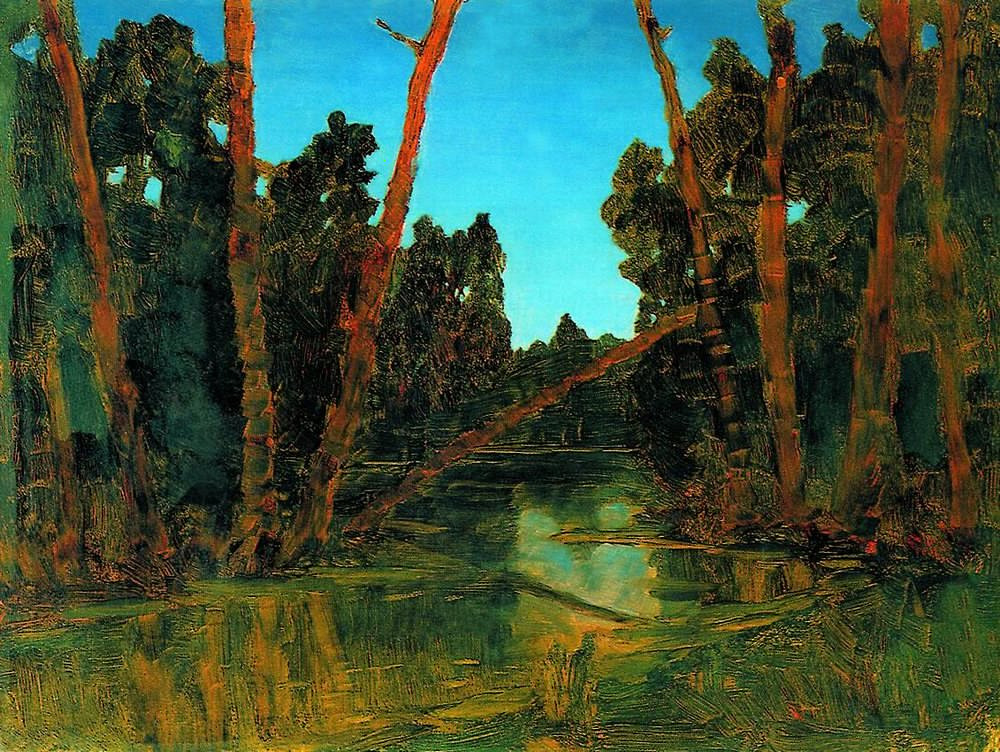
My nature writing blends into an arcane Spanish-language text. The publication circulates among Earth-lovers and wild foodists alike. Together, my readers and I endeavour through a dense thicket of swamp. Community leaders take the helm of a slow-moving canoe, shifting through the bullrush stands and mud vents emitting the hot gaseous fumes of peculiar decomposition. 

Forest Swamp by Arkhip Kuindzhi
A rattlesnake emerges from the rushes as we emerge from the blinding vegetation. On the waters, ready to disembark for a land crawl, a comrade teases and taunts the rattlesnake head. The venomous wisps and hissing instills a deep-set fear straight through my eyes. The rattling spells virulence and ire. Reptilian awe paralyzes my arms and legs as I stare, petrified, watching the snake slither madly towards me. It darts and in a split-second latches onto my arm. My reaction is pure thought. Still as stone, I feel its fangs stick into my blood. 

Old dream interpretation folklore sees a snakebite dream as a positive symbol of regenerative holism. See my recent nature writing publication for Canada's only independent news cooperative. 
__________

To return to primal and distended physical tumult
A chaotic folly
Dreaming in smokeless fires

...
In the post-kingdom English croak
Over bastions and landlocked heights
That furnishes much scheming

A trite & forced inhuman sense
Of belonging
In a war trench

Phase of lunatic civility,
As the prosperous few wade
In proud shores of quicksand

Loss of self,
Ruined foresight vanishing
Into the uncreated past

excerpts from "Horror-story jazz"


Saturday, 15 December 2012

Atheist Tomb of a Truth-Seeking American: A Plea for Disarmament

Tomb of D.M. Bennett in Brooklyn by Cory Doctorow
"I have learned to modify my prejudices. I am ready to believe Hamlet was right when he assured his friend Horatio that there was in Heaven and Earth many things not dreamed of in his philosophy." D.M. Bennett, as orated in The Truth Seeker 
It is at times like these that we Americans look to our history. Who are we? Where do we come from? How did we get here? What could have led to this? What is happening? 

Those among us strong enough to ask such questions are motivated to seek truth. As the president weeps for the children of the nation, so we must all begin to weep with minds full of emotion, burning with an intelligent self-awareness towards post-political change. We don't need rhetoric. We need new laws on guns. We need free thought to embellish the minds of such substance as founded free press in America. Disarmament is the new abolition, and as long as guns are indiscriminately accessible to immature minds and wounded hearts, we are all slaves to this mortal era.  
__________
The last thing I remembered was the initial feeling of impalement. Careening off a flight of concrete steps, I flew from my bike onto a metal pole. My back cracked in shards. When I came to, the city was dark. A Rastafarian man burned down a hand-rolled cigarette in the shadows. I knew from his countenance, to walk outside would be a bad move. I did anyways.

The Customs Cabin by Ferdinand du Puigaudeau
The street lamps glowed over empty streets. The absence was chilling, yet I could feel a human presence both alarming and alluring. As I made my way down to the riverbanks, the icy shoreline stared at me with two riveting eyes. The male stance was formidable and intimidating. Fear struck. The air breathed of danger. I needed to know why.

Night on the Southern Shore by Nikolay Dubovsky
As I hurried further on down the shoreline, a group of men whispered in the dark. I quickly smelled the entrenched anger, the mortal struggle at hand. I fled. On my way back, I met a friend from before the accident. He recounted his story, how he had broken his back in an accident that mirrored my own. I didn't question the curious coincidence as he went on to explain the unthinkable, we were now living in a world so hostile to mankind that people were literally killing each other for the last crusts of bread, the last drops of water, the last feet to walk, the last fresh air to breathe, the last day to live.
__________
"towed current
            pulled slow,
            drifted away

hand,
            fingers following new lines
...

virgin thorn brush
            frame lilting strong above the careless face
of artistic madness
in the jokester’s foam and rust
...

the pulse breaking off the tops of widow’s peak waves,
            blushing high over the coastal horizon,

a piercing thought
that boiled in the mind’s own brain,
an intuitive question
            with an answer as certain as death in the next step"

excerpts from "empty Blown mind"


Thursday, 20 September 2012

The Voice of Nothingness is Not Silent


Keep listening. Repetition is the rhythm of a harmonious narrative.
________

Grandma paces across the massive floor space. Such a humungous house is a crime to live in alone. This is the end, after more than half a lifetime, and he’s gone. The family remembers him well. He used to sit, unmoving, for immeasurable hours in that chair by the fireplace. 

My dad, begrudging this unseemly fact of life, is bent on taking out all the young folk (now almost in their thirties) to the grocery store, “to get whatever you want!” As we board the car, I can’t think of anything more to want than for us all to be together again, though I suppose even the Lutheran God would deem that otherwise. 

When we’ve all gone through the supermarket aisles, I’m left alone, at a loss to find exactly what I’m looking for, I trudge hell-bent through the fruits and vegetables. Everything’s rotten. 

Again, my vegetarianism is marginalized in the family, I can’t choose between swollen cantaloupe and mangled lettuce any more than I can between two cuts of meat, it all seems inedible to me. Everyone leaves the store without me. 

I walk the highways indefinitely, then, finally after a swathe of nights changing traces overhead with sunrays, I am bled of fictitious impersonality before the might of the great city ahead. The parks are filthy, and an ongoing fair only cements the fact. 

At a chess table I find my old friend from Sudan. He is indifferent, though welcoming. We move here and there amid the goings-on, attaining food and drink in our path, as we sight our circumstances and in the usual mode of conversation, dastardly criticize the milieu and technological demonry of our host society, brandishing bitter tongues of aging cynicism and spite. 

I again leave the scene, suddenly struck with a sense of purpose, to see my own Love, first-hand. 
________
In the reared tragedy of common history
Gone from the Irish shores that reach into the heart of a small mayflower
Lore teaching the youth and middle-aged men of their rights
                    And losing fate in the unreasonable song


To play out our entrenched groove that rides into spherical motion,
A dreamless awe maintaining the earthy power to cool enraged throats
                    And impress a soft layer of peace on the back
          An all-escaping flesh
                              Of our siblings who praise the sun
                                         And its ever-flowing majesty

- excerpt from "Along My Own Shore"

Saturday, 8 September 2012

Reflection on "The ABCs of Human Survival" by Arthur Clark


“In a nationalist culture we have a recurrent dream that political leaders and experts will get us out of the cycles of self-destruction. That is a false lead.” Arthur Clarke. The ABCs of Human Survival. Athabaska University Press. 2010. p. 196

It was in the memory of this author's late wife that ultimately sent me to Cairo for my second visit to conduct a full-scale research project with the refugee communities I had worked with two years earlier. I have met the author on numerous occasions, including at his private home for gatherings that would seem to emulate a scene from an F. Scott Fitzgerald novel if not for the prototypical ambiance that persists in Calgary in general.

I found many fantastic references and insights from reading this book deliberately. My immediate attention focused on the author's confession that he in fact is guilty of perpetuating old-paradigm thinking, where " we will perish as fools" in the recurrent words of Dr. Martin Luther King Jr. as he had never once refused to pay taxes to both the American and Canadian governments during the brutal war with Iraq (including the preliminary imposition of sanctions, which is an act of war). 

His repetitious voice on the ills of militancy and nationalistic ideology resembles that of an elderly person telling you the facts of life with a dry voice and welcoming candour, with its occasional seeds of perennial wisdom planted in your mind as interpretive potentiality. It is of this class of intellectual where with the know-how and the social compunction to organize people, there is proof enough for change, however the sphere of influence is mastered only where the personality of the actor's face is shown. 

With this, you have a new initiative to relegate the institutionalization of principles which somehow call to, once again, the era of F. Scott Fitzgerald, where with Herman Hesse and Theosophical Societies a global call to justice and reconciliation sounds from the bastion of its very corrupted centre. Still, I am optimistic of the efforts of the Calgary Centre for Global Community, as the book exhibits time and again, that optimism is the only way through, and cynicism is the bane of a young society propagating aging youth in this overly materialistic cascade of obscurity; the Western city.

In my mind, it becomes too easy to focus on global entelechy when embedded in social contexts founded on colonial principles, and it becomes too easy to focus on local action when fully empowered as a normalized identity in a welcoming society. That being said, this is not a critique of the book, only my personal reflection on themes which I find are also my life struggle as a member of the community. 

_________
“Where’s the washroom?” I turn my head wolfishly. “Is the door locked?” I break into a cold sweat. It’s early, before opening. I empty two crates of ripe oranges on a display. My head spins with discomfort, beginning my first day at work. “Where’s the washroom?” I’m dizzy, fatigued with lack of sleep. My uniform itches. The ammonium floor is rushing into my head. Crooked tags identify the price of two different kinds of orange. I’ve mixed them all up. They look fresh, enticing, I run to the locked washroom door. The echoing emptiness is cruelly fascinating. Oranges, ripen everywhere, with priceless disillusioning. I wallow sheepish, to forever line the halls with my uncooked thoughts.
________
written in the rocky glove of unsettled wild creative youth,
those two pair,
growing in unseeded soil
as a weed tossed into the vibrant dark matter of infinite bliss
by the great American eagle
flowing into the future of Vietnamese bathroom floors
swept of children and memory
...
the knot stifles truth and freedom in a frantic pause to strengthen terror's wave
crashing in the lonesome authority with tasteless glamour
reflected off the stretched mirrors of the disadvantaged, ugly, poor,
and our fate, unified into first expression,
to cast away all memory
and become plainly seen in the absolute center,
mind's eye of the Pacific, drenched in wandering,
an unworldly guise,
blended into worthless machine-eaten jungles
fried in the oil of littered rubbish
alongside a fixed marriage highway

to an undreamed following,
a place deeper than hell,
frozen in the backdrop imagining
where the burned order breeds asinine judgment
flowering into bitter hate for the lost
who stare remembering at the speechless knot,
held in minds full with blame and newly felt sorrow
for ancestors mourning what's to become of their kin
tied in fate with breathless teachings

- excerpts from "Listen to Your Self" 


Sunday, 2 September 2012

The Diamond Truths of New American Colonization

Detail of the Frontispiece, Diamond Sutra from Cave 17, Dunhuang, ink on paper (the oldest, dated printed book, 868 CE), universal distribution made possible by Wang Jie
"If a good man or good woman develops the mind of a bodhisattva and maintains this sūtra, even with as little as a four-line gāthā, and accepts, maintains, studies, recites, and explains it to others, then the merits of this surpass the others...

All conditioned dharmas
Are like dreams, illusions, bubbles, or shadows;
Like drops of dew, or flashes of lightning;
Thusly should they be contemplated."

- Vajracchedika (The Daimond Sutra), 32
________
Only a few days prior I had only passed by the reserve, Tsuu T’ina. The dilapidated rodeo stadium seemed dwarfed beside the traditional tipi stands, piercing through the pine forest canopy. Though, their well-worn canvas was visible in the instant of passing. And on down the highway, the billion dollar estates of cookie-cutter middle class residential colonies staggeringly featured on hillsides and valleys with the shallow, crooked smiles of worldwide settler ignorance.

Invited on reserve, what was I to expect. It became all too real and just so warming when in the presence of two young women, sitting on felled trees in a forest glade. They were humble, kind and open. They told me about the human experience, the incomprehensible ways and wherefores of corruption and the weary distillation of progress with or without wealth, on or off reserve. The original crime is at hand, though, truly, the unforgiving hand of an all-deceiving colonial contemporary oppresses us all.

This was my realization, though she didn’t have to say it as such, just kept flashing her warm smile and welcoming presence. A tea offered with such candor on a land infused with such bitter rumors, emptying on your heart with the depth of tragic realization, as viscerally near, as your own heartbeat struggling to course blood through your veins before the awe of an expectant spiritual confrontation. And here we were, sitting in the quiet peaceable forest. Three youth, peering out through the sun-cast opening towards a picturesque vale of mythic proportion. The warning sky cleared, as with ethereal empathy just for us at that moment. The sunrays cracked through the forest shade, enlightening the smoky dust. Looking at such wide-open beauty, I drank in the wild vocation of rapture at the mere sight of ecological wisdom in its simplicity. Yet, to the north horizon, as we looked west, a mountain had been reddened, as an eviscerated body, heaving the dim breath of laborious, earthly pain. I shrugged in careless abandon, questioning the lady to my right. She told me, briefly, of the catastrophe; a mistaken excavation, fruitless for all, rendering the mountainside clean of life.

Walking back through the town, I was led to meet others.
________
________
names tearing at the throat from the machete claw
breaking apart the vocal chord forests
dreamt in saw-cleared eyes
during the infamous winter of English settlement
from the prized mouth and stomach of burnt corn and lacrosse 
pages, ruffling in the French-Canadian afternoon

who remembers with sterling grace
and an ease unbeknownst in the blank wilderness of Western memory,
the oral grave of intergenerational strife
digging itself extra corpses to save face in the final rain of time

- excerpts from "New America, Go Forth!" 

Monday, 30 July 2012

In The Burning Memory of the Thousand-Dreamt Rimbaud

"montage en rouge: Arthur Rimbaud et éruption volcanique" by PRA
“A thousand Dreams within me softly burn” 

In the spirit of dream interpretation, I endeavour a creative interpretation of Rimbaud's oft-quoted line. All know the saying, "a picture is a thousand words" refers to the ability of the human eye to perceive new realities through the image, to a mode of internal perception awakening Dream, Realization, Insight, Beauty & Truth. Taking into consideration the outlandish tragedy of Rimbaud's life I would wonder to suggest that "softly burn" is an allegory on the fleeting nature of existence, which dream-like, escapes as a softly burning wick, where the wick is the body, tormented by the passing of life, in pain, and at once when life is realized as a dream, that passing burn is soft. Memories, awakenings, visions, are of those thousand dream-images through which the mind of the poet-seer burns, within. 

For a worthwhile initiation into another living mind revisiting this quote, please explore THE DREAMING, full of gorgeous mystical dream-mind renderings from the Yukon and beyond
________
The Hindu temple receives a multitude of bodies. Coffins too small for the eye bedeck the well-draped floor. Exotic designs move the carpeting fur under our crossed legs as we admonish the tragedy of a younger generation lost to the violent wave of an incredulous doom. The air is blameless while heavy with the intensity of childless mourning. I visit many coffins, pressing my hand over their delicately sheathed frames, wondering about the unwilling instant of realizing early death at hand. Luxurious instrumentation lightly carries our tears to the sky with a playful tabla swing, impassioned, vibrating the moment’s curse into a blessing of mysterious, celestial hosts. We supplicate for the presence of extra-human understanding.

The demons return to the doorstep of the temple. A slew of bodies fall limp to the floor, blood gushes, filling the red and gold henna-flavored carpet with monochromatic travesty. I hide myself in the ceiling. I can hear the marauders bellowing hotly underneath. Am I the sole survivor? The panicking sets in when bullets and swords pierce through the unprotected foam insulation, serving as a ceiling in between the stone encasing stone structure. The murderers smash idols and burn the priests’ fabrics. Then, they notice me. My heart shakes like a rattlesnake in a rib cage. Gently lowered by the facetious grin of a gangster, I retain my pride. Led to the doorway after bitter interrogation, I am let off, grieving now for the un-mourned, and un-passed, those whose deaths remained undreamt and survive with the turning flesh of burning memory.
_______
Temple
"To dream about a temple represents a need to be appreciated by those you love." (iDream)
_______
she, a mother-in-law, struck a few chords after work and fled to his new apt.
clean and unused, they spread genital juices all over the face of the linoleum floor,
not asking lawyers how to clean it up, they left it for dead
& fled the crime scene to her stepsister's house
where they indulged in mushroom chocolates
& fled the known universe

now legally insane, they saw themselves all perfectly unfit for more
in their mentally unbalanced state, slept soundlessly on the floor,
only he had a dream, that he was back in his home country,
though living on the border, officially, since 3,
& saw a mythical beast riding high in the military fly zone
just before the horizon, not a dragon, nor bird of sorts,
a great golden rabbit appeared, star-cast and beaten from eggshell glory

the profound gaze sent him into a subconscious stupor,
an eyes-glazed reverence serenaded his being with lightly caressing gusts
& breezes echoed sweetly from each celestial hop, the rabbit,
suddenly frozen in space
moved its ears at a lightning pace, and the resounding effect, a divine music
so piercing as to exhale a skeletal release from all human friction,
that generous, breathtaking gorge of sound streamed and crashed into depths unknown
with a lightness and eager wish for interdependent eternity

Wednesday, 18 July 2012

Spiritual Murder of the Mythopoetic Role


Fuxi and Nuwa by Anonymous
"Mythopoeisis is the act of shaping a myth into a new form, of making it anew; now I believe each of us does this poetic act daily, only we are not conscious of it, but myths, if alive, are always being renegotiated; we cosign them once more each day we wake up and go about our lives; but the action is unconscious. Poetry makes these processes conscious."

"...the individual psyche cannot, much as often it would like to, to be separated from the collective. Understanding the archetypal nature of our waking life and of our dream life would go a long way to revealing this truth."

- Dennis P. Slattery, from an Interview with Archetype in Action
________
“I have never traveled through West Africa! I have only seen East Africa.” I shout to the unconcerned on a bus through mud flats on the outskirts of town in Ghana. “It’s more industrialized here.” Suburban homes, colorful and well-roofed lie interspersed atop the unstable ground. Nothing grows here.

The plains shake off their sanded winds out onto a horizon as flat and majestic as any under a dim gorge of sky above. We approach an underprivileged village. The beams of their homes show with skeletal fright, a ghost of a shelter buries the inhabitants under a schema of incongruous monetary divisiveness. I am let out here with a group of excitable travelers. After a few bitter hours gazing into the masked poverty, the rest saunter off, straight into the shale-thin horizon, across the plain desert, leaving me behind to my shameful enjoyment.

The first unusual occurrence I notice is an old man, an elder, conducting witchcraft rites from a burlap, animal hid covered hut, half-emerging from a height of wires in the modern town center. He presses his hand up against a carved, convex piece of bone and wood overhead, pressed into the ceiling of his dusty keep. With that, the town comes alive. Animate devotion is surpassed unto grandiose might through communal dance, a powerful music enticing all to couple and find happiness in group intercommunication through a thankful greeting of sprites.

Then, chaos breaks loose from the fire. I disentangle the group of its emotional stability. I use a dull knife, a metal shard from their central structure. Cutting off hands and brazenly ambushing in an intoxicated insanity, bloodthirsty, I drive the community from their healthy nest. Only a few bodies remain, hanging onto life with the remaining ligaments and tendons still connecting their pulse, vibrating with accepted fate, a spiritual murder.

I flee. Following what I had learned in the village, I begin to collect seeds in the wilderness, these are jujus of flight. I need a new identity. I received wind of another African meeting, in the next town. Before I can get there, the Red Cross identifies me, soon to be incarcerated, deadened with madness I swallow the seeds. My flesh speaks of me, it says, “I am guilty.”
________
Murder
"If you commit murder, it signifies that you are engaging in some dishonourable adventure, which will leave a stigma upon your name...If you have a dream of murdering another, this is a warning that you must keep in control of your temper and emotions at all times and not get enraged to the point of murderous intent...You may also have some repressed anger at yourself or at others." (iDream)
________

clockwork porridge
spread over an island tongue
marauding, blasphemous
across seven oceans

timely
with education's pandemic drug:
the book

compromising home speech
on the First People's sand-quipped names
harboring love in their own unique hearts
with a history untold,
forgotten and enslaved to foreign grammar
to safekeep continued histories
of colonial struggle
in the vault of young minds
playing sound asleep
in the therapeutic mud
of their own beautiful creation.

March 7, 2011
Chinatown Calgary