Primarily a writing exercise, this dream journal-inspired blog is a quiet introspective sojourn into the process that we traverse in going from private dream to public art. I see our dreaming as an internalized mythmaking. As I philosophize and expressively exhibit dreams, both private and public, I encourage and delight in creative language as a way to practice experiential metaphors through a “public dreaming." Writing Theory: Creative Dream Fiction
Showing posts with label globalization. Show all posts

Monday, 28 October 2013

Globalization and All Our Relations: The Human Family Shall Overcome

Natural disasters caused by climate change by KVDP
"We've been told that climate change is a very serious threat, in fact the most serious threat facing humanity today. Groups like UNICEF and Save the Children are emphasizing the particular impact on young people around the world in developing countries, in the Global South…

….[The United Nations International Panel on Climate Change, representing thousands of scientists from 195 countries] have 95 to 100% certainty that climate change is manmade and that we really do need to be reducing the amount of fossil fuels that are being extracted and burned to get us back to that 350 parts per million. We're currently over 400 parts per million."

Ben West, from a podcast published with The Media Co-op titled, "Vancouver is debating a resolution to divest from fossil fuels"

Recently, I was asked to produce an essay without knowing the prompt, until the moment unveiled the golden word: Globalization. The off-the-cuff piece, shown here within the body of this text, is the result; derived from a deeply studied and well-experienced life as a global citizen, a youth whose formative years traversed four continents. Read ahead:
Living conditions in Third World countries are deplorable. In fact, the term Third World derives from the Cold War, signifying all of those countries outside of the pale of American and Soviet landholdings. Such countries have continued to face irremediable challenges with integration into the global economy. Culturally, such countries continue to embark on a multicultural path, as a legacy of post-colonial liberations. Yet, economic woes remain the side effect of these nations. Common people feel the impact the greatest. "War is the enemy of the poor," said Tavis Smiley and Cornel West during their recent "Poverty Tour" through the United States. 
Neo-liberal economics, spearheaded by American economic globalization, creates insurmountable debt for Third World countries. The Third World is now also termed the Global South, due to the fact that most of these countries are located in the resource-rich southern hemisphere. Neo-liberal economics is a unique phenomenon of globalization, which has essentially led the entire globe down the same path of economic debt and cultural greed as that currently faced by the American people. Yet, unlike in America, banks in the Global South will not be bailed out, and their people will not be "defended" by the most powerful military on Earth.    
In recent weeks, as the snakeskin of nature shed under the turning, cyclical gaze of the heavens, I have ruminated steadfastly, and piercingly into the nether reaches of my mind with one essential question. How is one to live directly? How is one to embrace the very source of life from which their every day nourishments and hungers, joys and sorrows, deaths and rebirths emerge? It is a question asked throughout the aeons, and in the Euro-American tradition of thought, also by the transcendentalists. 

Often times one will question whether they are to live as an urban dweller, bound to the manufactured waste stream that devastates as it deviates all from the nature of truth and union with creation. Simply, one might ask, "How can I live off the land?" Such self-interrogations are, at heart, nothing more than abstraction. In truth, one cannot exist without living off the land. It is our relationship to our life that matters, and by our life, I mean our water, our food, our air, our soil, our family, our Earth.

Pre-historically, human life was a bout of physical confrontation. Where, when life is lived directly, one sees straight into the eye of death, and beholds our own reflection staring back with the quiet and steaming grimace of fate. So, the trials and travesties of inter-human conflict seeded our mind as with the necessities of the harvest. Yet, today, instead of the spear, instead of the omen or plague, we have a curious social phenomenon called Globalization. Our confrontations are buffered by stone and metal walls. Our physical conflicts are transformed into backhanded and conniving corrupted relationships, not only among each other, but with all that we see, feel, taste, hear and smell. The most deviant and malign property of Globalization is that it moves to act upon a sixth sense of unreason and ignorance: consumerism. 

The objectified Earth, the manufactured life, canned and packaged and shipped and digitized, provokes our habits of overindulgence, not only in the physical, but also in the emotional, spiritual and mental aspects of existence. Our life is one of imbalance when our relationship to the sources of life we depend on are marred by the anxious flux of neo-liberalized, Westernized, and finally, globalized economic growth. In the end, I wonder how we might return, or go forth, into a paradigm of holism, where things are not treated as objectified individual separations of the world (a reflection of our own egos), but as representative of one and all in the cyclical round of being, of nature, growth and fulfillment. 
_____________
This path I have tread before. Tonight, the water is more still and tranquil, more at peace with its shores than ever; almost unified with the distant, clear sky, unmoving. Its depths seem parallel with the infinite universe behind the stars, behind my eyes, and I gaze into its elegant, silent motion. And into the moonlit waters, the icy river glows as an unconscious brew, a kindling power unfolding within the heart and source of the land. The river god sways gently in a dance of ecstasy, the slow rhythmic flow is its yearning to be one, again with the sun-fleshed mountain or of the ocean's undulating tide.
In the Spirit of Hermitage at Fu-ch'un River, painting by Wang Hsüeh-hao
A lunar glint in the stone-shaped waters reflects an unnerving presence ahead. One glint so similar from the eye of prowling fur, the catastrophic bend of a predator's spine sends a million shivers into my very human soul. Though many steps away from the water, I feel as submerged in its unforgiving current. The gates of a natural death; the moment when you embrace the Earth in the fullest, and the human form disintegrates in a flash of primordial hunger. The animal, entranced, paralyzed my every last cell, as its tail swung left and right with dizzying grace, as there were two beings of the hunt, in full and impenetrable balance. And then, the Tiger stopped. Her stare, curiously enough, then was warming.

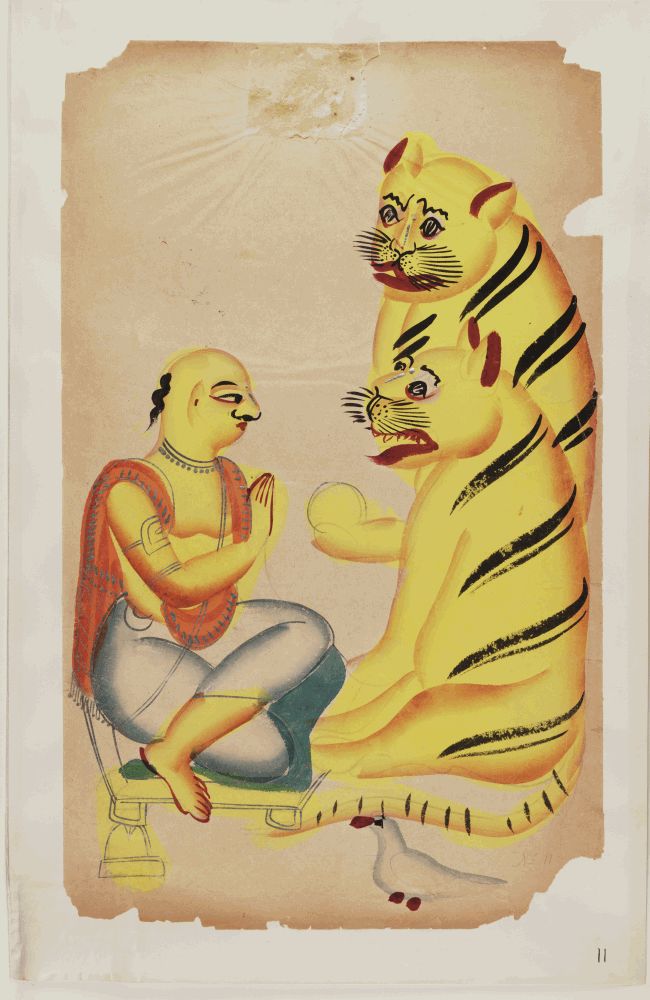
A Kalighat Painting, Kolkata, India, 1875 titled, "Brahmin Kneeling Before Two Tigers."
As captivated by an inward swell, as a yet unfelt emotion, the pangs of belonging, of a friendship undying since an unformed word first sprang from my infant mouth. My heart welled up with the strength of tears wept before the death of the beloved, and its release followed with utmost relaxation, both bittersweet as ecstatic. She walked with me, as two lifelong friends, along the human path. And my gut sank as I heard the footsteps of a band of unweary souls approaching.

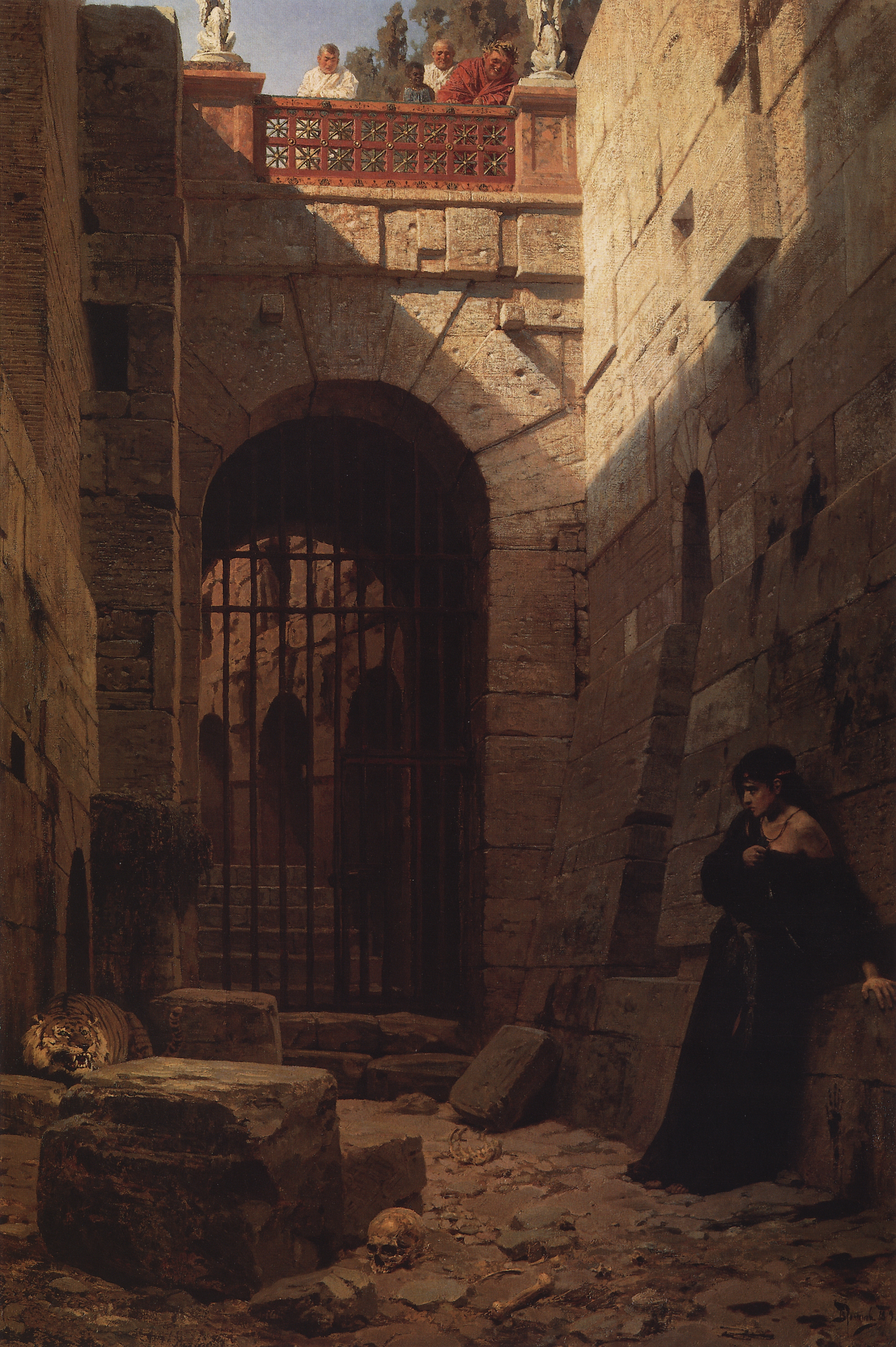
Tsezarskaya zabava (lit. "Caesar's joy", Russian: Цезарская забава) by Vasiliy Polenov
She was unprepared to join us as a race, if only to meet an individual of her heart's likeliness. As the unknowing travellers marched forward, they were met by the power of her charged fangs, her open jaw welcomed them as the air accepts a skydive. I fled, not looking back, confused, while with purpose, the scent of strength over the domineering self, over humanity and the narrow stiflings of egotism and myopia in the anthropocentric paradise of modernity.
___________

My sister. My brother. My mother. My wife. My maternal grandmother. My step-father. My step-mother. My great-grandfather. My paternal grandmother. And my late grandfather.

All of them, lived for and with music. Music brought us forth. Music brought us together. Music gave us wings to traverse the open skies, our imaginations, the open roads and lesser-beaten paths. Through music, we know where came from, where we are going, and how we might get there. In the new single by my sister Jesse, "Everything in Between" she brings it all home.

Listen to Jesse's first album, or even one track on it called, Voyageur, featuring myself and my wife. Listen. The lives of countless generations speak through her tones and chords, her voice, her words. Listen, and you just might hear that one that you know like your own. 

The track These Words is inspired by the wisdom offered as mementos, and as initiations into the power and meaning of family, tradition and the value of life. Be Kind, speaks the first of five wisdom truths, as the Five Noble Truths of Buddhism, our father unearthed five from his own suffered spirit, heartened by the stories and ways of our grandfather, who gave him music, and who passed down not only a tradition of sound, but a tradition of respect for our fellow human beings, for the strength and truth of work and its potential to give one meaning, to give one affirmation that their work is good, that even if it largely remains unsaid, the work is good when it is done in earnest in the trial to confront one's own innermost and enduring sufferings. 

In that way, Kindness transcended politeness, the mediocre drab of everyday humdrum gave way to an appreciation that bordered on spirituality. "My religion is kindness," said the Dalai Lama, and when practiced right, resonates and reverberates, and, ultimately, transcends human suffering as surely and directly as the high of a harmonious tune strummed to the effect of an age-old rhythm, not forgotten and passed down through the embrace of one's own blood. 

Friday, 7 December 2012

Climate Changes Civil Society To Support Dreamers


"This morning Munira Sibai, a Syrian-American student with SustainUs, delivered this speech on behalf of young people (YOUNGO). Although many governments could not be bothered to listen to their citizens, civil society was present in force: supporting Munira and each other in a way that governments can only dream of. Onwards." Earth in Brackets BLOG (Dec. 7 2012)

Tonight, as I drifted away, I read the latest Democracy Now! headlines on climate change. Civil society and democracy are shifting gears for full speed ahead as the human race confronts the most pressing issue yet known to humankind: A Warming Earth. 

Read the latest World Bank Research analysis on the devastating impacts of unheeded climate change warnings. At 4 degrees warmer, the science begins to frighten. 

Earlier tonight, as I cycled home, I met a bewildered fox. Scared and nervous, we approached each other. My fear suddenly transformed as I saw fear in the fox's eyes. I glided past carefully. I witnessed this incredible animal confusedly find an exit from the paved city pathways to the nearby riverbanks. I think of Native proverbs that ask, "who will speak for our beloved animals?" 
________

The candles are now all reconstituted wax. The rain boils and steams before it reaches its earthen ground. The sky is on fire and I need a new name.

In Peril by John Atkinson Grimshaw
Through my window of impoverishment, a sanded frame of dirt, I see tanks spewing the ire of mankind. Fire is the breath of unreason. Violence spreads across the land.

Miniature diorama in the Herat Military Museum by Marius Arnesen
Bombs and machine tracks seed great pocks of holes in the earth. The clouds are dark with soot and anger. Lightning cracks through the smiles of silenced memories. Families are swept away like dust.

Lunshunku battle during the Sino-Japanese war (1895) by Unknown
Fending off the soul-puncturing thunder of war, I flee through the bureaucratic maze of a police state. Warmongers drive their piercing insanity into my eyes, as I feel my way through back entrances and obsolete hallways. The border embassy shakes at the foundation. Our earth will be interminably scarred. We are equally victims and perpetrators of widespread ecological domestic abuse.

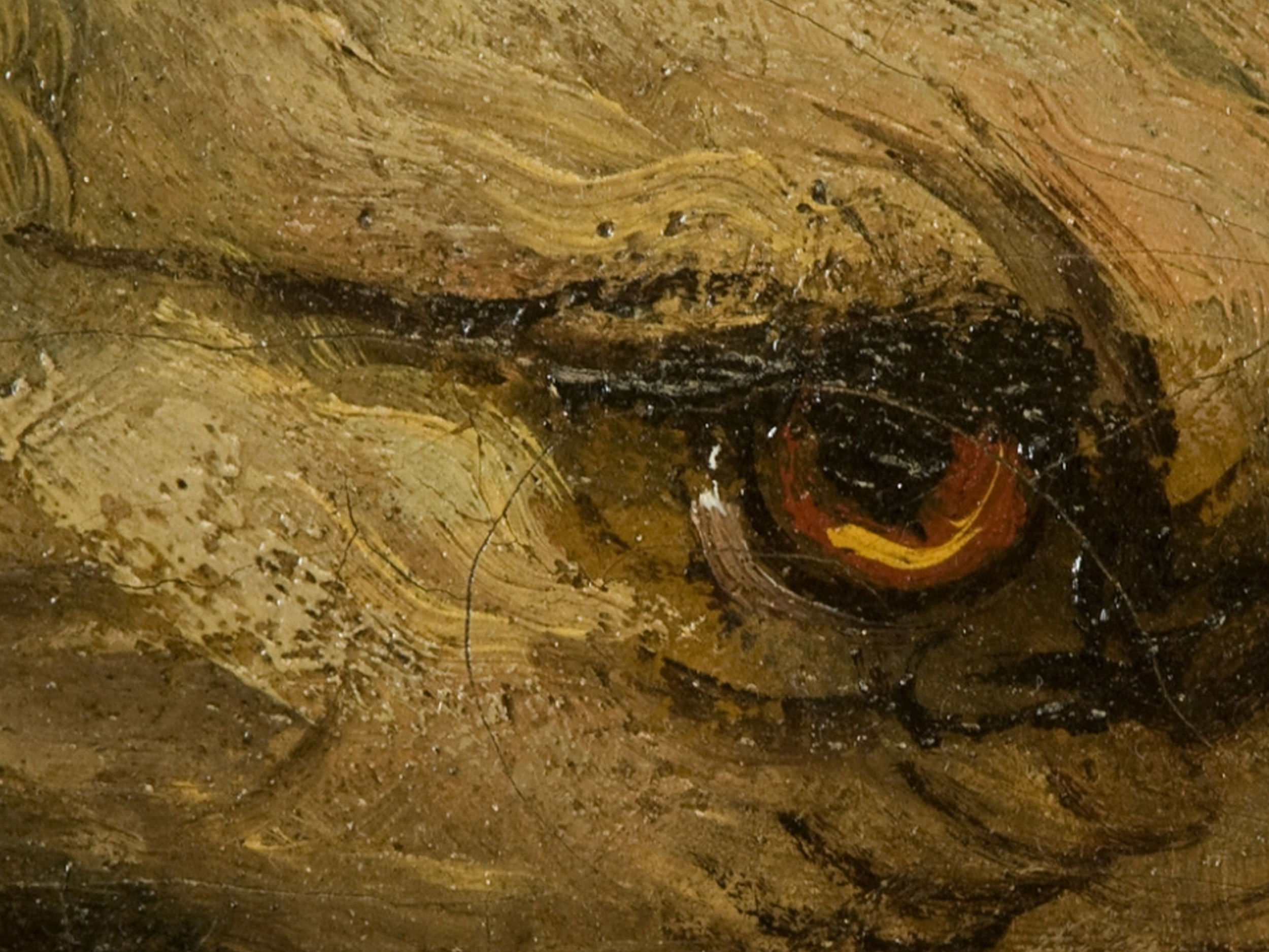
The Immaculate Conception, detail: Dragon's Eye by Giovanni Battista Tiepolo
In a vile trench of near-death urgency, I climb out, and into the sun of borderlands. Having escaped the eruptive core of my country’s open, bleeding veins of disintegration, I wade in scintillating wetlands. Vibrant green pasture, lily pads and low-lying bogs hydrate my contemplative sight.

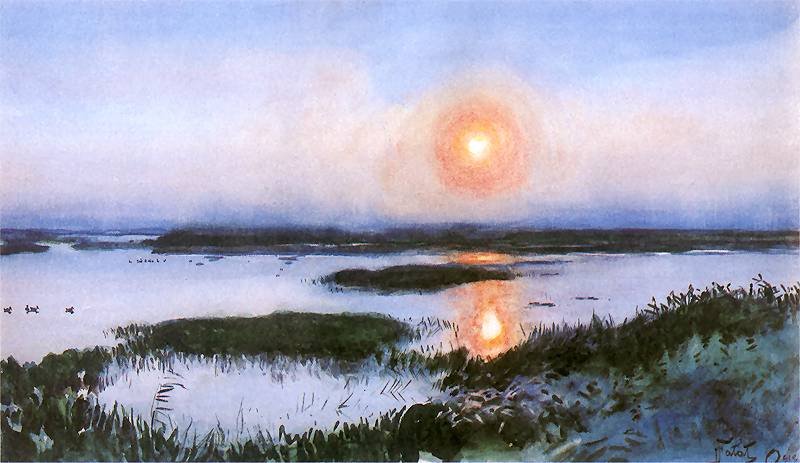
Sunset over wetlands by Julian Falat
I can almost see beyond the untimely closure of history. Birds and insects sleep with day, at peace, like me, in restful respite.
_________
"Escalations nerve-wracking, lonely murmurs murmuring

Crescent peaks dangling under bums grateful with uprooted membranous petrified and calcified flesh

Journey to roust the kneeling mind, with the desiring missed find, to be missed by nations feigning the patient behind swollen gum-brain awry, with skull-ache

“kinj moduls vrent speen og”

Desiring missiles
Desired missing
Failing nations

Patient fang"

excerpt from "Cajoled Spine-Tap"


Saturday, 8 September 2012

Reflection on "The ABCs of Human Survival" by Arthur Clark


“In a nationalist culture we have a recurrent dream that political leaders and experts will get us out of the cycles of self-destruction. That is a false lead.” Arthur Clarke. The ABCs of Human Survival. Athabaska University Press. 2010. p. 196

It was in the memory of this author's late wife that ultimately sent me to Cairo for my second visit to conduct a full-scale research project with the refugee communities I had worked with two years earlier. I have met the author on numerous occasions, including at his private home for gatherings that would seem to emulate a scene from an F. Scott Fitzgerald novel if not for the prototypical ambiance that persists in Calgary in general.

I found many fantastic references and insights from reading this book deliberately. My immediate attention focused on the author's confession that he in fact is guilty of perpetuating old-paradigm thinking, where " we will perish as fools" in the recurrent words of Dr. Martin Luther King Jr. as he had never once refused to pay taxes to both the American and Canadian governments during the brutal war with Iraq (including the preliminary imposition of sanctions, which is an act of war). 

His repetitious voice on the ills of militancy and nationalistic ideology resembles that of an elderly person telling you the facts of life with a dry voice and welcoming candour, with its occasional seeds of perennial wisdom planted in your mind as interpretive potentiality. It is of this class of intellectual where with the know-how and the social compunction to organize people, there is proof enough for change, however the sphere of influence is mastered only where the personality of the actor's face is shown. 

With this, you have a new initiative to relegate the institutionalization of principles which somehow call to, once again, the era of F. Scott Fitzgerald, where with Herman Hesse and Theosophical Societies a global call to justice and reconciliation sounds from the bastion of its very corrupted centre. Still, I am optimistic of the efforts of the Calgary Centre for Global Community, as the book exhibits time and again, that optimism is the only way through, and cynicism is the bane of a young society propagating aging youth in this overly materialistic cascade of obscurity; the Western city.

In my mind, it becomes too easy to focus on global entelechy when embedded in social contexts founded on colonial principles, and it becomes too easy to focus on local action when fully empowered as a normalized identity in a welcoming society. That being said, this is not a critique of the book, only my personal reflection on themes which I find are also my life struggle as a member of the community. 

_________
“Where’s the washroom?” I turn my head wolfishly. “Is the door locked?” I break into a cold sweat. It’s early, before opening. I empty two crates of ripe oranges on a display. My head spins with discomfort, beginning my first day at work. “Where’s the washroom?” I’m dizzy, fatigued with lack of sleep. My uniform itches. The ammonium floor is rushing into my head. Crooked tags identify the price of two different kinds of orange. I’ve mixed them all up. They look fresh, enticing, I run to the locked washroom door. The echoing emptiness is cruelly fascinating. Oranges, ripen everywhere, with priceless disillusioning. I wallow sheepish, to forever line the halls with my uncooked thoughts.
________
written in the rocky glove of unsettled wild creative youth,
those two pair,
growing in unseeded soil
as a weed tossed into the vibrant dark matter of infinite bliss
by the great American eagle
flowing into the future of Vietnamese bathroom floors
swept of children and memory
...
the knot stifles truth and freedom in a frantic pause to strengthen terror's wave
crashing in the lonesome authority with tasteless glamour
reflected off the stretched mirrors of the disadvantaged, ugly, poor,
and our fate, unified into first expression,
to cast away all memory
and become plainly seen in the absolute center,
mind's eye of the Pacific, drenched in wandering,
an unworldly guise,
blended into worthless machine-eaten jungles
fried in the oil of littered rubbish
alongside a fixed marriage highway

to an undreamed following,
a place deeper than hell,
frozen in the backdrop imagining
where the burned order breeds asinine judgment
flowering into bitter hate for the lost
who stare remembering at the speechless knot,
held in minds full with blame and newly felt sorrow
for ancestors mourning what's to become of their kin
tied in fate with breathless teachings

- excerpts from "Listen to Your Self