Primarily a writing exercise, this dream journal-inspired blog is a quiet introspective sojourn into the process that we traverse in going from private dream to public art. I see our dreaming as an internalized mythmaking. As I philosophize and expressively exhibit dreams, both private and public, I encourage and delight in creative language as a way to practice experiential metaphors through a “public dreaming." Writing Theory: Creative Dream Fiction
Showing posts with label India. Show all posts

Monday, 18 November 2013

Novel Liberation: The Humble Postcolonial Wisdom of E.M. Forster


"If I have had any influence, I would be very glad if it induced people to enjoy this wonderful world into which we're born, and of course to help others to enjoy it too."

“We must be willing to let go of the life we have planned, so as to have the life that is waiting for us.”

“They too entered the world of dreams- that world in which a third of each man's life is spent, and which is thought by some pessimists to be a premonition of eternity.”

E.M. Forster (the last quote is from A Passage to India)

The British Raj and the Indian Independence movement of the 1920s provide the setting for a poignant story between two principal characters in E.M. Forster’s 1924 novel, A Passage to India. The lives of Aziz, a Muslim doctor and Mrs. Moore, an older Englishwoman, represent themes of social constraint, in contrast with personal relationship. Constrained by title and culture, these characters manage to relate under unique circumstances. Aziz learns to respect Mrs. Moore unlike any Englishwoman he has ever known, while Mrs. Moore is, at first, captivated with the pride of knowing an endearing local closely.

Mrs. Moore, as with Miss Quested, is captivated by Aziz because he represents something of the “real India”, to use the words of Miss Quested. “Try seeing Indians” was the reply of the schoolmaster at the Government College, when Miss Quested asked how one might see their colony in its native authenticity. There is always room for remiss under the social umbrella of Indian-English relations; whether in the surprising first encounter between Mrs. Moore and Dr. Aziz in the mosque, or the arranged party at the tennis lawns, the tea gathering at Fielding’s or the excursion to the Marabar Caves, which, finally, proved more disastrous than any one had expected.

“May I know your name?” Aziz asks to Mrs. Moore, cautiously, in the mosque. His demeanor is one of near-desperation, as someone both protecting his native sphere, as well as struggling to see British humanity. “She was now in the shadow of the gateway, so that he could not see her face, but she saw his, and she said with a change of voice, ‘Mrs. Moore.’” This very revealing sentence emphasizes the obscurity of English presence from local, Indian eyes. In that moment, Mrs. Moore felt safe enough to share her name, the most important object of her title and superiority. Aziz remembers her generosity, as her fitful capacity to speak the truth becomes the apex of her story, truly a minor character in A Passage to India.

When after Dr. Aziz stands on trial for the assault of Miss Quested in the Marabar Caves, Mrs. Moore is decidedly frank in her stance on Aziz’s innocence. “Of course he is innocent,” says Mrs. Moore as Miss Quested begins to question her disillusioned experience on the excursion, all the while Mrs. Moore is quite fed up with India entirely. “She was by no means the dear old lady outsiders supposed, and India had brought her into the open…” writes Forster, who depicts her as a typical elder, uninhibited by the dramas of youth, and quick to speak the truth, even if it is unwanted. At this point, Mrs. Moore is on her way out of India, and the novel, where she soon dies in transit.

Regardless, Mrs. Moore is immortalized by the groundswell of Indian support for Aziz, who soon finds reprieve, as legends of “Esmiss Esmoor” soon manifest in the appearance of folk shrines in dedication to Mrs. Moore’s role in saving Aziz’s life. It is important to add that throughout the entire novel, Aziz is addressed by his first name only, while Mrs. Moore solely by her surname. Mrs. Moore’s name transforms when said by Indian voices. “It was revolting to hear his mother travestied into Esmiss Esmoor, a Hindu goddess,” thought Ronny, Mrs. Moore’s son, whose experience of India remained superficial, or, more accurately, guarded, throughout

Aziz and Mrs. Moore fail to truly connect in person, because English colonial formalities (and informalities) were too firmly laid beneath the foundations of imperial culture. During a scene of characteristic tension between the colonial masters and their subjects, Forster writes, “Aziz flamboyant, was patronizing Mrs. Moore.” The direct interactions between Aziz and Mrs. Moore are brief and sparse, as they are interceded by English formalities, typically mediation by a male authority – Mr. Fielding in this example. The scene, where Aziz and Mrs. Moore meet in more conventional circumstances, for a tea gathering at Mr. Fielding’s, reveals Aziz’s character (and Forster’s impeccable prose) as someone unable to speak on behalf of India. The scene also reveals the seemingly adventurous minds of Miss Quested and Mrs. Moore, on their search for the “real India” as a mere surface-level novelty.

Mrs. Moore, although agreeing to accompany Miss Quested on her excursion into the “real India” is soon overcome with the fundamental truth of her presence in the faraway land. As the excursion comes to a bitter close, it is said of Mrs. Moore, “…since her faintness in the cave she was sunk in apathy and cynicism. The wonderful India of her opening weeks, with its cool nights and acceptable hints of infinity, had vanished." While, from Aziz’s perspective, “…he agreed that all Englishwomen are haughty and venal.” Mrs. Moore is the stereotypical colonial British woman, whose curiosities for the rare and exotic life of India prove ineffectual to satisfy her experience of authentic India.

Their relationship reveals the meaning of liberation in colonial India, where Aziz’s fate becomes Mrs. Moore’s very undoing from India. For Aziz, he would come to know “…that an Englishwoman's word would always outweigh his own.” Generally, both characters speak well of each other, even if their personal, physical interactions are constrained. Conclusively, such is the larger relationship between the colonial British with India; ideal and positive on paper and second-hand experience, yet up close, absolutely ruinous.

This essay, entitled, "The Relative Liberation of India", was written for an acquaintance as part of his school curriculum. Consequently, I was reintroduced into the magnificent literary treasure troves of E.M. Forster's richly imaginative prose. 
_________
An expanse over the marshland floodplain. The drifting current sways gently through sap-lined pine trunks and decomposed maple leaves. Ahead, the riverbanks motion with unspeakable gratitude, bittersweet, enjoined to the drunk swell of an upraised wetlands. 
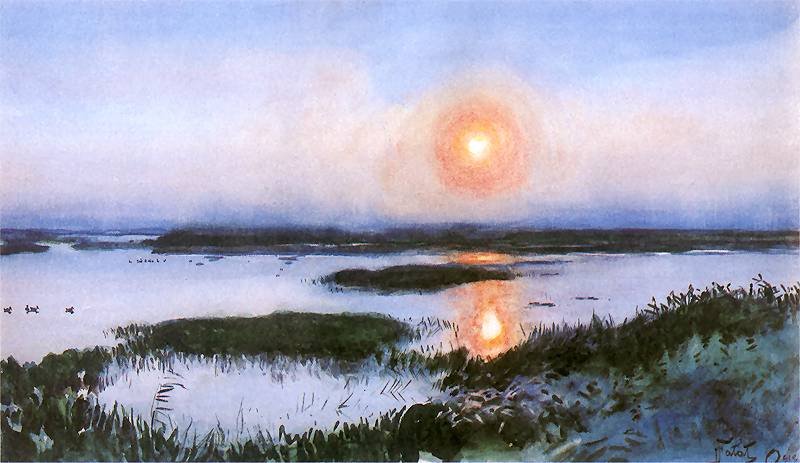
Sunset over wetlands by Julian Falat
He speaks, a guide of the ancient St. Lawrence river basin, to reinvigorate the ground with the renewing tides of Mother Earth. She beckons the swallowing of a forgotten landscape. The land is to be reclaimed. Indigenous nationhood reinstated over the American-Canadian divide. 
_________
Featuring a lyrical evocation from the collection, Sketches of Style and chapbook, Muse for the Wounded, Guise of the Beloved expresses thematic tides of visceral belonging amid landscapes both supernatural and inhuman in an age when the human body is more and more experienced only in its violent rending apart.

Yet, musical undertones, both electronic as acoustic, ring clear throughout, simultaneously presenting the source of human life, as our fate. In the commotion of bewildering psychic momentum, there the muse stands patient and waiting to receive the wounded, who with eyes of intoxication and skin of vulnerability, senses a way beyond and through the immense and spectacular Fear of Being.


The six poem chapbook, Muse for the Wounded, is comprised of selections from the larger collection, Sketches of Style. Here, the archetype of the wounded healer is redefined, wherein the muse becomes the healer in the mind of the poet-seer. The one poem, Guise of the Beloved is also featured as a sounding the artful designs of a musical elaboration on the Sketches of Style album

Monday, 15 July 2013

Transformative Art, Spiritual Fusion: Wisdoms of Ireland and India


"'All Balzac's characters;' said Baudelaire, 'are gifted with the same ardour of life that animated himself. All his fictions are as deeply coloured as dreams…'  
Art takes life as part of her rough material, recreates it, and refashions it in fresh forms, is absolutely indifferent to fact, invents, imagines, dreams, and keeps between herself and reality the impenetrable barrier of beautiful style, of decorative or ideal treatment 
Life holds the mirror up to Art, and either reproduces some strange type imagined by painter or sculptor, or realises in fact what has been dreamed in fiction.”  
Oscar Wilde, The Decay of Lying: A Protest

Here the abbreviated wisdom of Oscar Wilde, writer of voice and ear, the triumph of the great artful listening bespeaks a wind chime of honest and natural truth. The delicate interweaving of Art and Life brews a certain mould, from which the divine spark of the punch-drunk imagination breathes with ever raging glory. That mould is Dream. As such, fiction follows with music, as the pure intent of the human imagination to express the most basic intuitive sustenance of life at its clearest and most meaningful. 

During the past week, I had experienced an especially overwhelming night in the overactive imagination, a flood of subtle sensation, burrowed deeply under the skin, an impalpable bitterness, of a foreign spiritual strength outgrowing and boiling over in the silent reaches of sleep. The raw experience did not give way overnight, and yet transcended recurrence. The seed of a spirit spoke in dream, of a catastrophic undercurrent, sweeping virulently through the mud of a quaking settlement on Earth: the city. 

River and sun transformed to tower and spear, and I woke more tired than I had lain the night before. Yet, with the vigour of independent living and creative meaning, I rose through the art of sound to wake well beyond the confining, artificial binary of sleep and waking; to a spiritual awakening! And through an outpouring of musical emotion, I stirred my brain with cathartic rhythmic trespasses over the faraway and distant geography of my inner reaches. At one among many; dancers, drummers, singers, storytellers and artist of sound and space, we together climbed the staircase of fiction to a higher reality, to a truth of our own making. 

For nights after, and indefinitely in the frame of the images spawned in the post-traumatic flash of outpoured nightly grief, there was peace. Nyx bloomed like a sunflower in the hazy morning of calm, human flesh. The rites of Psyche and Morpheus drew from the magical fount of youth and light a knowledge as seminal as birth; that our waking lives are inextricably tied to the dream fiction of our conscious and unconscious lives made whole. 

Or in the profoundly authentic voice of master artist Ali Akbar Khan, "If you practice for ten years, you may begin to please yourself, after 20 years you may become a performer and please the audience, after 30 years you may please even your guru, but you must practice for many more years before you finally become a true artist—then you may please even God."

Read my recent publication for Unsettling America on Decolonization and Transformative Art
_______________
All in the Wailing City raised their arms, for the plagues of a swollen Earth flushed the unmentionable presence of God away, way beyond the horizon of knowledge and meaning. A great riverine tide swayed the living to their backs, drowning in a liquid rage. The seaside howled an unforgiving pain, calling all to remember its earnest retch of longing. Under the deep duress, a pause from the hollow movement, atop a quaking hilltop soon besieged on all sides by the amassing shores, I gazed ahead. 

 In 1879 the great flood in Szeged by Ferenc Somorjai (Somorjai Ferenc anyaga)
Gargantuan machines, with power enough to puncture a mountain, rammed innumerable tons of metal into the rising waves. All human effort subsided in a last ditch effort, as the naked winds blew away every last measure of reason, exposing the humbling futility of Man as a self-conceived separation from Nature. And the skies then parted, revealing the unspoiled Earth anew. 

The Great Flood by Bonaventura Peeters
Cleansed of human pain, the memories yet unearthed buried as spirit-hosts in the nightly youth whose ruined minds attuned with sensitive grace to the crushing prowess of the Earth. Ahead, I stole beyond the limits of the city lain to a soggy rubble in a flash. The riveting sun splayed its arms and legs with eye-splitting rays as gorgeous as the purity of Light itself. A golden cliff summit rose as an open palm to greet and hold me into a warm embrace. Amiable pelicans touched over the soothing flow of salt and weed, as my feet sped off, flying as together with the ancient birds of Attar; the flight of survival in beauty, circulation and ascendance.

Rocky Cliff with Stormy Sea, Cornwall by William Trost Richards
Arisen again, to the opaque summer sweat of passion and greed, the ascendancy was of illusion, a taste of mad lust in harnessing, benefitting and exploiting the power of Earth. I am only human. And, so I climb stairs and escalate to office-window pride, in the shy, glum and austere rest of an angering soul. Midwestern city of black flies and pale steam, the ire of billions casts a spectral gloom over such towering hypocrisy; dense as the soil of the Bitumen God of Calgary.

The Galata Tower by Moonlight by Ivan Konstantinovich Aivazovsky
Uprooted, the towers of Oil and Untruth move as a serpent staff in my hand, readied and pointed toward the heart of the Jungle, the most immaculately climaxed biological development of all life's known diversity here on Earth. The jungle heart beats with the breathing of a thousand trees giving air to a wounded atmosphere of acid night. Within shot, the Awajun stare back, defending their land as all Land; to defend the very source of human existence. I shrink back, retreating and lacking the muscle to flesh out my own hypocritical ground, resting on the fat of the land in the cruelest eye of the storm, shrouded by cheap intoxicants and ignorant bliss.  
_________________
"Holy Rope" is a metaphor for the piece of twine I've used to snare my 16' frame drum featured on this track. Inspired by the masterful and spiritual frame drumming of the First Peoples on the traditional territories now known as Canada. Aboriginal peoples from northern Manitoba to Athabasca territory in northern Alberta, where I had camped, exhibited their powerful and endangered musical traditions. The use of a piece of twine or rope over caribou and buffalo hides struck a particular tone of nostalgia within my own ancestral memory as a musical being. Most well-known to North Africa, the tar frame drum is one of many snared frame drums in the deep Mediterranean musical heritage. The buzzing vibratory emittance that issues from a snared frame drum as similar to the First Peoples of Turtle Island as in the Mediterranean moved me to ecstatic prayer through drumming at Indian Beach campground. As I joined Dene drummers, I was moved with singular intention towards a spiritual fusion of sound, harmony, and ecstasy.

So the musical interpretation to the piece, "Holy Rope" lyrically carries the meaning and message of the experience of intercultural spiritual fusion music. Begun, "the executioner's raffle" signifies the great life-or-death gravity of the drum, as for many, the lifeblood of tradition, voice and inner fulfillment. The use of a shaker stands for the regular heartbeat rhythm that is carried by traditional Aboriginal drummers, who then commonly sing with syncopated bravura over a simple, steady rhythm. So, in this case, the shaker represents the rhythmic attuning of the First Peoples of Turtle Island, while my snared frame drumming represents the lyrical rhythmic temperament of my own Mediterranean heritage as the descendent of a Greek Jewish lineage.


The following chapbook, "Act or Confront" derives its source of meaning and intent from the omnipotent realization of the fleeting and mortal nature of human existence. With deep regard for the passing flame, we are fulfilled at its passing in the conscious effort of continuing life on this sacred and beautiful planet Earth.

When the passing is not confronted, and is ignored for greed, or lack of honesty in any form, life itself is denied to future generations and to the vulnerable and marginalized peoples who have been placed at the end of the classist food chain hierarchies of the global market chains, as per their specific history in the multi-tiered colonization of Mother Earth across the great breadth of each and every corner of the Four Worlds (South-Emotional-Red; East-Spiritual-Yellow; North-Mental-White; West-Physical-Black). And on, ever deeper into the innate existential confrontation of co-existence and the inherent conundrums of reality, we "prepare our action". In continuity with confronting mortality, to prepare action is to recognize that we are action. As a basic principle of existence, we all act, and are all intimately involved in every last living and non-living process of becoming and disintegrating.

Monday, 17 June 2013

The Poetics of Resistance: Myths of India and Freedom


"Let us arm every song with dreams, in the time of war..." written by Kabir Kala Manch, in support of all artists silenced by imprisonment, poverty and ignorance in India and throughout the World

"Watch carefully,
Poetry burns quickly
Spreading like a forest fire.
Watch more carefully,
Poetry can stir people..."

excerpt from Telugu resistance poet, Varavara Rao, written while in solitary confinement in Secunderabad Jail 1985-89 - republished in Towards a New Dawn

Poetic practice, as a creative tradition in the life of a poet, opens the doorway to perennial creativity through which one may pass towards great, unseen and yet mysteriously innate gifts of passion and truth, gifts of fulfillment and love. SoJourn(al) is truly and essentially about one affirmation, that it is RIGHT to dream and that Dreaming is a Universal Right of not only humans, but of all beings. In the technocratic & plutocratic society of demonic habitual tendencies, towards the mechanization of action, thought and identity, the human qualities of patience, wisdom and devotion are best revealed in the outrageously uncommercial activity of pure poetic invention. Yet, as in the base & fleshly example of sleep, still the metaphor endures, let sleep sleep & dream dream! 

Become dream while the dream is dreamt & known & felt & seen & causing one to rise with the memory of desire & unrest, that the earthly facade of waking is insufficient to fulfill the ecstasy of creative imagination and the waning birth of intuitive creativity, instinctual and whole. Living & ecological self-awareness is the birthright of each human being, as a holistic affirmation attuned to the entire life of all creation, and including all of Earth, in one breath, where especially clear today, as in the interconnected & interdependent worldly techno-communing of peoples globally careers through timeless instantaneity. 

So, each and every life is equally without circumference as with omnipotent centre, as it has been throughout time. In the archaic sphere of psychic knowledge accessed through inborn trust and the sacred flesh of entheogenic presence, all are to be encouraged and passed through the body of the dreamer. Eyeless and seen through self-enacted visions of trust in the inward journeying of mind as matter, experience is simply the wave-form space of sensation in the subtle & internal creative nature of all manifest and unmanifest. The dreamer embraces the nameless mystery of sound & light in its pure & transcendent non-duality of formless emptiness, still forming the pathless direction of each individual stepping on self-made ground. In Algonquin, Sakahàn, to light a fire

Continue reading SoJourn(al) for an upcoming article with Unsettling America on the work of Japanese-Samoan artist Shigeyuki Kihara, currently showing artwork at the National Gallery of Canada's "Sakahàn: International Indigenous Art" exhibition, "Fa'aFafine: In a Manner of a Woman" co-written by the Dream Author with Vi An Diep, who shares perspectives on immigrant narratives in relation to indigenous art, theatre-music composition and notes on life as lived by a wildly independent, self-sustaining and vibrant artist of sound, art and love. 
__________

Emerging from the subterranean byways and thoroughfares of New York, City of Time and Sleepless Courage, Island of All That Is on the shores of America’s worldwide seduction and misplaced trust. The earth howls with tramcars funneling like the charnel trains that veer off and into the silent womb of industry. I walk, heavy with longing, through the unsteady street-side core.

Bird's Eye View of New York City and Environs by John Bachmann
A tidy man notices my ponderous walk, and gifts advice. “To the cafes and hearts,” he moans, irascible with derelict gravity. So, into the consumption I fade with stories of words, with the blank gush of pages unruffled by eyeing hands that stop and see. Yet, the nonplussed wires of change dissipate in the hammered trespass of independence and freedom. I, artist of days and nights spent afraid of death, linger in wallowing holes of unmentionable fortuity as the stares of reason and being break open the head of belonging.

Portrait of artist Karnakoski by Aalto, Ilmari
I cower, defeated into the dark, abysmal aftermath of slavery. The unwelcoming hordes brush past through fissures of smiles and skeletal eyes that careen past my deepest trench. Wavering in the thinning light, I angle around a bent door. The quality of my flesh sinks and curdles with undiminished emotion, with unparalleled fear. I move my hand to the knob, and it opens to opacity, pitch as the darkest matter of universal night. And in I walk, careful to the point of careless.

Death's Door by William Blake
A soundless and gentle presence invites, lowering my knees to the imprisoned, peopled earth. I move with a silenced throaty pause of recognition. Before me sits an extended family of Cree and Blackfoot Canadian First Nations: a lost band of Indian people. Condemned to an underground home, they offer a homely cup of sweet-grass tea. At first sip, steeped in incredulity, my tongue quakes with repose. I speak. “Thank you, Creator.” They bow, and with an opened palm, reddened and browned by the ruddy dearth of light. An elderly woman offers a gift from the people, her smile and dress more brilliant than the gift of sunlight. She hands a wooden sculpture of an ancient elder, with eagle feathers, bundle and headdress, draped in the glory of the Buffalo.

The Indian in his Solitude by N.C. Wyeth
Emerging again from the subterranean underpass, like waking with the memory of a dream, once so displaced with sorrow, now right with order and mind. I eagerly and joyfully share the vision of a totem, materialized in the palm of my hand as a brilliant sculpture, as a wish-fulfilling boon of the People of the Creator. And above-ground, even in the lush awe of the sun, isolated fragments of individuals and nations bleed with the blood of the First People an ignorance, a deathly drowning from within. The soft, modest and lightweight presence of the wooden holy man is nothing to their clouding eyes, to their opaque suits and flushed skins. I am ignored, and so return, only to find the once-known Native shelter, bare of all humanity.

Cave Painting - Bhimbetika (India) - Jumping Horse by Nikhil2789
Alone, with totem in hand, do I rise again to stand in the midst of such delusional darkness as above-ground, in the sky of a damned and cruel society? The uncivilized wade in the laughter of innocence and fame. All the while, the First Peoples dive deeper into inhuman insanity, into eternal retreat in this night of eternal war, while the paradigms of hate move ashore with quickened pace, and the First Peoples burrow, entrenched ever more in the quicksand fate of a lowly paradox. And the wooden man cries, as my palm rests on the burying earth.  
_________

the forthcoming album "Evocations: district.Columbia" is an experimental narrative sound art exploration into the text of the collection, "district.Columbia" releasing the first single, "New America" to incite the forthcoming album on the inaugural day of Aboriginal Awareness Week in Canada is auspicious and serendipitous in its symbolic import as an album whose narrations were triggered by an inner voice of resistance while in Washington D.C. where I began to dedicate myself to the literary vocation in light of my own personal development in the commission of truth, as in the social justice of 9/11 and Truth and Reconciliation truth commissions addressing political and historical-religious misinformation.

my creative work is in keeping with a lifelong demonstration to voice silenced histories, in honour and recognition of the atrocities committed against first peoples of the land, whose history, while older and more enduring, while land-based and unfathomably rich, is snuffed out by the dominant settler narratives of media and education that continue to ride the oppressive waves of war, colonization and assimilation in the ongoing struggle for american freedom that continues to this day.

"Evocations: district.Columbia" is a sounding directly from the heart, unmediated by the delusional independence of exclusive american identity, for an end to the war on freedom


a narrative of resistance. re-writing the language of american history, to translate the poetics of protest into the harmony of life. here, "New America" is a sound art exploration on the theme of visioning an "exit strategy" in the war for America, in de-institutionalizing and reclaiming the name of the land through the act of breath and proclamation.

using two frame drums (16 & 14 inch diameters) i recall the great conundrum of american life through the sound of modern frame drumming techniques together with a evocation, vocal sounding, on the re-history of colonial ecology into an awareness of self and environment, recognizing, respecting and regarding the singular devastations of american disunity in the wake of 500 years of ongoing struggle.

resistance is often most deeply traversed by artists, creative voices, purified in the air of one new proclamation of independence yet to be heard apparent on the pages of dominant history, and it will not be written, but vocalized, orated, and beaten from the face of a drum.

The chapbook, "Realizing our OBJECTION" is a selection of the first five poems from the larger collection, "district.Columbia". These pieces are reflections on the initial invocation by Percy Bysshe Shelley from Queen Mab, which reads, "For when the power of imparting joy / Is equal to the will, the human soul / Requires no other heaven."

In the context of Realizing our OBJECTION, the meaning is that the artist essentially promulgates the DIY spirit of heartened resistance as the shared co-unity of meaning for all people who identify as "people" and not the maelstrom of mechanized and monetized identities that waver in the brush as the incendiary & violent pages of human history, aflame in the eye of the seer who rewrites self as the self of all kind. "Realizing our OBJECTION" is a critical literary effulgence of a truth, that to be human in today's world is the central coin of resistance art.

Tuesday, 22 January 2013

Call of the Sacred River: Pather Panchali and Dreams of Varanasi

Wife

"Let's go to Benares. Don't the orators make lots of money?"

Husband

"We can't go. How can we? This is my ancestral home; how can I leave it?"

Wife

"Why not? You were away eight years before. You left me at my father's and never wrote."

Husband

"Then I did not know you sweet you are."

Wife

"Save your compliments. This is my home, too. But look at it; it's like living in the forest. At night the jackals prowl around. There are no neighbours I can talk to. You are not always here and sometimes I'm so depressed. You won't understand these things. You live in your work. Sometimes you're paid, sometimes not. I had dreams, too, of all the things I would do.

Outside Their Door, An Old Lady Beggar Sings:

"Those who came before are gone / I am left behind, a penniless beggar / Day draws to its close, night's mantle descends / Row me across to the other side"

From the film, Pather Panchali (Song of the Little Road)

The same night I look back to Pather Panchali for a few words of wisdom on the experience of human dreaming, I coincidentally happened on the film, "Beyond" by NYC-based photographers Joey L. and Cale Glendening. The quote in the classic 1955 Bengali film Pather Panchali speaks to the luring effect that the ancient city of Benares commands, also known as Varanasi, one of the oldest continuously inhabited cities in the world. Indeed, it is impressive to see the holy tradition of sadhus depicted in the light of modern photographic excellence. The final scenes in Joey L.'s film are incredibly touching as a young sadhu teaches about how the world is made for peace, and all must be as the sun, seeing all beings as equals and offering the light of wisdom with an exuberant heart to all indiscriminately. Long Live Mother India! 
_________
As the world turns, dreams often fall into the abyss of earthly shadows and solar illumination 

The Jaws of Life by RK
We Are Not Above Extinction by RK
Light On The Little Road by RK
Bridge Under Serene Sky by RK
All Rivers Sacred by RK
__________
and silence, and nothing, and silence,
and how in silent searching , the wandering fades

a trespasser in the popular living happen-stance of  “honest” life,
stopped,
self-betrayed,
to tarry with biblical heat
and white-skinned eyes

paranoiac doom
in the aftermath of domestic civilization
...

calling back to the childless dream
Earth
...

returning from within
the simplest symbolic stare into the beaten human sigh
pointing downwards

upwards

west and east
with the surest of numbered lies,
telling children to fear death and bless the flesh with ungrateful ears, blocked
to the great mystery
that is not
that I am.

excerpts from "that I am silence"


Thursday, 18 October 2012

Succubus, Temptress of Mystic Remembrance

Lilith by John Collier
"In folklore...a succubus (plural succubi) is a female demon or supernatural being appearing in dreams, who takes the form of a human woman in order to seduce men, usually through sexual intercourse. The male counterpart is the incubus. Religious traditions hold that repeated intercourse with a succubus may result in the deterioration of health or even death." Wikipedia

In Hebrew and Arabic mysticism, the figure exhibited above, of Lilith, is the central character for mythic remembrance of the succubus folklore, where she is a source of domestic superstition and the root of cosmic evil. Read more from the Jewish Women's Archive.
________

Low-lying jungles emerge only steps from the sea wall. As I enter through the darkening canopy my footprints sink deeper into the unsure ground of dying vegetation. I see a man and woman walk assuredly in Muslim dress. 

Muslim shawl-makers, Kashmir 1867 by William Simpson
This is Mother India, though I feel I am trespassing, at the dangerous edge, where two worlds have collapsed side by side. At seeing their weary countenances, their grimacing jaunts, I recoil nearer to the seaside, where the forest is less thick and try a new entry point. Again, wandering through the sweep of jungle, my mind presses onward with increasingly bleary sight as the landscape closes in and my sight nears my eyes, confronting the formidability of a climaxed rainforest. 

Lovers shoot at a tiger in the jungle.
 Illustration to the mystical Sufi text Madhumalati by Meister des Madhu-Malati-Manuskripts
As I enter through a clearing, I see a young woman, a Punjabi Sikh. She welcomes kindly, and warns me of the dangers ahead, though she reminds me that as long as I travel through the lands of her people, the Sikhs, I will be safe. 

Portrait of Rani Jind Kaur aka Jindan by George Richmond
I wander on, enlightened by the meeting with such a kind and endearing sprite. Increasingly entangled in the impenetrable bush, I come to a massive tree. Immediately, I begin climbing to gain a vantage point. The limbs are smooth and strong, a true jungle arbor. As I feel for a lookout, the branches stretch me inwards, and I rest on a limb as thick as my body, crawling toward a knot of branches creating a homely stand, a shaded hollow within the body of the tree. As I press on amid the enwrapping arms of the humungous tree, a woody formation beckons with the same quality as my bedroom. 

Abu'l Hasan and Mansur Squirrels in a Plane Tree by Abu'l Hasan and Mansur
Again, I wake, remembering the seaside cliffs beyond the jungle’s edge, the grandiose rocks, welcoming my step, as I notice two women of different religious custom playing, bounding from rock to rock with amiable laughter and sisterly freedom, I begin sketching in primary colors and rough lines, with an innocent beauty, and gravity enough to keep my word.   
_________
Where does the apple fall?
From a rootless tree?
A groundless source?

- excerpt from "My Name"

Monday, 8 October 2012

Vishnu's Universal Dream of Creation: A Philosophy of Art

The Recumbent Vishnu and the Creation of Brahma from Guler, Himachal Pradesh, India
The painting shown here is an illustration of Vishnu reclining on Shesha, a serpent alluding to the meaning of infinity, or Ananta, also one of the many names of Vishnu. Out of his navel, springs the universe, which is Brahma, pictured here as multi-faceted. Here, Brahma appears as the dream of Vishnu, dreaming the universe into existence.

The role of Vishnu as the existential dreamer, whose dreaming is the experience of creation gives the mythology of Vishnu profound meaning for artists and all creative thinkers. The striking thing that caught my eye about ancient Indian religious philosophy in relation to creative writing, is the way in which Joseph Campbell describes the role of Vishnu in leading the awe-inspiring traditions of ancient Indian yogic philosophy towards a recollection of the shattered mirror of thought and creative inspiration, into one yoked unity of enlightened perception, which is seen in its fullness as Vishnu eyes the dream-lotus of universal creation.

Read Joseph Campbell's brilliant article, "Hindu Wisdom"

Also, check out this arts book, interestingly eponymous with the Dream Author, called, "Secrets of Rusty Things" where an artist explores found art with mythological application to the creative dreaming of Vishnu's in-sight.
_________

Lightning premonitions, deft déjà vu of tone, the amalgamated voice of anger enunciates towards a new acquaintance, a poet of Canadian life. And in that rage, the unearthed moans of my internal aching, the gorge of indulgent emotional farce, an awakened source, spiked with the thirst of a skinless napalm victim. My life pains for the strength to express such incendiary anger, a pure rage, undignified.

Chemical Kali by Srimati lal
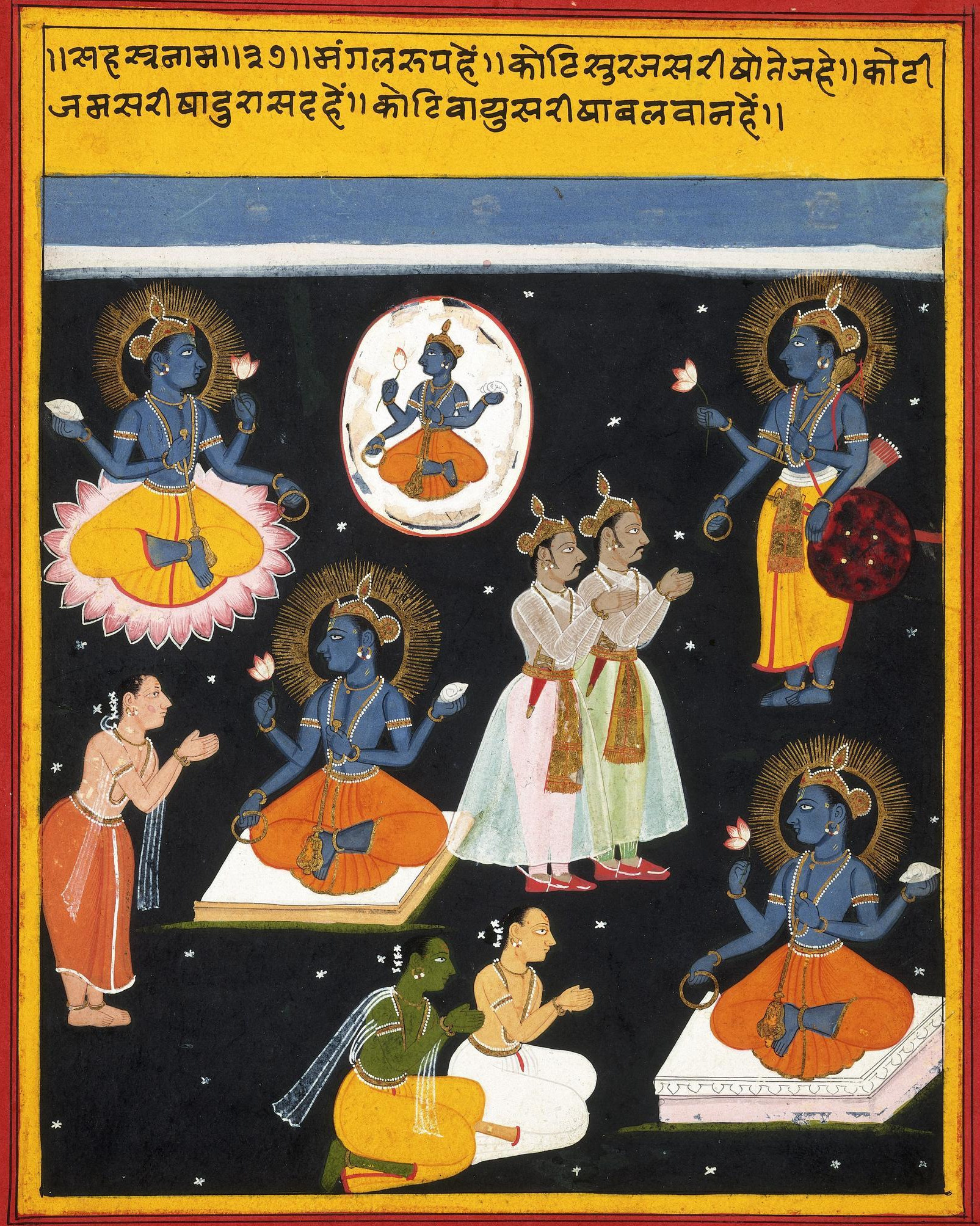
So, within seconds, a brief passing, I apologize with sturdy feet. My breath is steady, and at once I am relieved from my internal night, the concave flexing of cavernous rock, a burden of upended implosive tension. The wilds burn with stolid elasticity and I am inflamed with a secondary respite, at seeing my name lit towards the ceiling, and reacting with confident force, eyeing my winnings; a recognition of literary achievement, in multiple categories, standing beside renowned academics and independent artists of creative literacy.

Vishnu sahasranama manuscript by Anonymous 
I am bedecked with opulent outfitting, and walk to receive my medals with an ostentatious headdress and unnatural clothing. A blathering fake of heady fame, I steal through the tables clumsily and jeopardize the entire name, quickly hiding in the utter obscurity of another day. 
_________
A gourd filled with smoke speaks in a voice,

          Human,
A mindless bowl
                    of mirth
                             inflamed

glasses grow cold in the unheated concrete glue,
                    a fixture of the dead past

a golden consumer begs with a throat full of tears

in front of speakers
                 throbbing with broken-hearted names
                 burning up in a heat of worldly instrumentation,

transcending this same-self curse
                 with a storied high
                        of nameless voice
...
a spiritual womb formed
                        at the fingertips of an artist healer
                                     pursuing the groove of an epoch
                                     stolen from the mind of silent law

in a world’s motionless yearning

                 from afar

in the dark
fearless
night

excerpt from "A Joke Downstairs"


Saturday, 8 October 2011

Crash on the Mountain traveling to Coastal Vibration


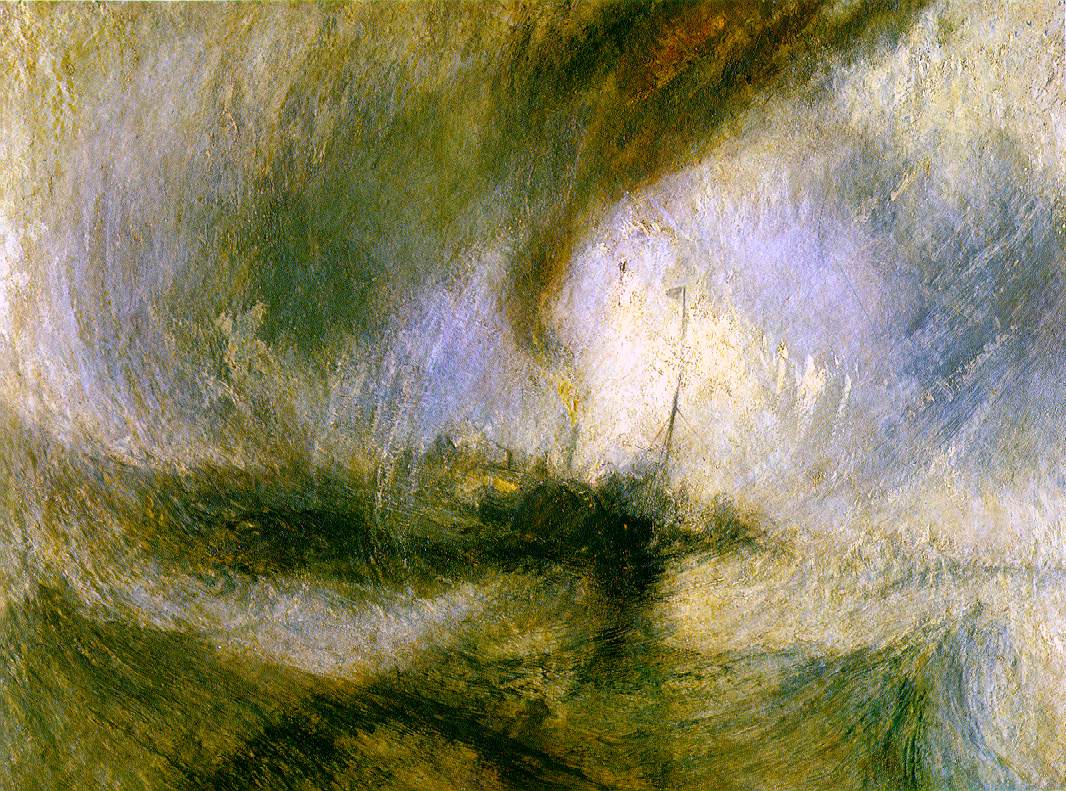
Snowstorm by Jospeh Mallord William Turner


I wake slowly, as if to fade from white, in a crashed helicopter on a snowy mountainside. The mountain is immense, with drifting snow and endless depressions and plateaus that show a premature horizon, not unlike a ski hill. I walk alone, as a sole survivor down to the base of the mountain. At the base, I find a house occupied by an East Indian family who seem active in the military, as a man proceeds from the house in uniform. Though I am hurt, and look foreign to them, they barely notice as I ask for their help next to their low fencing around their estate. The lady within the grounds of the house suddenly notices me, however there is no exchange, I could be invisible. Suddenly I find a small vehicle, similar to a scooter, however powered and able to push through the snow.

Next, I am in what seems as a coastal village in Egypt or Mexico or a place similar. I seem to have lost my powered scooter, however I see them around the village in different forms. The village, in some ways, appears to look like Sayulita, Mexico or Abu-Seer, Egypt. There are children running about and I befriend two young women about my age. These two young women remind me of two young women I met in Mexico City, Mexico. One of them is more fair-skinned and the other with dreadlocks and a bit of a darker character in general. I become somewhat attached to them as they help me around the village to find a powered scooter that is available. I find one within someone’s small yard near to a river and leave the girls behind.

Next, I am in a classroom style room, however without standardized desks, and the front of the room is occupied with a band. The band is very talented, playing mathematically-timed jazz/rock type music. The keyboardist is the front man and leads the band. I enjoy the music. After the show, the keyboardist begins to speak about the music, and the audience opens for questions.

Later, I meet the keyboardist at a bar/restaurant on Stephen Ave. in Calgary, AB. I don’t order any alcohol; however he is drinking and sits beside me. I compliment him on his music and we engage in steady conversation. I ask about the inner dynamics of his music and he accommodates my questions well. I then tell him that I am part of a music project with my wife. I introduce him to her instrument, the Chinese zither, and say that I play an Egyptian doumbek drum.  He is intrigued, however when I say that we only improvise and play spontaneously he says that he can not do that, which I can understand from listening to the highly methodical nature of the music.

Sept. 30, 2011