Primarily a writing exercise, this dream journal-inspired blog is a quiet introspective sojourn into the process that we traverse in going from private dream to public art. I see our dreaming as an internalized mythmaking. As I philosophize and expressively exhibit dreams, both private and public, I encourage and delight in creative language as a way to practice experiential metaphors through a “public dreaming." Writing Theory: Creative Dream Fiction
Showing posts with label book. Show all posts

Monday, 26 August 2013

Becoming Yours: Creative Origins in the Music of a Silent Love


"I really just want to help people understand you can go and get those things you want. I mean I was a bodybuilder for a while, I was a personal trainer, I did boxing, I worked as a bouncer, I, you know, started writing, did the creative writing, got an MFA, started my own literary magazine. Now, I'm doing the vagabonding thing, started my own blog, now Facebook page. It's like you really can go and like do all these different things, you just have to be wiling to make some sacrifices and just realize you can do things you've dreamed about doing. And I think all my life, this is the life I wanted. This is the life I wanted, where it's like I'm constantly learning." Jonathan Starke, vagabond writer and founding editor of Palooka Magazine

A Modern Odyssey of Vocation by Rusty Kjarvik 

Essay for “Book that Changed my Life” segment on The Drunken Odyssey with John King, written for the book of Nikos Kazantzakis, The Odyssey: A Modern Sequel

I was 18 years old, returning to my mother’s south shore home in Massachusetts after my first few months away at university. It began one evening, at the end of a series of meditations, where, motionless, I re-conceived the magic psalms of Ginsberg’s elemental void, the enlightened palms of Snyder’s versified mudras and the delicate alms of Kerouac’s prosaic spontaneity. In the pitch darkness, I wrote, “Tat Tvam Asi” on the wall with my trusty writing pencil. “You are it!” translated Alan Watts, whose English clarity rung through my mind with echoing resonance, reverberating interminably to the next day, when I had read every word on my bookshelf and sought more. 

I set out, to the library of my Greek-Jewish Romaniote grandfather; whose literary meditations on the healing properties of the written word had sent him unscathed from World War II to the centenarian desk. There he sat, with a penknife shakily opening letters as his Polack Jewess wife screamed from the downstairs banister. “Take whatever you want!” He spoke over the long-winded cacophony of domestic affairs. In the name Kazantzakis, I saw another Greek, an ancestral voice unperturbed by the walled house.

In a moment of intuition, scanning through the compendium of classics, I chose The Odyssey: A Modern Sequel. Crouched inside my off-white walls, completely bare if not for the Sanskrit scribble and a prized first draft poem hanging deliriously like a whitewashed door of perception. I began reading everything – the copyright date, the ISBN code, and every insignificant character in between. 

Smashed skulls, bespattered bowels and upended spines weaned my consciousness from a walled indoor adolescence. My mind voyaged onward into the travails of a maturing intellect. Spawned with a Greek flair for disinhibiting fleshly experience, I read with a burning momentum. I needed to feel each word pulsate its rhythms of modern wisdom into every minutiae of my being. I began reciting, with the quickening taste of the classical orator, moved by the enigmatic grandeur of such literary quality. Soon, it was dusk, and the tired footsteps of my stepfather climbed the stairs to rest his weary skull on a pillow of televised static.

Reading, reciting, orating, on and on and into my pores sunk the blood of the fallen men and raped women, and from my nostrils leaked the icy salt of the Mediterranean seas. I wept with unspoken clarity for the emotional barbarism of modern spiritual greed! 

At a break in the violent awe, I spoke sweet lines of sexual camaraderie. Women’s voices formed on my dry tongue as the fecund prosperity of mortal despair. In those tempestuous rhythms, my drunken brother stumbled longingly upstairs to lust in the barfly haven of suburban coitus.   

Undeceived, unwilling to desist, I read on, with soft muttering in the depths of red twilight as Morpheus, the Greek god of sleep, laid the house to rest. In my empty hollow, I swam to the subterranean netherworlds of the creative subconscious. Emerging, still as ever, with the light of morning, my mother’s knock could not startle my ever-strengthening concentration. 

I savored each of the 33,333 17-syllable verses as a ripe, freshly picked Kalamata olive, cleansing my palate, as with my cognitive sensibility. The unique versification of Kazantzakis’ voice led me onward into the depths of creative literacy, as I relished on his startlingly characteristic use of nouns, at once subjectively descriptive, while aesthetically presented with the definitive tone of proverbial lists. His “Cretan glance” remains unmatched in modern literature, evoking the spirit of the Mediterranean as an invocation to the deified ancestral hearth of earthly humanity: the book. 

On reading the final character, I threw the book into the air and sprang from my narrowing walls before the book crashed onto an unlit lamp. Visiting relatives, weakly frightened, noticed my sorry state, and their misguided sympathies amplified under the crushing noise of broken glass. 

After being handed a Greek salad, to end my bookish fast, I greeted my grandfather, whose smile shone with mutual respect and ancestral fraternity, as two men of pure literacy. Outside, a childhood friend stood to greet me. We had not seen each other since pre-pubescence. Her eyes, crooked, observed my own downward slant into the abnormal body of creative tradition. I was not mad, I was not sane, and yet, from that moment, her eyes told me what she could not. I was rapt, eternally in the powerful vocation of the word of silence and thought.    

This essay was featured in Episode 12 of The Drunken Odyssey with John King (1:22:50)
________________
Follower
Taken during the Calgary flood, this piece affirms communal living as a way to stay afloat. The onlooker, under the umbrella at the side of the picture stands proportioned as a much larger, enigmatic figure, showing how the individualistic and non-participatory way of life is much larger in our view. Yet, the smaller geese portrayed survive through such calamities that would forestall all of human life. This piece is dedicated to all the volunteers who helped out during the flood. 

Into
This piece revives a sense of mystery and adventure in the antique remnants of our city’s past as they continue into the present. So, in a sense, the very door itself offers an entry point, regardless of using it to enter the building. This piece is a practice in seeing that photographic art so meaningfully attempts to project for the seeing public. The city’s architectural heritage is reimagined through digital photography to capture the colorful beauty of the past, and to encourage everyone to see it in their daily lives at ground level. 
Lightly
An unaltered piece on perspective and contrast, this shot portrays the inner city perspective as immersed in a constant play of dwarfed and magnified artificial environments. Every great photographer must become a master of light, and yet, even the everyday bystander is subject to the subtle nuances and grand complexity of light and how the human eye perceives it. In order to further enhance the living experience of our city, we must pay attention to the power and effect of light and seeing. With the right contrast of shadow and light, we can see the way forward. 

Passage
 Shot on the Bleriot Ferry on the Red Deer River, the clarity of the flags over the oblong shapes and angular wirings on the ferry starkly contrast with the badlands horizon in the background. The contrast is not only in shape, but also in colour and texture, further emphasizing the newness of modern industrial technology to the land. The reflection of the badlands in the water is housed under the wiring for the lifeboat. The red of the ferryman’s jacket meld with the ocher stone and national flag, yet the provincial flag of Alberta stands taller and larger in the unworldly sky.   

Plaza
Taken at Olympic Plaza on Canada Day, the public was out in full form. The scene depicts Mayor Nenshi collecting impromptu charitable donations as the public crowds around him with money in hand to exemplify our compassionate, community spirit. On the horizon, the Calgary Municipal Building completes a semi-circular shape in continuity with the crowd below. The vibrant blue of the building matches the sky as if to emphasize the overarching presence of the municipal leadership, especially on that day, and especially with Nenshi’s leadership. The blue of the Alberta flag shows with a singular display, connecting the overall red color of the Canadian people to the local experience in Alberta, with special solidarity in light of the flood disasters.

Simplicity
A piece to reflect the feeling of cycling, this shot was taken on the riverfront bike path on bright and clear sunny day. The retouched colouring of the photo encourages the idea of each person experiencing and seeing the world through his or her own eyes. The ovular shape of the photo is meant to display the image as if directly seen through the eye of the seer. Light touches of white glow against the tips of the tree as sparse clouds drift.  


Solitude
Also taken during the Calgary flood, the image intends to capture the vibrant and intense presence of water, and the Bow River more specifically, entering our daily lives. What was once an anthropocentric, urban reality has become a very real connection to the presence and power of nature in her greatest manifestation. We cannot now go about our daily lives, nor even cross the street as this picture conveys, without being at least somewhat submerged in the omnipresence of the natural environment.  

Ancients
Set during Canada Day Pow-Wow at Olympic Plaza, my wife modeled under the spiraling flue of a magnificent, traditional tipi. The photograph emphasizes the Four Colours (yellow, white, black and red). Human life, within the womb of domesticity is constantly immersed in the sacred hoop of the Medicine Wheel, representing the Four Directions, Colours and Humours, among other symbolisms. The human figure is silhouetted in black, in connection to the black outline of at the very apex of the tipi. In this way, humanity represents the closest connection that we would have to the greater life in the original circle above, represented by the greenish-blue of the sky beginning the circular form of the tipi’s shape around the standing human form. 

Civilization
 Taken on a rooftop above Stephen Avenue. The image invigorates metaphors of the great urban passage through civilization in the shapes of modernity and industry in the 21st century. This piece highlights Calgary’s inner city architecture as from within, looking out through a small rectangular break in the multicolored, almost prismatic shapes of the contemporary building, as it were, virtually closing in. Yet, the sensational digital display is alluring and captivates with a fantastic beauty. Below, subterranean shapes represent the surfacing below, a whole image of the city as a living being. 


Danger
During a music video shoot not far outside of the city of Calgary, this still captures the remains of a true-life crash landing. Further dramatized by the winter prairie landscape in the background, the grounded plane conveys a sense of isolation. The remote and forgotten remains of a crash-landed plane convey a sense of warning to a society needing to avert its course, even if it may feel it is flying, and instead embrace greater diversity in transportation, such as cycling. 

Direction
Like much of my photography, there is often a central focus made blatantly apparent. Similarly, this shot invites viewers to remain true to a course that goes in peace with the natural environment. Even though there is an arrow pointing (with as strong a sign as any) in one direction, we need not always follow it. Instead, like the goose in the picture, we might simply sit on it, and reflect over the calm, natural flow of things as they are. 


Emerge
This piece speaks to the introverted, indoor culture of Calgary created by our housing, and, equally, by a harsh climate. Yet, this photo affirms the emergence of the public figure, to brave the weather and to go beyond the domestic sphere and simply get out. The photo embraces the creation of an extroverted, outdoor culture that is ready to move from isolation to community as the developing maturity of a young city. 
_________________


"Journeys end in lovers' meeting" wrote Shakespeare in the comedy, Twelfth Night. All the more so when the journeying are lovers of music! And so, the saying, "I'll see you on the other side" is expressed in the pure creativity of Earth and Sky, of rhythm and wind, of bone and breath, wherein musicians enter and emerge from the collective realm of collaborative unity through the essence of sound as beat, melody and harmony.

And in the above recording, a serendipitous connection forms between two lovers of music across the expanse of the Atlantic sea. From Barcelona to Boston to Calgary to Vietnam, windswept and travelling to the Chinatown home of two artist-seers of sound and light, we anchored our minds in the vast breadth of the true love that rests in our hearts. Improvising on the rhythmic influences of African blues, intermingled with Cuban folk music and original hymns of Catalonia through the instrumentations of guitar and voice (El Toubab), zheng (Vi An), together with my xaphoon and percussion.

The recording above represents one of the larger productions and mixings that I have engineered through collaboration, as opposed to my solo project, Mister E. Menachem. At first, I was inspired to reach back through the catalogue of recorded memory through field recordings of concerts, jams, cafe moods and late-night stirrings. Listen below for a collection of such recordings. Their wealth of emergent intonation in the voice of a flowering mind speaks tales and tomes of innocence and experience, of the extrovert amateur and introspective auteur, of the public artist and private dreamer.

After reflecting on the raw grit of creativity in the burgeoning flesh of a new community, a new movement, an incipient birth of open life, we see the whole society unvarnished. As the economy becomes more and more a blasphemous term of bitter and cold forewarning, the heart deepens and the mind sharpens. Look around. In every corner of the world there are shadows. Gold and oil are self-destructing through a mutual phase-out, blurred by irrelevance.

Each and every one has, and are part of, only one life. As I wrote in the essay, A Modern Odyssey of Vocation, "I was not mad, I was not sane, and yet, from that moment, her eyes told me what she could not. I was rapt, eternally in the powerful vocation of the word of silence and thought." SoJourn(al) is an offering of time to explore the inner space (the dream space) where the natural watercourse way of existence merges with the choice to be in unity with all of creation; the way of the wise fool, the blind seer, and the musician...of silence.    


Saturday, 26 January 2013

Talmud and Dream Interpretation: Thoughts of a Secular-Cultural Jew

Talmud Readers by Adolf Behrman
“Dreams which are not interpreted are like letters which have not been opened.” Talmud

I am a cultural Jew, a secular Jew, an ethnic Jew. As singer Arianne Zuckerman once said, I am "Jew-ish". Yet, I revere the tradition of the Talmud. As far as I know, it is the source of a great wealth of pride in the intellectual strength and heartened closeness to tradition that Jewish people have maintained throughout generations. We have kept our traditions intact because we are flexible. The Talmud is a massive compendium of volumes steeped in argumentation, discussion, rhetoric and criticism on the sacred text of the Torah. The Old Testament is not Old, it is vivified by thousands of years of continuous self-criticical analyses and contemplative thought. The Talmud is the tradition of intellectual meditation on the sacred word. No wonder why dream interpretation is honoured, as the Talmud is one of the oldest forms of imaginative interpretation known in book form. For more in-depth understanding of this quote, see Erich Fromm's work "Forgotten Language."
__________
An old woman sits languorous outside the concert hall entranceway. Her excessive body weight slumps over a barstool with the heaping fatigue of an overworked heart. Yet, in her eye, there is a glint of sound reason, a harmonious vocation towards authentic humanity. I stop for a moment to share a few words with the curious and unseemly woman.

Woman playing a kithara by Anoniem
(Wall painting from Room H of the Villa of P. Fannius Synistor at Boscoreale)
I become so filled with sympathy for her life story. I run out onto the street, looking for a candy that I recently became aware that she enjoys. All I can find is a broken piece of chocolate on a dirty sidewalk. In my nervous frustration, I dust off the candy and walk back into the hallway. As I step cautiously through the alleyway to the concert hall, a man a few years my elder feels he must give a word of advice.

Two women at the street by Ernst Ludwig Kirchner
"There is no sense in your sympathy," he affixes his language to my throat like the strangling inexorability of truth. "I've heard too many racial slurs from the mouths of your likening. You'd like to give back, and yet you cry on a pedestal," he musters an incendiary rage, of darkening complexion under the flickering streetlamp. "How many times have I heard your story, I'm Jewish, so I can empathize," he continues unalloyed. "And when you speak of G-d, I am utterly disgusted."
____________
The Italian connection, un-swayed by the prudent fire of tango nights
       stirring wilderness roosts
                in the back hall of some sterling porch façade
                in the mundane sky of an after-party dimming
                       beside alcoholic whiteout praise
                       and the ruined name.

excerpt from "The ruined name"

Saturday, 12 January 2013

A Battle For Wits: Ray Bradbury and The Illiterate Fires of Modernity

Philosophy and Christian Art by Daniel Huntington
 "I've got to read, I've got to catch up with the remembrance of the past!" Fahrenheit 451 (film)

The principal character, Montag, in the 1966 film adaptation of Ray Bradbury's Fahrenheit 451, by Francois Truffaut, says these lines before he dreams a nightmare. After breaking up a sterile grouping of house guests, who on being exposed to literature become fraught with the anxiety of original thought and complex emotions, his work as a book burner turns into a twisted night haunt. Ray Bradbury, author of the book, may have been alluding to much more than a simple prediction of a neo-Fascist regime burning books as did the Nazis, and other demented social movements throughout history. Note the Ancient Library of Alexandria. How much of our conscious memory collective was turned to cinder and dust. With the influx of new media, we are losing our grip on the greater part of human contact, that with the historical mind, descending with the literature of the ages into the fires of mass ignorance.  
_____________
Waking proof stirs the realms of the collective-creative imagination with inner-brewing mystery. 
Fahrenheit 451 Resurgence by Rusty Kjarvik 
Fire at the End of the Tunnel by Rusty Kjarvik 
Sail into the Flames by Rusty Kjarvik 
The Last House on Earth by Rusty Kjarvik
Broken Chinatown Lamp by Rusty Kjarvik
____________
Kneaded breathless
Behind television predilections

Guessing at the racy night
Caught in a frozen web-tied lesson

To shoot pyrotechnic tides over the urban mind
Digging into a buttressed yurt, cold

excerpt from "One Ambitious Species"


CHECK my latest Sketches of Style publication with Randomly-Accessed-Poetics 


Tuesday, 25 December 2012

Season's Greetings from the Wilderness of the Imagination

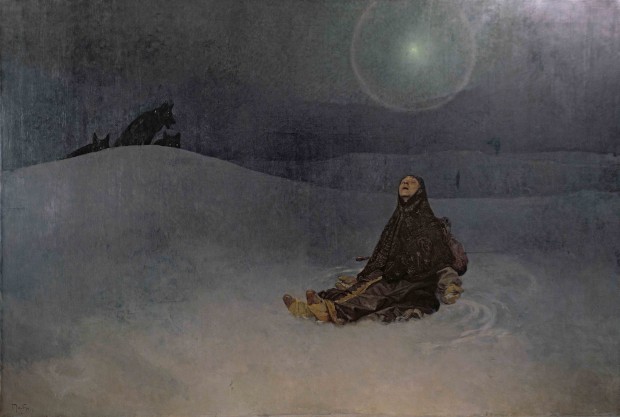
Woman in the Wilderness, Star or Siberia by Alfons Mucha 
“Listen: in dreams and particularly in nightmares, caused by indigestion or whatever you like, a man sometimes sees such artistic things, such a complex and actual reality, such events, or even a whole world of events, woven into such a plot, full of such astonishing details, beginning with he most exalted manifestations of the human spirit to the last button on a shirt-front that, I assure you, not even Leo Tolstoy could have invented it, and yet such dreams are sometimes seen not by writers but by the most ordinary people, civil servants, newspaper columnists, priests…” Fyodor Dostoyevsky in The Brothers Karamazov, p. 751-2
I recently read the last masterful work of Dostoyevsky, one of the world's greats of classic literature. The book is a testament to the sheer mental strength and quality of such a writer as experienced a mock execution ritual and incarceration in the labor camps of 19th century Siberia. Nearly one thousand pages, I received a copy of this masterpiece from a friend with a peculiar literary collection practice. The two volumes within which the book is contained were of different publications, yet corresponded to the page. This friend, while often aloof, has been a great literary mentor and companion. And as a final note, during the holiday season, I feel that Dostoyevsky's inkling as quoted above invigorates our lives especially today. The popular cult of the Christmas tree and its European folklore breeds a kind of mundane public dreaming, where the workers of the world unite in myth and imagine a complex world full of reindeer, gifts and traditions fabricated from the ordinary, to the ordinary. 
_________  
I have not remembered. Feelings unfamiliar slip away with the light of the world. Yet, in my waking night, before a small crowd of onlookers, I played along to my imagination, manifest with the unconscious origination of a dream reality. 

Whirling Dervishes by Jean-Leon Gerome
I swung Near Eastern rhythms towards her vibrating zither with emotive haste. As I felt the sway of awe form in my hands and heart, a lightness filled the room. I saw. A Sufi dervish began whirling. The air moved in circular deftness to my rhythmic accompaniment. The dancing figment continued unalloyed by the uninitiated crowd of the living; those led to dream only in the deepest dark of night. 
_________
Freeing the foundations of homeward longing onto a single raft
Out on the high seas,
A perplexed guide of Jewish law

Betrayed in the relaxed mystic fire
An American marijuana-seeding mind, Nepalese beauty
Direct from the magic psalm pinned against a “Tat Tvam Asi” wall

Frail pencil marks casting the Odyssey’s modern sequel
Into a vulnerable fasting mind, bled forth into the marathon sky
Massachusetts rain, following me to Calgary in rare consecutive days

Our literary giants, peering upwards, finally
In a New England fog haze through the mirrored mushroom mind
Whose perception flowered into feared atomic explosions

The true sexual freedom in nature
To lay soft stonework ground,
Firm with utterly expressed wonder at the world ‘round

Knowledge timed perfect with musical escapism
Into the bold motionless greed of a trapped metallic girl,
Re-born as prophetess in the unknown seed of Western belief

excerpt from "Grand Repertoire of Failure"


Tuesday, 27 November 2012

Enduring Towers' Crash in district.Columbia

After a three-day debacle (two very eerily appropriate document crashes), I've finally completed another full online version of the experimental writing collection titled, district.Columbia. At last, overcoming major technological crises along the way, the labours of my passion have come to fruition. The work is free for the creative reading pleasure of all. May the enduring inspiration to share my love of poetic art pass through you.

district.Columbia

I am continuing to offer book length collections to mark the completion of their excerpted contextualization within the creative fields of dream fiction and various intercultural reflections that I post once every two days on SoJourn(al).

The compiling of this collection has seen very interesting public development, as well as private. The art and accompanying writing is featured on OutwardLink.

"Untrained Timeless Tuning", one of the pieces revised for this newly edited and compiled collection, is published with Poydras Review. "Lugubrious background nearing an electromagnetic haze", another piece herein, will be forthcoming with Rio Grande Review in December 2012.

Wednesday, 29 August 2012

A New Settlement for Exotic Settlers

Exotic Settlers


Dear Bloggers, Dreamers and Visitors,

For those of you who have been following my blog thus far (or at least passing by to bear witness), I like to follow a series of excerpts from my experimental writing collection with the gift of a compiled book. Please read and download for your interpretive readings and creative pleasures!


Reception for "Exotic Settlers" to date:

Writing

monosexuality - The Poetic Pinup Revue (February 2012, print)


(1) how in the year of the rabbit, the pure still need things
(2) I drank in the stupor
(3) interpretive direction
(4) where is the mind in life?


Steel Bananas Art Collective (April 2012, Issue #29)


Art

The New Post Literate: A Gallery of Asemic Writing (April 2012)

Eskimo Pie: Sacramento Poetry, Art and Music (July 2012)

scissors and spackle (October 2012, Issue IX)