Primarily a writing exercise, this dream journal-inspired blog is a quiet introspective sojourn into the process that we traverse in going from private dream to public art. I see our dreaming as an internalized mythmaking. As I philosophize and expressively exhibit dreams, both private and public, I encourage and delight in creative language as a way to practice experiential metaphors through a “public dreaming." Writing Theory: Creative Dream Fiction
Showing posts with label publishing. Show all posts

Monday, 26 August 2013

Becoming Yours: Creative Origins in the Music of a Silent Love


"I really just want to help people understand you can go and get those things you want. I mean I was a bodybuilder for a while, I was a personal trainer, I did boxing, I worked as a bouncer, I, you know, started writing, did the creative writing, got an MFA, started my own literary magazine. Now, I'm doing the vagabonding thing, started my own blog, now Facebook page. It's like you really can go and like do all these different things, you just have to be wiling to make some sacrifices and just realize you can do things you've dreamed about doing. And I think all my life, this is the life I wanted. This is the life I wanted, where it's like I'm constantly learning." Jonathan Starke, vagabond writer and founding editor of Palooka Magazine

A Modern Odyssey of Vocation by Rusty Kjarvik 

Essay for “Book that Changed my Life” segment on The Drunken Odyssey with John King, written for the book of Nikos Kazantzakis, The Odyssey: A Modern Sequel

I was 18 years old, returning to my mother’s south shore home in Massachusetts after my first few months away at university. It began one evening, at the end of a series of meditations, where, motionless, I re-conceived the magic psalms of Ginsberg’s elemental void, the enlightened palms of Snyder’s versified mudras and the delicate alms of Kerouac’s prosaic spontaneity. In the pitch darkness, I wrote, “Tat Tvam Asi” on the wall with my trusty writing pencil. “You are it!” translated Alan Watts, whose English clarity rung through my mind with echoing resonance, reverberating interminably to the next day, when I had read every word on my bookshelf and sought more. 

I set out, to the library of my Greek-Jewish Romaniote grandfather; whose literary meditations on the healing properties of the written word had sent him unscathed from World War II to the centenarian desk. There he sat, with a penknife shakily opening letters as his Polack Jewess wife screamed from the downstairs banister. “Take whatever you want!” He spoke over the long-winded cacophony of domestic affairs. In the name Kazantzakis, I saw another Greek, an ancestral voice unperturbed by the walled house.

In a moment of intuition, scanning through the compendium of classics, I chose The Odyssey: A Modern Sequel. Crouched inside my off-white walls, completely bare if not for the Sanskrit scribble and a prized first draft poem hanging deliriously like a whitewashed door of perception. I began reading everything – the copyright date, the ISBN code, and every insignificant character in between. 

Smashed skulls, bespattered bowels and upended spines weaned my consciousness from a walled indoor adolescence. My mind voyaged onward into the travails of a maturing intellect. Spawned with a Greek flair for disinhibiting fleshly experience, I read with a burning momentum. I needed to feel each word pulsate its rhythms of modern wisdom into every minutiae of my being. I began reciting, with the quickening taste of the classical orator, moved by the enigmatic grandeur of such literary quality. Soon, it was dusk, and the tired footsteps of my stepfather climbed the stairs to rest his weary skull on a pillow of televised static.

Reading, reciting, orating, on and on and into my pores sunk the blood of the fallen men and raped women, and from my nostrils leaked the icy salt of the Mediterranean seas. I wept with unspoken clarity for the emotional barbarism of modern spiritual greed! 

At a break in the violent awe, I spoke sweet lines of sexual camaraderie. Women’s voices formed on my dry tongue as the fecund prosperity of mortal despair. In those tempestuous rhythms, my drunken brother stumbled longingly upstairs to lust in the barfly haven of suburban coitus.   

Undeceived, unwilling to desist, I read on, with soft muttering in the depths of red twilight as Morpheus, the Greek god of sleep, laid the house to rest. In my empty hollow, I swam to the subterranean netherworlds of the creative subconscious. Emerging, still as ever, with the light of morning, my mother’s knock could not startle my ever-strengthening concentration. 

I savored each of the 33,333 17-syllable verses as a ripe, freshly picked Kalamata olive, cleansing my palate, as with my cognitive sensibility. The unique versification of Kazantzakis’ voice led me onward into the depths of creative literacy, as I relished on his startlingly characteristic use of nouns, at once subjectively descriptive, while aesthetically presented with the definitive tone of proverbial lists. His “Cretan glance” remains unmatched in modern literature, evoking the spirit of the Mediterranean as an invocation to the deified ancestral hearth of earthly humanity: the book. 

On reading the final character, I threw the book into the air and sprang from my narrowing walls before the book crashed onto an unlit lamp. Visiting relatives, weakly frightened, noticed my sorry state, and their misguided sympathies amplified under the crushing noise of broken glass. 

After being handed a Greek salad, to end my bookish fast, I greeted my grandfather, whose smile shone with mutual respect and ancestral fraternity, as two men of pure literacy. Outside, a childhood friend stood to greet me. We had not seen each other since pre-pubescence. Her eyes, crooked, observed my own downward slant into the abnormal body of creative tradition. I was not mad, I was not sane, and yet, from that moment, her eyes told me what she could not. I was rapt, eternally in the powerful vocation of the word of silence and thought.    

This essay was featured in Episode 12 of The Drunken Odyssey with John King (1:22:50)
________________
Follower
Taken during the Calgary flood, this piece affirms communal living as a way to stay afloat. The onlooker, under the umbrella at the side of the picture stands proportioned as a much larger, enigmatic figure, showing how the individualistic and non-participatory way of life is much larger in our view. Yet, the smaller geese portrayed survive through such calamities that would forestall all of human life. This piece is dedicated to all the volunteers who helped out during the flood. 

Into
This piece revives a sense of mystery and adventure in the antique remnants of our city’s past as they continue into the present. So, in a sense, the very door itself offers an entry point, regardless of using it to enter the building. This piece is a practice in seeing that photographic art so meaningfully attempts to project for the seeing public. The city’s architectural heritage is reimagined through digital photography to capture the colorful beauty of the past, and to encourage everyone to see it in their daily lives at ground level. 
Lightly
An unaltered piece on perspective and contrast, this shot portrays the inner city perspective as immersed in a constant play of dwarfed and magnified artificial environments. Every great photographer must become a master of light, and yet, even the everyday bystander is subject to the subtle nuances and grand complexity of light and how the human eye perceives it. In order to further enhance the living experience of our city, we must pay attention to the power and effect of light and seeing. With the right contrast of shadow and light, we can see the way forward. 

Passage
 Shot on the Bleriot Ferry on the Red Deer River, the clarity of the flags over the oblong shapes and angular wirings on the ferry starkly contrast with the badlands horizon in the background. The contrast is not only in shape, but also in colour and texture, further emphasizing the newness of modern industrial technology to the land. The reflection of the badlands in the water is housed under the wiring for the lifeboat. The red of the ferryman’s jacket meld with the ocher stone and national flag, yet the provincial flag of Alberta stands taller and larger in the unworldly sky.   

Plaza
Taken at Olympic Plaza on Canada Day, the public was out in full form. The scene depicts Mayor Nenshi collecting impromptu charitable donations as the public crowds around him with money in hand to exemplify our compassionate, community spirit. On the horizon, the Calgary Municipal Building completes a semi-circular shape in continuity with the crowd below. The vibrant blue of the building matches the sky as if to emphasize the overarching presence of the municipal leadership, especially on that day, and especially with Nenshi’s leadership. The blue of the Alberta flag shows with a singular display, connecting the overall red color of the Canadian people to the local experience in Alberta, with special solidarity in light of the flood disasters.

Simplicity
A piece to reflect the feeling of cycling, this shot was taken on the riverfront bike path on bright and clear sunny day. The retouched colouring of the photo encourages the idea of each person experiencing and seeing the world through his or her own eyes. The ovular shape of the photo is meant to display the image as if directly seen through the eye of the seer. Light touches of white glow against the tips of the tree as sparse clouds drift.  


Solitude
Also taken during the Calgary flood, the image intends to capture the vibrant and intense presence of water, and the Bow River more specifically, entering our daily lives. What was once an anthropocentric, urban reality has become a very real connection to the presence and power of nature in her greatest manifestation. We cannot now go about our daily lives, nor even cross the street as this picture conveys, without being at least somewhat submerged in the omnipresence of the natural environment.  

Ancients
Set during Canada Day Pow-Wow at Olympic Plaza, my wife modeled under the spiraling flue of a magnificent, traditional tipi. The photograph emphasizes the Four Colours (yellow, white, black and red). Human life, within the womb of domesticity is constantly immersed in the sacred hoop of the Medicine Wheel, representing the Four Directions, Colours and Humours, among other symbolisms. The human figure is silhouetted in black, in connection to the black outline of at the very apex of the tipi. In this way, humanity represents the closest connection that we would have to the greater life in the original circle above, represented by the greenish-blue of the sky beginning the circular form of the tipi’s shape around the standing human form. 

Civilization
 Taken on a rooftop above Stephen Avenue. The image invigorates metaphors of the great urban passage through civilization in the shapes of modernity and industry in the 21st century. This piece highlights Calgary’s inner city architecture as from within, looking out through a small rectangular break in the multicolored, almost prismatic shapes of the contemporary building, as it were, virtually closing in. Yet, the sensational digital display is alluring and captivates with a fantastic beauty. Below, subterranean shapes represent the surfacing below, a whole image of the city as a living being. 


Danger
During a music video shoot not far outside of the city of Calgary, this still captures the remains of a true-life crash landing. Further dramatized by the winter prairie landscape in the background, the grounded plane conveys a sense of isolation. The remote and forgotten remains of a crash-landed plane convey a sense of warning to a society needing to avert its course, even if it may feel it is flying, and instead embrace greater diversity in transportation, such as cycling. 

Direction
Like much of my photography, there is often a central focus made blatantly apparent. Similarly, this shot invites viewers to remain true to a course that goes in peace with the natural environment. Even though there is an arrow pointing (with as strong a sign as any) in one direction, we need not always follow it. Instead, like the goose in the picture, we might simply sit on it, and reflect over the calm, natural flow of things as they are. 


Emerge
This piece speaks to the introverted, indoor culture of Calgary created by our housing, and, equally, by a harsh climate. Yet, this photo affirms the emergence of the public figure, to brave the weather and to go beyond the domestic sphere and simply get out. The photo embraces the creation of an extroverted, outdoor culture that is ready to move from isolation to community as the developing maturity of a young city. 
_________________


"Journeys end in lovers' meeting" wrote Shakespeare in the comedy, Twelfth Night. All the more so when the journeying are lovers of music! And so, the saying, "I'll see you on the other side" is expressed in the pure creativity of Earth and Sky, of rhythm and wind, of bone and breath, wherein musicians enter and emerge from the collective realm of collaborative unity through the essence of sound as beat, melody and harmony.

And in the above recording, a serendipitous connection forms between two lovers of music across the expanse of the Atlantic sea. From Barcelona to Boston to Calgary to Vietnam, windswept and travelling to the Chinatown home of two artist-seers of sound and light, we anchored our minds in the vast breadth of the true love that rests in our hearts. Improvising on the rhythmic influences of African blues, intermingled with Cuban folk music and original hymns of Catalonia through the instrumentations of guitar and voice (El Toubab), zheng (Vi An), together with my xaphoon and percussion.

The recording above represents one of the larger productions and mixings that I have engineered through collaboration, as opposed to my solo project, Mister E. Menachem. At first, I was inspired to reach back through the catalogue of recorded memory through field recordings of concerts, jams, cafe moods and late-night stirrings. Listen below for a collection of such recordings. Their wealth of emergent intonation in the voice of a flowering mind speaks tales and tomes of innocence and experience, of the extrovert amateur and introspective auteur, of the public artist and private dreamer.

After reflecting on the raw grit of creativity in the burgeoning flesh of a new community, a new movement, an incipient birth of open life, we see the whole society unvarnished. As the economy becomes more and more a blasphemous term of bitter and cold forewarning, the heart deepens and the mind sharpens. Look around. In every corner of the world there are shadows. Gold and oil are self-destructing through a mutual phase-out, blurred by irrelevance.

Each and every one has, and are part of, only one life. As I wrote in the essay, A Modern Odyssey of Vocation, "I was not mad, I was not sane, and yet, from that moment, her eyes told me what she could not. I was rapt, eternally in the powerful vocation of the word of silence and thought." SoJourn(al) is an offering of time to explore the inner space (the dream space) where the natural watercourse way of existence merges with the choice to be in unity with all of creation; the way of the wise fool, the blind seer, and the musician...of silence.    


Monday, 29 April 2013

Sexuality and the Self: A Walk Through Chaplin's Dreamland of Innocence


"Dreamland...Sin creeps in...Trouble begins...Innocence...Getting flighty...Jealousy..." concluding titles in Chaplin's The Kid

The penultimate scene in Chaplin's first feature as an auteur filmmaker brings the viewer into "Dreamland" an alternate world parallel to the slums of old America, where all the principal characters from the film are winged angelic humans, swayed by the ear-whisperings of stereotypical devil sprites prancing about unnoticed. Could Chaplin have been privy to the hermeneutical notion that angels and demons are internalized expressions of our inner nature, mirroring social experience within the self-reflective subconscious, a key to an awakening, which resolves such impacting triumphs as the orphan child reuniting with their birth mother? Could Chaplin's narrative insights on film have preceded psychoanalytic depth by seeing the substance of dream as holistic self-projection, and at the same time, maintains unrivaled importance for transforming the collective psyche? 

Alan Watts is famously known for relaying the following psychological narrative, an interrogative entry into the presence of mind, as it wanders through the imaginative hollows of two overarching conceptions, past and future, and their nexus of alternate psychic fruition in the netherworld of dream. 
"Let's suppose that you were able, every night, to dream any dream you wanted to dream. And that you could, for example, have the power, within one night, to dream 75 years of time, or any length of time you wanted to have. And you would naturally as you began on this adventure of dreams, you would fulfill all your wishes, you would have every kind of pleasure you could conceive. And after several nights of 75 years of total pleasure each, you would say that's pretty great, and now let's have a surprise. Let's have a dream that isn't under control. Where something is going to happen to me that I don't know what it's going to be. And you would dig that and come out of that and say, Wow, that was a close shave wasn't it. And you would get more adventurous and you would make further and further out gambles, and finally you would dream where you are now." 
Like a silent film, dream is also suggestive. The act of play is a prerogative of metaphorical truth, and finally, where chaos is a principle which reveals Self as the All-Self, Alan Watts, reminds us, "The whole nature of the Godhead is to play that he is not. In this idea then, everybody is fundamentally the ultimate reality...God in the sense of being the self, the deep-down-basic whatever it is. And you're all that, only you're pretending you are not." Dreaming is a doorway to a revelation of the nature of self as All, where we confront the play-form of creation as an inner process of personal creativity, as the embodiment of a creative mind. 

While we go about our "waking lives" fully immersed in the, "I am not that" attitude, the nightly vigil of our inborn collective life, our subtle creative instinct, bleeds with singular potency throughout the periphery of waking experience. In dream, we remember who, and what, we are: the stuff of play, Lila, in Sanskrit. There is a story of the seeker who goes to a guru and staring into the face of the holy man, meets only a curious smirk, as the holy man thinks, "Oh! Come off it, Shiva."  
____________
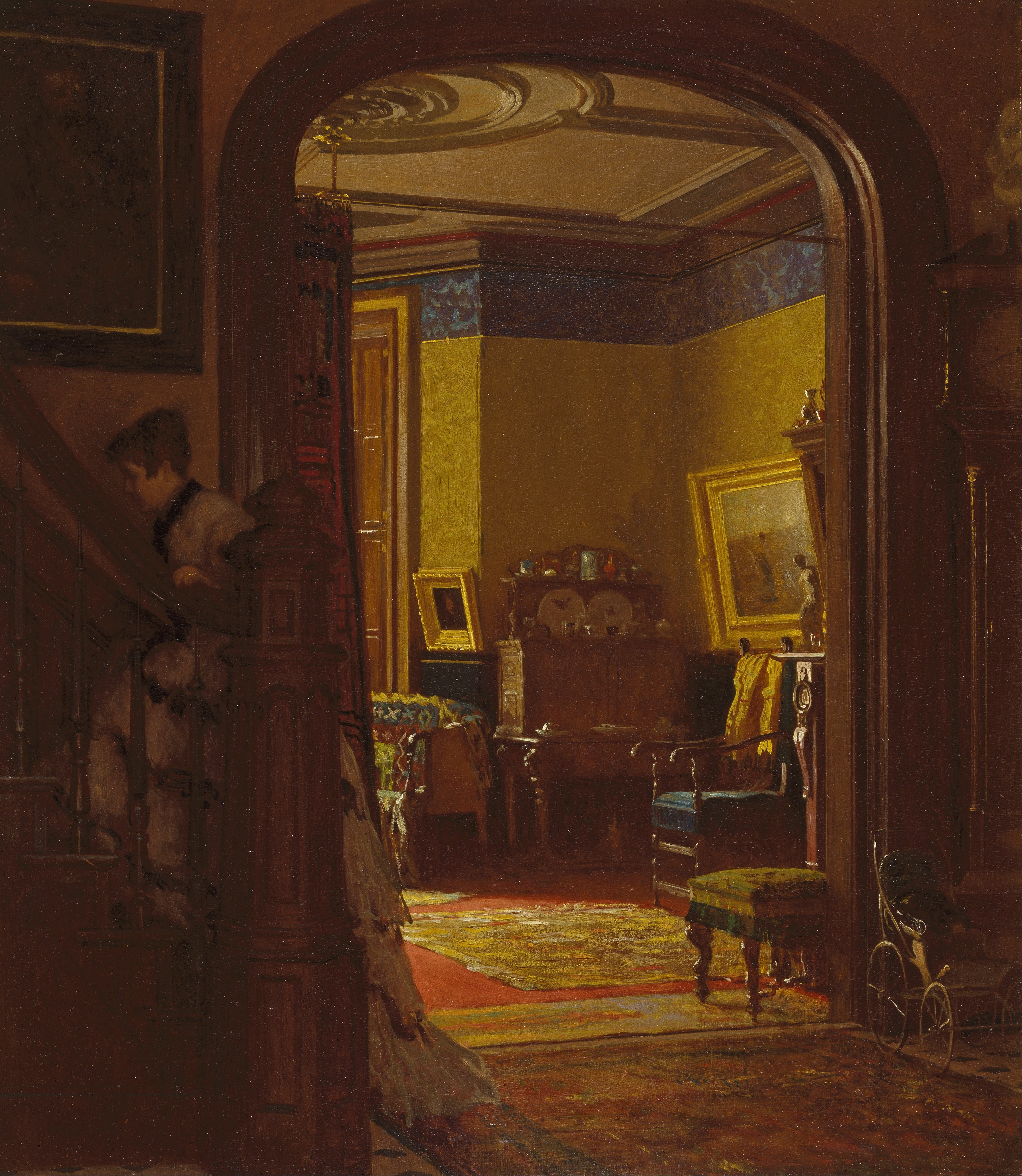
Shadows hang with somber repose. My beloved grandparent’s home is empty. And I’ve been away far too long. The dust has settled. The dining table is hollow with a loveless ardor. I can inhale the loss; the forgotten wealth of life lived once for each other now separated by nightfall and age.

Not at Home by Eastman Johnson
A middle-aged man in a black leather jacket stands outside, waiting. I’m hooked outwards. The sky calls me from the dank lament of the abandoned house now friendly to no one except for the wraiths of Death and Time. Who is the middle-aged man? I know him well, as I’ve known myself reflected in the old western visage of distempered exile.  

Devil Priest (credit: Gary Ashley)
I mount a bicycle along the cracked sidewalk curb. A dilapidated car, in the model once owned by my centenarian grandfather, clanks and sputters downwind. Is that my brother at the helm of a rusted, malign vehicle? I glide toward dawn. 

Automobile by Roman M. Semaschkewitsch
The middle-aged man seats himself blankly at the back of my bicycle. Like a burden to its beast, I carry his apathetic and listless indifference throughout the expansive elaborations of my most grandiose ambitions. 

Dynamism of a Biker by Umberto Boccioni
The map of Asia opens with the clarity of a skyline on a cloudless day. Traversing the backcountry of Vietnam, land of my lifelong love, I veer through incandescent bogs and sunbaked farmland. Natural beauty unending, my eyes turn inward, to visions of aspiration and wonder. To Europe, across Mongolia and the bleary maw of central Asia, I carry the burden of age, of settlement, of thought. Silenced, my mind is repressed with a hidden name.  
___________
The pure darbuka/doumbek track behind the voice sounding is essentially a decision to convey the beat-hop sexuality of modern techno-culture, and more, to welcome the sounds of the Arab-Muslim world through one of their traditional instruments, in coordination with a voice to affirm a re-sexualized Earth-bound society in honour of the Feminine - to move beyond what I have called, "monosexuality" a conception in response to our narrow myopia concerning the spectrum of global sexual expression.


Originally published in Poetic Pinup Revue's February 2012 print issue, "monosexuality" is written in the name of all the victims of a sexually repressed society, that being mostly all of us in the modern world. There is an epidemic of masculine dominance. The feminine perverted and repressed through our culture of rape. The lack of feminine empathy extends to the contemporary human relationship with Earth, as PachaMama, Mother Earth. Our birth-rite is to recognize Her.   

"monosexuality" was also my first published poem. Where poetry is conceived as a feminine art, to hell with the macho patriarchal cultural hegemony that diminishes the authentic creativities of our inborn humanity in favour of entitlement propaganda, figuratively illustrated as the "war on sex". Militarism further exacerbates the repressive/oppressive role that sex, in gender, reproduction, and the act of love, has assumed in our increasingly self-destructive society. As with all dualities, masculinity implies femininity.

Public Observance is essentially steeped in the act of 'people watching' with a keen eye for the social imbalances in play on any given occasion. Especial light is thrown on inter-sexual relativity. Included are the poems, "monosexuality" (Poetic Pinup Revue, 2012) and "Preposterous!" (Steel Bananas).

The piece, "Preposterous" makes a point for the significance of anarchical logic, or irrational meaning, and how the formal context of institutional learning delegitimizes the freedom to imagine beyond the bounds of normative thought and reason. It is at once an elegiac and at once celebratory, marking a flight from the institutional walls of predictable learning, towards the more experimental and risky, adventurous dream-education of self-knowledge.


Friday, 20 January 2012

Dream of Being a Published Poet...

courtesy of The Poetic Pinup Revue

This is my first ever print publication of an original poem.

The piece will appear in the The Poetic Pinup Revue


monosexuality

homo-
erect,
explorations into same
sex soundings,
flourishings, embellishments
on theme,
a blip into sonic humanity, striking
the most sensitive chord


[only the first stanza appears here]


To support this publication say Rusty sent you HERE