"Dreamland...Sin creeps in...Trouble begins...Innocence...Getting flighty...Jealousy..." concluding titles in Chaplin's The Kid
Alan Watts is famously known for relaying the following psychological narrative, an interrogative entry into the presence of mind, as it wanders through the imaginative hollows of two overarching conceptions, past and future, and their nexus of alternate psychic fruition in the netherworld of dream.
"Let's suppose that you were able, every night, to dream any dream you wanted to dream. And that you could, for example, have the power, within one night, to dream 75 years of time, or any length of time you wanted to have. And you would naturally as you began on this adventure of dreams, you would fulfill all your wishes, you would have every kind of pleasure you could conceive. And after several nights of 75 years of total pleasure each, you would say that's pretty great, and now let's have a surprise. Let's have a dream that isn't under control. Where something is going to happen to me that I don't know what it's going to be. And you would dig that and come out of that and say, Wow, that was a close shave wasn't it. And you would get more adventurous and you would make further and further out gambles, and finally you would dream where you are now."Like a silent film, dream is also suggestive. The act of play is a prerogative of metaphorical truth, and finally, where chaos is a principle which reveals Self as the All-Self, Alan Watts, reminds us, "The whole nature of the Godhead is to play that he is not. In this idea then, everybody is fundamentally the ultimate reality...God in the sense of being the self, the deep-down-basic whatever it is. And you're all that, only you're pretending you are not." Dreaming is a doorway to a revelation of the nature of self as All, where we confront the play-form of creation as an inner process of personal creativity, as the embodiment of a creative mind.
While we go about our "waking lives" fully immersed in the, "I am not that" attitude, the nightly vigil of our inborn collective life, our subtle creative instinct, bleeds with singular potency throughout the periphery of waking experience. In dream, we remember who, and what, we are: the stuff of play, Lila, in Sanskrit. There is a story of the seeker who goes to a guru and staring into the face of the holy man, meets only a curious smirk, as the holy man thinks, "Oh! Come off it, Shiva."
____________
Shadows hang with somber repose. My beloved grandparent’s home is empty. And I’ve been away far too long. The dust has settled. The dining table is hollow with a loveless ardor. I can inhale the loss; the forgotten wealth of life lived once for each other now separated by nightfall and age.
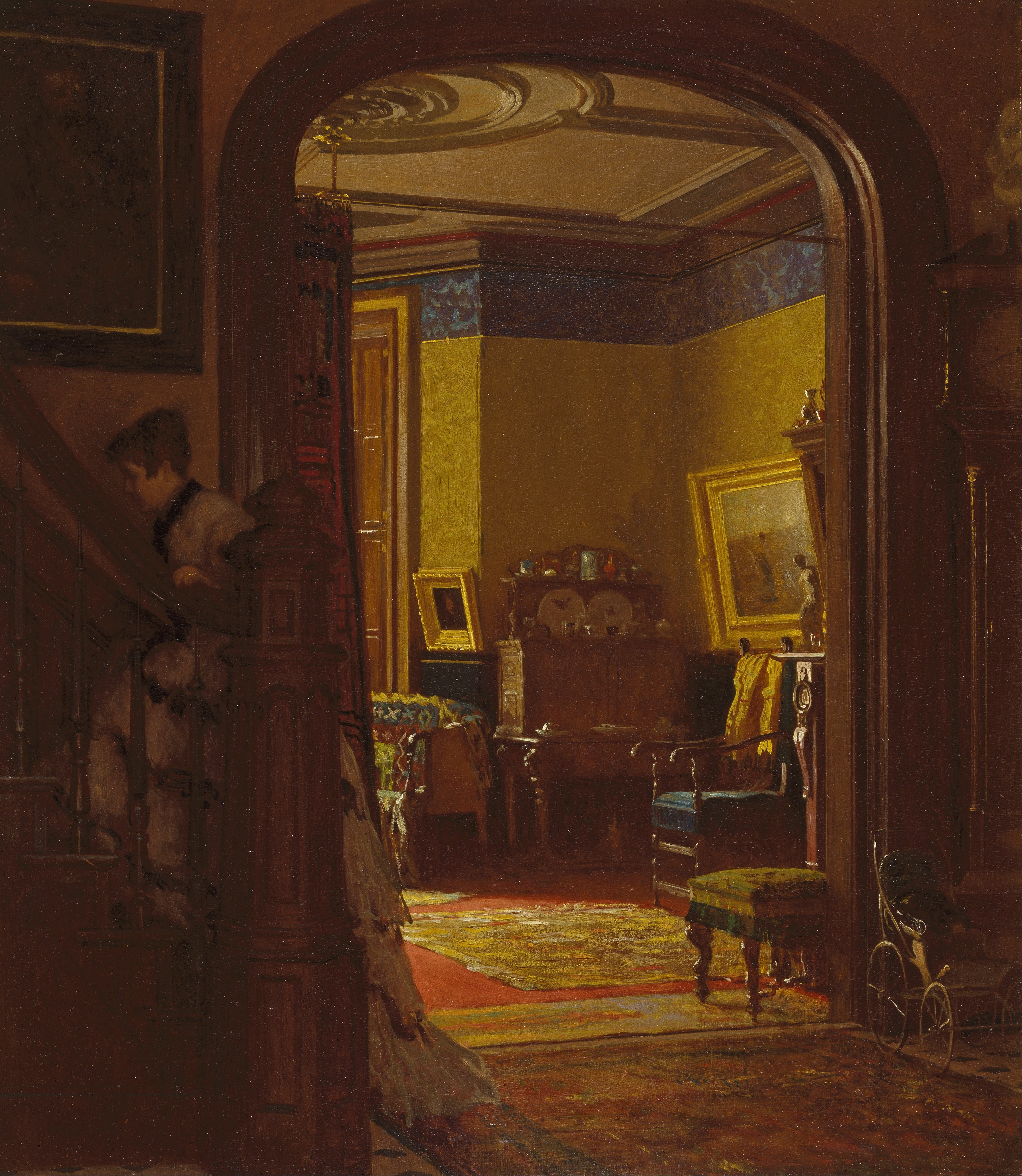 |
| Not at Home by Eastman Johnson |
A middle-aged man in a black leather jacket stands outside, waiting. I’m hooked outwards. The sky calls me from the dank lament of the abandoned house now friendly to no one except for the wraiths of Death and Time. Who is the middle-aged man? I know him well, as I’ve known myself reflected in the old western visage of distempered exile.
 |
| Devil Priest (credit: Gary Ashley) |
I mount a bicycle along the cracked sidewalk curb. A dilapidated car, in the model once owned by my centenarian grandfather, clanks and sputters downwind. Is that my brother at the helm of a rusted, malign vehicle? I glide toward dawn.
 |
| Automobile by Roman M. Semaschkewitsch |
The middle-aged man seats himself blankly at the back of my bicycle. Like a burden to its beast, I carry his apathetic and listless indifference throughout the expansive elaborations of my most grandiose ambitions.
_by_Umberto_Boccioni.jpg) |
| Dynamism of a Biker by Umberto Boccioni |
The map of Asia opens with the clarity of a skyline on a cloudless day. Traversing the backcountry of Vietnam, land of my lifelong love, I veer through incandescent bogs and sunbaked farmland. Natural beauty unending, my eyes turn inward, to visions of aspiration and wonder. To Europe, across Mongolia and the bleary maw of central Asia, I carry the burden of age, of settlement, of thought. Silenced, my mind is repressed with a hidden name.
___________
The pure darbuka/doumbek track behind the voice sounding is essentially a decision to convey the beat-hop sexuality of modern techno-culture, and more, to welcome the sounds of the Arab-Muslim world through one of their traditional instruments, in coordination with a voice to affirm a re-sexualized Earth-bound society in honour of the Feminine - to move beyond what I have called, "monosexuality" a conception in response to our narrow myopia concerning the spectrum of global sexual expression.
Originally published in Poetic Pinup Revue's February 2012 print issue, "monosexuality" is written in the name of all the victims of a sexually repressed society, that being mostly all of us in the modern world. There is an epidemic of masculine dominance. The feminine perverted and repressed through our culture of rape. The lack of feminine empathy extends to the contemporary human relationship with Earth, as PachaMama, Mother Earth. Our birth-rite is to recognize Her.
"monosexuality" was also my first published poem. Where poetry is conceived as a feminine art, to hell with the macho patriarchal cultural hegemony that diminishes the authentic creativities of our inborn humanity in favour of entitlement propaganda, figuratively illustrated as the "war on sex". Militarism further exacerbates the repressive/oppressive role that sex, in gender, reproduction, and the act of love, has assumed in our increasingly self-destructive society. As with all dualities, masculinity implies femininity.
Public Observance is essentially steeped in the act of 'people watching' with a keen eye for the social imbalances in play on any given occasion. Especial light is thrown on inter-sexual relativity. Included are the poems, "monosexuality" (Poetic Pinup Revue, 2012) and "Preposterous!" (Steel Bananas).
The piece, "Preposterous" makes a point for the significance of anarchical logic, or irrational meaning, and how the formal context of institutional learning delegitimizes the freedom to imagine beyond the bounds of normative thought and reason. It is at once an elegiac and at once celebratory, marking a flight from the institutional walls of predictable learning, towards the more experimental and risky, adventurous dream-education of self-knowledge.
Public Observance is essentially steeped in the act of 'people watching' with a keen eye for the social imbalances in play on any given occasion. Especial light is thrown on inter-sexual relativity. Included are the poems, "monosexuality" (Poetic Pinup Revue, 2012) and "Preposterous!" (Steel Bananas).
The piece, "Preposterous" makes a point for the significance of anarchical logic, or irrational meaning, and how the formal context of institutional learning delegitimizes the freedom to imagine beyond the bounds of normative thought and reason. It is at once an elegiac and at once celebratory, marking a flight from the institutional walls of predictable learning, towards the more experimental and risky, adventurous dream-education of self-knowledge.

