Primarily a writing exercise, this dream journal-inspired blog is a quiet introspective sojourn into the process that we traverse in going from private dream to public art. I see our dreaming as an internalized mythmaking. As I philosophize and expressively exhibit dreams, both private and public, I encourage and delight in creative language as a way to practice experiential metaphors through a “public dreaming." Writing Theory: Creative Dream Fiction
Showing posts with label interpretation. Show all posts

Monday, 2 December 2013

Ecological Storytelling: Dream, Hallucination and Vision


"I think it's easier than to formulate high ideals, but a few things are more difficult, and to discover the means whereby those ideals may be implemented one has to dream but one has to dream in a pragmatic way" Aldous Huxley, in Hoffman's Potion

Do I hear a tinge of surf rock here and a splash of psychedelic vocals there? And all wrapped up in a damn fine beat! The new Ketamines 7” So Hot! opens with its killer two-and-a-half minute title track. Resistance vibes ebb and flow as they bray and stomp through lyrics held down by the kind of upbeat clutch that makes this Toronto group well worth a listen, if not a full-fledged tracking down.

Released this October, the band’s three-track album buzzes under the genres of punk, garage and power-pop. Spacey breakdowns mood out these catchy and tight musical explorations with extra-hot reverberating guitar riffs smoothed out over ambient and effectively eerie vocals. “New Skull Tattoo,” the second cut on the album, begins with a daze of light-hearted, fifties-era doo-wop rhythms fused together into punk lyricisms.

The Ketamines provide a riot of trickster stylings, as the lyrics carry us through into a stupendous poetic irony. Final track, “Summer Mothers,” sounds off a dream-pop show with the power of good feelings, impressing the listener with a kind of end-of-concert bittersweet rush that takes no prisoners. It reminds us that when the summer or the year ends and all is lost, we should just hold fast to the driving beat and we’ll all be okay.

All in all, each and every song on this new 7” is good listening. Even multiple listens later the songs groove pulse more and more in the veins. Straight to the head, this one’s a gem.

This piece of interpretive writing was published with BeatRoute magazine on November 3, and conceived under the influence of soundscapes by Canadian psychedelic music band, KETAMINES
___________
The Union Street Y faces the Puerto Rican cafe where I used to sit over a microwaved chocolate chip muffin and hot chocolate, eyeing the clock, readying myself for Hebrew school. The elaborate turnstile reminiscences of the red-bricked Y invited with the flushing scent of chlorinated memory and the erased lunch-hour sweat of youth. There, a mere two jaunt to the fish-gut factory ocean, I spoke to children. Fascinated by the swung heart of musical storytelling, the night awaited patiently, as the fat bosom of American daytime on the human Earth struggled to a peaceful end. 

Lesser Ury: Café Bauer
A story of Massasoit and the unvanquished heads of Massachusetts flesh, spell out the old paradigm loosed from vocal chords, taut with knife-edge reason on a silent beach. Their indiscriminate wisdom emerges from white-skinned pride, to destroy the vainglorious ruse of ego and fate. Mortality ensued in the fading light, as speech lightened the animate Earth with a name, and its meaning. The soil spoke with a tongue of roots, with teeth of stone and and words of food. Saying: where the story is told is equally or more important to the telling. 
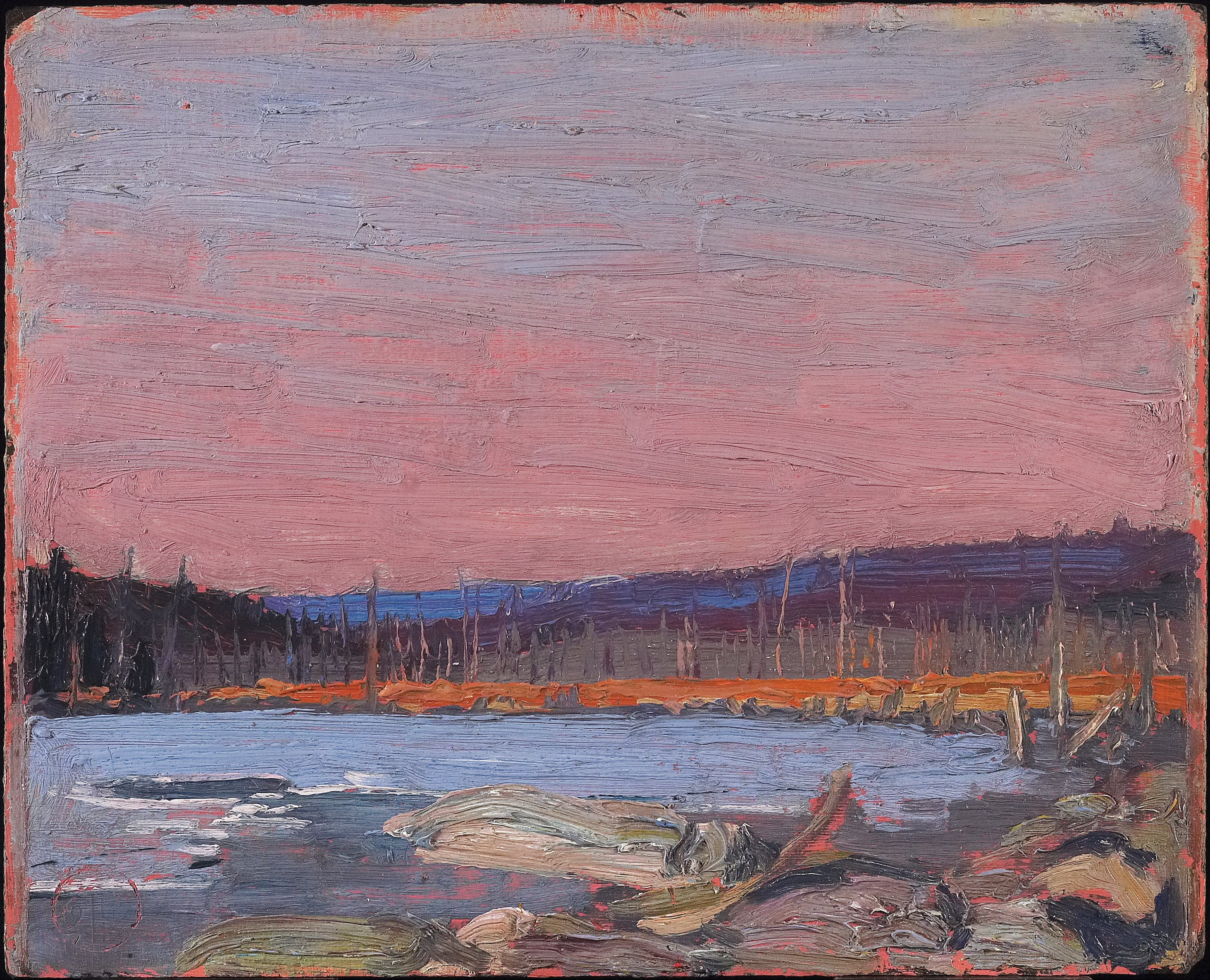
A Northern Lake by Unknown
Flown beyond the wellspring of distant knowledge, exotic in its geography, sacred in its ecology, and born of a feverish need in its cartographic attemptation, a single mountain rose as a breach of faith on the plain horizon. Monumental airs shifted and sprang from the glowering mass of insurmountable ice. Formed as from a frozen volcanic fire, the ice lifted with evaporating death, as the cold grip of lifelessness in nonbeing. The frozen hell still beckoned forward the unanswered mystery of longing, as the natural light waned atop its insuperable caracas, a skull of monastic belonging. 

Mer de Glace, in the Valley of Chamouni, Switzerland by J.M.W. Turner
I stepped forward, onto the slippery fall of the sky's over-hastened drop to Earth, as the violated inherent reason of nature, unearthed. The pool fragranced wisps of spiritual air, the will of the unmoving background to all life on Earth, revealed in the deadening cold. As the stone ascended to its paternal source above, each step closer frustrated the nervous system with defeat, failure, and the fatal swoon of all human belonging. The release of the spirit, awake. 

Harlem Valley, Winter by Ernest Lawson
Captured under the fault of a boot, I risked a greeting at the hand of death's blizzard smoke, the craving and seductive flaw of its embrace. Unable to get back afoot, I peered through the ice to see the reigning female of human law. The Queen shone glinting the fixing light, fleeting, yet absorbed needfully. With a hand mobilized by the insane truths of modern life, I sunk below the ice, to finger the freezing metal, and to possess its deathless strength. Ascendance moved to transcendence. The impossible summit slunk beneath my loins, hidden in hoarding pockets and disguised on lusting hands. 

Queen of Coins (Diamonds) from the Visconti tarot deck by Bonifacio Bembo
The line at the cinema began to move. I paid, and saw the unseen. I paid, and mounted the insurmountable. I paid, and lived the unliveable. I paid, and knew the unknown. I paid, and heard the unheard. I paid, and paid the unpaid. And I paid, and paid to pay for the priceless. I paid to pay for the invaluable. I called home the unreachable. I vanished in the light. I stole out on the intractable ice. I rose my shoulders above the limits of atmospheric pressure. I called out above the thinnest trace of oxygenated air the name of the unnameable: I.  
____________


Monday, 8 April 2013

Genocide and Extinction: Reflection on "in my dreams" by Mercedes Eng


"Whether this satirical inscription [PERPETUAL PEACE] on a Dutch innkeeper's sign upon which a burial ground was painted had for its object mankind in general, or the rulers of states in particular, who are insatiable of war, or merely the philosophers who dream this sweet dream, it is not for us to decide."  Immanuel Kant, "Perpetual Peace"

When I first read "in my dreams" by Mercedes Eng, on Geist, my heart pounded with the animate high of a synchronous intellect grounded with a feeling of urgency.

This piece illustrates the symbolic intersection of a pipeline as physical obstruction on the body of our Mother, as on our body. And to follow, the incarceration and de-legitimization of those voices and lives whose source of energy derives from a more profound and lasting than those harvested recklessly by government leadership, and the knee-jerk automaton droves of apologists, apathetics, pessimists and belligerent supporters of environmental crime. 

We have traversed the oceans and landscapes with a smothering footprint. In the wake of the wholesale devastation of First Nations communities across the country, it is the entirety of humankind that is next on the list of the entrenched ignorance of those who ignore science, who ignore civil society, and who ignore their own innate sense of empathy for the sake of power politics and saving face. 

When the source of a disease is unknown, for example lung cancer from smoking in the past, the individuals long since die while courts and politicians wade through policies and promotions to effectively prevent further death. Smoking is an especially useful symbol too, because it exhibits a problem with consuming that overrides even the strength of knowledge and law. People still die from smoking, just as we die from ignorance. Besides the individual death of one person, or even the genocide of a specific group, the extinction of our entire species is at hand when we talk about the continued, unabated burning of fossil fuels. 

Ocean acidification is the cause of five major extinctions on planet Earth, and the CO2 levels in our oceans now are rising at an unprecedented rate. See the work of Charlie Veron, the 'godfather' of coral and other scientists. The only way to prevent ocean acidification is to stop burning fossil fuels. Yet this time, we are realizing that we are essentially all one body in this fight to curtail the disease of overconsumption, overexploitation of non-renewable resources, and when it dies, there will be no lawyers or politicians left. In the 20th century, we faced the facts and prepared policies to prevent genocide. In the 21st century, we face the extinction of our species, and we are all at fault. 

Internationally, Canada is now a partisan country, we support other nations on their ventures into say for example, Afghanistan, based on exclusive measures of concern. This reflects within the domestic sphere, where representative leadership in government merely reflects a narrow margin of society. Those who are not aligned to the dominant mode of power are marginalized traumatically.    

We can remember the words of an assassinated democrat echo into the future, "Our children are still taught to respect the violence which reduced a red-skinned people of an earlier culture into a few fragmented groups herded into impoverished reservations.” JFK

To encourage ecocide is to choose extinction. 

Be aware: Oil Man and the Sea, Revolution (Film)350.org, Earthship Biotecture
___________
Struggling lone uphill through the barren rifts and scarred desertification of Judea, I look out from an outcrop towards the Sea of Galilee. Scanning feline eyes growl and hiss in the unkind wilderness of the famed Israelite passage to divine promise. Yet, here where the last suicidal stand of Judaic tradition withheld the Roman tide of enslavement, I grapple.

Tiberias and the Sea of Galilee by Emile Rouargue
The rocky earth tumbles with rolling quakes, as an avalanche of boulders careens beyond a nearby patch of scree. The earth teems with deadly fate, as I climb on, and reach the summit of sacred space.

Mount Tabor by Emile Rouargue
Under a cloudless sky, I phone the United States, to hear the short-toned speech of my elderly grandpop, hunched over a sandwich and remote in the old Jewish-American neighborhood of secular tradition. To my increasing surprise, he had been on the phone, yet with a late dignitary of American war, Ike himself, Dwight D. Eisenhower, the once commander-in-chief of North African forces in WWII, where my old pop first entered active service.

The Bully of the Neighbourhood by John George Brown
Pops welcomes me to cross lines and speak with the former president. Nervously, my voice reaches for sanity and order, with subtle interrogation, I chance a question over the unsettling silence, “What is your favorite book about WWII?” I ask, with An Army At Dawn in mind, as I’m currently in the middle of it. “I don’t much read any book of the kind.” He breathes a deep silent resolve, of little words.
___________
"Repeated Dance of the Fluid Earth" is an experimental narrative that plays off of American colonial history as a body of water, rippling throughout the waves of history. Cultural memory is as fluid as water itself, where consciousness may be revisited with the slightest alteration, leading to an eventual holistic transformation.

"Repeated Dance of the Fluid Earth" utilizes frame drum and shakuhachi together with synth beds to create an ulterior perspective in the retelling of popular history through a gendered and ahistorical mode. This also plays into our ecological history as a species, and how the ability (or inability) to listen to our story, as our voice, is similarly the story of our relationship to ecological knowledge, and how the fluidity of place with regard to land-based settlement is as dramatic in its shape-shifting nature, as the fluidity of place on a sea-based settlement. Simply put, the modern political notion of "settlement" is a myth.

In the era of consumption, we posit a sense of material as objectified by the consumptive attitude: that things are to be consumed, used, manufactured, wasted, eaten, assembled, etc. as opposed to a creative attitude, where all things are in flux. So, with regard to the battered histories of genocide and ecocide, "Repeated Dance of the Fluid Earth" asserts a revivification of the solemn bliss of knowing where we stand.


As the entire collection "Cyclical Wordplay" from which the chapbook, "Visitations" is derived, centres not only on the cyclical wordplay of language itself, but the travelogue of a cyclical journey, tracing the meaning of traveling abroad to returning through domesticity. The selections in "Visitations" recount the final step in that return, where after "A VIsit to L.A." the cyclical resolution leads to a transmigration of values. The final step homeward from a long season abroad, exhibited in experimental narratives, eventually transforms one's relationship to language, place, and meaning. The conclusion is a prelude to welcoming "other" visitations.

"Repeated Dance of the Fluid Earth", featured in "Visitations" was published in the Rusty Nail December 2012 Issue. The release of the "Visitations" chapbook on Scribd, goes together with the release of "Repeated Dance of the Fluid Earth" a spoken word narration on www.menachem.bandcamp.com


Monday, 18 February 2013

The Immortalizing Arts: Contributions by World Music Artist Vi An Diep

Gilgamesh by Samantha from Indonesia
"We have achieved two of the three alchemists' dreams: We have transmuted the elements and learned to fly. Immortality is next." - Max More, On becoming posthuman

The search for immortality is as old as humanity itself. The earliest remnants of human history, namely, the Epic of Gilgamesh, among others, speak of the quest for immortality, to find the fruit or fount of eternal youth is part of the perennial epic that is the myth of Man. 
Anu, Bel, and Ea are whispering (wisdom) into his ear.
Ere thou earnest down from the mountain
Gilgamesh beheld thee in a dream in Uruk
....
Gilgamesh sought to interpret the dream;
Spoke to his mother:
'My mother, during my night
I became strong and moved about among the heroes'
...
Gilgamesh said...Tell me, How didst thou come to dwell (here?) and obtain eternal life among the gods?
...
Build a house, construct a ship; Forsake thy possessions, take heed for thy life! Abandon thy goods, save (thy) life, and bring living seed of every kind into the ship

(Epic of Gilgamesh)
Now, it is interesting the way that modern medicine has adopted the principles of "life extension" to the archaic traditions of humanity in the search for immortality. Life Extension is a medical term used to acknowledge the major advancements in modern medicine which have led to the unprecedented increase of the average human lifespan. The logic is that if the lifespan can be extended by some fifty years or so in the last hundred years, why can't we extend life to virtual permanence. 

What are the implications of human immortality on Earth? What comes to mind for me are a few major points. For one, there will be an excited advantage by the keepers of modern scientific medicine, mainly the West. In many ways, this can be seen as the furthering of an egotism that the Western World and particularly the scientific community has, where they feel they prevail over all forms of life, as the dominant form of knowledge-creation in the world today. It is often ignored how steeped in Western European history our modern science is, and that it does have its immoderate faults. Essentially, modern medicine is best in dealing with immediate physical trauma. When it comes to preventive, and long-term medicine, like "life extension" for example, there is less attention to detail. 

Outside of medicine, there is a biological component. One of the foremost proponents of "biological immortality", professor in the Department of Ecology and Evolutionary Biology at University of California, Irvine, Michael R. Rose, PhD, says in the Immortality Institute documentary Exploring Life Extension, "Most people who work on aging do it from a medical standpoint, which means humans, or if not humans, then certainly mammals, and all these organisms that didn't have an aging process were far-removed from mammals." He went on to give examples in non-mammallian life forms, such as anemones, creosotes, juniper, and others that actually do not age. He continues, "...life can be thought of as being divided into three basic stages...that third phase, which has not really been explored by contemporary biology is what interests me now, late life." 

With regard to the biological component of immortality and life extension, and the medical egotism which counter-inuits the state of the world, it seems that if we do not co-evolve immortally with our Earthly ecology, a spiritualistic sense of medical immortality for humanity would only contribute to the degradation of every source of life that the Earth offers to Man, and which Man exploits obscenely. For example, if we innovate major advances in anti-aging and life extension, we ought to transpose that technology into the natural world, into the life that not only lives on earth (us), but is the life of earth (all forms of life and life-giving). 

Finally, my sense is that in the early epics of oral literature, such works as the Epic of Gilgamesh and Homeric works such as the Iliad, there is a lesson about the human quest for immortality, which is older than our backbone. The lesson is that only in our mortality, do we know our immortality. I would say this is also truer to Max More's reference to the alchemical tradition, where in the philosopher's stone there is a psychological mastery of the principles of physical life, yet it is in the psyche where the most enduring trial is overcome. Only in dying fully conscious and immersed in the ground of immortal intent, are we immortalized, and traditionally so in the words of the great poets, those of enduring words and pronounced voices to carry the names of certain individuals down the halls of human history. 
___________
First step in the thousand-mile journey by Vi An
Flight over the bridge by Vi An
Enlightenment over Peace Bridge by Vi An
Full Moon City by Vi An

First Light of Dusk by Vi An
____________


Vi An has generously agreed to contribute her musical artistry to SoJourn(al) for this exclusive post featuring original photography. This post celebrates her entry in a CBC music contest, Searchlight. Vote for Vi An!

In future posts, I will be featuring original world instrumental music by none other than the Dream Author. My idea is to feature a full-length album of original electro-acoustic improvisations on darbuka, frame drums, shakers, xaphoon, shakuhachi, guitar, harmonic, etc., then leading up to spoken word collaborations with my instrumental creativity to recollect the creative momentum from my experimental writing gallery usually featured at the end of each post. It is my intention to kick off this new paradigmatic focus of musical creativity with a contribution, and to offer space for photographers and musicians alike to contribute in the future.

Happy readings/listenings/viewings!!

Among all artists of One Love, in solidarity.

Friday, 1 February 2013

The Poppy and the Pride of Death: Interpretations on a Famous War Poem

Poppy Field in a Hollow near Giverny by Claude Monet
"Poppies have long been used as a symbol of sleep, peace, and death: sleep because of the opium extracted from them, and death because of the common blood-red color of the red poppy in particular. In Greek and Roman myths, poppies were used as offerings to the dead." [1]

"Another candidate for the psychoactive drug is an opioid derived from the poppy. The cult of the goddess Demeter may have brought the poppy from Crete to Eleusis; it is certain that opium was produced in Crete." [2]

References

[1] L. Frank Baum, Michael Patrick Hearn, The Annotated Wizard of Oz, p. 173

[2] Karl Kerenyi.Dionysos.Archetypal image of indestructible life.p 24
In Flanders fields the poppies blow
      Between the crosses, row on row,
   That mark our place; and in the sky
   The larks, still bravely singing, fly
Scarce heard amid the guns below.
We are the Dead. Short days ago
We lived, felt dawn, saw sunset glow,
   Loved and were loved, and now we lie
         In Flanders fields.
Take up our quarrel with the foe:
To you from failing hands we throw
   The torch; be yours to hold it high.
   If ye break faith with us who die
We shall not sleep, though poppies grow
         In Flanders fields. [John McCrae]
The above poem, written by John McCrae, is one of the important war poems in history. Today, it is read aloud by veterans at remembrance ceremonies with solemn intention. The symbol and metaphor poppy, here depicted, is especially relevant for the topic of war. 

The poppy symbolizes death. "In Flander's Fields the poppies blow" would then mean that in Flander's Fields, the dead sleep in peace. The second line further supports this. The last two lines, "We shall not sleep, though poppies grow in Flander's Fields" emphasizes the simple metaphor of the poppy as a symbol of eternal rest, however, in this sense, the poem transcends symbolic import and represents the pride of the soldier as immortal, and sleepless in constant struggle. This is a poem to incite emotion for the dead, and where we might once believe they lay in respite from worldly cause, we are wrong. So the poem is a call to action, "Take up your quarrel with the foe". 

Further, it symbolizes how the poppy is a metaphor for the illusory nature of war, as seen from outside the veteran perspective. It uniquely distinguishes the veteran, whether alive or dead, as having an eternal place in the battlegrounds and in the generations of youth to follow. The poppy symbolizes our ignorance as non-military, as we remember the soldiers who fight on. 

And so, in the land of poppies, Afghanistan, the longest war in U.S. history wages on. Remembrance, in the metaphor of the poppy, can also fog our vision of the dead, and of their eternal struggle for rebirth in the fields where men are laid low. 

Peace author Arthur Clark once said the poppy symbolizes all who die in war, not just the soldiers of one's own nation, but every victim of war, every innocent child, mother, elder, the destroyed lives and communities. The poppy is the drug of pride, and like all drugs, while instilling disillusionment, it reveals truths of the human condition. 
_________
The inborn drug of sleep has yet to bear new visions fruitful and enduring. I travel eastward towards the desolate earth, and find matchless beauty in the serene quiet of petrified earth, the resonance of death lingers like a gentle breeze.  

Westward! (RK)
Son of the Brown Earth (RK)
Hiker's Meadow (RK)
To The Mountaintop! (RK)
The Canyon Calls Me Forth (RK)
__________
An untouched grand awe
Landed finally to rest beside the sickening mildew

Mulch-pressed nude lakes
Praised unto the natural moon

Lowering close over the beached horizon
A thirteenth name

Pleasing those raised on the island to visit their blood
Despite being insane

A malformed genetic waste
Purchasing birth

Towering over the healthy dead, grovelling
Ensnared by the angry temptress who walks entombed in mind

And spiritually blessed beyond our mundane knowledge,
She treasures the feminine life

...

To put to death philosophy, and cursed forms of common language
Now replaced with magic and divinity

Inert
Enough to overact above the spilled heights

Grandiose unity
Frontiersmen who bite at raw flesh and faint under the jeering of native rumblings

In the overcast dusk of Western humanity
Fallen alas to the bitter womb of civilization

And the crass membrane stew of our unalienable forebears
Freaking us out

Into stomachs without mouths
To feed on the juice of the horned phantom

And only lick from inside
The wounds stinging our nameless pride

excerpts from "Untouched Grande Awe"


Saturday, 26 January 2013

Talmud and Dream Interpretation: Thoughts of a Secular-Cultural Jew

Talmud Readers by Adolf Behrman
“Dreams which are not interpreted are like letters which have not been opened.” Talmud

I am a cultural Jew, a secular Jew, an ethnic Jew. As singer Arianne Zuckerman once said, I am "Jew-ish". Yet, I revere the tradition of the Talmud. As far as I know, it is the source of a great wealth of pride in the intellectual strength and heartened closeness to tradition that Jewish people have maintained throughout generations. We have kept our traditions intact because we are flexible. The Talmud is a massive compendium of volumes steeped in argumentation, discussion, rhetoric and criticism on the sacred text of the Torah. The Old Testament is not Old, it is vivified by thousands of years of continuous self-criticical analyses and contemplative thought. The Talmud is the tradition of intellectual meditation on the sacred word. No wonder why dream interpretation is honoured, as the Talmud is one of the oldest forms of imaginative interpretation known in book form. For more in-depth understanding of this quote, see Erich Fromm's work "Forgotten Language."
__________
An old woman sits languorous outside the concert hall entranceway. Her excessive body weight slumps over a barstool with the heaping fatigue of an overworked heart. Yet, in her eye, there is a glint of sound reason, a harmonious vocation towards authentic humanity. I stop for a moment to share a few words with the curious and unseemly woman.

Woman playing a kithara by Anoniem
(Wall painting from Room H of the Villa of P. Fannius Synistor at Boscoreale)
I become so filled with sympathy for her life story. I run out onto the street, looking for a candy that I recently became aware that she enjoys. All I can find is a broken piece of chocolate on a dirty sidewalk. In my nervous frustration, I dust off the candy and walk back into the hallway. As I step cautiously through the alleyway to the concert hall, a man a few years my elder feels he must give a word of advice.

Two women at the street by Ernst Ludwig Kirchner
"There is no sense in your sympathy," he affixes his language to my throat like the strangling inexorability of truth. "I've heard too many racial slurs from the mouths of your likening. You'd like to give back, and yet you cry on a pedestal," he musters an incendiary rage, of darkening complexion under the flickering streetlamp. "How many times have I heard your story, I'm Jewish, so I can empathize," he continues unalloyed. "And when you speak of G-d, I am utterly disgusted."
____________
The Italian connection, un-swayed by the prudent fire of tango nights
       stirring wilderness roosts
                in the back hall of some sterling porch façade
                in the mundane sky of an after-party dimming
                       beside alcoholic whiteout praise
                       and the ruined name.

excerpt from "The ruined name"

Saturday, 29 December 2012

Van Gogh, Ophidian-Seer of Starlight Medicine

Cafe Terrace at Night by Vincent Van Gogh
"For my part I know nothing with any certainty, but the sight of the stars makes me dream." Vincent Van Gogh
Artists are seers, and so, are truth-seekers. Yet, human experience blurs the line between seeing and seeking. Certainty is flux, and flux is certainty as form is emptiness and emptiness form. The old Taoist adage of dual unity is the perplexing clarity of universal distinction. To the point, and contemporaneously with current societal and ecological trends, human life is further revealed as an innate paradox. Van Gogh continues in his mad method of artistry in saying, "I dream of painting and then I paint my dream."

The wisdom of Van Gogh speaks to my previous post, The Cubism of Unity: Shelley and the Myth of Monogamy where he speaks on God (Unity) and Love (Diversity). "Love many things," he says, "for therein lies the true strength, and whosoever loves much performs much, and can accomplish much, and what is done in love is done well." More simply put, Van Gogh confesses, "But I always think that the best way to know God is to love many things." 

In the beautiful and powerful 1956 film, Lust for Life starring Kirk Douglas, the tormented genius and emotional outcast paints Starry Night, while the narrator speaks: "Sometimes I work on into the night. I'm hardly conscious of myself anymore. The pictures come to me as in a dream with a terrible lucidity." Night and dream are married in a mystical love through the human as artist, animating the spirit of the dream towards a night imbued with the life-giving stars of an empyrean both transcendent and visceral. The dream stirs from the lowest of depths, and reaches towards our greatest heights. We are besieged with an all-consuming, all-cleansing, all-awakening, all-encompassing Mystery.  

Search on this site below for more original interpretations and creative contexts on Van Gogh
____________
My nature writing blends into an arcane Spanish-language text. The publication circulates among Earth-lovers and wild foodists alike. Together, my readers and I endeavour through a dense thicket of swamp. Community leaders take the helm of a slow-moving canoe, shifting through the bullrush stands and mud vents emitting the hot gaseous fumes of peculiar decomposition. 

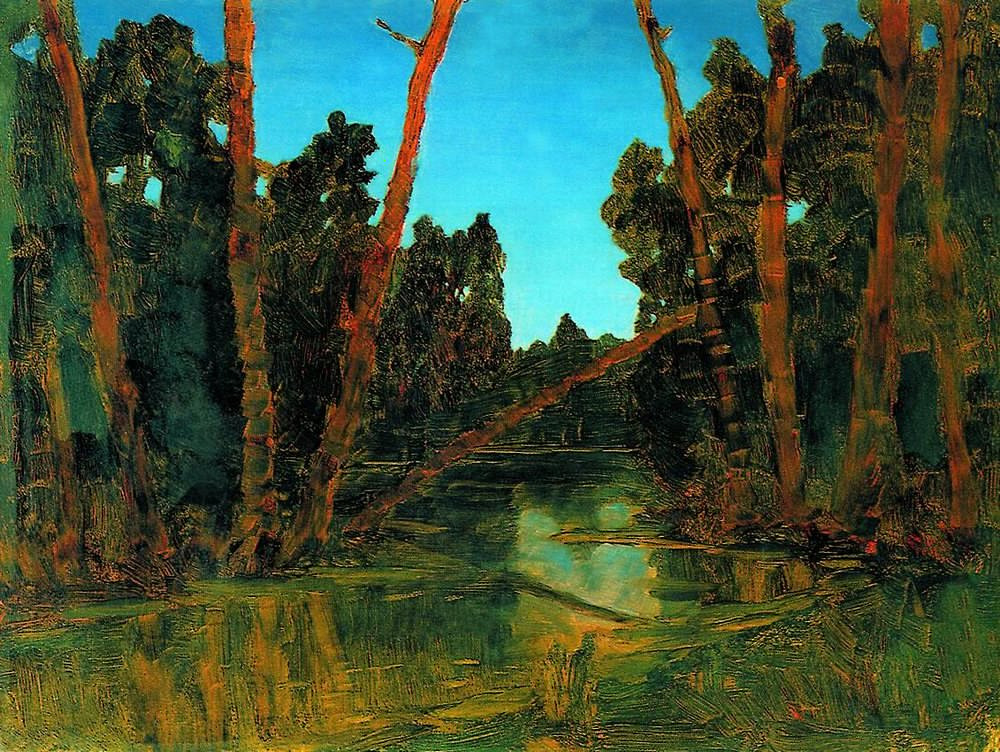
Forest Swamp by Arkhip Kuindzhi
A rattlesnake emerges from the rushes as we emerge from the blinding vegetation. On the waters, ready to disembark for a land crawl, a comrade teases and taunts the rattlesnake head. The venomous wisps and hissing instills a deep-set fear straight through my eyes. The rattling spells virulence and ire. Reptilian awe paralyzes my arms and legs as I stare, petrified, watching the snake slither madly towards me. It darts and in a split-second latches onto my arm. My reaction is pure thought. Still as stone, I feel its fangs stick into my blood. 

Old dream interpretation folklore sees a snakebite dream as a positive symbol of regenerative holism. See my recent nature writing publication for Canada's only independent news cooperative. 
__________

To return to primal and distended physical tumult
A chaotic folly
Dreaming in smokeless fires

...
In the post-kingdom English croak
Over bastions and landlocked heights
That furnishes much scheming

A trite & forced inhuman sense
Of belonging
In a war trench

Phase of lunatic civility,
As the prosperous few wade
In proud shores of quicksand

Loss of self,
Ruined foresight vanishing
Into the uncreated past

excerpts from "Horror-story jazz"


Thursday, 27 December 2012

Bridge to Kafka's Language of Dream-Identity

Kafka, Separated from the Fire by a Mirror by Paul Mersmann der Jungere
"Please, consider me a dream." Kafka

How may we interpret this mysterious quote, passed down through interminable echoes? What, if any, interpretation needs be? Read one interpretation. They say it sums up his life. Can a life be summed up? In the spontaneous trigger of language into the folds of space and listening, when do we hear the contemplative grab of a lifetime thrown into a phrase? 

The peculiar relevance of the painting above by German artist Paul Mersmann der Jungere speaks eloquently to the theme of self-reflection and passion. Self-consciousness, or conscious identity may sometimes block our passage into the spiritual heart of self-annihilation, providing us only with a thin display at which to gawk, and finally, withdraw oneself from participation in life altogether. It may be more useful to identify with the less formal, and more marginal states of mind. Or, as Kafka said in another dream reference, "Last night I dreamed about you. What happened in detail I can hardly remember, all I know is that we kept merging into one another. I was you, you were me." [source

If language is a bridge, we do not always cross it, but sometimes slip beneath, and after speaking in one direction, go our own way. 
__________
Memory fails to awaken dream into day. Here is bridge photography from the conscious state:

Entering the Blue Void by R.K. 
Electric Ice Reflection by R.K.
City Riverbank in Winter by R.K.
Ice Flow of Light by R.K. 
No One Lives Under The Bridge by R.K.
 ____________
Into infinity
            And the terminal plague of survival

Marching by
            Currents stepping like waves over the stone-headed martyrs

Staved off
            From one life inside
...

Painted fame twisting and writhing
            In the soundless urban deep
         
A rustic, inflamed few,
            Whose solemn grasp partakes in the early break
         
From an inevitable aftermath
            Draining the rage from our animal brain


excerpts from "Guise of the Beloved"


Sunday, 25 November 2012

Prophecy in Dreamland and Other Spells of Creative Literacy

Portrait of Rasputin by Ana Theodora Krarup
"Unconscious actions, mass unconscious actions have certain momentums, something that Tolstoy tried to explain more philosophically in the narrative of War and Peace, how the individuals with their own lives could be carried off by history's great forced floods this way or that. He was trying to describe often what I encounter in my study of prophecy, that there is a wave of mass human stupidity that is carrying even intelligent people into its current, that is converging on a collision in the Middle East...what I get wrong also is a helpful study of how the human mind misinterprets a sign with its own expectations and hopes and I think it helped me be a better interpreter as well as a predictor of the future..." John Hogue on Whitley Strieber's Dreamland: Journeys to the Extreme Edge

I first read Whitley Strieber's Communion, which stretched my understanding of non-fiction as a young reader, surveying a gamut of fiction, history, philosophy, mythology in my family library. 

Another genre-bender, who influenced my appreciation for literature in a more grounded way, was Jack Kerouac, who together with Allen Ginsberg, prophesied a shift in American social norms through their collective literary breakthroughs. They had noted that in the second half of the 20th century, Americans would shift from their hardline Christian upbringing to a more Buddhistic sensitivity. 

Reading both of their writings thoroughly, I soon interpreted within their work an interesting relationship to what we now call prophecy. More than to pin prophecy within the highly skeptical sensationalism of conspiracy theory, prophecy, in a more mythological sense, is simply the attuning of the intellect to certain eloquence in creatively utilizing timeless wisdom and ageless archetypes, reattributing them as signs. 

More often than not, prophecy in mystic circles is not an outward momentum, toward predicting profane outcomes, but simply one of the many old ways toward self-realization. One is inevitably of the infinite. Popular prophets are heady mixes of conspiracy theory or what Terence McKenna called, "epistemological cartoons". In Hebrew mysticism, my understanding is that prophecy is a numerological science, beheld within the Hebrew language of the Torah, encompassing a unitive vision of interpretive science as it meets with spiritual practice. 

Recently, I viewed the film, Rasputin, which was another prophetic figure portrayed on the literature on my shelf as a young man impressed by the literati. Rasputin certainly opened the popular discourse of prophecy on the world stage, especially as regards political intrigue, out into broad daylight. His eyes still transfix. 
________

With a mug to mirror the inescapable frame of Kerouac’s joual-toughened jaw, bespoken with the silent glimmer of streetside grief, walking alone and alone for the infinite mileage of American wanderings, a cyclical tongue of ruthless freedom, to free the passions from the word-order of choice and splay will on the open pain of roadside heat with a thumb and a meek treasury of manly poverty 

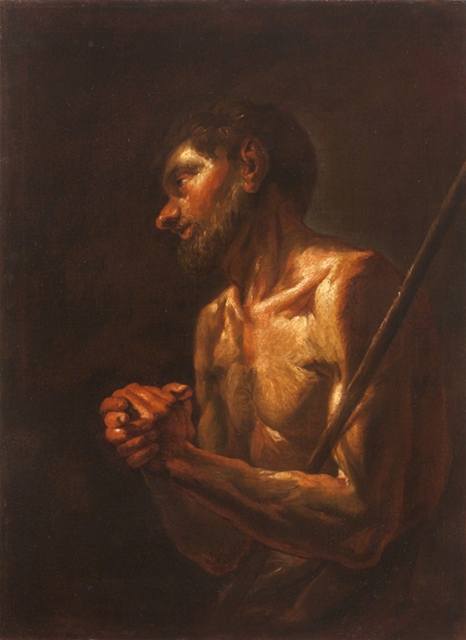
Pauper by Petr Brandl
that drunken cry that rang throughout the humbling scope of spectral telephone wires following with the unheard voice of millions distanced by the wiry nerves of a social neurosis towards mobility, and with the rootless leisure of a need to travel as a way of being, that holy rope burned the traveler’s hands as the writing cooled mind’s belonging on a land of no-land opening
_________
“American body,
May you be cooled,
May the dog days of the final moon in your Roman clock tick no more,
May your fires be dampened in the Fall,
May your body always be replenished,”

“This is a prayer from your navel,
Your own son”