Primarily a writing exercise, this dream journal-inspired blog is a quiet introspective sojourn into the process that we traverse in going from private dream to public art. I see our dreaming as an internalized mythmaking. As I philosophize and expressively exhibit dreams, both private and public, I encourage and delight in creative language as a way to practice experiential metaphors through a “public dreaming." Writing Theory: Creative Dream Fiction
Showing posts with label music. Show all posts

Tuesday, 24 December 2013

Anaïs Nin and the Secret Self: From Blindness to the Mountaintop


Henry Miller

In the last few years one sees quite a few either writings about you or quotations from you about dreams and the dream life and I feel that they haven't really understood what you mean about this. I don't think you want people to be living in a dream state while conscious, do you?

Anaïs Nin

No.

HM

But you mean that dream has its uses, its effectiveness in life afterwards.

AN

No, I meant something else, I meant that what we could arrive at a state where what we dream at night would be the blueprint for what we wish to fulfill, or to reach, and if we understand the dream then we know what the secret self is and then this secret self we can fulfill.


Anaïs Nin, whose literary renown is most prolifically exampled in her posthumously published diary writing, is also respected and admired for her role in encouraging and stimulating the work of Henry Miller. Her opening preface to the Tropic of Cancer, Miller's first book, is one of the most incisively written dedications to the literary spirit that I have ever read. Her quotations on dream, are poignant in their truth and magical in their realism, vibrant in their imagination and open in their accessibility. 

Similarly as with Carl Jung, both Nin and Miller drew liberally from interpretations between Western psychoanalysis and the traditional religious learning, thought and practice of Hindu, Buddhist and Taoist cultures. As highly creative minds, who lived richly balanced in heart and mind, stood for a conscientious human being, who through developing thorough self-awareness comes naturally to be a part of compassionate change in the creative universe. 

“Dreams pass into the reality of action. From the actions stems the dream again; and this interdependence produces the highest form of living,” said Nin, in a comment that affirms the dream psychology of Jung, who considered the dream life, or the life of the imagination, of the mind and of creativity as more real, meaning a more direct form, or manifestation, of experience, than the life lived through the senses. Thus, Nin determines, “Dreams are necessary to life.” 

Indeed, Nin would press ever on into conceiving the dream life as integral to meaning, to holism and self-truth. She asserts, “Our life is composed greatly from dreams, from the unconscious, and they must be brought into connection with action. They must be woven together.” Further, one might add that when woven together, the dreamer, as artist-visionary-thinker-writer, becomes the seer, as in the mystic of unmediated experience, of eternal unity in the present, of enlightenment in non-being. 

Eventually, dreams are life, as life is certainly made of dream, and that we are the substance of dream, as the subtle nature of perception, meaning, truth and self-knowing. In reaching the transformation of necessity to becoming, in the paradigm shift of dream action fulfilled in daily living, is for Nin, a miraculous occurrence, likened to the rare and precious goal of enlightenment. She reminds, “The dream was always running ahead of me. To catch up, to live for a moment in unison with it, that was the miracle.”
_________
Night in the forest, like soot and anger, under a flattening sky. I fell from Paradise into History in the moment of a sting, the lunging insect-antennae, electric, lunged into my paranoid flesh. Hooked under the stark and opaque canopy, obscuring starlight into the bitter and directionless flood of need, anxiety and hope. I sprang from the petrified mud to the swaying vegetable maw of a blind quake, a wild charge.

Georges Lacombe, La forêt au sol rouge
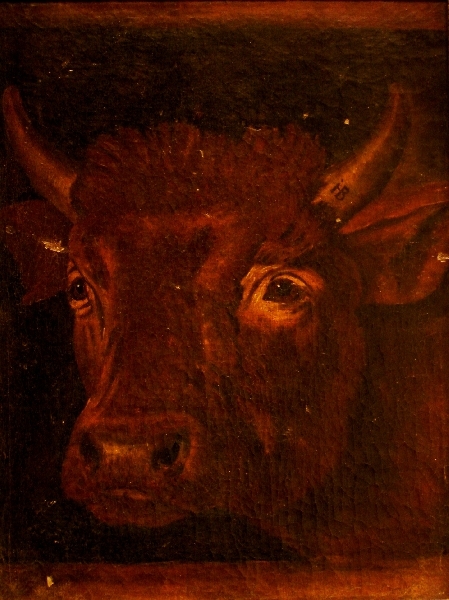
Extinction moved in the sad, ghastly wave of moonlight over frostbitten leaves. Bone-white spears upended my eyes, as I dodged a full-grown bull. Adrenaline-shocked, I sped, scanning the immobile trunks, weighing the Earth down with inhuman strength. And the soil broke in a jarring flash of bestial rage, as another bull, of sturdy, muscular build, spun me around, my heart waning of life.

Bull's head, painting by Johann Heinrich Baumann
I tore through the endless nothing. Then, one bull split my body from the waist up the gut. Marching on my hands, stomping and cracking bone with its merciless strength, adrenaline rushed and spilled out into the open air as I climbed back to my feet, nearly wasted by the crushing jeer. Countless bulls encircled, as I fled, bleeding, the pain yet to reach my brain, grabbing for low-hanging anything, my stomach burning, my feet turning to knee-splitting daggers and brain-flushing mush.

Animals in a Landscape (aka Painting with Bulls) by Franz Marc
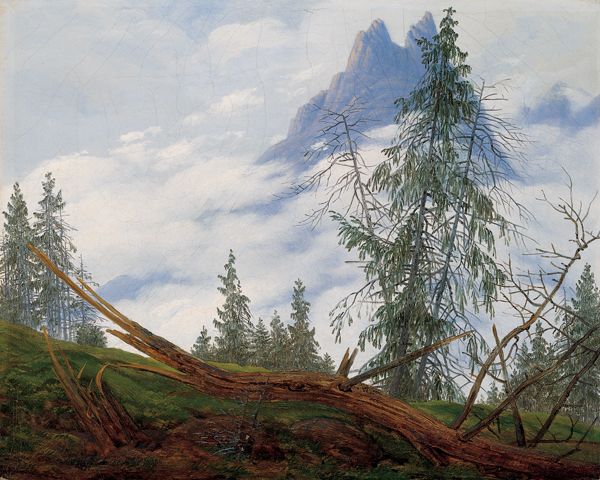
Pit against an escalating fever and white with near-mortalizing blood loss, I fainted under the powerless impression of my death, only steps from the forest edge, still besieged under the sightless underground forest of the human Earth. A single house stood at the edge of a rock face, and I was carried to its door. From a window fogged with subzero condensation, I could make out the moonlit peak, and with every second that my mind ascended, my body shrank with fear, and I gasped for each breath as my last.

Mountain Peak with Drifting Clouds by Caspar David Friedrich
Staring at the summit, and then was enshrouded by cloud-cover, my eyes closed, I stole beyond the body, and time, beyond death and need, beyond blood and truth, beyond the waves of human flesh that rode on this belligerent tidal sway of hope and tragedy, to summit the Everest flight of dream, and survive through this tyrannical flood of mortal reality.
__________

Tuesday, 17 December 2013

Create You: Fearless Artistry and Creative Identity


"I began to dream heavily, violently, every night, and then I learned how to wake up…" 

"Consciously or unconsciously, all writers employ the dream, even when they’re not surrealists. The waking mind, you see, is the least serviceable in the arts. In the process of writing one is struggling to bring out what is unknown to himself. To put down merely what one is conscious of means nothing, really, gets one nowhere." 


Creation is life. More, the incipience of creation is the life of the creator. The life of the artist is bound to their creation, in the same way that a mammal survives on each breath of fresh air. As long as the air is fresh, the artist will continue to create, and as long as the authentic substance of heart issues from the core of the artist's own vision, the arist-seer will align and harmonize with all of creation. 

To forego a path without heart is acceptable. The great mystical physicist of our age, Fritjof Capra, began his famed text, The Tao of Physics, with that realization. Yet, on the path of heart, a different narrative runs its course. To remain true to oneself is to hold fast to the consciousness of one's life source as not merely the beginning precepts of one's physical subsistence, but of the visionary path onto which one is led through to the heights of meaning and becoming. 

The proud artists will realize their vision in the instant of a moment, at simply being the processional experience of creation, the ever-beating heart of co-unity with individuality and universality on Earth. To not over-think is the key to strengthen the creative momentum, reminds Henry Miller, the American author with a self-professed Chinese ascetic's nature. 

So, in holding fast, the artist and author of self-creation, is near-shattered, sensitized by the flood of the fleeting that files down the materialism and consumerism of an all-pervasive cultural fear, to belittle the uncultivated mind to ignorant non-being and blind negativity. In this way, the inner sanctum from where the creativity of an artist is strengthened by the water-like ability to be vulnerable, naked, raw and emotive in a full and unbridled formless truth. 

To all artists, and to the Self, I call on you to be strong, and to claim the ideas and visions and dreams in your mind and heart and being as you would claim your rightful place on Earth. For that creativity, and the perfect imagination of its fruition in your life, is your truth, your heart, your mind, your being, your soul, your foundation, your meaning, and all your own, it is you, your nature, your life, all yours, be it and be proud. 

Everyone, as with one mind and one heart, is capable of becoming sensitive to the expression of your truth as an unheard knowledge that only you possess and that is invaluable, necessary in its tragedy, absolute in its humour, refined in its judgment, authoritative in its experience, wild in its reason, cautious in its aspiring, and pure in its love. Create you. 
___________
Around this circle danced the flame of eternity. In the green spark licked the tongue of heaven. Spring in the Jungle bloomed with effervescent majesty among the ruined foundations of another remote, human wasteland paradise. The veils of fame and belonging passed like a soothing tide, recoiling in the abyss of oceanic depth. We smoked the herb of forgetfulness, harmony and love. 

Ernst Haeckel's 1905 Wanderbilder (Travel Pictures)
The smoke coiled around our lazing necks, floundering amid the slow-moving river, her brown body motioned like a heavy emotion. One among us, an artist of metal and flowers spoke up as paper and marijuana stung our eyes, blinded by the greedy moment, a fleeting light. "Native community leaders announced their wish to use our space. They will hold facilitations, meetings and workshops on the militarization of the Indian people; their War." 

Coolies on the Road near Kalicut, Malabar by Edward Lear
A shade lifted and a heaviness shrank as our hearts wept and our minds faltered along the brink. She, the speaker, high as the azure, fled to the banks, to swim and cleanse in thoughtful reflection. She swung on a low-hanging vine, falling into the naked river, dressed still in paltry coverings, now a resident of the Amazon for well over a decade. Her eyes spoke of what her tongue could not shake. 

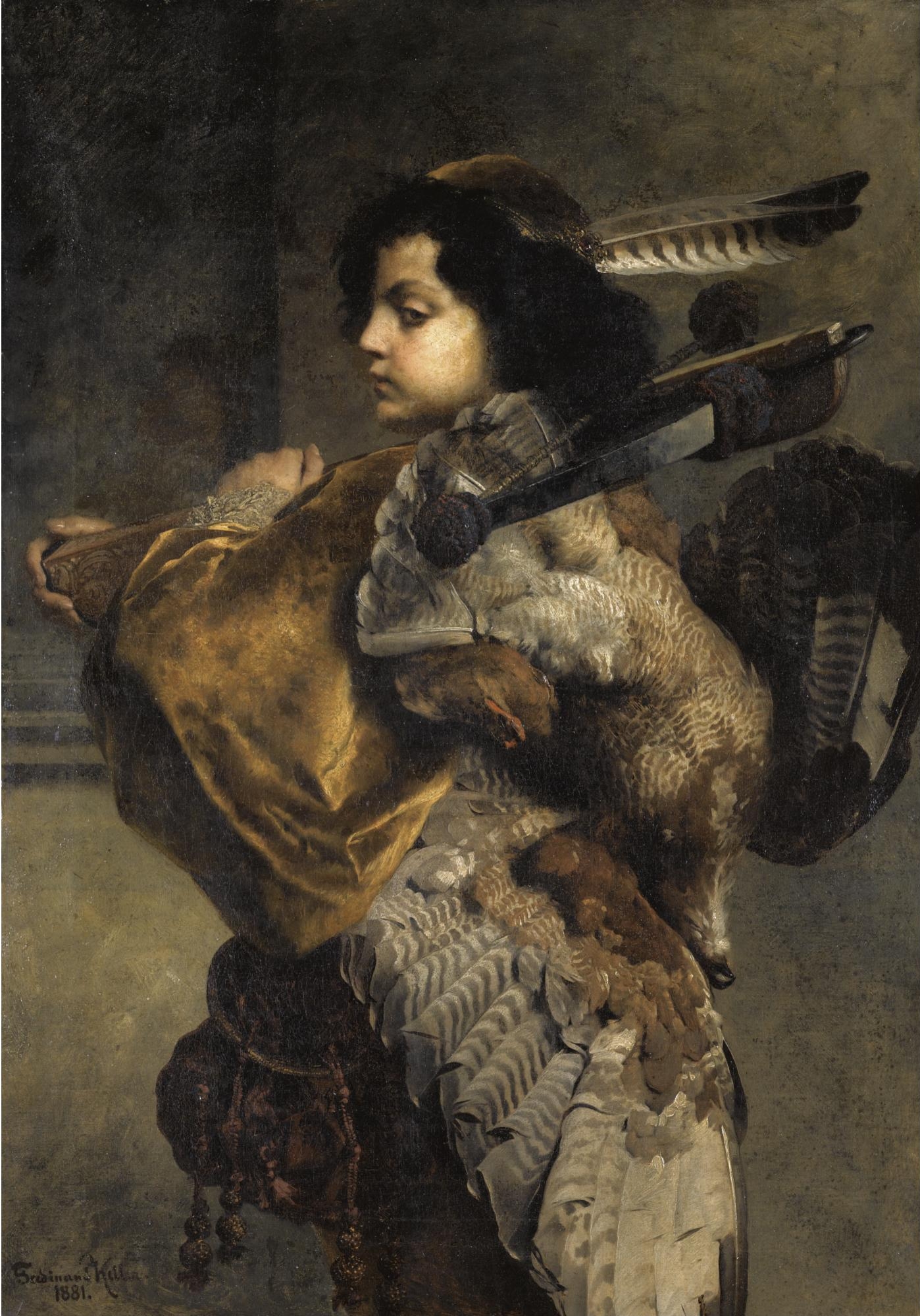
Young hunter by Ferdinand Keller
They arrived, and we vacated the area, as a show of respect. And one day, on the top floor, whereon we store our arts, with wood canvases lain and strewn, I saw her. She was not Native. She was a woman of the Old Country. Her heart was cold as a perennial shadow. Her moonlit face eyed me with an inhuman glare, and her blood then boiled, raising her hair, intoning a voice as harsh and ghastly as the screaming bite of a bullet ant. 

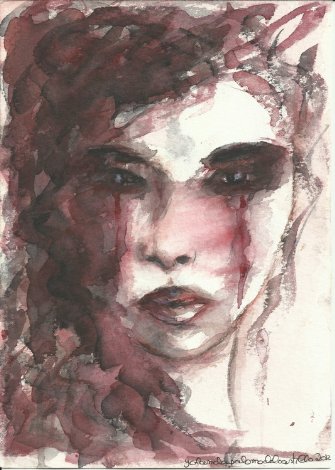
14 abril by Yolanda Palomo del Castillo
I ran. And then falling with desperation in the rushing river, we were swept along. In the instant of our near-death, she lunged towards my angular body, stretched out above the surface, in full display of my superior experience on these riverine lands. I watched as the infamous cult leader, impostor of the Cocama ethnic struggle was buried in the open jaw of the current, as her bones cracked in the turbulent stream. Awash, I lay at the edge of reason. 

Giant tree in Brazil's tropical forest by Johann Moritz Rugendas
Then, I saw the body. The tattooed flesh, gouged and lacerated. Two arrows pierced the man's underside, widening a deep, mortal wound. With bowels distended, his blood having since let almost completely of his sunken frame, I cried, lowered to the wet jungle floor, bleary-eyed. Not only had his own turned on him, but the man also suffered bullets. Scarred and mutilated, his body is the story of his people, dead to the world, brutalized and beaten down by the perpetrators of human trust, by invaders and blood alike. 
_________

Monday, 9 December 2013

Rebuilding the Unconscious: National Reconciliation and Personal Poverty


"What was in the unconscious, by talking about it, was brought into the conscious mind, and since the conscious mind, Dr. King's already won, the behaviour changes. Wait a minute, what's that mean? Wait a minute, what's that mean? That means that we may be closer to Dr. King's dream than we fear, but we got to keep talking. We've got to keep talking, even when it's uncomfortable." 

"Today, the American Dream is under threat. Our veterans are coming home to few jobs and little hope on the home front. Our young people are graduating off a cliff, burdened by heavy debt, into the worst job market in half a century. The big banks that American taxpayers bailed out won’t cut homeowners a break. Our firefighters, nurses, cops, and teachers – America’s everyday heroes – are being thrown out onto the street." From the Rebuild the Dream Contract 

Van Jones

Usually, this space features original writing, mostly essays, articles, and creative pieces published across the globe, a repository of works featured online. Such original writing usually comes after referencing relevant quotes from the luminaries of the age, those who spoke and clarified humanist dream-thinking beyond conceptual idealism to the pragmatism of imaginative vision and achievable action. Yet, in light of the exceptional words of Van Jones, noted public intellectual on green economics and social justice, a project on the American Dream, and the War on Poverty, a non-fiction work entitled, The American Nightmare: Deconstructing the War on Poverty that I had been working on for on average 6-10 hours daily over a span of three weeks has been suspended due to negligent correspondence. 

The suspension of the work has led me to seriously question my place in the Struggle. I have reflected earnestly and steadfastly into the bitter and stubborn recesses of my young mind, to uncover and explore the history that has led me to my current state, profession, and living circumstances. Not only has the suspension irked me personally, it has led to a seemingly irreparable disintegration of my professional development, as I have been led to question the very foundation of my primary income-earning as a freelance writer. Simply, I accepted a job to write a major work on poverty, which truthfully, paid so little, and asked so much of my time, that it may as well have led me into poverty. 

Added to the initial fact, while I did the work out of curiosity and an impetus to serve a greater work ethic in the name of fulfilling a position asked of me, the suspended correspondence between myself and the publishing agency has caused unmentionable anxiety. The topic on poverty in the United States, and government programming intended to reduce and eradicate poverty had led me to very interesting conclusions on the nature of governance and civil progress in the American context. The freelance job that I had taken to produce 215 pages of carefully written and closely studied work on the subject was truly an exhilarating and inspiring process. 

However, the process as a whole, and the empty-handed result thus far, has left me with an enduring impression with regard to the nature of work, one that, honestly, compels me to complete exasperation. Was it vain pride at the chance of writing a book, and being paid for such work? Or, the overall scheme of my life that has led to this point of personal and professional denigration in the name of accomplishment, work and independence? 

The work of SoJourn(al), this space, is essentially one where the process of a young life, and its manifestation of dreams, come to fruit through perennial dedication to the passions of independence (i.e. self-employment) and creativity (i.e. resourcefulness). After completing the original sound-art works relative to the Sketches of Style collection, I intend to break from uploading more original content here, to recollect and compile all of the works that support the overall intent, create a master publication (i.e. in the form of self-published collected original materials, such as dream fiction and essays on the narrative subconscious), and begin a new page on a new project.     

For now, more music reviews from BeatRoute are forthcoming… 
__________
There was a sheen of golden sand on the top of the butte, where I sat, immersed in the Valley of the Gods. And as I opened my eyes, the sand sparked, as an invisible flame rose to greet the monumental sun. Tears cracked the thirsting rock as I held in my arms the newborn drum. Taut calf-skinned and maple-encircled instrument of spirit, it moved, as inside me, with a petrified grace. 

Mount Desert Island, Maine, by Jervis McEntee
Not alone, yet from the clouds above, heavy with a sad rain, pregnant with the forecast of solitude, I remained silent, a silhouette of the drunk Earth, whose lines disappear and merge with the clear and lucid landscape horizon. Then, there were others behind me. With hands held at their sides, solemn. We awaited the grace of the Royal Native footstep, a rush of patient anxiety, the air true and sound of our hearts' own unhindered regularity.

"Prayer in the Desert" by Jean-Léon Gérôme
Then, as with the march of an oncoming storm, they strode in dancing. Their flat footwear dusting the tops of the sky, elegant with strength. Their movements sure and ancient, greeting the naked stone with the trust of an artist's hand, as the land's own song cried and intoned the sacred. And all then overcame the one great Fear of Death, displaced by the Beauty of Truth. Their songs spoke of Love, Peace and Unity. Then a rain flattened our wild hair, and we cried in unison for the end of a loud and gross age.

"Early in Day in Desert Quiet" by Mary Agnes Yerkes
I began to beat my skin, summoning the gravel and the hail, I floated on a subtle ecstasy, my own song, for them, for here, for us. The drum cracked and moaned, and my heart opened with a newfound longing. The rhythms of the Earth called forth the Witness. Of sight and mind, I broke fast on the holy mount, within the inner sanctum of my own restrained and haunted psyche. Liberated, I stood, bowed with respect to the territorial spirits in whose name I intoned the first breath of song. 

Lions in the Desert by Henry Ossawa Tanner
We left the butte alone, as it had been for aeons. The Valley of the Gods lay silent and waiting behind our upraised eyes, sharing in the unsayable fate of humankind. 
 _____________
Thelonious Monk, the great American composer...


Monday, 2 December 2013

Ecological Storytelling: Dream, Hallucination and Vision


"I think it's easier than to formulate high ideals, but a few things are more difficult, and to discover the means whereby those ideals may be implemented one has to dream but one has to dream in a pragmatic way" Aldous Huxley, in Hoffman's Potion

Do I hear a tinge of surf rock here and a splash of psychedelic vocals there? And all wrapped up in a damn fine beat! The new Ketamines 7” So Hot! opens with its killer two-and-a-half minute title track. Resistance vibes ebb and flow as they bray and stomp through lyrics held down by the kind of upbeat clutch that makes this Toronto group well worth a listen, if not a full-fledged tracking down.

Released this October, the band’s three-track album buzzes under the genres of punk, garage and power-pop. Spacey breakdowns mood out these catchy and tight musical explorations with extra-hot reverberating guitar riffs smoothed out over ambient and effectively eerie vocals. “New Skull Tattoo,” the second cut on the album, begins with a daze of light-hearted, fifties-era doo-wop rhythms fused together into punk lyricisms.

The Ketamines provide a riot of trickster stylings, as the lyrics carry us through into a stupendous poetic irony. Final track, “Summer Mothers,” sounds off a dream-pop show with the power of good feelings, impressing the listener with a kind of end-of-concert bittersweet rush that takes no prisoners. It reminds us that when the summer or the year ends and all is lost, we should just hold fast to the driving beat and we’ll all be okay.

All in all, each and every song on this new 7” is good listening. Even multiple listens later the songs groove pulse more and more in the veins. Straight to the head, this one’s a gem.

This piece of interpretive writing was published with BeatRoute magazine on November 3, and conceived under the influence of soundscapes by Canadian psychedelic music band, KETAMINES
___________
The Union Street Y faces the Puerto Rican cafe where I used to sit over a microwaved chocolate chip muffin and hot chocolate, eyeing the clock, readying myself for Hebrew school. The elaborate turnstile reminiscences of the red-bricked Y invited with the flushing scent of chlorinated memory and the erased lunch-hour sweat of youth. There, a mere two jaunt to the fish-gut factory ocean, I spoke to children. Fascinated by the swung heart of musical storytelling, the night awaited patiently, as the fat bosom of American daytime on the human Earth struggled to a peaceful end. 

Lesser Ury: Café Bauer
A story of Massasoit and the unvanquished heads of Massachusetts flesh, spell out the old paradigm loosed from vocal chords, taut with knife-edge reason on a silent beach. Their indiscriminate wisdom emerges from white-skinned pride, to destroy the vainglorious ruse of ego and fate. Mortality ensued in the fading light, as speech lightened the animate Earth with a name, and its meaning. The soil spoke with a tongue of roots, with teeth of stone and and words of food. Saying: where the story is told is equally or more important to the telling. 

A Northern Lake by Unknown
Flown beyond the wellspring of distant knowledge, exotic in its geography, sacred in its ecology, and born of a feverish need in its cartographic attemptation, a single mountain rose as a breach of faith on the plain horizon. Monumental airs shifted and sprang from the glowering mass of insurmountable ice. Formed as from a frozen volcanic fire, the ice lifted with evaporating death, as the cold grip of lifelessness in nonbeing. The frozen hell still beckoned forward the unanswered mystery of longing, as the natural light waned atop its insuperable caracas, a skull of monastic belonging. 

Mer de Glace, in the Valley of Chamouni, Switzerland by J.M.W. Turner
I stepped forward, onto the slippery fall of the sky's over-hastened drop to Earth, as the violated inherent reason of nature, unearthed. The pool fragranced wisps of spiritual air, the will of the unmoving background to all life on Earth, revealed in the deadening cold. As the stone ascended to its paternal source above, each step closer frustrated the nervous system with defeat, failure, and the fatal swoon of all human belonging. The release of the spirit, awake. 

Harlem Valley, Winter by Ernest Lawson
Captured under the fault of a boot, I risked a greeting at the hand of death's blizzard smoke, the craving and seductive flaw of its embrace. Unable to get back afoot, I peered through the ice to see the reigning female of human law. The Queen shone glinting the fixing light, fleeting, yet absorbed needfully. With a hand mobilized by the insane truths of modern life, I sunk below the ice, to finger the freezing metal, and to possess its deathless strength. Ascendance moved to transcendence. The impossible summit slunk beneath my loins, hidden in hoarding pockets and disguised on lusting hands. 

Queen of Coins (Diamonds) from the Visconti tarot deck by Bonifacio Bembo
The line at the cinema began to move. I paid, and saw the unseen. I paid, and mounted the insurmountable. I paid, and lived the unliveable. I paid, and knew the unknown. I paid, and heard the unheard. I paid, and paid the unpaid. And I paid, and paid to pay for the priceless. I paid to pay for the invaluable. I called home the unreachable. I vanished in the light. I stole out on the intractable ice. I rose my shoulders above the limits of atmospheric pressure. I called out above the thinnest trace of oxygenated air the name of the unnameable: I.  
____________


Monday, 18 November 2013

Novel Liberation: The Humble Postcolonial Wisdom of E.M. Forster


"If I have had any influence, I would be very glad if it induced people to enjoy this wonderful world into which we're born, and of course to help others to enjoy it too."

“We must be willing to let go of the life we have planned, so as to have the life that is waiting for us.”

“They too entered the world of dreams- that world in which a third of each man's life is spent, and which is thought by some pessimists to be a premonition of eternity.”

E.M. Forster (the last quote is from A Passage to India)

The British Raj and the Indian Independence movement of the 1920s provide the setting for a poignant story between two principal characters in E.M. Forster’s 1924 novel, A Passage to India. The lives of Aziz, a Muslim doctor and Mrs. Moore, an older Englishwoman, represent themes of social constraint, in contrast with personal relationship. Constrained by title and culture, these characters manage to relate under unique circumstances. Aziz learns to respect Mrs. Moore unlike any Englishwoman he has ever known, while Mrs. Moore is, at first, captivated with the pride of knowing an endearing local closely.

Mrs. Moore, as with Miss Quested, is captivated by Aziz because he represents something of the “real India”, to use the words of Miss Quested. “Try seeing Indians” was the reply of the schoolmaster at the Government College, when Miss Quested asked how one might see their colony in its native authenticity. There is always room for remiss under the social umbrella of Indian-English relations; whether in the surprising first encounter between Mrs. Moore and Dr. Aziz in the mosque, or the arranged party at the tennis lawns, the tea gathering at Fielding’s or the excursion to the Marabar Caves, which, finally, proved more disastrous than any one had expected.

“May I know your name?” Aziz asks to Mrs. Moore, cautiously, in the mosque. His demeanor is one of near-desperation, as someone both protecting his native sphere, as well as struggling to see British humanity. “She was now in the shadow of the gateway, so that he could not see her face, but she saw his, and she said with a change of voice, ‘Mrs. Moore.’” This very revealing sentence emphasizes the obscurity of English presence from local, Indian eyes. In that moment, Mrs. Moore felt safe enough to share her name, the most important object of her title and superiority. Aziz remembers her generosity, as her fitful capacity to speak the truth becomes the apex of her story, truly a minor character in A Passage to India.

When after Dr. Aziz stands on trial for the assault of Miss Quested in the Marabar Caves, Mrs. Moore is decidedly frank in her stance on Aziz’s innocence. “Of course he is innocent,” says Mrs. Moore as Miss Quested begins to question her disillusioned experience on the excursion, all the while Mrs. Moore is quite fed up with India entirely. “She was by no means the dear old lady outsiders supposed, and India had brought her into the open…” writes Forster, who depicts her as a typical elder, uninhibited by the dramas of youth, and quick to speak the truth, even if it is unwanted. At this point, Mrs. Moore is on her way out of India, and the novel, where she soon dies in transit.

Regardless, Mrs. Moore is immortalized by the groundswell of Indian support for Aziz, who soon finds reprieve, as legends of “Esmiss Esmoor” soon manifest in the appearance of folk shrines in dedication to Mrs. Moore’s role in saving Aziz’s life. It is important to add that throughout the entire novel, Aziz is addressed by his first name only, while Mrs. Moore solely by her surname. Mrs. Moore’s name transforms when said by Indian voices. “It was revolting to hear his mother travestied into Esmiss Esmoor, a Hindu goddess,” thought Ronny, Mrs. Moore’s son, whose experience of India remained superficial, or, more accurately, guarded, throughout

Aziz and Mrs. Moore fail to truly connect in person, because English colonial formalities (and informalities) were too firmly laid beneath the foundations of imperial culture. During a scene of characteristic tension between the colonial masters and their subjects, Forster writes, “Aziz flamboyant, was patronizing Mrs. Moore.” The direct interactions between Aziz and Mrs. Moore are brief and sparse, as they are interceded by English formalities, typically mediation by a male authority – Mr. Fielding in this example. The scene, where Aziz and Mrs. Moore meet in more conventional circumstances, for a tea gathering at Mr. Fielding’s, reveals Aziz’s character (and Forster’s impeccable prose) as someone unable to speak on behalf of India. The scene also reveals the seemingly adventurous minds of Miss Quested and Mrs. Moore, on their search for the “real India” as a mere surface-level novelty.

Mrs. Moore, although agreeing to accompany Miss Quested on her excursion into the “real India” is soon overcome with the fundamental truth of her presence in the faraway land. As the excursion comes to a bitter close, it is said of Mrs. Moore, “…since her faintness in the cave she was sunk in apathy and cynicism. The wonderful India of her opening weeks, with its cool nights and acceptable hints of infinity, had vanished." While, from Aziz’s perspective, “…he agreed that all Englishwomen are haughty and venal.” Mrs. Moore is the stereotypical colonial British woman, whose curiosities for the rare and exotic life of India prove ineffectual to satisfy her experience of authentic India.

Their relationship reveals the meaning of liberation in colonial India, where Aziz’s fate becomes Mrs. Moore’s very undoing from India. For Aziz, he would come to know “…that an Englishwoman's word would always outweigh his own.” Generally, both characters speak well of each other, even if their personal, physical interactions are constrained. Conclusively, such is the larger relationship between the colonial British with India; ideal and positive on paper and second-hand experience, yet up close, absolutely ruinous.

This essay, entitled, "The Relative Liberation of India", was written for an acquaintance as part of his school curriculum. Consequently, I was reintroduced into the magnificent literary treasure troves of E.M. Forster's richly imaginative prose. 
_________
An expanse over the marshland floodplain. The drifting current sways gently through sap-lined pine trunks and decomposed maple leaves. Ahead, the riverbanks motion with unspeakable gratitude, bittersweet, enjoined to the drunk swell of an upraised wetlands. 

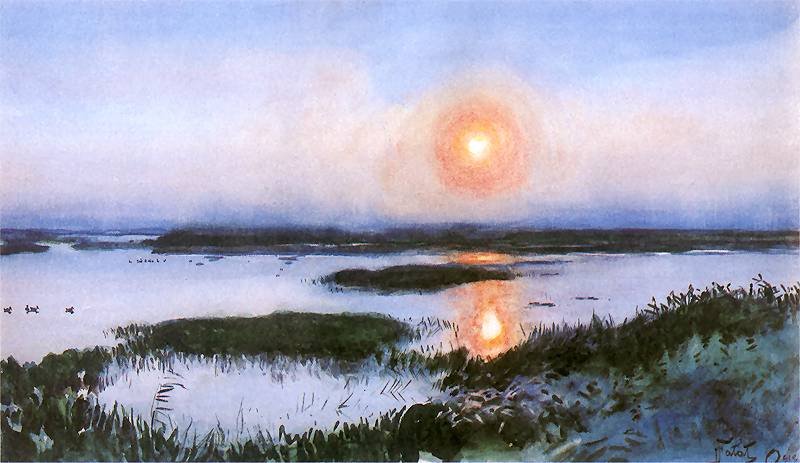
Sunset over wetlands by Julian Falat
He speaks, a guide of the ancient St. Lawrence river basin, to reinvigorate the ground with the renewing tides of Mother Earth. She beckons the swallowing of a forgotten landscape. The land is to be reclaimed. Indigenous nationhood reinstated over the American-Canadian divide. 
_________
Featuring a lyrical evocation from the collection, Sketches of Style and chapbook, Muse for the Wounded, Guise of the Beloved expresses thematic tides of visceral belonging amid landscapes both supernatural and inhuman in an age when the human body is more and more experienced only in its violent rending apart.

Yet, musical undertones, both electronic as acoustic, ring clear throughout, simultaneously presenting the source of human life, as our fate. In the commotion of bewildering psychic momentum, there the muse stands patient and waiting to receive the wounded, who with eyes of intoxication and skin of vulnerability, senses a way beyond and through the immense and spectacular Fear of Being.


The six poem chapbook, Muse for the Wounded, is comprised of selections from the larger collection, Sketches of Style. Here, the archetype of the wounded healer is redefined, wherein the muse becomes the healer in the mind of the poet-seer. The one poem, Guise of the Beloved is also featured as a sounding the artful designs of a musical elaboration on the Sketches of Style album

Monday, 11 November 2013

Fear, Incorporated: The Transformative Theatrics of Living


"Never ever forget that you are the future of this country…You mustn't be frightened of life, it's a very exciting life because you can make your dreams come true" Pieter-Dirk Uys, from the documentary Darling! The Pieter-Dirk Uys Story

“In the end it will be up to audiences each time in the event because they will determine the stories,” says Diamond. “My hope is that we have the courage, in a way, not to look at how to change that thing out there, but how to change ourselves.”

That self-reflexive and socially conscious attitude has defined the theatre company right from its humble beginnings in Vancouver in 1981, and it continues to exemplify creative leadership around the most sensitive topics in contemporary public debate. Diamond’s first prominent role in the company, as associate director of the 1982 production Right to Fight, addressed affordable housing. Later, Diamond wrote The Enemy Within, which satirized B.C. politics in 1986. Two years later, he had his directorial debut for the company with one of its Power Plays, which use theatre games and exercises to explore social issues and create community-specific theatre.

Corporations in Our Heads is one of Diamond’s more experimental works in his effort to reach out to community through art. Based on the work of Brazilian theatre visionary Augusto Boal, creator of Theatre for the Oppressed, Diamond’s new work is an original interpretation of Boal’s Cops in the Head, but takes an entirely different approach. “The rules of the Theatre of the Oppressed, I’ve thrown them right out the window,” says Diamond.

The production asks Calgary residents to reflect on, share, act on and change the dominant messages that influence society . “The reason to do the thing for me is there’s a lot of good work happening out there on how the messages of corporations affect our consuming,” says Diamond. “But I don’t think we’re doing a lot of talking about how those messages affect our own images, not just of ourselves but of our relationships with each other. And it’s at the relationship level, in fact, that our consuming originates.

Corporations in Our Heads will be facilitated by (or “joked by,” as Theatre for Living puts it) Diamond himself, who incites the audience to participate. “The power of it, for me, is that it really is a democratic thing,” he says. “While we are framing the general subject matter, Corporations in Our Heads, the actual content really is going to be determined by the people who enter the room that night. And nobody — not me, not the sponsoring groups, nobody — is going to be able to predetermine the content.”

This article, titled, New theatre work examines corporate psychology, continues where it was originally published on November 7 in Fast Forward Weekly. The piece is a continuity on the theme presented by Pieter-Dirk Uys and his arts activism in South Africa, as David Diamond represents a similar following in social consciousness and public engagement in Canada.
__________
Chinatown Delight
_________
Following the trend of the album, Sketches of Style, this sounding is an amalgamation of three instrumental improvisations harmonized and syncopated together with a synthetic rhythm. The beat creeps in, reminding the listener of the abstract organ that touches on soul, as the reeded music blends with darbuka.

Originally published in a comic, the poem that led to the musical expression of the same title, "find Inspiration!" first appeared in Maad Sheep, an illustrated print publication of cartoon and literature that I once found while sitting in an open-air cafe. The issue in which my piece was featured was displayed at a Comic Convention in Canada.

Lyrically, the piece is a foray into the bitter savagery that cooks the great mass of minds; all who are saturated by the consumptive bread of modern life. The challenge of simply being creative in confrontation with the overwhelming burst and pop mirrorscape of infinite self-deception is the subject and of this sketch of style.

The rest of the chapbook is a fourteen page collection of poetry on the subject of gaining respect and appreciation for the superhuman qualities of nature, as more than grandiose, and more than human intellect and possession could ever capture or convey. Many are observational, and drawn from insights into the ground of being as the naked soul of humanity.

Monday, 4 November 2013

Emerging Local Creativity: Literature, Music and Art Create Community

Matt Hanson, Calgary Working Group (photo: Drew Anderson)
"I want to work in revelations, not just spin silly tales for money. I want to fish as deep down as possible into my own subconscious in the belief that once that far down, everyone will understand because they are the same that far down."

“All human beings are also dream beings. Dreaming ties all mankind together.”


How did you get involved in trying to start a local media co-op?

I was corresponding with Montreal Media Co-op founder Dru Oja Jay and he expressed a kind of interest in the idea of a local in Calgary. I had been a member of the media co-op for about two years, the national. As I was more active, I was just more interested in what that means to be local. How they operate in Montreal, Halifax, Vancouver and Toronto — how they operate and what that might mean for Calgary. I started to put the word out there and it was very well received by Dru. He basically encouraged me to get together with others and talk about the idea and consider what is independent media in Calgary. Basically what I found is that many people are interested in their own projects, in terms of starting their own papers, but the difference here was that I was interested in connecting that kind of activity with a national co-operative site.

So, what’s set up right now?

Basically right now there is a Calgary Working Group as part of the Media Co-op and that has about 130 members, since 2009. All different kinds of stories have come from that. But in the past two years since I was writing with the Media Co-op, I found not many people contributing to the Calgary Working Group. I was just wondering about where is that understanding in Calgary in terms of this great engine of independent media and this source for people to get involved in media activity. So I went to different people who were involved in co-ops, like co-operative housing, and I talked about the idea and started to get it out there and I posted flyers and things about meeting with people. Initially I got three people that were very actively engaged in promoting and organizing the idea. Those were Melissa Manzone, she’s from Montreal but she lives in Calgary and she has a masters in journalism. Then a journalism student at MRU who has a certificate from SAIT in journalism and he’s still a student, and then another young woman named Chelsea Pratchett, who has done a lot of multimedia work — she has alternativemediayyc.com. Basically the next step was I applied for a small grant through the Arusha Centre, a Take Action Grant, that I received. I just started, DIY, working with Melissa who was editing articles with me, and also doing video interviews with people, and then through Alternative Media YYC I was organizing podcasts as weekly contributions. This small amount of funding is just an encouragement to the people here that might consider the idea of a local media co-op in Calgary.

How so? Would you use that money to pay them?

Yeah. The money has been used to pay contributors. Encouraging people with honorariums. To pay editors. To pay people organizing even. If they’re putting dedication into that, we consider that and we want to value their efforts. It’s a very free grant that I received.

How are decisions made? I come from more traditional media where decisions are made by editors. Who makes decisions in a co-op?

I’m really learning myself because I’m new to the co-operative sphere. But I’ve been really trying to figure out in terms of how the application of the co-operative organization works in relation to this. How we want to organize it is in a way that everybody has a share of the company, the collective. For me, this is really a learning process, in terms of how a co-operative organization works. Part of the funding I received, I’m putting into going to a conference to learn about worker co-operatives in Edmonton. Part of the forward process of this idea is really generating that structure. Right now, we’re at a very initial stage.

Why do it? A response to the media that exists? Do you think the media isn’t doing its job?

I think, to me, there’s that. I don’t want to be too reactive. I think it’s more about having a sense of imagination and taking things into your own hands, and really learning by doing in a way where the kind of media that I want to see is one that doesn’t just tell you about something, but incites you to action. The page is not the end of the matter.

So more of an activist slant.

Yeah, more of a fact that this is part of being more involved. Journalism should be about being involved.


This piece, also published for The Media Co-op, is an excerpt from this week's Your Face Here interview featured in Fast Forward Weekly on October 31
________________
War zone. Huddled under protection of stone, the dusty clamour of steaming trucks file past, carrying explosives, ammunition; the all-potent death of armed men. The sky burns under a 40 degree desert sun, magnifying the light of illusion with the bitter disbelief of guts strewn in the angry heat. The moonlit fox scatters beyond the floodlit path, and I sit, knowing I'm under the eye of a flagrant bomb pattern, patiently scanning the sky for my fate. 

Cpl. Alicia R. Giron
Down the gravelly road, an older man, built strong and lean, walking assuredly through hell's gate. In this valley, the shadow of death casts invisibly, as the omnipotent fear, that cutting vibration that pierces as it electrifies. Every last medieval hell of our wildest imagining is child's play in comparison. The daytime moon fills my mind, obscuring the passion of escape into the dizzying architecture of mythology, roasting in this Middle Eastern world fire.

Collateral Damage by James Miller
The black fly of fire-bomb death squeals past overhead, and I run, sliding my fingers along the desert rock, the stone crumbles into rough sand. My fingers, mysteriously blackened, feel into the stone. A black liquid seethes. Viscous, thick, it's oil. I realize I can't leave. The desert spring overpowers my body in a storm of evil lust. I treasure the root of all fleshly worship in this age of fire as the swarm of madness overcomes, and in a blinding instant, the stone implodes, my hand flits to dust, the Earth gives way to pools of ash, and I sink in the quicksand of eternal war, condemned to modern night. 

On the Impacts of the Iraq War, Read COMMON DREAMS
_____________

For an ecstatic and mesmerizing experience, listen to this album while watching SAMSARA. There are new waves of sound yet to break on the open mind who might stand to listen on these ancient shores.


Delighting Destiny: Selections of our best during a live performance with audience. All proceeds from this album sales will go towards producing future performances and future recordings. Thank you for your continued support.

Tuesday, 22 October 2013

The Spring of the South is the Fall of the North: Writing on Liberation

A 25th of January key freeing Egypt by Carlos Latuff
“People who shut their eyes to reality simply invite their own destruction, and anyone who insists on remaining in a state on innocence long after that innocence is dead turns himself into a monster.”

“The poet or the revolutionary is there to articulate the necessity, but until the people themselves apprehend it, nothing can happen ... Perhaps it can't be done without the poet, but it certainly can't be done without the people. The poet and the people get on generally very badly, and yet they need each other. The poet knows it sooner than the people do. The people usually know it after the poet is dead; but that's all right. The point is to get your work done, and your work is to change the world.” 


Regarding the current situation in Egypt, the armed forces and the police backed with thugs are massively shooting and killing suspected pro-the deposed President Mohammed Morsi in streets, at mosques, and in alleys close to demonstration areas. The shooting is happening in all major cities of Egypt. Many religiously motivated violence and shooting incidents have taken place in Christian populated cities located in Southern Egypt.

In Cairo, the violence is escalating and the death toll of Muslim Brotherhood is soaring as the grand son of Hassan El-Banna, the first founder of Muslim Brotherhood organization in Egypt was shot dead on Friday clashes (Source: Al –Jazeera News TV). Another son of prominent Muslim Brotherhood leader was shot dead on Friday evening during clashes with the police force and the army. Egypt’s temporary government has declared a State of Emergency, and all citizens, as well as foreigners, were warned by the police and the army to keep away from street demonstrations and public governmental buildings, and to avoid entering Tahrir Square.

As you may know, most Egyptians have aggressive sensitivity to being photographed by foreigners, whether in normal daily situations or during public demonstrations. That is why we saw many Western journalists attacked at Tahrir Square, and one female journalist raped consecutively by a group of thugs in Tahrir square. It seems to me that the current military regime in Egypt has fully determined to uproot the Muslim brotherhood organization, not only in Egypt, but also in the whole region, and that might lead to the unwanted birth of another Syria in the area.

Most pro-democracy supporters insist to protest. The Muslim Brotherhood protesters are still surrounded inside the Al-Fateh Mosque in Ramses’ Square. They want to come out from the mosque but they afraid that the thugs outside the mosque might attack them. The police force outside the mosque is striking the protesters inside the mosque with tear gas after a gunman shot at police forces from the minaret of the mosque (Source: Al-Jazeera News TV. 6:00 pm. Cairo. GMT.)

Mr. Abdel Rahman Siddiq Hashim, Correspondent in Cairo, Egypt (August 17)

            Thirty minutes by car from downtown Cairo, the predawn sky of Abu-Seer village revealed the most ancient, complete stonework in the world. Alone, I climbed the eroding rooftop of my host’s concrete dwelling. Sleepless, I gazed into the unworldly pyramid landscape with sand-blooded eyes. The quiet rustling of goats and chickens from an adjacent rooftop finally subsided under the mounting sun. The cool desert night slowly began to burn in the morning haze. It was as common a start as any to another harsh day in a small village of Egypt.

On the village margins, Saqqara Pyramid decayed in the encircling sands, humbled by the glowing Sahara Desert horizon. A middle-aged Egyptian man, donning a dark grey jellabiya, cautiously rode his mule across the rubble-strewn sands. Then, an airplane flew overhead.

Three divergent ages of human existence on Earth emerged as one, sharing a moment, side-by-side. The eldest of the three appeared motionless. The Egyptian man meditatively attended to morning duties as his forebears had done for over a millennium. The airplane, a symbol of Egypt’s national independence and economic prosperity, vanished in an instant.

Tahrir Square, meaning Liberation Square, invited all with pleasant cafes hailing from Egypt’s belle époque period. Patrons intermingled with families at the KFC, and all coveted the dollar menu. In the square, historic speakers in the Headquarters of the Arab League heard the call of muezzin belting out the call to prayer. Five times a day, the prayer, known as the adhan, ascended above the city of a thousand minarets: El Qahira.

For a twenty-year old student attending the American University in Cairo (AUC), overlooking Tahrir from the east, there was liberation. The first day of my young life in Cairo opened with one fiery orange dawn in the fall of 2007. Sipping a hot ginger tea, I waited for my cab in Tahrir Square. Mohammad, age thirty-three, chauffeured me to what would become my home for the next ten months. Zamalek, an island on the Nile, stood besieged on all sides by a city of 18 million.

In the past three years, the AUC’s Zamalek student residence went through two evacuation processes during the 2011 Revolution, and again this summer. Due to the unsafe proximity to Tahrir Square, ground zero for the infamous belligerence of military and riot police, international students were sent home. The residence became a safe haven for the AUC community; domestic students and staff were offered free accommodation and complementary meals.

Emotionally overwhelming, everyone present will never forget the bloodied streets paved with the burnt skin of nonviolent protestors. “They all have witnessed history unfold and a lot of them went to Tahrir Square. They all left in tears having to abide to the evacuation request,” Fatma Abou Youssef, Associate Dean for Residential Life at AUC wrote via email from Zamalek, Cairo on August 19.

In 2007, through a yearlong study in the humanities, Egypt held a potent charm. For a child of American suburbia, life in downtown Cairo was a true and magnificent freedom; where a dollar bought cab fare through thirty minutes of scorching highway from the Great Pyramids to the fortress of Salah ad-Din. At ground level, the city was not only safe; it was ever so welcoming. In comparison to crime in the average American city, Cairo was exceptionally low-key.

After many captivating hours learning intensive Arabic from a local Egyptian professor or studying Islamic philosophy with a visiting lecturer from England, the streets beckoned with an extraordinary spirit of discovery. Only after minutes of walking southeast from Tahrir Square, I wandered to the shrine of Saint Patron Sayyida Zeinab during the pilgrimage festival, or ‘Moled’, in celebration of the birth of this special granddaughter of Prophet Mohammad.

Irrespective of prohibitive warnings from AUC’s student orientation the day of the Moled, I decided to traverse the uninhibited grounds where Sufis and rural Egyptians (known as Sa’idis) pilgrimaged. I espied characters from a bygone era. Many had never before seen the pale face of such foreign skin. An elderly man without legs moved with the aid of wooden blocks, another with a gnarled cane and goatskin satchel appeared at the end of an impressive journey. One younger man, about my age, carried a paralyzed companion on his back. With equal wonder, they smiled at both having reached the shrine as staring into blue irises.

For the next months, practically every time I set foot in public in the city of Cairo, as throughout Egypt, children ran to greet me, jellabiyad-graced elders responded generously to my regular salaam alaikums. Peers offered a traditional glass of Egyptian whisky – the joke name for black tea served with a generous helping of sugar. Ordering a freshly pressed sugar cane drink (qasab) from street-side juicers became a delectably regular pastime under the all-pervasive sun. In fact, the original word for sugar (sukkar) is derived from Arabic. Similarly, the tamarind drink (tamr-hindi) was served by charming fez-wearing men (hearkening to Ottoman times) on street corners amid the harrowing traffic in Tahrir Square.

First impressions of Cairo were smoothed over with genuine smiles and hearty laughter. The people of Cairo soon became my teachers, more than any university professor. First having sought to learn Arabic from the locals, I then learned of dignity, humility and simplicity through their open hospitality and street-wise intuition. Uniquely, Ramadan became my favorite time, when a piece of unbroken baladi flatbread always accompanied the savored mulukhiya soup; welcoming any blessed stranger, even if arriving from the next unassuming alleyway.  

Rapidly, the most frequented haunts, such as Cairo Club and El-Bustan, saw mounting anxiety. Sugar, oil and other daily commodities soared in price, both in the formal, as in the informal economy. Conversations became more grave, jokes more cynical and youth were feeling the brunt of a serious economic downturn.

One year before the 2011 Egyptian Revolution, the air was full of gunpowder. Every whisper seemed that moment, when the spark would light and the very social fabric would begin to incinerate. The deep traumas of colonialism, corruption and fear were immanent, and felt by the overwhelming majority everyday. More importantly, an unruly intensity was felt every night, when the mass of people returned to sleep on the bedrock concrete of Cairo’s sprawling suburban slums. In such an environment, the status quo ceases to quell the rage. The traditional café became peripheral to the cyber café, where social media and youth activism quickened into the perfect storm of 2011.

Three years prior, an incipient sandstorm clouded the streets on a day of mass action in the wake of an inexcusable rise in bread prices, while former Egyptian President Hosni Mubarak celebrated his 80th birthday. On that night, we crowded into El Horreya Café & Bar (literally meaning Freedom) on May 4, 2008, as on any other downtown metropolitan night in what was once the Amsterdam of the Middle East. Downing local Stella Beer and chain-smoking Cleopatra cigarettes could not snuff out the bitter cynicism looming like a rickety ceiling fan about to fall and leave the place roasting.

The very earth around Egypt is often as imperious as the social hierarchy itself. The desert becomes part of the inimitable struggle for life in Cairo as trade has nefariously altered the course of most people’s lives around the world, so dramatically in the modern era. One week before the Egyptian Revolution of 2011 commenced on January 25, my uncle, visiting on business, listened with ungraspable curiosity to his Egyptian host talk about the gaining local obsession with Facebook. The word was on its way out, and never to return.

Remembering Cairo before the Egyptian Revolution of 2011, and in light of the escalating crisis, life will obviously never be the same. There is irrevocable damage, and if the people, who lived and worked in the downtown area, survive, they may never return, and if they do it will be to a different place. Tahrir Square has become home to a near impregnable military, a scavenger’s paradise of the most lowly and vicious of thugs, a place of smoke and blood, where tear gas blinds and the storied hangouts of a bygone era are stained with the outrage of a military coup in broad daylight. In its wake rests a throng of massacred civilians.

Will the bartender at El Horreya Café & Bar return, he, who snickered and grimaced with local spite, subtly disproving yet overtly encouraging Egyptians’ mixing with European, American and African socialites over incalculable packs of Cleopatra cigarettes and football? Will the papyrus painter return, who gypped me out of a small fortune, cleverly convincing me into becoming a rare arts collector? Will his son return, learning his trade not only for the trade, but also for the tricks; he who walked with me past the now besieged Ramses’ station mosque to deliver my papyrus paintings home to America? Will the mythic female taxi driver return; she, who dazzled our imaginations by crossing the gender line into such a masculine space as the world-infamous streets and thoroughfares of Cairo’s largely unregulated (or, self-regulated) traffic?

As social critic Tariq Ali wrote this July for counterpunch, an independent investigative journalism source, after all is said and done, “Who will take the Army away?” In the intermediate period between the first Egyptian Revolution of 2011 and this year’s ongoing protests, which began with the presidential coup of Mohamed Morsi on July 3, the Iranian Green Movement receded, while Bahrani and Syrian social unrest continues to derail. After the ecstatic hype following the Egyptian Revolution of 2011, weary voices from the Middle Eastern diaspora warned of immanent crisis. Westerners scratched their heads when the Muslim Brotherhood ascended to power.

As a foreigner in Egypt, one learns that a human connection to anyone on Earth, to anywhere on Earth, from anyone and anywhere can be learned simply by walking in public, in the street, and more importantly, the square, with an open heart, engaging in dialogue and being present. When we listen, we observe how everyone has a backstory, which does not merely explain one’s present situation, but supports and rounds it out with a complex spectrum of life experience.

Today, this truth is more than possible; it is inevitable as more and more people are forced out of their homes, out of the comfort of their lives in their countries and cultures of origin, whether by war, civil unrest or the urge to change things, to meet face-to-face with another, and see the clearest reflection of one’s own life. The deaths of Egyptian protestors are not isolated incidents. They are part of the larger narrative of one unified history of all people. In another two years, will they have fallen in vain, or will everyone empowered with the knowledge of the uprising ensure that they have not?

On returning to the U.S. after three months in Cairo during the summer of 2010, the adage from the American Revolution curiously repeated in my head: No Taxation Without Representation. The city streets should see my sign, I thought, held up on display; the Revolutionary slogan of 1776, concluding with the statement: Stop Funding the Militarization of the Middle East. That sign was never raised.

After over a year of living on the ground in Cairo intermittently from 2007-2010, I had about enough of armed forces on every street corner. As an American, I felt complicit with the military presence. An iconic moment from the Egyptian Revolution of 2011 revealed the ugly face of global militarism when a demonstrator exhibited the “Made in the U.S.A.” stamp on canisters of tear gas.

As in the ancient materiality of Saqqara, the medieval trot of the mule and modern flight were spawned out of an instant on the archetypal sands of time. An airplane summons the precarious future in all its speed, might and, finally, in the local historic context, its fleeting insignificance. The pyramid, now stationary and unascending, contrasted with the way of the mule and the plane moving in the same direction.

Yet, as with today in Egypt, the very power and speed of the plane overhead not only outmatches the mule’s strength, arriving at their common destination first, it leaves nothing behind for those arriving at a deliberate pace, as allegorically, by mule.

The people of Egypt seek development through truly democratic means, as opposed to Western democratic means, i.e. foreign aid, sanctions and war. For Egypt, as with most of the world, true independence is a long-awaited, and as yet unfulfilled promise. When allowed to proceed at their own pace, in step with tradition, and an engaged contemporary society (as demonstrated in the revolutionary context), the people become aware that the plane overhead is exactly as distant and unconcerned as it appears. Contrasted to the pyramid, or the mule, the plane (and the elitism it represents) consumes the country’s (human and natural) resources with it, and all in a passing instant.

During the daily commute through Tahrir Square, one of the largest public insignias near to the square’s Omar Makram Mosque stood out: “Everything Should Be XX” (meaning: everything should be 20th century). Before the revolutionary fervor, quotidian time in Egypt screamed with the anxiety of delay. The rushes of traffic, the strength of the black tea, and the overconsumption of sugar were offset by fitful exhausts, religious rituals, and the sun; and now, an army, sponsored by the most militarized, energy-rich and power-hungry nation in the entire world. Nevertheless, as countless Egyptians stage sit-ins, many say the people of the unmoving Saqqara still live and walk in the streets of Cairo.


NOTE: This article, titled, Fall of the Arab Spring, was published with The Media Co-op on October 16, was produced in partnership with AlternativeMediaYYC.com and the Arusha Centre with the Calgary Working Group initiative to establish a new local of The Media Co-op in Calgary

Read our other recent pieces produced by the project: 

"Vancouver is debating a resolution to divest from fossil fuels"
The 3rd of October
Egypt's War on Terrorism and Extremism
Hayseed Magazine
Corporations in our Heads
Working North
___________
It was our last night. The sirens of Death displaced the air with an eerie silence. The dissonant projection moved us with a most unsettling scream as from the constellations above. In an incomprehensible language, the alien voice bore down on our skulls as through our entire skeletons with the most devastating form of spiritual dread.
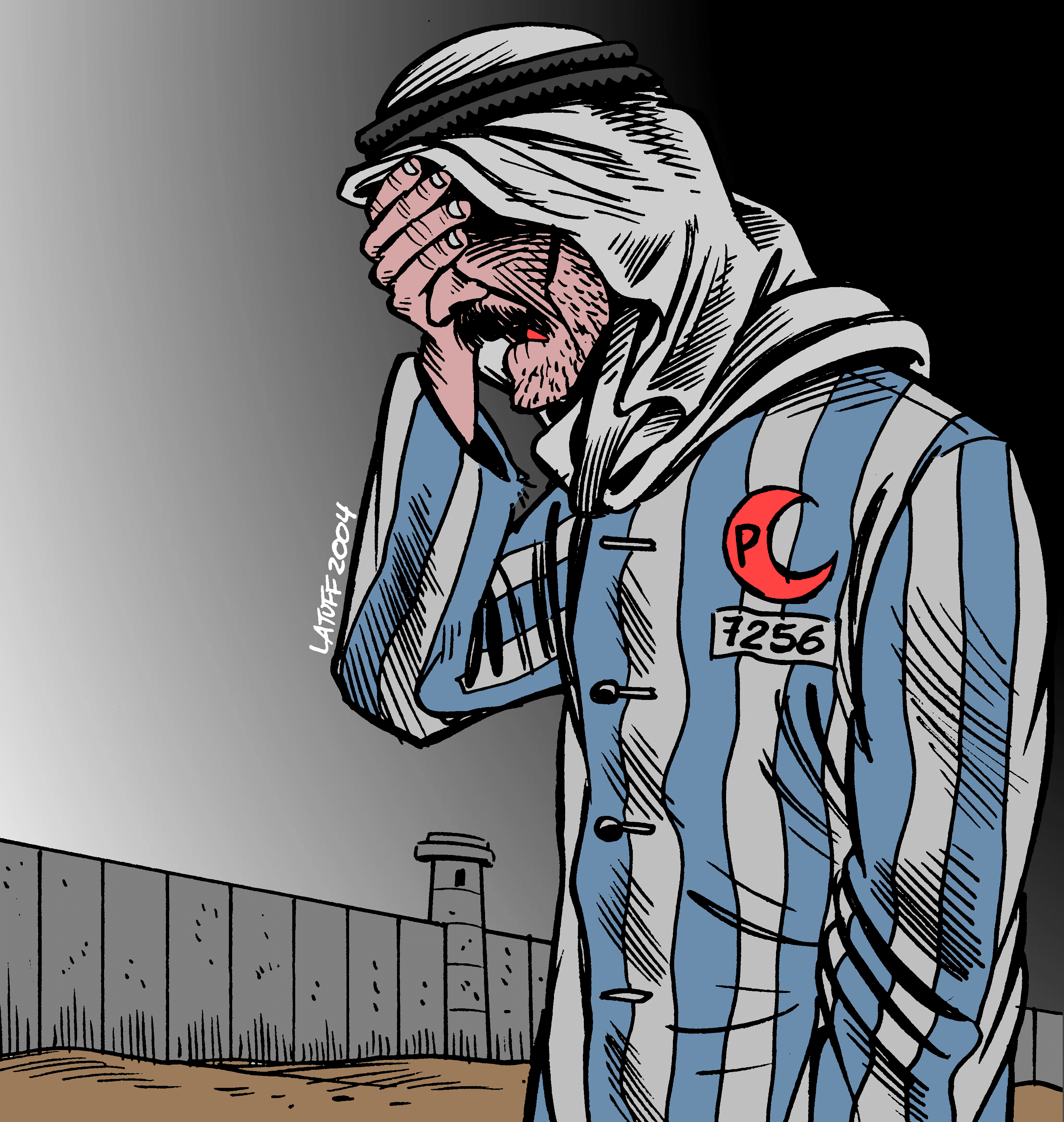
IsraHell's concentration camp by Carlos Latuff
Neo-Nazi ghosts awakened to round up non-Aryan cattle from their millennial imprisonment under the northern cross. Before the first ounce of blood was spilled, I eyed the forest beyond the edge of the encampment, where concentration then turned to liberation. For a reason unknown to me at the time, I saw my way out. Others noticed as I ran through the fencing, bewildered by the transcendent feeling of freedom beyond the barbed hatred that confined my elders, my children and brethren of closest kin.
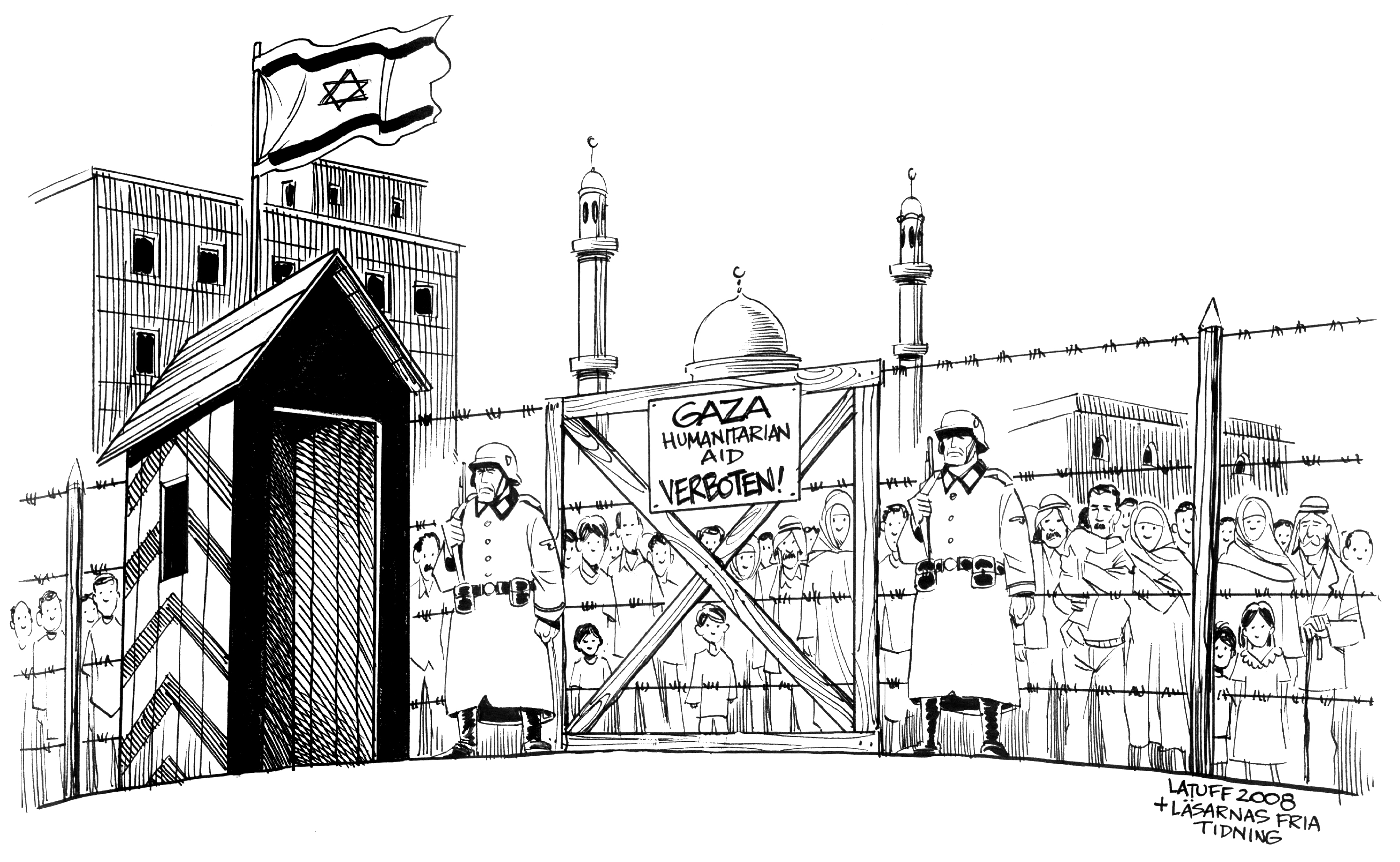
The Gaza Ghetto by Carlos Latuff
Out into the wayward plain, I fled, alone, veiled under a new moon. The sky enlightened my distance with steps unheard inside the emptying prison. Yet, I could hear wails. As I moved into the dizzying silence, my heart muffled by the fear of no-return, I wept. I felt my skull crack at bearing the guilt, the shade and the humility of survival among my most honoured family and friends, of my blood and spirit, they left behind to suffer excruciating gasp of liquidation.
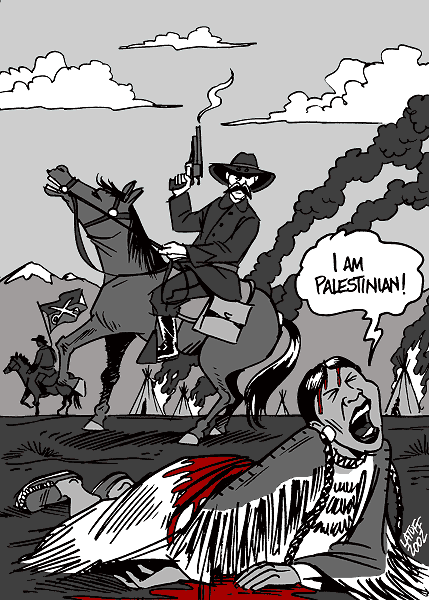
We are all palestinian - Native Americans by Carlos Latuff 
The sky filled with light, and as the fog of my vision cleared, a field of people opened before me, as with the harmonious revelation of a smile. Youth prayed and rejoiced under the morning sun, strong with music, to greet the day with endless festivity. The glow of the Earth radiated as a face after being kissed by a warm lover. The air moved softly, and my skin pulsed with gratitude. I enjoyed the music, spontaneous and ambient, as if I had heard music for the first time. Then, a face stared into mine.

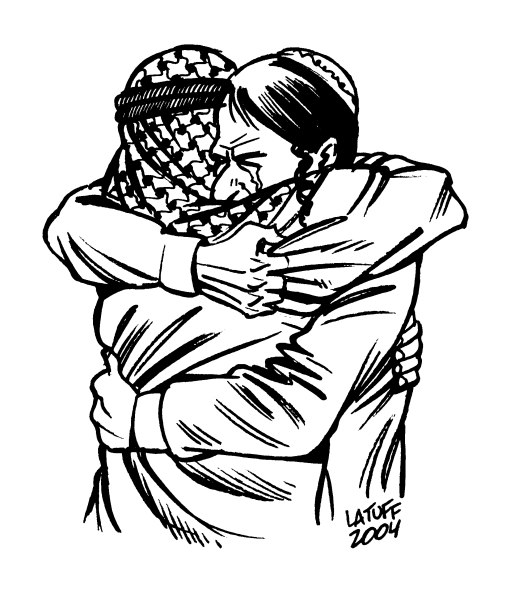
Forgiveness by Carlos Latuff
They recognized me, where I had come from, my origins and imprisonment. I wondered if they had escaped as I had. My first reaction was to run, yet, as the moment passed, I felt their empathy. The young woman, working as an attendant to the open-air music festival, expressed her concern, and showed me the way to a bus station near to the edge of the forest. From there, I could travel on and farther away from the destitute evil of my past.

Che Guevara wearing a keffiyeh by Carlos Latuff
As I approached the station, others noticed me, with fearing eyes, saddened with the truths of human compassion, they earnestly helped me along. I couldn't decide where to go. The schedule was complicated by the tightness of the knot in my heart. Where would I go? What would I do? Should I return and face the death that had me in its embrace, and that had since now consummated its passion with everyone I had ever known? I remain, immobilized. 
___________

Listen to live recordings taken from the Trio's debut performance on October 18th, 2013 in Self Connection Books (Canada). More on Jasmin's brilliant skills, gifts and about her amazing Crystal singing bowls please visit her today at Singing Bowl Music. This live album was produced by Vi An. Funds from this album goes towards artists involved and especially to fund future endeavours together as a collective, to rent venues, promotional material, transportation, meals, accommodation, etc. Thank you for your amazing continued support of these fine artists.

Monday, 14 October 2013

Fall of the Artist in Transformation: The Moon at Dawn Exhibit

Full Moons and Dawn's Crepescules
"Do we break rules all the time? All the time. Do you stretch the rules, break the rules, all the time, and in the theatre in particular...It's the difference between working against the world we don't want and deciding to work towards the world we do want." David DiamondCorporations in our Heads: Theatre for Living Tours New Production to Calgary

Two Octobers ago, when the seasonal round turned, the leaves of many pages filled with the love of language. Foresight and impermanence intoned a name: SoJournal. After the first year, this weblog had reached 10,000 lucid pairs of eyes, and now one year later, the lucidity has tripled in the pupils of innumerable dreamers; thousands and thousands of imaginations sparked, eyes opened and minds revealed as the clear movement of subtle knowledge - that supernatural creativity embedded deeply within, slightly beneath the folds of memory, as the enchantment of rain through the glass of consciousness, falling with near-silence, full of potent harmony, of life and renewal. The seasonal cycle returned. 

And so, as I began the creative journey of SoJournal with Cyclical Wordplay - a visual and literary purging from the spiritual gut of language - I now celebrate year two of this virtual space with the sixth artwork representing the collection, Full Moons and Dawn's Crepescules, in a seven-series cycle of visual, literary and musical collections/exhibits/movements. The elaboration of dawning abstraction unveiled as the phases of a moon, coloured as with the foliage of a cosmic fall from space into the mind of humankind; as formed of ethereal dream creations engulfing and erupting with the pangs of a voracious heart. 

So, the above quote is in reference to an assertion from David Diamond's fascinating book, "Theatre for Living" that in order for art to be transformational it must break the rules. In dreaming, we break the rules of identity. Everything is us - and yet we are curiously not - somehow bizarrely connected with the inner world of all that dwell in the subconscious netherworld of Spirit. In my art (visual, literary and musical), I am inclined toward the same effect. Dissolving boundaries is the practice, and the technique is the creation of art that ascends to transcendent heights of unity with the source of creative energy - the instinctual centre, before reason, simply to the joy, wonder and love of creation. 

In, the artwork, Full Moons and Dawn's Crepescules, look through the wintry window light into a charged, otherworldly space where the boundaries of inner and outer dissolve, where the moon cycles around and within our perspective, where we can look through and into a realm of potential, where harmony is interpretive and the veil of beauty and truth is lifted to reveal the nude face of raw creation. As with Present Sound, Silent Space, there is an accompanying collection of written works. For now, read on, through earlier altered states of visual writing below, and into the mergence of Sketches of Style in the form of sound. 
______________
Electro-Acoustic Improvisations
Cyclical Wordplay
Evocations: Cyclical Wordplay
Exotic Settlers

Evocations: Exotic Settlers
district.Columbia
Evocations: district.Columbia
Double-Mirror: Truths of district.Columbia

Sketches of Style
Present Sound, Silent Space
_____________
Sketches of Style is the fourth album in a seven-work cycle of art, writing and music. Experimental, ambient, improvisations through an eclectic blend of world instruments (darbuka, frame drums, xaphoon, shakuhachi) synchronize together with original electronic beat loops conceived on very basic virtual drum pads.

The addition of electronic beats offers a new entrance into sound art that differs from the three albums preceding in this cycle of seven works. Three supporting and leading instrumental tracks are co-intoned together with voicing abstract, improvisational language - as in selections from the written form of Sketches of Style.


Firstly, the bed track of original electronic beats, under the name "Grey Sky Jump" figures well into a mood of autumnal ambience. The orchestration of world percussion added to the repetitive regularity moves the listener through a hypnotic, ambient xaphoon melody. The vocalization, abstract and experimental, gives way to a light, almost humorous, vibration of the incipient curiosity that sparks prior to the experience of absolute wonder, and finally, open-form astonishment at hearing the raw flood of creative instinct that pours boundlessly through every last aspect of our innumerable senses of visceral and noetic perception. 

Visions of Outer Conflict is a five-poem chapbook opening and setting the stage for the Sketches of Style collection with explorative extroversions of the spiralling mind. Through stories of perception into the paradigmatic movement of humankind through themes of diaspora and extinction, the chapbook then ends with Cajoled Spine-Tap, which alludes to a surgical procedure whereby the spine is alleviated of pressure to relieve a debilitating bodily experience. The aspiration is for the chapbook to have a spiritually resonant effect as the procedure, effectively allowing a clarity and relief from the pressures of normalized thought and predictable emotion.