Primarily a writing exercise, this dream journal-inspired blog is a quiet introspective sojourn into the process that we traverse in going from private dream to public art. I see our dreaming as an internalized mythmaking. As I philosophize and expressively exhibit dreams, both private and public, I encourage and delight in creative language as a way to practice experiential metaphors through a “public dreaming." Writing Theory: Creative Dream Fiction
Showing posts with label Terence McKenna. Show all posts

Monday, 22 April 2013

Noocide and the Community Within: Legendary Voices on Ego-Dissolution


“I had a dream once that I was at an international conference, debating economics…” by Gilberto Gil, in support of Xingu+23


Dreaming, conscious & active, increases our potential for empathy and curbs egotism. The lucid consciousness of the dream sees from all perspectives through one perspective. The actions and emotions of every dream character are essentially rooted in the dreamer. This is our natural engine of empathy, and our natural organ of humility before the great diversity of human life, and the infinite spectrum of mental expression.

"You want to reclaim your mind," said Terrence McKenna, "and get it out of the hands of the cultural engineers who want to turn you into a half-baked moron consuming all this trash that's being manufactured out of the bones of a dying world." In this talk, McKenna also goes on to convey how we have lost touch with Chaos, and how older forms of ego-dissolution, such as ecological meditation and entheogenic use, are essentially about the meaning of sacrifice, which is the only thing that will solve our current problems. Ego is adamantly focused away from sacrifice, the role of contemporary humanity is to realign ourselves to a renewed sense of the diminished ego, and a healthy sacrificial attitude towards the greater reality, which is our immediate now of earthly presence. 

Chaos is within us, known through the act of dreaming, where the mystery-engine of narrative is spurred on through the natural inborn creative imagination, our promised birth-rite. The inner worlds of nature mirror this internal intelligence, which constantly breathes as an inhale and exhale of sacrificial flow, a reciprocity with the spiritual presence of subtle energy, generated through the noosphere. At once, as there is a crisis bearing towards ecocide and ethnocide (see my earlier post: Genocide and Extinction), there is also a crisis of what I will call "noocide", or the extinction of our natural capacity to think for ourselves, and look past the egotism of individuated consumer consciousness.  

Attention for the contents of dream narrative allow the mind to reorient within, to the source of dreaming that so inevitably follow outwards with the chaotic madness of global consumerism, expensive vacations, and a whole slew of energy misuse in the wake of ego-manufactured externalized dreaming. The inertia of internal dream substance, awakens the mind to the archetypal community that all share. As Jung said, "Who looks outside, dreams; who looks inside, awakes." We can also look for community within. 

Read my recent article on Media Co-op: Resistance to Canadian Oil Extraction in the Amazon Continues
____________
Can you hear life? by RK
Read the signs by RK
Flightless Cubism by RK
National Isolation by RK

Inner Light Cityscape by RK
_______________
The forthcoming album, "Evocations: Exotic Settlers" is an evocative musing on the sound language nestled deep within the poetic substance of orated selections from a collection of works under the same title. In continuity with the theme of "exotic settlers", the album is an experimental narrative-sound art exploration into the imagination of a journey of settlement, both archaic and modern. Here, voice soundings are mixed with one instrument at a time, to convey a sense of the traveler, whose light pack is ideal for the road ahead, and whose voice traverses the simple grandeur of sonic revelry from a single instrumental accompaniment. Themes of travel are juxtaposed with settlement, both in the settlement of tradition and ecology, and the inner and outer journey to that destination. To settle on one instrument at a time is a metaphor for the inward/outward experience of settlement for the migrant, who eventually becomes an "exotic settler".

The choice to accompany the voice with a single-reeded bamboo saxophone or xaphoon instrument is based on my affinity for the African sound of the reeded instrument, as in African-American jazz roots. I put an old vinyl effect on the first improvisation to hearken to these early recordings. Also, the xaphoon is originally from Maui Hawaii, and so, the great waters of the Pacific Ocean that separate the North American continent from Hawaii, with its deep Aboriginal heritage, mirror the poetic river offering through the sound of the instrument as a metaphoric nostalgic passage across the western ocean.


Beginning with a reminiscence of life in Africa, poetic reflections written on hillsides in rural central Mexico, overlooking a wide lake in a small village, I remembered Africa. The words allude to Africa as the Mother of all Humanity, as Mother Africa, where all people can know their origins as one human family. If wondering, "What has Africa given to the world?" The answers are many, including the soul of contemporary music, but also our very biological evolution, as humankind. Africa has given us ourselves, our poetry, our music, our spirituality, our creative eye, as well as other aspects of ourselves not so likened to evolution such as our politics. Yet in the words I have chosen in "I remember Africa", I ruminate on the spiritual origins, beneath the flesh, "our skeletal humanity" where we are all one, where we are one with Mother Mater.

The second haiku-like oration, "Selflessness is the father of human survival" was written down after an impromptu spoken word over a city bridge, overlooking the grandiose ice sheets concatenate and break into the singular northern landscape. In Aboriginal folklore, passage across a river is a time of deep meditation in gratitude and honour for the life-giving waters. Traditionally, a sacrificial offering of tobacco, or a ceremonial smoke, is offered to the sacred life source of all creation. Yet, here, I offer the clear smoke of my worded breath, enunciating an egoless passage of impromptu heart resonance.

The other pieces featured in this chapbook draw from the barebones intensity of visceral experience re-felt through memory and the act of writing. In that process, the emphasis becomes one of awareness that drives one to act. To reflect, ruminate and contemplate the living significance of Africa in our own lives is to be moved onward in the struggle for life and for our humanity.


Monday, 15 April 2013

History and Humanity: How Self-Awareness Leads to Reconciliation

Mary Wollstonecraft Shelley and Percy Bysshe Shelley by George J. Stodart
"No more let Life divide what Death can join together." Shelley

"We cannot continue to be recognizable and survive…if everything you know is wrong, then all the problems you thought were insoluble can be framed differently. And there's a way to take the world apart and put it back unrecognizably. We don't really understand what consciousness is at the really deep levels," said Terence McKenna in an interview for bOING bOING #10, to hail the oncoming psychic transformation of humanity in the 21st century, also known as the post-2012 New Age eschatology. 

Yet, historically, we have ever been unrecognizable when we look at interrelations between human societies, especially with regard to the European saga of colonialism and the institutionalized racism that followed (and arguably continues) in its wake. People from other continents, the Native, Indigenous peoples of the world, most emphatically Africans, Australians and Native Americans (from both North and South America), were for a considerable portion of history considered an inferior race, a subhuman species likened to earlier primates less developed than the European genus. 

As we have now begun to recognize ourselves wholly, all of humanity included, through science and reconciliation with our inhumane past, the challenge now remains clearer than ever, for it is our own selves, the Self of Humankind that is in need of development, and not any other form of life. So, we might ask, might we grow up from the childish state of irresponsible resource waste and join the community of life on planet Earth, or become extinct. As the human family becomes recognizable, next the whole of life on Earth must be recognized as our own self, as the body of a relative, and until it does, and we remain unrecognizable to ourselves, there is catastrophe as we straddle the line between dominance and extinction. 

Interpreting the above quote by Shelley in the last line of the third to last stanza of Adonais, An Elegy on the Death of John Keats, essentially reads as "don't let life get in the way of dreaming" where the diversity of life, as it manifests in the human family, a wealth of ethnicities, spiritualities, and physiques can be seen not as a source of division, but of connectivity. And so, as I write, this the capital city in the state of my birth, Boston, has allegedly been bombed. In such times, it is ever paramount to instil the meaning of reconciliation within the human family. Peace studies author and professor George Melnyk recently shared with me the simple notion that "That's what happens in war, you define an enemy." And, so, with our nation(s) at war in the Middle East, and the "enemy" at hand, we can keep vigil with the caution that we should not jump to quick conclusions in our search for vengeance. 

The crossroads of human life in the 21st century divides Humankind between himself and the planet; the potential of nuclear fallout and the immanent ecocide with the unabated burning of fossil fuels. The struggle to survive as one, whole being, as a united humanity, is to be fought at our doorstep, and we must remain strong not to waver from our ultimate direction towards peace through reconciliation. See the documentary by Chris Hedges OBEY, at minute 22, where he writes, "Resentment against a disenchanted secular world will find deliverance in the ecstatic escape of unreason." Let this unfortunate incident be an opportunity to empathize with those who experience bombings on a regular basis as part of our government's foreign policy, as opposed to perpetuating violence through self-pity and aggression. 
_____________
A stone-bedded homely abode of five rabbis, all with simplicity and humor muttering of their bearded visage, they meander from home to a day’s work in the predawn night. I, a furtive wraith, clandestine in the dim corner, emerge to observe the floor-set scribes and their flowing fountain of wise austerity. The dusty air breathes sanctity unknown to most, yet from the window a flicker of artificial light breaches the soup of mind with Maras of temptation, apparitions of the female sex, flaunting a shadowy tint of flesh. I trudge outside, unencumbered by the pleasures of the intoxicating sights. We are at war.

Titus destroying Jerusalem by Wilhelm von Kaulbach
The direction of sight is clear. The enemy is known, and our targets destructible. The air is thinning of passion and feeling, to make way for hate. The true victim in this war is Earth. The all-out industrial fire has spurred on the makers of enmity under a veil of infinite resource. Brothers, sons and fathers bleed with for the ground on which they are laid to rest. The backdrop is far-reaching. There is a sense of humor in this war.
Toronto Rolling Mills by William Armstrong
Foregrounds blur into modernity, as a civilian is murdered, shot in the back, running towards us. Iraq is not Germany. Civilian and army are a rough and indiscernible duality. The cold smoke of hate becomes the backwash of sanity as soldiers and men secrete their pain into the willful triggers of deadly remorse. I, a photographer, capture the minutiae of existence full-born in the surviving families of Earth-bred singularity. Modern natives, the indigenous, bold eyes of people, now the last grave on which an unmarked praise still glorifies the vanity of war and power. Massive trucks crack and sputter past me, with so much gun, bomb and shell materiel that my knees weigh fierce into the concrete below. Rushing past, the soldiers reveal faces of bleary sweat and stinging tears, flowing from a smiling façade of youth, their graying eyes grow cold with fate as my photos are ignored.

Collateral Damage by James Miller 
When we declared war on Earth in WWII, the invasion of Iraq granted us full impunity as we commit the last atrocity on the only lasting connection humankind might instill from Earth to the mass of societies born and bred of global war. They line up, shaman to farmer, hunter to midwife, storyteller to seer, a community of global wisdom, attuned to the lightness of being, as in the creation stories of practical love. And in their firing squad, they choose to sit, meditating on the gun-barrel of unsightly loss – the drifting eyes of hate and need merge.
___________
After a cumulative process of self-publication, a DIY attitude of writing and publishing often spreads into the realms of experimentation and exploration with all aspects of the creative process and, especially where self-publishing is concerned, into self-innovated and creatively conceived avenues for sustainability.

Art is the "divinely superfluous beauty" as Robinson Jeffers says, however the artist is inherently tied to the whole of life. For this reason, I have decided to experiment with monetary value as a way to further understand my self-published works and the general field wherein I am situated as a self-taught creative artist active in a variety of artistic disciplines, with special regard for the overlap of media, thought and art.

Please join this conversation as society embarks ever on towards greater connectivity between the sacred, the communal and the entrepreneurial; that all three may one day join in a vision of society directed at once toward pragmatic utopia, while mutually creative and destructive, or better worded as discerning, in its ability to see and create potential.

I will still be offering the full collection online for free viewing, however, I have added the option of supporting the artistry exhibited by none other than the Dream Author. Jah!


Opening the page to experimental, improvised writing which emphasizes and attempts a most strict depiction of the spontaneous nature of mind can be perceived with harrowing aspiration in the realm of continuity, that is flipping the page, and its mystery, that is interpreting the language. As a forewarning of sorts, this collection of writing, as devised for readership, is the result of an editing which has purpose in giving the spontaneous flow of mental activity form. While attempting to convey the refreshing action of letting go, all structure and boundary and, in sense, constructs of mind are dissolved.

Created solely by one human being through "One Shot" intuitive improvisation stylings, Evocations: Cyclical Wordplay is the completion of a creative cycle of renewal, regeneration and return to the primary source of visionary inspiration: voice. With due reverence and respect for the infinite diversity of vocal and verbal forms among the worlds of the living and the dead, I hereby speak directly from the heart. Here, in these soundings, I am re-conceived through the mouth of the pen in all its power to amplify and obscure.

"Evocations" is a practice in contemporary experimental narrative, as opposed to the traditional conventions of spoken word. The poetics of oral storytelling are alive through soundings for the muses of voice in all its forms, whether in the tongues of wood, metal, plastic or flesh. The language of unity speaks through every medium.

Monday, 25 March 2013

Experimental Cave Art: Philosophies in Word, Vision and Sound

Aboriginal Rock Art, Ubirr Art Site, Kakadu National Park, Australia
Photo: Thomas Schoch
When your night becomes day, then that which is dreamed is on earth. Do not be too high-spirited, but go, and go alertly.” Aborigine Saying

In continuity with the theoretical writings on the natural sleep cycle as expansive beyond the twenty-four hour day, and especially beyond the programmatic workaday cycle, it is not only the activity of waking activity that might define the energy experienced by the mind-body based on sleep cycles but the content of dream itself.

For example, we go through cycles of remembrance and forgetting, this is a fundamental attitude of the cosmos, as we see in the natural tendency to the peek-a-boo gameplay in all children. Similarly, as this is reflected in our conscious and unconscious experience of life, so this is true with the content of our dreaming. We will go through periods where dreams are not remembered, and then after a time, will begin to remember again. These periods of remembering the content of dreams ultimately point to an unresolved momentum of energy building up in the psyche as a consequence of either personal or collective unconscious activity that one becomes susceptible to in their daily life.

Until this mode of consciousness is directly confronted and transformed through creative insight and practical application in thought, reflection and in some basis of continuity in consciousness, e.g. imaginative outpourings based on the theme and nature of dreaming, where all suppressed and repressed energies are focused and shifted into full view, the involuntary sleep or unconscious REM will continue to emerge and take shape in the psyche through imagination, emotion, intellect and every exhaustible mode of subtle activity.

Every time a dream is remembered, the remembered content, whether imagery or emotion or otherwise, is part of a string of remembrance leading back to a source of reflection deep within the whole being of both the individual dreamer and the society throughout the entire spectrum of its history, propaganda, knowledge, media, relationships, etc.

Oftentimes, the strength or immediacy of memory, the lucidity of the dream state as it interweaves through the waking mind, forecasts the urgency of attention to the subconscious. For example, I have experienced lately that the instant I am ready to sleep, as fast as I close my eyes, I see the content of my dreaming, the imaginations is teeming with life and energy, needing to be witnessed, calling out over the margins of consciousness.

The only way to resolve the inception of remembered dreaming is to confront the subtle impulse to emote or inspire a certain inborn expression, metaphorically illustrated in the dream itself. When dream and life are subsumed into wholeness, undivided by the normative values of structured time and analytical thought, the subconscious and the conscious merge into a healthful surrender of the cosmic unconscious faculty of Being, as the great mystery of self-awareness. As reads the motto in Athanasius Kircher chiseled over the alchemist's doorway, originally in Latin, it says, "While Sleeping, Watch'. See previous post: Alchemical Poetry of Terence McKenna
_________
Breathtaking hot night. The empty dark dream of memory. Narrow canals, irrigation trenches in the backyard under a pitch-black sky, a starless new moon. The seizure of domesticity; fencing blinds besiege all passage to horizon’s beginning, and a house cat skits through the mud with a silent flit of dusty soil. A chase begins, until I grab the fickle creature by its muzzle, and in the raw and ruddy brown earth, I tangle its fibrous backbone, cracking the living spine with the brute edge of my wrist. The sky clears like a strong exhale, and the ground takes formless cover of the starless sky above. I drift away from a mind to a life as inert as the swift welcome of death.

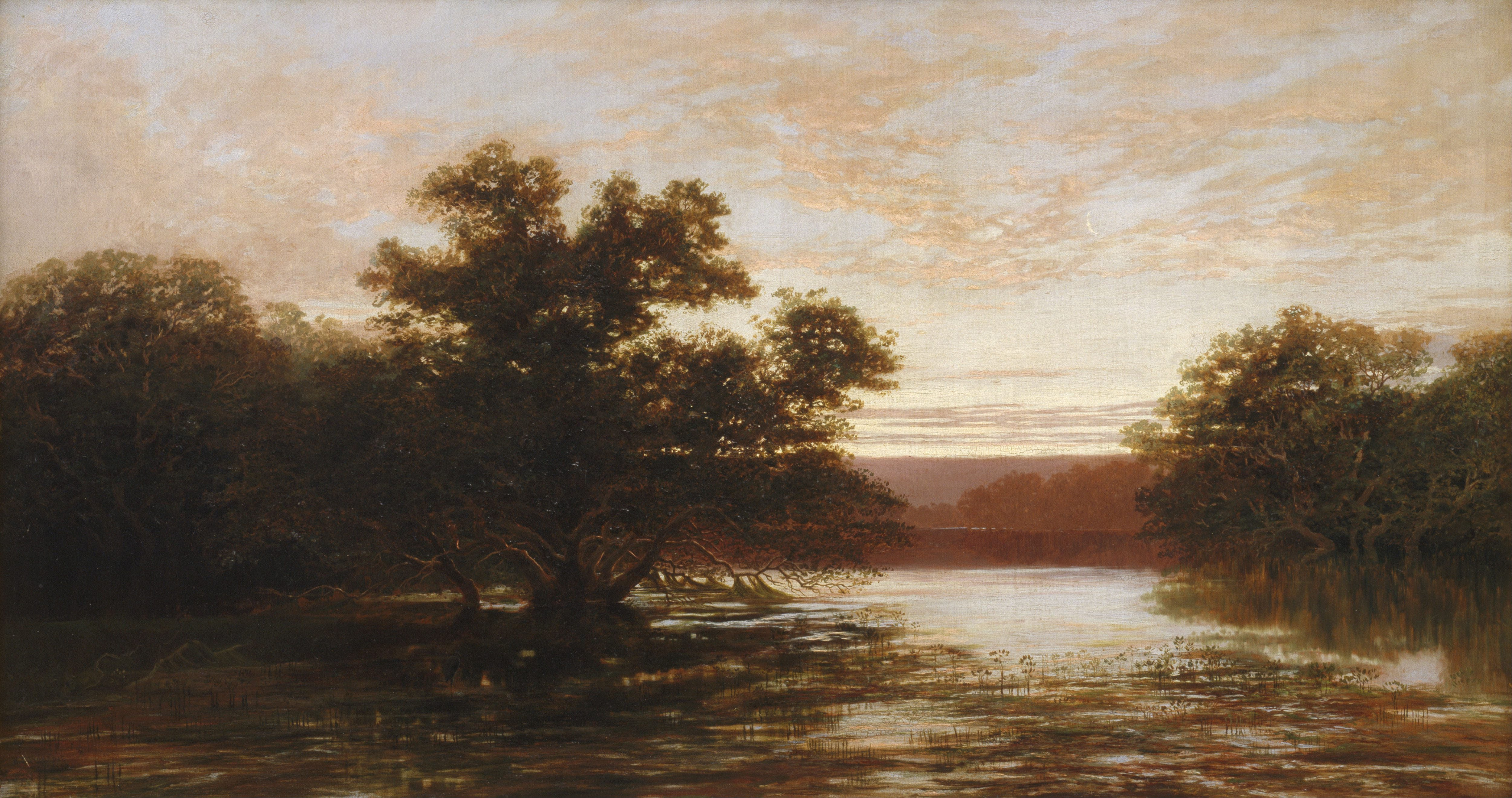
An Australian mangrove, ebb tide by WC Piguenit 
Worshipful room of sweat and lust, the emotive spring of music keeps us swinging to a joyful noise, the urban sound of pain alleviated before closed eyes, staring inward to hear the sight of the muses, invoked by the musician hosts sweltering mad before a small though dedicated crowd of movement. And the headline group enunciates first note with strength unseen; the crowd has since escaped into the bleak, old night. A few straggling local friends stand by the stage, amused and apologetic. One song passes in the silent hollow, a space deemed fit for thousands reduced to pin drop nothingness.

Musical entertainment at the spinet by Johann Heinrich Schönfeld
The emptiness is as palpable as the heartless mind, rounding off pales shots into the murderous pangs of repeated history, the bitter angst of adolescence returning in a white noise of a flushed and ruthless voice, the weird ground rumbles and quakes with burning trust; that a future still opens ahead – full and potent with renewing vigor, to wake again, and live the day from the start, even if our rise coincides with dusk. A silent vision unearths our eternal belonging with grace, and the human community within, where the heart is still in its constant beating, in its rhythmic patience with a more sacred trust.
__________
An elegiac satire on split vein of domesticity, as it unravels and spurns the knowledge-creation of a more unstructured style. The home is the centrepiece of domestic life. Yet, for many thousands of years, there is evidence that we were in fact cave-dwellers. "Caveless" muses on nostalgia for those cavernous days through a reading of "Cave! Home", about a time when petroglyphs and charcoal painting were more important than off-white, beige and any number of dull, and sterile wall aesthetics, and the great-image language of visionary rites were outweighed the significance of antique literature. How can we resurrect the idea of the cave in the context of the modern home, with its womb-like contours and living light that curls throughout our waking minds like breath, and infiltrates our dreams like a warm lover enduring a midnight meditation at our feet?

"Placeless Human Society" is also read here to recognize the dramatic shift from our ancestral pre-history as cave-dwellers of imagination and earth, where suburbia (and its non-subordinate counterpart: the city, for that matter) has essentially uprooted us from this inborn life as a dweller from the earth. On a mass scale, we now dwell on earth abstractly, our imaginations have breathed on, yet the umbilical cord to the womb-cave-home from whence we emerged has long been cut.


"Cave! Home" was published in 3:AM Magazine on September 17, 2012 and is also featured in the most recent chapbook, "Creating in the City" which was released with "When No Stars Appear".

"Placeless Human Society" was published in Outward Link on November 7, 2012. The "Caveless" track release marks the release of the chapbook, "Suburbia to Suburbia: America-Egypt".


Monday, 11 February 2013

Food for the Imagination: Contributor Article Completes Sketches of Style

Dream Cuisine by RK
I am happy to present the first contributor article to SoJourn(al): Private Dreams to Public Art. I am especially proud to present this article because it speaks to many themes in the life of the Dream Author. I have been a vegetarian for over seven years, many of which were spent in the Middle East and Latin America, which posed interesting challenges. 

Nonetheless, I stayed true to a time in my life when I was thoroughly exposed to interpretive experience. My mental development was spurred on by alternative living practices, founded on a diet of psychoactive compounds and creative literature. Maintaining an alternative diet has been an essential ingredient in living a life based on principles of subtle recollection and acute awareness. 

Blurring the separation between external causes and their internal effects has been a lifelong inquiry. The experience of how foods have an impact on the subtle realms of dreaming is an invaluable source of critical thinking. As Terence McKenna put it, to "dissolve boundaries" is a natural step towards creative thinking, and becoming a seer of "true hallucinations" of which dreaming is an integral example.  

Food for the Body Equals Food for the Imagination

When Scrooge was visited by the ghost of Jacob Marley in Dickens’ A Christmas Carol, he believed that he was dreaming and put the apparition that stood before him down to ‘an undigested bit of beef, a blot of mustard, a crumb of cheese, a fragment of an underdone potato.’ ‘There’s more of gravy than of grave about you,’ he joked. The idea that foods can influence our dreams has featured heavily in literature throughout the years. There is a commonly held belief that what is going on in a person’s digestive system can have an affect upon his or her subconscious mind during sleep. To what extent is this true though? Can eating the wrong thing really plunge somebody into a world of nightmares?

Does Cheese Give you Bad Dreams?

There is significant evidence to suggest that eating healthily can help to keep a person’s mind to remain healthy. According to the Dieticians of Canada, maintaining a healthy diet can reduce irritability and mood swings and increase an individual’s ability to concentrate. Does this only apply to when people are awake though or does it also make a difference when they are dreaming? The food that has the strongest association with nightmares is undoubtedly cheese. However a study carried out by British researchers in 2005 suggests that there is actually no correlation between cheese consumption and bad dreams. The results of the study actually indicate that different varieties of cheese are capable of inducing specific types of pleasant dream, for example cheddar cheese is thought to lead to dreams about celebrities. The good dreams that cheese can bring about are believed to be due to the fact that it contains the amino acid tryptothan, which is commonly linked to a reduction in stress.

A report published in the Folklore sociology and anthropology journal questions whether the idea that cheese causes nightmares is linked in some way to its association to witches in literature. In ancient Roman writing, women who were viewed as potential sexual partners were referred to as ‘cheese’. In eleventh century English literature, several stories about ‘night witches’ came into being that included references to cheese. Folklore suggests that this was used to imply that the witches had a sexual element to them and wished to corrupt their victims by exposing them to sin. The report puts this forward as a possible reason that cheese might have ended up being blamed for bad dreams.

Spicy Foods

Spicy foods are also thought to lead to nightmares, which is backed up by the results of a study that was published in the International Journal of Psychophysiology in which a group of healthy men were given spicy foods to eat before they went to sleep. They were observed to have a more restless night’s sleep than they did when they had not consumed any spicy foods before they went to bed. The author of the study speculated that this could have been due to the fact that the spicy foods had elevated the internal body temperature, causing the discomfort to work its way into the participants’ subconscious and leading to bad dreams.

Unhealthy Foods

Research cited by Justine Sterling of food magazine Meatpaper indicates that consuming foods that are high in sugar or fat immediately before going to bed can lead to nightmares. The study also indicates that going to bed on a full stomach can bring about bad dreams and low blood sugar caused by going for a prolonged period without eating can lead to vivid nightmares. This is because the body releases adrenaline when it is desperately hungry, which translates into the subconscious.

Mustard

Mustard was another foodstuff that Scrooge blamed for Marley’s appearance – and with good reason as well, as a study carried out by researchers at the Department of Biochemistry at the University of Tasmania in Hobart, Australia, indicates that consuming it can result in nightmares. The researchers concluded that this is probably because it contains capsaicin, which can change the body’s temperature and lead to discomfort. It appears that what we eat really can affect the way that our minds work once we have passed over into the land of sleep. Perhaps cheese was not the main culprit in the case of Scrooge though; maybe Marley was merely a result of too much mustard before bed.

Evelyn Donaldson is a mother of two and full-time writer. She grew up in Idaho, but now lives in Kansas. She recently became vegetarian and has long been interested in dreams and their interpretations.
__________
My blanket drifts up into sky, its multicolored fabric bleeds scarlet and lime into the nearing front of storm clouds gathering. The wind-whipped fabrics touch and scatter the bedroom floor, above without ceiling, empty unto the grandiose firmament. I wake to the numbing air, as on a mountain summit, where the thunder resonates in delicate cyclones. As I rise, the storm pierces the earth with overgrown fingernails of Zeus. A crepuscular storm, breathing in an unwelcome morning, filled with signs of a new god. 

Jupiter and Semele by Sebastiano Ricci
And the machines of war rape our Earth. Nazi terror sweeps as the witch’s broom throughout the countless, destroyed Jewish homes of Europe. My family is strangled and sucked clean through the medical tubes of an astral fire as hot as the blunt knives of torture. I escape. To Russia, I follow the blank news pages with a heart kept earnest. Directions swarm as the buzzing of toxic insects, and my rivals are blended as fruit sap in the teeth of metallic pincers. 

Nude II by Willy Fick
In the heart of Russia, I am free; yet full with a dark heart. The Earth trembles and fades each day with a transparent rush of nostalgia. I wish and writhe for the beating hearts of my beloved mother and father, sisters and brother. The wedding feasts and blind bliss, how we gorged on the salt of the seven seas with triumphant abandon. Every day, there was a moment of repose.

Cigarette Seller (Wandering Jewish Man) by Dome Skuteczky
We knew the day might come, when all would be rent, cleansed by the impotent flood of mad war. Should I wander further astray, eastward to the cold forest sands of Siberia, or westward, to the commercial forge of America, and sleep by the pill of forgetfulness? Lost again, if found anew, will I be recognized? 
___________

As per SoJourn(al) tradition, I have prepared a free PDF for the entire Sketches of Style collection which has been excerpted in the past few months in complement to my dream writings. 

Enjoy! 


Sunday, 25 November 2012

Prophecy in Dreamland and Other Spells of Creative Literacy

Portrait of Rasputin by Ana Theodora Krarup
"Unconscious actions, mass unconscious actions have certain momentums, something that Tolstoy tried to explain more philosophically in the narrative of War and Peace, how the individuals with their own lives could be carried off by history's great forced floods this way or that. He was trying to describe often what I encounter in my study of prophecy, that there is a wave of mass human stupidity that is carrying even intelligent people into its current, that is converging on a collision in the Middle East...what I get wrong also is a helpful study of how the human mind misinterprets a sign with its own expectations and hopes and I think it helped me be a better interpreter as well as a predictor of the future..." John Hogue on Whitley Strieber's Dreamland: Journeys to the Extreme Edge

I first read Whitley Strieber's Communion, which stretched my understanding of non-fiction as a young reader, surveying a gamut of fiction, history, philosophy, mythology in my family library. 

Another genre-bender, who influenced my appreciation for literature in a more grounded way, was Jack Kerouac, who together with Allen Ginsberg, prophesied a shift in American social norms through their collective literary breakthroughs. They had noted that in the second half of the 20th century, Americans would shift from their hardline Christian upbringing to a more Buddhistic sensitivity. 

Reading both of their writings thoroughly, I soon interpreted within their work an interesting relationship to what we now call prophecy. More than to pin prophecy within the highly skeptical sensationalism of conspiracy theory, prophecy, in a more mythological sense, is simply the attuning of the intellect to certain eloquence in creatively utilizing timeless wisdom and ageless archetypes, reattributing them as signs. 

More often than not, prophecy in mystic circles is not an outward momentum, toward predicting profane outcomes, but simply one of the many old ways toward self-realization. One is inevitably of the infinite. Popular prophets are heady mixes of conspiracy theory or what Terence McKenna called, "epistemological cartoons". In Hebrew mysticism, my understanding is that prophecy is a numerological science, beheld within the Hebrew language of the Torah, encompassing a unitive vision of interpretive science as it meets with spiritual practice. 

Recently, I viewed the film, Rasputin, which was another prophetic figure portrayed on the literature on my shelf as a young man impressed by the literati. Rasputin certainly opened the popular discourse of prophecy on the world stage, especially as regards political intrigue, out into broad daylight. His eyes still transfix. 
________

With a mug to mirror the inescapable frame of Kerouac’s joual-toughened jaw, bespoken with the silent glimmer of streetside grief, walking alone and alone for the infinite mileage of American wanderings, a cyclical tongue of ruthless freedom, to free the passions from the word-order of choice and splay will on the open pain of roadside heat with a thumb and a meek treasury of manly poverty 

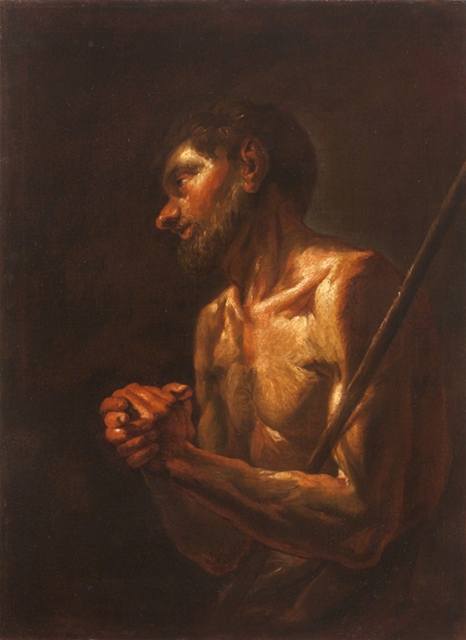
Pauper by Petr Brandl
that drunken cry that rang throughout the humbling scope of spectral telephone wires following with the unheard voice of millions distanced by the wiry nerves of a social neurosis towards mobility, and with the rootless leisure of a need to travel as a way of being, that holy rope burned the traveler’s hands as the writing cooled mind’s belonging on a land of no-land opening
_________
“American body,
May you be cooled,
May the dog days of the final moon in your Roman clock tick no more,
May your fires be dampened in the Fall,
May your body always be replenished,”

“This is a prayer from your navel,
Your own son”


Saturday, 17 November 2012

Schopenhauer and the Unconscious Fate of Recurrent Thought

Recognise the truth in yourself, recognise yourself in the truth; and in the same moment you will find, to your astonishment, that the home which you have long been looking for in vain, which has filled your most ardent dreams, is there in its entirety, with every detail of it true, in the very place where you stand. It is there that your heaven touches your earth. Arthur Schopenhauer. On The Wisdom Of Life: Aphorisms
Aphorismen zur Lebensweisheit by H.P. Haack (photo)
Schopenhauer suggests that just as your dreams are composed by an aspect of yourself of which your consciousness is unaware, so, too, your whole life is composed by the will within you. And just as people whom you will have met apparently by mere chance became leading agents in the structuring of your life, so, too, will you have served unknowingly as an agent, giving meaning to the lives of others. The whole thing gears together like one big symphony, with everything unconsciously structuring everything else. And Schopenhauer concludes that it is as though our lives were the features of the one great dream of a single dreamer in which all the dream characters dream, too; so that everything links to everything else, moved by the one will to life which is the universal will in nature. Joseph Campbell. What is Metaphor? 
Here, I continue to find cross-references between three great thinkers of the 20th century, now with their source in the earlier precedence of Schopenhauer. The 20th century, with its unveiling of depth psychology towards the transpersonal meanings of self and agency in the will of the world have risen this line of Schopenhauer's thoughtful development with poignant regard. Joseph Campbell, James Hillman, Terence McKenna, all arrived independently at three concurrent patterns of human behaviour as a self-reflective being; character (self), narrative (fate) and dream (unconscious). The most accurate form of self-identification seems to be when we see ourselves as characters. As McKenna said, "we are in some kind of engine of narrative." Where Schopenhauer linked this to dream psychology underlies the mystic identification of fate by Carl Jung who said, "the unconscious exists in our lives as fate." The unconscious, fate, and the narrative engine of character are central to analyzing dream psychology as the major themes which now lead the humankind towards a humbling before nature as the greater mind of collective agency, and that to know nature, is ultimately to experience self-knowledge from the deepest base of the unconscious to a fully conscious, self-willed awakening of independent and transnational human sovereignty on Earth. 
_________

a city rat friend and I duel with competitive rage, amassing a firebomber brigade of red trucks fuming with the waterless engine of their stolen malfunctioning, and careening past the lights of midtown manhattan we stream as a rapid at open floodgate through the sleepless streets out of town

The Painting Reads: The Neighbourhood Belongs to the People Not Big Business
over a northbound bridge, we find refuge in an overgrown motel lot, the air is sweet, and we are invited to tea inside a cozy, furnished lobby, strangely reminiscent of a personal home, with sofa, television, and toys for young children, and our steam fumigates absently, unaware we separate to each our own rooms 
__________
Playful mortality, and the scream of death
Under stadium lights,
3rd block West Clinton Street New Bedford

And mortality reigns with his eminent consort Time
Ever-gazing into the strict law of entrance into the beyond,
Beyond reclining chairs and horizontal graves
...

Beneath a delicate skin of man
Braving the deforested aftermath of Assimilation
In the name of survivalist migration

After years of subconscious insubordination,
The doorway now flattened with the invincible family bond
Carrying our name and grown humor

excerpts from "Playful Mortality"