Primarily a writing exercise, this dream journal-inspired blog is a quiet introspective sojourn into the process that we traverse in going from private dream to public art. I see our dreaming as an internalized mythmaking. As I philosophize and expressively exhibit dreams, both private and public, I encourage and delight in creative language as a way to practice experiential metaphors through a “public dreaming." Writing Theory: Creative Dream Fiction
Showing posts with label Vancouver. Show all posts

Monday, 28 October 2013

Globalization and All Our Relations: The Human Family Shall Overcome

Natural disasters caused by climate change by KVDP
"We've been told that climate change is a very serious threat, in fact the most serious threat facing humanity today. Groups like UNICEF and Save the Children are emphasizing the particular impact on young people around the world in developing countries, in the Global South…

….[The United Nations International Panel on Climate Change, representing thousands of scientists from 195 countries] have 95 to 100% certainty that climate change is manmade and that we really do need to be reducing the amount of fossil fuels that are being extracted and burned to get us back to that 350 parts per million. We're currently over 400 parts per million."

Ben West, from a podcast published with The Media Co-op titled, "Vancouver is debating a resolution to divest from fossil fuels"

Recently, I was asked to produce an essay without knowing the prompt, until the moment unveiled the golden word: Globalization. The off-the-cuff piece, shown here within the body of this text, is the result; derived from a deeply studied and well-experienced life as a global citizen, a youth whose formative years traversed four continents. Read ahead:
Living conditions in Third World countries are deplorable. In fact, the term Third World derives from the Cold War, signifying all of those countries outside of the pale of American and Soviet landholdings. Such countries have continued to face irremediable challenges with integration into the global economy. Culturally, such countries continue to embark on a multicultural path, as a legacy of post-colonial liberations. Yet, economic woes remain the side effect of these nations. Common people feel the impact the greatest. "War is the enemy of the poor," said Tavis Smiley and Cornel West during their recent "Poverty Tour" through the United States. 
Neo-liberal economics, spearheaded by American economic globalization, creates insurmountable debt for Third World countries. The Third World is now also termed the Global South, due to the fact that most of these countries are located in the resource-rich southern hemisphere. Neo-liberal economics is a unique phenomenon of globalization, which has essentially led the entire globe down the same path of economic debt and cultural greed as that currently faced by the American people. Yet, unlike in America, banks in the Global South will not be bailed out, and their people will not be "defended" by the most powerful military on Earth.    
In recent weeks, as the snakeskin of nature shed under the turning, cyclical gaze of the heavens, I have ruminated steadfastly, and piercingly into the nether reaches of my mind with one essential question. How is one to live directly? How is one to embrace the very source of life from which their every day nourishments and hungers, joys and sorrows, deaths and rebirths emerge? It is a question asked throughout the aeons, and in the Euro-American tradition of thought, also by the transcendentalists. 

Often times one will question whether they are to live as an urban dweller, bound to the manufactured waste stream that devastates as it deviates all from the nature of truth and union with creation. Simply, one might ask, "How can I live off the land?" Such self-interrogations are, at heart, nothing more than abstraction. In truth, one cannot exist without living off the land. It is our relationship to our life that matters, and by our life, I mean our water, our food, our air, our soil, our family, our Earth.

Pre-historically, human life was a bout of physical confrontation. Where, when life is lived directly, one sees straight into the eye of death, and beholds our own reflection staring back with the quiet and steaming grimace of fate. So, the trials and travesties of inter-human conflict seeded our mind as with the necessities of the harvest. Yet, today, instead of the spear, instead of the omen or plague, we have a curious social phenomenon called Globalization. Our confrontations are buffered by stone and metal walls. Our physical conflicts are transformed into backhanded and conniving corrupted relationships, not only among each other, but with all that we see, feel, taste, hear and smell. The most deviant and malign property of Globalization is that it moves to act upon a sixth sense of unreason and ignorance: consumerism. 

The objectified Earth, the manufactured life, canned and packaged and shipped and digitized, provokes our habits of overindulgence, not only in the physical, but also in the emotional, spiritual and mental aspects of existence. Our life is one of imbalance when our relationship to the sources of life we depend on are marred by the anxious flux of neo-liberalized, Westernized, and finally, globalized economic growth. In the end, I wonder how we might return, or go forth, into a paradigm of holism, where things are not treated as objectified individual separations of the world (a reflection of our own egos), but as representative of one and all in the cyclical round of being, of nature, growth and fulfillment. 
_____________
This path I have tread before. Tonight, the water is more still and tranquil, more at peace with its shores than ever; almost unified with the distant, clear sky, unmoving. Its depths seem parallel with the infinite universe behind the stars, behind my eyes, and I gaze into its elegant, silent motion. And into the moonlit waters, the icy river glows as an unconscious brew, a kindling power unfolding within the heart and source of the land. The river god sways gently in a dance of ecstasy, the slow rhythmic flow is its yearning to be one, again with the sun-fleshed mountain or of the ocean's undulating tide.
In the Spirit of Hermitage at Fu-ch'un River, painting by Wang Hsüeh-hao
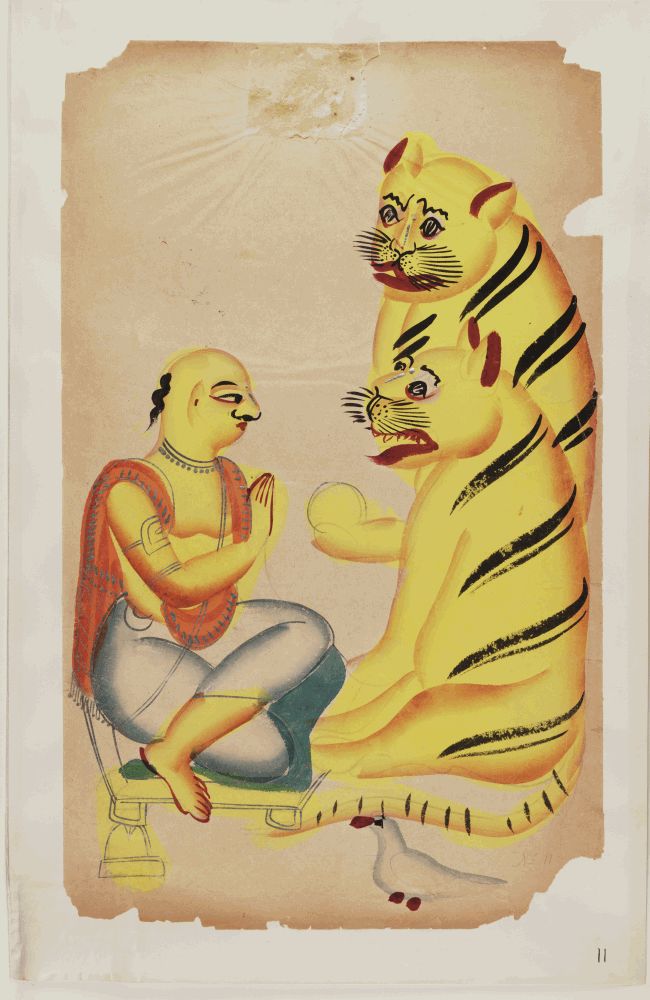
A lunar glint in the stone-shaped waters reflects an unnerving presence ahead. One glint so similar from the eye of prowling fur, the catastrophic bend of a predator's spine sends a million shivers into my very human soul. Though many steps away from the water, I feel as submerged in its unforgiving current. The gates of a natural death; the moment when you embrace the Earth in the fullest, and the human form disintegrates in a flash of primordial hunger. The animal, entranced, paralyzed my every last cell, as its tail swung left and right with dizzying grace, as there were two beings of the hunt, in full and impenetrable balance. And then, the Tiger stopped. Her stare, curiously enough, then was warming.

A Kalighat Painting, Kolkata, India, 1875 titled, "Brahmin Kneeling Before Two Tigers."
As captivated by an inward swell, as a yet unfelt emotion, the pangs of belonging, of a friendship undying since an unformed word first sprang from my infant mouth. My heart welled up with the strength of tears wept before the death of the beloved, and its release followed with utmost relaxation, both bittersweet as ecstatic. She walked with me, as two lifelong friends, along the human path. And my gut sank as I heard the footsteps of a band of unweary souls approaching.

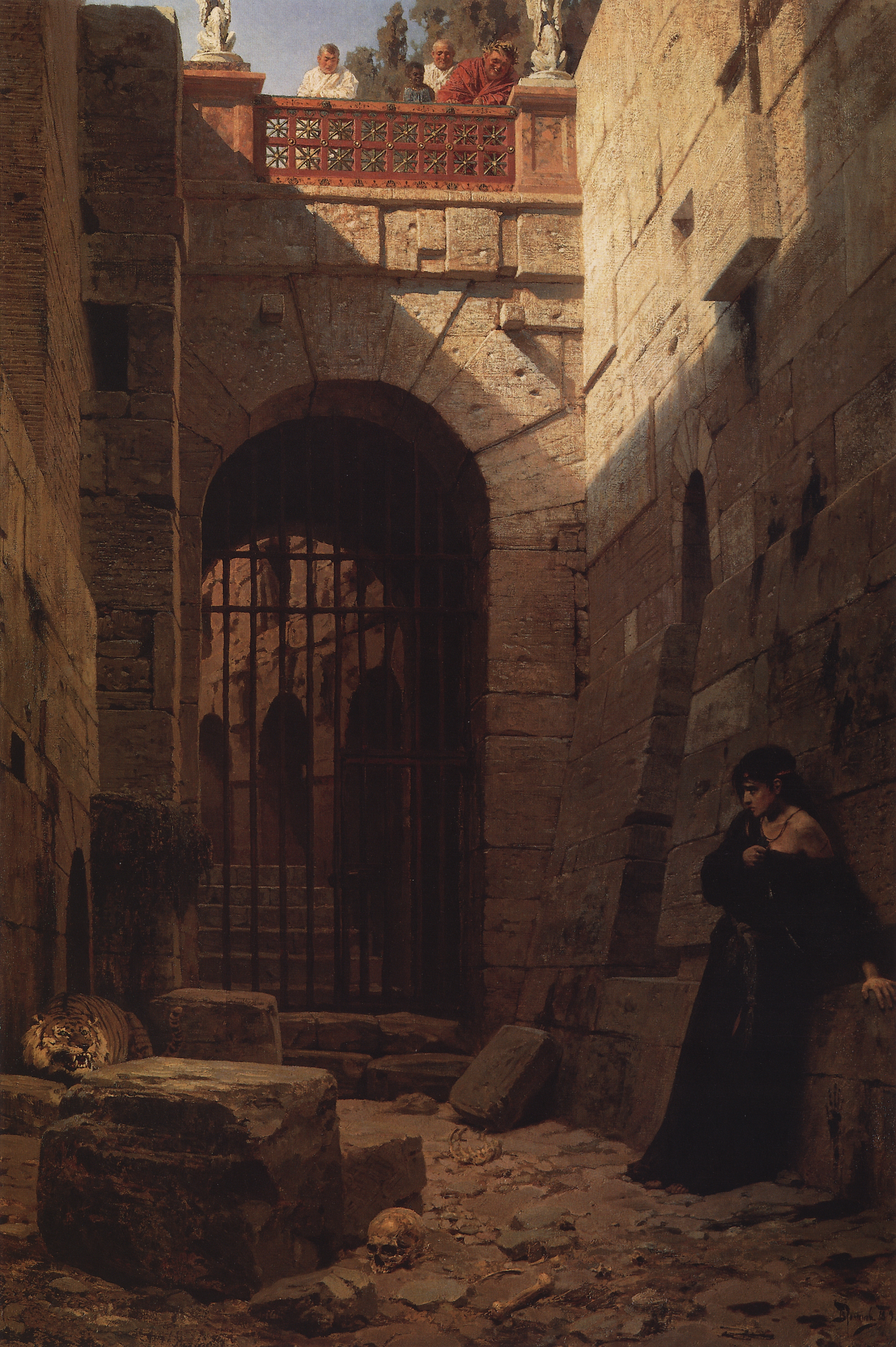
Tsezarskaya zabava (lit. "Caesar's joy", Russian: Цезарская забава) by Vasiliy Polenov
She was unprepared to join us as a race, if only to meet an individual of her heart's likeliness. As the unknowing travellers marched forward, they were met by the power of her charged fangs, her open jaw welcomed them as the air accepts a skydive. I fled, not looking back, confused, while with purpose, the scent of strength over the domineering self, over humanity and the narrow stiflings of egotism and myopia in the anthropocentric paradise of modernity.
___________

My sister. My brother. My mother. My wife. My maternal grandmother. My step-father. My step-mother. My great-grandfather. My paternal grandmother. And my late grandfather.

All of them, lived for and with music. Music brought us forth. Music brought us together. Music gave us wings to traverse the open skies, our imaginations, the open roads and lesser-beaten paths. Through music, we know where came from, where we are going, and how we might get there. In the new single by my sister Jesse, "Everything in Between" she brings it all home.

Listen to Jesse's first album, or even one track on it called, Voyageur, featuring myself and my wife. Listen. The lives of countless generations speak through her tones and chords, her voice, her words. Listen, and you just might hear that one that you know like your own. 

The track These Words is inspired by the wisdom offered as mementos, and as initiations into the power and meaning of family, tradition and the value of life. Be Kind, speaks the first of five wisdom truths, as the Five Noble Truths of Buddhism, our father unearthed five from his own suffered spirit, heartened by the stories and ways of our grandfather, who gave him music, and who passed down not only a tradition of sound, but a tradition of respect for our fellow human beings, for the strength and truth of work and its potential to give one meaning, to give one affirmation that their work is good, that even if it largely remains unsaid, the work is good when it is done in earnest in the trial to confront one's own innermost and enduring sufferings. 

In that way, Kindness transcended politeness, the mediocre drab of everyday humdrum gave way to an appreciation that bordered on spirituality. "My religion is kindness," said the Dalai Lama, and when practiced right, resonates and reverberates, and, ultimately, transcends human suffering as surely and directly as the high of a harmonious tune strummed to the effect of an age-old rhythm, not forgotten and passed down through the embrace of one's own blood. 

Monday, 7 October 2013

The Wild Path: An Oceanic Reunion of Musical Discovery

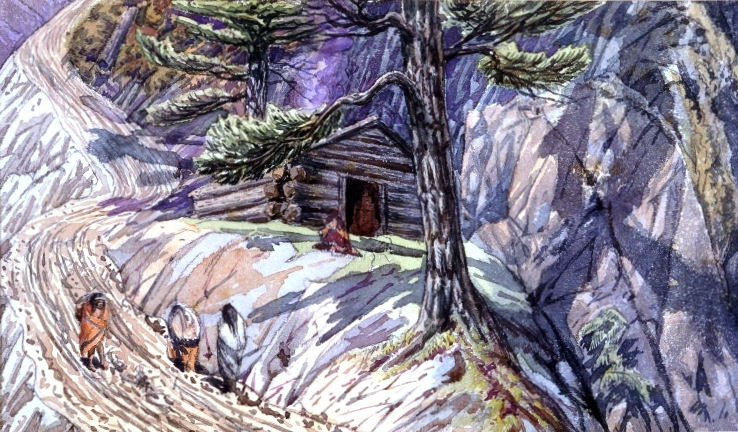
New Government Road, Lillooet, B. C. by William George Richardson Hind
"I get privy to an area that most people have not seen and will not see, and that's just amazing, and I get to see it at this point in time before any of these projects go through whether they do or not - maybe they don't get approved by the NEB [National Energy Board] or maybe they do - but if they do and these pipelines happen, the places that I visit this summer or next summer or the summer past, they won't be the same as they were when I saw them.

It'll have gone through an irreversible alteration and not for the better. For the betterment of some human notion of bettering the Canadian economy, wealth, or prosperity but not for any betterment of the land." Ian MacNairn, Working North: Calgary Worker Speaks on Labour Conditions in Northern Alberta and BC

In two years, I hadn't seen the ocean. The epic grasslands of Alberta prairie filled my pupils with daily life, lived fully and for the present. Answering to no one except Father Sky, Trickster Napi and the Bow River, I moved humbly through the auspicious momentums of friendship, solace, distance, rootedness, and foresight. The elegant plans of my life incinerated like a vintage map under a breaking candle. In the bitter hours, I wore my bone to nothing but pure face. And the ocean called. At summer's end, as the leaves slowly dying with bursts of peace said in the silent flesh of wood, I broke past the unanswered din of prairie sky mind. The expanses narrowed with focus of sight, and the road stretched on through mysteries immemorial: a land of hidden truth and naked passion. The Earth spun on a gamble, and the sea rose. 

In two years, I hadn't seen the ocean. Firstly, through goggles of tires and binoculars of steel, I then moved through mountain fog to sail toward the island shore. Orcas lifted above the snowy crests, as solar rays burned through the misty sky raining a refreshing, and most rejuvenating, beautiful life. Water flushed my spirits in a spiralling lust, unafraid to lick the clouds and skim atop the brightening ocean. In the rain, I sang and wept oceans of longing fulfilled. The inner world lost its axis and at a loss for balance whirled in ecstatic harmony with the chaotic ring of Beginning. As the sky opened, arriving closer and closer to the island shore, my mind lunged with feline prowess over the horizon, to feel my own heart stretch across this watery earth in a divine embrace of superhuman love, of imagination and unity. 

In two years, I hadn't seen the ocean. The cedar hat and drum vibrated with untouchable grace, as I remembered the northernmost step I had taken arm-in-arm with the coastal peoples of the Canadian west. How their drum sang with opulent harmonies only so sweet as when filling the cold air above the tear-blending Pacific. Under the first sun, my friend, a luthier of fine wooden drums (harvested locally) led me to meet the Black Bear, wise fool of the gentle, lazy, clumsy earth. We found sacred fungi and cooked and smoked and bore down with rhythmic intonation over the self-built family home. The forest spoke with a voice to shelter our lives with the hard woods of a door and staircase, of walls and rooms of birth, childhood, adolescence and maturity to the soft woods of art, passion and a work to spell freedom from the burdensome street of poverty, class, race, addiction and anger. 

In two years, I hadn't seen the ocean. The night sky breathed light, streams raged in the subtle beyond as death called us inward to sleep under the reign of the green dragon tincture, a home concoction of herbal divinity. Sea lions surfaced to the call of the drum skins reverberating madly over ocean stones. Overlooking the snowcapped island range, we viewed the lush orchestral arrangement of oak, cedar and pine as nearby eruptions solidified into earth-bound communities, moved by the crafting of local life as it etches its place on currents of stone and seed. And so I left, speechless from the first mountaintop days ago as the journey from Alberta started, and from where it ended. To see the ocean, and to sing with the opening sky. To drum along the banks of the island range, seeing snowcapped mountains stare into the distance, over local life as it thrives and nests behind the silencing waves. 
____________
at home in the woods
from where the rain begins
full speed behind
horizontal moments
the daily unground
the first time we sang
the reason we left
to openness we come
the way of the blue unnamed
afterwork time
_____________
She came
She saw
She conquered
Video Description: So far the only 36 stringed zheng, Taiwanese made long zither in the world. Great innovation it was about time this was invented(?), innovated at least, because this is my first time improvising on one this grand of a size! Grateful to the luthier and to Sonia Liu of Vancouver's "Crystal Gu-zheng Centre" for allowing me this great honour to share.

Monday, 30 September 2013

Source of New Media: Resonant Lives Harmonize in the West


“What I began by reading, I must finish by acting.” Henry David Thoreau

Where is our all-inclusive local media source, one that is not generic, yet doesn't cater to only one group, one that embraces local lore, custom and myth, one that encourages people who live the story, who are located downtown or in the community, whose lives are on the pulse of the daily, local narrative? They are to tell their story, to emphasize selected statements said by their own voice, and to speak from experience, because good media should begin with experience and end with experience. Good media should not begin with inexperience and end with inexperience. Good local media should reunite with social cause, and ultimately, incite action.

The introduction, history, structure and funding of The Media Co-op is explicitly written out in, Know Your Co-op, a nineteen page document prepared by journalist Dawn Paley in 2007 and self-published by The Dominion editorial collective. What began in 2003 as a newspaper, The Dominion (still circulating nationally), was reincorporated as a multi-stakeholder cooperative in 2007, now known as The Media Co-op.

“The multi-stakeholder is a situation in which you have more than one class of membership within the cooperative and they collaborate together to meet the needs of the different classes of membership,” Peter Hough, Fund Manager of Tenacity Works Fund at the Canadian Worker Co-op Federation told the Calgary Working Group of The Media Co-op. “In a retail store it would be trying to produce good working conditions for the employees but also trying to produce good service and fair prices for the consumer members. And then all of them would share in any surpluses.”

In 2009, the first local of The Media Co-op formed into the Halifax Media Co-op. In the next three years, Vancouver, Toronto and Montreal formed locals (in that order). “Each local has an editorial collective that meets face-to-face to discuss stories and coverage in their cities and surrounding areas,” wrote Dawn Paley, in Know Your Co-op. “The new model has required the creation of a web platform where contributors can upload news, videos, audio and photos, as well as interact through comments, working groups and discussions.”

Cooperative and local media is a process of decentralization, essentially giving media back to its rightful source: the people. In this way, the oft-repeated slogan, “Own Your Media” is The Media Co-op mantra. With stories such as the 2004 Haiti coup d’étatand the Vancouver Olympics, The Media Co-op and its locals transcend corporate media coverage, connect with untapped readership in the Canadian public and have worked with larger media organizations internationally, such as Democracy Now!

Yet, as typical to news media, the bad news is ever-present. As reiterated in Know Your Co-op, Montreal Media Co-op founder Dru Oja Jay, bore the bad news that The Media Co-op could not accept new locals in the 2010 article, How to start a local of The Media Co-op. Due to the overwhelming commitment and the underwhelming budget, The Media Co-op instead encouraged incipient Working Groups. The Calgary Working Group was opened under the direction of Jay in 2010 with top-notch international reportage on the challenges to a national election in Manila, Philippines.

Since then, the Calgary Working Group has received over 120 members with contributions on topics ranging from the G20 Summit to The Alberta League Encouraging Storytelling (TALES), to Environmental Justice, to Café Koi to Young and Future Generations Day. Articles, podcasts, photo essays, editorials and blogs are among the many mediums of cooperative journalism local to Calgary. After a new (and very active) Calgary Working Group contributor corresponded with Jay earlier this year, the momentum shifted. Dialogue on starting a new local of The Media Co-op reopened.

The potential for the Calgary Working Group to become the Calgary Media Co-op is a vision that has since been shared in the local community, and the support is gaining. The Calgary Working Group started meeting with this objective in May of 2013. Besides forming a basis of unity, and establishing an editorial collective, the Calgary Working Group requires sustained and significant contribution in order to shift gears into the full-fledged Calgary Media Co-op.

The initiative is mutually coordinated with The Media Co-op, where all posts contributed to the Calgary Working Group (and in the future the Calgary Media Co-op) will appear as published on The Media Co-op nationally-syndicated, online news source. Stories written by a local, such as the Montreal Media Co-op, also appear as such when published in The Dominion. The Calgary Media Co-op is a vision for local cooperative media, in advocating for the publication of local stories, connecting them to a national community of journalists, activists, communities and leaders.

The basis of unity and editorial collective has been organized successfully since May with core organizational capacity developed with Daniel Rodriguez, a graduate of SAIT Journalism and Melissa Manzone, who holds an M.A. in Journalism from Kingston University (U.K.). Our basis of unity establishes a rational, concerted response to the inadequate agenda of dominant media to address and give voice to local concerns, perspectives and narratives. The unity is also founded on a deep appreciation for journalism as a public base of knowledge where cooperative values are formed, maintained and encouraged.

The editorial collective organizes a weekly program of contribution. Each piece submitted to the collective will be edited by at least two other core or guest editors. Three pieces a week are to be contributed by one regular contributor and two guest contributors. The publication schedule will be organized according to three themes – Uncovered, Alternative and Editorial.

On Monday, the focus will be on misinformation in the dominant news sources. Simply, we ask, “What is the popular news not covering?” The same issue published in dominant newspapers will be assessed and critiqued with regard to the uncovered angles, perspectives and stories. Not only will contributors critique, their articles and/or multimedia pieces will address and give agency to the unvoiced, and unknown, in our community.

On Wednesday, pieces will map alternative press locally, in Calgary, and Alberta. For example, we ask, “What is being voiced by independent media sources, non-English newspapers, podcasts and blogs?”

On Friday, the editorial collective will publish editorials spotlighting special voices from within the community. This new initiative of the Calgary Working Group aspires to convene with the entire political spectrum, including all identities of class, religion, gender, and ethnicity into a refreshingly local forum to reenergize debate, understanding and willpower in the community.

The Calgary Working Group still has a long way to go until the proposed momentum is established, and finally, there is a new local chapter of The Media Co-op in Calgary. According to the latest draft of New Local Policy (pending issue by The Dominion editorial collective), the Calgary Working Group remains in Phase 0 of 5 successive stages until a full-fledged Local can open in Calgary.

First and foremost, what this means is that the Calgary Working Group may not use The Media Co-op name to raise money. All funds currently fostered through the voluntary leadership of media activists involved in developing the Calgary Working Group are nominally channeled through AlternativeMediaYYC.com, an independent media and podcast source for Calgary-based voices. At Phase 0, the Calgary Working Group may not refer to itself as the Calgary Media Co-op. At this initial stage, administrators at the Calgary Working Group helping with site content do not have editor access through working group admin privileges.

Currently, the Calgary Working Group is developing from a working group (Phase 0) to a website working group (Phase 1). In the first stage of the working group’s becoming a local new content is posted weekly, collective membership is stable and meets regularly; collective processes, membership criteria and operating principles are formed; editorial policies are adopted; formal agreement is made with The Media Co-op basis of unity; and lastly, the collective (Calgary Working Group) agrees not to use The Media Co-op name to raise money nor refer to themselves as the Calgary Media Co-op.

At this transition, the working group applies to The Media Co-op Board of Directors (in this case, through Dru Oja Jay). Leaders from this Calgary Working Group initiative are currently organizing a conference call with Dru and The Media Co-op Board of Directors. [To get involved, please contact us via the Calgary Working Group coordinator, Matt Hanson (mhanson1717@yahoo.com).]

______________

In the context of modern literary history, Hungarian-American Jewish newspaperman Joseph Pulitzer set the quality standard for publishing at the turn of the century. Pulitzer, best known for the eponymous award for not only journalism, but also photography, literature, history, poetry, music and drama is attributed with the quote: “The newspaper that is true to its highest mission will concern itself with the things that ought to happen tomorrow, or next month, or next year, and will seek to make what ought to be come to pass.”

Good media begins with the very real ground-level experience of people who are the subject of good stories. The middle ground is where people read and learn. Finally, good media ends when the lives of the people voicing their story are changed as often as the people who learn that story. Good media compels and instills action.

Mediocre or god-awful media begins with inexperience, namely the daily political rhetoric, hearsay, or at best a secondary source. Next, its core value is the repetitive sound of a cash register receiving a dollar and some change for a paper. For the tremendous act of reading is enough for some literati, however news media should be a call to extroversion and community.

Oftentimes, media consumerism ends with apathy, inaction and at best a satiated boredom, and at worst, accepting that life merely boils down to hearsay. More subtly, office-enclosed research on secondary sources so conveniently bolsters today's social (and unsocial) media frenzy; a frenzy that can overwhelm experience into the dull silence of an unprovoked voice in an abyss of unquestioned answers, facts, statistics, records.
"It's as if newspapers have broken their bargain with democracy in turning away from editorial excellence and towards profit, marketing and cost-cutting...fewer of us can turn to our papers and see what we all have in common, or what our common stake might be if we participate in our democracy." (Yesterday’s News, John Miller)
The glossy overdub display of empty space is often filled with meaningless advertisements, meant to convince people that their lives are as empty and meaningless as an unfulfilled consumer niche, such as the newspaper; slowly becoming a dying, trivialized miscellany for the intellectual exploits of the few.

The media less and less provokes action because it never quite does anything for anyone, yet still somehow exists because of the inkling that it could. If only media behaved as it once did before politicized buyouts and delegitimizing advertisements, when a paper was a conduit of experience through which new learning passed to connect, share and welcome all voices to truly and transparently voice an urgent cause to act!

Dominant news sources less and less provoke action, and more and more reveal mere dangers. Is our fear-based culture a result of the classist leadership in dominant sources of media and information in the public sphere, where stories are always politicized according to the dominant agenda? As a result the rhetoric dissuades change, i.e. delegitimizes alternative perspectives. The narrowing national and public debates are also a resultant of the unremitting and domesticized war on [domestic] terror and its repercussions within the consumer identity crisis of the West.

Local media often promotes reliable, ongoing coverage, because people are interested in the longstanding nature of their community. Merely because a story is told does not mean the story itself is over. Ongoing coverage on a topic that immediately concerns people, on which they have daily experience as a default to their local lives, provides opportunities for readers to learn more, gain news perspectives, contact key leaders on the issue, and most importantly, become involved in currents of change.

Dominant papers don't often voice underprivileged perspectives because they are the least marketable consumers. Instinctually, good journalism bolsters weak areas of coverage, not simply profit margins. As Pete Hamill wrote in News Is A Verb, “True accomplishment is marginal to the recognition factor. There is seldom any attention paid to scientists, poets, educators, or archaeologists.” Traditionally, papers lead communities toward mutual solutions and shared vales. Consumer marketing instills myopia and is, finally, beside the point, and decidedly antithetical to providing true information.

The advent of community, as opposed to commercial, journalism can teach citizens of a democracy (and more, a democratically inclined world) how challenging it is to create consensus. Journalists are practitioners of democracy. Their work necessitates service and humility. Community journalism cultivates voluntarism, and promotes education, vision and friendship. An unknowing public spawns a culture of denial, impotence and misinformation. The more a society realizes its source of community, the more its people are independent, thoughtful and generous.


References:

Hamill, Pete. News Is A Verb: Journalism at the End of the Twentieth Century. The Ballantine Publishing Group. New York. 1998. Page 80.

Miller, John. Yesterday’s News: Why Canada’s Daily Newspapers Are Failing Us. Fernwood Publishing. Halifax. 1998. Pages 15-16.

Kennedy, Dan. The Wired City: Reimagining Journalism and Civic Life in the Post-Newspaper Age. University of Massachusetts Press. Amherst & Boston. 2013.

Paley, Dawn. Know Your Co-op. The Media Co-op:http://www.mediacoop.ca/index.php?q=knowyourcoop. Canada. 2011.

Jay, Dru Oja. How to start a new local of the Media Co-op. The Media Co-op:http://www.mediacoop.ca/blog/dru/4378. Canada. 2010.


The article above, Community, Not Commercial, Journalism, was written and published exclusively for The Media Co-op on September 27, 2013. 
_____________
I cross a deep green field. The sky, overcast, rains on a dark earth. Dusk spells weary and wayward bands of lonesome greed. The marijuana burns. I, cold in dank clothing, trail beyond the grey horizon. Smoothly, with a gliding wind, I escape across the open shield. My mind breathes awake. 

Pluie de mai. Pays basque by Darío de Regoyos y Valdés
Cautious, I walk slow. The friend waits, cold, faceless. I unwrap a fabric, revealing the value of our exchange. Sweetgrass fills the air. Moved, life graces. Forlorn and ungraspable, we stretch out to reach the fleeting air. Police siren. The air becomes a noxious haze of suspicion. I fly. 

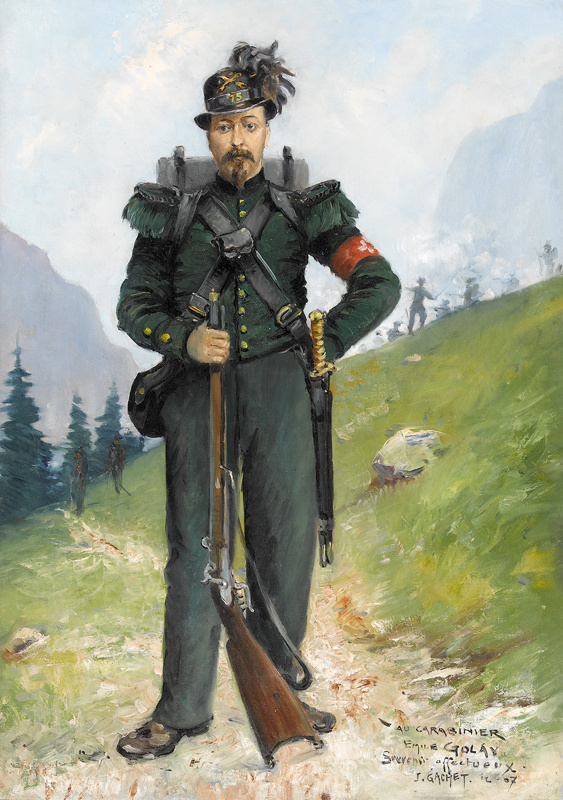
Le carabinier by Jules Gachet
The sweetgrass confiscated. Our lives are in our hands. I look up. Abyss. Black. Open. Dead light fades. Escarpment of the human gargoyle decaying, and erased from the map of heaven. Sharp and hard, the light petrifies, crystallizes and vibrates of the endless spectrum. 

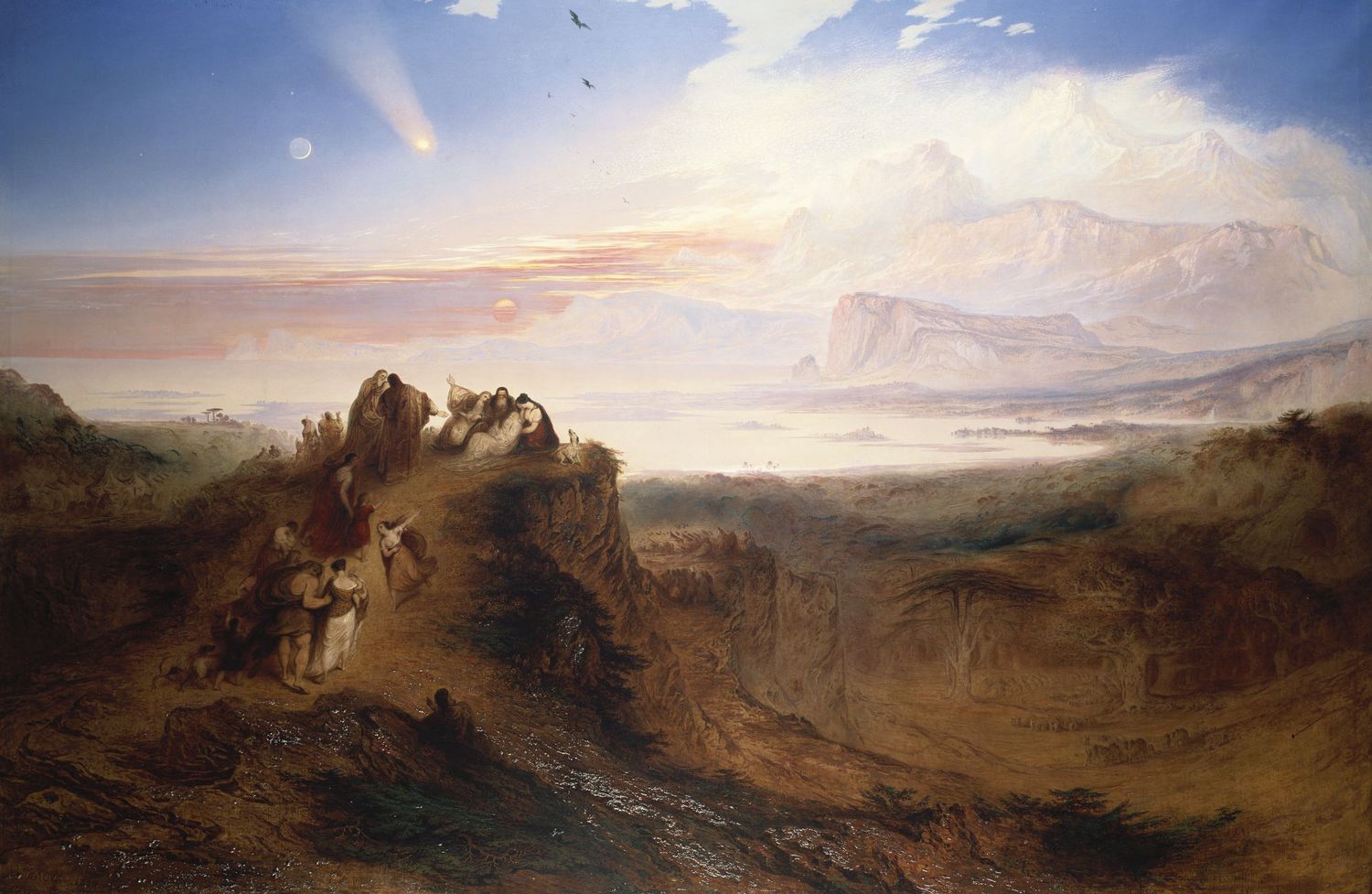
The Eve of the Deluge by John Martin
Galaxies enervate spines, nerves, veins and nodes of wonder; cosmic laughter at the sound of a split gong. Through, I, again, look up. Cobalt azure. Blinding, solar, pure and naked, sky. Cloud obscures. Rain, a memory. Summer passes in the afterglow noon. 
____________
First time in Vancouver, my love and I stayed with our dear friend Buckman Coe. I left early, leaving her to an extraordinary night with rich music and great friendship, and leaving, on my way back home, I played Buckman's first CD on my headphones. The first track, "Give Up The Fright", began "If you must go overseas / If that's where you feel that you ought to be." 

And tears streamed. I shook with the fear of love as I watched my one exit from the bus station and into the west coast cityscape. It was the first step on my way to Cairo, and further and further away from her. "Don't know if it was wishful thinking on her part / For now, this little rogue has got my heart," ends the song, a wishful lament to the ambiguity of human relationship, the lyrics struck so many chords with perfect accuracy. 

Years later, our dear friend's second CD, By The Mountain's Feet, opened with Not So Farfetched, a brilliant rhythmic melody to the course and rush of love - and again, the lyrics spoke with impeccable insight as we schemed our return west, to our Pacific lust of belonging - "This is how the story of you and I begins / And it's not so farfetched..." 

To the resounding continuity of love in our hearts. We grow to return. 

Multimedia Video on Jewish-Chinese Intercultural Music

Jewish and Chinese. The pot boils. Visiting the coast, we accompany a friend staying in the home of Lan Tung and Jonathan Bernard, whose special hospitality warms with musical instruments of a deep and resonant heritage. Their contemporary fusion music of world union reconciles the magic of our hearts with an unspoken quality of communal love - an uncanny similarity to our own strength of heart, soul and mind in the music of our coastal upbringing. 

Tuesday, 29 May 2012

Weathering Tornados from The Lover's Music


Vi An Music

"If we go somewhere on foot, we know the way perfectly, whereas if we go by car or airplane, we are hardly there at all. It becomes merely a dream." 

Excerpt from "Meditation in Action" by Chogyam Trungpa
_______
On my way to see my Love! She’s giving a presentation in a high tower, what a glorious teacher she is, a teacher in secret, with hidden wisdom and enlightening prophecy leaking clean out of a package of such humble eloquence.

The road is dry in the warm, new summer air. I see a woodwind shop to my left. A Xaphoon, hanging in the wall! Why, I do have one at home, but that one looks so beautiful today! I have been enjoying this instrument so very much, but I think I’ll have to buy another for the special occasion that is this day. In the shop, a saleswoman is short with me. No extra conversation ensues despite my attempts after I’ve decided on their only functioning Xaphoon. For the $30 I walk away with my new instrument, smiling quaintly in sweet visions for the day, gaily in love.

I arrive to the towering silver building. Strangely, I decide on the stairs. Massive windows bedeck the entirety of the walls, the low plains stretch as a mercilessly singular mural throughout. I find the room of my love’s presentation. There she is; a ghost of decadence, beauty, a word in her honor, is unready for its true name. In her presence I am light with the fresh gold of summer dreams. Her hair is bunched and flowing, the gargantuan black mass swells and streams down her side as a mythical waterfall of visceral lust, untouched and unrivaled by any substance beside. As I move in closer to her, weary as not to interrupt her occasion, a mirror image of her hair in the sky appears!

A black, icy fleece of cloud boils upside-down into the gleaming pasture, a wild tornado approaches! “This is a building of glass!” I scream weakly and run alone back into the stairwell to find sanctuary. The tornado crashes violently. A 9/11 of natural law brews gravely in the high destruction. The crude aftermath burns with electric ash as the ruins fume, awaiting the ever-darkening sky for yet another whiplash. Too afraid to return above, I journey onward outside of the city core, with instrument in hand, I dreamily invoke the unmoved trust of community in the survivalist reign of mounting fear from the shape-shifting sky above. Human vibrancy responds coolly in the aftermath of lost pain.


_________
Tornado
"If you dream that you are in a tornado, you will be filled with disappointment and perplexity over the miscarriage of studied plans for swift attainment of fortune...Tornadoes in dreams suggest you are very angry about a current situation and are afraid to express your feelings - which you need to do - for fear of hurting others."
________
Echoes from the polar wisdom of our earthly rotation
unraveling the truth in the thousand-worded letter
and pictographs of ethereal meaning
climbing through the bowels of a holy mountain
to the void of spiritual absence
in the land of prophets
unheard since ancient words lifted
to the ceiling of the temple built before time

On the sands of the strong & fuming,
leaving no one to posit an older order of belief

In sky temples & borders that signal friendship
enmity awaits in the selfish vine
a mark where the western mind strayed too far
to become its own enemy
in the reflexive mold of war
for basic rights.

- excerpt from "Royalty of the Weird

Sunday, 6 November 2011

A String of Unforgettable Dreaming

Passage of the Iron Gates in Algeria, 18. October 1839 by Adrien Dauzats


Dream Memory 1

I see a map attached to what looks like a conference board display in a war room of sorts. The map has impressions which remind me of old wood stamp envelope seals, however they are marked in a fashion as to resemble blood forced into an array of impassioned fervor, an explosion of red paint or wax fixed on deliberate points on the map. I see the largest impression, which my eyes are drawn to first, is on Indonesia, next on Southeast Asia, there is an very large impression on Chile, on Japan, on Turkey, and then I realize these imprints represent shockwaves and their traces of carnage. Earthquakes and tsunamis are scaled with an imprint of blood on the map. I look closely at the geographic place where I am, in North America, and I see small traces of red. Is this a forecast I wonder?

Dream Memory 2

I am walking through a densely wooded road with my cousins and family friends. We find our way to a cliffside. One of my older cousins, about my age, decides to be risky. He begins walking alongside the cliff very close. I try to one up him, and so I slink on down the side of the cliff, letting myself hang on an overhanging root. I become quite frightened by the implausibility of survival if I were to slip and fall from such heights. My cousin then does me in by lowering himself to a rocky outcrop far beneath our feet at the cliff's edge. I am frightened for him. I can feel his vertigo. Then he falls. It is as if I fall with him. We all act as if he is now dead. After some time passes, I am a presence, with him, though he can not see me. He is lying on his side at the bottom of the cliff. A black man finds him. This man seems to resemble more of an African character than American. Soon, however, we are in what appears to be a gang-ridden neighborhood in Southern California. There is great risk, as people surround us with guns. The rest is clouded.

Dream Memory 3

I am in a Chinese grocery store. It reminds me somehow of the city of Vancouver. I find to my great delight a whole bunch of good items to purchase, however I don't leave the shop for two days. I am in their rummaging through all of the items, without much sense of purpose, and suddenly as I am working on the tile floor, trying to fix it, the owner of the shop points me out. She takes my to go box of orders and begins throwing them out, telling me they have gone bad. I plead with her while each piece of delicious food is bit into, prodded and thrown into the trash. She then kicks me out.