Primarily a writing exercise, this dream journal-inspired blog is a quiet introspective sojourn into the process that we traverse in going from private dream to public art. I see our dreaming as an internalized mythmaking. As I philosophize and expressively exhibit dreams, both private and public, I encourage and delight in creative language as a way to practice experiential metaphors through a “public dreaming." Writing Theory: Creative Dream Fiction
Showing posts with label oil. Show all posts

Monday, 28 October 2013

Globalization and All Our Relations: The Human Family Shall Overcome

Natural disasters caused by climate change by KVDP
"We've been told that climate change is a very serious threat, in fact the most serious threat facing humanity today. Groups like UNICEF and Save the Children are emphasizing the particular impact on young people around the world in developing countries, in the Global South…

….[The United Nations International Panel on Climate Change, representing thousands of scientists from 195 countries] have 95 to 100% certainty that climate change is manmade and that we really do need to be reducing the amount of fossil fuels that are being extracted and burned to get us back to that 350 parts per million. We're currently over 400 parts per million."

Ben West, from a podcast published with The Media Co-op titled, "Vancouver is debating a resolution to divest from fossil fuels"

Recently, I was asked to produce an essay without knowing the prompt, until the moment unveiled the golden word: Globalization. The off-the-cuff piece, shown here within the body of this text, is the result; derived from a deeply studied and well-experienced life as a global citizen, a youth whose formative years traversed four continents. Read ahead:
Living conditions in Third World countries are deplorable. In fact, the term Third World derives from the Cold War, signifying all of those countries outside of the pale of American and Soviet landholdings. Such countries have continued to face irremediable challenges with integration into the global economy. Culturally, such countries continue to embark on a multicultural path, as a legacy of post-colonial liberations. Yet, economic woes remain the side effect of these nations. Common people feel the impact the greatest. "War is the enemy of the poor," said Tavis Smiley and Cornel West during their recent "Poverty Tour" through the United States. 
Neo-liberal economics, spearheaded by American economic globalization, creates insurmountable debt for Third World countries. The Third World is now also termed the Global South, due to the fact that most of these countries are located in the resource-rich southern hemisphere. Neo-liberal economics is a unique phenomenon of globalization, which has essentially led the entire globe down the same path of economic debt and cultural greed as that currently faced by the American people. Yet, unlike in America, banks in the Global South will not be bailed out, and their people will not be "defended" by the most powerful military on Earth.    
In recent weeks, as the snakeskin of nature shed under the turning, cyclical gaze of the heavens, I have ruminated steadfastly, and piercingly into the nether reaches of my mind with one essential question. How is one to live directly? How is one to embrace the very source of life from which their every day nourishments and hungers, joys and sorrows, deaths and rebirths emerge? It is a question asked throughout the aeons, and in the Euro-American tradition of thought, also by the transcendentalists. 

Often times one will question whether they are to live as an urban dweller, bound to the manufactured waste stream that devastates as it deviates all from the nature of truth and union with creation. Simply, one might ask, "How can I live off the land?" Such self-interrogations are, at heart, nothing more than abstraction. In truth, one cannot exist without living off the land. It is our relationship to our life that matters, and by our life, I mean our water, our food, our air, our soil, our family, our Earth.

Pre-historically, human life was a bout of physical confrontation. Where, when life is lived directly, one sees straight into the eye of death, and beholds our own reflection staring back with the quiet and steaming grimace of fate. So, the trials and travesties of inter-human conflict seeded our mind as with the necessities of the harvest. Yet, today, instead of the spear, instead of the omen or plague, we have a curious social phenomenon called Globalization. Our confrontations are buffered by stone and metal walls. Our physical conflicts are transformed into backhanded and conniving corrupted relationships, not only among each other, but with all that we see, feel, taste, hear and smell. The most deviant and malign property of Globalization is that it moves to act upon a sixth sense of unreason and ignorance: consumerism. 

The objectified Earth, the manufactured life, canned and packaged and shipped and digitized, provokes our habits of overindulgence, not only in the physical, but also in the emotional, spiritual and mental aspects of existence. Our life is one of imbalance when our relationship to the sources of life we depend on are marred by the anxious flux of neo-liberalized, Westernized, and finally, globalized economic growth. In the end, I wonder how we might return, or go forth, into a paradigm of holism, where things are not treated as objectified individual separations of the world (a reflection of our own egos), but as representative of one and all in the cyclical round of being, of nature, growth and fulfillment. 
_____________
This path I have tread before. Tonight, the water is more still and tranquil, more at peace with its shores than ever; almost unified with the distant, clear sky, unmoving. Its depths seem parallel with the infinite universe behind the stars, behind my eyes, and I gaze into its elegant, silent motion. And into the moonlit waters, the icy river glows as an unconscious brew, a kindling power unfolding within the heart and source of the land. The river god sways gently in a dance of ecstasy, the slow rhythmic flow is its yearning to be one, again with the sun-fleshed mountain or of the ocean's undulating tide.
In the Spirit of Hermitage at Fu-ch'un River, painting by Wang Hsüeh-hao
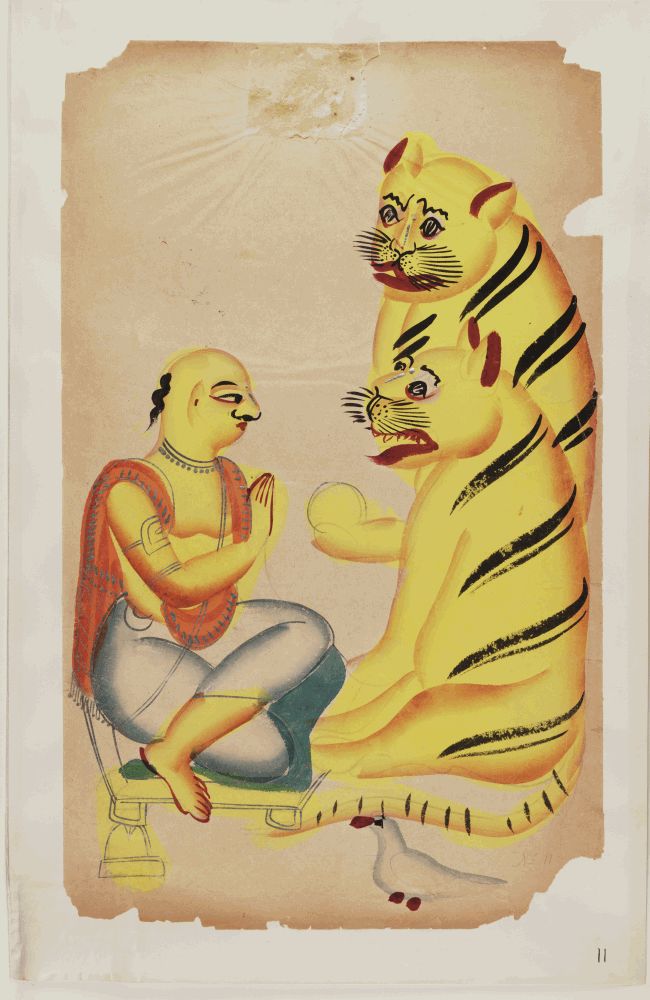
A lunar glint in the stone-shaped waters reflects an unnerving presence ahead. One glint so similar from the eye of prowling fur, the catastrophic bend of a predator's spine sends a million shivers into my very human soul. Though many steps away from the water, I feel as submerged in its unforgiving current. The gates of a natural death; the moment when you embrace the Earth in the fullest, and the human form disintegrates in a flash of primordial hunger. The animal, entranced, paralyzed my every last cell, as its tail swung left and right with dizzying grace, as there were two beings of the hunt, in full and impenetrable balance. And then, the Tiger stopped. Her stare, curiously enough, then was warming.

A Kalighat Painting, Kolkata, India, 1875 titled, "Brahmin Kneeling Before Two Tigers."
As captivated by an inward swell, as a yet unfelt emotion, the pangs of belonging, of a friendship undying since an unformed word first sprang from my infant mouth. My heart welled up with the strength of tears wept before the death of the beloved, and its release followed with utmost relaxation, both bittersweet as ecstatic. She walked with me, as two lifelong friends, along the human path. And my gut sank as I heard the footsteps of a band of unweary souls approaching.

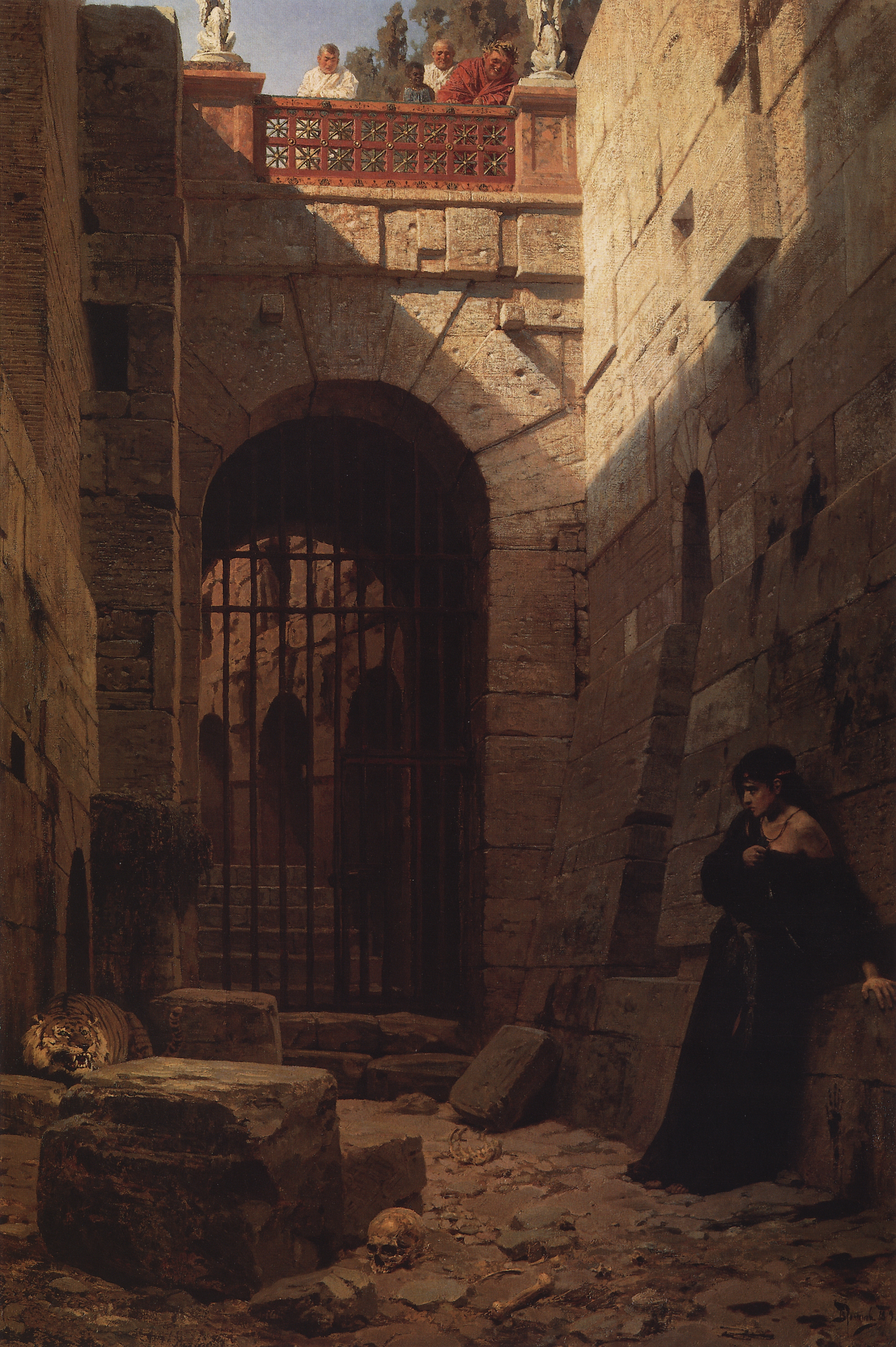
Tsezarskaya zabava (lit. "Caesar's joy", Russian: Цезарская забава) by Vasiliy Polenov
She was unprepared to join us as a race, if only to meet an individual of her heart's likeliness. As the unknowing travellers marched forward, they were met by the power of her charged fangs, her open jaw welcomed them as the air accepts a skydive. I fled, not looking back, confused, while with purpose, the scent of strength over the domineering self, over humanity and the narrow stiflings of egotism and myopia in the anthropocentric paradise of modernity.
___________

My sister. My brother. My mother. My wife. My maternal grandmother. My step-father. My step-mother. My great-grandfather. My paternal grandmother. And my late grandfather.

All of them, lived for and with music. Music brought us forth. Music brought us together. Music gave us wings to traverse the open skies, our imaginations, the open roads and lesser-beaten paths. Through music, we know where came from, where we are going, and how we might get there. In the new single by my sister Jesse, "Everything in Between" she brings it all home.

Listen to Jesse's first album, or even one track on it called, Voyageur, featuring myself and my wife. Listen. The lives of countless generations speak through her tones and chords, her voice, her words. Listen, and you just might hear that one that you know like your own. 

The track These Words is inspired by the wisdom offered as mementos, and as initiations into the power and meaning of family, tradition and the value of life. Be Kind, speaks the first of five wisdom truths, as the Five Noble Truths of Buddhism, our father unearthed five from his own suffered spirit, heartened by the stories and ways of our grandfather, who gave him music, and who passed down not only a tradition of sound, but a tradition of respect for our fellow human beings, for the strength and truth of work and its potential to give one meaning, to give one affirmation that their work is good, that even if it largely remains unsaid, the work is good when it is done in earnest in the trial to confront one's own innermost and enduring sufferings. 

In that way, Kindness transcended politeness, the mediocre drab of everyday humdrum gave way to an appreciation that bordered on spirituality. "My religion is kindness," said the Dalai Lama, and when practiced right, resonates and reverberates, and, ultimately, transcends human suffering as surely and directly as the high of a harmonious tune strummed to the effect of an age-old rhythm, not forgotten and passed down through the embrace of one's own blood. 

Monday, 5 August 2013

How to Listen to the Land: Raincoast Music and the Eye's Awakening


"Right now is the time when we wake up and start paying attention to what we are actually doing. I've always said we can do whatever we want. The question is what do we want to do. And we need a new definition of progress, you know, toward listening to scientists, and toward elegance and beauty. And so we have to get our philosophy right. What way do we want to go forward? And we need a critical mass of people who care deeply in their hearts about nature." Robert Bateman, Canadian artist from the B.C. coast sponsored by Raincoast Conservation Foundation for an Oil-Free Coast

This past weekend, I headed a block over from my apartment to grab my usual afternoon matcha. As I swung my head around to grab a coffee cup lid, my line of sight was crowded with the most peculiar, and at once familiar, beauty. Frame drums, doumbeks, and instruments of all kind, beautifully hand-crafted in the likelihood of natural aesthetics. The clouds of a waking dream parted as I stepped forward to shake the hand of the drum-maker himself. 

From Vancouver Island, Sylvan Temple Drums boasts specially crafted hand-made local woods just south of the Great Bear Rainforest. At first meeting, the key to my city's grandest music festival was gifted, unceremoniously, and with the sincerity of a true friendship. Before purchasing an absolutely gorgeous alder doumbek, I became privy to the music of such as Alabama Shakes, Thievery Corporation, Cat Empire, Caravan Palace, The Harpoonist and the Axe Murderer, Mamselle, Haram, and on. It was a splendid weekend. The gift of music breathed new life, and as through the wood of our country, the sound reverberated with untouchable magic into my heart and marrow. 

Such as luck would have, the serendipitous vibe of the exchange revealed the marked truth of reciprocity in nature. Human beings are mere messengers, and vessels of light and wisdom, others more naked and bright than the rest. They who are naked and bright are merely known as generous to us more gross souls. And so, in a parable of ancient China, correlative meaning ensues. 

Source: Galen Mongeau
After receiving the great gift, not as from divinity, but from the hands of a fellow man. I was moved to wonder on the spiritual nature of the harvest. In such a world as where the sense of harvest has breached sustainability to egregious excess in exploiting the natural resources of the land, where is the sane harvester of life's great gifts of creation? And from the musical instrument of the trees sings a tale of the potent harmony embedded within the forest, within the land. The land is imbued with the music of life, with the instruments of soul, art and meaning. 

When will we honour right harvesting, as in those who are traditional users of the land since time immemorial, not mere environmentalists, but as local harvesters who depend on the land for their livelihood? Whether it is in the food or the materials, in opening a doorway to family, community and inner fulfillment, our vocation, role and fulfillment is in the land, offering all a place, as a truly honest way of making each our own living. Might we see the hidden inner nature of the Earth as not only our source of physical life, but as our source of grounding and flight, as our source of reciprocal creativity, the inertia of magic and play as the source of harmony itself, as a way to growth, promise, and all our relations?

Learn More about Pipelines:


And the People Protecting Future Generations:
KEEPERS OF THE ATHABASCA

Also, read my Comment on Geist.com on the Energy&Art debates
__________________ 
A pipeline twice the size of a whale. A gargantuan opening, closing the way through into an opaque, unholy void. The brackish filth of water moves as on its own under our quaking boots. And the spill seeps into the metallic soil below. The Earth shrieks, yet her voice is muted under a dense, resin helmet. Deafened by fortunes of squandered wealth, the murderous cold frays the nerves with blinding speed, and then, all there is to do is work.

Interior of an Ironworks by Godfrey Sykes 
"Give 'em yr bucket." Our manager removes our defecation pails, to be filled with drinking water for the next hour. The only change of the guards is vomit and an empty stomach. Coffee, whisky and blood. The grisly, noxious sky burns with the weight of an Earth turning on its side, looking out through grey eyes, a globular iris of naked waste. The entombed sky wretches as the darkening muck churns and writhes like a cold snake. What was once soil and groundwater, turned to the tar and feathers of the shamed petro-state of Canada.

Cottonopolis by Edward Goodall 
The pipe gargles and spews rasping smoke, as if it were a choking throat, attempting a last word before immobile onlookers. The brevity of life and death makes us motion-sick. There is a sea of greed, corruption and ignorance below these decks of metal and bone. The quiet break the loudest. And at once, as the gushing oil explodes with a merciless fire from the side of frozen metal, men are trapped behind the void. Wading in the flush of a liquid worse than sewage, the brain nauseates, overwhelmed with the job of planetary death.
______________

In celebration of the filters of raw earth into breathable air. The track "America! America!" is inspired by the forestal creation of a hand-crafted alder doumbek from Vancouver Island, at the cusp of the Great Bear Rainforest, a place that also signifies a cusp of human civilization. So, the sound of the wooden drum, of the local land, is played in conjunction with a Maple Shakuhachi (also indicative of the local country's national tree).


The doumbek and flute seek a passage, of wind and earth, into the waters of being and becoming, towards a sense of grounding (drum) and direction (flute). The vocalization/narrative sounding muses on the exhausting reactionary sense of progress that ensues in the modern world, where people continue to consume and waste, yet there is a lack of listening, and a lack of sheer creation.

The calamity of today is not one of natural resources, it is our state of mind, and as the musical instruments of the natural world teach us, there is much to learn from the shapes and sounds within. As Chuang Tzu said, "What happened was my own collected thought encountered the hidden potential in the wood. From this live encounter came the work that you ascribe to the spirit."


This nine-poem chapbook speaks to the deformed nature of land under the warped perception of consumerist greed and a wholesale corruption of value in life, and unsurprisingly human life. The interludes speak to a frenetic base of experience in the fragmented world of manufactured waste and devastated landscapes that have become the norm, closing our minds and eyes from the truths and repercussions of our noxious way of life.

Through poetry, I affirm and re-encounter all my relations through a sense of the inner community. Creative language inspires an inward journeying to find the root and nature of mind. The place where our whole selves may firmly take root in the most fertile of soil, in the home of universal belonging, and so give back and become one with the self-regulating, self-sustained renewability of life in harmony with all of creation.


Monday, 8 July 2013

Walking the Tar Sands: Storytelling from the 4th Annual Healing Ceremony


"If the development of the Tar Sands has one good thing about it, it might be that it wakes us up.

Business as usual is over. We've run out of time. It is the tipping point. It's telling us that everything about fossil fuel economies have changed, in terms of cost, in terms of scale, in terms of environmental footprint. Everything has changed. Now, if as a society we can respond to that and say, you know what, we need to get off this within 30 years, then that would be great. If we don't respond to it, then as a society we will likely collapse, because you can not sustain a civilization on a resource as dirty as bitumen." Andrew Nikiforuk, multi-award winning Canadian journalist, and author of Tar Sands, in the documentary Tipping Point: The End of Oil

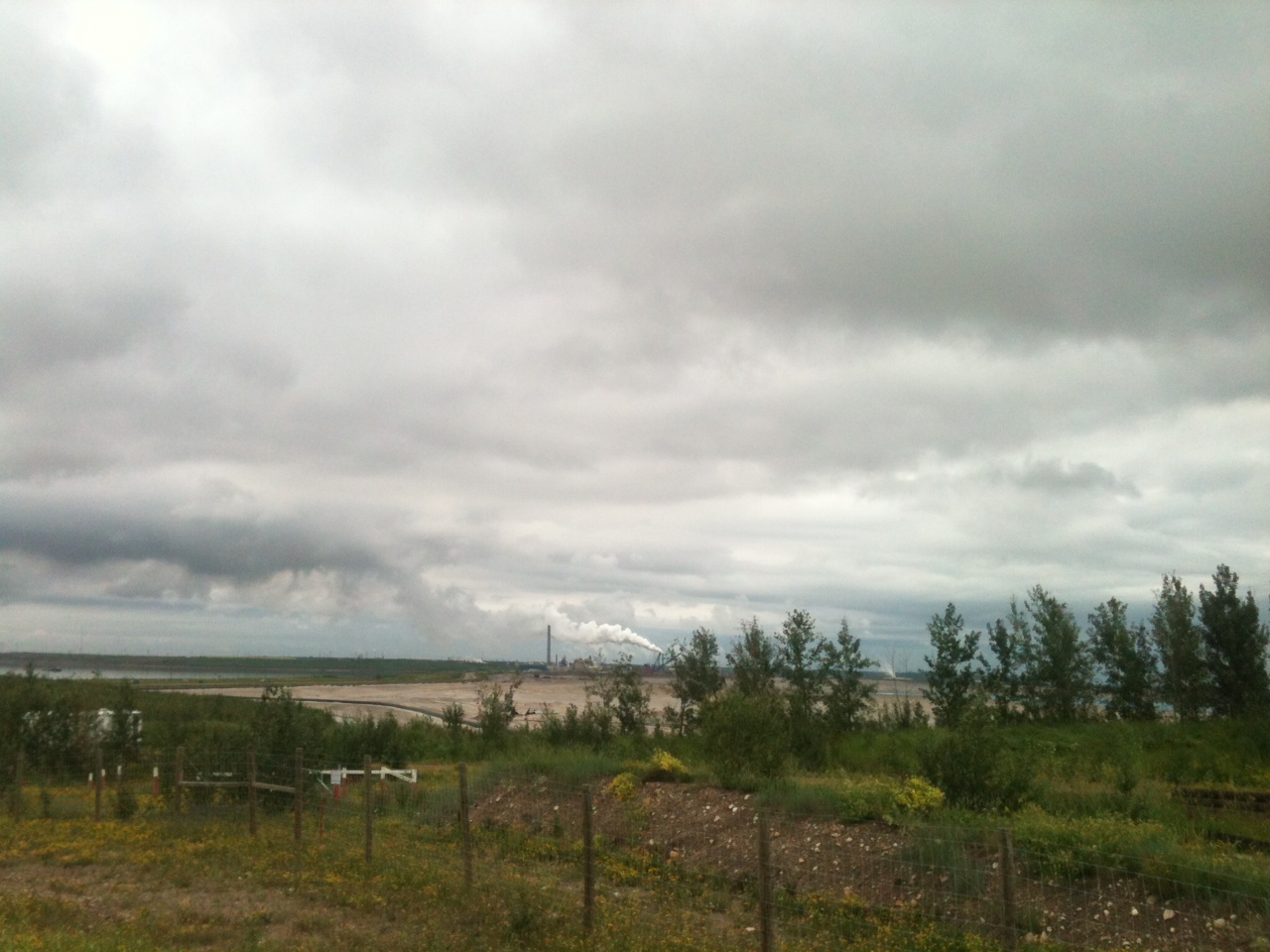
Highway 63 to the Athabasca Tar Sands, past cords of balsam poplar, I am reminded of the old adage from the Second World War. "Bodies stacked like cords of wood." The puncturing wind howls and slams with a dry heave over the windshield as sixteen wheels burn past, loaded with split trunks. To my right, a comrade of voice and indigenous rights advocate, Gregor MacLennan tells me the green corridor of lush grassy, treelines are a mere trick for the eye. Behind them lies the gargantuan tragedy that could only be wrought by the world's largest industrial project. Gregor had visited the Tar Sands with the Achuar people of Peru, who had recently fended of Calgary-based oil company Talisman from drilling on their territory in the Western Amazon rainforest. Not long ago, as a student in Iquitos, the largest city in the Western Amazon, multiple truckloads of logged jungle timber floating along the Amazon basin became a common sight for me. First impressions on bearing witness to the immense destruction and its repercussions for local communities along the Athabasca river, the Achuar, Gregor said, were overcome with sadness, and lack of hope from the locals. 

Yet, on July 6, as a contingency of solidarity groups, activists, environmentalists, scientists, and First Nations leadership, including Winona LaDuke, Bill McKibben, Naomi Klein, walked the 4th Annual Tar Sands Healing Walk, there was certainly no shortage of hope. Beyond hope, however, there was the sheer presence of strength on that full day of walking to bear witness, pray and heal in solidarity. The Healing Walk encircled Tar Sands development, pausing for a moment of silence at each of the Four Directions to heal Mother Earth. Together with elders, traditional drummers from the Dene Nation led all who followed in support. At the final direction along the path, having reached the homestretch, I asked one of the lead drummers for an extra drum, as I had forgotten mine, and wished to accompany the rhythm. "We don't have any others, it's personal. We each cut our own," he said. As they proudly held their snare-tightened skin-headed drums.

In that moment, I was struck by a revelation. Jokingly, the drummers made affable conversation, to lighten the moment through friendship and good spirits, and I was struck by each of their genuinely unique relationships to their respective drums. It was as if the making and playing of one's drum represented the circular holism of life, and the central role that creativity plays in that sustenance, that deep nourishment of living in the human experience. As they played on, not with the sophisticated manner of virtuosic world-class music, but with the honest grit and sincere genuflection of direct connection to the spirit of creativity: the heart. And the heartbeat rhythms moved me through the pain and humbling endurance of the Healing Walk. Each step a strike of the skin, a beat of the drum, the rhythm of forward movement, of positivity, of light and love. 

The number 4 had especial significance to my experience at the 4th Annual Healing Walk. Not only is the number 4 a deeply meaningful symbol to Aboriginal culture, but also to my own ancestral culture. The night before the Healing Walk, the two converged in a momentous expression of joy and harmony. On Turtle Island, 4 represents the directions, seasons, and in the Medicine Wheel of Four Colours (Red, White, Black, Yellow) and Four Lives (Mental, Spiritual, Emotional, Physical). 

In my musical life, deeply bound by Mediterranean musical culture, I have given to the Sufi spiritual practice of seeing the numerical symbol 4 as sacred. More closely allied to my blood, in Kabbalah or Jewish mysticism, the wisdom tradition of the Four Worlds, symbolizes the spiritual realms. And so, I dedicate 4 hours of every day to meditation through music, which is a special revelation of Sufism and other world spiritualities. 

At Indian Beach campground, around the sacred fire, I drummed on a 14' frame drum with Dene Nation drummers local to Fort McMurray, who inspired all present to grace the Earth with a ceremonial round dance. Our frame drums, created of the spiritual womb of Turtle Island and the Mediterranean, danced in unprecedented harmony under the inspiring rush of Dene song. Their welcoming me was a moment of incredible significance as I sunk my mind deep into the heartbeat of Mother Earth, to emerge, offering the light step of a dance, the voice of a song, and the resonance of a drum.  

So, as with SoJourn(al), the drum represents a spiritual and personal expression, where we all move and feel necessary to ourselves and the world, whether on a stage, in a publication, or through a drum, we live our lives with enduring harmony and perennial meaning. The traditional drumming is in no way redolent of economic ambition, but of an honouring for the ancestral and allied community that warms us and embodies our truth. The drum is the inner life, the spiritual life, the way to sacred holism, to health and healing. To beat the drum is to impress upon one's spirit the unshakable continuity of the richness that the inner life provides, as to forego the unwelcome trespasses of soulless possessiveness, greedy overconsumption and mindless ignorance. So, in beating the drum we are humbled as we are fulfilled. I could not imagine a more fitting leadership to the 4th Annual Tar Sands Healing Walk, than the unwavering spirit of the Dene drummers.   

See Previous Posts on the Alberta Tar Sands:


water is sacred
the whole world is with us
the fourth direction
gathering firewood for community
remember Indian Beach
awake at first light
living in unity
on the land
remnants of Fort McMurray


onward to the end of the tunnel
touch the cleansing water
women lead from the beginning
caribou-hide singers with Dene National Chief Bill Erasmus 
the sacred circle of the round dance

Mohawk and Algonquin Confederacy youth dance in pride
to the pipe ceremony to begin the healing

suspicion lurks amid catastrophe
allies in solidarity wear Healing Walk t-shirts
Dene Nation youth represents with Eriel Deranger and Chief Allan Adam
Chief Bill Erasmus smudges for all near Tantoo Cardinal
Cleo Reese speaks to media prior to Healing Walk 
Dene National Chief Bill Erasmus opens Walk
start the Healing
active media set off by way of Fort McMurray
and the smoking gun
exhale emotion
where the treeline ends
warnings echo the birds away from deathly toxic waters
wavering dispersal of fear and anxiety
straight and narrow solidarity as a movement of one
forward
Bill McKibben interviewed at Buffalo viewpoint
youth of the Mohawk and Algonquin Confederacy show pride 
seize the day and slow industrial traffic! 
as one we are the strength of many
exiles march through babylon 
never let your flag below our sight
going the wrong way
see Earth as one of one mind
stronger than anything on our path
hold up the flag of the Athabasca Chipewyan First Nation
Winona LaDuke meets Brigette DePape
left behind for dead
self-portrait at Tar Sands

praying to the first of the Four Directions
clear-cut deforested desertification in the boreal forests
the Algonquin Confederacy is from the ground
protect your mind in the unholy land of destructive ignorance
human death sanctifies the wounded earth
 sign reads, "reclamation area" at the world's largest industrial project
carrier of the Medicine Wheel walks on Turtle Island

youth drummers inspire all to step to the sacred heartbeat of our Mother
Dene elder represents his Nation
dwarfed under acid skies
raise a new flag in the name of Aboriginal justice
Aboriginal youth bear witness
we shall overcome 
under darkening skies we march ahead
walk the land and see for your self
the largest industrial project on Earth spins out of control
life emerges still from the deepest atrocity
forward this image so all may see and bear witness
violence begets violence and madness fuels madness
look and look again and meditate on your newfound awareness
pipe dreams of the Old World 
we see so clearly yet they are blinded by greenhouse emissions
walk across the devastated earth with hallowed footsteps
the atrocious path of denial shows its ugly face
the black soil of unreason and hypocrisy
workers' barracks of the neo-fascist petro-state
we the people seek freedom and independence anew

shame on the greedy and lifeless work of ignorance 
shame on Canada from the neo-colonial Anglo-dominated west

the road to hell and the largest dam in the world
outside the Syncrude Tailings Dam
an unsavoury welcome from the largest single source producer in Canada 
return to creation, to the beginning, to the drum 
inadvertent signs remind us always to continue our work
back in Calgary the sacred is locked behind urbanity
and the fortune of a local neighbourhood walk
______________

inspired by the experience of living through a flood, while during a week of taking refuge in the residences of close friends, I committed my mind to an expression to creatively express the emotional flood known only by its victims. while the floods of southern alberta were nowhere near as devastating with such human costs as those concurrently in India, still there is a communal trauma, a proven post-traumatic stress that visits all victims of flooding. this is the result of immature development on a 100-year floodplain, where commercial zeal trumps human life, and we become aware of being entirely objectified as city-dwellers within an intensively privatized, economic existence. our lives are bought and sold, and Mother Earth reminds us that whether we like it or not, we always return to her.

The wise ones say that we can never know where we are going if we do not know where we are from. We are from our Mother Earth, and it is back to her where we will go. As ever her children, throughout our lives, we consume from her sources of life, the milk of water, and if we are unaware and ignore the offering of sacred space that recognizes her movement and presence, then we are inevitably reminded that we are ever at her mercy. where I live, the city of Calgary, one of the most significant commercial centres of the global big oil industry was particularly impacted by flooding this summer solstice. if we can hear them, Ma Earth sends us very direct, timely and pertinent messages, namely in this case a message to the tune of, "slow down!" as there was flooding soon before in Fort McMurray, home of the dreaded Tar Sands, and as i write this, flooding in the Petro-State capital of Canada, Toronto. Ma Earth is quite articulate this summer.

This five poem chapbook, Understanding our MEANING, is the second complementary work from the district.Colombia collection. Beginning with a foray into the philosophic Taoist way of compassion that enunciates our living with the giving strength and deep humbling of fluid harmony in improvised music, the poems then take a broad step into the humanities of reason and the struggle for justice in the age of outrageous cultural consumption and environmental ignorance.

We Understand our MEANING when we know our place in the struggle for human freedom against the institutions that would likely allow human life to be bought and sold as the despicable days of slavery, masked by the post-colonial economic privatizations and revealed by the resurgence of decolonization among the First Peoples of Turtle Island. Finally, Morning Dew, the last poem, is revisited through an experimental narrative sounding in the album, Evocations:district.Colombia, where an experience as a temporary climate change refugee embodies the contemporary significance of the common struggle to be human on planet Earth today.