Primarily a writing exercise, this dream journal-inspired blog is a quiet introspective sojourn into the process that we traverse in going from private dream to public art. I see our dreaming as an internalized mythmaking. As I philosophize and expressively exhibit dreams, both private and public, I encourage and delight in creative language as a way to practice experiential metaphors through a “public dreaming." Writing Theory: Creative Dream Fiction
Showing posts with label mythology. Show all posts

Monday, 15 July 2013

Transformative Art, Spiritual Fusion: Wisdoms of Ireland and India


"'All Balzac's characters;' said Baudelaire, 'are gifted with the same ardour of life that animated himself. All his fictions are as deeply coloured as dreams…'  
Art takes life as part of her rough material, recreates it, and refashions it in fresh forms, is absolutely indifferent to fact, invents, imagines, dreams, and keeps between herself and reality the impenetrable barrier of beautiful style, of decorative or ideal treatment 
Life holds the mirror up to Art, and either reproduces some strange type imagined by painter or sculptor, or realises in fact what has been dreamed in fiction.”  
Oscar Wilde, The Decay of Lying: A Protest

Here the abbreviated wisdom of Oscar Wilde, writer of voice and ear, the triumph of the great artful listening bespeaks a wind chime of honest and natural truth. The delicate interweaving of Art and Life brews a certain mould, from which the divine spark of the punch-drunk imagination breathes with ever raging glory. That mould is Dream. As such, fiction follows with music, as the pure intent of the human imagination to express the most basic intuitive sustenance of life at its clearest and most meaningful. 

During the past week, I had experienced an especially overwhelming night in the overactive imagination, a flood of subtle sensation, burrowed deeply under the skin, an impalpable bitterness, of a foreign spiritual strength outgrowing and boiling over in the silent reaches of sleep. The raw experience did not give way overnight, and yet transcended recurrence. The seed of a spirit spoke in dream, of a catastrophic undercurrent, sweeping virulently through the mud of a quaking settlement on Earth: the city. 

River and sun transformed to tower and spear, and I woke more tired than I had lain the night before. Yet, with the vigour of independent living and creative meaning, I rose through the art of sound to wake well beyond the confining, artificial binary of sleep and waking; to a spiritual awakening! And through an outpouring of musical emotion, I stirred my brain with cathartic rhythmic trespasses over the faraway and distant geography of my inner reaches. At one among many; dancers, drummers, singers, storytellers and artist of sound and space, we together climbed the staircase of fiction to a higher reality, to a truth of our own making. 

For nights after, and indefinitely in the frame of the images spawned in the post-traumatic flash of outpoured nightly grief, there was peace. Nyx bloomed like a sunflower in the hazy morning of calm, human flesh. The rites of Psyche and Morpheus drew from the magical fount of youth and light a knowledge as seminal as birth; that our waking lives are inextricably tied to the dream fiction of our conscious and unconscious lives made whole. 

Or in the profoundly authentic voice of master artist Ali Akbar Khan, "If you practice for ten years, you may begin to please yourself, after 20 years you may become a performer and please the audience, after 30 years you may please even your guru, but you must practice for many more years before you finally become a true artist—then you may please even God."

Read my recent publication for Unsettling America on Decolonization and Transformative Art
_______________
All in the Wailing City raised their arms, for the plagues of a swollen Earth flushed the unmentionable presence of God away, way beyond the horizon of knowledge and meaning. A great riverine tide swayed the living to their backs, drowning in a liquid rage. The seaside howled an unforgiving pain, calling all to remember its earnest retch of longing. Under the deep duress, a pause from the hollow movement, atop a quaking hilltop soon besieged on all sides by the amassing shores, I gazed ahead. 

 In 1879 the great flood in Szeged by Ferenc Somorjai (Somorjai Ferenc anyaga)
Gargantuan machines, with power enough to puncture a mountain, rammed innumerable tons of metal into the rising waves. All human effort subsided in a last ditch effort, as the naked winds blew away every last measure of reason, exposing the humbling futility of Man as a self-conceived separation from Nature. And the skies then parted, revealing the unspoiled Earth anew. 

The Great Flood by Bonaventura Peeters
Cleansed of human pain, the memories yet unearthed buried as spirit-hosts in the nightly youth whose ruined minds attuned with sensitive grace to the crushing prowess of the Earth. Ahead, I stole beyond the limits of the city lain to a soggy rubble in a flash. The riveting sun splayed its arms and legs with eye-splitting rays as gorgeous as the purity of Light itself. A golden cliff summit rose as an open palm to greet and hold me into a warm embrace. Amiable pelicans touched over the soothing flow of salt and weed, as my feet sped off, flying as together with the ancient birds of Attar; the flight of survival in beauty, circulation and ascendance.

Rocky Cliff with Stormy Sea, Cornwall by William Trost Richards
Arisen again, to the opaque summer sweat of passion and greed, the ascendancy was of illusion, a taste of mad lust in harnessing, benefitting and exploiting the power of Earth. I am only human. And, so I climb stairs and escalate to office-window pride, in the shy, glum and austere rest of an angering soul. Midwestern city of black flies and pale steam, the ire of billions casts a spectral gloom over such towering hypocrisy; dense as the soil of the Bitumen God of Calgary.

The Galata Tower by Moonlight by Ivan Konstantinovich Aivazovsky
Uprooted, the towers of Oil and Untruth move as a serpent staff in my hand, readied and pointed toward the heart of the Jungle, the most immaculately climaxed biological development of all life's known diversity here on Earth. The jungle heart beats with the breathing of a thousand trees giving air to a wounded atmosphere of acid night. Within shot, the Awajun stare back, defending their land as all Land; to defend the very source of human existence. I shrink back, retreating and lacking the muscle to flesh out my own hypocritical ground, resting on the fat of the land in the cruelest eye of the storm, shrouded by cheap intoxicants and ignorant bliss.  
_________________
"Holy Rope" is a metaphor for the piece of twine I've used to snare my 16' frame drum featured on this track. Inspired by the masterful and spiritual frame drumming of the First Peoples on the traditional territories now known as Canada. Aboriginal peoples from northern Manitoba to Athabasca territory in northern Alberta, where I had camped, exhibited their powerful and endangered musical traditions. The use of a piece of twine or rope over caribou and buffalo hides struck a particular tone of nostalgia within my own ancestral memory as a musical being. Most well-known to North Africa, the tar frame drum is one of many snared frame drums in the deep Mediterranean musical heritage. The buzzing vibratory emittance that issues from a snared frame drum as similar to the First Peoples of Turtle Island as in the Mediterranean moved me to ecstatic prayer through drumming at Indian Beach campground. As I joined Dene drummers, I was moved with singular intention towards a spiritual fusion of sound, harmony, and ecstasy.

So the musical interpretation to the piece, "Holy Rope" lyrically carries the meaning and message of the experience of intercultural spiritual fusion music. Begun, "the executioner's raffle" signifies the great life-or-death gravity of the drum, as for many, the lifeblood of tradition, voice and inner fulfillment. The use of a shaker stands for the regular heartbeat rhythm that is carried by traditional Aboriginal drummers, who then commonly sing with syncopated bravura over a simple, steady rhythm. So, in this case, the shaker represents the rhythmic attuning of the First Peoples of Turtle Island, while my snared frame drumming represents the lyrical rhythmic temperament of my own Mediterranean heritage as the descendent of a Greek Jewish lineage.


The following chapbook, "Act or Confront" derives its source of meaning and intent from the omnipotent realization of the fleeting and mortal nature of human existence. With deep regard for the passing flame, we are fulfilled at its passing in the conscious effort of continuing life on this sacred and beautiful planet Earth.

When the passing is not confronted, and is ignored for greed, or lack of honesty in any form, life itself is denied to future generations and to the vulnerable and marginalized peoples who have been placed at the end of the classist food chain hierarchies of the global market chains, as per their specific history in the multi-tiered colonization of Mother Earth across the great breadth of each and every corner of the Four Worlds (South-Emotional-Red; East-Spiritual-Yellow; North-Mental-White; West-Physical-Black). And on, ever deeper into the innate existential confrontation of co-existence and the inherent conundrums of reality, we "prepare our action". In continuity with confronting mortality, to prepare action is to recognize that we are action. As a basic principle of existence, we all act, and are all intimately involved in every last living and non-living process of becoming and disintegrating.

Monday, 6 May 2013

Roots of a Grecian Heart: Seeds of Superstition and Truth

"Even in our day there are plenty of soothsayers and sibyls, and many people still believe in dreams and omens. It is no wonder that the ancients did so, too. But we should keep well in mind that while these arts are now despised by educated people and ranked with superstition they were an acknowledged part of Greek religion." Martin P. Nilsson, Greek Popular Religion

"I woke with this marble head in my hands; / It exhausts my elbows and I don't know where to put it down. / It was falling into the dream as I was coming out of the dream. / So our life became one and it will be very difficult for it to separate again." Seferis, Mythistorema

Sunday April 21 is another afternoon, like any other late winter day in Calgary, where sporadic snowfall lights on the sprawling residential landscape. A few blocks from the university in the northwest quarter of the city, one home opens its doors to lovers of Greek culture, ancient and contemporary. A neighbor walks down the road, on her way to the event, to show a bewildered downtown urbanite the way in a dizzying maze of suburbia. Host Karen Gummo greets at the door, a member-at-large of TALES, The Alberta League for the Encouragement of Storytelling.

The house concert event features Jennie Frost, recently selected in August 2012 byStorytellers of Canada / Conteurs du Canadaas an Elder in Canadian storytelling, a prestigious recognition awarded only once a year. She will be recording for the StorySave Project, which honors and preserves the oral storytelling traditions of Canada. Aboriginal, Irish and Canadian heritages are among the many recognized by Story Save storytellers. Frost, a classics scholar, published her first book, “The Courtship of Hippodameia” in 2005. Frost has performed stories for festivals, concerts, conferences, libraries and over one hundred schools in eight provinces and one territory since 1996. A 2-CD set of her workPygmalion and Other Greek Myths was for sale at the event, along with her book.

The event did not begin with storytelling, however, but a taksim, a term and practice borrowed from other Middle-Eastern cultures meaning the improvisatory opening to a song in Greek music. Calgary Greek music band, Rembetika Hipsters were present to provide dynamic energy to the overall muse and meaning of story in the Greek tradition. Having toured much of Canada and Greece, the Rembetika Hipsters have released three successful CDs. The band continues to receive great recognition in Greece, especially for a video recording of their tenth anniversary concert in Calgary, where they played with a nine-piece ensemble. After performing the first song, bouzouki player and vocalist Nick Diochnos told one of his own personal stories, set during his Greek wedding in Athens, where he bought his first bouzouki with extra wedding money.

Rhythm guitarist and singer Allen Baekeland of the Rembetika Hipsters gave historical background and taught the meaning of the Greek band name. In the wake of the most significant and traumatic period in Modern Greek history, the Greco-Turkish War (1919-1922), the Rembetika culture formed. The war, known as the Catastrophe by Greeks, led to the forced expulsion, or “population exchange treaty” of all Greek communities in Turkey, including the notable city of Smyrna. Over one million Greeks in Turkey were forced into exile. As a result, one in five people in Greece were refugees.

With their Turkish-influenced culture, vagrant impoverishment, drug use and outlaw mentality, refugee youth became what in Greek is known as Manges, loosely translated as hipsters. While very popular in the 1920s and 30s, the Rembetika music, likened to American blues, was banned by government authorities. Nick explained that there are two connotations to the word, either it is used between buddies to denote camaraderie, or between parent and child as a means of castigation. Throughout many songs played during the course of the event, Nick would exclaim, “Hey Mange…Opa!”

With a repertoire of over a hundred songs, the Rembetika Hipsters played a diverse selection, not only of Rembetika songs, but also of Greek folk and popular songs. Two songs were especially poignant for their performance, as well as the stories that accompany. Firstly, they sung Sto Perigiali To Krifo, with music by legendary Greek composer Mikis Theodorakis in collaboration with Greek poet, and Nobel laureate, Giorgos Seferis. The work of Theodorakis, spanning from orchestral suites to popular tunes, has also been integral to the revitalization of Rembetika music into post-WWII popularity. Secondly, Ta Pedia Tou Pirea was sung in memory of Melina Mercouri, a Greek actress, singer and political activist, who sung the ode to the beauty of the Greek port town of Pireus in the film, Never on Sunday. The Rembetika Hipsters commented that the port town’s charm is actually a bit more of the rough than the diamond.

Jennie Frost captivated a silent crowd of about twenty keen listeners with stories from the ancient sagas of the Greek pantheon. Storytelling alternated with the music throughout the afternoon. Frost introduced her storytelling modus operandi with a short prefatory anecdote regarding her break from conventional academic interpretations. She gives ancient stories a refreshing new life. During her lively orations, she holds an elegantly crafted wooden cane, in homage to Indigenous traditions of the talking-stick. An elephant sculpture melts into an Ankh-shaped handle, in which are tied innumerable paper-crafted memorabilia from all of the communities she has visited to enlighten through the living tradition of oral storytelling.

With detail enough to craft the most intricate narrative, Frost weaves in and out of character dialogue and illustrates setting with the lithe energy of the overseeing deities she so magically conveys. One of her most memorably enchanting stories drew from Zeus, in relationship with his children, Hermes and Apollo. The visceral imagination of ancient Greek life, as in the story of Apollo’s maturation into his role as the god of music, knowledge and poetry evokes the divine majesty of creative human faculties. Hermes, who ultimately gifts Apollo his lyre in the story, becomes messenger of the gods, evincing respect for the underlying interconnectedness of all great worldly and divine phenomena into a harmonious narrative of familial interrelationships.

Frost told many stories, drawing not only from classical Greece. Her final story revealed a welcome gift for diverse cultural expression. Before reciting a quaint Chinese tale about a half-wit boy named Noodle, who eventually outsmarted the gentry of an ancient city through a spirited affinity to poetic meter, Frost proclaimed to all her enthusiasm for epic storytelling sessions. For Frost, a five-hour long telling passes with sparkling enthusiasm. Nonetheless, Frost finished telling her last line on time to close the three-hour event, leaving all with a smile.

The Calgary cityscape glowed from the picture window behind the musicians and storyteller. The love of storytelling is a common root of social cohesion, yet the traditional arts of oral storytelling are too often ignored with similar cultural dissolution as seen in the disappearance of global language diversity. Storytelling, in the traditional and artistic forms of oration, is not simply a nostalgic reversion to childhood.

The lyrics of Giorgos Seferis speak with god-like insight and metaphoric clarity. Impermanent love, the hasty fool’s rush to consummate young lust, is the subject of his poem Denial, better known as the song, Sto Perigiali To Krifo, sung by the Rembetika Hipsters. In a society dependent on non-renewable life sources, is the consumer resource paradigm of a young nation as Canada not also likened to a parable of the impermanent lust of young love? As Seferis writes in Denial:


On the secret seashore
white like a pigeon
we thirsted at noon;
but the water was brackish.

On the golden sand
we wrote her name;
but the sea-breeze blew
and the writing vanished.

With what spirit, what heart,
what desire and passion
we lived our life: a mistake!
So we changed our life...


Oral storytelling roots people to an inner renewal of life, as innately creative, and in continuity with the most fundamental and longest standing traditions of humanity.

This story has appeared on The Media Co-op and will also appear in the upcoming June issue of TALES (newsletter)
___________
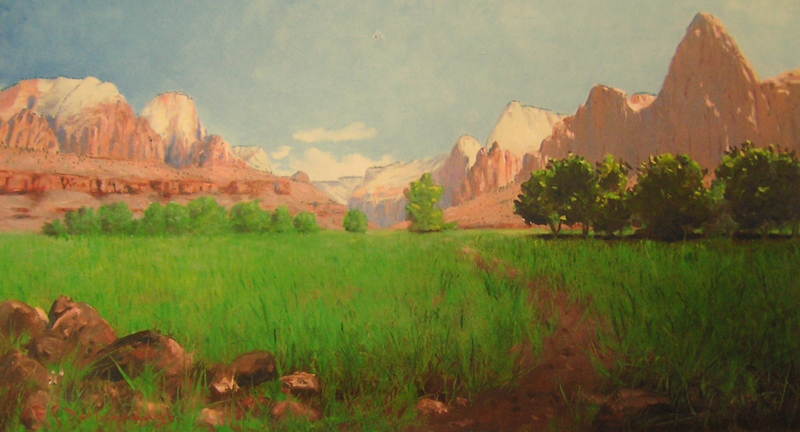
Where are we? Israel? Canada? No, North American Zion!
Zion Canyon by Frederick S. Dellenbaugh
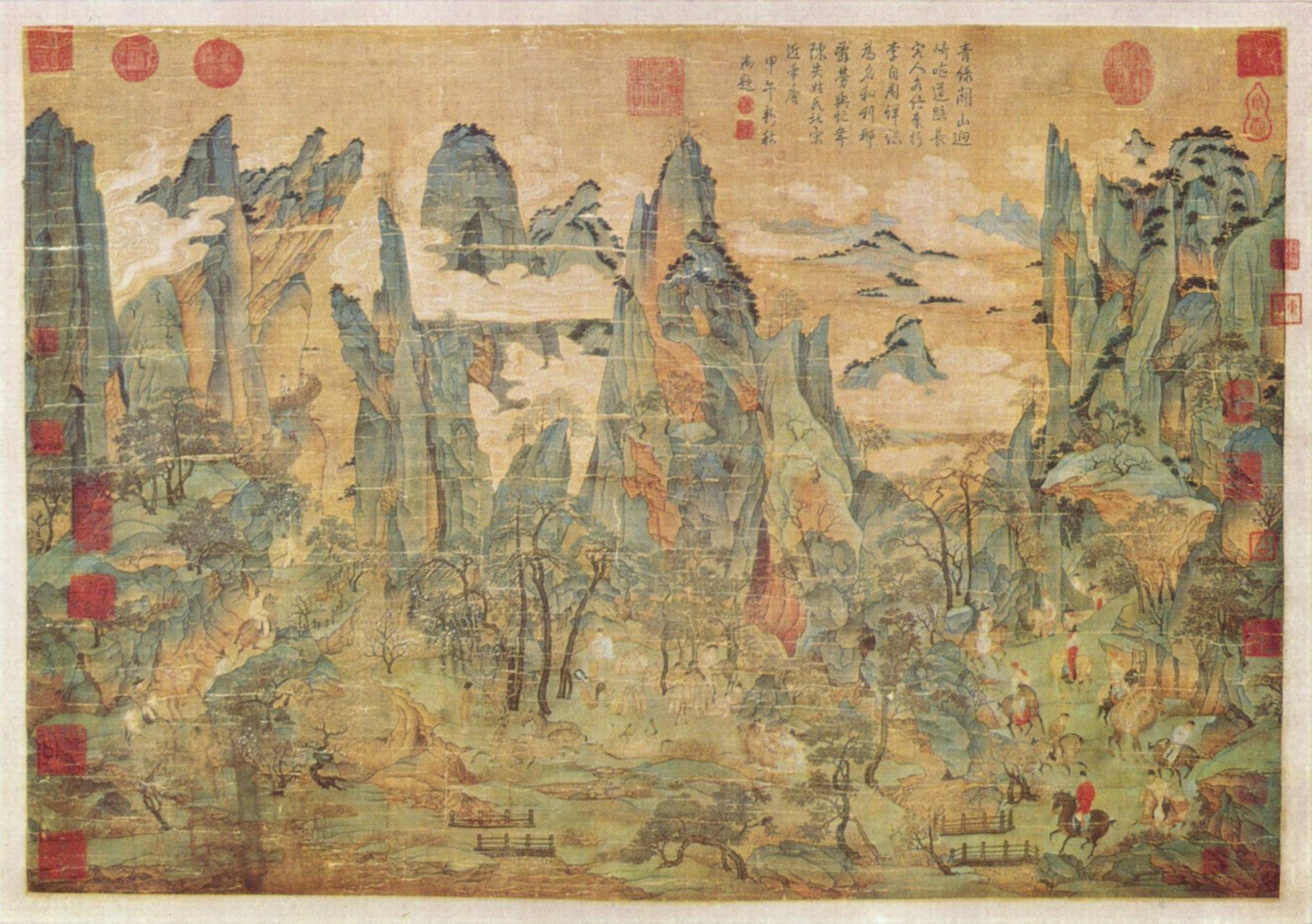
Desolate summer ski hills are lush, verdant with pine undergrowth. Through an open ski lane, gargantuan Canadian flags billow. A park ranger sights us. I escape solo, just barely through a bush thicket. Trailing beside a river’s edge, where I once ogled at two young lovers, the Israeli sky burns with the beautiful bounty of original sin multiplying with infinity at every touch, every sight, sound, smell and every taste of spirit. The racket of espionage flutters in the newspaper wind. I heave a sigh, bitter with unrest.

Fleeing to Sichuan province from Chang'an to escape the violence by Li Chao-tao
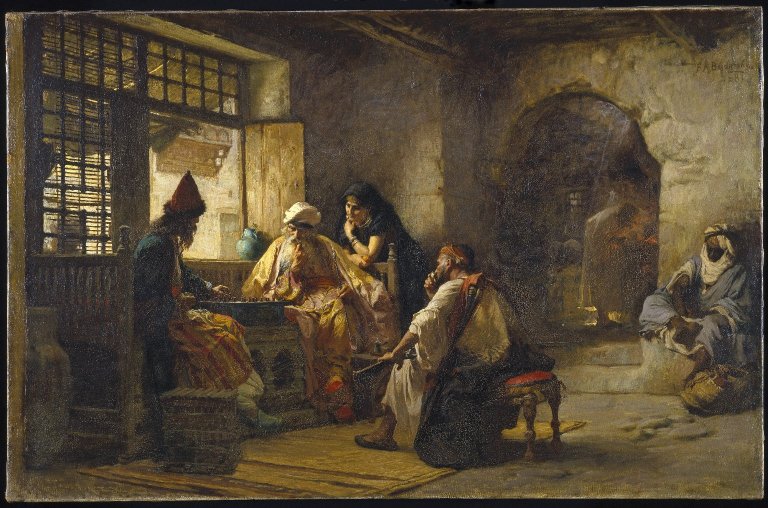
Nightfall, the shattered windows and shades of old Brooklyn stare with criminal rites. Anger seethes from the manhole pores of the upended city. A ruinous dearth of humanity bleeds from my open-strung heart down the spinal chords of a silent song: my jungle cage. Television home blink, flicker, there! The thief, drunk, with rapist eyes eyes mine concrete stone grounded roof possessions. A friend points-blank his rifled arm into our pitch fate. The silence groans with inner loathing, like a brooding cancer unknown, deep in the marrow.

An Interesting Game by Frederick Arthur Bridgman
So, morning, we rise with the tide and board a ship set with haste. A vacant room, splotched with growl, we swung with the churning waves, a smiling rat-spawned day. The worst was over. America far behind, Zion of mind and heart derided in a momentary pause, to reflect on the Old World border of genocidal rampage, the forgotten wick, unlit on this Sabbath morning. Two friends, we disappear within a schizophrenic race. Evening fires glow soft with candlelight.

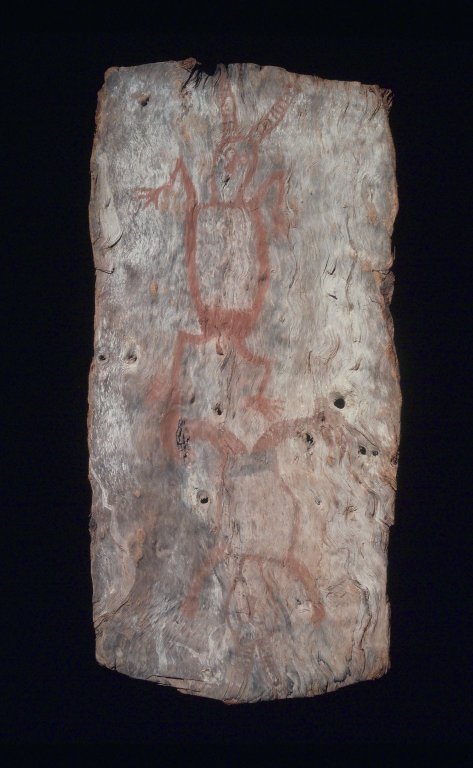
Painting of Dream Figures on Bark by Unknown
Tattooed mistresses, with raised skin, beset with the tribal bond of white scars breathe from lungs rising and falling under the most intricately carved bones. The monarch is absent. Bewildered, the ship sinks like a dead man, flooding as with the inverted pressure of the oceanic ambiance bursting outwards, into the wooden vessel of sleep and need.  
__________
A hyper-ambient, atmospheric guitar & voice elucidation on themes of the variance between the doer and the doing, subject and object, creation and creator. The vocal sounding contemplates the inner nature of human life as the most provident offering back to nature. To learn reciprocity with the entire universe begins by looking within. The word is a gift. "shaped by more hands" refers to the creative act as in step with the dream-notion, going back to Carl Jung, that 'I am not the only one in my house' or that the psyche is full with collective consciousness, that within us is all of us. All things issue through us by way of conscious intent.

In the creative arts, dreaming and waking often cross paths. Is speaking and thinking similar in psychic variance from that of dreaming and waking?This is the question I am posing in the aftermath of the creative process, which led to the track, "shaped by more hands". The question is meant for all to ruminate with thoughtless meditation, through a constant emptying of mind, towards a renewal of deeper intelligence beyond the egotism of intellect and apparent word-logic.


The chapbook, "Seeds and Roots" from the larger collection, Exotic Settlers, contains 9 poems on the theme of cultural metaphors related to heritage, ancestry and the myths and rites of collective human identity. Beginning with simple muses on Jewish cultural roots, I then embellish a transcendence of nostalgia through a regression of biological metaphors.

The root, with all of its instilled metaphors of stability, truly originates from seed. While reminiscent of the old chicken-egg riddle, the seed is a transient holder of sacred inner truth, ultimately leading to a grounded promise of settlement. Yet, in exploring a healthy and holistic mind of settlement, i.e. through the experimental writings found in Exotic Settlers, the more ephemeral or fleeting reality of origination must be kept close at hand. For, in Buddhist terms, the root is the middle way, yet the seed is that ephemerality from which we come and to which we go.

The selected piece for sound art / experimental music works, found on Evocations: Exotic Settlers (menachem.bandcamp.com) is "Shaped By More Hands" which I find to be a blissful rendering of the beauty of Wu Wei, or the Taoist philosophy of non-intervention with the flux of being and mind, where in the allowance of natural flow is the growth of the seed from the root to the flowering seed.


Monday, 1 April 2013

Mythologies of Freedom and Dreaming: Interpretations and Reminiscences


“Human soul, should it dream of me, Let my memory wakened be.
/ Moon, moon, oh do not wane, do not wane, /
Moon, oh moon, do not wane....” lyrics from Dvorak’s Song to the Moon

“There is no freedom, because we die,” said Winston Churchill in a fated passage through the subtle imagination of nighttime visions – speaking as the personification of death itself. He emerged from the grave of innumerable veteran crosses and stars over unmarked graves lining an immaculately manicured grassy hillside in neat rows. The cemetery is reminiscent of the dead bodies once ordered with haunting linearity in the aftermath of the many battlefields fought over in world war.

The realization of human mortality is the psychological maturation of recognizing freedom as a myth. Even in dream there is limitation; the mortal scars of suffering – destructive emotions and negative repressions – continue into the deepest corners of the subtle mind. As in thinking, the natural mode of an animate and intelligent psyche is to comb through the vast interweaving analytic and creative spawns of experience and memory, as they unfold with newfound insights and revelations. Yet, in that process, the evolutionary cycle naturally spurns most content with the greatest psychological defense mechanism of mortality: forgetting. To release, let go or forget the contents of the mind as they build and diminish is part of the natural breathability of discernment that allows every person to function as a rational agent in both human society and in wild nature. Yet, there is intermittently a thought that recurs, as in dream, that reminds us that thought and the more subtle activities of the mind and of human experience are intricately linked to the repetitive urges of necessity in the libido or the gut, for example. When a thought is forgotten, it was meant to pass, and thus facilitate further emptiness, to clean the slate, or empty the glass, so to speak, so that it may become full with the nourishment of more enduring concerns. Yet, when a thought clings, as with the subconscious content of a recurring dream, it is calling out to be transformed through consciousness. There are many modes of transformation through consciousness, i.e. creativity, reflection, speaking, and action.

Similarly, as the facility of the mind to think filters through generative content towards enduring insights through word, sound, emotion, intuition, and image, the content of dream has like potential as an agent of subconscious “thought”. Yet, where thought is often sound-oriented, as the whisper of words, dream, and specifically dream-writing, entices the mind to reflect on what images endure, and why, through their free-associative interpretation. Those images that endure from dream into the memory of consciousness and daily activity are as thoughts that recur and beg further recognition. Both involuntary, subconscious – dream and thought – are inceptions of creativity that arise from instinctual mechanisms that the body has to self-reconciliation. Recognizing and listening to the inner voice that speaks in the image-language of dream and the sonic subtleties of thought through an internalized intellect form a holistic psychological healing likened to the regenerative quality of the physical body to heal itself.

Former child soldier and international rap sensation Emmanuel Jal uses storytelling and music for social-emotional learning. He says that peace is “equality, justice and freedom for all”. His triad of concepts that can lead to peace – equality, justice and freedom – will be the basis for understanding how dream becomes thought, and thought becomes action.

While there is no earthly, or worldly, freedom after a full recognition and confrontation with the mythology of human dreaming, both consciously and subconsciously, there is equality. In Sufi mysticism, it is said that all of creation essentially began from an image. In Hindu cosmology, the Self, or Atman, sat alone, and pondering a sense of cosmic loneliness, split into two. Thus, seeing a reflection of the Self gave birth to the world. In other traditions the first creation was sound, particularly in dominant Western religious tradition, “In the beginning was the word.” In more acute interpretations based on studying original texts and incipient cultural contexts, sound is understood to mean vibration. From this understanding, great wisdom energy emerges from the fabric of all creation, vibrating with the cosmic equality of being essentially of one substance, from one origin, and to one destination. Also, when people become competitive and separatist in worldly affairs, this sense of cosmic equality is lost. For ultimately, an individual is not born of their accord, nor is their lot in life prescribed by them, but they are subject to the cosmic interdependence of the I-Consciousness of All-Unity. Deep equality is seeing that there is beauty and tragedy, form and emptiness, sophistication and simplicity in every instant and every aspect, in every individual and independent form of being.

On a deep level, freedom and equality are absolutes. There is no true freedom, yet ultimately all are equal. Justice is relative. Time and the fabric of relations temper Justice as it is broken and mended by the conscious action of peoples, animals and all forms and modes of being: ocean and acidification, mountain and mine, consumer and resource, victim and perpetrator, predator and prey. Freedom is a dream that never becomes real. Equality is a reality that does not extinguish by dreaming, and also a dream that does not extinguish in reality. Justice is a dream that may, or may not become a reality, unless dreams are made real through conscious action, and then waking realities can potentially become our greatest dream.  
___________
Barroom fade-out, the groveling aspiration of a few young guts feeding on the fermented sting of a foreigner’s every desire. The walls steam and sweat to the touch of human skin, crowds meander and mingle in a scintillating core of the ruthless dance. The beat of bare feet on the wet soil engraves the trammeled heart of the night onto the soles at every step.

Le bar des Martégales, Marseille by Marcel Leprin
Escaped into the washroom, the narrow claustrophobia is deafening, with a seed of empty remorse, I trudge backwards, to scale the heights of misdirection, and a friendly face peers through the swinging doorway, a member of the female race, she glides back dispassionately. I wade through swinging bodies back to a table, where my friends eye my every movement with a gentle regard for the creative word, emanating like sunlight from my chest like a cross-legged aesthetic seeing visions of outer space. I am warmed, basking in tongues of like entanglement. A live hip-hop act floods the ceiling with the reverberations of bass and rhyme.

Fuge in Rot by Paul Klee
Next morning, the cemetery air is thick with warning. Veteran markers stretch 3,000 deep down a coursing hill, steep with shadow and disbelief. The anger mounts like an unchallenged breeze on the face of the beloved. And I starve for words of remembrance and the final end to the deep finishing hate that swarms and seethes in our bones like the lost blood of too many young men and women. We are guided along by the preeminent Allied emissaries of WWII; Roosevelt, Patton, Eisenhower all emerge from the ground of the lain, and lastly Churchill.

The Cemetery, Etaples, 1919 by Sir John Lavery
Rising from a grave bed, the sparse, delicate grass wakes with air at his emergence. Churchill guides a small tour through the narrow passage between the blinding dizzy-spell of white crosses. After reading the bare bones epitaph of one fallen, slain by the brutal, forsaken. We can almost hear the utter ignorance of speed, metal and waste. Scanning over a generic war axiom, he says with spitting disdain, “There is no freedom on this earth, because we die, because we are mortal, freedom is a dream within a dream.”

The Hat of Freedom by Herman van der Mijn
Freedom is a tear in the cry of eternity.
___________

The mangrove is a peculiar tree, featured most recently in Ang Lee's Life of Pi, the man-eating vegetable is an interesting folkloric attribution to the reciprocity found in nature. "Sour Mangrove" is a piece that uses two types of percussion, doumbek and frame drums together with digitized xaphoon with an atmospheric ethereum of shakuhachi.

This instrumentation breathes with the three minute narrative, an experimental movement that gives voice and embodiment to the numbness of apathy and dogma that drives humanity to unprecedented elevations of ignorance with regard to the environment. With the reduction in the rhythmic pace at the very middle of the track, there is a slight turnaround, where natural objects are at least recognized, yet by the end, there is mere allusion to voice as performance, reduced to mere agency in the creation of an all-consuming, and ultimately cheap contrivance: the public.

The mangrove, a gorgeous and exemplary form of environmental wonder in its sheer aesthetic beauty, and its symbiosis with the ocean (and especial trait that modern humanity lacks) is simplistically reduced to an act of consumption as a disagreeable taste, sour.


This chapbook is comprised of thirteen selections from Cyclical Wordplay under the subtitle, "Sleep Cycle" as they were all written during meta-conscious states of creative emergence. This chapbook release celebrates the music release of the feature piece, "Sour Mangrove" on my bandcamp site, where I upload experimental sound art and different forms of narrative readings. "Jailed Desire" and "Sour Mangrove" were published in "ditch, poetry that matters" on April 24, 2012.

Monday, 19 November 2012

Dream, or Intoxication: Nietzsche and the Tradition of the Master Singers

The Ravens (For a poem of Nietzsche) by Margaret Hofheinz-Doring
"...dream and of intoxication, physiological phenomena between which we can observe an opposition corresponding to the one between the Apollonian and the Dionysian. According to the idea of Lucretius, the marvellous divine shapes first stepped out before the mind of man in a dream.* It was in a dream that the great artist saw the delightful anatomy of superhuman existence, and the Greek poet, questioned about the secrets of poetic creativity, would have also recalled his dreams and given an explanation similar to the one Hans Sachs provides in Die Meistersinger.*

My friend, that is precisely the poet’s work—
To figure out his dreams, mark them down.
Believe me, the truest illusion of mankind
Is revealed to him in dreams:
All poetic art and poeticizing
Is nothing but interpreting true dreams.

The beautiful appearance of the world of dreams, in whose creation each man is a complete artist, is the precondition of all plastic art, and also, in fact, as we shall see, an important part of poetry."

Nietzsche, Birth of Tragedy (e-text)

One night I had been tirelessly searching for this very stanza by Hans Sachs, however I'm unable to read German so my stalwart online efforts proved futile. After glossing over Nietzsche's "Birth of Tragedy" a few times within the body of other texts on mythology, psychology, dream and poetry, I have now found a predecessor to Nietzsche, Hans Sachs, embedded in his monumental philosophical work. This is one of my favourite tracts of literature, and yet I've still to read it in its entirety. I continue to draw from this work the kind of lucid understanding of our inner being as it has moved and developed since the first pages of history unto time immemorial. Such an exhibition of prime thought beckons one's mind, as a lure into the opaque night of isolation and longing, yet when nostalgia dissipates the true character of one alone breathes the kind of truth that is our universal whole, a cosmic constancy of holism, triumphant in its lasting mystery. 
_________
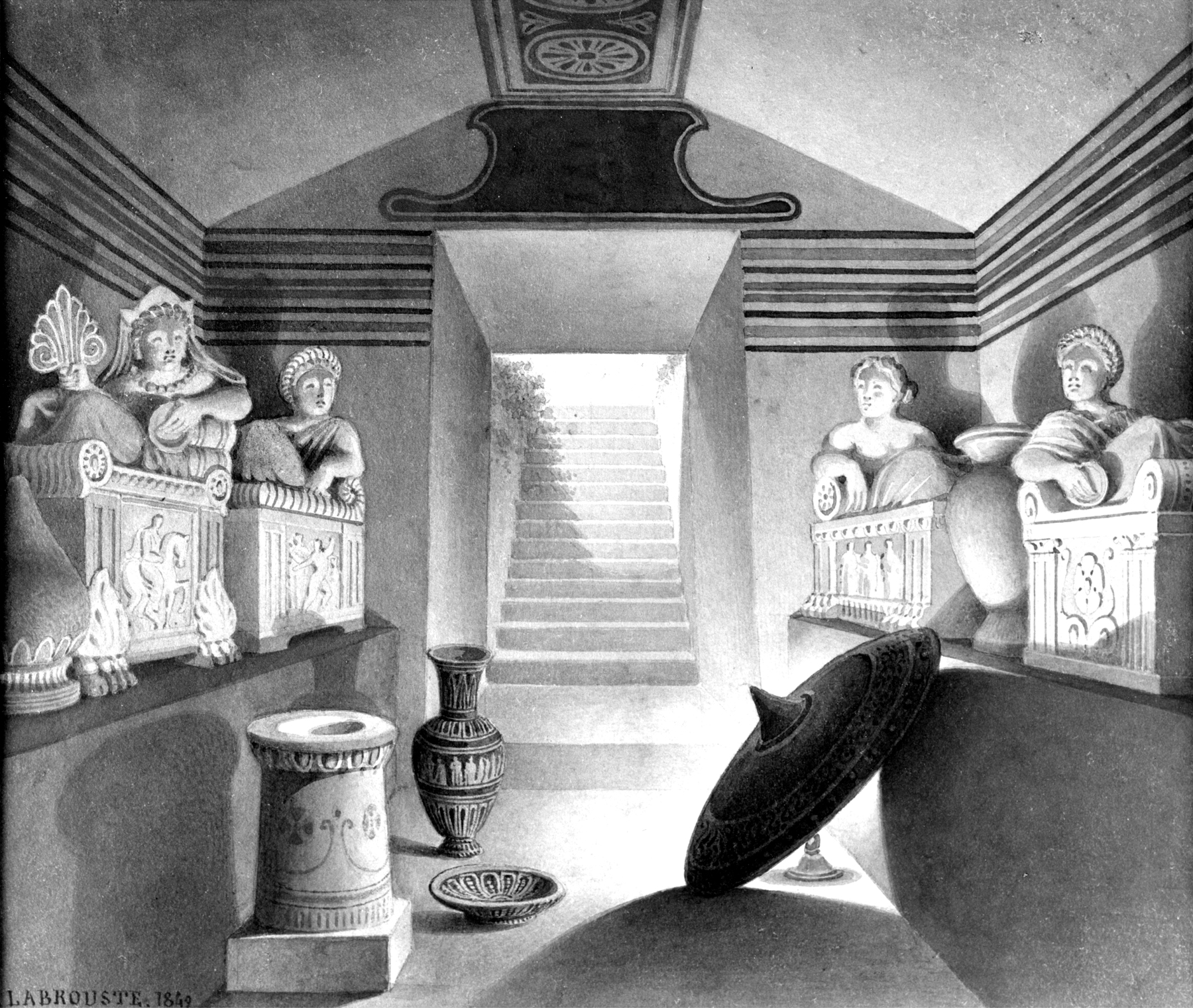
The air, invisibly opaque, opaque in its emptiness, invisible in its bodiless humor, I gaze through the sheathed firmament, a room, a body, jacketed in the empty dark. Forcing my eyes to move, I see a slight pitch in the cruel nothingness, a fleck of something in a bruised vacuum of light. Where am I? 

View of an Etruscan Tomb by Henri Labrouste
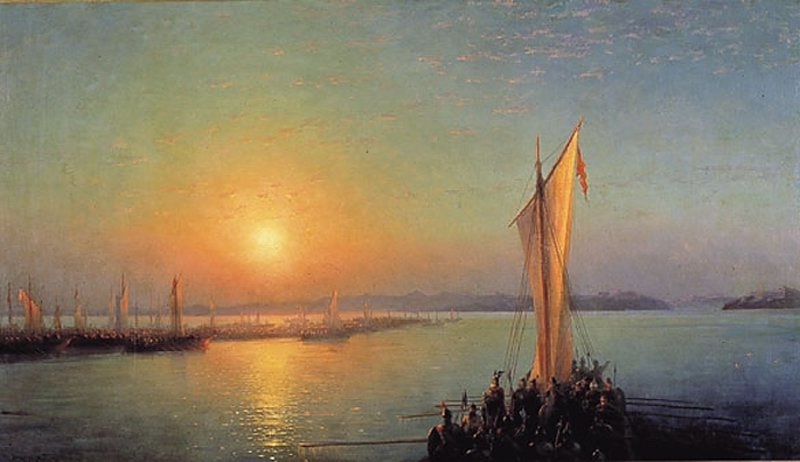
I am upraised, I am raised above ground, on a bunk, on an old bunk of childhood longing, bedside window staring, the endless bunk of isolated raised up childhood. On my head, a Viking helmet… It’s sheer weight, it’s ridiculous… My arms flail under a body weighed by the lowering ceiling, and a head crowned with a horned and vast slate of crudely nailed metal. 

Viking Saga: The path of the Vikings to the Greeks by Айвазовский И.К.
And as I look up, the ceiling, lowering, eyes me back with a staring mushroom, with an elongated stem, a fungal growth, upside-down, to stare at me with its sexual head of strange and auspicious gloom, a vivid flight of the hallucinating noesis, the natural misplaced in a mind-born hell of undone pain, to sleep and writhe, in a landless bed of the upright bunk, swollen helmeted head. 

Winter by Giuseppe Arcimboldo
And at once, I toss the disfiguring crown over the edge! It dings off the edge of a television perched on a dresser, and the reverberation is near-unending, an unnatural sound emits, and sends my unconscious flesh storming at the gate. 
_________
One proud, unseemly yet everlasting hoary wind
Escaping into the breathless fold of a storm-brought love
Escalating above the tumult of grounded trees
Lowered to rest in the silent play of her touch
With Mother Nature in lust at the American shoulder-sculpted God

President of inveterate honor
Failing to maintain true gaze
Into the outpouring blind Persian mystic call

Excerpt from "Untrained Timeless Tuning" [featured on Poydras Review]


Thursday, 15 November 2012

The Wordless Dream Language of Myth

Chinese Goddess Nuwa by Unknown
"Until we get to dreams, there is a tendency to think of stories as 'words.' In dreams we experience stories as structures and patterns that evoke images and experiences, often without words...In dealing with dreams, such noted authorities as James Hillman have instructed us to "hold the image."By 'Holding the image,' the conscious mind can begin to discern patterns and structures that can eventually reveal rich psychic content...Some have said that, 'Myths are cultural dreams.'" Ontogenic Mythotypes by G. Charles Andersen

What is the relationship between language and dream? Dream is a language in and of itself. Language is mutable to Dream Language, when traditional dream interpretation is foregone, and creative writing is utilized as a means to "hold the image" in the mind of James Hillman. Such psychological import brings to mind the psychoactive artistry of Laurence Caruana and others who have respected the imagination as a prehuman remnant of archaic information. "The world is made of language" says Terence McKenna. And so, in using that language, we may hear our mythic vocation, a calling towards that which we had never dreamed, unearthed as from the unsaid and unconscious mysteries of our own psychic invention. 
__________
What a breath of fresh air! To drink, and see. I could feel my brother’s weeping, his heart caving in his shaking flesh as he triumphed again over a nervous breakdown, carrying him by air through the over-privileged dome of Western skies. And into the darkened haunt of old coast bumhood, and the numbing agents of a musical life amid the New England smile of selfish mockery and divulging swine. The ruthless remark, a self intensified in the bitter alcoholic night, the cobblestone streets, swept of hurricane feet and tires of his once-sickened flight returning.

Lombard Landscape by Fulvia Bisi
At home, lost to the time of his forgetting, he returns, an old man in his distant youth. The tingling respite of belonging in the gutters of Eastern fame, the ruinous gold of a mind enslaved to eternal seeking, he clambered down tumbling steps of creaking wood and linoleum brains, as I stared immobilized into the dark porch silhouette. A large man sat there, with dreadlocks lower than his back, and as he lifted an ember of smoke to his lips, his dark skin shone with the muscular life of a physical laborer on break, alone, a nameless body of the historic present.

Man with a Hoe by Jean-Francois Millet
I could only see him clearly under the bar lighting. The dizzying indoor lunacy of the drinker’s habit, a hovel of bored and roughened life spoke through his bristling mouth. After the rare silence of a few pints, he ended the night with means to see each other again. And like that, he disappeared in the great fog of blackness, opaque as the light-polluted air of a once booming industrial city, now smoking upward with the final ashen gasp of smoky incineration. 
__________
“What grievous horror betook these dumb streets?”

Touched with the unkindness of a meek following
From the near elderly, an old town deemed to inquietude
...
Taking off the English hat of a long gone America
Seeing no one in the mist fired laugh from this war

Breathing ocean
Suffocated by the calm before the storm
...
Clucking behind the chicken wire of suburban fate
...
Gripping for death at the edge of the western, manifest

As nature’s law thrives in disbelief

excerpts from "Calm before the Storm"

Wednesday, 7 November 2012

Tristan and Isolde: A Meeting of Musician-Lovers


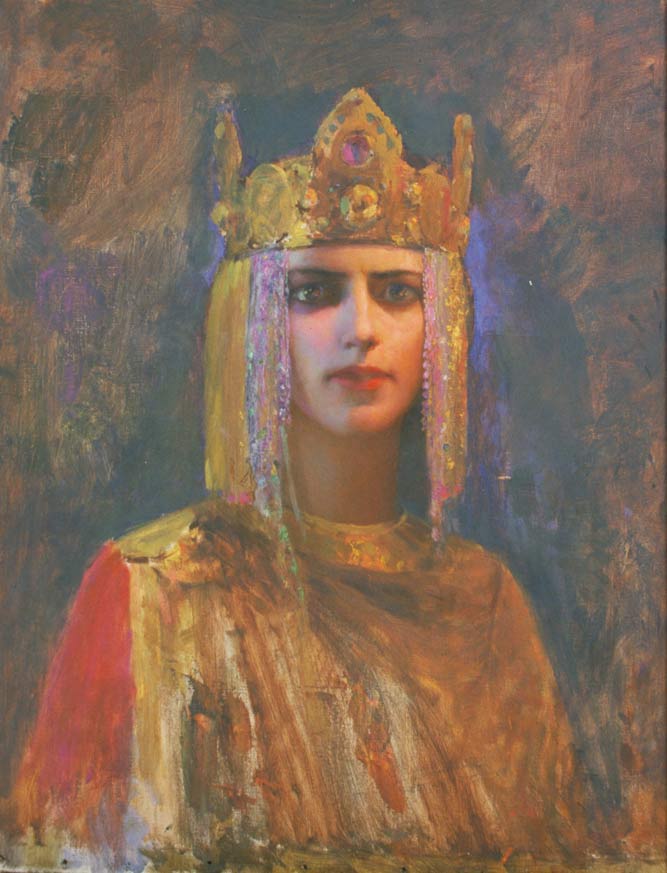
Yseult la blonde by Gaston Bussiere
Isolde

"...Half dreaming melt into the elements,
When they seem most alive and beautiful :
To fade into the purple of the west."

Brangaena

"...Bad dreams are said to augur opposites,
And bring us joys in weeds of sorrow draped."
Tristan and Isolde: A Tragedy. Louis K. Anspacher. Brentano. NY. (1904). Act II

I first became aware of the special importance of the Tristan and Isolde legend reading Joseph Campbell. The first known literary attribution to the tale is by Gottfried von Strassburg. The incredible mark that this story has made on Western civilization and truly world history is based on the central theme in the tale: Love. It is love, outside of Christian wedlock, which motivates the principal characters towards dissolution. For the first time in history, the cast of collectivism imposed over individuality was broken by a spell of love. Suddenly, the individual appeared at the fore of socio-cultural continuity for the first time and proclaimed an as yet unknown impact on the founding institution of social cohesion. Not only did love surmount the apex of all human relationship, the creative life, which sparks and endures love, became attainable, enabling the sacrificial character of a new individuality of self-knowledge and self-development in the art of life on Earth. 

See my previous post: From Genius Mind to Genius Heart: Wagner, Liszt and Dream's End
_________
a strong wind blows, and night falls, penetratingly raw, I pick up my face and screw it to the side of a cabin, changing my ways before the all-consuming blush of my red wife, gently winnowing my insides into the decadence of a youthful love story, she is my only one, and we decide to attend a party, by invitation to perform music, she is diligent in her work

Female Musician by Unknown
and in this response, a mystery hangs breathless with the unprofessional glint of our new friend’s weakened sigh, and stammering over the frozen concrete mold of a battering casino avenue, the wading head of sky simmers in an uncooked pit of flesh as we enter a home riddled with the divorce of youth from the useable head, dark rooms of sexual witnessing, of strange rumors, and fatherless groans, cruel mothers bedecked with the sorrow of an empty need

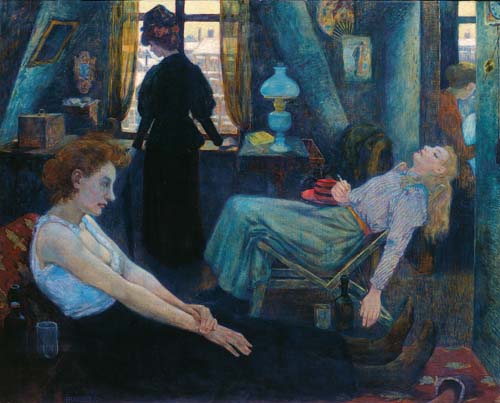
Monday Morning by Hans Baluschek
old children sit silently staring at a naked couple, motionless and bearing nothing but their side skin in two separate rooms of frightening disarray, and back in the foreground, the entrance hall, two young men sport a frantic jam session with homemade instrumentation, wood and stone chopped in a dizzying fray of wires and bone, strung together for a wish-fulfilled greed of rhythmic sounding, which stuns and climbs atop the phantom noose of age with momentous fleeting tones

The Savoyard by Alfred Jacob Miller
in that moment, the hostess of our strange inkling of a human party hands us a small envelope, and in it a card, reading the names of my wife and I, and best wishes in our move to new york city
_______ 
A space for listening, to cleanse the air with sacred voice,
An incensed feeling,
Touching on lost beauty within and under the strongly pressed clothing
Worn like skin that drops sadly over her neck of virulent sorrow
As a shapeless feature in the energy of her following
...
Passing through a foreign box
Crafted with a tongue for sensuous musical fruition,
To meld in the sorrow and aftermath of prehistoric eyes
Dreaming around the enshrined doorway
Through our billions in pain


Monday, 16 July 2012

Borges On Volcanic Riddles of the Unconscious


“The great English writer and dreamer Thomas de Quincey, wrote in some of the thousands of pages of his 14 volumes wrote that to discover a new problem was quite as important as discovering the solution of an old one. But I cannot even offer you that. I can only offer you time-honored perplexities.”

“And in our less beautiful mythology we speak of the subliminal self, of the subconscious, of course those words are rather uncouth when we compared them with the muses or with the Holy Ghost, but still we have to put up with the mythology of our time.”

- Borges, from his 1967-8 lectures "The Riddle of Poetry"
_________
An acquaintance, an intellectual from Latin America sends me an email bursting at the seams of the twenty-five megabyte limit. The prolific backlog of written research, charts, graphs and maps is stunning. He has proved, through simple correspondence, a scenario for the turn of the tide, an epochal shift in the geological age of the planet. The continents will roll, as on a dial, between the ocean currents. Coastal lands will be subsumed one on side by the leeching magma, on the other by tidal waves with enormity enough to swallow entire cities in a heartbeat’s notice. During this time, mythical beasts make themselves known, many from the below, many from above.

The Edge of Doom by Samuel Colman
The swirling aftermath of an ocean-swept city follows us upwards toward the mountain peaks. The shifting plates boom and gush, spitting fire and ash into the sunless sky, raining in metals and the boiling fury of an endless toxic night. We are protected by a subterranean demi-god, hidden to our waking eyes in the days of light. The simian beast grapples a crushing hammer, defeating a swimming ape three times his size emerging from the opaque, deathly soup of ocean water below. The battle is, to our human eyes, a goliath sight, many proportions beyond our own. Greedily, fear seizes as a last hope in the will to life. The blasting mountaintop seethes with equal force as the rising waters. 
________
Volcano
"To see a volcano in you dreams, signifies that you will be in violent disputes, which threaten your reputation as a fair dealing and honest citizen...Volcanic eruptions in dreams usually represent our erupting emotions. Feelings that you may be harbouring during the day might take the form of a volcanic eruption in a dream state. The unconscious psyche might be releasing positive or negative feelings in a safety of a dream (e.g. strong sexual feelings, passion, anger, rage, and fear). Superstition-based dream interpretations say that pouring lava is a warning about poor health. Dreaming about a volcano means the dreamer is in danger of losing a close friendship if she is not honest with that person." (iDream)
________
...
a planetary dissolution,
wavering on the edge,
deemed a wanderer,
stolen soul,
dreamer in artistic wonderland,
or violent binge-seeking parasite,
working miracles inside a silenced freedom,
without home, or conceived place
guiding mundane goals,
roaming vagrant, or seer,
yet still unripe,
recently fallen
from knowledge,
into wish, luck, intuition, and the all ecstatic
passion,
bellowing "good and evil are through"
impaled by the one breath,
strange yet true
...
throughout the known universe,
into the home of a single man,
living atop a mountain,
dreaming in the orbital spawn,
a satellite, the globe itself,
winding round, predictably,
to the course of light,
ending with beginning and finding us along the way
on the way,
all along

- excerpts from "Divorce & Diaspora

Tuesday, 10 July 2012

Woolf, Submerged In Idleness


Christiaan Tonnis - Virginia Woolf (1998)

It is in our idleness, in our dreams, that the submerged truth sometimes comes to the top.
- Virginia Woolf (Source)

Idleness is the parent of all psychology
- Friedrich Wilhelm Nietzsche (Source

"The statements of every religion, of many poets, and so on, are statements about the inner mythological process which is a necessity because Man is not complete if he is not conscious of that aspect of things." C.G. Jung from "Matter of Heart" (Part 8)
_______
A friend from Central African Republic invites me to follow him as he runs through the jungle, practicing for a race. I watch him tread the waking ground, a delicate step, and light footprints on the unsteady ground. A narrow tunnel opens through the thick upturned ground and low-lying canopy. An old, very tall Caucasian man runs alongside, in exercise clothes, drenched in sweat. The sun boils the moisture, even through the dense layers of African rainforest. He races on, continuing without me, full of life and vigor. Later, we both sit at a cheap restaurant. The city around us is gray and bitter. A host of flies mocks our enjoyment with pointed annoyance. The man from the C.A.R. is grounded, with a strong smile, though uncomfortable in the restaurant for foreigners. I walk home after, alone, through the sickly grass aside a highway. My building lies ahead, embedded in patchwork concrete, almost unlivable, weak with age.
______
Race
"To dream that you are in a race, foretells that others will aspire to the things you are working to possess...Dreaming that you are in a race signifies that others are envious of your achievements and want what you have...Running in your dreams may also symbolize the energy levels, the strength, or the force that you have to get through life." (iDream)
______
as moment's inspiration passes,
across from me, an embodiment,
that is love.

dreaming in seeds 
( ,,,***... )
browned, cooked nights,
leading my eyes into the unwavering boundless beyond,
outside our balcony

...

raised with ephemeral delight,
a turning of the road commences,
our path clarifies as it dims to an other,
though faring bold, with an immense laughter,
a humbling draws one in,
to the other

- excerpts from "silent trust"