Primarily a writing exercise, this dream journal-inspired blog is a quiet introspective sojourn into the process that we traverse in going from private dream to public art. I see our dreaming as an internalized mythmaking. As I philosophize and expressively exhibit dreams, both private and public, I encourage and delight in creative language as a way to practice experiential metaphors through a “public dreaming." Writing Theory: Creative Dream Fiction
Showing posts with label chapbook. Show all posts

Monday, 18 November 2013

Novel Liberation: The Humble Postcolonial Wisdom of E.M. Forster


"If I have had any influence, I would be very glad if it induced people to enjoy this wonderful world into which we're born, and of course to help others to enjoy it too."

“We must be willing to let go of the life we have planned, so as to have the life that is waiting for us.”

“They too entered the world of dreams- that world in which a third of each man's life is spent, and which is thought by some pessimists to be a premonition of eternity.”

E.M. Forster (the last quote is from A Passage to India)

The British Raj and the Indian Independence movement of the 1920s provide the setting for a poignant story between two principal characters in E.M. Forster’s 1924 novel, A Passage to India. The lives of Aziz, a Muslim doctor and Mrs. Moore, an older Englishwoman, represent themes of social constraint, in contrast with personal relationship. Constrained by title and culture, these characters manage to relate under unique circumstances. Aziz learns to respect Mrs. Moore unlike any Englishwoman he has ever known, while Mrs. Moore is, at first, captivated with the pride of knowing an endearing local closely.

Mrs. Moore, as with Miss Quested, is captivated by Aziz because he represents something of the “real India”, to use the words of Miss Quested. “Try seeing Indians” was the reply of the schoolmaster at the Government College, when Miss Quested asked how one might see their colony in its native authenticity. There is always room for remiss under the social umbrella of Indian-English relations; whether in the surprising first encounter between Mrs. Moore and Dr. Aziz in the mosque, or the arranged party at the tennis lawns, the tea gathering at Fielding’s or the excursion to the Marabar Caves, which, finally, proved more disastrous than any one had expected.

“May I know your name?” Aziz asks to Mrs. Moore, cautiously, in the mosque. His demeanor is one of near-desperation, as someone both protecting his native sphere, as well as struggling to see British humanity. “She was now in the shadow of the gateway, so that he could not see her face, but she saw his, and she said with a change of voice, ‘Mrs. Moore.’” This very revealing sentence emphasizes the obscurity of English presence from local, Indian eyes. In that moment, Mrs. Moore felt safe enough to share her name, the most important object of her title and superiority. Aziz remembers her generosity, as her fitful capacity to speak the truth becomes the apex of her story, truly a minor character in A Passage to India.

When after Dr. Aziz stands on trial for the assault of Miss Quested in the Marabar Caves, Mrs. Moore is decidedly frank in her stance on Aziz’s innocence. “Of course he is innocent,” says Mrs. Moore as Miss Quested begins to question her disillusioned experience on the excursion, all the while Mrs. Moore is quite fed up with India entirely. “She was by no means the dear old lady outsiders supposed, and India had brought her into the open…” writes Forster, who depicts her as a typical elder, uninhibited by the dramas of youth, and quick to speak the truth, even if it is unwanted. At this point, Mrs. Moore is on her way out of India, and the novel, where she soon dies in transit.

Regardless, Mrs. Moore is immortalized by the groundswell of Indian support for Aziz, who soon finds reprieve, as legends of “Esmiss Esmoor” soon manifest in the appearance of folk shrines in dedication to Mrs. Moore’s role in saving Aziz’s life. It is important to add that throughout the entire novel, Aziz is addressed by his first name only, while Mrs. Moore solely by her surname. Mrs. Moore’s name transforms when said by Indian voices. “It was revolting to hear his mother travestied into Esmiss Esmoor, a Hindu goddess,” thought Ronny, Mrs. Moore’s son, whose experience of India remained superficial, or, more accurately, guarded, throughout

Aziz and Mrs. Moore fail to truly connect in person, because English colonial formalities (and informalities) were too firmly laid beneath the foundations of imperial culture. During a scene of characteristic tension between the colonial masters and their subjects, Forster writes, “Aziz flamboyant, was patronizing Mrs. Moore.” The direct interactions between Aziz and Mrs. Moore are brief and sparse, as they are interceded by English formalities, typically mediation by a male authority – Mr. Fielding in this example. The scene, where Aziz and Mrs. Moore meet in more conventional circumstances, for a tea gathering at Mr. Fielding’s, reveals Aziz’s character (and Forster’s impeccable prose) as someone unable to speak on behalf of India. The scene also reveals the seemingly adventurous minds of Miss Quested and Mrs. Moore, on their search for the “real India” as a mere surface-level novelty.

Mrs. Moore, although agreeing to accompany Miss Quested on her excursion into the “real India” is soon overcome with the fundamental truth of her presence in the faraway land. As the excursion comes to a bitter close, it is said of Mrs. Moore, “…since her faintness in the cave she was sunk in apathy and cynicism. The wonderful India of her opening weeks, with its cool nights and acceptable hints of infinity, had vanished." While, from Aziz’s perspective, “…he agreed that all Englishwomen are haughty and venal.” Mrs. Moore is the stereotypical colonial British woman, whose curiosities for the rare and exotic life of India prove ineffectual to satisfy her experience of authentic India.

Their relationship reveals the meaning of liberation in colonial India, where Aziz’s fate becomes Mrs. Moore’s very undoing from India. For Aziz, he would come to know “…that an Englishwoman's word would always outweigh his own.” Generally, both characters speak well of each other, even if their personal, physical interactions are constrained. Conclusively, such is the larger relationship between the colonial British with India; ideal and positive on paper and second-hand experience, yet up close, absolutely ruinous.

This essay, entitled, "The Relative Liberation of India", was written for an acquaintance as part of his school curriculum. Consequently, I was reintroduced into the magnificent literary treasure troves of E.M. Forster's richly imaginative prose. 
_________
An expanse over the marshland floodplain. The drifting current sways gently through sap-lined pine trunks and decomposed maple leaves. Ahead, the riverbanks motion with unspeakable gratitude, bittersweet, enjoined to the drunk swell of an upraised wetlands. 
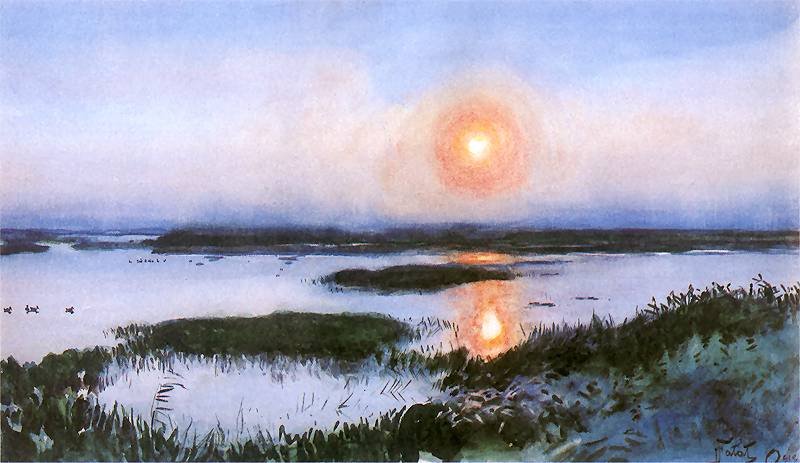
Sunset over wetlands by Julian Falat
He speaks, a guide of the ancient St. Lawrence river basin, to reinvigorate the ground with the renewing tides of Mother Earth. She beckons the swallowing of a forgotten landscape. The land is to be reclaimed. Indigenous nationhood reinstated over the American-Canadian divide. 
_________
Featuring a lyrical evocation from the collection, Sketches of Style and chapbook, Muse for the Wounded, Guise of the Beloved expresses thematic tides of visceral belonging amid landscapes both supernatural and inhuman in an age when the human body is more and more experienced only in its violent rending apart.

Yet, musical undertones, both electronic as acoustic, ring clear throughout, simultaneously presenting the source of human life, as our fate. In the commotion of bewildering psychic momentum, there the muse stands patient and waiting to receive the wounded, who with eyes of intoxication and skin of vulnerability, senses a way beyond and through the immense and spectacular Fear of Being.


The six poem chapbook, Muse for the Wounded, is comprised of selections from the larger collection, Sketches of Style. Here, the archetype of the wounded healer is redefined, wherein the muse becomes the healer in the mind of the poet-seer. The one poem, Guise of the Beloved is also featured as a sounding the artful designs of a musical elaboration on the Sketches of Style album

Monday, 11 November 2013

Fear, Incorporated: The Transformative Theatrics of Living


"Never ever forget that you are the future of this country…You mustn't be frightened of life, it's a very exciting life because you can make your dreams come true" Pieter-Dirk Uys, from the documentary Darling! The Pieter-Dirk Uys Story

“In the end it will be up to audiences each time in the event because they will determine the stories,” says Diamond. “My hope is that we have the courage, in a way, not to look at how to change that thing out there, but how to change ourselves.”

That self-reflexive and socially conscious attitude has defined the theatre company right from its humble beginnings in Vancouver in 1981, and it continues to exemplify creative leadership around the most sensitive topics in contemporary public debate. Diamond’s first prominent role in the company, as associate director of the 1982 production Right to Fight, addressed affordable housing. Later, Diamond wrote The Enemy Within, which satirized B.C. politics in 1986. Two years later, he had his directorial debut for the company with one of its Power Plays, which use theatre games and exercises to explore social issues and create community-specific theatre.

Corporations in Our Heads is one of Diamond’s more experimental works in his effort to reach out to community through art. Based on the work of Brazilian theatre visionary Augusto Boal, creator of Theatre for the Oppressed, Diamond’s new work is an original interpretation of Boal’s Cops in the Head, but takes an entirely different approach. “The rules of the Theatre of the Oppressed, I’ve thrown them right out the window,” says Diamond.

The production asks Calgary residents to reflect on, share, act on and change the dominant messages that influence society . “The reason to do the thing for me is there’s a lot of good work happening out there on how the messages of corporations affect our consuming,” says Diamond. “But I don’t think we’re doing a lot of talking about how those messages affect our own images, not just of ourselves but of our relationships with each other. And it’s at the relationship level, in fact, that our consuming originates.

Corporations in Our Heads will be facilitated by (or “joked by,” as Theatre for Living puts it) Diamond himself, who incites the audience to participate. “The power of it, for me, is that it really is a democratic thing,” he says. “While we are framing the general subject matter, Corporations in Our Heads, the actual content really is going to be determined by the people who enter the room that night. And nobody — not me, not the sponsoring groups, nobody — is going to be able to predetermine the content.”

This article, titled, New theatre work examines corporate psychology, continues where it was originally published on November 7 in Fast Forward Weekly. The piece is a continuity on the theme presented by Pieter-Dirk Uys and his arts activism in South Africa, as David Diamond represents a similar following in social consciousness and public engagement in Canada.
__________
Chinatown Delight
_________
Following the trend of the album, Sketches of Style, this sounding is an amalgamation of three instrumental improvisations harmonized and syncopated together with a synthetic rhythm. The beat creeps in, reminding the listener of the abstract organ that touches on soul, as the reeded music blends with darbuka.

Originally published in a comic, the poem that led to the musical expression of the same title, "find Inspiration!" first appeared in Maad Sheep, an illustrated print publication of cartoon and literature that I once found while sitting in an open-air cafe. The issue in which my piece was featured was displayed at a Comic Convention in Canada.

Lyrically, the piece is a foray into the bitter savagery that cooks the great mass of minds; all who are saturated by the consumptive bread of modern life. The challenge of simply being creative in confrontation with the overwhelming burst and pop mirrorscape of infinite self-deception is the subject and of this sketch of style.

The rest of the chapbook is a fourteen page collection of poetry on the subject of gaining respect and appreciation for the superhuman qualities of nature, as more than grandiose, and more than human intellect and possession could ever capture or convey. Many are observational, and drawn from insights into the ground of being as the naked soul of humanity.

Monday, 9 September 2013

The Woman Behind The Dream: Chopin and the Timeless Tuning


“Because perhaps to my misery, I already have my perfect one whom I have without saying a word, served faithfully for a year now. Of whom I dream and in whose memory the adagio of my concerto has been written.” Chopin, The Women Behind the Music

In the memory of such early genius as Chopin, our cultural continuity glorifies bygone eras with a creative resurgence only known to Western opulence. And looking out from the window of one's own, the sparks of desire light. At first, softly, the Earth burns. Then, the air plumes in a haze of smoke. The bonfire of magic absolves the moon of its light, and the stars become mere smoky display. Inside, and from underneath, the imagination fires the kindling of co-unity with the mind.
___________
And in such as a bout of unspent night, where slumber is deep and each morning fresh, I woke into dream. The longing test of emotive fire, the blinding seed of passion instilled. To work, and to find solace in worldly accomplishment deceived! The wakeful night spun an inglorious frost, a loosened hold on the sunless firmament. 


The Night with the Genii of Study and Love by Pedro Américo
A summit revealed the greatest of depths as the wounded sky bled rain and ice, brewing over the darkening clouds. We traversed impossible concave stone, sharp as a split mirror, the ice moved our flesh towards the brink. In a vivid flash, I saw memory itself, bear unto the apex of Earth. The stars crowned the lonely top as we gazed into our battered arms with hands of ice and stone. 


Storm in the Mountains by Albert Bierstadt
From the greatest of heights, the shadow of a man fell to die. Scattered in the colourless flush of snow, the piercing rock dashed all hope. Still, with chests full of heart, we climbed on and to the frozen prison. Alone, I emptied my eyes and climbed the last step. The day sped past in a hearse, as a vision of unity stung my heart with its sole truth: alone with the Alone. 
____________
To close the album, "Evocations: district.Columbia" the track, "Untrained Timeless Tuning" consists of improvisations on piano (keyboard) and xaphoon (bamboo sax). The age-old American sound of piano and woodwind hearkens to the unique sonic fusion that is completely unique and characteristic of the country. Especially in the use of a certain type of improvisation, the classic sounds evince an internal discovery of not only the human soul, but the soul of the land known to Americans as home.

In such a time as today, when war after war knocks at our doorstep, we can be reminded of the cultural heritage that more prominently identifies us as a unified people: music, the one common language of humanity. So, the sound is masked with electronic innovation into the 21st century, where the piano sound is a controller, and the woodwind is a recent invention. The first xaphoon was made only forty years ago on the island of Hawaii.

Further, the title, "Untrained Timeless Tuning" speaks to that harmony that is basic to all regardless of class, education, ethnicity or religious identification. There is a way to shared harmony, and it emerges through a music untrained by the classism and privilege of modern higher education. Whether speech, or instrumentation, the music that is untrained, while in tune with the essence of human life as pain, raw and blunt, is the very timelessness that high art seeks to capture. That timelessness is bred in every interaction and exchange whether within or between us always.

When we speak of Re-Writing our STORY, as in the chapbook wherein this piece is written, this very realization is the voice that carries our experience to such wonderful stretches of the imagination; present and transformational. So, the traditional keyboard and woodwind sound is transformed into an electronic movement of triumph in contemporary sound creativity.  


The following six-poem chapbook, Re-Writing our STORY, is the final series of works from the district.Columbia collection. The pieces reflect the penultimate phase of true revolution as a spiritual transformation of one's narrative. That is, one re-imagines their perspective through a revolutionary act of storytelling. This kind of storytelling reflects personal truths, daily experiences and common points of view with regard to the larger narratives and mythologies that consume unknowing minds through belief, propaganda and pride. The feature piece, Untrained Timeless Tuning, was published with Poydras Review in August of 2012.

Monday, 19 August 2013

The Artist of Moloch: Creativity and Capitalism in the New West


“Moloch in whom I dream angels...Dreams! adorations! illuminations! religions! the whole boatload of sensitive bullshit!” from Ginsberg’s Howl, Part II

What is it to be an independent in thought and action, to be an artist of heart and mind, and, most radically, to live within one's means in the New West? I live in a city where my next door neighbour makes over a billion dollars a month. I, personally, don't make money. Or, more accurately, my profits are nearly zero. Yet, I live life fully and exuberantly. On a whim I could splurge on an evening of luxury fine dining with my wife, or rent a car and go to the mountains, or even purchase a new musical instrument and the latest computer hardware. I am not in debt. In fact, the one and only stipulation to entering higher education, was that I not get into debt. I save, and live within my means, although I don't exactly see my money growing as the incessant growth models of Western capitalism would encourage. 

Nonetheless, as a city dweller, and especially in the city wherein I live, considered a global oil capital, the mean streets of capitalism are hawk-eyed and omnipotent on every corner. As an artist, the very ground under my feet is funded by the turning soil of the most destructive earthquake in human history known as the fossil fuel industry. Living the majority of the time through physical self-propulsion as a primary means of transportation balances one's perspective as an outsider of marginal and radical import to the status quo. Energy and economy, in their most fundamental and basic meanings, derive from the physique in relation to the sources of life in the ground (energy) and the way of relating to living exchanges through reciprocity and foresight (economy). Happiness is learned when expense is measured in sweat, growth in a smile and dividends in generosity. 

Daily the innocence of play in the mind of art, creativity and community is buried under the debris of an open-pit mine with lightning swift efficiency. Once aware of the mounting genocidal ecocide inherent in the dominant global energy policy, how can one go on knowing that at the end of the day the artists of the world become mere charade, trick and distraction for the bowling force of industrial belligerence? One of the greatest pearls of wisdom that my grandfather shared with me was what he had learned among his Greek family of early immigrants to Lower East Side Manhattan, New York. "We were poor, but we were happy, because we were together," he repeats like a charm against the malevolent truth of Western life: family separates. So, often, I feel, as a communitarian-individualist independent-ecologist artist-worker radical-traditionalist of the 21st century and of eternity, that my life is the epitome of what Ginsberg describes above, as in Moloch, and dreaming of angels. 

In the next weeks, I will be transitioning the SoJourn(al) site as a supplement to a new web-source exhibiting an ongoing creative non-fiction work that gives breath and voice to original knowledge. Oral storytelling, family tradition, and cultural literacy are waves of realization that have revealed a sliver of moonlight over the oil-dark sea. I see a way, and directed by intuition, the art of living further breathes a channel of oceanic action towards as yet unseen, inner prosperity. Philo of Alexandria, an ancient who fused Jewish and Greek philosophy at the beginning of the first millennium of the common era, is quoted: "Households, cities, countries, and nations have enjoyed great happiness when a single individual has taken heed of the Good and Beautiful. Such people not only liberate themselves; they fill those they meet with a free mind." 
______________

away up
passive aggressive
play waste
science silenced
weary night
______________
The track, "Columbian Map" is derived from the written piece, "Phantom Pages of a Medieval Columbian Map" from the district.Columbia collection of experimental writing. The meaning of the title refers to Columbia, the goddess myth of precolonial America, the ubiquitous feminine divinity of the land itself as seen and heard through Western European eyes. The "Phantom Pages" open an understanding of the land that transcends European representation through the cartographic delusions of "discovery", colonization and settlement.

A narrative art sounding is embedded between guitar and shakuhachi music. The introductory guitar melodies on the track are resonant of Indian Sitar music, yet also merge into influences from West African blues and Middle Eastern Oud playing techniques. The shakuhachi, through its abject dissonance and airy ambience, bridges two instruments from opposite ends of the globe, that through harmony and chaos move the voice to speak, as middle ground, as the remoteness of truth between directional extremes. My approach to the guitar (a quintessential Western instrument) as the embodiment of non-Western sonic influence further melds with my approach to the shakuhachi without any classical training, thus playing it with a Western ear. And so, western instrument with an eastern ear, and eastern instrument with a western ear redirect the two-dimensional cartographic reality of discovery into the 4th dimension of time through sound as narrative, voice and, more, a pure medium of truth.


A collection of five works from the penultimate chapbook from district.Columbia, "Changing our PERSPECTIVE" includes such works as "An Unknown Pleasure of Respect" and "Phantom Pages from a Medieval Columbian Map". With an ahistorical to contemporary thought in light of the current need to shift from an industrial to ecological society, this chapbook addresses that first perspective, or where we stand is the crucial point of change. Perspective, is also history. Until we transcend the dualistic norms of media consumption and direct experience, there is no way to begin again from a new point in history. The junction of the present and the past affix humanity at a crossroads of time. 

Before ascending into the next era of humanity on Earth and traversing the crossroads ahead, each and every last individual will be asked, Who are you and where have you come from? Anishinaabe Elder Dave Courchene wisely advises all people to return to creation, to return to the very beginning of our nature whenever unsure, whenever inundated with a sense of ignorance, confusion, loss. On the path to inner knowledge, light blinds, and the shadows reveal the road home

Monday, 12 August 2013

Nonviolent Dreams of the Mystic Heart: The Sufi Path of Silence


"I have found in every word a certain musical value, a melody in every thought, harmony in every feeling, and I have tried to interpret the same things with clear and simple words to those who used to listen to my music." Hazrat Inayat Khan, The Mysticism of Sound and Music

In the beginning, there was sound, and not only sound - a sound. What was that sound? Was it the sound of one hand clapping? OM? The percussive bang of everything exploding into existence? It was the sound of all sound, the sound from where all originates, the intonation of creation.

In traditional music around the world, percussion precedes music, or more accurately, melody. Percussion is the first sound. From the clacking of bones to the taut skin of the drum, the percussive rhythm announces the beginning of music, and thus art, language and community.

What is the origin of language? Seekers for the origin of language are mystified and further entrenched in mystery by searching through the very device they seek to derive from its source. It is obvious that language originated as sound. It would be only logical to presume that language was derived of music, rhythm and song.

Does music influence language, or more intently, the way we speak and what we say? If music is a prime suspect in the origination of language, then it would not only influence the way we speak and what we say - music will cause us to speak. Yet, speech caused directly by music uses the language of poetry, lament, cries of ecstasy and deep reflection.

Speech caused by music is also self-reflective, sympathetic to the transformative creativity within the subjective life. Imagine, the first sound of the universe - a cry - reverberating throughout time and creation as a lament for the ultimate truth - that beginning ends.

In narrative, beginnings are almost always preceded by an end, giving rise to the potential for beginning anew. Music is a constant affirmation of the cyclic nature of ending and beginning, as sound falls and rises, always with the shadow of silence before, after and throughout. Indeed, great music is often a testament to the musician's play with silence.

Silence teaches of right listening. Music is the result of right listening. Music teaches of right speech. Knowledge is the result of right speech. Knowledge teaches of right action. Enlightenment is the result of right action. Enlightenment teaches of right listening. Silence teaches of right listening. 

In the film, The Way of the Heart, Hazrat Inayat Khan's wisdom is conveyed through his prophecies of music as becoming the future religion of humanity. Inayat Khan taught how all religious and social disputes are founded in the inconsistencies and ambiguities within verbal language. Yet, in music, where profound meaning is clear and immediate, ideas and beliefs are expressed without conflict.  

When speaking is united to the knowledge of music, the silence of listening births a voice of the path. 

Listen to more Dreams of Sufi Music: Mercan Dede
Dream of Shams, Dream of Perhan, Dream of Lover
____________
flightless dragon
memory blast
rash city
silent anger
three ways
urban nature
______________

Created immediately before a Lantern Memorial remembrance for the victims of the bombing of Nagasaki on August 9, the track features a poem published with the University of Texas, El Paso, entitled, "Lugubrious Background Nearing an Electro-Magnetic Haze". The piece, transformed into narrative sound art through the trajectory of experimental music, is essentially about the explosive omnipresence of America juxtaposed with its remoteness. The marginal landscapes of America are the birthplace for one of the the world's greatest questions: atomic energy. The poem, "Lugubrious Background..." begins in the traditional lands of the American Southwest, with its rich history of Original Peoples. That history becomes estranged into small-town marginality by the overwhelming shadow of a towering American presence. Leading finally to the sounds of New York, the sirens of immigration and post-colonial history remove the people further from the true and original history of the land, until, finally, the inside becomes outside, and the electrified modernization of progress displaces connectivity in nature with a sheen of bright lights. The outside has transformed to the inside, and without a way out, people are terminally trapped by misperception and ignorance.

The musical instrumentation on the track, "Lugubrious Background" speaks to another contemporaneous event, namely the 400th year anniversary of the first treaty between Europeans and Native Americans. On the same day as people remembered the bombing of Nagasaki, canoes waded down Hudson River to New York City to meet delegates of the UN to not only celebrate World Indigenous Day, but to remember the beginning of a formal international relationship between Native Americans and European settlers, begun by the Iroquois Confederacy and the Dutch Kingdom. So, the instrumentation on this track, a frame drum (bodhran) and a xaphoon (bamboo sax) speaks to a renewed history of American tradition. The modern frame drumming techniques of North America have spawned an entirely new way of hearing and playing the frame drum. Although using a bodhran, the frame drum is a universal instrument known throughout the Original Traditions of Native Americans across Turtle Island. Similarly, the xaphoon is likened to a refreshed jazz tradition, wherefrom Hawaii a new saxophone was invented only thirty years ago. The sound of the fame drum with a bamboo sax conjures American sentiments from the historical age beyond the contemporary into the imagination of a future where co-existence revives cultural tradition.


The title of the following chapbook, "Truth our Up-Pressing" is a call to evince our oppressive actions, and speak our truth in a humble way. Either through poetry or prose, the human voice is a powerful agent of active creativity in the spirit of life, survival and freedom. "Truth" is here used as a verb, a kind of call to transform our forms of oppression that we often feel entitled to uphold in the name of family honour, and to dismiss that, and in turn, change our language. Therefore, I use "Up-Pressing" instead of "Oppressing" to say go from seeing our oppression as being a burden on others to seeing our oppression as a burden on ourselves. The oppressed oppresses, the oppressive are oppressed. In truth, all are both oppressor and oppressed, and until each and every last human being realizes this, there is no freedom for anyone.


Monday, 5 August 2013

How to Listen to the Land: Raincoast Music and the Eye's Awakening


"Right now is the time when we wake up and start paying attention to what we are actually doing. I've always said we can do whatever we want. The question is what do we want to do. And we need a new definition of progress, you know, toward listening to scientists, and toward elegance and beauty. And so we have to get our philosophy right. What way do we want to go forward? And we need a critical mass of people who care deeply in their hearts about nature." Robert Bateman, Canadian artist from the B.C. coast sponsored by Raincoast Conservation Foundation for an Oil-Free Coast

This past weekend, I headed a block over from my apartment to grab my usual afternoon matcha. As I swung my head around to grab a coffee cup lid, my line of sight was crowded with the most peculiar, and at once familiar, beauty. Frame drums, doumbeks, and instruments of all kind, beautifully hand-crafted in the likelihood of natural aesthetics. The clouds of a waking dream parted as I stepped forward to shake the hand of the drum-maker himself. 

From Vancouver Island, Sylvan Temple Drums boasts specially crafted hand-made local woods just south of the Great Bear Rainforest. At first meeting, the key to my city's grandest music festival was gifted, unceremoniously, and with the sincerity of a true friendship. Before purchasing an absolutely gorgeous alder doumbek, I became privy to the music of such as Alabama Shakes, Thievery Corporation, Cat Empire, Caravan Palace, The Harpoonist and the Axe Murderer, Mamselle, Haram, and on. It was a splendid weekend. The gift of music breathed new life, and as through the wood of our country, the sound reverberated with untouchable magic into my heart and marrow. 

Such as luck would have, the serendipitous vibe of the exchange revealed the marked truth of reciprocity in nature. Human beings are mere messengers, and vessels of light and wisdom, others more naked and bright than the rest. They who are naked and bright are merely known as generous to us more gross souls. And so, in a parable of ancient China, correlative meaning ensues. 

Source: Galen Mongeau
After receiving the great gift, not as from divinity, but from the hands of a fellow man. I was moved to wonder on the spiritual nature of the harvest. In such a world as where the sense of harvest has breached sustainability to egregious excess in exploiting the natural resources of the land, where is the sane harvester of life's great gifts of creation? And from the musical instrument of the trees sings a tale of the potent harmony embedded within the forest, within the land. The land is imbued with the music of life, with the instruments of soul, art and meaning. 

When will we honour right harvesting, as in those who are traditional users of the land since time immemorial, not mere environmentalists, but as local harvesters who depend on the land for their livelihood? Whether it is in the food or the materials, in opening a doorway to family, community and inner fulfillment, our vocation, role and fulfillment is in the land, offering all a place, as a truly honest way of making each our own living. Might we see the hidden inner nature of the Earth as not only our source of physical life, but as our source of grounding and flight, as our source of reciprocal creativity, the inertia of magic and play as the source of harmony itself, as a way to growth, promise, and all our relations?

Learn More about Pipelines:


And the People Protecting Future Generations:
KEEPERS OF THE ATHABASCA

Also, read my Comment on Geist.com on the Energy&Art debates
__________________ 
A pipeline twice the size of a whale. A gargantuan opening, closing the way through into an opaque, unholy void. The brackish filth of water moves as on its own under our quaking boots. And the spill seeps into the metallic soil below. The Earth shrieks, yet her voice is muted under a dense, resin helmet. Deafened by fortunes of squandered wealth, the murderous cold frays the nerves with blinding speed, and then, all there is to do is work.

Interior of an Ironworks by Godfrey Sykes 
"Give 'em yr bucket." Our manager removes our defecation pails, to be filled with drinking water for the next hour. The only change of the guards is vomit and an empty stomach. Coffee, whisky and blood. The grisly, noxious sky burns with the weight of an Earth turning on its side, looking out through grey eyes, a globular iris of naked waste. The entombed sky wretches as the darkening muck churns and writhes like a cold snake. What was once soil and groundwater, turned to the tar and feathers of the shamed petro-state of Canada.

Cottonopolis by Edward Goodall 
The pipe gargles and spews rasping smoke, as if it were a choking throat, attempting a last word before immobile onlookers. The brevity of life and death makes us motion-sick. There is a sea of greed, corruption and ignorance below these decks of metal and bone. The quiet break the loudest. And at once, as the gushing oil explodes with a merciless fire from the side of frozen metal, men are trapped behind the void. Wading in the flush of a liquid worse than sewage, the brain nauseates, overwhelmed with the job of planetary death.
______________

In celebration of the filters of raw earth into breathable air. The track "America! America!" is inspired by the forestal creation of a hand-crafted alder doumbek from Vancouver Island, at the cusp of the Great Bear Rainforest, a place that also signifies a cusp of human civilization. So, the sound of the wooden drum, of the local land, is played in conjunction with a Maple Shakuhachi (also indicative of the local country's national tree).


The doumbek and flute seek a passage, of wind and earth, into the waters of being and becoming, towards a sense of grounding (drum) and direction (flute). The vocalization/narrative sounding muses on the exhausting reactionary sense of progress that ensues in the modern world, where people continue to consume and waste, yet there is a lack of listening, and a lack of sheer creation.

The calamity of today is not one of natural resources, it is our state of mind, and as the musical instruments of the natural world teach us, there is much to learn from the shapes and sounds within. As Chuang Tzu said, "What happened was my own collected thought encountered the hidden potential in the wood. From this live encounter came the work that you ascribe to the spirit."


This nine-poem chapbook speaks to the deformed nature of land under the warped perception of consumerist greed and a wholesale corruption of value in life, and unsurprisingly human life. The interludes speak to a frenetic base of experience in the fragmented world of manufactured waste and devastated landscapes that have become the norm, closing our minds and eyes from the truths and repercussions of our noxious way of life.

Through poetry, I affirm and re-encounter all my relations through a sense of the inner community. Creative language inspires an inward journeying to find the root and nature of mind. The place where our whole selves may firmly take root in the most fertile of soil, in the home of universal belonging, and so give back and become one with the self-regulating, self-sustained renewability of life in harmony with all of creation.


Monday, 17 June 2013

The Poetics of Resistance: Myths of India and Freedom


"Let us arm every song with dreams, in the time of war..." written by Kabir Kala Manch, in support of all artists silenced by imprisonment, poverty and ignorance in India and throughout the World

"Watch carefully,
Poetry burns quickly
Spreading like a forest fire.
Watch more carefully,
Poetry can stir people..."

excerpt from Telugu resistance poet, Varavara Rao, written while in solitary confinement in Secunderabad Jail 1985-89 - republished in Towards a New Dawn

Poetic practice, as a creative tradition in the life of a poet, opens the doorway to perennial creativity through which one may pass towards great, unseen and yet mysteriously innate gifts of passion and truth, gifts of fulfillment and love. SoJourn(al) is truly and essentially about one affirmation, that it is RIGHT to dream and that Dreaming is a Universal Right of not only humans, but of all beings. In the technocratic & plutocratic society of demonic habitual tendencies, towards the mechanization of action, thought and identity, the human qualities of patience, wisdom and devotion are best revealed in the outrageously uncommercial activity of pure poetic invention. Yet, as in the base & fleshly example of sleep, still the metaphor endures, let sleep sleep & dream dream! 

Become dream while the dream is dreamt & known & felt & seen & causing one to rise with the memory of desire & unrest, that the earthly facade of waking is insufficient to fulfill the ecstasy of creative imagination and the waning birth of intuitive creativity, instinctual and whole. Living & ecological self-awareness is the birthright of each human being, as a holistic affirmation attuned to the entire life of all creation, and including all of Earth, in one breath, where especially clear today, as in the interconnected & interdependent worldly techno-communing of peoples globally careers through timeless instantaneity. 

So, each and every life is equally without circumference as with omnipotent centre, as it has been throughout time. In the archaic sphere of psychic knowledge accessed through inborn trust and the sacred flesh of entheogenic presence, all are to be encouraged and passed through the body of the dreamer. Eyeless and seen through self-enacted visions of trust in the inward journeying of mind as matter, experience is simply the wave-form space of sensation in the subtle & internal creative nature of all manifest and unmanifest. The dreamer embraces the nameless mystery of sound & light in its pure & transcendent non-duality of formless emptiness, still forming the pathless direction of each individual stepping on self-made ground. In Algonquin, Sakahàn, to light a fire. 

Continue reading SoJourn(al) for an upcoming article with Unsettling America on the work of Japanese-Samoan artist Shigeyuki Kihara, currently showing artwork at the National Gallery of Canada's "Sakahàn: International Indigenous Art" exhibition, "Fa'aFafine: In a Manner of a Woman" co-written by the Dream Author with Vi An Diep, who shares perspectives on immigrant narratives in relation to indigenous art, theatre-music composition and notes on life as lived by a wildly independent, self-sustaining and vibrant artist of sound, art and love. 
__________

Emerging from the subterranean byways and thoroughfares of New York, City of Time and Sleepless Courage, Island of All That Is on the shores of America’s worldwide seduction and misplaced trust. The earth howls with tramcars funneling like the charnel trains that veer off and into the silent womb of industry. I walk, heavy with longing, through the unsteady street-side core.

Bird's Eye View of New York City and Environs by John Bachmann
A tidy man notices my ponderous walk, and gifts advice. “To the cafes and hearts,” he moans, irascible with derelict gravity. So, into the consumption I fade with stories of words, with the blank gush of pages unruffled by eyeing hands that stop and see. Yet, the nonplussed wires of change dissipate in the hammered trespass of independence and freedom. I, artist of days and nights spent afraid of death, linger in wallowing holes of unmentionable fortuity as the stares of reason and being break open the head of belonging.

Portrait of artist Karnakoski by Aalto, Ilmari
I cower, defeated into the dark, abysmal aftermath of slavery. The unwelcoming hordes brush past through fissures of smiles and skeletal eyes that careen past my deepest trench. Wavering in the thinning light, I angle around a bent door. The quality of my flesh sinks and curdles with undiminished emotion, with unparalleled fear. I move my hand to the knob, and it opens to opacity, pitch as the darkest matter of universal night. And in I walk, careful to the point of careless.

Death's Door by William Blake
A soundless and gentle presence invites, lowering my knees to the imprisoned, peopled earth. I move with a silenced throaty pause of recognition. Before me sits an extended family of Cree and Blackfoot Canadian First Nations: a lost band of Indian people. Condemned to an underground home, they offer a homely cup of sweet-grass tea. At first sip, steeped in incredulity, my tongue quakes with repose. I speak. “Thank you, Creator.” They bow, and with an opened palm, reddened and browned by the ruddy dearth of light. An elderly woman offers a gift from the people, her smile and dress more brilliant than the gift of sunlight. She hands a wooden sculpture of an ancient elder, with eagle feathers, bundle and headdress, draped in the glory of the Buffalo.

The Indian in his Solitude by N.C. Wyeth
Emerging again from the subterranean underpass, like waking with the memory of a dream, once so displaced with sorrow, now right with order and mind. I eagerly and joyfully share the vision of a totem, materialized in the palm of my hand as a brilliant sculpture, as a wish-fulfilling boon of the People of the Creator. And above-ground, even in the lush awe of the sun, isolated fragments of individuals and nations bleed with the blood of the First People an ignorance, a deathly drowning from within. The soft, modest and lightweight presence of the wooden holy man is nothing to their clouding eyes, to their opaque suits and flushed skins. I am ignored, and so return, only to find the once-known Native shelter, bare of all humanity.

Cave Painting - Bhimbetika (India) - Jumping Horse by Nikhil2789
Alone, with totem in hand, do I rise again to stand in the midst of such delusional darkness as above-ground, in the sky of a damned and cruel society? The uncivilized wade in the laughter of innocence and fame. All the while, the First Peoples dive deeper into inhuman insanity, into eternal retreat in this night of eternal war, while the paradigms of hate move ashore with quickened pace, and the First Peoples burrow, entrenched ever more in the quicksand fate of a lowly paradox. And the wooden man cries, as my palm rests on the burying earth.  
_________

the forthcoming album "Evocations: district.Columbia" is an experimental narrative sound art exploration into the text of the collection, "district.Columbia" releasing the first single, "New America" to incite the forthcoming album on the inaugural day of Aboriginal Awareness Week in Canada is auspicious and serendipitous in its symbolic import as an album whose narrations were triggered by an inner voice of resistance while in Washington D.C. where I began to dedicate myself to the literary vocation in light of my own personal development in the commission of truth, as in the social justice of 9/11 and Truth and Reconciliation truth commissions addressing political and historical-religious misinformation.

my creative work is in keeping with a lifelong demonstration to voice silenced histories, in honour and recognition of the atrocities committed against first peoples of the land, whose history, while older and more enduring, while land-based and unfathomably rich, is snuffed out by the dominant settler narratives of media and education that continue to ride the oppressive waves of war, colonization and assimilation in the ongoing struggle for american freedom that continues to this day.

"Evocations: district.Columbia" is a sounding directly from the heart, unmediated by the delusional independence of exclusive american identity, for an end to the war on freedom


a narrative of resistance. re-writing the language of american history, to translate the poetics of protest into the harmony of life. here, "New America" is a sound art exploration on the theme of visioning an "exit strategy" in the war for America, in de-institutionalizing and reclaiming the name of the land through the act of breath and proclamation.

using two frame drums (16 & 14 inch diameters) i recall the great conundrum of american life through the sound of modern frame drumming techniques together with a evocation, vocal sounding, on the re-history of colonial ecology into an awareness of self and environment, recognizing, respecting and regarding the singular devastations of american disunity in the wake of 500 years of ongoing struggle.

resistance is often most deeply traversed by artists, creative voices, purified in the air of one new proclamation of independence yet to be heard apparent on the pages of dominant history, and it will not be written, but vocalized, orated, and beaten from the face of a drum.

The chapbook, "Realizing our OBJECTION" is a selection of the first five poems from the larger collection, "district.Columbia". These pieces are reflections on the initial invocation by Percy Bysshe Shelley from Queen Mab, which reads, "For when the power of imparting joy / Is equal to the will, the human soul / Requires no other heaven."

In the context of Realizing our OBJECTION, the meaning is that the artist essentially promulgates the DIY spirit of heartened resistance as the shared co-unity of meaning for all people who identify as "people" and not the maelstrom of mechanized and monetized identities that waver in the brush as the incendiary & violent pages of human history, aflame in the eye of the seer who rewrites self as the self of all kind. "Realizing our OBJECTION" is a critical literary effulgence of a truth, that to be human in today's world is the central coin of resistance art.

Monday, 6 May 2013

Roots of a Grecian Heart: Seeds of Superstition and Truth

"Even in our day there are plenty of soothsayers and sibyls, and many people still believe in dreams and omens. It is no wonder that the ancients did so, too. But we should keep well in mind that while these arts are now despised by educated people and ranked with superstition they were an acknowledged part of Greek religion." Martin P. Nilsson, Greek Popular Religion

"I woke with this marble head in my hands; / It exhausts my elbows and I don't know where to put it down. / It was falling into the dream as I was coming out of the dream. / So our life became one and it will be very difficult for it to separate again." Seferis, Mythistorema

Sunday April 21 is another afternoon, like any other late winter day in Calgary, where sporadic snowfall lights on the sprawling residential landscape. A few blocks from the university in the northwest quarter of the city, one home opens its doors to lovers of Greek culture, ancient and contemporary. A neighbor walks down the road, on her way to the event, to show a bewildered downtown urbanite the way in a dizzying maze of suburbia. Host Karen Gummo greets at the door, a member-at-large of TALES, The Alberta League for the Encouragement of Storytelling.

The house concert event features Jennie Frost, recently selected in August 2012 byStorytellers of Canada / Conteurs du Canadaas an Elder in Canadian storytelling, a prestigious recognition awarded only once a year. She will be recording for the StorySave Project, which honors and preserves the oral storytelling traditions of Canada. Aboriginal, Irish and Canadian heritages are among the many recognized by Story Save storytellers. Frost, a classics scholar, published her first book, “The Courtship of Hippodameia” in 2005. Frost has performed stories for festivals, concerts, conferences, libraries and over one hundred schools in eight provinces and one territory since 1996. A 2-CD set of her workPygmalion and Other Greek Myths was for sale at the event, along with her book.

The event did not begin with storytelling, however, but a taksim, a term and practice borrowed from other Middle-Eastern cultures meaning the improvisatory opening to a song in Greek music. Calgary Greek music band, Rembetika Hipsters were present to provide dynamic energy to the overall muse and meaning of story in the Greek tradition. Having toured much of Canada and Greece, the Rembetika Hipsters have released three successful CDs. The band continues to receive great recognition in Greece, especially for a video recording of their tenth anniversary concert in Calgary, where they played with a nine-piece ensemble. After performing the first song, bouzouki player and vocalist Nick Diochnos told one of his own personal stories, set during his Greek wedding in Athens, where he bought his first bouzouki with extra wedding money.

Rhythm guitarist and singer Allen Baekeland of the Rembetika Hipsters gave historical background and taught the meaning of the Greek band name. In the wake of the most significant and traumatic period in Modern Greek history, the Greco-Turkish War (1919-1922), the Rembetika culture formed. The war, known as the Catastrophe by Greeks, led to the forced expulsion, or “population exchange treaty” of all Greek communities in Turkey, including the notable city of Smyrna. Over one million Greeks in Turkey were forced into exile. As a result, one in five people in Greece were refugees.

With their Turkish-influenced culture, vagrant impoverishment, drug use and outlaw mentality, refugee youth became what in Greek is known as Manges, loosely translated as hipsters. While very popular in the 1920s and 30s, the Rembetika music, likened to American blues, was banned by government authorities. Nick explained that there are two connotations to the word, either it is used between buddies to denote camaraderie, or between parent and child as a means of castigation. Throughout many songs played during the course of the event, Nick would exclaim, “Hey Mange…Opa!”

With a repertoire of over a hundred songs, the Rembetika Hipsters played a diverse selection, not only of Rembetika songs, but also of Greek folk and popular songs. Two songs were especially poignant for their performance, as well as the stories that accompany. Firstly, they sung Sto Perigiali To Krifo, with music by legendary Greek composer Mikis Theodorakis in collaboration with Greek poet, and Nobel laureate, Giorgos Seferis. The work of Theodorakis, spanning from orchestral suites to popular tunes, has also been integral to the revitalization of Rembetika music into post-WWII popularity. Secondly, Ta Pedia Tou Pirea was sung in memory of Melina Mercouri, a Greek actress, singer and political activist, who sung the ode to the beauty of the Greek port town of Pireus in the film, Never on Sunday. The Rembetika Hipsters commented that the port town’s charm is actually a bit more of the rough than the diamond.

Jennie Frost captivated a silent crowd of about twenty keen listeners with stories from the ancient sagas of the Greek pantheon. Storytelling alternated with the music throughout the afternoon. Frost introduced her storytelling modus operandi with a short prefatory anecdote regarding her break from conventional academic interpretations. She gives ancient stories a refreshing new life. During her lively orations, she holds an elegantly crafted wooden cane, in homage to Indigenous traditions of the talking-stick. An elephant sculpture melts into an Ankh-shaped handle, in which are tied innumerable paper-crafted memorabilia from all of the communities she has visited to enlighten through the living tradition of oral storytelling.

With detail enough to craft the most intricate narrative, Frost weaves in and out of character dialogue and illustrates setting with the lithe energy of the overseeing deities she so magically conveys. One of her most memorably enchanting stories drew from Zeus, in relationship with his children, Hermes and Apollo. The visceral imagination of ancient Greek life, as in the story of Apollo’s maturation into his role as the god of music, knowledge and poetry evokes the divine majesty of creative human faculties. Hermes, who ultimately gifts Apollo his lyre in the story, becomes messenger of the gods, evincing respect for the underlying interconnectedness of all great worldly and divine phenomena into a harmonious narrative of familial interrelationships.

Frost told many stories, drawing not only from classical Greece. Her final story revealed a welcome gift for diverse cultural expression. Before reciting a quaint Chinese tale about a half-wit boy named Noodle, who eventually outsmarted the gentry of an ancient city through a spirited affinity to poetic meter, Frost proclaimed to all her enthusiasm for epic storytelling sessions. For Frost, a five-hour long telling passes with sparkling enthusiasm. Nonetheless, Frost finished telling her last line on time to close the three-hour event, leaving all with a smile.

The Calgary cityscape glowed from the picture window behind the musicians and storyteller. The love of storytelling is a common root of social cohesion, yet the traditional arts of oral storytelling are too often ignored with similar cultural dissolution as seen in the disappearance of global language diversity. Storytelling, in the traditional and artistic forms of oration, is not simply a nostalgic reversion to childhood.

The lyrics of Giorgos Seferis speak with god-like insight and metaphoric clarity. Impermanent love, the hasty fool’s rush to consummate young lust, is the subject of his poem Denial, better known as the song, Sto Perigiali To Krifo, sung by the Rembetika Hipsters. In a society dependent on non-renewable life sources, is the consumer resource paradigm of a young nation as Canada not also likened to a parable of the impermanent lust of young love? As Seferis writes in Denial:


On the secret seashore
white like a pigeon
we thirsted at noon;
but the water was brackish.

On the golden sand
we wrote her name;
but the sea-breeze blew
and the writing vanished.

With what spirit, what heart,
what desire and passion
we lived our life: a mistake!
So we changed our life...


Oral storytelling roots people to an inner renewal of life, as innately creative, and in continuity with the most fundamental and longest standing traditions of humanity.

This story has appeared on The Media Co-op and will also appear in the upcoming June issue of TALES (newsletter)
___________
Where are we? Israel? Canada? No, North American Zion!
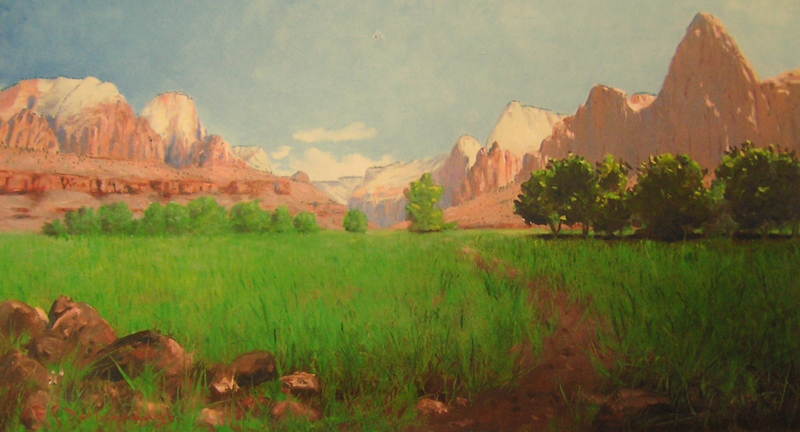
Zion Canyon by Frederick S. Dellenbaugh
Desolate summer ski hills are lush, verdant with pine undergrowth. Through an open ski lane, gargantuan Canadian flags billow. A park ranger sights us. I escape solo, just barely through a bush thicket. Trailing beside a river’s edge, where I once ogled at two young lovers, the Israeli sky burns with the beautiful bounty of original sin multiplying with infinity at every touch, every sight, sound, smell and every taste of spirit. The racket of espionage flutters in the newspaper wind. I heave a sigh, bitter with unrest.

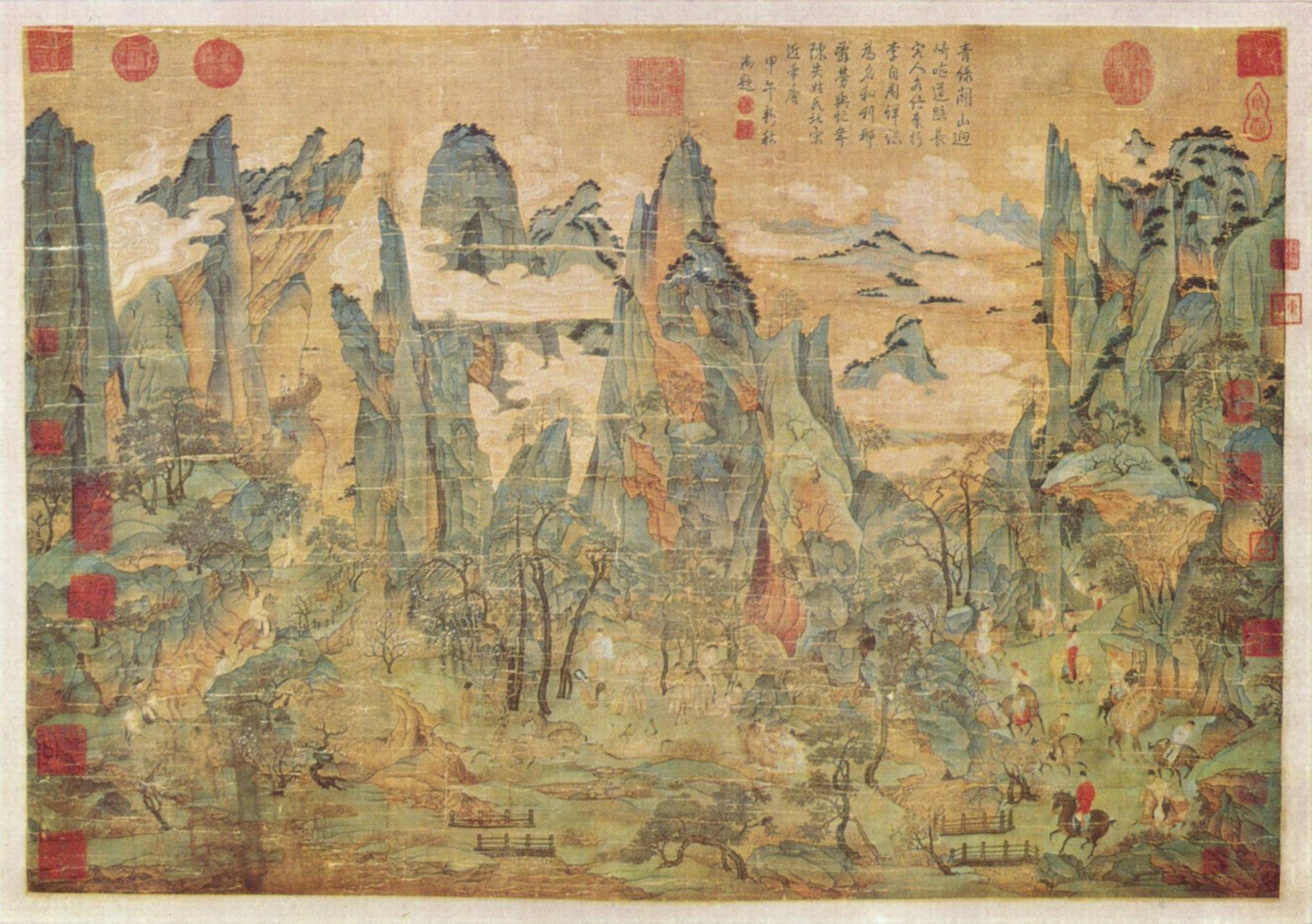
Fleeing to Sichuan province from Chang'an to escape the violence by Li Chao-tao
Nightfall, the shattered windows and shades of old Brooklyn stare with criminal rites. Anger seethes from the manhole pores of the upended city. A ruinous dearth of humanity bleeds from my open-strung heart down the spinal chords of a silent song: my jungle cage. Television home blink, flicker, there! The thief, drunk, with rapist eyes eyes mine concrete stone grounded roof possessions. A friend points-blank his rifled arm into our pitch fate. The silence groans with inner loathing, like a brooding cancer unknown, deep in the marrow.

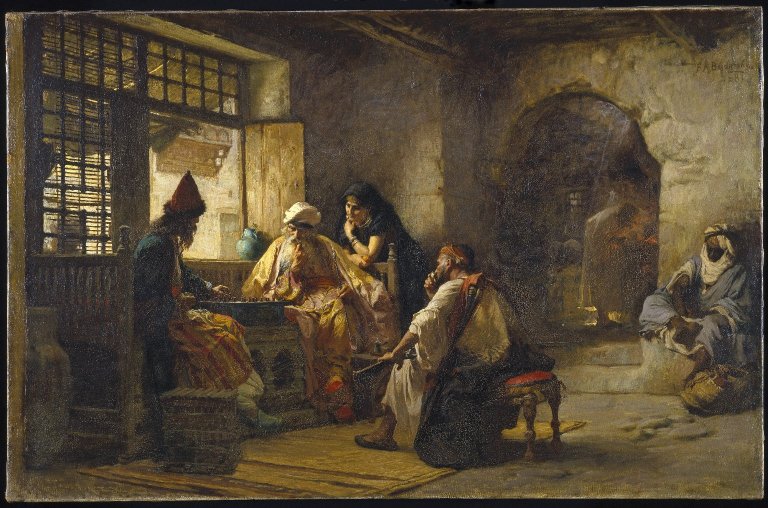
An Interesting Game by Frederick Arthur Bridgman
So, morning, we rise with the tide and board a ship set with haste. A vacant room, splotched with growl, we swung with the churning waves, a smiling rat-spawned day. The worst was over. America far behind, Zion of mind and heart derided in a momentary pause, to reflect on the Old World border of genocidal rampage, the forgotten wick, unlit on this Sabbath morning. Two friends, we disappear within a schizophrenic race. Evening fires glow soft with candlelight.

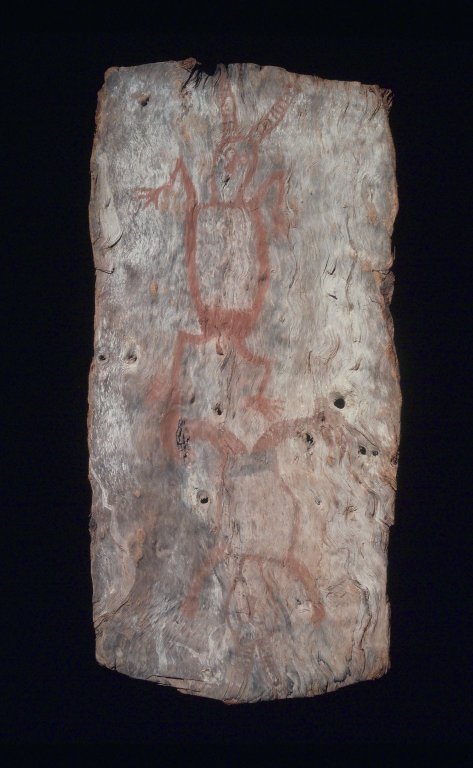
Painting of Dream Figures on Bark by Unknown
Tattooed mistresses, with raised skin, beset with the tribal bond of white scars breathe from lungs rising and falling under the most intricately carved bones. The monarch is absent. Bewildered, the ship sinks like a dead man, flooding as with the inverted pressure of the oceanic ambiance bursting outwards, into the wooden vessel of sleep and need.  
__________
A hyper-ambient, atmospheric guitar & voice elucidation on themes of the variance between the doer and the doing, subject and object, creation and creator. The vocal sounding contemplates the inner nature of human life as the most provident offering back to nature. To learn reciprocity with the entire universe begins by looking within. The word is a gift. "shaped by more hands" refers to the creative act as in step with the dream-notion, going back to Carl Jung, that 'I am not the only one in my house' or that the psyche is full with collective consciousness, that within us is all of us. All things issue through us by way of conscious intent.

In the creative arts, dreaming and waking often cross paths. Is speaking and thinking similar in psychic variance from that of dreaming and waking?This is the question I am posing in the aftermath of the creative process, which led to the track, "shaped by more hands". The question is meant for all to ruminate with thoughtless meditation, through a constant emptying of mind, towards a renewal of deeper intelligence beyond the egotism of intellect and apparent word-logic.


The chapbook, "Seeds and Roots" from the larger collection, Exotic Settlers, contains 9 poems on the theme of cultural metaphors related to heritage, ancestry and the myths and rites of collective human identity. Beginning with simple muses on Jewish cultural roots, I then embellish a transcendence of nostalgia through a regression of biological metaphors.

The root, with all of its instilled metaphors of stability, truly originates from seed. While reminiscent of the old chicken-egg riddle, the seed is a transient holder of sacred inner truth, ultimately leading to a grounded promise of settlement. Yet, in exploring a healthy and holistic mind of settlement, i.e. through the experimental writings found in Exotic Settlers, the more ephemeral or fleeting reality of origination must be kept close at hand. For, in Buddhist terms, the root is the middle way, yet the seed is that ephemerality from which we come and to which we go.

The selected piece for sound art / experimental music works, found on Evocations: Exotic Settlers (menachem.bandcamp.com) is "Shaped By More Hands" which I find to be a blissful rendering of the beauty of Wu Wei, or the Taoist philosophy of non-intervention with the flux of being and mind, where in the allowance of natural flow is the growth of the seed from the root to the flowering seed.