Primarily a writing exercise, this dream journal-inspired blog is a quiet introspective sojourn into the process that we traverse in going from private dream to public art. I see our dreaming as an internalized mythmaking. As I philosophize and expressively exhibit dreams, both private and public, I encourage and delight in creative language as a way to practice experiential metaphors through a “public dreaming." Writing Theory: Creative Dream Fiction
Showing posts with label imagination. Show all posts

Tuesday, 24 December 2013

Anaïs Nin and the Secret Self: From Blindness to the Mountaintop


Henry Miller

In the last few years one sees quite a few either writings about you or quotations from you about dreams and the dream life and I feel that they haven't really understood what you mean about this. I don't think you want people to be living in a dream state while conscious, do you?

Anaïs Nin

No.

HM

But you mean that dream has its uses, its effectiveness in life afterwards.

AN

No, I meant something else, I meant that what we could arrive at a state where what we dream at night would be the blueprint for what we wish to fulfill, or to reach, and if we understand the dream then we know what the secret self is and then this secret self we can fulfill.


Anaïs Nin, whose literary renown is most prolifically exampled in her posthumously published diary writing, is also respected and admired for her role in encouraging and stimulating the work of Henry Miller. Her opening preface to the Tropic of Cancer, Miller's first book, is one of the most incisively written dedications to the literary spirit that I have ever read. Her quotations on dream, are poignant in their truth and magical in their realism, vibrant in their imagination and open in their accessibility. 

Similarly as with Carl Jung, both Nin and Miller drew liberally from interpretations between Western psychoanalysis and the traditional religious learning, thought and practice of Hindu, Buddhist and Taoist cultures. As highly creative minds, who lived richly balanced in heart and mind, stood for a conscientious human being, who through developing thorough self-awareness comes naturally to be a part of compassionate change in the creative universe. 

“Dreams pass into the reality of action. From the actions stems the dream again; and this interdependence produces the highest form of living,” said Nin, in a comment that affirms the dream psychology of Jung, who considered the dream life, or the life of the imagination, of the mind and of creativity as more real, meaning a more direct form, or manifestation, of experience, than the life lived through the senses. Thus, Nin determines, “Dreams are necessary to life.” 

Indeed, Nin would press ever on into conceiving the dream life as integral to meaning, to holism and self-truth. She asserts, “Our life is composed greatly from dreams, from the unconscious, and they must be brought into connection with action. They must be woven together.” Further, one might add that when woven together, the dreamer, as artist-visionary-thinker-writer, becomes the seer, as in the mystic of unmediated experience, of eternal unity in the present, of enlightenment in non-being. 

Eventually, dreams are life, as life is certainly made of dream, and that we are the substance of dream, as the subtle nature of perception, meaning, truth and self-knowing. In reaching the transformation of necessity to becoming, in the paradigm shift of dream action fulfilled in daily living, is for Nin, a miraculous occurrence, likened to the rare and precious goal of enlightenment. She reminds, “The dream was always running ahead of me. To catch up, to live for a moment in unison with it, that was the miracle.”
_________
Night in the forest, like soot and anger, under a flattening sky. I fell from Paradise into History in the moment of a sting, the lunging insect-antennae, electric, lunged into my paranoid flesh. Hooked under the stark and opaque canopy, obscuring starlight into the bitter and directionless flood of need, anxiety and hope. I sprang from the petrified mud to the swaying vegetable maw of a blind quake, a wild charge.

Georges Lacombe, La forêt au sol rouge
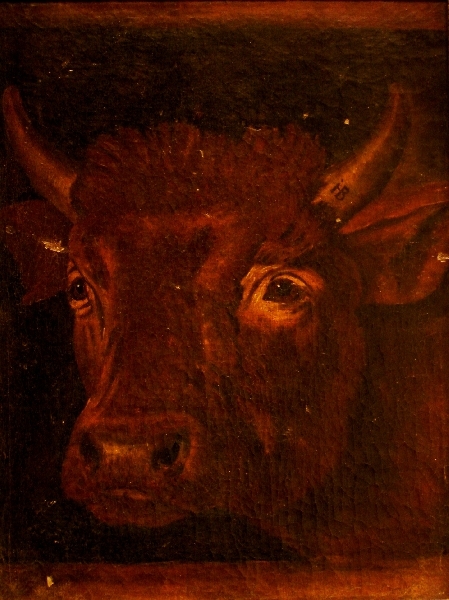
Extinction moved in the sad, ghastly wave of moonlight over frostbitten leaves. Bone-white spears upended my eyes, as I dodged a full-grown bull. Adrenaline-shocked, I sped, scanning the immobile trunks, weighing the Earth down with inhuman strength. And the soil broke in a jarring flash of bestial rage, as another bull, of sturdy, muscular build, spun me around, my heart waning of life.

Bull's head, painting by Johann Heinrich Baumann
I tore through the endless nothing. Then, one bull split my body from the waist up the gut. Marching on my hands, stomping and cracking bone with its merciless strength, adrenaline rushed and spilled out into the open air as I climbed back to my feet, nearly wasted by the crushing jeer. Countless bulls encircled, as I fled, bleeding, the pain yet to reach my brain, grabbing for low-hanging anything, my stomach burning, my feet turning to knee-splitting daggers and brain-flushing mush.

Animals in a Landscape (aka Painting with Bulls) by Franz Marc
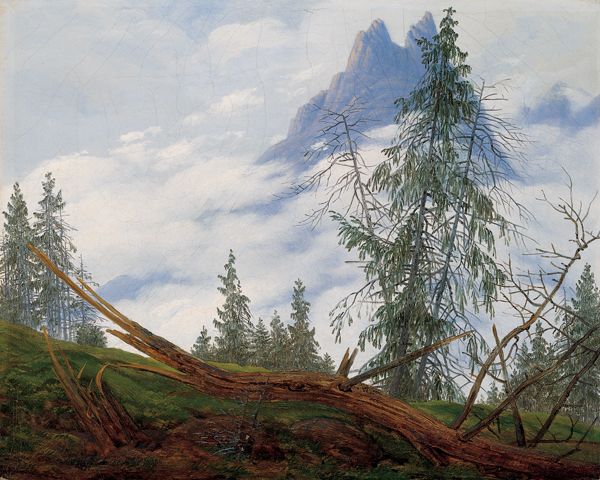
Pit against an escalating fever and white with near-mortalizing blood loss, I fainted under the powerless impression of my death, only steps from the forest edge, still besieged under the sightless underground forest of the human Earth. A single house stood at the edge of a rock face, and I was carried to its door. From a window fogged with subzero condensation, I could make out the moonlit peak, and with every second that my mind ascended, my body shrank with fear, and I gasped for each breath as my last.

Mountain Peak with Drifting Clouds by Caspar David Friedrich
Staring at the summit, and then was enshrouded by cloud-cover, my eyes closed, I stole beyond the body, and time, beyond death and need, beyond blood and truth, beyond the waves of human flesh that rode on this belligerent tidal sway of hope and tragedy, to summit the Everest flight of dream, and survive through this tyrannical flood of mortal reality.
__________

Monday, 18 November 2013

Novel Liberation: The Humble Postcolonial Wisdom of E.M. Forster


"If I have had any influence, I would be very glad if it induced people to enjoy this wonderful world into which we're born, and of course to help others to enjoy it too."

“We must be willing to let go of the life we have planned, so as to have the life that is waiting for us.”

“They too entered the world of dreams- that world in which a third of each man's life is spent, and which is thought by some pessimists to be a premonition of eternity.”

E.M. Forster (the last quote is from A Passage to India)

The British Raj and the Indian Independence movement of the 1920s provide the setting for a poignant story between two principal characters in E.M. Forster’s 1924 novel, A Passage to India. The lives of Aziz, a Muslim doctor and Mrs. Moore, an older Englishwoman, represent themes of social constraint, in contrast with personal relationship. Constrained by title and culture, these characters manage to relate under unique circumstances. Aziz learns to respect Mrs. Moore unlike any Englishwoman he has ever known, while Mrs. Moore is, at first, captivated with the pride of knowing an endearing local closely.

Mrs. Moore, as with Miss Quested, is captivated by Aziz because he represents something of the “real India”, to use the words of Miss Quested. “Try seeing Indians” was the reply of the schoolmaster at the Government College, when Miss Quested asked how one might see their colony in its native authenticity. There is always room for remiss under the social umbrella of Indian-English relations; whether in the surprising first encounter between Mrs. Moore and Dr. Aziz in the mosque, or the arranged party at the tennis lawns, the tea gathering at Fielding’s or the excursion to the Marabar Caves, which, finally, proved more disastrous than any one had expected.

“May I know your name?” Aziz asks to Mrs. Moore, cautiously, in the mosque. His demeanor is one of near-desperation, as someone both protecting his native sphere, as well as struggling to see British humanity. “She was now in the shadow of the gateway, so that he could not see her face, but she saw his, and she said with a change of voice, ‘Mrs. Moore.’” This very revealing sentence emphasizes the obscurity of English presence from local, Indian eyes. In that moment, Mrs. Moore felt safe enough to share her name, the most important object of her title and superiority. Aziz remembers her generosity, as her fitful capacity to speak the truth becomes the apex of her story, truly a minor character in A Passage to India.

When after Dr. Aziz stands on trial for the assault of Miss Quested in the Marabar Caves, Mrs. Moore is decidedly frank in her stance on Aziz’s innocence. “Of course he is innocent,” says Mrs. Moore as Miss Quested begins to question her disillusioned experience on the excursion, all the while Mrs. Moore is quite fed up with India entirely. “She was by no means the dear old lady outsiders supposed, and India had brought her into the open…” writes Forster, who depicts her as a typical elder, uninhibited by the dramas of youth, and quick to speak the truth, even if it is unwanted. At this point, Mrs. Moore is on her way out of India, and the novel, where she soon dies in transit.

Regardless, Mrs. Moore is immortalized by the groundswell of Indian support for Aziz, who soon finds reprieve, as legends of “Esmiss Esmoor” soon manifest in the appearance of folk shrines in dedication to Mrs. Moore’s role in saving Aziz’s life. It is important to add that throughout the entire novel, Aziz is addressed by his first name only, while Mrs. Moore solely by her surname. Mrs. Moore’s name transforms when said by Indian voices. “It was revolting to hear his mother travestied into Esmiss Esmoor, a Hindu goddess,” thought Ronny, Mrs. Moore’s son, whose experience of India remained superficial, or, more accurately, guarded, throughout

Aziz and Mrs. Moore fail to truly connect in person, because English colonial formalities (and informalities) were too firmly laid beneath the foundations of imperial culture. During a scene of characteristic tension between the colonial masters and their subjects, Forster writes, “Aziz flamboyant, was patronizing Mrs. Moore.” The direct interactions between Aziz and Mrs. Moore are brief and sparse, as they are interceded by English formalities, typically mediation by a male authority – Mr. Fielding in this example. The scene, where Aziz and Mrs. Moore meet in more conventional circumstances, for a tea gathering at Mr. Fielding’s, reveals Aziz’s character (and Forster’s impeccable prose) as someone unable to speak on behalf of India. The scene also reveals the seemingly adventurous minds of Miss Quested and Mrs. Moore, on their search for the “real India” as a mere surface-level novelty.

Mrs. Moore, although agreeing to accompany Miss Quested on her excursion into the “real India” is soon overcome with the fundamental truth of her presence in the faraway land. As the excursion comes to a bitter close, it is said of Mrs. Moore, “…since her faintness in the cave she was sunk in apathy and cynicism. The wonderful India of her opening weeks, with its cool nights and acceptable hints of infinity, had vanished." While, from Aziz’s perspective, “…he agreed that all Englishwomen are haughty and venal.” Mrs. Moore is the stereotypical colonial British woman, whose curiosities for the rare and exotic life of India prove ineffectual to satisfy her experience of authentic India.

Their relationship reveals the meaning of liberation in colonial India, where Aziz’s fate becomes Mrs. Moore’s very undoing from India. For Aziz, he would come to know “…that an Englishwoman's word would always outweigh his own.” Generally, both characters speak well of each other, even if their personal, physical interactions are constrained. Conclusively, such is the larger relationship between the colonial British with India; ideal and positive on paper and second-hand experience, yet up close, absolutely ruinous.

This essay, entitled, "The Relative Liberation of India", was written for an acquaintance as part of his school curriculum. Consequently, I was reintroduced into the magnificent literary treasure troves of E.M. Forster's richly imaginative prose. 
_________
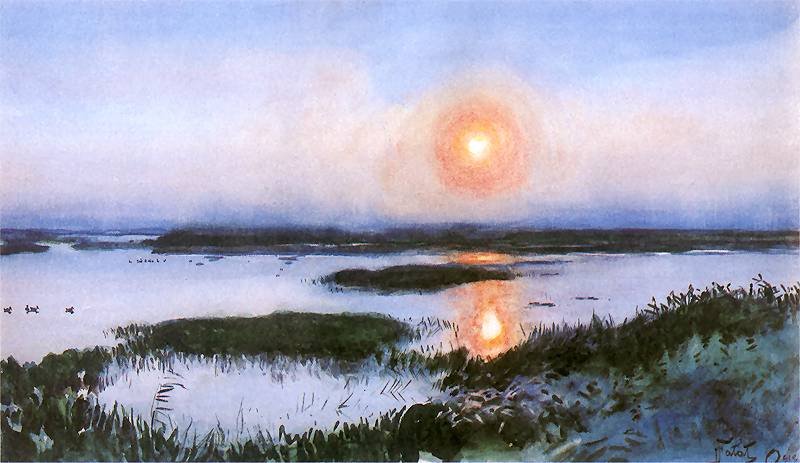
An expanse over the marshland floodplain. The drifting current sways gently through sap-lined pine trunks and decomposed maple leaves. Ahead, the riverbanks motion with unspeakable gratitude, bittersweet, enjoined to the drunk swell of an upraised wetlands. 

Sunset over wetlands by Julian Falat
He speaks, a guide of the ancient St. Lawrence river basin, to reinvigorate the ground with the renewing tides of Mother Earth. She beckons the swallowing of a forgotten landscape. The land is to be reclaimed. Indigenous nationhood reinstated over the American-Canadian divide. 
_________
Featuring a lyrical evocation from the collection, Sketches of Style and chapbook, Muse for the Wounded, Guise of the Beloved expresses thematic tides of visceral belonging amid landscapes both supernatural and inhuman in an age when the human body is more and more experienced only in its violent rending apart.

Yet, musical undertones, both electronic as acoustic, ring clear throughout, simultaneously presenting the source of human life, as our fate. In the commotion of bewildering psychic momentum, there the muse stands patient and waiting to receive the wounded, who with eyes of intoxication and skin of vulnerability, senses a way beyond and through the immense and spectacular Fear of Being.


The six poem chapbook, Muse for the Wounded, is comprised of selections from the larger collection, Sketches of Style. Here, the archetype of the wounded healer is redefined, wherein the muse becomes the healer in the mind of the poet-seer. The one poem, Guise of the Beloved is also featured as a sounding the artful designs of a musical elaboration on the Sketches of Style album

Monday, 9 September 2013

The Woman Behind The Dream: Chopin and the Timeless Tuning


“Because perhaps to my misery, I already have my perfect one whom I have without saying a word, served faithfully for a year now. Of whom I dream and in whose memory the adagio of my concerto has been written.” Chopin, The Women Behind the Music

In the memory of such early genius as Chopin, our cultural continuity glorifies bygone eras with a creative resurgence only known to Western opulence. And looking out from the window of one's own, the sparks of desire light. At first, softly, the Earth burns. Then, the air plumes in a haze of smoke. The bonfire of magic absolves the moon of its light, and the stars become mere smoky display. Inside, and from underneath, the imagination fires the kindling of co-unity with the mind.
___________
And in such as a bout of unspent night, where slumber is deep and each morning fresh, I woke into dream. The longing test of emotive fire, the blinding seed of passion instilled. To work, and to find solace in worldly accomplishment deceived! The wakeful night spun an inglorious frost, a loosened hold on the sunless firmament. 


The Night with the Genii of Study and Love by Pedro Américo
A summit revealed the greatest of depths as the wounded sky bled rain and ice, brewing over the darkening clouds. We traversed impossible concave stone, sharp as a split mirror, the ice moved our flesh towards the brink. In a vivid flash, I saw memory itself, bear unto the apex of Earth. The stars crowned the lonely top as we gazed into our battered arms with hands of ice and stone. 


Storm in the Mountains by Albert Bierstadt
From the greatest of heights, the shadow of a man fell to die. Scattered in the colourless flush of snow, the piercing rock dashed all hope. Still, with chests full of heart, we climbed on and to the frozen prison. Alone, I emptied my eyes and climbed the last step. The day sped past in a hearse, as a vision of unity stung my heart with its sole truth: alone with the Alone. 
____________
To close the album, "Evocations: district.Columbia" the track, "Untrained Timeless Tuning" consists of improvisations on piano (keyboard) and xaphoon (bamboo sax). The age-old American sound of piano and woodwind hearkens to the unique sonic fusion that is completely unique and characteristic of the country. Especially in the use of a certain type of improvisation, the classic sounds evince an internal discovery of not only the human soul, but the soul of the land known to Americans as home.

In such a time as today, when war after war knocks at our doorstep, we can be reminded of the cultural heritage that more prominently identifies us as a unified people: music, the one common language of humanity. So, the sound is masked with electronic innovation into the 21st century, where the piano sound is a controller, and the woodwind is a recent invention. The first xaphoon was made only forty years ago on the island of Hawaii.

Further, the title, "Untrained Timeless Tuning" speaks to that harmony that is basic to all regardless of class, education, ethnicity or religious identification. There is a way to shared harmony, and it emerges through a music untrained by the classism and privilege of modern higher education. Whether speech, or instrumentation, the music that is untrained, while in tune with the essence of human life as pain, raw and blunt, is the very timelessness that high art seeks to capture. That timelessness is bred in every interaction and exchange whether within or between us always.

When we speak of Re-Writing our STORY, as in the chapbook wherein this piece is written, this very realization is the voice that carries our experience to such wonderful stretches of the imagination; present and transformational. So, the traditional keyboard and woodwind sound is transformed into an electronic movement of triumph in contemporary sound creativity.  


The following six-poem chapbook, Re-Writing our STORY, is the final series of works from the district.Columbia collection. The pieces reflect the penultimate phase of true revolution as a spiritual transformation of one's narrative. That is, one re-imagines their perspective through a revolutionary act of storytelling. This kind of storytelling reflects personal truths, daily experiences and common points of view with regard to the larger narratives and mythologies that consume unknowing minds through belief, propaganda and pride. The feature piece, Untrained Timeless Tuning, was published with Poydras Review in August of 2012.

Tuesday, 26 February 2013

Music of the Dream Author: Electro-Acoustic Improvisations I Release

Electro-Acoustic Improvisations I Album Art

Electro-Acoustic Improvisations I

Winded Keys Duet for Piano & Shakuhachi 

"Winded Keys" alludes to a number of esoteric meanings, the most significant conveys a personification of keys. A key is used to open a doorway, highly relevant for an opening track. The track also relays that in a sense, we are all potentially keys. Through deeply listening to people, they can become as a key, opening the most significant doors. The person speaking at the beginning of this track is a passerby, stranger, and seeming vagrant in a riverine Canadian city. He is a key to Love, yet he is winded by the turmoil of life, and as so, opens the doorway to a key, strung by piano strings, and spinning in the Shakuhachi wind. That key is you while you listen to "Winded Keys".

Northern Shelter 2 Movements for Xaphoon & Percussion

"Northern Shelter" opens with an optimistic frame drum and xaphoon, as a young traveler eyeing the horizon, knowing his loved ones are near, and his bed is made. He traverses the grandiose open that he knows as well as the back of his hand, and with music on his tongue, he enters home. In the north, long stretches of life throughout the year are homebound due to the chronic lack of sunlight, rapid change in weather, and intermittent blistering cold. While under cover of shelter, in the deep, dark of night, an opening of the subtle sky of dream invites human eyes into worlds beyond our greatest imaginative stirrings.

Desert Plains Waves for Darbuka & Xaphoon

"Desert Plains" dramatizes the imaginative soundscapes of any day in the life of a dweller in the "desert plains". The inspiration for this track lives in the landscape. I have spent the last six years travelling between and living in Alberta and Egypt. I have noticed that the desert dry climate is common to both ecologies. The high plains whereon the great civilizations of the Blackfoot Confederation once hunted buffalo and the Sahara desert, wherefrom the ancient glyphs that are the foundation of most living language scripts on earth (except Chinese-derived), are home to an incredible vivacity, enveloped in the mysterious paucity of life. The horizon is grandiose and welcoming, yet equally embracing. "Desert Plains" is essentially in two segments, where at first there is a rhythmic yearning to see beyond the open, and escape the blinding immensity of the seemingly lifeless horizon, then after a time, there is a soulful maturation into the melody of a whole person, rooted in the landscape they call home. In that transition, the harmonic register of the xaphoon alludes to "Caravan" by Duke Ellington, as the traveler sees the mirage of a caravan ahead in the distant horizon of the desert plains, and at once entering the fold, the apparition dissipates. "Desert Plains" is a solemn homage in defence of rootedness, in this our age of heightened mobility.

Inward Flight Sketches for Shakuhachi & Darbuka

At this point in the saga that is "Electro-Acoustic Improvisations I" the desert-plains dweller seeks the gift of a shaman; an end-blown flute. In a clearing, under the starlight of a new moon, the once traveler, now dweller, becomes seeker. At this point, the journey moves from outward-driven to inward-seeking. The journey within is a journey into the infinite. The Self is the immovable point, around which all subjects waver, orbit and grasp in eternal flux. Yet, this is the play of the universe. For the Ancient Hindus, the universe was play, or as they called it, Lila. "Inward Flight" illustrates how the inward journey is playful.

Cold-Blooded River Epic for Frame Drums & Wind

In his inward search, the seeker becomes seer. All that exists on Earth, all that humans have created, the vast plenitudes of universal form in life and art become as ephemeral as an unrecorded improvisation, played aloud to the spirits and muses of a seer rapt in a vision of death. Here, the "Cold-Blooded River" comes into focus, where a visualization not unlike the Ancient Greek River Styx is seen in a vision. As in a buddhist ice hell, the river mists with the deathly cold of a swift and unforgiving seduction. Will the seeker cross the river of death? "Cold-Blooded River" asks the listener that question.

Four Directions Moments for Darbuka, Frame Drum, Shakuhachi & Xaphoon

After making it across the "Cold-Blooded River", that is the river of death and extinction, our spiritual humanity sees the realization that a sense of direction goes beyond the cardinal points of seasonal, ecological and temporal occasion in life's experience. "Four Directions" unites the dream vision, or literal physical manifestation in the mind's eye with a more spiritual vision, which is more like a revelation of insight. In this sense, the "Four Directions" unites four primary instruments; darbuka, frame drum, shakuhachi and xaphoon, where each represents a unique way of seeing, yet no instrument of perception is more clear or true than another. The four directions, or the heart compass is set deep within every mode of will. South, symbolized in the darbuka, is of growth and warmth. The darbuka is the prime origin point of my current growth in music and the creative life. The darbuka is closest to my ancestral heart, as it speaks to Greek and Jewish music, where my blood rests deepest. North, symbolized in the frame drum, is of wisdom and endurance, because it is a humbling instrument, and used in many sacred traditions, for example the Persian Daf frame drum in Sufi ceremonies. West, symbolized in the xaphoon, is of introspection. The xaphoon, also known as the bamboo sax, is a new instrument, invented in Hawaii in the 1970s, yet it follows in the great tradition of reeded instruments. East, symbolized in the Shakuhachi, is of illumination and enlightenment. It is with the Shakuhachi, the renowned end-blown Japanese flute, that I often meet twilight. Breathing through the river-fleshed air, I keep a bit of that sunlight with me as the moonrise enlightens the depths of winter.

_____________

Original concepts formed after hearing the wax cylinder recording of Walt Whitman's voice reciting his poem, "America". An impromptu recording of street voices led to creating an atmosphere of the mood, feeling and soul that goes into voice, and the unintended harmonies of using our speaking voice. Instruments are extensions of the subtle body of the spiritual human form. When recognized as such, our voice speaks through them, as through us.

Electro-Acoustic Improvisations I is the celebration of voice through sound. After my first year as an incipient writer in visual form, my creativity bubbled and erupted with mysterious energy into a realm of creative visual stimuli, of spatial literature, of manuscript art, of asemic writing. Now, as I begin to record the sound of my voice, I first amuse in the imaginative spectrum of voice through instrumentation.

Electro-Acoustic Improvisations I is the first part of a seven track series, mirroring my process in seeing through a cycle of sevens in the creation of manuscript art and experimental writing. Electro-Acoustic Improvisations II will feature a single LP-length track in four parts. A collage from four of my currently finished manuscript artworks have been used as cover art.

Influences: John Cage, Brian Eno, Duke Ellington, Pharoah Sanders, Miles Davis, John Coltrane, Sun Ra, Jan Garbarek, Godspeed You Emperor, Hossam Ramzy, Vi An Diep, Ai Hagiwara, Walt Whitman, Jack Kerouac, street conversation, birds, wind, clouds, river, silence 

_____________

See other instances of my musical creativity on earlier recordings: 

Dream Music and the Creative Breath


Monday, 11 February 2013

Food for the Imagination: Contributor Article Completes Sketches of Style

Dream Cuisine by RK
I am happy to present the first contributor article to SoJourn(al): Private Dreams to Public Art. I am especially proud to present this article because it speaks to many themes in the life of the Dream Author. I have been a vegetarian for over seven years, many of which were spent in the Middle East and Latin America, which posed interesting challenges. 

Nonetheless, I stayed true to a time in my life when I was thoroughly exposed to interpretive experience. My mental development was spurred on by alternative living practices, founded on a diet of psychoactive compounds and creative literature. Maintaining an alternative diet has been an essential ingredient in living a life based on principles of subtle recollection and acute awareness. 

Blurring the separation between external causes and their internal effects has been a lifelong inquiry. The experience of how foods have an impact on the subtle realms of dreaming is an invaluable source of critical thinking. As Terence McKenna put it, to "dissolve boundaries" is a natural step towards creative thinking, and becoming a seer of "true hallucinations" of which dreaming is an integral example.  

Food for the Body Equals Food for the Imagination

When Scrooge was visited by the ghost of Jacob Marley in Dickens’ A Christmas Carol, he believed that he was dreaming and put the apparition that stood before him down to ‘an undigested bit of beef, a blot of mustard, a crumb of cheese, a fragment of an underdone potato.’ ‘There’s more of gravy than of grave about you,’ he joked. The idea that foods can influence our dreams has featured heavily in literature throughout the years. There is a commonly held belief that what is going on in a person’s digestive system can have an affect upon his or her subconscious mind during sleep. To what extent is this true though? Can eating the wrong thing really plunge somebody into a world of nightmares?

Does Cheese Give you Bad Dreams?

There is significant evidence to suggest that eating healthily can help to keep a person’s mind to remain healthy. According to the Dieticians of Canada, maintaining a healthy diet can reduce irritability and mood swings and increase an individual’s ability to concentrate. Does this only apply to when people are awake though or does it also make a difference when they are dreaming? The food that has the strongest association with nightmares is undoubtedly cheese. However a study carried out by British researchers in 2005 suggests that there is actually no correlation between cheese consumption and bad dreams. The results of the study actually indicate that different varieties of cheese are capable of inducing specific types of pleasant dream, for example cheddar cheese is thought to lead to dreams about celebrities. The good dreams that cheese can bring about are believed to be due to the fact that it contains the amino acid tryptothan, which is commonly linked to a reduction in stress.

A report published in the Folklore sociology and anthropology journal questions whether the idea that cheese causes nightmares is linked in some way to its association to witches in literature. In ancient Roman writing, women who were viewed as potential sexual partners were referred to as ‘cheese’. In eleventh century English literature, several stories about ‘night witches’ came into being that included references to cheese. Folklore suggests that this was used to imply that the witches had a sexual element to them and wished to corrupt their victims by exposing them to sin. The report puts this forward as a possible reason that cheese might have ended up being blamed for bad dreams.

Spicy Foods

Spicy foods are also thought to lead to nightmares, which is backed up by the results of a study that was published in the International Journal of Psychophysiology in which a group of healthy men were given spicy foods to eat before they went to sleep. They were observed to have a more restless night’s sleep than they did when they had not consumed any spicy foods before they went to bed. The author of the study speculated that this could have been due to the fact that the spicy foods had elevated the internal body temperature, causing the discomfort to work its way into the participants’ subconscious and leading to bad dreams.

Unhealthy Foods

Research cited by Justine Sterling of food magazine Meatpaper indicates that consuming foods that are high in sugar or fat immediately before going to bed can lead to nightmares. The study also indicates that going to bed on a full stomach can bring about bad dreams and low blood sugar caused by going for a prolonged period without eating can lead to vivid nightmares. This is because the body releases adrenaline when it is desperately hungry, which translates into the subconscious.

Mustard

Mustard was another foodstuff that Scrooge blamed for Marley’s appearance – and with good reason as well, as a study carried out by researchers at the Department of Biochemistry at the University of Tasmania in Hobart, Australia, indicates that consuming it can result in nightmares. The researchers concluded that this is probably because it contains capsaicin, which can change the body’s temperature and lead to discomfort. It appears that what we eat really can affect the way that our minds work once we have passed over into the land of sleep. Perhaps cheese was not the main culprit in the case of Scrooge though; maybe Marley was merely a result of too much mustard before bed.

Evelyn Donaldson is a mother of two and full-time writer. She grew up in Idaho, but now lives in Kansas. She recently became vegetarian and has long been interested in dreams and their interpretations.
__________
My blanket drifts up into sky, its multicolored fabric bleeds scarlet and lime into the nearing front of storm clouds gathering. The wind-whipped fabrics touch and scatter the bedroom floor, above without ceiling, empty unto the grandiose firmament. I wake to the numbing air, as on a mountain summit, where the thunder resonates in delicate cyclones. As I rise, the storm pierces the earth with overgrown fingernails of Zeus. A crepuscular storm, breathing in an unwelcome morning, filled with signs of a new god. 

Jupiter and Semele by Sebastiano Ricci
And the machines of war rape our Earth. Nazi terror sweeps as the witch’s broom throughout the countless, destroyed Jewish homes of Europe. My family is strangled and sucked clean through the medical tubes of an astral fire as hot as the blunt knives of torture. I escape. To Russia, I follow the blank news pages with a heart kept earnest. Directions swarm as the buzzing of toxic insects, and my rivals are blended as fruit sap in the teeth of metallic pincers. 

Nude II by Willy Fick
In the heart of Russia, I am free; yet full with a dark heart. The Earth trembles and fades each day with a transparent rush of nostalgia. I wish and writhe for the beating hearts of my beloved mother and father, sisters and brother. The wedding feasts and blind bliss, how we gorged on the salt of the seven seas with triumphant abandon. Every day, there was a moment of repose.

Cigarette Seller (Wandering Jewish Man) by Dome Skuteczky
We knew the day might come, when all would be rent, cleansed by the impotent flood of mad war. Should I wander further astray, eastward to the cold forest sands of Siberia, or westward, to the commercial forge of America, and sleep by the pill of forgetfulness? Lost again, if found anew, will I be recognized? 
___________

As per SoJourn(al) tradition, I have prepared a free PDF for the entire Sketches of Style collection which has been excerpted in the past few months in complement to my dream writings. 

Enjoy! 


Thursday, 24 January 2013

A Triunity of Conscious Remembrance: Writings on Noetic Symbolism

“We can dream about anything, no matter how preposterous, topsy-turvy or unnatural it may be.” Cicero

The three-tiered modes of consciousness, being unconscious, subconscious and conscious are reflected in the synchronous relationship between dream and memory. This is a daily experience from which we may understand the depths of mind on an elementary level. Fundamentally, it is a known fact that all people, and even many animals, are inevitably sent into the subtle realms of dream; it is part of our natural physiology. The three modes are as follows:

1)

Unremembered dreams are phenomena of the unconscious. The subtle emotions that the body and mind feel as a reaction to such dreams are only known by the most acutely aware. 

2)

Dreams that are had, and are known, where the dreamer on waking knows they were dreaming, however cannot remember any specific details apart from references to waking experience, are manifestations of the subconscious. At this point, waking and dreaming states of consciousness meld into a noetic dialogue, an inter-meeting, wherein the fluid exchange of reason and sense are exchanged with imagination and emotion. 

3)

Dreams that are remembered vividly, and dreamt lucidly, are part of the conscious realm. Most people are not fully conscious in their waking life, meaning they are not fully aware and actively engaged in their own lives, as in the source of their own lives, spiritually, mentally, emotionally and physically. A conscious dream is more than a physiological memory of the natural, instinctual imagination, it is a gift from the transcendent inner world, a gate into our inmost being, where we contact that which seems at once incredibly strange and entirely familiar, our fully exposed, and whole selves. 
__________
The sting of marshland rushes bruise and cut the soles while tangling the toes in knots of wet, risen moisture. The earth perspires with enduring anxiety under these blank skies. Emitting the hot sweat of gaseous vents through the decaying roots and bacterial soil, I trudge. 

The Pontine Marshes at Sunset by August Kopisch
On the horizon, a large city is burnt to ash. They say it all begin with the conflagration of a movie theatre, and a plane crash that split the small city in two with massive fires extending outwards. Not a soul survived. The earth feels cleansed by the death of a throaty death rattle. The decay of human bodies seems to rise as from the strength of the grasses rooted in the damp, dank shifting ground. 

The Unknown by John Charles Dollman
Above our heads, a plane spews hot trails of ash. A man behind me loads a rocket and stings the plane through its side. I watch as the behemoth machine incinerates in mid-air, crumbling with a hauntingly delicate rush through the death-consuming land. I am surrounded by a feel of homicidal, at once in the horizon, while within the breast of the alive. The air is heavy with fate. 
__________
The rains bear down hard and long
On these deceased pangs, longing to embrace ghosts
Long shied-away, deep within memory’s misbegotten despair
...
The diminished poor bear arms while the rains fall
Calling them home no more to breath
In the air of pure and raw savagery
Beckoning our rice-fought union to work
In undivided shame across river’s breadth
That brings wealth and a name to the American prince

With breast inflamed
Prepared to reason with his shame
And engrave in the desert an unplanned way
Towards brotherhood
...
Freeing spontaneous whispers
To a last pleasurable remorse
Upraised and sacrificed
As great offering to the Klezmer bonfire
Whitewashing the New York tide with Greek verse,
In one soundless escapade towards relaxed state of being
...
Cyclically bridging the human body with the global fate
In one silent orbital wave that resounds instantly in every curve of lost strength
Between arms where the beat follows to our brethren and kin,
A growing and invisible host to our name, thinking up a sound
And so, calling forth the blessed invocation of being

excerpts from "The rains bear down"

Saturday, 12 January 2013

A Battle For Wits: Ray Bradbury and The Illiterate Fires of Modernity

Philosophy and Christian Art by Daniel Huntington
 "I've got to read, I've got to catch up with the remembrance of the past!" Fahrenheit 451 (film)

The principal character, Montag, in the 1966 film adaptation of Ray Bradbury's Fahrenheit 451, by Francois Truffaut, says these lines before he dreams a nightmare. After breaking up a sterile grouping of house guests, who on being exposed to literature become fraught with the anxiety of original thought and complex emotions, his work as a book burner turns into a twisted night haunt. Ray Bradbury, author of the book, may have been alluding to much more than a simple prediction of a neo-Fascist regime burning books as did the Nazis, and other demented social movements throughout history. Note the Ancient Library of Alexandria. How much of our conscious memory collective was turned to cinder and dust. With the influx of new media, we are losing our grip on the greater part of human contact, that with the historical mind, descending with the literature of the ages into the fires of mass ignorance.  
_____________
Waking proof stirs the realms of the collective-creative imagination with inner-brewing mystery. 
Fahrenheit 451 Resurgence by Rusty Kjarvik 
Fire at the End of the Tunnel by Rusty Kjarvik 
Sail into the Flames by Rusty Kjarvik 
The Last House on Earth by Rusty Kjarvik
Broken Chinatown Lamp by Rusty Kjarvik
____________
Kneaded breathless
Behind television predilections

Guessing at the racy night
Caught in a frozen web-tied lesson

To shoot pyrotechnic tides over the urban mind
Digging into a buttressed yurt, cold

excerpt from "One Ambitious Species"


CHECK my latest Sketches of Style publication with Randomly-Accessed-Poetics 


Tuesday, 25 December 2012

Season's Greetings from the Wilderness of the Imagination

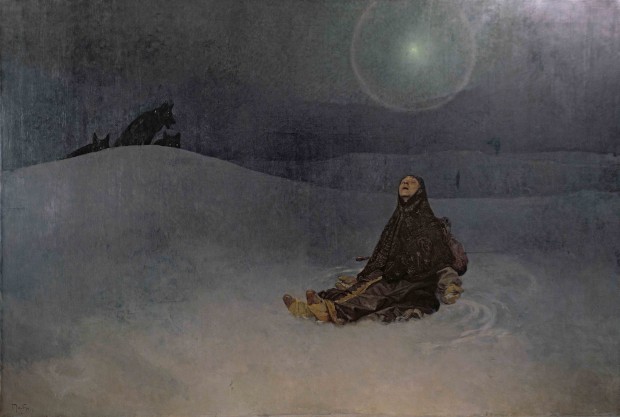
Woman in the Wilderness, Star or Siberia by Alfons Mucha 
“Listen: in dreams and particularly in nightmares, caused by indigestion or whatever you like, a man sometimes sees such artistic things, such a complex and actual reality, such events, or even a whole world of events, woven into such a plot, full of such astonishing details, beginning with he most exalted manifestations of the human spirit to the last button on a shirt-front that, I assure you, not even Leo Tolstoy could have invented it, and yet such dreams are sometimes seen not by writers but by the most ordinary people, civil servants, newspaper columnists, priests…” Fyodor Dostoyevsky in The Brothers Karamazov, p. 751-2
I recently read the last masterful work of Dostoyevsky, one of the world's greats of classic literature. The book is a testament to the sheer mental strength and quality of such a writer as experienced a mock execution ritual and incarceration in the labor camps of 19th century Siberia. Nearly one thousand pages, I received a copy of this masterpiece from a friend with a peculiar literary collection practice. The two volumes within which the book is contained were of different publications, yet corresponded to the page. This friend, while often aloof, has been a great literary mentor and companion. And as a final note, during the holiday season, I feel that Dostoyevsky's inkling as quoted above invigorates our lives especially today. The popular cult of the Christmas tree and its European folklore breeds a kind of mundane public dreaming, where the workers of the world unite in myth and imagine a complex world full of reindeer, gifts and traditions fabricated from the ordinary, to the ordinary. 
_________  
I have not remembered. Feelings unfamiliar slip away with the light of the world. Yet, in my waking night, before a small crowd of onlookers, I played along to my imagination, manifest with the unconscious origination of a dream reality. 

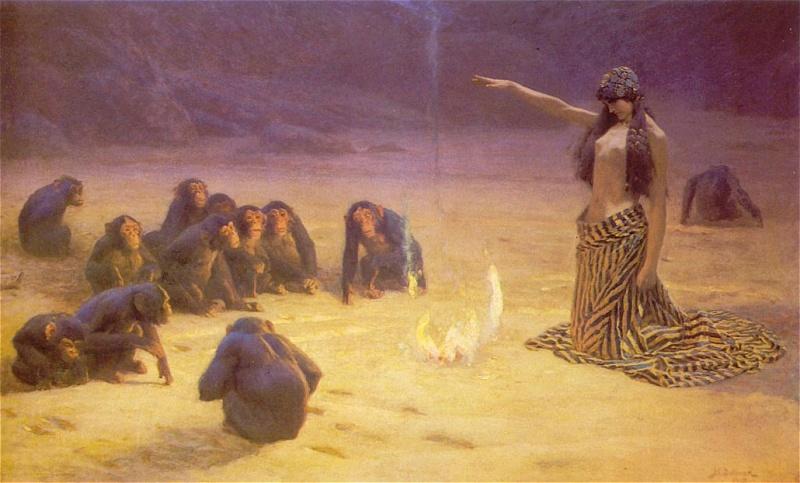
Whirling Dervishes by Jean-Leon Gerome
I swung Near Eastern rhythms towards her vibrating zither with emotive haste. As I felt the sway of awe form in my hands and heart, a lightness filled the room. I saw. A Sufi dervish began whirling. The air moved in circular deftness to my rhythmic accompaniment. The dancing figment continued unalloyed by the uninitiated crowd of the living; those led to dream only in the deepest dark of night. 
_________
Freeing the foundations of homeward longing onto a single raft
Out on the high seas,
A perplexed guide of Jewish law

Betrayed in the relaxed mystic fire
An American marijuana-seeding mind, Nepalese beauty
Direct from the magic psalm pinned against a “Tat Tvam Asi” wall

Frail pencil marks casting the Odyssey’s modern sequel
Into a vulnerable fasting mind, bled forth into the marathon sky
Massachusetts rain, following me to Calgary in rare consecutive days

Our literary giants, peering upwards, finally
In a New England fog haze through the mirrored mushroom mind
Whose perception flowered into feared atomic explosions

The true sexual freedom in nature
To lay soft stonework ground,
Firm with utterly expressed wonder at the world ‘round

Knowledge timed perfect with musical escapism
Into the bold motionless greed of a trapped metallic girl,
Re-born as prophetess in the unknown seed of Western belief

excerpt from "Grand Repertoire of Failure"


Sunday, 14 October 2012

Reflection on "The Force of Character" by James Hillman


James Hillman, an archetypal depth psychologist, whose post-Jungian conception of the human experience is essentially imaginative, and whose amoral fluctuation between endurance and immaturity lies nascent in the temporal grains of salt which gather and line the throat with ever increasing grab as aging commences upon the personality. Written at an old age, the author speaks clearly against any kind of aging therapy, and humanizes the current malaise which treats aging as a virus.

The author unwraps biological naturalism with the psychological bloom of a mind fermented with insightful, though not inundated, research on the literary and aesthetic character of human aging as a welcoming asset to life, in flagrant contrast to the ceremonial traditionalism of preparing for death, a non-issue in the continuous envelopment of life throughout the growing and falling of seasonal lasting. Dreams are referred to for their imagistic plentitude in bringing the holistic human experience towards fruition in the entire round of consciousness.

In short, Hillman's psychology is life-affirming unto the limits of modern knowledge-bearing with regard to the biological strength of humankind to age well and vigorously, as an essential presence in social reflection, as a memory of characterful belonging in the psyche of an unconscious gathering of the old triumphant spirit of age in all its mythic fortitude and human vulnerability.

Read Scott London's brilliant interview with the late author: On Soul, Character and Calling : A Conversation with James Hillman
__________
Strutting down main street, Northampton, the little city atmosphere in a smaller town, brevity of metrosexual burning. Eyehole of gouged recollection, that there is a grayer hiss over the obscure horizon edge. A paranoiac whereabouts, a drinkability churning in the ingrate stomach as cold rice turns to frothy fluid within mellowed bowels. The attuned ear swings in frantic respite as the free march to movie theatre skies nickels and dimes my racy birth rite beginnings in the stingy hollow of American noonday education.
Northampton (Massachusetts) by William Henry Bartlett
Deeper along the edge of the township, towards rougher pasture, the greener grass gives to a brown floor of the barn stead. Outside, a reenactment of the medieval lance posture, only instead of a game between knights, the Anglo matador speaks in a murderous war with the human horse. I try my hand. With two lances upraised, I pierce the flesh of a gorgeous brown horse, mirroring the hue of the dirt circle fenced by a weak wooden ring and an audience steeped in American farmhouse poverty. As other horses, unsaddled and with fierce eyes, carouse into the ring, I jet from the gathering into a blacker city.
The Present by Thomas Cole
The jurist is deliberate, patient and silent. Instead of an easy interpretation by the passive jury of bored, directionless public witnessing, a guitarist lights the court with unfailing melodies, an original spirit of human will, to impose the individual struggle with death outside of foreign deliberation in the mind of an other. Because truly, in listening, the other melds seamlessly with the brain of a decidedly active witness, pardoning all in the sonic flight of metaphysical charm.
_________
Gazing at my Love's face, I see through the apparent reality to a frameless art. A sacred geometry in the flesh. A timeless elision, going beyond spent energy.

To consume a day; imagining with laughter in the midst of family. 

- excerpt from "Gazing at Love's Face"
 

Friday, 12 October 2012

The Imperial Ethereality of the Christian Cross

Eusebius of Caesarea 
"...when the day was already beginning to decline, he saw with his own eyes the trophy of a cross of light in the heavens, above the sun, and bearing the inscription, CONQUER BY THIS."

EUSEBIUS PAMPHILUS OF CAESAREA: THE LIFE OF THE BLESSED EMPEROR CONSTANTINE. CHAPTER XXVIII. The Bagster translation, revised by Ernest Cushing Richardson, Ph.D.

For a magnificent compendium on Medieval and also Ancient and Modern Literature, visit Internet History Sourcebooks
________
A medieval townscape; similarly forged in the imaginative filmmaking of Kurosawa, yet in the guise of European history. I see lowered clay-roofed structures, and dirt roads amassing with each step into the muddy ground. There is an instinctual defensive glare from the executioner’s hat and the stymying bureaucrat’s shallow presence as I enter the gates of the stead. 

Meeting at the Golden Gate by Jean Hey (Master of Moulins)
At my first meeting, I am greeted by a youth, an apprentice to a knight, with radiant innocence so bright I am shocked to the core. And in that moment I lash out. In a single slash of my sword, an instantaneous move, I split the defenseless youth in half. 

Bors and Lionel
Blood sprays from his center and the gore filters through my footprints in stone and mud. I am taken aback by my own actions, yet as the clouds roll on, the silence is ever penetrating, unfulfilled by redolent justice, coursing on as voiceless blood, loyal only to the alive.
________
Witnessing the continuance of an apocalyptic crusade on these modern shores

Breaking open the earth-less ocean unto the final turning of Europe’s last romantic page,

Closure to the novel convulsions of a people well-practiced in ethnic cleansing and rife with general ethno-cultural frights

- excerpt from "Feel Old, Death?"


Monday, 24 September 2012

Persian Mysteries and the Immortality Rites of Zoroaster

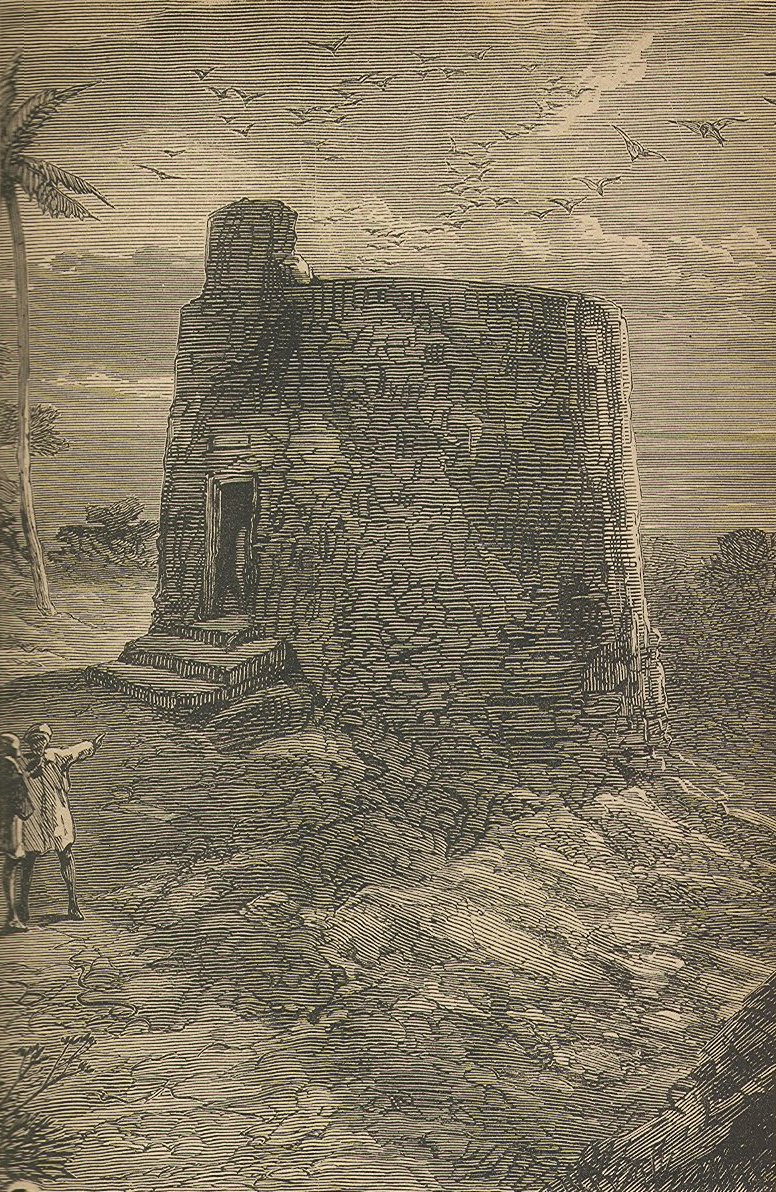
Tower of Silence (Dakhma), Mumbai by Cornelius Brown
“…never age and never die, never decay and never rot, ever living and increasing, being master of its own wish: when the dead will rise, life and immortality come, and the world be restored to its wish.” 

Yasht 19.2.11. James Darmesteter, The Zend-Avesta, Part II, The Sirozahs,Yashts and Nyayis; Sacred Books of the East, Vol. XXIII (Oxford, 1883), p.290
__________

It is 12th century Persia, the continental-temporal mirror image of 21st century Canada. After a lesson on the estate, I a youth of educable age, begin to row across a placid lake with my father. The day is warm, with cool breezes flushing our skin in a mixed haze of natural praise and remorse for the end days of summering. My father, a muscular, bearded intimidation of manhood, speaks with the grazing lurch of intense commanding. As we row, in separate crafts, the waters turn rapid. In that moment, he begins testing me on my learned material. 


The oral literature of the day is mind-bending and terse in its memorable strings of morality, geography and spirituality. I’m able to recall various characters and events, and as I extrapolate, the waters toss and turn unexpectedly. At my wavering voice, my father’s eyes brim with the frosted fire of dark Persian mirth. Yet, as soon as I veer into future’s allusions, spouting the literary names and waves of later centuries unheard, a fire burns in his eyes of serious intent to quiet my youth’s wandering. As he reaches out to grab me into his craft and row back ashore to the consistent presence of historic symmetry, we are both swallowed by the apparition of a waterfall along the other shore, pouring us downward with the turbulent waters in a vein of undone chronology and placeless imagination. 

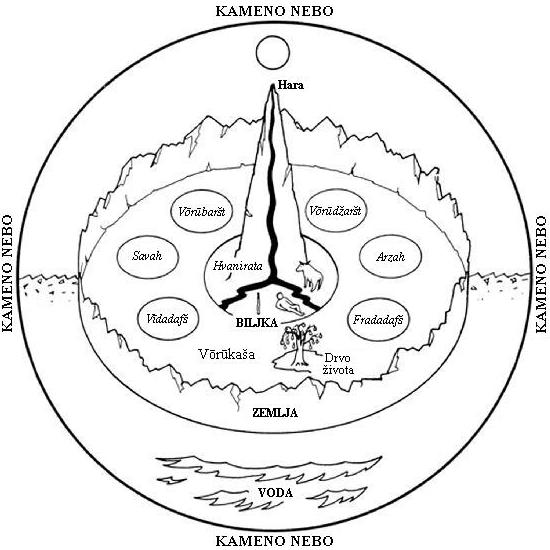
World According to Avesta by Orijentolog
I call out the names of literary history upwards along the upended future. Until the 21st century’s own dawning, my mind, feckless among the archaic forms of Iranianization, is unceasing in its deliberations on the foreshadowed youth of humanity. I turn and writhe with ancestral might into the sheer unknowable mists. My father has since disappeared, and in that silence I begin to know my name.  
_________
Driving out demons with Masonic symbology
         Over the infinite sands of civilization,
         breathed and created out of time
In the sun’s ravishing corner of a universe,
         un-tempted and forever at a loss
                Between the child’s two eyes
                closing
On death and the holocaust of our forsaken government
         Laughing at the trees’ roots


When stretched to the bottom of India’s or Africa’s wells
         Ousting up the belief in life as a drunken tragedy
                              Yet, be not humourless
                              nor without comic sophistry


In the dance and song
         Come alive by the sexual majesty
                              In theatre’s delicate ways,


To present the creative being
as one with truth’s bold and upheld music
         Reflecting back in the caged mirror
                              A creator anew

- excerpt from "From Behaved Freedom to Absolute Nonsense"