Primarily a writing exercise, this dream journal-inspired blog is a quiet introspective sojourn into the process that we traverse in going from private dream to public art. I see our dreaming as an internalized mythmaking. As I philosophize and expressively exhibit dreams, both private and public, I encourage and delight in creative language as a way to practice experiential metaphors through a “public dreaming." Writing Theory: Creative Dream Fiction
Showing posts with label war. Show all posts

Monday, 4 November 2013

Emerging Local Creativity: Literature, Music and Art Create Community

Matt Hanson, Calgary Working Group (photo: Drew Anderson)
"I want to work in revelations, not just spin silly tales for money. I want to fish as deep down as possible into my own subconscious in the belief that once that far down, everyone will understand because they are the same that far down."

“All human beings are also dream beings. Dreaming ties all mankind together.”


How did you get involved in trying to start a local media co-op?

I was corresponding with Montreal Media Co-op founder Dru Oja Jay and he expressed a kind of interest in the idea of a local in Calgary. I had been a member of the media co-op for about two years, the national. As I was more active, I was just more interested in what that means to be local. How they operate in Montreal, Halifax, Vancouver and Toronto — how they operate and what that might mean for Calgary. I started to put the word out there and it was very well received by Dru. He basically encouraged me to get together with others and talk about the idea and consider what is independent media in Calgary. Basically what I found is that many people are interested in their own projects, in terms of starting their own papers, but the difference here was that I was interested in connecting that kind of activity with a national co-operative site.

So, what’s set up right now?

Basically right now there is a Calgary Working Group as part of the Media Co-op and that has about 130 members, since 2009. All different kinds of stories have come from that. But in the past two years since I was writing with the Media Co-op, I found not many people contributing to the Calgary Working Group. I was just wondering about where is that understanding in Calgary in terms of this great engine of independent media and this source for people to get involved in media activity. So I went to different people who were involved in co-ops, like co-operative housing, and I talked about the idea and started to get it out there and I posted flyers and things about meeting with people. Initially I got three people that were very actively engaged in promoting and organizing the idea. Those were Melissa Manzone, she’s from Montreal but she lives in Calgary and she has a masters in journalism. Then a journalism student at MRU who has a certificate from SAIT in journalism and he’s still a student, and then another young woman named Chelsea Pratchett, who has done a lot of multimedia work — she has alternativemediayyc.com. Basically the next step was I applied for a small grant through the Arusha Centre, a Take Action Grant, that I received. I just started, DIY, working with Melissa who was editing articles with me, and also doing video interviews with people, and then through Alternative Media YYC I was organizing podcasts as weekly contributions. This small amount of funding is just an encouragement to the people here that might consider the idea of a local media co-op in Calgary.

How so? Would you use that money to pay them?

Yeah. The money has been used to pay contributors. Encouraging people with honorariums. To pay editors. To pay people organizing even. If they’re putting dedication into that, we consider that and we want to value their efforts. It’s a very free grant that I received.

How are decisions made? I come from more traditional media where decisions are made by editors. Who makes decisions in a co-op?

I’m really learning myself because I’m new to the co-operative sphere. But I’ve been really trying to figure out in terms of how the application of the co-operative organization works in relation to this. How we want to organize it is in a way that everybody has a share of the company, the collective. For me, this is really a learning process, in terms of how a co-operative organization works. Part of the funding I received, I’m putting into going to a conference to learn about worker co-operatives in Edmonton. Part of the forward process of this idea is really generating that structure. Right now, we’re at a very initial stage.

Why do it? A response to the media that exists? Do you think the media isn’t doing its job?

I think, to me, there’s that. I don’t want to be too reactive. I think it’s more about having a sense of imagination and taking things into your own hands, and really learning by doing in a way where the kind of media that I want to see is one that doesn’t just tell you about something, but incites you to action. The page is not the end of the matter.

So more of an activist slant.

Yeah, more of a fact that this is part of being more involved. Journalism should be about being involved.


This piece, also published for The Media Co-op, is an excerpt from this week's Your Face Here interview featured in Fast Forward Weekly on October 31
________________
War zone. Huddled under protection of stone, the dusty clamour of steaming trucks file past, carrying explosives, ammunition; the all-potent death of armed men. The sky burns under a 40 degree desert sun, magnifying the light of illusion with the bitter disbelief of guts strewn in the angry heat. The moonlit fox scatters beyond the floodlit path, and I sit, knowing I'm under the eye of a flagrant bomb pattern, patiently scanning the sky for my fate. 
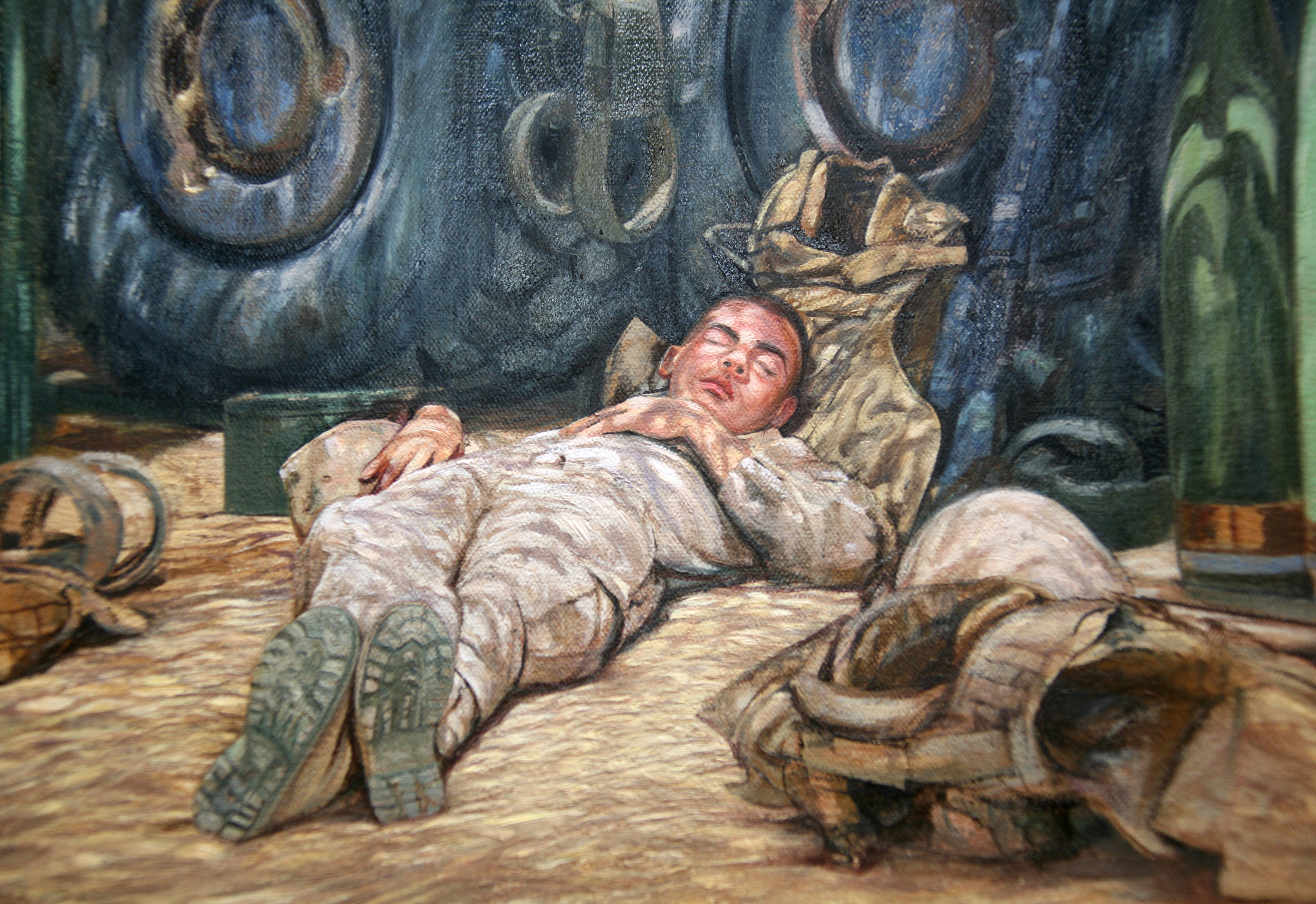
Cpl. Alicia R. Giron
Down the gravelly road, an older man, built strong and lean, walking assuredly through hell's gate. In this valley, the shadow of death casts invisibly, as the omnipotent fear, that cutting vibration that pierces as it electrifies. Every last medieval hell of our wildest imagining is child's play in comparison. The daytime moon fills my mind, obscuring the passion of escape into the dizzying architecture of mythology, roasting in this Middle Eastern world fire.

Collateral Damage by James Miller
The black fly of fire-bomb death squeals past overhead, and I run, sliding my fingers along the desert rock, the stone crumbles into rough sand. My fingers, mysteriously blackened, feel into the stone. A black liquid seethes. Viscous, thick, it's oil. I realize I can't leave. The desert spring overpowers my body in a storm of evil lust. I treasure the root of all fleshly worship in this age of fire as the swarm of madness overcomes, and in a blinding instant, the stone implodes, my hand flits to dust, the Earth gives way to pools of ash, and I sink in the quicksand of eternal war, condemned to modern night. 

On the Impacts of the Iraq War, Read COMMON DREAMS
_____________

For an ecstatic and mesmerizing experience, listen to this album while watching SAMSARA. There are new waves of sound yet to break on the open mind who might stand to listen on these ancient shores.


Delighting Destiny: Selections of our best during a live performance with audience. All proceeds from this album sales will go towards producing future performances and future recordings. Thank you for your continued support.

Monday, 20 May 2013

Dreamers Reconcile with Harsh Truths: S. Sudan and the Music of Memory


One thing that keeps me pushing these painful stories; the dreams I have. Sometimes, like, the voices of the dead that I have seen would tell me don't give up, keep on going, because sometimes I feel like stopping and not doing it, because I didn't know what I was putting myself into. (Emmanuel Jal, 2009)

What are your hopes and dreams?

I want to fly an airplane.

What else?

I want to be able to study in the daytime. And in the morning. And I want a day that I can just live…so I can build my house…where there aren't any problems that could destroy it.

Emmanuel Jal, age 9 (War Child)

On April 8, the Peace and Reconciliation Conference in Juba, the capital of South Sudan, began an unprecedented step forward in the nation’s history. On Monday April 15, South Sudan President Salva Kiir Mayardit suspended the conference indefinitely. Besides the $885 million contributed by the Canadian federal government to Sudan for humanitarian assistance between 2006-2012, many of the 4 million plus South Sudanese displaced have resettled in Canada to remain active in community rehabilitation. Activist groups, both based in South Sudanese communities as well as larger Canadian social organizations continue to sustain the meaning of reconciliation not only as an example for South Sudan, but for the globe.

            The most pressing issue with regard to reconciliation in South Sudan is creating an inclusive society where larger social participation is grassroots-oriented. In a country with one of the lowest literacy rates in the world, with over sixty unique spoken languages, democracy is a precarious notion for most. In an open letter to South Sudanese Vice-President, Dr. Riek Machar, David Mabior Atem of New Sudan Vision wrote:

Healing those long inflicted wounds against one another cannot be dealt with in 3-4 days as well as top down approach instead of bottom up approach…Another added advantage of beginning at grassroots level is the flexibility of language (dialects), which can result into high interactive and productive engagement.

            Dr. Riek Machar launched the official opening of the conference, which trains 200 peace and reconciliation mobilizers. “The newest nation on earth has embarked on a journey of healing for the national reconciliation,” the Sudan Tribune noted. Dr. Machar had also been married to British aid worker Emma McCune. International recording artist Emmanuel Jal, winner of the 2013 Calgary Peace Prize, had been rescued from Waat, South Sudan by Emma McCune as a Lost Boy. Jal took refuge in Kenya, eventually leading him to the UK, and Canada. Emmanuel Jal’s acceptance of the Calgary Peace Prize on behalf of all South Sudanese marks an especially significant moment in the common reconciliation efforts of Canada and South Sudan.

            “He uses himself as an example in his storytelling of how hard and difficult and long it's taken for him to begin the process of healing and of reconciliation with his former enemies, and that's the story that he told,” Consortium for Peace Studies director George Melnyk told The Media Co-op. “He's also very careful to not critique the South Sudanese who made him a child soldier.” The Consortium awards the Calgary Peace Prize to global visionaries working towards peace, beginning with Hiroshima Mayor Tadatoshi Akiba in 2006. The Consortium is currently the only post-secondary Peace Studies initiative in Calgary.

            James Nguen, founder of Biluany Literacy and Water project, responded with deep concern in an Op-Ed piece in South Sudan News Agency, decrying the indefinite suspension of the Peace and Reconciliation Conference in Juba. “This unfortunate development shocked everyone in South Sudan and around the world. There were no further details why the project was suspended,” Nguen wrote to The Media Co-op via email. “If people reconciled, then there will be no petty tribal raids which the past 8 years cost South Sudan government and the international community millions of dollars.”

            Although the Second Sudanese Civil War, which ultimately led to an independent South Sudan, started in 1984, the world did not respond until 2004. The political situation in Sudan, and now in South Sudan as well, is very complex and is steeped in both European colonial history as well as Egyptian foreign policy. The legalities of genocide with regard to reconciliation have remained unparalleled in controversy ever since the United Nations adopted the Genocide Convention in 1948. “There was a genocide in Darfur, and there was genocide in South Sudan from the beginning,” James Nguen said to The Media Co-op. “In order to secure the CPA [Comprehensive Peace Agreement], they could not force Al-Bashir to step down without confidence that his successor would respect the CPA. Only one of the three agreements of the CPA was met, which included peace agreements with Abyei, secondly, and Blue Nile and Nuba Mountains as a third agreement.”

            The outstanding agreement to respect the right to self-determination with the people in the Nuba Mountains has especially intensified on the issue of genocide. Global activism in solidarity with the Nuba people has followed in the wake of the independence of South Sudan in 2011, including the End the Nuba Genocide Coalition. The only area not consulted in drawing the new national border, Abyei, is directly impacted and holds outstanding land disputes. Abyei territory is a priority for the Juba Conference.

            South Sudan’s independence was “the most significant redrawing of the map of Africa since the colonization,” Angel Batiste, Area Specialist with the Africa and Middle Eastern Division of the Library of Congress in Washington D.C., noted, before introducing the lecture, Cultural Heritage in South Sudan in November 2012. 

            During the Calgary Peace Prize events this March, Emmanuel Jal raised eyebrows concerning the latest news from South Kordofan, where another genocide in Sudan seems to be taking shape with unprecedented momentum. “UN people down in Sudan are saying there’s a possibility that in South Kordofan that the genocide there could be worse than in Darfur,” said Jal to an eager crowd at the University of Calgary on March 1, 2013.

            The diaspora is truly integral to peace activism for South Sudanese. “They actually support their family members more than even the government does,” Jal told The Media Co-op, referring to the diaspora of South Sudan and their role in the reconciliation efforts ahead. “If you’re educated, if you have a degree in whatever form, don’t go home to look like you’re going to be employed by the government. You go there as an employer. Go there and use the skills we have there and establish something, because the country is still new. Whatever you touch will prosper.”

            Since late last year over sixty genocide scholars and anti-genocide activists initiated a letter writing campaign in response to the genocide atrocities in the Blue Nile and Nuba Mountains. These letters have fallen on what South Sudan’s leading independent news source, South Sudan News Agency has called, “absolute silence”. The Atrocities Prevention Board (APB), founded by U.S. President Obama specifically in response to the lack of U.S. governmental initiative towards preventing crimes against humanity and genocide, became the most important, and also most unresponsive, target audience. This April, South Sudan News Agency published the latest letter, sent to U.S. Ambassador to the United Nations Susan Rice. An excerpt from the letter reads:

We never expected, though, to have our letter (and now letters) go unanswered… when we, scholars of genocide studies and human rights activists, fail to receive a reply to a letter that we first wrote back in December 2012 and have now sent five times to four different individuals affiliated with the APB, it, indeed, feels as if the APB and its focus/work is little more than “a sideline in our foreign policy.”

             Similarly, in recent news, the only head of state in the Americas to be tried for genocide crimes, U.S.-backed Guatemalan dictator Efraín Ríos Montt, saw amnesty on April 18 after the current Guatemalan president intervened to have the case annulled. “It was the first time that any nation had been able to use its domestic criminal courts to try a former head of state for genocide,” said investigative journalist Allan Nairn on Democracy Now!

            Despite ineffective government intervention, independent non-profit and charity organizations, spearheaded by leaders from South Sudan, continue to work towards a sustainable society through reconciliation efforts. Biluany Literacy and Water Project, a development initiative led by James Nguen based in Calgary, has been active for over three years in building wells and providing educational resources in South Sudan. “There is no sustainable infrastructure in South Sudan, and without a lot of assistance from the international community, trust cannot be rebuilt,” Nguen said to The Media Co-op. “The greatest struggle is to represent ourselves, to know who we are as one community. The war eroded our cultural values, our history, our society.” Nguen recently partnered with Gua Africa, the charity of Emmanuel Jal, to fund well development and to organize a conference in Canada to mirror the Peace and Reconciliation Conference in Juba.

            Since winning national independence, other organizations in the Calgary area, home to the predominant South Sudanese community in Canada, are working towards reconciliation. South Sudan Peace Building International Foundation Inc. (SSPBIF) is one among them. Secretary of the SSPBIF Kuir ë Garang is also a prolific multi-genre author of six books. “People in South Sudan tend to regard literature as ornamental, they don't see how it can help relate people, to help people find relations between one another, so they can get together and have mutual understanding through education,” Garang told The Media Co-op. “Through literature, we can better represent ourselves. Now up to 70% [of people in South Sudan] are dissatisfied with their government.” Garang is currently working with a publishing house and bookstore in Juba to open a forum on multiculturalism and diversity for professional writers from Canada and South Sudan.

            Rural South Sudan is reputedly the most marginalized and underrepresented, effectively causing the need for grassroots inclusivity in Juba’s Peace and Reconciliation Conference and beyond. Resource conflicts both at national (oil exploitation) and grassroots (cattle raiding) levels have been at the root of social disorder in South Sudan. Augustino Lucano, a South Sudanese migrant from the Equatoria region living in Calgary, shares an unrivalled success story in bringing together divided rural ethnic groups and organizing incipient meetings with government representatives.

            Lucano received personal permission from South Sudan MP Joseph Lokodo Kolombos to open a peace center in his home region of Equatoria after presenting to the MP a research paper inspired by an Initiatives of Change workshop. “The problem is that people in rural South Sudan are still very divided, they do not see a way to live together yet with the whole nation yet,” Lucano said to The Media Co-op. Lucano, a member of the Didinga ethnic group, lost two brothers in conflicts with the neighboring Toposa people. “The Maaji peace centre is located in the middle of Didinga and Toposa land, in a flatland valley, where both tribes can meet peacefully,” Lucano conveyed to The Media Co-op. “So far there has been no raiding at the peace centre in Maaji. First, it was necessary to establish the peace centre where resources could be shared, and then we can discuss reconciliation.”

             In February 2013, the South Sudanese Minister of Wildlife’s visit to the Maaji Peace Centre drew tears from elders and children alike who had never before seen a car, no less a government car. “It showed how marginalized these people had been in the national developments, and also that the government was starting to establish a relationship with rural people, including them in the dialogue of the upcoming Peace and Reconciliation Conference in Juba,” Lucano told The Media Co-op.

             2013 is quickly becoming a year of unprecedented global reconciliation movements. The Peace and Reconciliation Conference in Juba is especially significant to Canada with its direct relationship to the activism of the Canadian diaspora of South Sudan. With the first head of state in the Americas having faced genocide charges, a more intimate link can be made with Indigenous peoples’ history in Canada. Will Canada renew its role as a global human rights leader in the wake of mounting genocide awareness around the world? Ongoing debates in Canada, spurred by Idle No More, emphasize reconciliation with First Nations as an inclusive reconciliation with humanity. 

This article previously appeared for The Media Co-op on April 29, 2013
___________
the road to rome is paved in bones by RK
madness by RK
the human rabbit hole by RK
old west art by RK
papercut & stoned by RK
____________
conjuring a sense of the once roaming herds of mammals that lit upon the open horizons of our once naked landscapes - the frame drum evokes a sacred connection to our mammalian evolution through a heartened soul brethren with large mammals, and our precarious evolutionary stability as one of the most vulnerable types of living creatures on planet earth - in the piece, i speak of the charge of the electric pole of patriotic industry over the breadth of our continent as the sacrifice of ourselves, as male-female witch, burned on the flagpole of national identity, a sacrifice brought about by the all-devastating silence of voice, speaking of a way of life not bound to the dominant settler society, yet existing now only in negation to the sedentary ecology of consumerism and vacation, with regard to the lost history and memory of our true selves in communion with the deeper movement of life as we once knew it


Placed Anonymity, like the chapbook, "A Sick Society Amuck" is inspired by the words of Jiddhu Krishnamurti, iconoclastic spiritual philosopher, who said, "truth is a pathless land". Truth lies in the anonymity of place as is, without meaning, as a river is in essence meaningless until commemorated by a name and story, whether of scientific or folkloric mythologies.

in a pathless land, how do we come to know the land, or know what is true, HERE? that exploration is the foundation for this four poem chapbook, eventually culminating in collectivist thinking, to aspire towards a basis of unity evading the muddled institutionalization of creative freedom


Monday, 15 April 2013

History and Humanity: How Self-Awareness Leads to Reconciliation

Mary Wollstonecraft Shelley and Percy Bysshe Shelley by George J. Stodart
"No more let Life divide what Death can join together." Shelley

"We cannot continue to be recognizable and survive…if everything you know is wrong, then all the problems you thought were insoluble can be framed differently. And there's a way to take the world apart and put it back unrecognizably. We don't really understand what consciousness is at the really deep levels," said Terence McKenna in an interview for bOING bOING #10, to hail the oncoming psychic transformation of humanity in the 21st century, also known as the post-2012 New Age eschatology. 

Yet, historically, we have ever been unrecognizable when we look at interrelations between human societies, especially with regard to the European saga of colonialism and the institutionalized racism that followed (and arguably continues) in its wake. People from other continents, the Native, Indigenous peoples of the world, most emphatically Africans, Australians and Native Americans (from both North and South America), were for a considerable portion of history considered an inferior race, a subhuman species likened to earlier primates less developed than the European genus. 

As we have now begun to recognize ourselves wholly, all of humanity included, through science and reconciliation with our inhumane past, the challenge now remains clearer than ever, for it is our own selves, the Self of Humankind that is in need of development, and not any other form of life. So, we might ask, might we grow up from the childish state of irresponsible resource waste and join the community of life on planet Earth, or become extinct. As the human family becomes recognizable, next the whole of life on Earth must be recognized as our own self, as the body of a relative, and until it does, and we remain unrecognizable to ourselves, there is catastrophe as we straddle the line between dominance and extinction. 

Interpreting the above quote by Shelley in the last line of the third to last stanza of Adonais, An Elegy on the Death of John Keats, essentially reads as "don't let life get in the way of dreaming" where the diversity of life, as it manifests in the human family, a wealth of ethnicities, spiritualities, and physiques can be seen not as a source of division, but of connectivity. And so, as I write, this the capital city in the state of my birth, Boston, has allegedly been bombed. In such times, it is ever paramount to instil the meaning of reconciliation within the human family. Peace studies author and professor George Melnyk recently shared with me the simple notion that "That's what happens in war, you define an enemy." And, so, with our nation(s) at war in the Middle East, and the "enemy" at hand, we can keep vigil with the caution that we should not jump to quick conclusions in our search for vengeance. 

The crossroads of human life in the 21st century divides Humankind between himself and the planet; the potential of nuclear fallout and the immanent ecocide with the unabated burning of fossil fuels. The struggle to survive as one, whole being, as a united humanity, is to be fought at our doorstep, and we must remain strong not to waver from our ultimate direction towards peace through reconciliation. See the documentary by Chris Hedges OBEY, at minute 22, where he writes, "Resentment against a disenchanted secular world will find deliverance in the ecstatic escape of unreason." Let this unfortunate incident be an opportunity to empathize with those who experience bombings on a regular basis as part of our government's foreign policy, as opposed to perpetuating violence through self-pity and aggression. 
_____________
A stone-bedded homely abode of five rabbis, all with simplicity and humor muttering of their bearded visage, they meander from home to a day’s work in the predawn night. I, a furtive wraith, clandestine in the dim corner, emerge to observe the floor-set scribes and their flowing fountain of wise austerity. The dusty air breathes sanctity unknown to most, yet from the window a flicker of artificial light breaches the soup of mind with Maras of temptation, apparitions of the female sex, flaunting a shadowy tint of flesh. I trudge outside, unencumbered by the pleasures of the intoxicating sights. We are at war.

Titus destroying Jerusalem by Wilhelm von Kaulbach
The direction of sight is clear. The enemy is known, and our targets destructible. The air is thinning of passion and feeling, to make way for hate. The true victim in this war is Earth. The all-out industrial fire has spurred on the makers of enmity under a veil of infinite resource. Brothers, sons and fathers bleed with for the ground on which they are laid to rest. The backdrop is far-reaching. There is a sense of humor in this war.
Toronto Rolling Mills by William Armstrong
Foregrounds blur into modernity, as a civilian is murdered, shot in the back, running towards us. Iraq is not Germany. Civilian and army are a rough and indiscernible duality. The cold smoke of hate becomes the backwash of sanity as soldiers and men secrete their pain into the willful triggers of deadly remorse. I, a photographer, capture the minutiae of existence full-born in the surviving families of Earth-bred singularity. Modern natives, the indigenous, bold eyes of people, now the last grave on which an unmarked praise still glorifies the vanity of war and power. Massive trucks crack and sputter past me, with so much gun, bomb and shell materiel that my knees weigh fierce into the concrete below. Rushing past, the soldiers reveal faces of bleary sweat and stinging tears, flowing from a smiling façade of youth, their graying eyes grow cold with fate as my photos are ignored.

Collateral Damage by James Miller 
When we declared war on Earth in WWII, the invasion of Iraq granted us full impunity as we commit the last atrocity on the only lasting connection humankind might instill from Earth to the mass of societies born and bred of global war. They line up, shaman to farmer, hunter to midwife, storyteller to seer, a community of global wisdom, attuned to the lightness of being, as in the creation stories of practical love. And in their firing squad, they choose to sit, meditating on the gun-barrel of unsightly loss – the drifting eyes of hate and need merge.
___________
After a cumulative process of self-publication, a DIY attitude of writing and publishing often spreads into the realms of experimentation and exploration with all aspects of the creative process and, especially where self-publishing is concerned, into self-innovated and creatively conceived avenues for sustainability.

Art is the "divinely superfluous beauty" as Robinson Jeffers says, however the artist is inherently tied to the whole of life. For this reason, I have decided to experiment with monetary value as a way to further understand my self-published works and the general field wherein I am situated as a self-taught creative artist active in a variety of artistic disciplines, with special regard for the overlap of media, thought and art.

Please join this conversation as society embarks ever on towards greater connectivity between the sacred, the communal and the entrepreneurial; that all three may one day join in a vision of society directed at once toward pragmatic utopia, while mutually creative and destructive, or better worded as discerning, in its ability to see and create potential.

I will still be offering the full collection online for free viewing, however, I have added the option of supporting the artistry exhibited by none other than the Dream Author. Jah!


Opening the page to experimental, improvised writing which emphasizes and attempts a most strict depiction of the spontaneous nature of mind can be perceived with harrowing aspiration in the realm of continuity, that is flipping the page, and its mystery, that is interpreting the language. As a forewarning of sorts, this collection of writing, as devised for readership, is the result of an editing which has purpose in giving the spontaneous flow of mental activity form. While attempting to convey the refreshing action of letting go, all structure and boundary and, in sense, constructs of mind are dissolved.

Created solely by one human being through "One Shot" intuitive improvisation stylings, Evocations: Cyclical Wordplay is the completion of a creative cycle of renewal, regeneration and return to the primary source of visionary inspiration: voice. With due reverence and respect for the infinite diversity of vocal and verbal forms among the worlds of the living and the dead, I hereby speak directly from the heart. Here, in these soundings, I am re-conceived through the mouth of the pen in all its power to amplify and obscure.

"Evocations" is a practice in contemporary experimental narrative, as opposed to the traditional conventions of spoken word. The poetics of oral storytelling are alive through soundings for the muses of voice in all its forms, whether in the tongues of wood, metal, plastic or flesh. The language of unity speaks through every medium.

Monday, 11 March 2013

The Art of Freedom: 2 Years Since Fukushima in the Post-Scientific Era


"The existence of nuclear weapons means we could potentially create a disequilibrium, an imbalance, on the planet and the atmosphere by the launching of some of these systems, some of these systems. There are 27,000 of these systems. This is more than enough to wipe out the whole planet. You also got people working to say, 'you know you gotta save the planet.' Well you're right, we've got to save the planet. And so the whole environmental effort, as laudable and as absolutely critical as it is, can be for absolutely not in the space of hours if these guys actually went at each other." Lt. General Romeo Dallaire (Ret.) Pugwash Canada

Today is the two year anniversary of Fukushima Daiichi disaster. In my previous post, Hatsuyume of Peace, I kicked off a new paradigm in the life of this blog with reference to the apocalyptic transition that nuclear energy essentially means for life on earth. This is an enduring creative metaphor, a source of reflection that begs to be heard and never left in the silent empty ignorance. For, as the unrivalled Persian poet and filmmaker Forugh Farrokhzad said in her landmark film to inspire Iranian New Wave Cinema, a groundbreaking force of thought, emotion and impeccable insight, "There is no shortage of ugliness in the world. If a man closed his eyes to it, there would be even more." Her film, The House is Black is about a leper colony, and the humanization of treatment for a disease that simply requires attention. While the impacts of a nuclear disaster do indeed course through the blood and infect the children of the victims, there is even more recourse to action, to look, and with the kind of remembrance that breathes in the present moment, to see the eyes of the victims as through the eyes of our own children, our own mothers, fathers, and siblings. For there is evidence that it could be forty years or more to clear up the Fukushima disaster, which is the worst of its kind since Chernobyl. The transition of nuclear energy as a weapon, the atom bomb, has essentially moved the world from the era of World War, into an era primarily defined by war over intelligence, the post-cold war era. Vietnam is an example where the government authority of the United States actually never declared war, incapacitating the ability to detonate another atom bomb on a human population in Asia. We are now living in the post-scientific era, and the Age of Reason is long past. Our existence is not defined by scientific knowledge, but of technical know-how.

On an investigative bend, I took the time, as part of the research praxis of a literary arts journal, to go to photographer, Arthur Nishimura's exhibit, "Dream Country" at the largest university in town. In the exhibit, Nishimura creatively interposes landscape photography with prepared or rendered film. I went for the purpose of interviewing others who happened to stroll through the exhibit about the significance of today's anniversary remembrance of Fukushima, not only as a Japanese disaster, but as a world disaster. What do the photos of a globetrotting Japanese nature photographer say about the remembrance of Fukushima? My questions, and my approach to a conscious public as an experimental journalist fell on a silent room. In the last hour of the gallery's opening today, not one person visited Nishimura's exhibit. Instead of heading into abstract philosophic directions regarding the nature of public ignorance, I peered deliberately, patiently and acutely into the breathtaking symbology of a master photographer.


Let me take you through an abbreviated version of the exhibit, and how I related my experience of "seeing" to the memory and lasting impact, and future legacy of Fukushima. Firstly, Nishimura's piece, "The Book of Flatland Dharma - Of Two Religions: Conclusion" (1978) captivated me. It is a juxtaposition of a sacred Japanese temple, as a diptych next to a silo in the Alberta countryside. This struck me first, because Nishimura captures the elegant majesty of mystery and beauty all over the globe, yet Japan and Canada have sacred significance, yet the cultural dissimilarity could not be more clear in the way that aesthetics are a reflection of social expression. Next, in his Homeland Tourist series, "Higashi Honganji Temple (1978) flattened me with its elusive doorway of symbolic insight. The bicycle in the foreground, outside of a sacred temple in the background, emphasizes that while there is a sense of the infinite within us, we are after all impermanent, and as we ride the mundane bicycle of worldly experience to its end, the higher awe of spirituality lives on, with or without us. Finally, while there were others that struck me uncannily, I will leave off with one last one that took even more time to set in than the rest, however after peering into its silvery textures, and its striking imagery, I latched on to a hint of perennial truth. The work, "Pre-dharma Sentience" (1978) in The Flatland Book of Dharma - The Singularities series, a stone lies in the foreground. In the background, an open landscape, with a path leading to the horizon, to nowhere. What this says to me is that, essentially nature, as with our nature, is fundamentally meaningless. Nature, in its raw, open and original forms do not offer the human heart a rest stop on which the mind may imagine and conceive a reason for being. The meaning of no-meaning is the great point of flux in realizing our humanity as vulnerable, fleeting, and if at once emergent with direction, also futile and unimpressive. As Paul Valery said, "God made everything out of nothing, but the nothing shows through."

On my return home, on this unusually warm Canadian winter day, I read a very short Associated Press article buried in Metro Calgary on the legacy of Fukushima. In the article, 'Outlook bleak two years later' a quote read, "Everyone, from bureaucrats to construction giants to tattooed gangsters, is trying to prey on decontamination projects. And the government is looking the other way," said Nakamura, who refused to give his first name out to the press for "fear of retaliation". As I reflected on my train ride home through the downtown corridor, passing above rivers of melting ice and the glare of the profound midwestern sky, where the rich sunlight exposes the midriff of an aging humanity, I had a realization. Being human means taking the responsibility that we have as stewards of the land, as a conscious potential unmatched in the known universe. If we do not take responsibility for being human, then there will soon be no more human beings. We do not write the highest law, and we can not speak the highest truth. 

____________
She sets the stage with a sweeping introduction. In the impeccable garb of a beauty queen in love with life. The public gushes with heart-sleeved pandering. The world is set like a red carpet before her.

Queen by Sten Porse
The musical ambiance, the tone, is grandiose and emergent as the Jonah-swallowing fish of all-conceived breathtaking wonder. Her introduction is the mindful worship of momentary repose, for the elemental truths to seduce all through her sonic dance of grace.

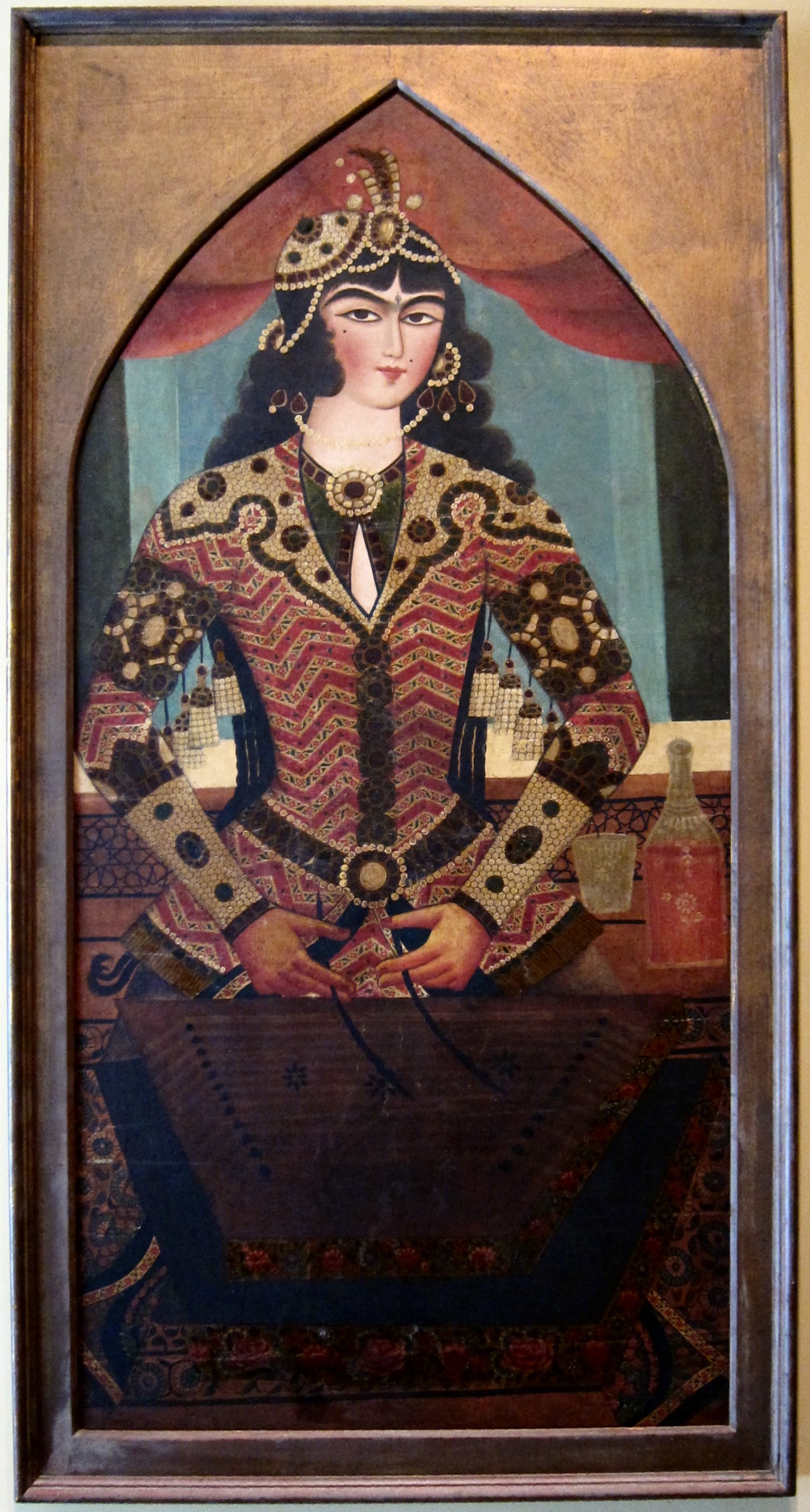
Female Musician by Anonymous
She continues ever on, without me. Frustrated by my own deviance, and in the backwash tunnel of personal failure, I triumph in disaster. The airs of isolation breathe a sad remorse, the regret of guilt itself takes over like an icy bath.

The Ambassadors (detail) by Hans Holbein the Younger
I strain over my broken instrument, and snap its neck in one fell swoop. Not even a ping from the cracked strings are heard in the overarching foment of fanatic bursts and swoons of delight as the mob breathes down the throat of my love the kiss of popular contagion.

Interesting enough, the short dream sketch narrative above, and that described in my last post, where I exhibited a noetic travelogue through Sudan, have coincided with the events of the days to follow. In the previous incident, I had dreamed that I was traveling through Sudan, and had born witness to the social resurgence of positive forward movement. So, on that day, I met and interviewed Emmanuel Jal, as he accepted the Calgary Peace Prize on behalf of all South Sudanese people. Similarly, though without such heavy global precedence, the events within the dream sketch illustrated here preceded a botched concert appearance by none other than myself to accompany my Love onstage.
___________
My first exhibition of an original "sounding" in the internal collaboration of creative music with creative writing. Improbability in Upswing, was published at poeticdiversity: the poetry zine of los angeles in December 2012. In my reading, with relation to the content of this post, I am taking off towards the eye of the sun. The teeming cloud-born sky quakes with the burning rush of human flight. Riding through the energetic outpouring of modern rocket fuel, I feel a beneficiary of similar technologic might that burned the bodies and fuelled the fires of war. Nuclear energy is not far distant, and my body begins to churn with the physical imagination of experiential interdependence, smouldering at the cusp of freedom and death.


To set forth another tradition of self-publishing, every week from now on, as I offer a "sounding" of spoken word and original music, I will release a chapbook of the section from which the "sound poem" derives in the series of collected experimental writings. Enjoy and ponder the experimental imagination through visions of "Aircloudsky".

Monday, 4 March 2013

Electro-Acoustic Improvisations II: A Sonic Narrative from the Far West

Electro-Acoustic Improvisations I (Album Art Remake) 
Electro-Acoustic Improvisations II (Album Art)
"The first question I ask myself when something doesn't seem to be beautiful is why do I think it's not beautiful. And very shortly you discover that there is no reason." John Cage

Essentially one album, Electro-Acoustic Improvisations I & II are to be listened to in continuity, as a single expression of seeking through sound as voice and agency for the soul of the word. Electro-Acoustic Improvisations II is conceptually the final track of I, divided into 4 parts for listening.

Experiment with your ear, and look to the bottom of this post for an aural transport to the Far West.


Electro-Acoustic Improvisations II

On the margins of the vast, interlocking web of technology and nature, with broken instruments (both acoustic and electronic), we are beginners on the road to merging technology with all of life in this the human experience of Earth and the inner world as an evolutionary being of conscious development. 

Imagine sitting at the edge of a fire in the raw, teeming wilderness. The forest is thick. The air is heavy with an unbroken gamut of vegetable breathing. Warming your hands by the fire, under cover of starlight and the faint haunts of a new moon, the mind seeps and seethes with memories, dreams and reflections on the world “out there”. Civilization and its discontented fires of electric madness pour into your brain like an acid flashback. The Earth is still, yet your hands shake. So, before you is the music of the muses, the bare wonderment takes its own course into the heavens and hells of your own nature. Through music, the seeker of solitude purges the concrescence of electro-social distension. Discordant dissonance marries with harmonic essence as the jeering subtle flesh of mad electricity merges in the mind, hand and heart of one in touch with the strings, blood and fire of creative sound.  

Part I - The seeker discovers music as a beginner. The instrument is slightly out of tune, and the playing is imperfect. The melodies are introduced with electronic music, featuring static electric synthetic effects throughout. The seeker gains mental balance by overcoming the first break beyond the shores of civilization into the open expanse of nature beyond, where other, even more trying challenges are to be had in confrontation with the self, exposed and untended.  

Part II – With emboldened consciousness, the instrument and its sound are clearer. A fire has been set and night opens to the gorgeous possibilities of the sonic imagination. Electric distension is transformed into unseen beauty. The grandeur of melodic instrumentation opens up with a new strength of diversity. As the clouds above part to reveal pure sky, memory and reflection are enlightened through joining with traditions of seeking, as with the sonic movement into Middle-Eastern influenced lute music, translated to guitar in creative solitude with the empty awe of all-potent Nature. 

Yet, the seeker soon realizes this is only the beginning of the journey, and there have ever been electric distension scattered throughout the night’s hearth. By the end, the celebratory feel becomes more solemn as the seeker attains the first seed of self-knowledge, and understands the need to set one’s own pace and prepare certain deliberation before embarking on the pathless sojourn ahead. The music ends with the realization that it is dawn, and the horizon welcomes ahead.    

Part III – Reprieve from the journey, alongside a mountain ascent, beneath a cliff. Cool air from a spring entices the cold march of winter’s coming winds to turn and wade in the lush mountain air. Without a fire, music is the warmth. Creative passion warms from the inside with the brightest of flames. At first, blowing hard into the hands and fingers for the warm breath to spread throughout and allow for the wealth of instrumental music to unfold, the seeker stops playing as soon as it begins to rain. As in Taoist tradition, when the rain makes rhythmic motion, and the melodies of the thunderclouds fly with the magical presence of wind, one is to listen, and be humbled by the music of the spheres.  

Part IV – Beginning with a light touch of electronic moments, the music glides atop sounds of weather, especially as the seeker gets closer to the ocean. Following rivers, streams and tributaries, faring flash floods and rain-swept gullies, the seeker emerges from the wilderness with a great boon of discovery. A new instrument to behold! Notice, the music approaches harmonies with the natural way of impermanence and unity, as opposed to listening, where creative interaction with nature breeds a kind of musical kinship among humans and all life on Earth. As the seeker sights the ocean, the new instrument is played, ending the music and the journey. 

The new instrument is the xaphoon. Invented in the 1970’s in Hawaii, the xaphoon, also known as the bamboo sax, is a contemporary single-reed woodwind. The track ends with a homage to Jack Kerouac describing San Francisco, the very edge of the west, to crystallize the final xaphoon improvisation solo; a traversal of the “far west” in sound. 

Influences: Bill Frisell, Hamza El-Din, Vi An Diep, Steve Roach, Brian Eno, stones/minerals, earth, water/ice, winter, landscapes of the North American west, Jack Kerouac, fire, trees, reflection, solitude

See my previous post: Music of the Dream Author: Electro-Acoustic Improvisations I Release 
___________
On a clean, medical train through Sudan, my Nilotic companion eyes me with a piercing grin as we pass south of Juba into the New South. We have arrived at his hard-won home, South Sudan. His smile is buried deep within the pain of intergenerational loss, the hellfire of war still sting his reddening eyes as he tears up, the pictures of his innocent family smolders into the soil. The land speaks with his voice.

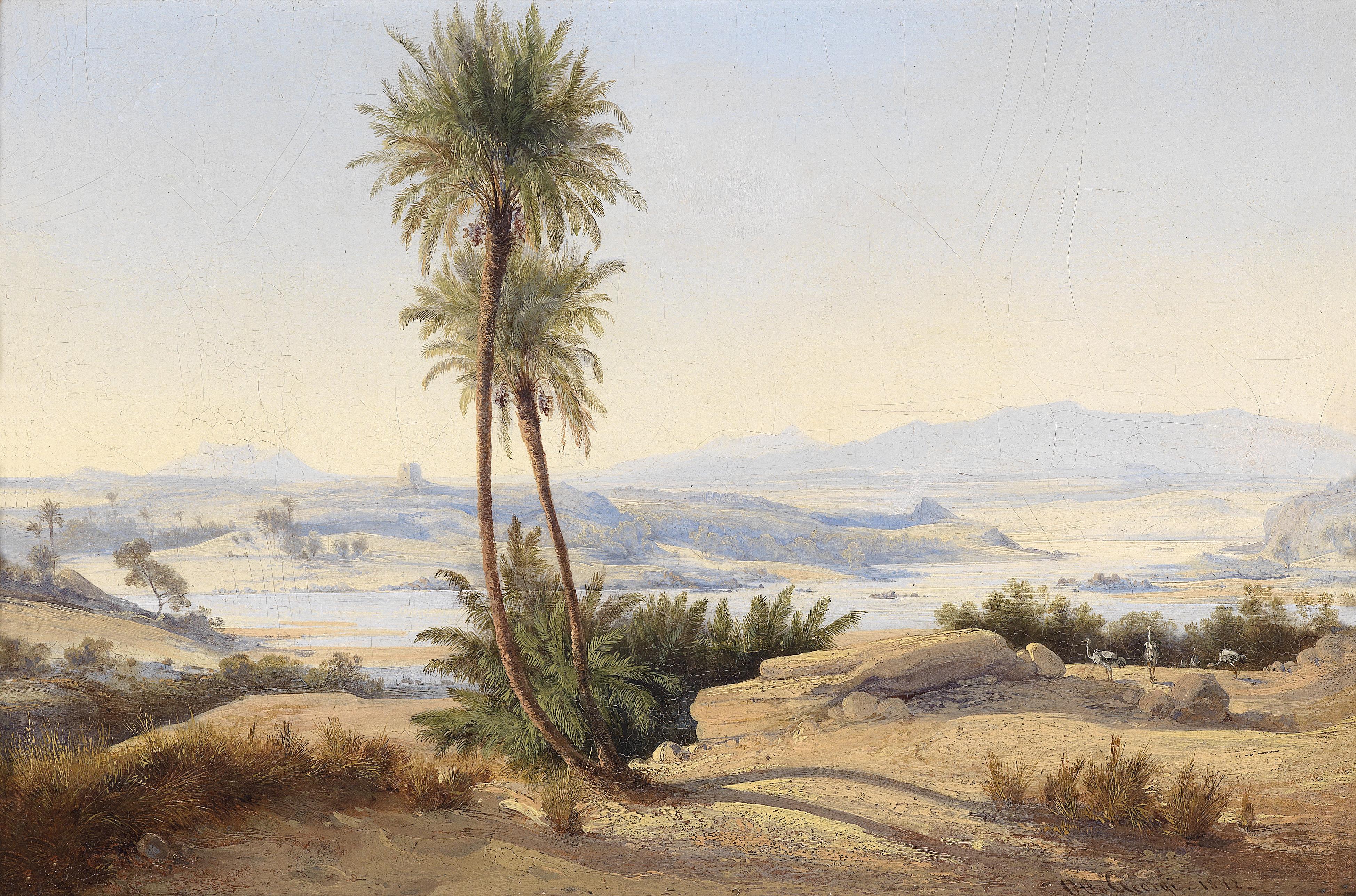
Southern Nubia by Friedrich Otto Georgi
A number of tourists from Europe and America depart from the train stop, as we all exit to proudly march through the gates of the newly formed customs center. Before I ready myself to stand up and follow in the foreigner’s line, I see the winking horror of rats, spiders and snakes twice the size of my face, gnawing at my brains in the middle of the first night. I’ve read such stories. This is open country for sub-Saharan life-threatening insects and arachnids galore. If only they sold us preventive supplies before stepping foot on the blood-torched burial grounds of a still cold reconciliation between tribes and kin. The first thing I see is a smile, wide and innocent as the all-embracing horizon. Before I entered Sudan, an asylum seeking Sudanese refugee in Egypt told me, “Sudan is the easiest place to kill someone.”

Tornai Man from Sudan by Gyula Tornai
I heave a sigh of relief as the other westerners depart into the folds of pyramidal shopping and freewheeling nature photography. I journey on, to the heart of the people. My friend is ever stoic, silent, basking in the wonders of a new nation in its infancy, victorious after so many losses, after so many needless ends, there is at least one fresh start to be had, and one that all can have a part in. Concrete residential towers spring up almost before my eyes, fresh paint lingers and drips throughout the dry stinging horizon of African sun.

African Riddle by John Mainga
Men work diligently, with the force of triumph, erecting monumental stone structures, for future generations to thrive, for the plentiful, abundant optimism of the future. The complexes are almost identical to the substandard suburban housing of greater Cairo, where many must have returned from as once-neglected refugees, now with a determined hand and proud say in social affairs. They don sun-deflecting head coverings, and traditional footwear made with scarlet fabric and coins. Women are nowhere to be seen.

Battle of Tamai by Geoffrey Douglas Giles
We drive on, deeper into the south. The more south we go, the fresher the earth, the more bare the optimism, the more innocent the smiles. The more south we go, welcomes are heard with more sincerity. The air is full of potential. The energy is warm, and the harshness that once thrived now sees a chance of dwindling beneath the pulsing chests of hard work. My friend dissipates into the sunlight now flooding our vehicle; as the inimitable human spirit washes us clean of fear.  
____________


The completion of this instrumental music project, "Electro-Acoustic Improvisations I & II " sets the ground for the next stage of my creative development, where I feature my experimental writing as spoken word together with my world music instrumentation. More art, music and writing next week! 

Friday, 1 February 2013

The Poppy and the Pride of Death: Interpretations on a Famous War Poem

Poppy Field in a Hollow near Giverny by Claude Monet
"Poppies have long been used as a symbol of sleep, peace, and death: sleep because of the opium extracted from them, and death because of the common blood-red color of the red poppy in particular. In Greek and Roman myths, poppies were used as offerings to the dead." [1]

"Another candidate for the psychoactive drug is an opioid derived from the poppy. The cult of the goddess Demeter may have brought the poppy from Crete to Eleusis; it is certain that opium was produced in Crete." [2]

References

[1] L. Frank Baum, Michael Patrick Hearn, The Annotated Wizard of Oz, p. 173

[2] Karl Kerenyi.Dionysos.Archetypal image of indestructible life.p 24
In Flanders fields the poppies blow
      Between the crosses, row on row,
   That mark our place; and in the sky
   The larks, still bravely singing, fly
Scarce heard amid the guns below.
We are the Dead. Short days ago
We lived, felt dawn, saw sunset glow,
   Loved and were loved, and now we lie
         In Flanders fields.
Take up our quarrel with the foe:
To you from failing hands we throw
   The torch; be yours to hold it high.
   If ye break faith with us who die
We shall not sleep, though poppies grow
         In Flanders fields. [John McCrae]
The above poem, written by John McCrae, is one of the important war poems in history. Today, it is read aloud by veterans at remembrance ceremonies with solemn intention. The symbol and metaphor poppy, here depicted, is especially relevant for the topic of war. 

The poppy symbolizes death. "In Flander's Fields the poppies blow" would then mean that in Flander's Fields, the dead sleep in peace. The second line further supports this. The last two lines, "We shall not sleep, though poppies grow in Flander's Fields" emphasizes the simple metaphor of the poppy as a symbol of eternal rest, however, in this sense, the poem transcends symbolic import and represents the pride of the soldier as immortal, and sleepless in constant struggle. This is a poem to incite emotion for the dead, and where we might once believe they lay in respite from worldly cause, we are wrong. So the poem is a call to action, "Take up your quarrel with the foe". 

Further, it symbolizes how the poppy is a metaphor for the illusory nature of war, as seen from outside the veteran perspective. It uniquely distinguishes the veteran, whether alive or dead, as having an eternal place in the battlegrounds and in the generations of youth to follow. The poppy symbolizes our ignorance as non-military, as we remember the soldiers who fight on. 

And so, in the land of poppies, Afghanistan, the longest war in U.S. history wages on. Remembrance, in the metaphor of the poppy, can also fog our vision of the dead, and of their eternal struggle for rebirth in the fields where men are laid low. 

Peace author Arthur Clark once said the poppy symbolizes all who die in war, not just the soldiers of one's own nation, but every victim of war, every innocent child, mother, elder, the destroyed lives and communities. The poppy is the drug of pride, and like all drugs, while instilling disillusionment, it reveals truths of the human condition. 
_________
The inborn drug of sleep has yet to bear new visions fruitful and enduring. I travel eastward towards the desolate earth, and find matchless beauty in the serene quiet of petrified earth, the resonance of death lingers like a gentle breeze.  

Westward! (RK)
Son of the Brown Earth (RK)
Hiker's Meadow (RK)
To The Mountaintop! (RK)
The Canyon Calls Me Forth (RK)
__________
An untouched grand awe
Landed finally to rest beside the sickening mildew

Mulch-pressed nude lakes
Praised unto the natural moon

Lowering close over the beached horizon
A thirteenth name

Pleasing those raised on the island to visit their blood
Despite being insane

A malformed genetic waste
Purchasing birth

Towering over the healthy dead, grovelling
Ensnared by the angry temptress who walks entombed in mind

And spiritually blessed beyond our mundane knowledge,
She treasures the feminine life

...

To put to death philosophy, and cursed forms of common language
Now replaced with magic and divinity

Inert
Enough to overact above the spilled heights

Grandiose unity
Frontiersmen who bite at raw flesh and faint under the jeering of native rumblings

In the overcast dusk of Western humanity
Fallen alas to the bitter womb of civilization

And the crass membrane stew of our unalienable forebears
Freaking us out

Into stomachs without mouths
To feed on the juice of the horned phantom

And only lick from inside
The wounds stinging our nameless pride

excerpts from "Untouched Grande Awe"


Tuesday, 11 December 2012

Apolitical America: Nightmares of the Preventive Paradigm


"In the past, politicians promised to create a better world. They had different ways of achieving this, but their power and authority came from the optimistic visions they offered their people. Those dreams failed, and today people have lost faith in ideologies...But now, they have discovered a new role that restores their power and authority. Instead of delivering dreams, politicians promise to protect us from nightmares...But much of this threat is a fantasy, which has been exaggerated and distorted by politicians. It's a dark illusion that has spread unquestioned through governments around the world, security services and the international media." BBC Documentary Power of Nightmares
As George Carlin said, "You have no choice, you have owners." Yet, before I heard the words of this comic genius, I had an inkling that America was having its way with me, and I desperately needed to get out. When the twin towers came crashing down, I was a teenage male, bent up in a corner, with only one response, the one I thought my American family wanted to hear, "I would kill to get revenge." As I watched the growing stores of books on international post-Cold war espionage supporting the drama of "war on terror" dialectic, I became more and more sickened and disillusioned. Bush's maddeningly insane propaganda machine of backwards language and foolish bad humour turned my stomach. I fled America, to live in the Middle East. I needed to hear the breathing from "the other side". I found human hearts, not enemy minds. I found a camaraderie so naturally human, and so deeply universal, that I was fulfilled from my need to be "American" at all. With Obama's "war on terror" claim to fame at finally finding success in hunting down Osama, I remain ever firm in my convictions. American "terror" propaganda is so deep-seated that it is truly beyond politics, it is the very lifeblood and backbone of American society. 

See my post: Flightless Dreams and Dark Humour of a Post-W.orld...
__________
A gargantuan supply of Spanish rice, washed in a tantalizing array of chiles and spices galore, wades in a fine cream sauce. A team of cooks work with exceptional efficiency in an open kitchen. The dining area is of a posh nightlife design. Smoke wafts among whisky inhalation in the metropolitan air. 

New York Restaurant by Edward Hopper
As I stare into the blaring kitchen lights from the dim seating area, I notice a cook saunter over to a telephone on the wall. His white frock is stained with stout culinary effort. Taking another sip from my snifter, eyeing a fantastic belle at the table across from me, the dining lights suddenly dim uncomfortably. The kitchen light glares out over the tables with the stillness of an all too noticeable silence. Everyone is motionless. 

At the Moulin Rouge by Henri de Toulouse-Lautrec
My eyes survey the room with blundering anxiety. The white frock of the cook at the phone reflects a brutal white light over fearing eyes. His mouth opens, and out emits a breath so hot I can feel it nearly twenty feet distant. His eyes become two open holes. The man falls, and I can see his frock begins to stain red. Crawling along the open floor, he is steaming hot. As he unbuttons his cook's clothing, his chest pours with ashen blood, a red so crimson it floods my eyes with a blinding hue. In my mind, I kneel to help him. I sit, frozen. 

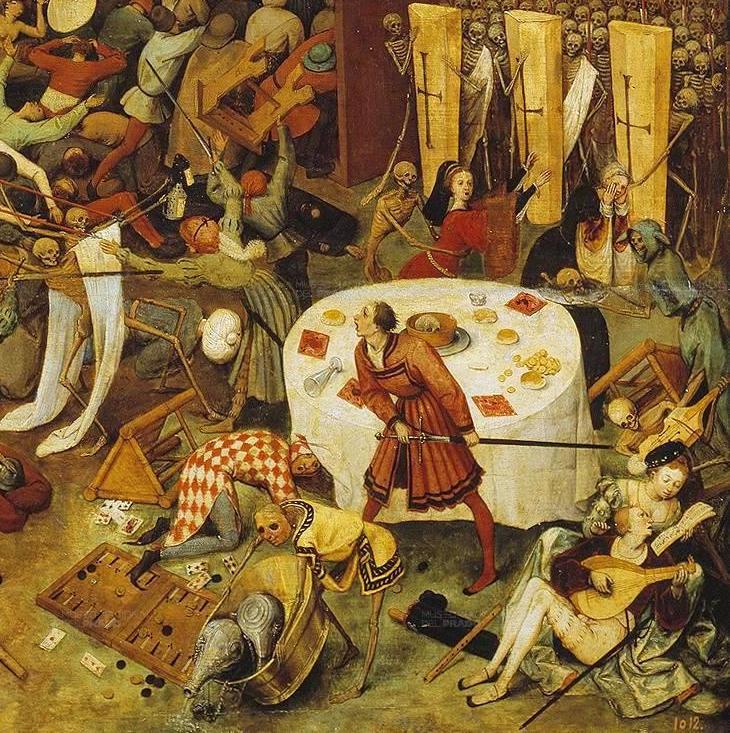
Triumph of Death (detail) by Peter Bruegel the Elder 
All realize the man will soon die. One cook slowly meanders over to a phone, shakily dialling to quell the emergency at hand. In a last gruesome attempt to breathe, the man on the floor has almost completely undressed himself. Swelling with heat, blood pours from his chest and mouth. Staring at me with empty, soulless eyes. I faint. 
_________
"Fires beneath the throat, hand and breast of a reflected sky
Inside the single-eyed, whose perfect clock chimed roughly over the groundless

Patience, dusting off wine bottles
Into Californian eternity
...

The idealistic round elegized by madmen before indulgent crowds,
A folklore, pained to vulgarity in the thick mire

Soaked with herbal grime,
That dream-forsaken wine of the ancient, pours

Sending women to mind thankless law
In the first civil war before nationhood or tragic mores

The fallacy in and out of sight,
Instantaneous with thoroughly flushed wives, fanning themselves awake

As the flies descend and drink their salivating gore-fest tirades,
The Queendom, saved by the ranting duration of a minor apocalypse

When all the rest of the world lies in tears
Shaken only by worldwide fame"

excerpts from "Co-creative Wondering"


Friday, 7 December 2012

Climate Changes Civil Society To Support Dreamers


"This morning Munira Sibai, a Syrian-American student with SustainUs, delivered this speech on behalf of young people (YOUNGO). Although many governments could not be bothered to listen to their citizens, civil society was present in force: supporting Munira and each other in a way that governments can only dream of. Onwards." Earth in Brackets BLOG (Dec. 7 2012)

Tonight, as I drifted away, I read the latest Democracy Now! headlines on climate change. Civil society and democracy are shifting gears for full speed ahead as the human race confronts the most pressing issue yet known to humankind: A Warming Earth. 

Read the latest World Bank Research analysis on the devastating impacts of unheeded climate change warnings. At 4 degrees warmer, the science begins to frighten. 

Earlier tonight, as I cycled home, I met a bewildered fox. Scared and nervous, we approached each other. My fear suddenly transformed as I saw fear in the fox's eyes. I glided past carefully. I witnessed this incredible animal confusedly find an exit from the paved city pathways to the nearby riverbanks. I think of Native proverbs that ask, "who will speak for our beloved animals?" 
________

The candles are now all reconstituted wax. The rain boils and steams before it reaches its earthen ground. The sky is on fire and I need a new name.

In Peril by John Atkinson Grimshaw
Through my window of impoverishment, a sanded frame of dirt, I see tanks spewing the ire of mankind. Fire is the breath of unreason. Violence spreads across the land.

Miniature diorama in the Herat Military Museum by Marius Arnesen
Bombs and machine tracks seed great pocks of holes in the earth. The clouds are dark with soot and anger. Lightning cracks through the smiles of silenced memories. Families are swept away like dust.

Lunshunku battle during the Sino-Japanese war (1895) by Unknown
Fending off the soul-puncturing thunder of war, I flee through the bureaucratic maze of a police state. Warmongers drive their piercing insanity into my eyes, as I feel my way through back entrances and obsolete hallways. The border embassy shakes at the foundation. Our earth will be interminably scarred. We are equally victims and perpetrators of widespread ecological domestic abuse.

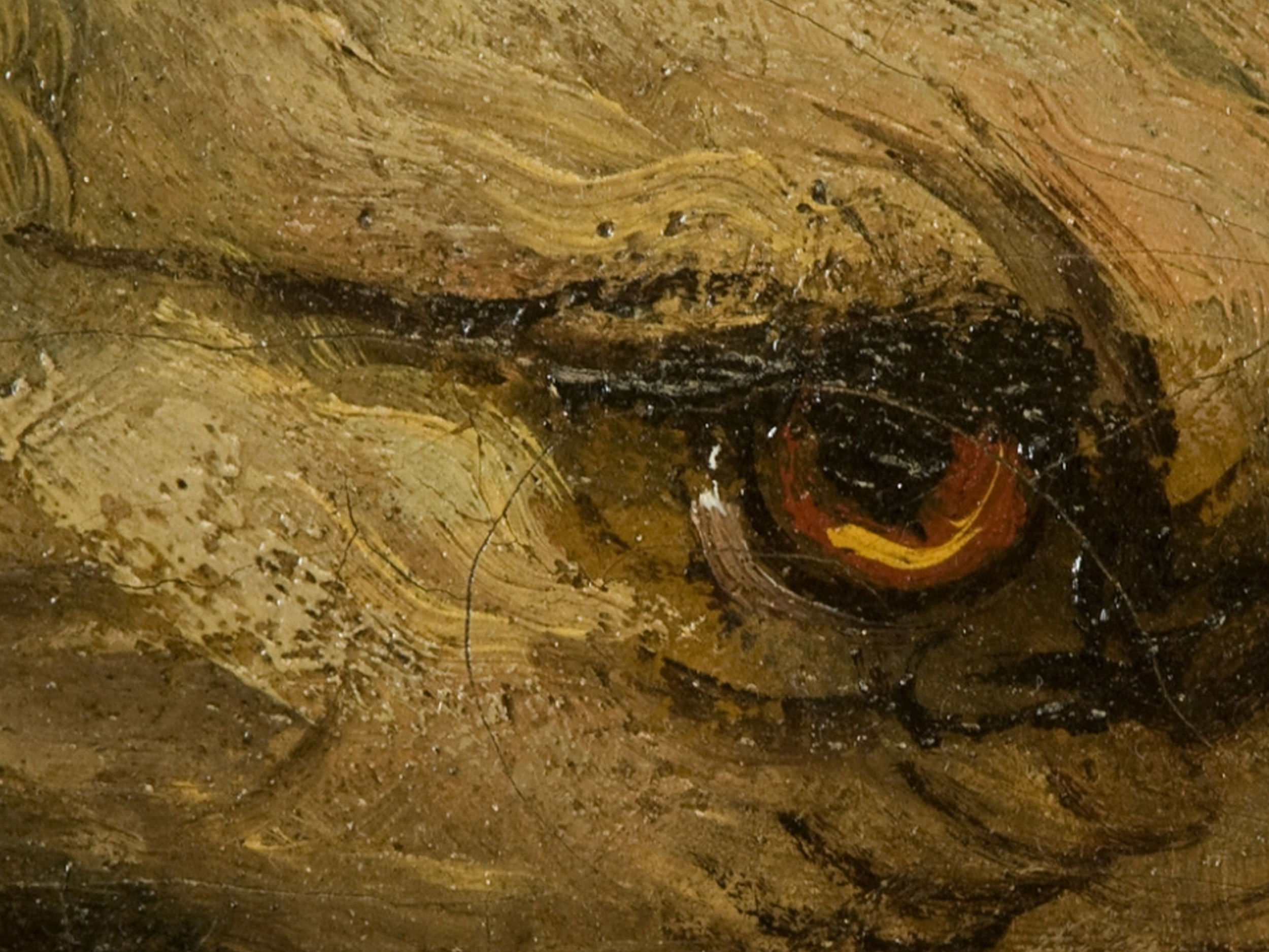
The Immaculate Conception, detail: Dragon's Eye by Giovanni Battista Tiepolo
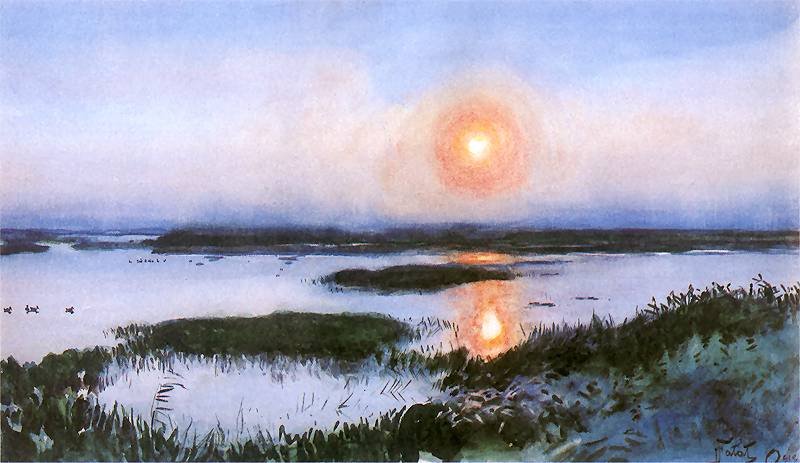
In a vile trench of near-death urgency, I climb out, and into the sun of borderlands. Having escaped the eruptive core of my country’s open, bleeding veins of disintegration, I wade in scintillating wetlands. Vibrant green pasture, lily pads and low-lying bogs hydrate my contemplative sight.

Sunset over wetlands by Julian Falat
I can almost see beyond the untimely closure of history. Birds and insects sleep with day, at peace, like me, in restful respite.
_________
"Escalations nerve-wracking, lonely murmurs murmuring

Crescent peaks dangling under bums grateful with uprooted membranous petrified and calcified flesh

Journey to roust the kneeling mind, with the desiring missed find, to be missed by nations feigning the patient behind swollen gum-brain awry, with skull-ache

“kinj moduls vrent speen og”

Desiring missiles
Desired missing
Failing nations

Patient fang"

excerpt from "Cajoled Spine-Tap"