Primarily a writing exercise, this dream journal-inspired blog is a quiet introspective sojourn into the process that we traverse in going from private dream to public art. I see our dreaming as an internalized mythmaking. As I philosophize and expressively exhibit dreams, both private and public, I encourage and delight in creative language as a way to practice experiential metaphors through a “public dreaming." Writing Theory: Creative Dream Fiction
Showing posts with label empathy. Show all posts

Saturday, 26 January 2013

Talmud and Dream Interpretation: Thoughts of a Secular-Cultural Jew

Talmud Readers by Adolf Behrman
“Dreams which are not interpreted are like letters which have not been opened.” Talmud

I am a cultural Jew, a secular Jew, an ethnic Jew. As singer Arianne Zuckerman once said, I am "Jew-ish". Yet, I revere the tradition of the Talmud. As far as I know, it is the source of a great wealth of pride in the intellectual strength and heartened closeness to tradition that Jewish people have maintained throughout generations. We have kept our traditions intact because we are flexible. The Talmud is a massive compendium of volumes steeped in argumentation, discussion, rhetoric and criticism on the sacred text of the Torah. The Old Testament is not Old, it is vivified by thousands of years of continuous self-criticical analyses and contemplative thought. The Talmud is the tradition of intellectual meditation on the sacred word. No wonder why dream interpretation is honoured, as the Talmud is one of the oldest forms of imaginative interpretation known in book form. For more in-depth understanding of this quote, see Erich Fromm's work "Forgotten Language."
__________
An old woman sits languorous outside the concert hall entranceway. Her excessive body weight slumps over a barstool with the heaping fatigue of an overworked heart. Yet, in her eye, there is a glint of sound reason, a harmonious vocation towards authentic humanity. I stop for a moment to share a few words with the curious and unseemly woman.

Woman playing a kithara by Anoniem
(Wall painting from Room H of the Villa of P. Fannius Synistor at Boscoreale)
I become so filled with sympathy for her life story. I run out onto the street, looking for a candy that I recently became aware that she enjoys. All I can find is a broken piece of chocolate on a dirty sidewalk. In my nervous frustration, I dust off the candy and walk back into the hallway. As I step cautiously through the alleyway to the concert hall, a man a few years my elder feels he must give a word of advice.

Two women at the street by Ernst Ludwig Kirchner
"There is no sense in your sympathy," he affixes his language to my throat like the strangling inexorability of truth. "I've heard too many racial slurs from the mouths of your likening. You'd like to give back, and yet you cry on a pedestal," he musters an incendiary rage, of darkening complexion under the flickering streetlamp. "How many times have I heard your story, I'm Jewish, so I can empathize," he continues unalloyed. "And when you speak of G-d, I am utterly disgusted."
____________
The Italian connection, un-swayed by the prudent fire of tango nights
       stirring wilderness roosts
                in the back hall of some sterling porch façade
                in the mundane sky of an after-party dimming
                       beside alcoholic whiteout praise
                       and the ruined name.

excerpt from "The ruined name"

Monday, 22 October 2012

The Twilight of a Psychopathic Civilization


We also, when building a relationship with people, believe that they are real. What a psychopath does is they weave a picture of a person that’s really a dream. It’s a spirit. It’s not real...When the psychopath is done with you, they leave. They’ve never had a bond with you. It’s all been a game…feeling no empathy…” Paul Babiak, psychologist, author of Snakes in Suits in I Am Fishead

I've showed this film to a friend of mine who has worked in mega corporations, and been subsequently laid off for his personable style of mitigating interrelationships between different interest groups. Simply  put, he was not a megalomaniac nor a psychopath, increasingly necessary prerequisites for keeping one's job in the field of human indecency, the corporate world.

I live in a city where oil corporations run amuck, seen as the life of the party, and there are Fisheads among us here, this is a city ruled by psychopaths, and the status quo lauds them. My friend, mentioned above, who worked for an oil company described their worldview well, "they are a storage and pipeline facility, and their worldview is as narrow as one looking down a pipeline."
________
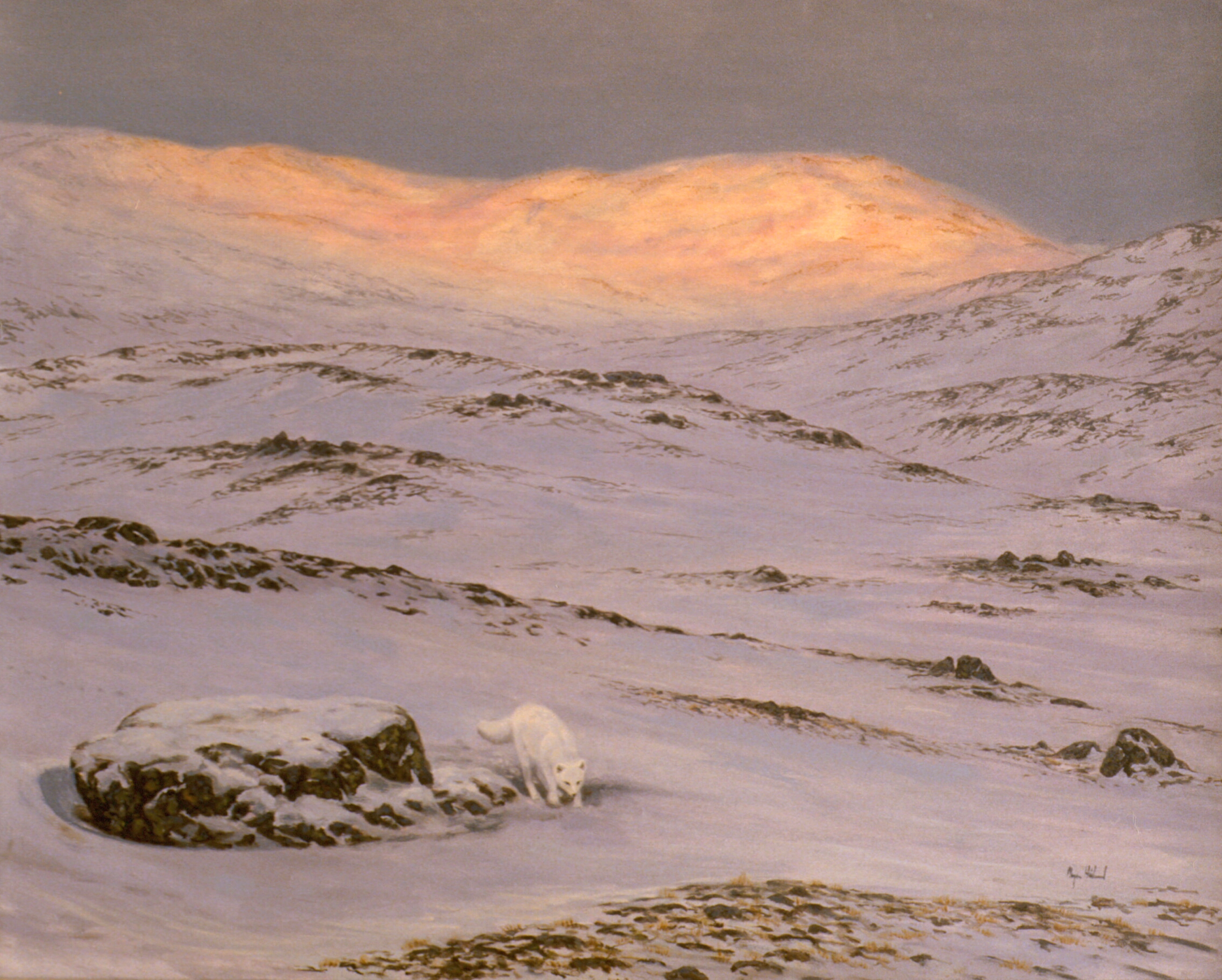
Arctic light fills the top of the room with a brittle delicacy, like the tooth of a gentle jaw in the unknown hours of a white night. I sit across from a well-known theatre music composer. In his characteristic black jacket, he eyes me with the filling presence of boreal light, as a friend in the mysterious haunts of a northern dream. I’m at work on an essay. The title marks a conscious turnabout towards the psychic rush of art in the unconscious; a memory become prophecy as the light dims and the man disappears with my thought.

Arctic fox in winter mountain by Magne Håland
Leaving my room for the main complex of the northern university, I feel on edge as concave walls cut with sharp angles into grass-laden gardens, while up above the window glass refracts the incessant sun with chilling delight. As I move through a room, I am accosted for passing over an international boundary.

Mikak and Tukauk by John Russell
An Inuit woman breathes with intensive definition as she explains the national boundary, seemingly on the grounds of the school. With a bright empathy, I willingly and pleasantly follow the guidelines and roam across the border daily, with attention and respect for the defense of physical difference. 
________
        Throughout the sanctified fields of one human home
                  Lived to the final digression into creative madness 
The right to be
        As connected as all beings
                  With electric happiness
                          Outside

Monday, 12 March 2012

Reading Predators on a Street of Arabic


“Reading, something most of us take for granted, can help unlock remarkable powers. Reading builds new connections in the brain, which in turn allow us to use written words as stepping stones to understand other people’s worlds. A good book literally has the power to change you."

Origins of Reading

"Our ability to use our visual areas to immediately know whether that object is prey or predator is actually being recycled for us in order to be automatically recognizing symbols."

Using Nouns as Verbs

"...it's like an evolutionary tool, that's to say it raises levels of attention, it primes the mind for difficulty, and the chances are, that it may be that it leads on to the mind being ready to take different pathways from the obvious one"

Creative Reading

"...I think that reading is a creative act in itself, as writing is, because you are creating something while you're reading it, you are bringing in your own experiences...when you can get into the minds of other characters and see what they're experiencing, it makes you better at empathizing...fiction has made me see things from other people's points of view”

Literacy and Empathy

"So, when we think of reading as purely about literacy, there's obviously another dimension to it, which is empathy."

From BBC Documentary “Why Reading Matters” documentary
________

Kasr al-Aini Street in Cairo, Egypt is primarily a street for government bureaucracy centers and large and lucrative local banks and other big businesses, however there are a good many small juice stands and cafes tucked away, one is called cafe Vienna. 

I find I am living on this street in a quaint little house, feeling something like the way how in Calgary there are random character homes sparsely interwoven in the city core. The insides and the outer wear reminds me of a ramshackle country house. The first time I exit the home, I am immediately met by a shady individual, a rotund young white male, who offers me money in exchange for delivering a package just around the corner at the gas station. Curiously, I take the package and run inside, asking my wife what to do! She vigorously reminds me that I am being foolish so I return the package to the exceptionally inexpressive young man. He takes the package back without question and rounds the bend, after which police storm immediately. 

In the next instance, we are at the house when a roommate is moving in. He is a man with dark complexion not unlike the local Egyptian man, however he seems more American in his mannerisms. He later tells me he is from Hawaii. He is a nice man. One day he helps us receive two amphibians and a fish. I am not sure why we have these creatures, however another smaller man, a caretaker of such amphibians, helps us all to cut them out of a stomach lining packaging. He says to be careful of the one as it spits mini-bullets. I take the creatures, beautiful and exotic to a pet shop, leaving them there. I return to the house only to find my wife is missing, I look all over our property in the dimly polluted urban backyard for any sign of her, staying awake in a candlelit room all night contemplating her loss. I don't feel she is dead, only that I may be in the wrong place. I am without any impetus to look. I simply wait, despite the presence of our Hawaiian roommate who offers to help.

_______

My fingers press into each letter
with a singular stroke
My head figures weightless across shoulder and palm 
holding up my brain box, short-circuiting

“What actually happened?”

“Conversations of new words
led to the experimental consciousness
of language
as a human creation.”

“What else?” 

- excerpt from "What Else?"

Thursday, 16 February 2012

The New West of Dreams

It occurs to me that the Old West has become mythologized to conceal things about our past that were lost. What did we lose? Who did we pass that loss along to?


Hollow in the snow by Jean-Baptiste Armand Guillaumin

Autumn leaves drape over the ground. The parchment texture moistens in places, as leaf pigments turn to resemble how I would imagine our internal organs. We are staying at a house, where the cool drafts pass through every corner, and the outside smells better than the inside. We are in the wilderness, though I feel close to home with my old friend from school days back in the Northeast. He’s his usual nonchalant self. We all feel the way one feels a few hours after chain-smoking for days on end. We’re moving on out. The trouble is, the only drivable car is with less capacity than can accommodate the five or six of us needing to get some more supplies in town. We hit the road, I leave my friend behind.

We soon arrive at another house in much the same condition as ours after a ride through the tamed highway wilderness. There is still a calling, leading us out into the mushroom pasture beyond the roadside horizon. We enter a house much like ours; it is empty, with cereal boxes punctured by hungry worms and roving mice. We manage to salvage some granola and milk. Some stay behind and begin to smoke comfortably upon upholstery pockmarked with careless fire. There is now room in the car for my friend, who I’m surprised to see. At the same time, I find it somehow predictable that he’s mustered a stealth ability to show up unannounced at any moment in this drably subdued, heaving chest of fresh air and color admired faintly around us. With immediacy, we are isolated from our past and our future. Yet, there are pinholes of awareness, where our perception heightens to envision the crystalline beauty of our surroundings. It usually happens simultaneously with my old time friend. We now both live in the North American West, though so many miles apart in this vast regional territory of our deliberately open, youthful minds.

We arrive in a town resembling Northern California, where many young men and women once moved many years ago and simply kept wheeling “trees” to all the naïve newcomer spirits. There is a winking eye of newcomer and seasoned residence in these parts, separating us only by distances of a few miles at a time. Blonde dreadlocks and glass-blown artistry melt in a haze of fruitful laughter amongst new kinds of friends, whose eyes touch upon the truth that most friendships disintegrate into a stock of fiends. Now, we are unstable, and lack any apparent humanity in this consumptive island of molten bread and wallowing dreams.


The Page Mazeppa by Jean Louis Theodore Gericault


The dry air is crisp and cloudless over a small town in the dead of the Colorado winter. A silence is treasured with each step. The conservative decisiveness of every citizen follows quickly behind me, like a lingering pet surveying one’s every move. I clamber down from a high iron fence. I see two friends in dense black coats. They greet me simply and inexpressively move on further along their frozen sidewalk path.

There is a young local friend of mine. She is a masculine young woman, resembling Jean-Michel Basquiat in some features of her unadorned, spindly matted hair. She is a bold, creative type, yet stifled with destructive emotion and nasty habits. I can see her hiding a needle in the thick folds of her winter sweatshirt. She walks out into the grayscale concrete light, dimming with a vibratory curse, a mathematical fate, to put her underground. So, she thinks, she will take her life into her own hands, and throw the trash out herself. She shoots up, and meets a couple of tall white guys on an outskirts corner near an open field. I see them as I walk past one morning, thinking of how she was killed. The image of her walking away from me endures.

"whose giving breathes iridescent crystalline surety
under a city lain bare as a leafless twig 
in the winter of human occupation

over the frigid glare of our northern memories
fickle, as we approach a secondary wisdom
understood from blind precepts
that erase the open wounds found in deep cleansing
and spiritual promise"

- excerpt from "The Mythic West"