Primarily a writing exercise, this dream journal-inspired blog is a quiet introspective sojourn into the process that we traverse in going from private dream to public art. I see our dreaming as an internalized mythmaking. As I philosophize and expressively exhibit dreams, both private and public, I encourage and delight in creative language as a way to practice experiential metaphors through a “public dreaming." Writing Theory: Creative Dream Fiction
Showing posts with label Aboriginal. Show all posts

Monday, 16 September 2013

For the Love of Humanity: An Essay on the Ecological Auschwitz of Canada

Dostoevsky's notes for chapter 5 of The Brothers Karamazov
"You see, I so love humanity that—would you believe it?—I often dream of forsaking all that I have...I close my eyes and think and dream, and at that moment I feel full of strength to overcome all obstacles." Fyodor Dostoyevsky, The Brothers Karamazov

“It's a scandal,” environmental activist Tzeporah Berman shouted to an encamped crowd at Indian Beach the night before the Healing Walk. Imagine, each and every CEO to all the employees of the oil and gas industry, blatantly raping their mother and profiting obscenely in the act. The Tar Sands scandal has gone viral. The proposed Enbridge Northern Gateway pipeline “is probably the most controversial project in the history of British Colombia other than perhaps Claquoyot Sound logging operations,” said Ben West, Forest Ethics Tar Sands Campaign Director, at a Project Ploughshares event in Calgary on April 27.
It’s been the #1 talked about news story in British Colombia now for two years running. In fact there is a study that was done that shows all the next five stories, in terms of coverage, if you combined all the coverage, still did not get as much coverage as the Enbridge Northern Gateway pipeline in the last two years.
The entire world is a voyeur to the most heinous crime of physical abuse on Earth today. “All fights, all battles for the planet are important, but some are more important than others. And there is no battle on the face of the Earth more important than what’s going on here in Alberta,” Bill McKibben, climate change scientist and founder of 350.org, said for the outdoor press conference immediately prior to the beginning of the Healing Walk. “There are three or four places on planet Earth where there is enough carbon below the soil, that if it gets dug up and burned, then there is no chance that we’ll ever stabilize this planet’s climate, and this is one of them.”

Yet, since 1967, when the first commercial project began to exploit the Athabasca Tar Sands, the crime intensifies to the benefit of a society corrupted by cheap oil across Canada, and around the world. “From the seven pipeline spills in the last five weeks, we know that oil corrodes, and what we’re just beginning to learn is that it’s not just corroding our pipelines,” Berman asserted. “Oil in Canada is corroding our democracy.”

The 4th Annual Healing Walk, attended by about five hundred demonstrators, sent a clear message: local people matter, have voice and are strongly represented across the country and the world. While international activism often necessitates globalization and fossil fuels to wage peace on the Tar Sands, the First Nations in and around Fort McMurray, the Athabasca Chipewyan and Dene peoples, are leading humankind by simply walking, in prayer to the Four Directions. Because of ancient wisdom and the spirit of traditional ceremony and community, industrial traffic slowed to a near halt as far as the eye could see on July 6 around the 14km Syncrude Tailings Loop.

“When I went into that town of Fort McMurray, you know what it reminds me of, it reminds me of going into the town that’s the ecological equivalent of Auschwitz,” Anishinaabe author Winona LaDuke proclaimed during her keynote speech the night before the Healing Walk.
“The town that’s sitting right next to Auschwitz and saying, ‘Hey, we’re good here, you can get a $35 steak, you can get an $18 hamburger and it’s okay.’ There’s something just psychotically wrong with all that.”
LaDuke’s Auschwitz comparison, especially in the light of modern consumer culture, is significant. Another outspoken critic of power politics, Hannah Arendt, had once led a scandal, transforming international dialogue on the perpetrations of Auschwitz into a parable of modern life. Arendt’s notion of the “banality of evil” speaks to the mass consumerism that fuels the current destruction of the planet. Status quo consumer society encourages technology and energy overconsumption. One tier of society justifies through intellectual analysis regarding energy, society and the environment, while most are overwhelmed by the unreasonable complicity of leadership.

Therefore, most people remain ignorant of the fact that their immediate, daily actions cause the very atrocities committed against marginalized people and the environment. Espoused in 1961 during the Eichmann Trial, the philosophy behind Arendt’s “banality of evil” teaches how everyday people perpetrate the greatest crimes of humanity, often more so than their leaders. The idea is slowly gaining acceptance among genocide scholars, such as in Daniel Jonah Goldhagen’s Worse Than War.

“If you breathe air and you drink water, this is about you,” Crystal Lameman, Treaty 6 activist of Beaver Lake Cree Nation, declared at the beginning of the Healing Walk at Crane Lake Park. If the great-grandchildren of Canada look back on the current generation, will they see the current society as people of today see Nazi Germany? As the Jews were liquidated for business purposes, so the Earth and its First Peoples are being bought and sold, and killed in the process, for the liquidation of bitumen tar into petroleum gasoline. Every day, Canadians are told that progress must continue and economic growth must never regress for any sake outside of myopic anthropocentricism and politicized Canadian values.

“On the eve of the NEB hearings for the Enbridge pipeline, when our National Minister of Natural Resources put an open letter to Canadians [in the Globe and Mail], calling anyone who opposed these pipelines a terrorist,” Berman reminded demonstrators camped only fifteen minutes away from Fort McMurray. “Essentially saying that if you express concerns then you are acting against Canada’s national interests, that you are an enemy.” When environmentalists and Aboriginal peoples who oppose pipeline development are deemed terrorists, political-economic rhetoric in Canada begins to look more like that of the Department of National Defence.

Dissuading public debate is typically fascist. The undemocratic nature of the petro-state further supports the colonial Eurocentric project of civilization, where marginalized minorities, such as Indigenous peoples, are meant to suffer the growing pains of modernization. Indeed, modern progress is often underhandedly defined by the achievements of warfare and genocide against marginal ways of life.

The Canadian infrastructure, as with much of the world, is dependent on the continued suffering, and the scandalous crimes, of the continued power imbalances from the colonial past. “We’ve got to feed these people that consume a third of the world’s resources. That requires pretty much constant intervention into other peoples’ territories, whether they’re Dene, Anishnaabe, Cree, or whether they’re in Venezuela,” LaDuke said with a voice of experience and reason at the Healing Walk. “Constant intervention into other peoples’ territories to keep up this level of entitlement.”

Today, there is global complicity in the status quo, in the consumers and beneficiaries of non-renewable energy resources, and its concomitant intergovernmental policies. If Canada survives into the future as a memorable entity, people may look back on the country as yet committers of yet a deeper atrocity, against Earth, and as with a genocidal inclination towards the entire human race.

Will others follow in the example of the First Nations of the Athabasca river basin, whose warnings resound with deep socio-ecological truth? Will Healing Walks spring from the people across the Earth, so that in the name and significance of Mother, the destruction stops and healing starts? Are people around the world willing to stop the destruction and walk for the healing of the Earth, to find a path that slows the destructive course of industry (business) as usual and that offers, not one direction alone, but Four Directions, whole and undivided? When will people begin to pray through movement, action, and participation?

Around the same time that unparalleled innovations in alternative energy came to the fore, there was a great leap in Western consciousness of natural philosophy. Contemporary science is providing the world with unprecedented advances in material technology and innovation. “The last two years, we have seen more advances in clean energy, in renewable energy and technology, than the last twenty years,” said Berman, at the close of her keynote speech at the Healing Walk conference at Indian Beach. “The last two years were the first two years in human history where new investment in electricity generation for renewable energy, for wind, for solar exceeded new investment for electricity in oil, coal, and nuclear combined!” Nonetheless, today there is a greater vacuum of innovation, and that is within the human mind. The current struggle for life on Earth is within each and every human being bridging the great rift between modern life and ancient wisdom.

“I think what has to happen is a change in understanding. It’s not a matter of power, or of muscle or of energy,” the late philosopher Alan Watts said in the documentary, Zen.

It’s a matter of the way in which we understand and feel our own existence, not as strangers in a hostile universe, but as integral parts of that universe, as fruits of the universe, in the same way as an apple is a fruit of a tree we are a fruit of this galaxy, we belong to it, we are something it’s doing, but we don’t feel that.
Similarly, in the name of modern physics, the same basic knowledge that allows for the expansion of physical technology offers renewed integrations between ancient wisdom and modern life. The same way of applied thinking – that might destroy life on Earth when derived from philosophies of conquering nature and ethno-cultural assimilation – would also affirm interconnectedness with all forms of life.

Yet, petro-state fascism muzzles scientific inquiry that affirms rootedness, while ensnaring science with political ideology. “The internationally recognized journal of Nature this year, in an editorial, said ‘It’s time for Canada to set their scientists free,’” Berman, author of This Crazy Time, said at the Healing Walk. Science, as a truly inventive field of human inquiry, would logically presuppose the very undoing of its concurrent technological manifestations.

“The natural environment is treated as if it consisted of separate parts to be exploited by different interest groups. The fragmented view is further extended to society which is split into different nations, races, religions and political groups,” physicist and international best-selling author Fritjof Capra wrote in The Tao of Physics.
The belief that all these fragments – in ourselves, in our environment, and in our society – are really separate can be seen as the essential reason for the present series of social, ecological, and cultural crises. It has alienated us from nature and our fellow human beings. It has brought a grossly unjust distribution of natural resources creating economic and political disorder, an ever-rising wave of violence, both spontaneous and institutionalized, and an ugly, polluted environment in which life has often become physically and mentally unhealthy.
Life is without meaning, not because it is despairing, but because it requires no other meaning than itself. Life itself is significant. Life is self-renewing. Modern human life is more and more devoid of a connection to the sources of life, and so, the mind, and its encouraged symbolic outputs, estranges daily existence from the nature of life. Proactive language (e.g. solutions-oriented media), as with the most advanced scientific thinking, gives voice and agency to ways of life that are self-sufficient, yet still recognize the interdependent nature of life.

The First and Original Peoples of Turtle Island, Aboriginal Peoples of Canada, continue to share the fundamental philosophical similarities with the ecological consciousness of wise, ancient cultures from bygone eras and faraway lands. Understandings that had once triggered a revival of interest in the practical philosophies of interdependence and rootedness are not only springing from Western science itself, but are being voiced by the First Peoples of the Land with greater potency. “Science is important but only if it’s governed and held in check by wisdom, and that wisdom that people have been ignoring for hundreds of years on this continent is finally reasserting itself at exactly the moment when it is most needed,” Bill McKibben said to close his speech only moments before the Healing Walk began.

Bad news is good news. Spotlight triggers response, and, at the end of the day, people think as they please, or, more accurately, as is pleasing. Regardless of what it is called, Oil Sands, or Tar Sands, industry gets the lip service. “I don’t want to squander my energy entirely on being reactive, on being reactive to their craziness. Be clear on where we are going,” LaDuke stressed with grounded intensity. “It’s our choice upon which path to embark. One miikanan [path] is well worn but it’s scorched. The other path, they say, is not well worn but it’s green, and it’s our choice. It’s our choice. That’s what our people said about 800-900 years ago.” The ancient wisdom of the Anishinaabe prophecy for the time of the Seventh Fire shared by Winona LaDuke at the 4th Annual Tar Sands Healing Walk offers all a path, or miikana, to a future that is fresh and green, and very simply, to a future.

Beyond pro- and anti-, beyond reaction and action, there is a beginning; a place, from where all people would begin life renewed. That beginning is the elephant in the room; it is every last man, woman and child. In the name of Mother Earth, the Original Peoples along the Athabasca River, and every Healing Walker: All my relations.


This piece is featured in the current print edition of Dialogue Magazine

(If you would like to have a FREE copy of the issue wherein this piece is printed, please notify the magazine or the author)

Also, read my Spotlight piece, "Tales from the tar sands" in the current September/October print issue of This Magazine in an online exclusive at The Media Co-op.  
_______________
blessed horn
entranced night
korean shades
light buddha
sun hat
_______________
The album "Evocations: district.Columbia" is an experimental narrative sound art exploration into the text of the collection, "district.Columbia" releasing the first single, "New America" to incite the forthcoming album on the inaugural day of Aboriginal Awareness Week in Canada is auspicious and serendipitous in its symbolic import as an album whose narrations were triggered by an inner voice of resistance while in Washington D.C. where I began to dedicate myself to the literary vocation in light of my own personal development in the commission of truth - as in the social justice of 9/11 and Truth and Reconciliation truth commissions - to address political and historical-religious misinformation.

My creative work is in keeping with a lifelong demonstration to voice silenced histories, in honour and recognition of the atrocities committed against first peoples of the land, whose history, while older and more enduring, while land-based and unfathomably rich, is snuffed out by the dominant settler narratives of media and education that continue to ride the oppressive waves of war, colonization and assimilation in the ongoing struggle for american freedom that continues to this day. "Evocations: district.Columbia" is a sounding directly from the heart, unmediated by the delusional independence of exclusive american identity, for an end to the war on freedom


Inspired by the pre-colonial and pre-revolutionist metaphor for America, “Columbia,” a Goddess of Freedom, as an archetypal myth, once proudly personifying poetic optimism through feminine form. Through these writings, I personify the process of mythmaking as a dedication to compassionate awe and voiced protest in the historic confrontation with self and nation. The name Columbia was immortalized immediately before the Revolutionary War in 1775 by Phillis Wheatley, the first African American woman to publish her writing, in her poem, “His Excellency, General Washington.”

Written primarily based on a visit to Washington D.C., this collection is a vocal reclamation. These chronicles present a visitor returning to his home country, where visitation is defined by traversing an international land border. I represent my struggle to reclaim and recognize my unique voice. In these pages, I confront the realization that I am, in certain respects, an inheritor of the American way of life. Regardless, the inheritance is fraught with the psychological complexities of exile.

In this reclamation, I throw off vestigial principles of experience. I attempt to revision a new way of being through the living temperance of the written word, and specifically, my own practice of stream-of-consciousness writing. Such revision includes confronting a natural process of self-awareness, whereby self-expression revolutionizes into an identity with nature as a self-perpetuating source of renewal and life.

Spontaneous word creation, or improvisational writing, is a natural activity of the human mind. There is a power within that endless fount, that when regularly tapped as a spiritual practice, unleashes one’s surroundings with an ever-renewing energy. Such a practice motivates one personally, to interact with one’s immediate environment in dynamic ways. The reason for this effect is because in this practice, which actualizes into a way of being, the present moment becomes central. When the present is cherished with just significance, the mundane begins to breathe with new life.

The practice of improvised writing, in this sense, outlines a processional transformation in throwing off sterile notions of self and environment. district.Columbia begins by defining autonomous interactions between self and environment (as to parallel notions of the “New World” for pre-colonial Europeans and pre-revolutionist Americans) and ends with a declarative pronouncement; to create an openness to uninhibited spontaneity in personal creativity and a diverse awareness in social activity in our public spaces (as to parallel the current fomentation of creative social activity blurring the lines of public and personal art).

Monday, 25 March 2013

Experimental Cave Art: Philosophies in Word, Vision and Sound

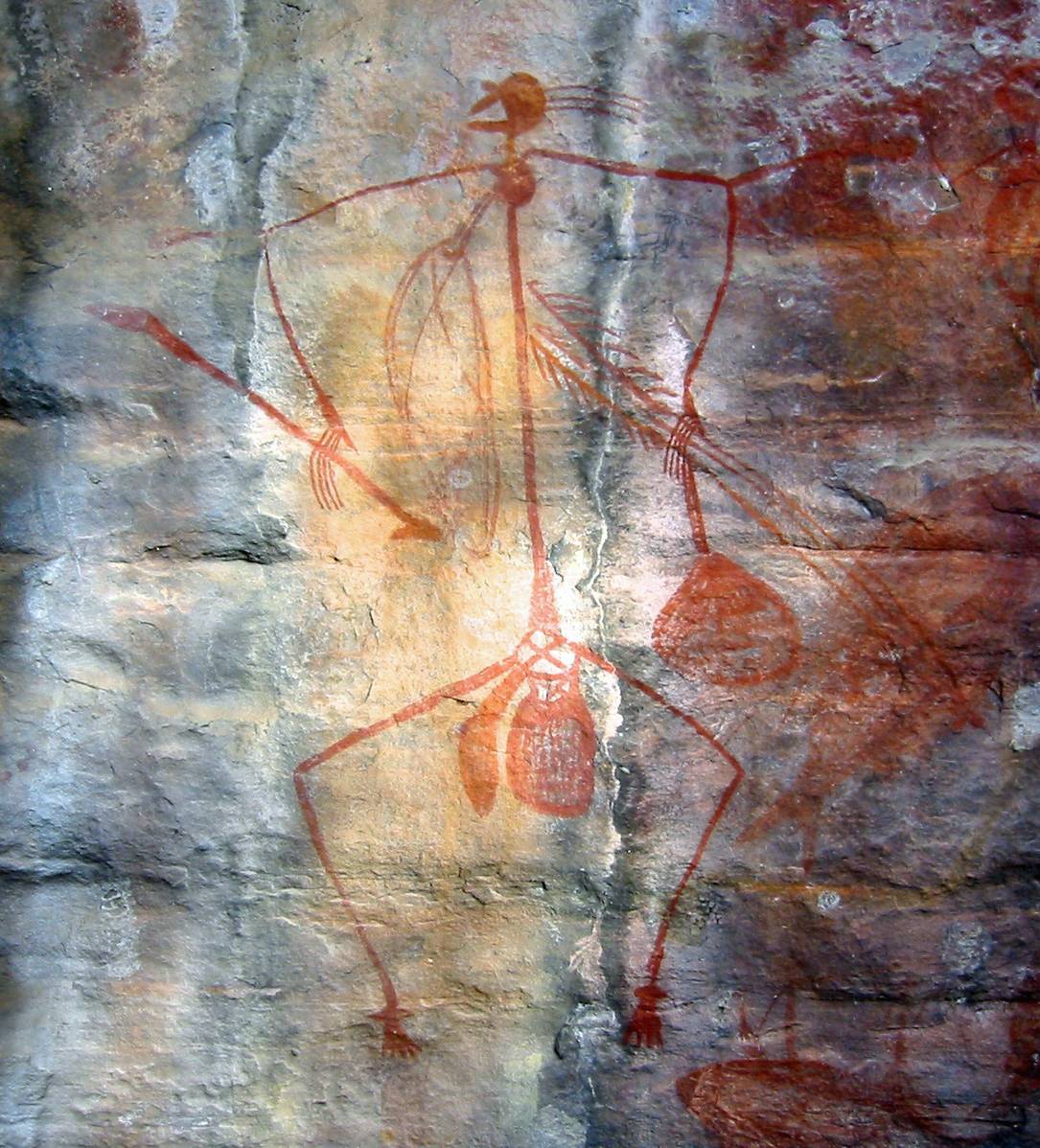
Aboriginal Rock Art, Ubirr Art Site, Kakadu National Park, Australia
Photo: Thomas Schoch
“When your night becomes day, then that which is dreamed is on earth. Do not be too high-spirited, but go, and go alertly.” Aborigine Saying

In continuity with the theoretical writings on the natural sleep cycle as expansive beyond the twenty-four hour day, and especially beyond the programmatic workaday cycle, it is not only the activity of waking activity that might define the energy experienced by the mind-body based on sleep cycles but the content of dream itself.

For example, we go through cycles of remembrance and forgetting, this is a fundamental attitude of the cosmos, as we see in the natural tendency to the peek-a-boo gameplay in all children. Similarly, as this is reflected in our conscious and unconscious experience of life, so this is true with the content of our dreaming. We will go through periods where dreams are not remembered, and then after a time, will begin to remember again. These periods of remembering the content of dreams ultimately point to an unresolved momentum of energy building up in the psyche as a consequence of either personal or collective unconscious activity that one becomes susceptible to in their daily life.

Until this mode of consciousness is directly confronted and transformed through creative insight and practical application in thought, reflection and in some basis of continuity in consciousness, e.g. imaginative outpourings based on the theme and nature of dreaming, where all suppressed and repressed energies are focused and shifted into full view, the involuntary sleep or unconscious REM will continue to emerge and take shape in the psyche through imagination, emotion, intellect and every exhaustible mode of subtle activity.

Every time a dream is remembered, the remembered content, whether imagery or emotion or otherwise, is part of a string of remembrance leading back to a source of reflection deep within the whole being of both the individual dreamer and the society throughout the entire spectrum of its history, propaganda, knowledge, media, relationships, etc.

Oftentimes, the strength or immediacy of memory, the lucidity of the dream state as it interweaves through the waking mind, forecasts the urgency of attention to the subconscious. For example, I have experienced lately that the instant I am ready to sleep, as fast as I close my eyes, I see the content of my dreaming, the imaginations is teeming with life and energy, needing to be witnessed, calling out over the margins of consciousness.

The only way to resolve the inception of remembered dreaming is to confront the subtle impulse to emote or inspire a certain inborn expression, metaphorically illustrated in the dream itself. When dream and life are subsumed into wholeness, undivided by the normative values of structured time and analytical thought, the subconscious and the conscious merge into a healthful surrender of the cosmic unconscious faculty of Being, as the great mystery of self-awareness. As reads the motto in Athanasius Kircher chiseled over the alchemist's doorway, originally in Latin, it says, "While Sleeping, Watch'. See previous post: Alchemical Poetry of Terence McKenna
_________
Breathtaking hot night. The empty dark dream of memory. Narrow canals, irrigation trenches in the backyard under a pitch-black sky, a starless new moon. The seizure of domesticity; fencing blinds besiege all passage to horizon’s beginning, and a house cat skits through the mud with a silent flit of dusty soil. A chase begins, until I grab the fickle creature by its muzzle, and in the raw and ruddy brown earth, I tangle its fibrous backbone, cracking the living spine with the brute edge of my wrist. The sky clears like a strong exhale, and the ground takes formless cover of the starless sky above. I drift away from a mind to a life as inert as the swift welcome of death.

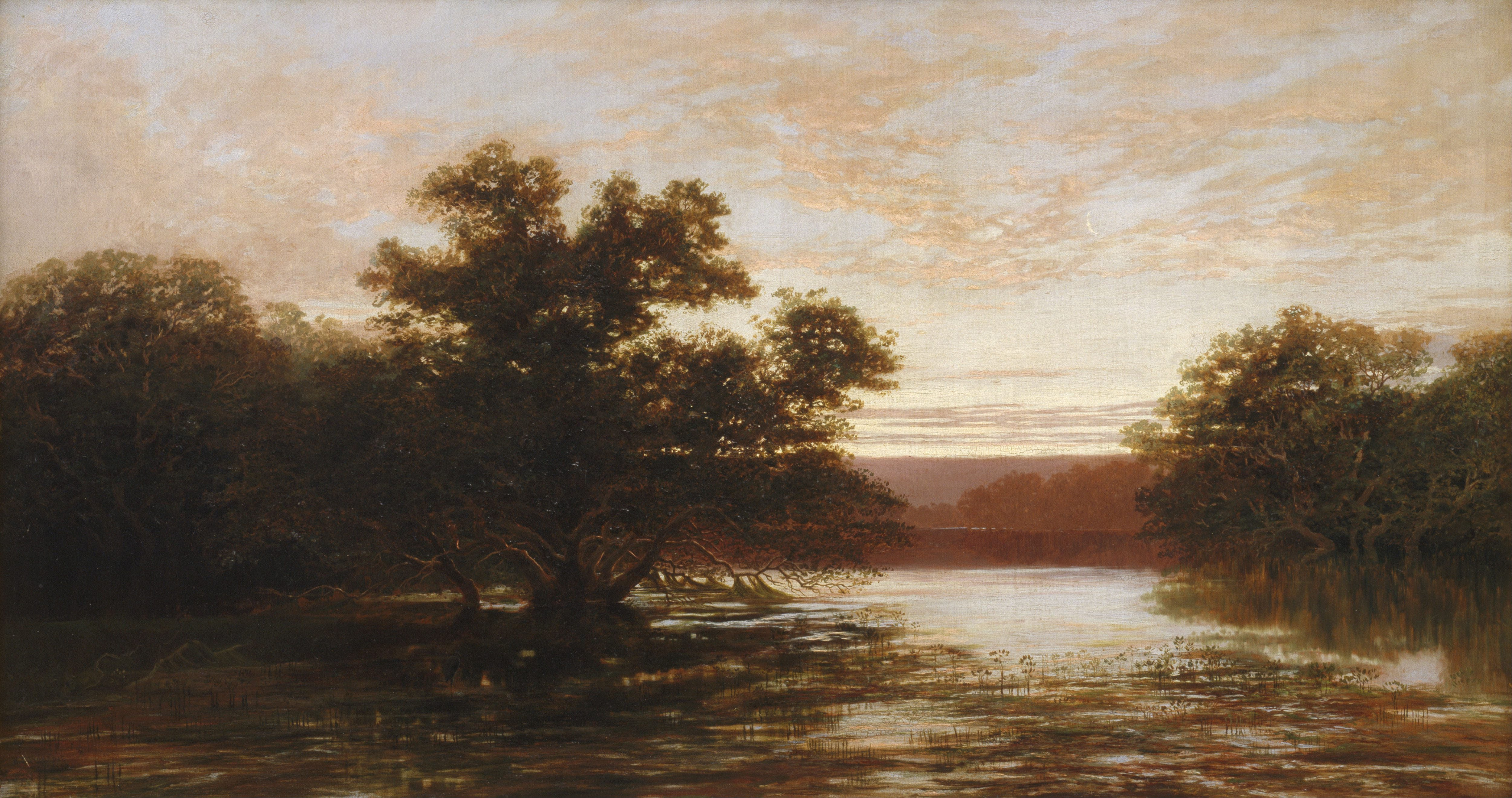
An Australian mangrove, ebb tide by WC Piguenit 
Worshipful room of sweat and lust, the emotive spring of music keeps us swinging to a joyful noise, the urban sound of pain alleviated before closed eyes, staring inward to hear the sight of the muses, invoked by the musician hosts sweltering mad before a small though dedicated crowd of movement. And the headline group enunciates first note with strength unseen; the crowd has since escaped into the bleak, old night. A few straggling local friends stand by the stage, amused and apologetic. One song passes in the silent hollow, a space deemed fit for thousands reduced to pin drop nothingness.

Musical entertainment at the spinet by Johann Heinrich Schönfeld
The emptiness is as palpable as the heartless mind, rounding off pales shots into the murderous pangs of repeated history, the bitter angst of adolescence returning in a white noise of a flushed and ruthless voice, the weird ground rumbles and quakes with burning trust; that a future still opens ahead – full and potent with renewing vigor, to wake again, and live the day from the start, even if our rise coincides with dusk. A silent vision unearths our eternal belonging with grace, and the human community within, where the heart is still in its constant beating, in its rhythmic patience with a more sacred trust.
__________
An elegiac satire on split vein of domesticity, as it unravels and spurns the knowledge-creation of a more unstructured style. The home is the centrepiece of domestic life. Yet, for many thousands of years, there is evidence that we were in fact cave-dwellers. "Caveless" muses on nostalgia for those cavernous days through a reading of "Cave! Home", about a time when petroglyphs and charcoal painting were more important than off-white, beige and any number of dull, and sterile wall aesthetics, and the great-image language of visionary rites were outweighed the significance of antique literature. How can we resurrect the idea of the cave in the context of the modern home, with its womb-like contours and living light that curls throughout our waking minds like breath, and infiltrates our dreams like a warm lover enduring a midnight meditation at our feet?

"Placeless Human Society" is also read here to recognize the dramatic shift from our ancestral pre-history as cave-dwellers of imagination and earth, where suburbia (and its non-subordinate counterpart: the city, for that matter) has essentially uprooted us from this inborn life as a dweller from the earth. On a mass scale, we now dwell on earth abstractly, our imaginations have breathed on, yet the umbilical cord to the womb-cave-home from whence we emerged has long been cut.


"Cave! Home" was published in 3:AM Magazine on September 17, 2012 and is also featured in the most recent chapbook, "Creating in the City" which was released with "When No Stars Appear".

"Placeless Human Society" was published in Outward Link on November 7, 2012. The "Caveless" track release marks the release of the chapbook, "Suburbia to Suburbia: America-Egypt".


Monday, 14 January 2013

The Voice of Youth: Stories from Idle No More


It was a Friday afternoon. I listened to the video above the morning of my phone interview with Rob Stewart. I had read that Idle No More was quickly becoming a global movement to follow Occupy with equal weight. It was time to dispel my own pipe dreams. I needed to see what may be the greatest current change movement for myself. 

It happened to be one of the coldest days yet in the brutal Calgary winter season when I began to ride my rickety bike south from the downtown core. Not only was it especially cold, but there was record snowfall the day prior. I tread forward, over the blinding snow, into the untended parkland trails ahead. Three hours later, I made it to my previously unknown destination: Prime Minister Stephen Harper's Calgary constituency. As soon as I saw the demonstrators, I was immediately shocked with disappointment. I stared, from my bike, over to the sparse crowd, filled with boredom and teeming with weakness. There were only a handful of people. The only time I attended  a demonstration previously, was when George W. Bush came to Calgary after his term as president. That was an incredible showing, one of the most emotionally exuberant and lively demonstrations I have known in Canada. I left, curiously pondering with a comic bent, "Do Canadians only protest in numbers when the issue is to oppose the States?" 

In the United States, where I'm from, I was a frontline demonstrator in anti-war marches to the Pentagon, "No War" rallies in Boston, and magnificent protests in support of Latin American resistance in New York City. A public demonstration is a place where the old and the young meet, to exchange hearts on a platform of free speech and free assembly with the naked flesh of human freedom. I stayed outside Harper's constituency only for a few moments, to place myself in the crowd, and continue on my way to a Metis friend's house to buy him coffee. The next day, my wife attended the more crucial demonstration. I've posted her brilliant story on Media Co-op.  

_________
The true war is now officially being fought in our backyard.

Things are lookin' up by (Kjarvik)
Before it is dark a light will shine through the clouds (Kjarvik)

May All Youth Live Free on Earth (Kjarvik)
There's nothing in your way (Kjarvik)
Heaven on Earth (Kjarvik)
__________
"Matter disguised as her unfolding paradise,
A genital incision, without

Brewed spawn all quaking and facing heart failure
With thick-rimmed glasses and a paranoiac daze,
A thin glimmer of repose
...

Useless triviality
In the maze of Puritanical property and stubborn consensual heavens
Drowned in blue time
...

Oceanward,
Where the thumb and nose meet at the spun wheeling whys,
Whose greed lurched from above the lily swamp and naked,
Pressed their white head to the diamond name"

excerpts from "Pulp Massage"


Wednesday, 26 September 2012

Dreamtime and the Repatriation of Sacred Letters

Stencil art showing unique clan markers and dreamtime stories symbolising attempts to catch the deceased's spirit
"The source of the word alcheringa is Arunta, an aboriginal language of Australia. Sometimes translated as “the dreamtime,” it refers to a mythic world that existed at the beginning of time and continues to exist in our own time as a parallel world, revealing itself whenever we dream and whenever someone speaks or sings a myth." Dennis Tedlock, An Introduction to the Alcheringa Archive (From Jacket2, also on Jerome Rothenberg's Poems & Poetics) 

In the first edition of "Alcheringa" a quote reads, "He who loses his dreaming is lost", attributed to "Australian Aborigine". In opening of the Autumn 1970 journal, the final "Statement of Intention" reads, "to combat cultural genocide in all its manifestations". That being said, it is curious to read such studies as that printed in the Australian Journal of Media & Culture (vol. 2, no. 1 1987), where an article by Vijay Mishra entitled, "Aboriginal representations in Australian texts" reads, 

Forgotten I lost dreaming
Country I left forgotten lost 
which is epigrammatieally reduced, by the translator T.G .H. Strehlow, to "He who loses his dreaming is lost," is directly related to a failure to perceive the radical difference between oral poetics (the fluid verse translation) and the wrillen text (the epigrammatic reduction). Obviously no one can maintain a total separation of the oral from the written.

Meanwhile, if one searches in the active publications of Australia's Central Land Council, an Indigenous repertoire of activism and scholarship dedicated to principles of sovereignty, there is a very interesting article on the Strehlow, the subject of lost attribution in Alcheringa's English translation from "Australian Aborigine"entitled, "The Strehlow collection of sacred objects" regarding further issues of repatriation, while focusing on the repatriation of sacred object collected by the modern anthropologist, as opposed, in the case of Alcheringa, the repatriation of sacred letters, collected by post-modern anthropologists of world literature.

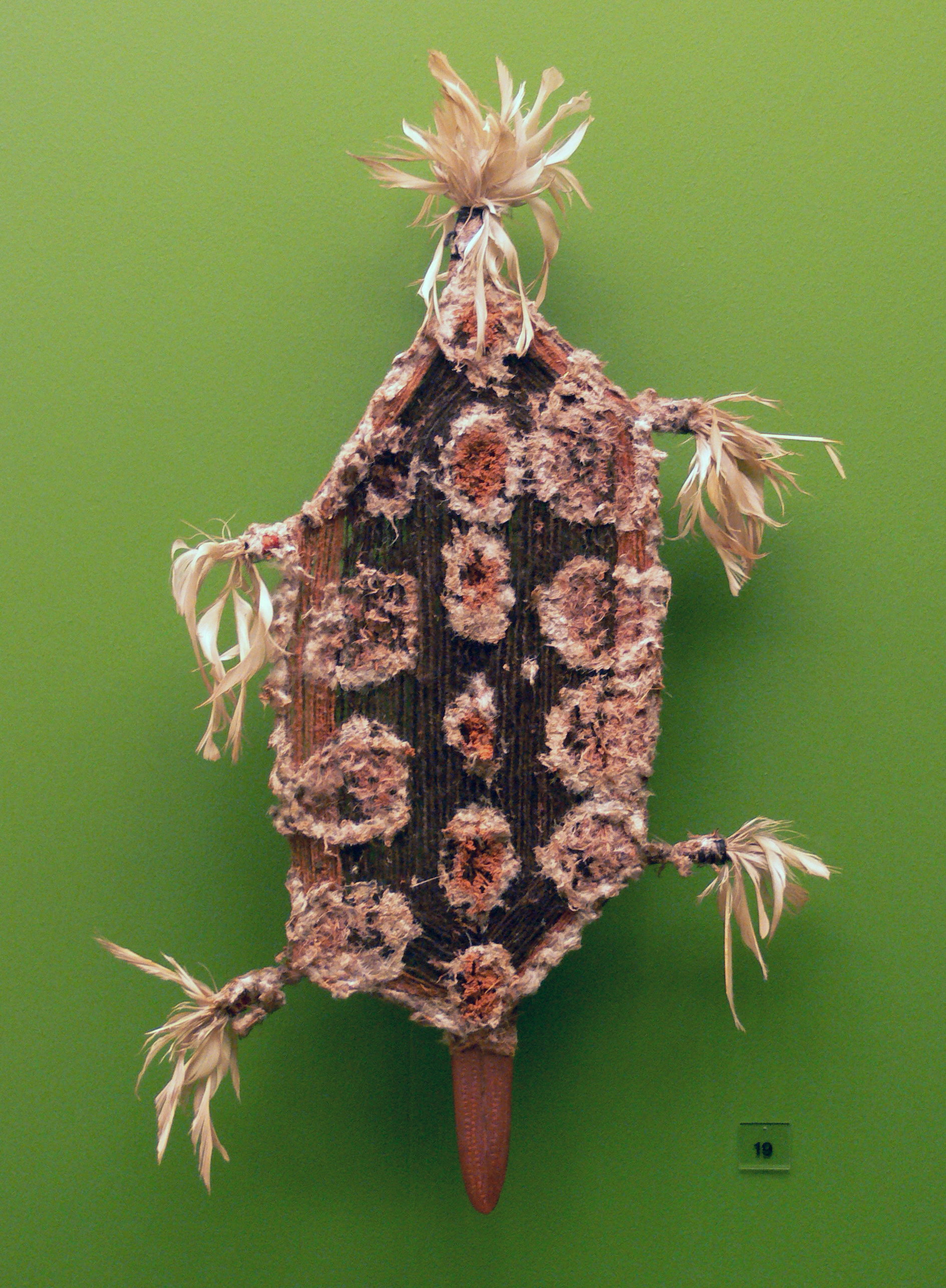
Headgear worn during dancing (wood, human hair, kangaroo hair, feathers); Arrernte people, Australia
________
My mother visits her perception of my reality. North of here, it gets even colder, earlier, and winter is almost perpetual. I ask her exactly what her interests are. She is unresponsive. There are two streets that accommodate visitor appeal, with cafes and the like. We walk on the frozen sidewalk ground. A haze of white ice sheathes the panorama, compressing the moment into one look of sheer petrification. Walking down the main street, it seems as though no one lives here, the outside aesthetics are drab and unused, mere coverings for the inside hospitality, driven by weathered necessity. As we walk into a café, I realize I have enemies here. In the back hall, awaiting our hot teas, a youth of my age wrestles my muscles and joints in a twisted bout of unwanted pain. Unable to satisfy his need for violence, I ask that we exit the café, and so we return into the cold, sunless ache of our thirsting feet. 

Shoes (made from feathers and human hair); Arrernte people, Australia
Midway through the year, I go south to visit my father, to witness birth. With video camera in hand, I capture my contracting stepmother on the front lawn overlooking the St. Lawrence River. In great joyful upheaval, she cries, “it’s a boy!” as the body emerges. 

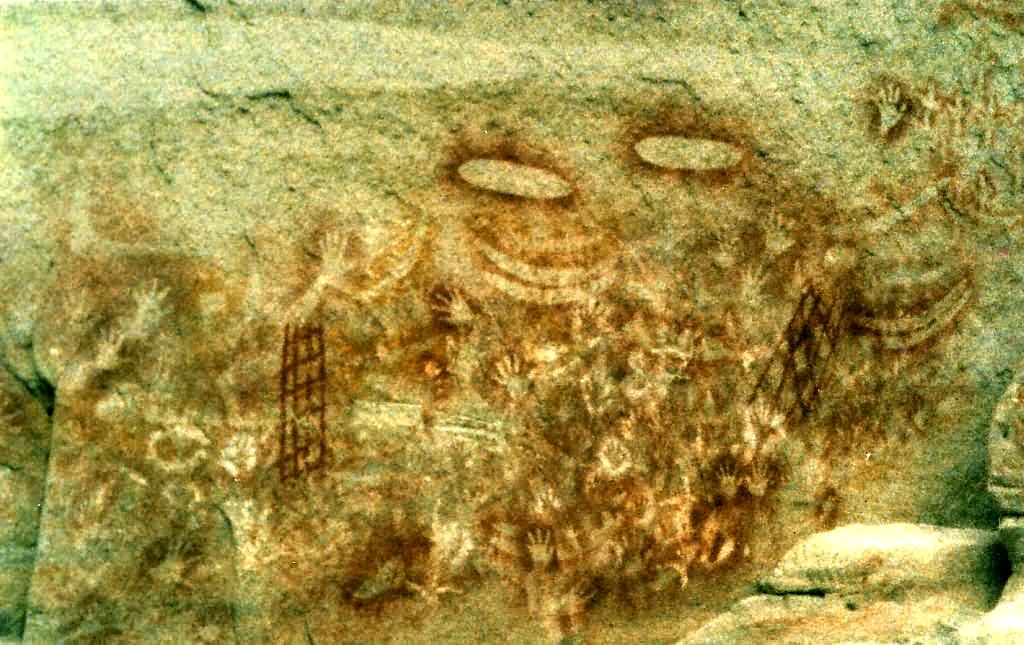
Ku-ring-gai_Chase - petroglyph, via Waratah Track (Rock is triassic Hawkesbury Sandstone, 220 million years of age)
That night, sitting lone by the coal-burning fire, I am visited by a presence. A naked Indian, greeting me with the power of a thousand friendships, unites in my melodrama with healing insight. He teaches me the power of the directions, North and South. The cold childless North of human danger and the impenetrable forces of nature, and the warm South of youthful diversion in the over-ritualized haunt of abundant fires. He reaches out to me, to plead with him for the stars to answer in earthly illumination. While with eyes closed, he recounts the bitter tales of repatriation, colonization and the staggering visions of post-genocide rehabilitation, for the entire world. And I wake, alone. The sun, directly overhead in a cloudless sky, is in full eclipse.
________
A presence belied in the soft air aglow with diligent drizzle
         From this, our American lighthouse heaven,
                 Alit with dream
                 in stories told by great-grandmother’s
                          Life lived outside the pages of the “true”
                                      And into the truly earth-quaking
                                      of dream
...
Men whose throats burn with the soil of their unloved mother
        Croaking up agro-fossil drains
                Reaching from modern skylines to prehistory,
                issuing from our Christ-death
...
In the housed mystery of our yet undiscovered world
        Beneath each colonial home
                Shot out of the ugly worldview
                        Misplaced over the moral genealogy

In an ecological philosophy
        To dry the eyes of our spectral hosts
               Who watch and wonder
                        With still unborn eyes

- excerpt from "With Still Unborn Eyes"


Tuesday, 18 September 2012

Achuar Victory! A Dream Come True Is An Awakening


"We have fought long and hard against Talisman. Now we've achieved this, but it doesn't end here. We have to remain awake." Achuar (FENAP) President Peas Peas Ayui

See the Amazon Watch report 

Proof: international networks of civil society and allied global citizenry make unprecedented change in the policies of big business and government. 

See my past posts on the Achuar struggle (Here & Here & Here), and we must remain aligned!
__________
An acquaintance, a young African-Canadian woman, confident and jovial, meets with me on literary terms, to edit a short story of mine. The story is in its very beginning stages of development, only a few phrases and scattered ideas. She is diligent, and always supportive. As I begin to tell her the story, I penetrate the image-letters and enter into the mystery of its narrative continuity, to explore experientially.

The concrete walls, unfinished, breathe with shadow. A well-known author sits in a dim corner, incommunicative. He is deep in listening, with headphones on to gather the soundscape of the strange, even horrifying darkness surrounding. Then, I notice his subject, a grumbling bunch of ruffians thirsting in the mud of Mexican pain. They secrete primal sounds from unlit depths below, before trailing off into the endless night. In that moment, the famed author saunters off with recording equipment in hand, leaving me to the bare depths, an empty memory.

I bleed on through the folds, with pain-stricken mind, searching through memory, confronted with a hollow mixture of painted nostalgias. A university campus, brimming with beer gush fads and costumed throwbacks to the glorious sexual revolution of their parents, now filling their pockets with the fool’s gold of American savagery. As I wander through the woods, the clouds gather above, warning of a rainstorm.

On the forest path, exiting from the campus, a friend and I are spotted by a group of peaceful youth, with meditative eyes and friendly sight. One remarks on my shirt, a gift from Israel. Soon, I find he is from Israel. He asks me, “Why is it that Americans never emerge from the forest?” I understand his referring to the colonial history. I empathize with his heart, worn from the break of political waves crashing in mid-sea. The Mediterranean harbors of our once shared ancestral home are now given speed to the sacrificial meaning of e-state.

We clamber on, my friend, an Aboriginal man, and I, as he critically rethinks the statement by the Israeli, “Haifa is a place not unlike Halifax? A seaport, where you fly from America without heed to the other?” We walk on into the city, through art galleries, attendants offer free espressos and truffles, through the museums of old travesty, and in an off-white room, sightless without a spot of focal interest, we separate.
__________
your eyes crack open
with subtle wanting
in the cold

drop

mourning
...
with the unforgiving pull,
a soft whirr from the sky's clear vacuum
exhaling
the rusty kisses of lips gone stale
with a life
lived too long

- excerpt from "Morning Dew"

Sunday, 5 August 2012

Cuban Youth and Creative Autonomy


Video streaming by Ustream
"José Martí said, 'the children are the hope of the world.' He's very well known in Cuba and the rest of the world. And we could also say that youth is the light of the world, the hope of the world...Youth is very important in our society, because they are very well educated and many of them are professionals. Because of the universal right to education and many university graduates. In the last decade, the number of university students has risen five fold.

Today's youth is a population that has grown up after what we call the "Special Period." So, youth has grown up during this economic crisis and under the economic blockade of the United States, by the United States of Cuba. So therefore, they have been subjected to scarcity and economic limitations. And that has made more stumbling blocks and obstacles to the fulfillment of their dreams...They are the protagonists of cultural, community and artistic creativity."

Maria Isabelle Dominguez, sociologist and Director of Psychological and Sociological Research of Havana (1:01:30 of Cuba in Focus 2012: Part I)

"Children are the ones who know how to love." - José Martí
________

An impromptu, Hakim Bey TAZ (Temporary Autonomous Zone), an occupation, a force field of instant creative spontaneous group presence, artist-magicians freeing the spare moment of interconnected spatial continuity in the visceral act of communal play, a boastful pantomime of acknowledgment, an undreamt torrent of sound waves blindly over my urban fate. A walk alongside the river pathway, and I sit with a group of peers, individual revolutionists, spit-shining the nature of mind with DUI grit. They hand me the most unusual instruments I’ve ever seen, self-invented out of sheer devotion to original ingenuity. Experimenting with a four-tiered frame drum, I notice the circle waits, watching for my creative intelligence to light the group momentum in the fire of scintillating freedom, manifest before their innocent eyes.

The next evening, I walk through an Eastern market, an Arabian Nights treasure trove for belligerent desire, fuelled by monetary drive amid strong wafts of perfume, spice, and the kohl-lined female blink into human want. I am saturated with immense apology. A downpour of mental guilt bruises my faded intentions with each step deeper into the dim havoc throughout the winding earth-ground pathways, leading into unlit alleyways, mental obscurity beckons my drowning, swollen self-pity as I lead myself ever deeper into the unknown grave of my found esoteric ecology.

The wares of an instrument seller captivate me. Albogues, duduks and exotic snakeskin frame drums line the wooden frame of a rickety wooden kiosk stand, seemingly unattended. As I stretch my hand out to feel the skin of a drum, an impish sprite, a young, rosy-cheeked tomboy gazes, beatific into a beam of light above my face. I can’t help but notice her unusual countenance, a proud and noble stature from her youthful facial expressions, shining brighter than the floodlight above us. Without speaking, she begins gesturing hands in avian wing patterns, mimicking the tongue, conveying a plethora of human emotion without missing a beat. 

Her play is expert, her storytelling movements well expressed, imbued with commonly understood meaning. A local woman emerges from the opaque shade of the antiques stone building, narrowing the market pathways. “That’s a well-known Aboriginal dance theatre,” she says, confirming the story well told. At the moment of her pausing, my mouth breathless with wonder and admiration, she gathers a small hand drum, only a touch larger than her palm, and taps with a wild energy, a direct speech of rhythmic pulsing. She speaks through the abstraction of form with an artistry not yet experienced by my foggy, nonplussed eyes, still burdened with internal weight. In that moment, I enter the sky, bodiless over sonic clouds, a booming voice silences the air at the cusp of our earthly atmosphere. I have been here before. With her help, I will return. 
________
Dance
"The dance is always a good omen and it foretells many things, such as children dancing signifies that your marriage will produce lively, happy children who are well behaved, older people shows a better business income and if you are enjoying the dance you will receive and unexpected windfall!" (iDream)

Drum
"To hear the muffled beating of a drum, denotes that some absent friend is in distress and calls on you for aid. To see a drum, foretells amiability of character and a great aversion to quarrels and dissensions. It is an omen of prosperity to the sailor, the farmer and the tradesman alike." (iDream)
________
filled. with immediacy
profaning eternity
of now, into secondary manifestation
of everything, into ignorant cries

for an end to all life, and unswayed
the silent mother feeds greater discontent
into the belly of her sanctified martyrdom,
consecrated over the neoclassical demise of New England

sameness, howling European mockery
and second-guessing the entire First History

- excerpt from "where is the mind in life?"

Sunday, 15 April 2012

To All The Freedom Poets Shouting In The Dark


“HAMAD DREAM OF 2030 IS NOT APPEARED YET IN BAHRAIN!...HAMAD YOU ARE A DICTATOR”  - from a protest sign at beginning of film

“I feel really alone. Whether it was a democratic country or an authoritarian country. All of them acted the same when it came to us. I discovered that my humanity is a subject of discussion. Should I be killed in the street or not be killed? Based on the interests of the United States or Saudi Arabia or other countries. It’s the killing of a dream.”

“When I’m sleeping, a lot of times I dream we are returning to the roundabout. To this day I dream it is there. I don’t feel it is broken.”

"This [facebook] page was a virtual lynch mob, focused on a 20 year old girl, named Ayat al Qurmezi. She had read a poem criticizing Khalifa and the King at Pearl Roundabout. The page asked thousands to participate in defaming her honor, and demanded her arrest and torture in prison. It wasn't long before they got their wish. Masked commandos broke down the door of her family home and took her to prison...After three months in prison, Ayat surfaced for this apology on state TV, which the family says was obtained by electric shock torture and forcing her to open her mouth while army and police officers spat in it." 

- from "Bahrain: Shouting in the Dark" by May Ying Welsh of Al-Jazeera, the only journalists who stayed

Ayat al Qurmezi (read her BLOG)
"I have not yet finished forcing every candle of dreams (youth) on this motherland..." 

- line from the poem by Ayat al Qurmezi which led to her imprisonment, translated by Mohamed Al-mahroos
_________
I had come out of a bedroom, pajamas and all, to greet a few friends. Sitting patiently and in reserved calm is my wife and a local actor in town, sitting outside in the main room of my abode. I begin talking about recent books I’ve read. I start talking about a book on the subject of black history in the American South pointed at the presence of the actor, who I only recently became acquainted with. I continue to divulge in The Inconvenient History of Brazil, which I learned received the greatest influx of African slaves than anywhere else. She is sweet and doesn’t mind me carrying on. In another room, my brother and a friend are worriedly arguing about how to get to Los Angeles, specifically to have more drinks. Ignoring them, I saunter out of the house and find my way to a nearby bus stop. 

Small trickles of rain bear down on the fogged windows of the bus as we cross through a muddy swamp area. The bus driver is exceptionally personable and a great comfort, in total control. In mid-conversation, I ask to be dropped off at a local convenience store. The cold, wet ground feels like a vent of sticky moisture from the saturated soil. Immediately outside the door, three homeless Aboriginal people kneel prostrating outside the store entrance, while one of them, a middle aged lady takes to a free gift of exceedingly processed fast food. I enter, greeting the store owners. As I look out the window, I see a group of girls in beachwear catapulting themselves off a nearby roof for the humorous purposes of landing on a trampoline. I walk out to get a closer look. The first lands extremely short, the second a bit further and right on her spine. She gets up aching, only to watch a third catapult far beyond the trampoline’s distance. Her impact is felt with crushing intensity as she writhes in a split-second. Witnessing, one can immediately tell her thigh must be broken. I then enter the store again, and with uncontrollable laughter, we are outraged by the stark contrast between the different kinds of help needed around the store. 
_________
History
"To dream that you are reading history, indicates a long and pleasant recreation."  
Rain
"A powerful symbol of renewal and spiritual cleansing...Interpretation is contingent on your current circumstances as well as the kind of rain that is falling...Depending on the dreamer it could suggest a period of renewal and fertility (reproduction or creativity)." 
Help
"If you dream that you help someone, or someone asked you for help, it means that you will succeed without needing help from anyone."

(iDream)
_________
can you tell me why you want to lose your minds?

“is the mind not a functional device?
a stronghold of impurity, though weak as a right?
a vile desire entrenched in the quickening of race and drabness? 
or old as a tire-stretched din?"

shrieking at dawn with favored kids,
roped to the sound in time 
only for a moment

“to flesh out the wicked rot 
a spawn of loss and un-coped wires
fuming ghastly as the corpse 
that smoked wild smoke
and leapt to a magic unseen and disbelieved
except by the weeded out freak-smiling lawmakers at dawn”

the hopeless mold sweetens through an unearthly jail
round toxic commotion encircles in ash and loneliness
wakefulness opens to the sole breath of god
and waiting awhile for the noose tightened,
alas around the saviors brightened tooth shown under a restful laugh...

Friday, 24 February 2012

Missing and Murdered Aboriginal Women over Black Coffee


Color Drawing by Anonymous (collected as Tsimshian Art)


Interview with Ojibwe Poet David Groulx by Black Coffee Poet

“I remember as a kid, dreaming about a poem. There was a huge hand coming out of the clouds writing on a scroll, a poem about an aboriginal man, man it was the most beautiful poem I’ve ever read, I was reading it as this hand from the clouds was writing it and a voice from behind me told me to get up and write it down, I said I would do it later as I wanted to finish reading it and I couldn’t remember a word of it by morning, maybe I’ve been looking in my mind for that poem ever since.”

_________


I have a deep yearning to visit the office of a highway connected to the missing and murdered Aboriginal women in Canada. I am outraged, yet powerless without any direct contact with the victims or their communities. I am not local, yet I find an office which oversees one of the most afflicted highways. I walk in, and am immediately distracted by an environment of mundane administrative and bureaucratic office work. I wait among a few chairs, deeply incensed by the seeming apathy. There is no information or any immediate signs which would point to the atrocities being committed under their watch. I am called up. The two office workers appear as under a guise of extreme passivity and banal normalcy. My presence is reacted to with equal monotony. They review maps of the highway layout with me, and yet their striking imbecility leads me breathless with an introverted silence. I leave disappointed with myself.  

For creative sources on social justice and arts activism dedicated to the missing and murdered Aboriginal women of Canada, start with More of Black Coffee Poet 

_________

"to the foreign drum of an impenetrable toxicity
left unconsumed and needed by feet
lit under concrete sustained magic
of the urban disillusioned,

northern mind
bringing the steady rings of a consciousness
prepared as the instrument of a government culture
performing the theatrical stronghold of minority no-release
fish-burdened town of extracted marrow
through procedural temperaments
that go unled and steam up
with chaotic strictures
that demean the meaning
of man and woman
or masculine-
feminine time"

- excerpt from "Northern mind"

Friday, 25 November 2011

Dreams from the Ethnosphere

Plains Cree Man from "The Plains Cree: an ethnographic, historical and comparative study" by David G. Mandelbaum


"And in the end then it really comes down to a choice: do we want to live in a monochromatic world of monotony or do we want to embrace a polychromatic world of diversity?

Margaret Meade, the great anthropologist said before she died that her greatest fear was that as we drifted to this blandly amorphous, generic worldview, not only would we see the entire range of the human imagination reduced to a more narrow and more narrow modality of thought, but that we would wake from a dream one day having forgotten that there were even other possibilities.

And it's humbling to remember that our species has perhaps been around for 600,000 years, the neolithic revolution, which gave us agriculture, at which time we succumbed to the cult of the seed; the poetry of the shaman was displaced by the prose of the priesthood, we created hierarchy, specialization, surplus is only ten thousand years ago, the modern industrial world as we know it is barely three hundred years old. Now that shallow history doesn't suggest to me that we have all the answers for all the challenges that will confront us in the ensuing millenia.

When these myriad cultures of the world are asked the meaning of being human they respond with 10,000 different voices. And it is within that song that we all rediscover the possibility of being what we are: a fully conscious species, fully aware of ensuring that all peoples in all gardens find a way to flourish."

from Wade Davis: Dreams from endangered cultures, a TED talk ( http://www.ted.com/talks/wade_davis_on_endangered_cultures.html#.Tswyaa16evc.facebook )

Sunday, 6 November 2011

Dream of the Enlightened Persian

Arriving at an idea upon which all may Dream

Original story of an initial arrival

To Canada! Without place or concrete plan to find one, he begins with the simple purchase of a vehicle, to roam the entirety of this vast nation without foresight or reckoning with fate.

First night in Montreal, a dream;

An Aboriginal elder, playing his frame drum in the dream fog of a striking, celestial presence, tells him repeatedly "...this is the land of the Buffalo." He repeats, "Respect this, the land of the Buffalo."

Out of all destinations, traveling throughout the country, without ever having even known anything about Canada, he arrives in Calgary to live. Calgary is an auspicious place with respect to the Buffalo. The traditional lands of the Blackfoot Confederacy, which includes Calgary and the surrounding region, bespeak a plains culture which has honored the Buffalo like none other. The last herds still roam in the northernmost regions of this province.

He goes on to talk about his travails as a boy of only 10 years when the Iranian revolution began. He tells of how he was forced to read in the dim light of a locked vault; a tunnel wherein subversive books were protected by his family. Therein he caused such foment in his mind that would have never been possible in the veiled reality of the Shah's theocratic mental confinements. So, as a true seeker, artist, visionary and dreamer within his growing heart, cultivated by the creation of literary might found in the truth of so many ingenious ghosts unveiled by sanctimonious literary iconoclasm. He remained trapped as it were, underground, with thoughts hailed as mystery in the whisper of a clouded heart.

Yet, his traumatic devotion to the tunnel-enclosed vault gave seed within the dank depths of his early budding mind. With practiced devotion he went to the darkest places in the world, hidden under inhumane truths silenced by war, poverty, corruption, hypocrisy, and censorship. In Canada, specifically in Calgary, he was led to the traditional womb of our Mother Earth among the plains Buffalo culture. Led, as it were, unaware, under the inverted belly of the Buffalo. The hide blanket of the Sweat draped over his unknowing spirit and found in him a place where to confront his mental wound, to rise from that vaulted literary wisdom, and see an inner light reflecting from within his own self as the sensory magic of spiritual knowledge. Upon exiting from the womb, blinded, suffocated, and nearly maimed with the burn of volcanic rocks aflame, his healing journey had commenced, and the vault of his childhood swung wide in the clear open before him as never before as he entered a newfound paradigm of artistic awakening through the dream of a music-theatre production with us all.

As a man who has experienced Sufi tradition in the mountains of Kurdistan, the poetry of my new friend has proclaimed a clear vision directed to all who may listen. In his voice is a uniqueness, an artistic dreaming forged by a soul strengthened and clarified within the tight impasse of as yet unraveled knots of complex human suffering. His voice reminds us of places beset with burdens so immense as to drown many a human heart in endless sorrow. Still, in his voice is a passion enduring with deft creativity and boundless truth-seeking that is infectious and empathetic in its wisdom. He now seeks shared visionary exploration, a lyrical orchestration towards a lasting expression of a public dreaming.   

His story was shared in the name of the passing artist and Sufi healer through the music of Sayed Khalil Alinejad; who was recently killed by the still repressive government in Iran. His murder is an outcry of world shame, an example of absolute heresy against the human spirit by the glowing red eye of a deeply traumatized society, living earnestly, without repose in the recesses of a hellbound subconscious blur. This honest-hearted musician and spiritually expressive man was told before the incident by a fellow Sufi that he would burn in hell, a few weeks later, he was burned in his home with his son. To a person of spirit, we have to wonder, how in life he spoke through music, and how Death became the last tone vibrating through the soul of his forever respectful listeners.

It is said that the character of the American Buffalo, unlike all the other animals and creatures of the North American plains, would charge headlong into an oncoming blizzard, while all others will flee. The American Buffalo will find its way through the worst of storms, earnestly engaged in the collective healing met between the spirit of the storm and the spirit of its own animal nature. With the strength of the Buffalo, he passes through to the bounty of a naked Earth on the other side. We have to wonder if people like Sayed Khalil Alinejad have tasted an ardour similar to that of the American Buffalo, braving the worst of storms, and have become as a message of this near-vanquished Spirit to the people of the Earth and Sky.

Listen here