Primarily a writing exercise, this dream journal-inspired blog is a quiet introspective sojourn into the process that we traverse in going from private dream to public art. I see our dreaming as an internalized mythmaking. As I philosophize and expressively exhibit dreams, both private and public, I encourage and delight in creative language as a way to practice experiential metaphors through a “public dreaming." Writing Theory: Creative Dream Fiction
Showing posts with label Greek. Show all posts

Monday, 6 May 2013

Roots of a Grecian Heart: Seeds of Superstition and Truth

"Even in our day there are plenty of soothsayers and sibyls, and many people still believe in dreams and omens. It is no wonder that the ancients did so, too. But we should keep well in mind that while these arts are now despised by educated people and ranked with superstition they were an acknowledged part of Greek religion." Martin P. Nilsson, Greek Popular Religion

"I woke with this marble head in my hands; / It exhausts my elbows and I don't know where to put it down. / It was falling into the dream as I was coming out of the dream. / So our life became one and it will be very difficult for it to separate again." Seferis, Mythistorema

Sunday April 21 is another afternoon, like any other late winter day in Calgary, where sporadic snowfall lights on the sprawling residential landscape. A few blocks from the university in the northwest quarter of the city, one home opens its doors to lovers of Greek culture, ancient and contemporary. A neighbor walks down the road, on her way to the event, to show a bewildered downtown urbanite the way in a dizzying maze of suburbia. Host Karen Gummo greets at the door, a member-at-large of TALES, The Alberta League for the Encouragement of Storytelling.

The house concert event features Jennie Frost, recently selected in August 2012 byStorytellers of Canada / Conteurs du Canadaas an Elder in Canadian storytelling, a prestigious recognition awarded only once a year. She will be recording for the StorySave Project, which honors and preserves the oral storytelling traditions of Canada. Aboriginal, Irish and Canadian heritages are among the many recognized by Story Save storytellers. Frost, a classics scholar, published her first book, “The Courtship of Hippodameia” in 2005. Frost has performed stories for festivals, concerts, conferences, libraries and over one hundred schools in eight provinces and one territory since 1996. A 2-CD set of her workPygmalion and Other Greek Myths was for sale at the event, along with her book.

The event did not begin with storytelling, however, but a taksim, a term and practice borrowed from other Middle-Eastern cultures meaning the improvisatory opening to a song in Greek music. Calgary Greek music band, Rembetika Hipsters were present to provide dynamic energy to the overall muse and meaning of story in the Greek tradition. Having toured much of Canada and Greece, the Rembetika Hipsters have released three successful CDs. The band continues to receive great recognition in Greece, especially for a video recording of their tenth anniversary concert in Calgary, where they played with a nine-piece ensemble. After performing the first song, bouzouki player and vocalist Nick Diochnos told one of his own personal stories, set during his Greek wedding in Athens, where he bought his first bouzouki with extra wedding money.

Rhythm guitarist and singer Allen Baekeland of the Rembetika Hipsters gave historical background and taught the meaning of the Greek band name. In the wake of the most significant and traumatic period in Modern Greek history, the Greco-Turkish War (1919-1922), the Rembetika culture formed. The war, known as the Catastrophe by Greeks, led to the forced expulsion, or “population exchange treaty” of all Greek communities in Turkey, including the notable city of Smyrna. Over one million Greeks in Turkey were forced into exile. As a result, one in five people in Greece were refugees.

With their Turkish-influenced culture, vagrant impoverishment, drug use and outlaw mentality, refugee youth became what in Greek is known as Manges, loosely translated as hipsters. While very popular in the 1920s and 30s, the Rembetika music, likened to American blues, was banned by government authorities. Nick explained that there are two connotations to the word, either it is used between buddies to denote camaraderie, or between parent and child as a means of castigation. Throughout many songs played during the course of the event, Nick would exclaim, “Hey Mange…Opa!”

With a repertoire of over a hundred songs, the Rembetika Hipsters played a diverse selection, not only of Rembetika songs, but also of Greek folk and popular songs. Two songs were especially poignant for their performance, as well as the stories that accompany. Firstly, they sung Sto Perigiali To Krifo, with music by legendary Greek composer Mikis Theodorakis in collaboration with Greek poet, and Nobel laureate, Giorgos Seferis. The work of Theodorakis, spanning from orchestral suites to popular tunes, has also been integral to the revitalization of Rembetika music into post-WWII popularity. Secondly, Ta Pedia Tou Pirea was sung in memory of Melina Mercouri, a Greek actress, singer and political activist, who sung the ode to the beauty of the Greek port town of Pireus in the film, Never on Sunday. The Rembetika Hipsters commented that the port town’s charm is actually a bit more of the rough than the diamond.

Jennie Frost captivated a silent crowd of about twenty keen listeners with stories from the ancient sagas of the Greek pantheon. Storytelling alternated with the music throughout the afternoon. Frost introduced her storytelling modus operandi with a short prefatory anecdote regarding her break from conventional academic interpretations. She gives ancient stories a refreshing new life. During her lively orations, she holds an elegantly crafted wooden cane, in homage to Indigenous traditions of the talking-stick. An elephant sculpture melts into an Ankh-shaped handle, in which are tied innumerable paper-crafted memorabilia from all of the communities she has visited to enlighten through the living tradition of oral storytelling.

With detail enough to craft the most intricate narrative, Frost weaves in and out of character dialogue and illustrates setting with the lithe energy of the overseeing deities she so magically conveys. One of her most memorably enchanting stories drew from Zeus, in relationship with his children, Hermes and Apollo. The visceral imagination of ancient Greek life, as in the story of Apollo’s maturation into his role as the god of music, knowledge and poetry evokes the divine majesty of creative human faculties. Hermes, who ultimately gifts Apollo his lyre in the story, becomes messenger of the gods, evincing respect for the underlying interconnectedness of all great worldly and divine phenomena into a harmonious narrative of familial interrelationships.

Frost told many stories, drawing not only from classical Greece. Her final story revealed a welcome gift for diverse cultural expression. Before reciting a quaint Chinese tale about a half-wit boy named Noodle, who eventually outsmarted the gentry of an ancient city through a spirited affinity to poetic meter, Frost proclaimed to all her enthusiasm for epic storytelling sessions. For Frost, a five-hour long telling passes with sparkling enthusiasm. Nonetheless, Frost finished telling her last line on time to close the three-hour event, leaving all with a smile.

The Calgary cityscape glowed from the picture window behind the musicians and storyteller. The love of storytelling is a common root of social cohesion, yet the traditional arts of oral storytelling are too often ignored with similar cultural dissolution as seen in the disappearance of global language diversity. Storytelling, in the traditional and artistic forms of oration, is not simply a nostalgic reversion to childhood.

The lyrics of Giorgos Seferis speak with god-like insight and metaphoric clarity. Impermanent love, the hasty fool’s rush to consummate young lust, is the subject of his poem Denial, better known as the song, Sto Perigiali To Krifo, sung by the Rembetika Hipsters. In a society dependent on non-renewable life sources, is the consumer resource paradigm of a young nation as Canada not also likened to a parable of the impermanent lust of young love? As Seferis writes in Denial:


On the secret seashore
white like a pigeon
we thirsted at noon;
but the water was brackish.

On the golden sand
we wrote her name;
but the sea-breeze blew
and the writing vanished.

With what spirit, what heart,
what desire and passion
we lived our life: a mistake!
So we changed our life...


Oral storytelling roots people to an inner renewal of life, as innately creative, and in continuity with the most fundamental and longest standing traditions of humanity.

This story has appeared on The Media Co-op and will also appear in the upcoming June issue of TALES (newsletter)
___________
Where are we? Israel? Canada? No, North American Zion!
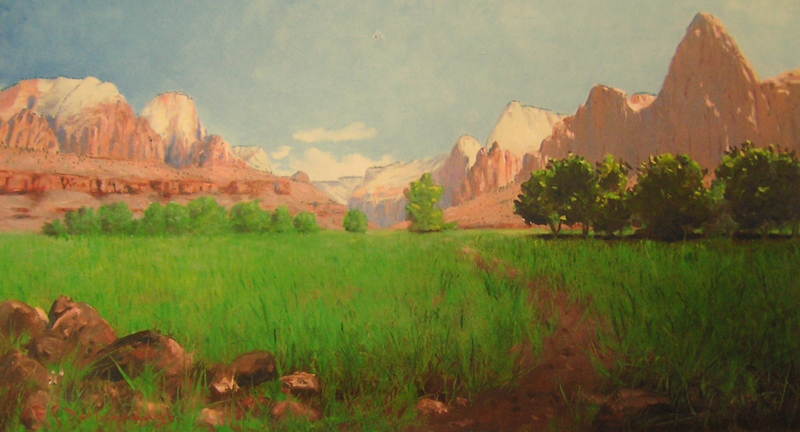
Zion Canyon by Frederick S. Dellenbaugh
Desolate summer ski hills are lush, verdant with pine undergrowth. Through an open ski lane, gargantuan Canadian flags billow. A park ranger sights us. I escape solo, just barely through a bush thicket. Trailing beside a river’s edge, where I once ogled at two young lovers, the Israeli sky burns with the beautiful bounty of original sin multiplying with infinity at every touch, every sight, sound, smell and every taste of spirit. The racket of espionage flutters in the newspaper wind. I heave a sigh, bitter with unrest.

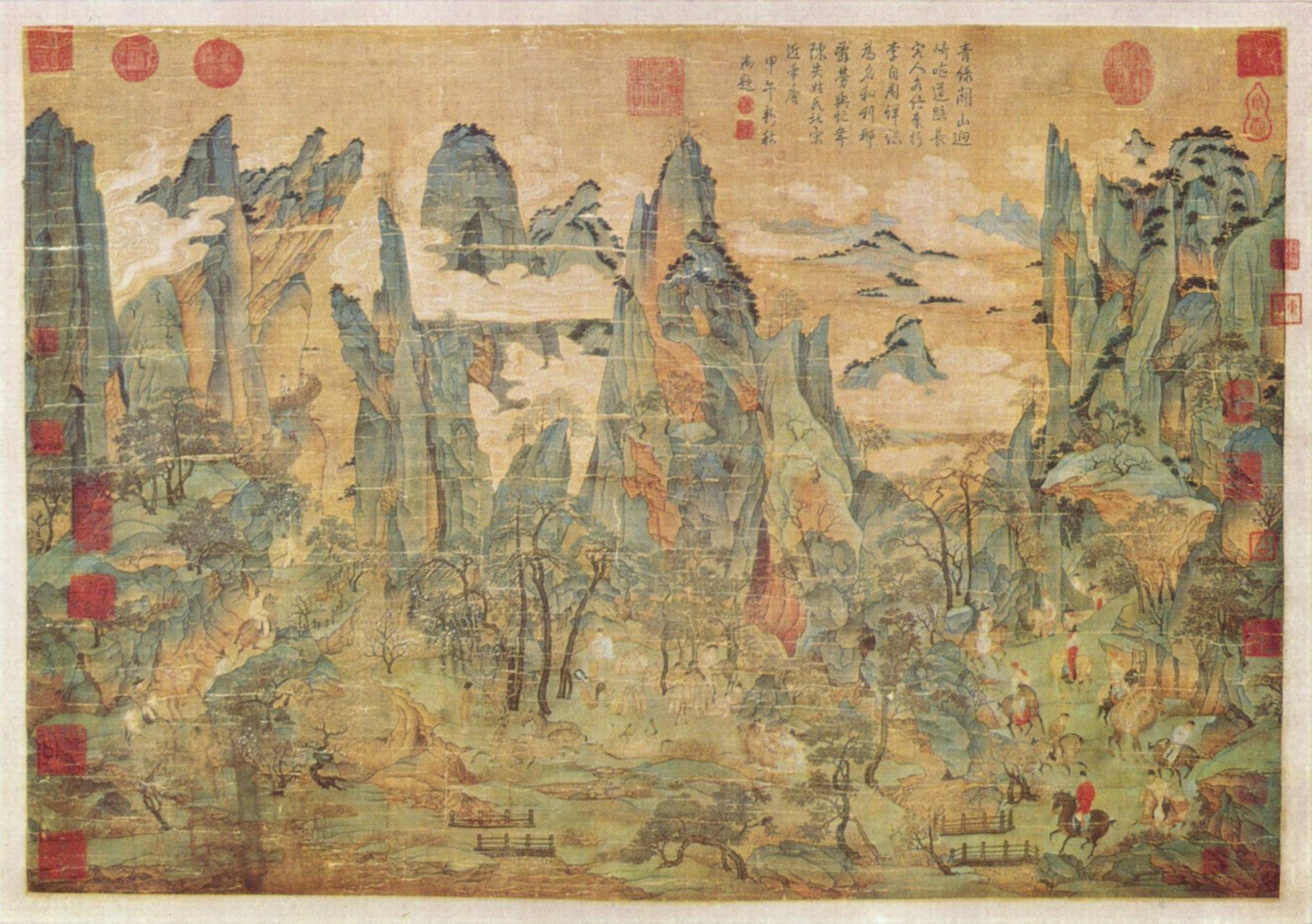
Fleeing to Sichuan province from Chang'an to escape the violence by Li Chao-tao
Nightfall, the shattered windows and shades of old Brooklyn stare with criminal rites. Anger seethes from the manhole pores of the upended city. A ruinous dearth of humanity bleeds from my open-strung heart down the spinal chords of a silent song: my jungle cage. Television home blink, flicker, there! The thief, drunk, with rapist eyes eyes mine concrete stone grounded roof possessions. A friend points-blank his rifled arm into our pitch fate. The silence groans with inner loathing, like a brooding cancer unknown, deep in the marrow.

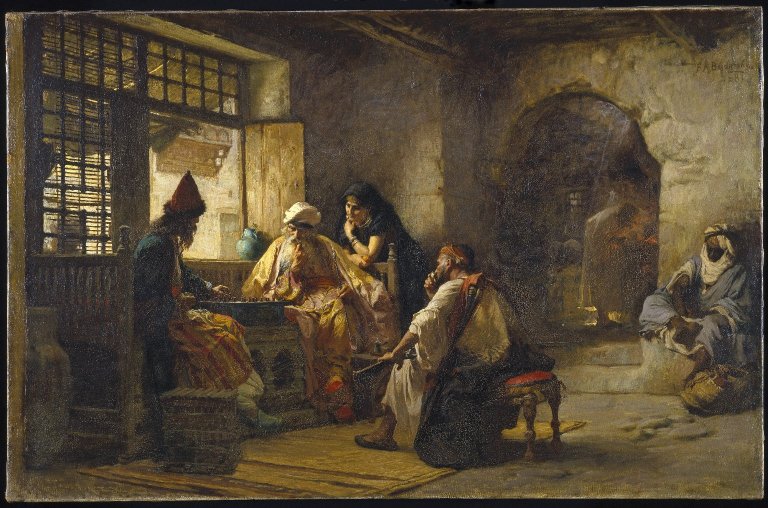
An Interesting Game by Frederick Arthur Bridgman
So, morning, we rise with the tide and board a ship set with haste. A vacant room, splotched with growl, we swung with the churning waves, a smiling rat-spawned day. The worst was over. America far behind, Zion of mind and heart derided in a momentary pause, to reflect on the Old World border of genocidal rampage, the forgotten wick, unlit on this Sabbath morning. Two friends, we disappear within a schizophrenic race. Evening fires glow soft with candlelight.

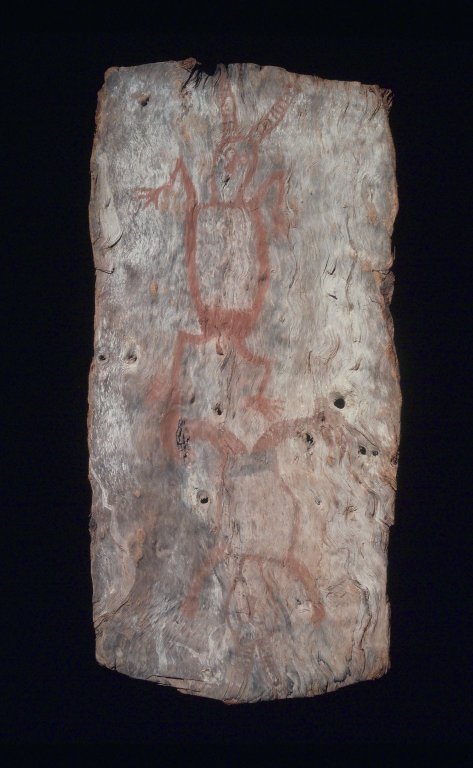
Painting of Dream Figures on Bark by Unknown
Tattooed mistresses, with raised skin, beset with the tribal bond of white scars breathe from lungs rising and falling under the most intricately carved bones. The monarch is absent. Bewildered, the ship sinks like a dead man, flooding as with the inverted pressure of the oceanic ambiance bursting outwards, into the wooden vessel of sleep and need.  
__________
A hyper-ambient, atmospheric guitar & voice elucidation on themes of the variance between the doer and the doing, subject and object, creation and creator. The vocal sounding contemplates the inner nature of human life as the most provident offering back to nature. To learn reciprocity with the entire universe begins by looking within. The word is a gift. "shaped by more hands" refers to the creative act as in step with the dream-notion, going back to Carl Jung, that 'I am not the only one in my house' or that the psyche is full with collective consciousness, that within us is all of us. All things issue through us by way of conscious intent.

In the creative arts, dreaming and waking often cross paths. Is speaking and thinking similar in psychic variance from that of dreaming and waking?This is the question I am posing in the aftermath of the creative process, which led to the track, "shaped by more hands". The question is meant for all to ruminate with thoughtless meditation, through a constant emptying of mind, towards a renewal of deeper intelligence beyond the egotism of intellect and apparent word-logic.


The chapbook, "Seeds and Roots" from the larger collection, Exotic Settlers, contains 9 poems on the theme of cultural metaphors related to heritage, ancestry and the myths and rites of collective human identity. Beginning with simple muses on Jewish cultural roots, I then embellish a transcendence of nostalgia through a regression of biological metaphors.

The root, with all of its instilled metaphors of stability, truly originates from seed. While reminiscent of the old chicken-egg riddle, the seed is a transient holder of sacred inner truth, ultimately leading to a grounded promise of settlement. Yet, in exploring a healthy and holistic mind of settlement, i.e. through the experimental writings found in Exotic Settlers, the more ephemeral or fleeting reality of origination must be kept close at hand. For, in Buddhist terms, the root is the middle way, yet the seed is that ephemerality from which we come and to which we go.

The selected piece for sound art / experimental music works, found on Evocations: Exotic Settlers (menachem.bandcamp.com) is "Shaped By More Hands" which I find to be a blissful rendering of the beauty of Wu Wei, or the Taoist philosophy of non-intervention with the flux of being and mind, where in the allowance of natural flow is the growth of the seed from the root to the flowering seed.


Monday, 19 November 2012

Dream, or Intoxication: Nietzsche and the Tradition of the Master Singers

The Ravens (For a poem of Nietzsche) by Margaret Hofheinz-Doring
"...dream and of intoxication, physiological phenomena between which we can observe an opposition corresponding to the one between the Apollonian and the Dionysian. According to the idea of Lucretius, the marvellous divine shapes first stepped out before the mind of man in a dream.* It was in a dream that the great artist saw the delightful anatomy of superhuman existence, and the Greek poet, questioned about the secrets of poetic creativity, would have also recalled his dreams and given an explanation similar to the one Hans Sachs provides in Die Meistersinger.*

My friend, that is precisely the poet’s work—
To figure out his dreams, mark them down.
Believe me, the truest illusion of mankind
Is revealed to him in dreams:
All poetic art and poeticizing
Is nothing but interpreting true dreams.

The beautiful appearance of the world of dreams, in whose creation each man is a complete artist, is the precondition of all plastic art, and also, in fact, as we shall see, an important part of poetry."

Nietzsche, Birth of Tragedy (e-text)

One night I had been tirelessly searching for this very stanza by Hans Sachs, however I'm unable to read German so my stalwart online efforts proved futile. After glossing over Nietzsche's "Birth of Tragedy" a few times within the body of other texts on mythology, psychology, dream and poetry, I have now found a predecessor to Nietzsche, Hans Sachs, embedded in his monumental philosophical work. This is one of my favourite tracts of literature, and yet I've still to read it in its entirety. I continue to draw from this work the kind of lucid understanding of our inner being as it has moved and developed since the first pages of history unto time immemorial. Such an exhibition of prime thought beckons one's mind, as a lure into the opaque night of isolation and longing, yet when nostalgia dissipates the true character of one alone breathes the kind of truth that is our universal whole, a cosmic constancy of holism, triumphant in its lasting mystery. 
_________
The air, invisibly opaque, opaque in its emptiness, invisible in its bodiless humor, I gaze through the sheathed firmament, a room, a body, jacketed in the empty dark. Forcing my eyes to move, I see a slight pitch in the cruel nothingness, a fleck of something in a bruised vacuum of light. Where am I? 

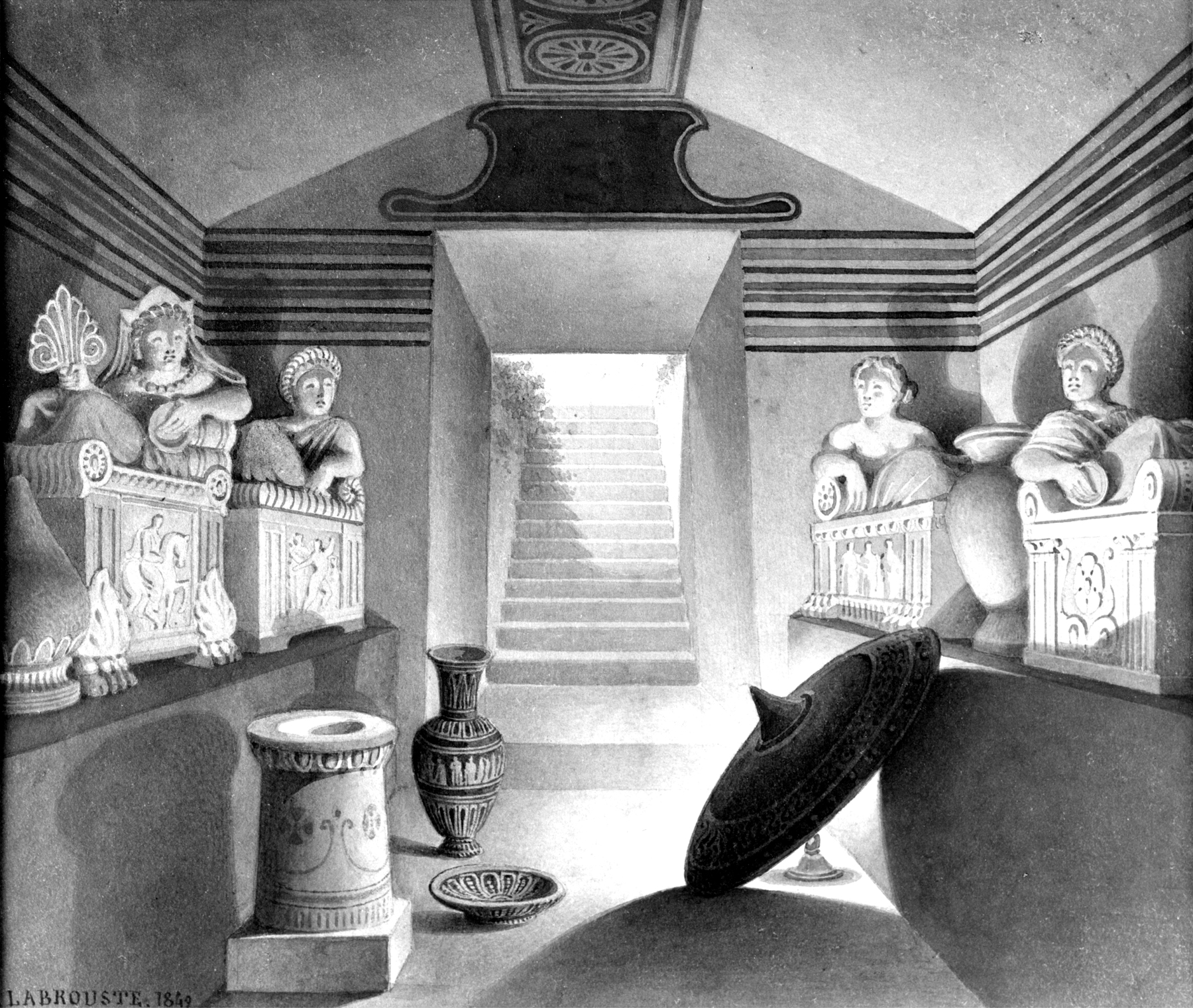
View of an Etruscan Tomb by Henri Labrouste
I am upraised, I am raised above ground, on a bunk, on an old bunk of childhood longing, bedside window staring, the endless bunk of isolated raised up childhood. On my head, a Viking helmet… It’s sheer weight, it’s ridiculous… My arms flail under a body weighed by the lowering ceiling, and a head crowned with a horned and vast slate of crudely nailed metal. 

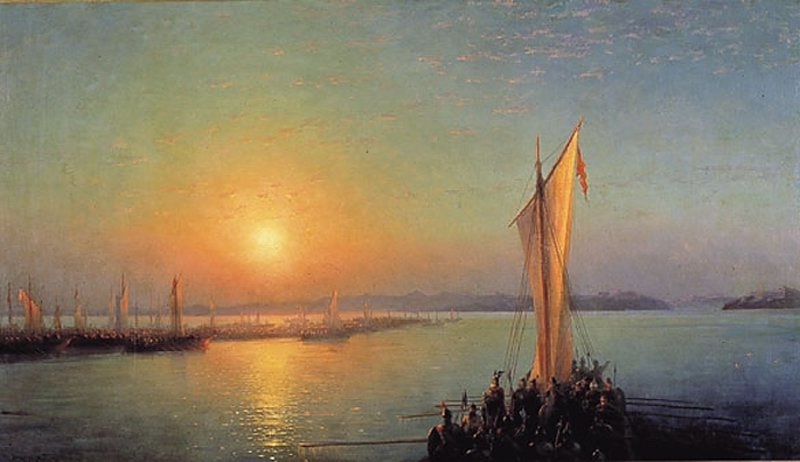
Viking Saga: The path of the Vikings to the Greeks by Айвазовский И.К.
And as I look up, the ceiling, lowering, eyes me back with a staring mushroom, with an elongated stem, a fungal growth, upside-down, to stare at me with its sexual head of strange and auspicious gloom, a vivid flight of the hallucinating noesis, the natural misplaced in a mind-born hell of undone pain, to sleep and writhe, in a landless bed of the upright bunk, swollen helmeted head. 

Winter by Giuseppe Arcimboldo
And at once, I toss the disfiguring crown over the edge! It dings off the edge of a television perched on a dresser, and the reverberation is near-unending, an unnatural sound emits, and sends my unconscious flesh storming at the gate. 
_________
One proud, unseemly yet everlasting hoary wind
Escaping into the breathless fold of a storm-brought love
Escalating above the tumult of grounded trees
Lowered to rest in the silent play of her touch
With Mother Nature in lust at the American shoulder-sculpted God

President of inveterate honor
Failing to maintain true gaze
Into the outpouring blind Persian mystic call

Excerpt from "Untrained Timeless Tuning" [featured on Poydras Review]


Saturday, 2 June 2012

Unanswerable Sufferings of Sleep, a Q&A

lovers on an island by Anna Chromy
Q:

I am wondering what you would say about someone who wakes up with having recalled no dreams .. are we always dreaming and just can't recall and what does that mean??? last night again I was woken up by my spouse yelling in his dream .. it's amazing that he does not awaken but I do .. I guess that has to do with what type or cycle of sleep you are in..

A:

I've heard that we do indeed always dream, though it's a problem of memory whether we can remember the substance of our subconscious imagination during REM cycles. For certain cultures and traditions of varying times and origins, reflecting on dreams is an essential daily practice, as common to us as reading, watching TV, exercising, etc. It is a belief that such dream reflection, if you will, opens doors and provides keys to otherwise hidden aspects of ourselves. In our history, western psychology only caught up to the wisdom of interactive dream cultures existent throughout human history and still remote corners of the globe, based on the work of Carl Jung, who purported to exercise the notion that dreaming is the reality and our waking consciousness is made up entirely of myth, symbol, and such inert vanities as are controlled by our subconscious drives.
________

The night before we were to leave for the states I clicked purchase on my laptop while sleepwalking. The next day I called my mother. “A forty dollar purchase!” I spent the entire morning trying to return it. Meanwhile, my wife and I prepare to travel across the border from Canada. This has not been an easy for us in the past. Unbeknownst to me, she prepares her computer. As usual, in the final minutes before we leave my wife begins to mind our departure. As she walks into the bathroom, my mother and grandparents surprise us in our house. Simultaneously, my wife zips through the washroom doorway, shirtless. I talk my relatives down as I begin to re-assess our travel preparations. Trouble stews in the bathroom. She is cornered by border patrol in our own private bathroom! They threaten to confiscate her hard drive for security purposes. She goes into shock. I can feel her anxiety and fear, nightmarish and certain as day. I can’t help but accompany her in distress. Walking through an unknown labyrinth in my bathroom, I’m unable to see any one. I’m lost. The shower emanates with an opaque quagmire of steam. Groped thighs and high chests creak like wood in unspoken sexual majesty. Forbidden flights breach a proud, open humanity with a love forsaken beyond scrutiny, to instinctual rites of passionate floundering in the cruel pain of the body’s lowering, prehistoric travesties. Weak with sanity, I become raw with self-doubt, admiring and at once twisted inside. Where is my Love? We are far from family.  
_______
Computer
"The computer is saying 'put the pieces together to understand the overall meaning'...if you use a computer a lot during your waking life for work or play, your dream could be telling you to get out more and take a break from the screen."
_______
The unchallenged lurch into an Olympian fire,
brushing off the wintry air with a scent of northern herbs
collected by remote, yearning hands

The woman-philosopher, seated in absolute disguise behind a curtain of folk knowledge
beguiles the most aware onlookers, who know of the perfect scrutiny of knowledge
as an aspect of a specific place.”

“Knowledge is a performance for the Spirits!”

Light sparks rescind the importance of global community to a physical presence
holding each of our bodies with local sacrifice.

Fumes of wonderment & bewildered attraction fuel the traveler’s possessions with cathartic activity.

“And Life, is ongoing pleasure!”

“…What about suffering?”

Respect, communicated through body language, reciprocates

“I don’t have all the answers…”

- excerpt from "Catatonic Body Language"

Thursday, 19 April 2012

In Defense of the Dreamer as Individual


“The great events of world history are, at bottom, profoundly unimportant. In the last analysis, the essential thing is the life of the individual.

This alone makes history, here alone do the great transformations first take place, and the whole future, the whole history of the world, ultimately spring as a gigantic summation from these hidden sources.

In our most private and most subjective lives we are not only the passive witnesses of our age, and its sufferers, but also its makers. We make our own epoch.

C.G. Jung, 1934"
________
We climb the old-fashioned narrow wooden staircase to the humble apartment where my grandfather was born in Lower East Side Manhattan, 1915, into a family of Greek immigrants. The colors of the neglected wood panes and creaking floorboards radiate with a rustic golden aura. The internal structures are mostly charcoal etched, as a black and white drawing, pockmarked with rough patches of oblique pitch darkness. I am accompanied by my Iranian friend who peeks in abandoned night table drawers. Searchingly, he endeavors to reach through a pile of handwritten pages and small books. He begins talking to me about Eduardo Galeano, all the while correcting my Spanish pronunciation in conversing over the dense terminology. At that, he leaves with a few leaves in his coat jacket. I stand amid the bare walls, as the airless womb of my ancestral birth in this country is revealed. I sit at a gothic typewriter. Copious thoughts string in a massive upheaval of soundless striving through the mind of a creational writing that ceases only with pure death, and at once, below me are the distracted lives of my parents. Their televisions blare mindlessly with brainwashed floundering. I empty a nearby drawer, seeking madly for a worthy object, a true talisman, to invigorate my standards of inspiration before this all-consuming pyre of human intentionality, transmogrified by the immense distance of a screen and its subjects never felt by palm or breath. Does their lower meandering mirror my own creative origins on lettered key before the abstract maw of my own typographic lore?   
________
Typewriter
"To see a typewriter in  your dream indicates that you need to open the lines of communication with someone in your life." (iDream)
________
“from the mountains' worshippd gaze
I am estranged as a foodbank flourishing madly
in a churlish booth-fountain
spurning liminal trespassers in a just tirade
isolating occupied human vats”

- excerpt from "Spare my Spit"

Friday, 30 March 2012

I Dream to Honor Our Greek-Jewish Ancestors


It was a dream of mine to share the unique heritage of Jewish-Greek culture in my city. I saw a great opportunity when the film "My Sweet Canary" began their North America tour. An event which links the history with our very own Greek Rembetika band, The Rembetika Hipsters. 

After extensive correspondence with Roy Sher, filmmaker of "My Sweet Canary" and the Greek Community and Hellenic Society of Calgary, I finally contacted the Rembetika Hipsters band, our local Rembetika music.

Here's what bandleader Allan Baekeland had to say:

"This is a fantastic idea...I'm not sure you're going to get a lot of help from the Greek community. There is a degree of ambivalence and even hostility towards rembetiko music amongst the local Greeks...unsavoury lyrics about drugs and criminal behavior, its Turkish origins, etc...I think we can get a good size audience for such an event in the fall."
______

I am sitting around a table at the Kehila Kedosha Greek Synagogue in Lower East Side Manhattan. This is the last remnants of Greek Jewish culture in the area. I am with my extended Greek Jewish family, dining upon some traditional delights. There is some argument at play. My grandfather stands out among the crowd, somehow dissatisfied. In my reflection, I see the argument revolves around the ancestral name. Did our name change upon immigration? In order to find the answer I travel outside of the synagogue, outside of the city limits to a small hut, in which an American hermit, living out in nature in a small, ramshackle hut often recurs as a returning dream-character. When I arrive to his hut, he greets me graciously. I ask about how to attain filtered water without a filter, after which he points me in the direction of a stream. Unaware, I lead the way and find that his once-densely forested nature hermitage is now interspersed with half-destroyed concrete buildings and functioning industrial office rooms. I enter one of the offices to let people know we are here to understand how to filter water without a filter, they look at me ignorantly and distractedly brush me off. The hermit then leads me to a stream, where the water is rushing clear as a cloudless sky through a gorgeous array of stones. I feel I’ve found what I’ve been after, but there is more, now faded into the forgetfulness of day.  


______

fire light  
widening, the open mountain 
crevasse of grandfather's memory
"God's country west" 
Mt. Rainier
Washington is there 
"is he in you?"


Wednesday, 28 March 2012

Pasolini Dreams of Oedipus Rex


Narrator

“That is the thing that inspired Pasolini the most in Sophocles, the contrast between total innocence and the quest for knowledge.

Pasolini

“It isn’t so much the cruelty that produces crimes but the fact that crimes are committed because people don’t understand history, life or reality…if Oedipus had not been so fatally innocent and unconscious, if he had been an intellectual and had first sought out the truth, he might have been able to alter reality. The only hope is a cultural one, to be an intellectual.”

Narrator

“Pasolini wanted the central part, which is the main part of the film, to resemble a dream. This explains the settings and the choice of costumes, and in a sense, the general rhythm of the film.” 


______


Immediately, I fall into a field, transformed into a beast with qualities of a saber-toothed tiger, a large prehistoric dog and massive reptile. I fly, as with vestigial wings, across the golden, low-lying field on foot, beside me are other beasts of similar quality. Above us, a helicopter hovers menacingly. We race towards a cliff side and plummet off its edge.

In mid-air, we become human, though prehistoric humans. We wear rough animal hides. The others become topless women with faces resembling famous actresses and a friendly girl who used to live on the same property as me in the Western Massachusetts countryside. She had spiky dreadlocks and was an inveterate marijuana user, yet a tough spirit at heart. I watch as she glides effortlessly down the daring tree trunks, only just evading a branch with spikes sharp enough to impale straight through the bone. We finally reach the bottom, and this reality transforms to me running with my golden retriever through the paved neighborhoods in the suburban coastal woodlands of modern day Massachusetts.

I enter the woods. My dog has since left my side. I find my way onto the property of another identical suburban home as the rest. I find a choice between a kayak and a canoe to flee down a nearby stream. At first I choose the canoe, and then return for the kayak for greater stability and smaller, lighter body. I begin to flow down the stream, and suddenly it turns into a great river. I am on this river, which I call Shaganappi River. I feel safe, as this is a great and mighty river, and it will lead me along its course for days through the gorgeous riverine banks of forest, cliff-side and freshwater island scenery. This river slightly resembles the St. Lawrence, where I once kayaked solo for hours under a deafening thunder of sky and empty spiritual witnessing.

As soon as I sense that I am beyond the sights and feelers of my past, I enter a mucky, narrow zone that I am unable to penetrate through. I feel someone has followed me here, and I am at risk of being sent back to my former life in paved neighborhoods. Yet, I manage to sneak past this murky undergrowth violating the surface of the river with vegetable muck and mire and continue on unnoticed.

I continue on the river as before, for days and nights, sleeping under the floating watery stars, as my subjective eye pierces the veil of Earth’s atmosphere with a unity of being in tune with the flow of the great being below my nightly watercraft and bed. Ultimately, I find a small stand, perched against the unsteady shore. Inside is an on old friend from Calgary, who has since fled this city eagerly for the brilliance of Brazil. She is friendly an offers me a cold drink and an ice slush, which she is selling to passersby. I look ahead and see the river mysteriously turned into highway, a crooked bend of road packed with cars in rush hour. I tell her that I think I will turn back and go upstream against the flow of the great river, back where I came rather than face this void impasse of humanity ahead. She agrees, however she brings up that it would be easier for my friend, an ultra-marathon runner than I, however she wishes me good luck and offers me her plutonic friendship, which, for me, is the greatest gift from her.

I begin upstream, although it may seem difficulty, I see no challenge, and simply row along swiftly until the beginning road. My dream cycle fades, and next I am rising up in an elevator. I meet a local Greek restaurant owner who I’ve been trying to contact and he offers me the funding to organize an event for Greek Heritage and Culture, highlighting the music of Roza Eskenazi. I am delighted. There is a man there who’s working for my betterment, on my behalf, he resembles Poet Tree and I am glad to know his physical dream presence as he is kind and encouraging in life.

I descend in the elevator and next find myself waiting for my wife outside a cinema. The movie house lobby is packed with kids who appear to be nearing the end of their high school, they are a beat group. One walks up to me, noticing me from a music venue, and begins talking to me about how he rides waterfalls. He literally uses a board or foot-born craft of some kind and traverses the verticality of some of the world’s most formidable waterfalls. It is a death-defying sport, yet he is keen to show me.

I walk along a damp dirt pathway. This is Athabaska territory. We are at the largest waterfall in the region. I feel the presence of snakes and other venomous creatures about. They say there is a snake who dwells here that is especially aggressive. As we near the edge of the waterfall cliff where the man dips down into the abyss beyond, I see one of these snakes challenging one guy in our party. The guy is playful, trying to disarm the snake with his experience, however he is bitten, which in my mind is fatal, however no one is panicking. Afraid, I dart back, tracing my steps along the path, meeting many snakes along the way, I manage to avoid their wicked advances. Coming to an outcrop, I look out and see this new extreme sportsman riding the waterfall with prowess. It is a sight to behold.    

________

Man towards Mule

ghost of the stalking whispers of human division blind my inside vision as I stir with personal betrayal over the family history in spirit, the moment's occurrence on this very land, quiet peacemaking, mobility tightly screws the factions of an embittered mind each hour, dying to the painful alcoholic grimace of glum infamy

our brewed, wide, drunken grave stammers, laughing to the holy fix and we are reduced to a liar, crying on man towards a mule

- Calgary Winter 09’


Monday, 30 January 2012

Death of the Papu

St. Catherine receiving the stigmata of St. Benedict and St. Jerome altarpiece, detail: St. Catherine by Domenico Beccafumi


I walk into my grandparents' house. The subdued beige carpet fades against the similarly hued walls. My grandmother, Nana as I call her, barely notices me walk in. This is unusual. She is usually open arms, with hugs and kisses. With her head down, she only pays attention to the baby grand Chickering piano that her deceased brother left her. She seems very anxious. My Papu, which means grandfather in Greek, is strangely absent. I feel I have been away too long and my Nana lets me know that by her body language. They have dealt with too much pain without me, and now I am lost to them. 

There is a black coffin on the porch. It glimmers in the sunlight. The coffin rises to the porch ceiling. 


Folk Taoist Interpretation:

He will live longer…the reality is opposite of the dream.