Primarily a writing exercise, this dream journal-inspired blog is a quiet introspective sojourn into the process that we traverse in going from private dream to public art. I see our dreaming as an internalized mythmaking. As I philosophize and expressively exhibit dreams, both private and public, I encourage and delight in creative language as a way to practice experiential metaphors through a “public dreaming." Writing Theory: Creative Dream Fiction
Showing posts with label Joseph Campbell. Show all posts

Sunday, 6 January 2013

Theft of the Stallion: Pantheist Wisdom of California Poet Robinson Jeffers

A Wild Stallion by Albert Bierstadt

"She endured, and to hasten the act she feigned desire; she had not
for long, except in dream, felt it.
Yesterday's drunkenness made him sluggish and exacting; she
saw, turning her head sadly,
The windows were bright gray with dawn; he embraced her still,
stopping to talk about the stallion.
...
The nerves and the flesh go by shadowlike, the limbs and the lives
shadowlike, these shadows remain, these shadows
To whom temples, to whom churches, to whom labors and wars,
visions and dreams are dedicate...
...
The child Christine waked when her mother left her
And lay half dreaming, in the half-waking dream she saw the
ocean come up out of the west
And cover the world, she looked up through clear water at the
tops of the redwoods." (Roan Stallion by Robinson Jeffers)

I had first become aware of the brilliant illuminations of Robinson Jeffers while listening to the Joseph Campbell lecture, Origins of Man and Myth. Where the poetry of Jeffers is invoked to describe that which makes us human, the affinity for "a divinely superfluous beauty." I also like his Natural Music. Some poetry enthusiasts consider Jeffers' work to be pantheist. In this regard, when I read Jeffers, I indulge in the right road to my relationship with the world, as with that of my mother. Every natural phenomenon calls to a supernatural truth, a divine magic, personified in the ambient face of seasonal change, the drastic force of the weather, or the inner passions ignited. A theme that started this blog currently recurs in my life, that being a recognition of the wayward allure of exceeding exposure to the night so often accompanying life in the northern climes. Yet, after reading such poetic masters as Robinson Jeffers, I can't help think that in the opaque cold of infinite nothingness, there is a mythopoeic field of space, love and silence; the kiss of a goddess in recline.   

More intellectual blogging on Jeffers & Dream
___________
I am a child amid the street market tianguis of Mexico, the grand bazaars of Egypt, and I brush past the singing troubadours of Italy. The air is wild, and my light coat loose. As I glide in and out of various merchants and their wares. I grab a handful of corn, pocket a cookie, and steal away with a sandwich wrap, to enjoy under a youthful sun.

A pretty fair woman by Ferdinand Wagner 
The subtle gate of theft and its freedoms beckon a cause bursting and boiling over within me. I am full with need. The essence of life is stolen away to the fair of justice and the game of life. Still, I scarf down my winnings in jubilee, and return for more. 
_________
A threshed sweat leaf, singled out over the billowing masses,
A high, overstated nocturne

Dreaming in workaholic shivering screams
That transform lightly into breath of song with male weeping

And her deserted lips struggle to purse
Over the citrus flesh of an Iberian mother

Calling for heart chains to unlock
Yet distressed and of unruly mind

She dresses timelessly with prophetic sophistry
Beyond the rasped vocal bead of the Roman elite

Prideful with elegant cheeses to smother their appetite
For lower slavery below the belt of animal sanity

excerpt from "Natural Pleasure"


Saturday, 17 November 2012

Schopenhauer and the Unconscious Fate of Recurrent Thought

Recognise the truth in yourself, recognise yourself in the truth; and in the same moment you will find, to your astonishment, that the home which you have long been looking for in vain, which has filled your most ardent dreams, is there in its entirety, with every detail of it true, in the very place where you stand. It is there that your heaven touches your earth. Arthur Schopenhauer. On The Wisdom Of Life: Aphorisms
Aphorismen zur Lebensweisheit by H.P. Haack (photo)
Schopenhauer suggests that just as your dreams are composed by an aspect of yourself of which your consciousness is unaware, so, too, your whole life is composed by the will within you. And just as people whom you will have met apparently by mere chance became leading agents in the structuring of your life, so, too, will you have served unknowingly as an agent, giving meaning to the lives of others. The whole thing gears together like one big symphony, with everything unconsciously structuring everything else. And Schopenhauer concludes that it is as though our lives were the features of the one great dream of a single dreamer in which all the dream characters dream, too; so that everything links to everything else, moved by the one will to life which is the universal will in nature. Joseph Campbell. What is Metaphor? 
Here, I continue to find cross-references between three great thinkers of the 20th century, now with their source in the earlier precedence of Schopenhauer. The 20th century, with its unveiling of depth psychology towards the transpersonal meanings of self and agency in the will of the world have risen this line of Schopenhauer's thoughtful development with poignant regard. Joseph Campbell, James Hillman, Terence McKenna, all arrived independently at three concurrent patterns of human behaviour as a self-reflective being; character (self), narrative (fate) and dream (unconscious). The most accurate form of self-identification seems to be when we see ourselves as characters. As McKenna said, "we are in some kind of engine of narrative." Where Schopenhauer linked this to dream psychology underlies the mystic identification of fate by Carl Jung who said, "the unconscious exists in our lives as fate." The unconscious, fate, and the narrative engine of character are central to analyzing dream psychology as the major themes which now lead the humankind towards a humbling before nature as the greater mind of collective agency, and that to know nature, is ultimately to experience self-knowledge from the deepest base of the unconscious to a fully conscious, self-willed awakening of independent and transnational human sovereignty on Earth. 
_________

a city rat friend and I duel with competitive rage, amassing a firebomber brigade of red trucks fuming with the waterless engine of their stolen malfunctioning, and careening past the lights of midtown manhattan we stream as a rapid at open floodgate through the sleepless streets out of town

The Painting Reads: The Neighbourhood Belongs to the People Not Big Business
over a northbound bridge, we find refuge in an overgrown motel lot, the air is sweet, and we are invited to tea inside a cozy, furnished lobby, strangely reminiscent of a personal home, with sofa, television, and toys for young children, and our steam fumigates absently, unaware we separate to each our own rooms 
__________
Playful mortality, and the scream of death
Under stadium lights,
3rd block West Clinton Street New Bedford

And mortality reigns with his eminent consort Time
Ever-gazing into the strict law of entrance into the beyond,
Beyond reclining chairs and horizontal graves
...

Beneath a delicate skin of man
Braving the deforested aftermath of Assimilation
In the name of survivalist migration

After years of subconscious insubordination,
The doorway now flattened with the invincible family bond
Carrying our name and grown humor

excerpts from "Playful Mortality"


Wednesday, 7 November 2012

Tristan and Isolde: A Meeting of Musician-Lovers


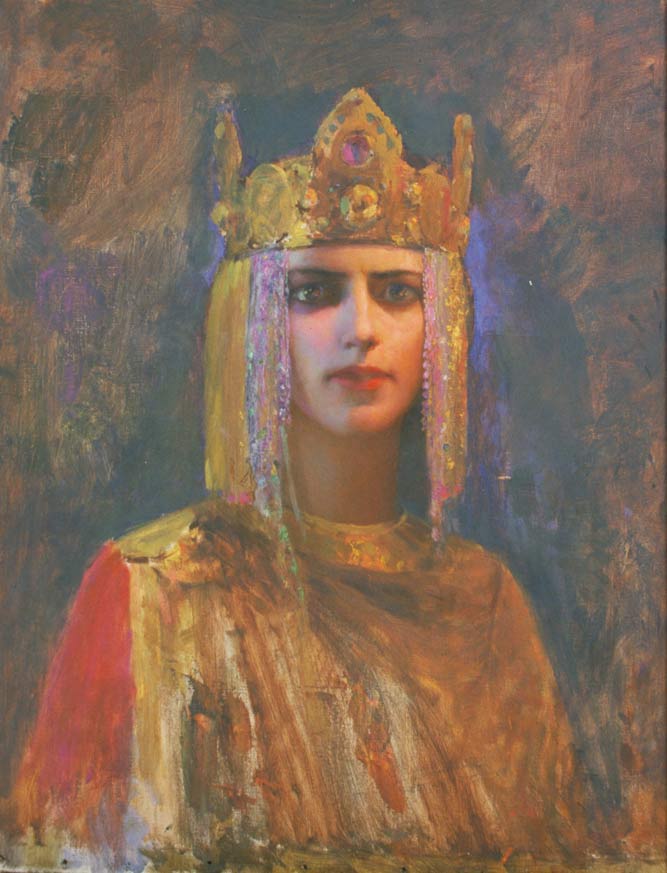
Yseult la blonde by Gaston Bussiere
Isolde

"...Half dreaming melt into the elements,
When they seem most alive and beautiful :
To fade into the purple of the west."

Brangaena

"...Bad dreams are said to augur opposites,
And bring us joys in weeds of sorrow draped."
Tristan and Isolde: A Tragedy. Louis K. Anspacher. Brentano. NY. (1904). Act II

I first became aware of the special importance of the Tristan and Isolde legend reading Joseph Campbell. The first known literary attribution to the tale is by Gottfried von Strassburg. The incredible mark that this story has made on Western civilization and truly world history is based on the central theme in the tale: Love. It is love, outside of Christian wedlock, which motivates the principal characters towards dissolution. For the first time in history, the cast of collectivism imposed over individuality was broken by a spell of love. Suddenly, the individual appeared at the fore of socio-cultural continuity for the first time and proclaimed an as yet unknown impact on the founding institution of social cohesion. Not only did love surmount the apex of all human relationship, the creative life, which sparks and endures love, became attainable, enabling the sacrificial character of a new individuality of self-knowledge and self-development in the art of life on Earth. 

See my previous post: From Genius Mind to Genius Heart: Wagner, Liszt and Dream's End
_________
a strong wind blows, and night falls, penetratingly raw, I pick up my face and screw it to the side of a cabin, changing my ways before the all-consuming blush of my red wife, gently winnowing my insides into the decadence of a youthful love story, she is my only one, and we decide to attend a party, by invitation to perform music, she is diligent in her work

Female Musician by Unknown
and in this response, a mystery hangs breathless with the unprofessional glint of our new friend’s weakened sigh, and stammering over the frozen concrete mold of a battering casino avenue, the wading head of sky simmers in an uncooked pit of flesh as we enter a home riddled with the divorce of youth from the useable head, dark rooms of sexual witnessing, of strange rumors, and fatherless groans, cruel mothers bedecked with the sorrow of an empty need

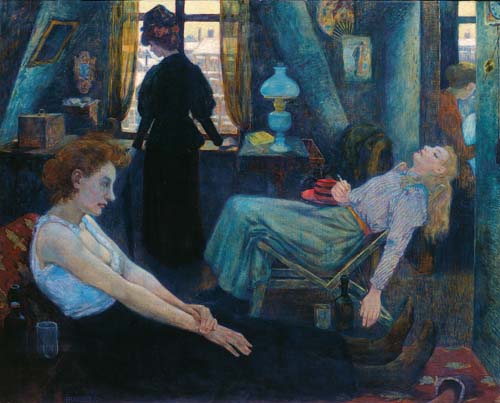
Monday Morning by Hans Baluschek
old children sit silently staring at a naked couple, motionless and bearing nothing but their side skin in two separate rooms of frightening disarray, and back in the foreground, the entrance hall, two young men sport a frantic jam session with homemade instrumentation, wood and stone chopped in a dizzying fray of wires and bone, strung together for a wish-fulfilled greed of rhythmic sounding, which stuns and climbs atop the phantom noose of age with momentous fleeting tones

The Savoyard by Alfred Jacob Miller
in that moment, the hostess of our strange inkling of a human party hands us a small envelope, and in it a card, reading the names of my wife and I, and best wishes in our move to new york city
_______ 
A space for listening, to cleanse the air with sacred voice,
An incensed feeling,
Touching on lost beauty within and under the strongly pressed clothing
Worn like skin that drops sadly over her neck of virulent sorrow
As a shapeless feature in the energy of her following
...
Passing through a foreign box
Crafted with a tongue for sensuous musical fruition,
To meld in the sorrow and aftermath of prehistoric eyes
Dreaming around the enshrined doorway
Through our billions in pain


Tuesday, 16 October 2012

Kieran of Ireland and the Sainthood of Dream History

Detail of a stained glass window depicting Saint Kieran
(St. Brendan's Church, Ireland - Photography by Andreas F. Borchert)
"Kieran of Saighir was the first saint born in Ireland...Before she conceived Kieran in her womb his mother had a dream: as it were a star that fell into her mouth; which dream she related to the magicians and to the knowledgeable ones of the time, and they said to her: “thou wilt bear a son whose fame and whose virtues shall to the world’s latter end be great [i.e. notorious].” Afterwards that holy son Kieran was born..." Life of S. Kieran of Saighir. at Celtic Literature Collective

Strangely familiar to the origin stories for Buddha, I first read about this aspect of Irish history in Joseph Campbell's Occidental Mythology. Reflecting, I see similarities to Mexico's Virgin de Guadalupe, who was seen in a vision (see also my post: The Imperial Ethereality of the Christian Cross), to incite the mask of christian history over the indigenous face. I wonder, was the story more brutal, covered up by fables of dream and superstition, to align with dominant perspectives on native irrationality.

______

In the penthouse suite version of my tiny apartment, I cavort around the fine art, baby grand piano, clear glass tables and impeccable wood floors with my mother. She is youthful and gay, enjoying the space with matchless ardor. As I look into her face, I begin to call out for my wife. “Where is she?” I ask pleadingly. Strangely, the stars shine clearly outside, entering our dimly lit space through the window. We are high above the smog and pollution, high above the human world of earthly obligation.

Cupid and Psyche in the natural bower by Hugh Douglas Hamilton
As I step down, to visit my grandparents in their New York home, I wait, fixed in place within the center of a foyer condensed by the continuous movement of relatives up and down the stairs. The air is heavy. I embrace each family member longingly, and with a strength characteristic of my waking need. Our grandfather is dying.

Interior by William Gerard Barry
Later that night, my wife and I decide to cross a high river. Our kayaks soon tip in the rushing torrent, flooded with murky water. We swim earnestly to the edge, where my wife quits on me as I gather strength enough to submerge in a second-hand craft to retrieve one of our vessels caught in the shoreline brush. Sitting in a sinking vessel, with only a dilapidated, half-worn paddle, a family of ducks begins attacking with an incessant hunger for my pruned, sore fingers.  
_______
Where am I falling?
Who do I call?
I have fallen, I am getting small.

- excerpt from "I Have Fallen"


Monday, 8 October 2012

Vishnu's Universal Dream of Creation: A Philosophy of Art

The Recumbent Vishnu and the Creation of Brahma from Guler, Himachal Pradesh, India
The painting shown here is an illustration of Vishnu reclining on Shesha, a serpent alluding to the meaning of infinity, or Ananta, also one of the many names of Vishnu. Out of his navel, springs the universe, which is Brahma, pictured here as multi-faceted. Here, Brahma appears as the dream of Vishnu, dreaming the universe into existence.

The role of Vishnu as the existential dreamer, whose dreaming is the experience of creation gives the mythology of Vishnu profound meaning for artists and all creative thinkers. The striking thing that caught my eye about ancient Indian religious philosophy in relation to creative writing, is the way in which Joseph Campbell describes the role of Vishnu in leading the awe-inspiring traditions of ancient Indian yogic philosophy towards a recollection of the shattered mirror of thought and creative inspiration, into one yoked unity of enlightened perception, which is seen in its fullness as Vishnu eyes the dream-lotus of universal creation.

Read Joseph Campbell's brilliant article, "Hindu Wisdom"

Also, check out this arts book, interestingly eponymous with the Dream Author, called, "Secrets of Rusty Things" where an artist explores found art with mythological application to the creative dreaming of Vishnu's in-sight.
_________

Lightning premonitions, deft déjà vu of tone, the amalgamated voice of anger enunciates towards a new acquaintance, a poet of Canadian life. And in that rage, the unearthed moans of my internal aching, the gorge of indulgent emotional farce, an awakened source, spiked with the thirst of a skinless napalm victim. My life pains for the strength to express such incendiary anger, a pure rage, undignified.

Chemical Kali by Srimati lal
So, within seconds, a brief passing, I apologize with sturdy feet. My breath is steady, and at once I am relieved from my internal night, the concave flexing of cavernous rock, a burden of upended implosive tension. The wilds burn with stolid elasticity and I am inflamed with a secondary respite, at seeing my name lit towards the ceiling, and reacting with confident force, eyeing my winnings; a recognition of literary achievement, in multiple categories, standing beside renowned academics and independent artists of creative literacy.

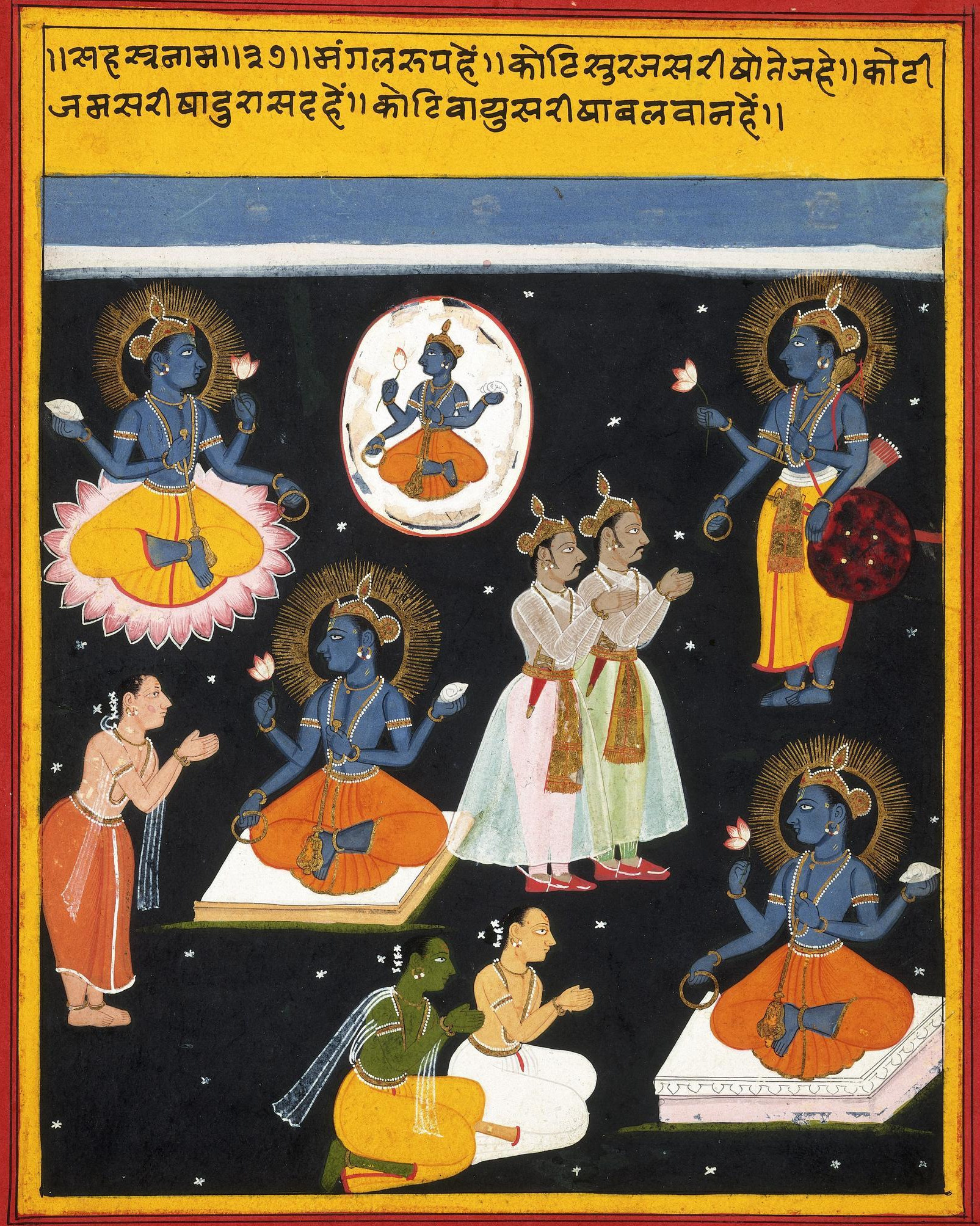
Vishnu sahasranama manuscript by Anonymous 
I am bedecked with opulent outfitting, and walk to receive my medals with an ostentatious headdress and unnatural clothing. A blathering fake of heady fame, I steal through the tables clumsily and jeopardize the entire name, quickly hiding in the utter obscurity of another day. 
_________
A gourd filled with smoke speaks in a voice,

          Human,
A mindless bowl
                    of mirth
                             inflamed

glasses grow cold in the unheated concrete glue,
                    a fixture of the dead past

a golden consumer begs with a throat full of tears

in front of speakers
                 throbbing with broken-hearted names
                 burning up in a heat of worldly instrumentation,

transcending this same-self curse
                 with a storied high
                        of nameless voice
...
a spiritual womb formed
                        at the fingertips of an artist healer
                                     pursuing the groove of an epoch
                                     stolen from the mind of silent law

in a world’s motionless yearning

                 from afar

in the dark
fearless
night

excerpt from "A Joke Downstairs"


Thursday, 23 August 2012

Reflection on "Myths, Dreams and Religion" edited by Joseph Campbell


In this collection of eleven essays, edited by Joseph Campbell, I found a wealth of impassioned research into the mystagogy of our literate foundations. My reason for reading this piece of fine literature, was to creatively unmask the roots of a new mythology to re-identify with humankind, i.e. humanity, fashioned by my own literary aspirations. With essays by Alan Watts, Joseph Campbell himself, and other fascinating minds embedded in the culture of mythological literacy, I mainly focused my reading on the traits of human self-identity as it has evolved throughout mythic time. With regard to dreaming, the essays touched on the subject in the light of religious cultural referencing, often comparing Levantine with Indian dream philosophy, as either a visionary or intermediary state burgeoning natural self-transformation; an acorn, if you will, planted in the rough soil of the unconscious by the prehistoric mind of our mysterious bio-archetypal origins. And the perennial quote, from the final essay by Richard A. Underwood, "Myth, Dream, and the Vocation of Contemporary Philosophy" a reference to Heraclitus' Fragments reads, "Even sleepers are workers and collaborators in what goes on in the universe."

See my reflection on Amazon

_________
Shrapnel of memory in the ephemeral reflection of a broken shard forced up the neck. Checkerboard flooring sprayed with clear blood. I loosened my grip around his slippery esophagus-cored flesh, dripping with the moldy puss in long-neglected balloon, deflated in the workman’s hand. In the dense obscurity where the long way back from the faint escape route memories still linger. Drinkable, luring, the tidal flush of shared pain extorts the constant sleep, the blathering, ongoing consciousness, never put to rest by the wasted highs of an unceasing mind, running off the bare edge of a fleeting freedom to simply be, and not be moved to contemplate homicide and escape in the backdrop imagination of the unreal & surreal & real fire of raw instinctual creativity.    
_________
Strangle/Strangling
"To dream about strangling someone, or being strangled yourself, means you have been hiding an important part of personality - one that you need to express to be happy - just to please someone in real life." (iDream)
_________
of memory and the strange
the lofty touch,
reminiscing beyond the treasured wine of death
as an end to meaning
in the fingertip and pupil
shone lunar and astral
with vanished luck

- excerpt from "hallelujah"