 |
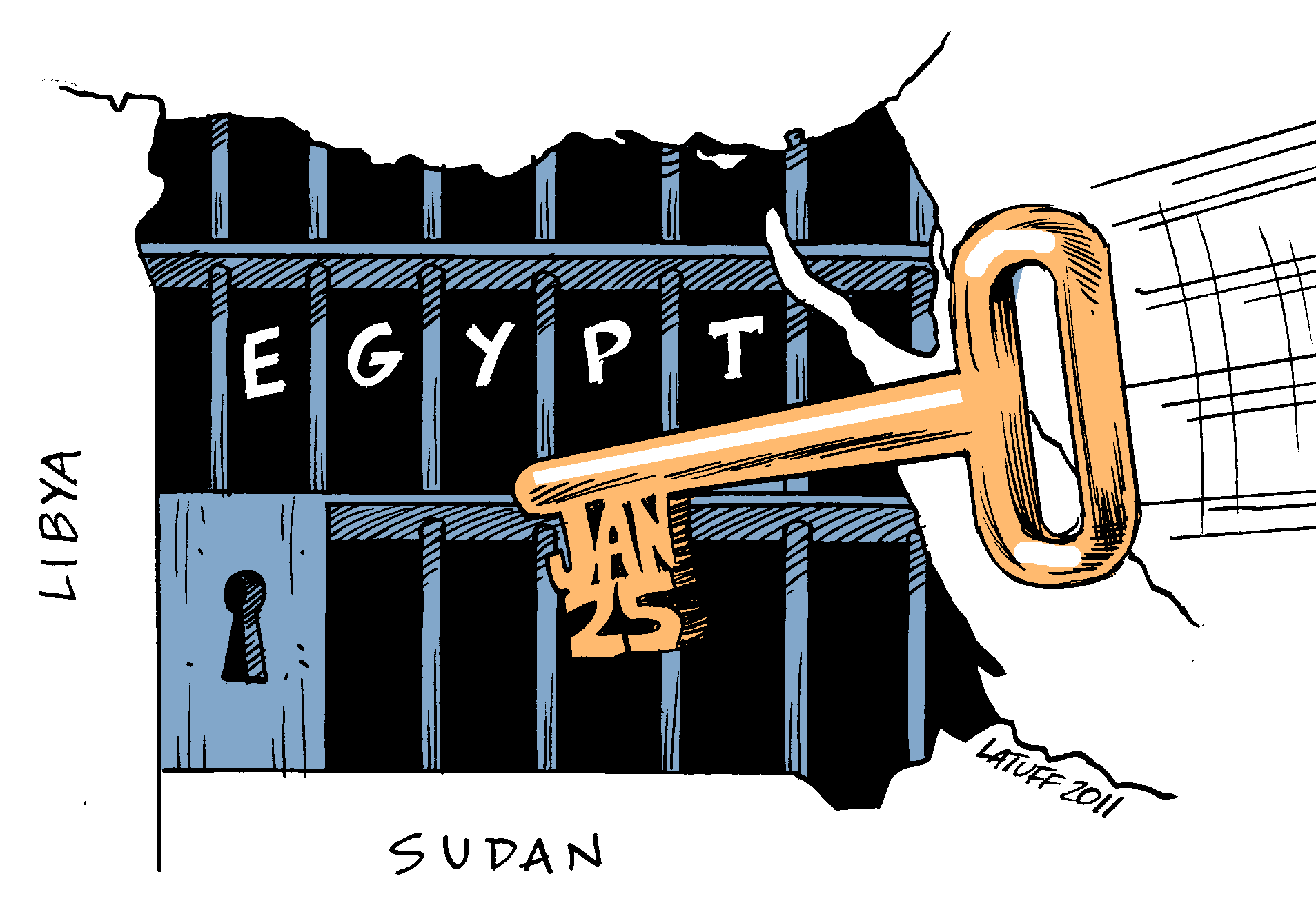
| A 25th of January key freeing Egypt by Carlos Latuff |
“The poet or the revolutionary is there to articulate the necessity, but until the people themselves apprehend it, nothing can happen ... Perhaps it can't be done without the poet, but it certainly can't be done without the people. The poet and the people get on generally very badly, and yet they need each other. The poet knows it sooner than the people do. The people usually know it after the poet is dead; but that's all right. The point is to get your work done, and your work is to change the world.”
Regarding the current situation in Egypt, the armed forces and the police backed with thugs are massively shooting and killing suspected pro-the deposed President Mohammed Morsi in streets, at mosques, and in alleys close to demonstration areas. The shooting is happening in all major cities of Egypt. Many religiously motivated violence and shooting incidents have taken place in Christian populated cities located in Southern Egypt.
In Cairo, the violence is escalating and the death toll of Muslim Brotherhood is soaring as the grand son of Hassan El-Banna, the first founder of Muslim Brotherhood organization in Egypt was shot dead on Friday clashes (Source: Al –Jazeera News TV). Another son of prominent Muslim Brotherhood leader was shot dead on Friday evening during clashes with the police force and the army. Egypt’s temporary government has declared a State of Emergency, and all citizens, as well as foreigners, were warned by the police and the army to keep away from street demonstrations and public governmental buildings, and to avoid entering Tahrir Square.
As you may know, most Egyptians have aggressive sensitivity to being photographed by foreigners, whether in normal daily situations or during public demonstrations. That is why we saw many Western journalists attacked at Tahrir Square, and one female journalist raped consecutively by a group of thugs in Tahrir square. It seems to me that the current military regime in Egypt has fully determined to uproot the Muslim brotherhood organization, not only in Egypt, but also in the whole region, and that might lead to the unwanted birth of another Syria in the area.
Most pro-democracy supporters insist to protest. The Muslim Brotherhood protesters are still surrounded inside the Al-Fateh Mosque in Ramses’ Square. They want to come out from the mosque but they afraid that the thugs outside the mosque might attack them. The police force outside the mosque is striking the protesters inside the mosque with tear gas after a gunman shot at police forces from the minaret of the mosque (Source: Al-Jazeera News TV. 6:00 pm. Cairo. GMT.)
Mr. Abdel Rahman Siddiq Hashim, Correspondent in Cairo, Egypt (August 17)
Thirty minutes by car from downtown Cairo, the predawn sky of Abu-Seer village revealed the most ancient, complete stonework in the world. Alone, I climbed the eroding rooftop of my host’s concrete dwelling. Sleepless, I gazed into the unworldly pyramid landscape with sand-blooded eyes. The quiet rustling of goats and chickens from an adjacent rooftop finally subsided under the mounting sun. The cool desert night slowly began to burn in the morning haze. It was as common a start as any to another harsh day in a small village of Egypt.
On the village margins, Saqqara Pyramid decayed in the encircling sands, humbled by the glowing Sahara Desert horizon. A middle-aged Egyptian man, donning a dark grey jellabiya, cautiously rode his mule across the rubble-strewn sands. Then, an airplane flew overhead.
Three divergent ages of human existence on Earth emerged as one, sharing a moment, side-by-side. The eldest of the three appeared motionless. The Egyptian man meditatively attended to morning duties as his forebears had done for over a millennium. The airplane, a symbol of Egypt’s national independence and economic prosperity, vanished in an instant.
Tahrir Square, meaning Liberation Square, invited all with pleasant cafes hailing from Egypt’s belle époque period. Patrons intermingled with families at the KFC, and all coveted the dollar menu. In the square, historic speakers in the Headquarters of the Arab League heard the call of muezzin belting out the call to prayer. Five times a day, the prayer, known as the adhan, ascended above the city of a thousand minarets: El Qahira.
For a twenty-year old student attending the American University in Cairo (AUC), overlooking Tahrir from the east, there was liberation. The first day of my young life in Cairo opened with one fiery orange dawn in the fall of 2007. Sipping a hot ginger tea, I waited for my cab in Tahrir Square. Mohammad, age thirty-three, chauffeured me to what would become my home for the next ten months. Zamalek, an island on the Nile, stood besieged on all sides by a city of 18 million.
In the past three years, the AUC’s Zamalek student residence went through two evacuation processes during the 2011 Revolution, and again this summer. Due to the unsafe proximity to Tahrir Square, ground zero for the infamous belligerence of military and riot police, international students were sent home. The residence became a safe haven for the AUC community; domestic students and staff were offered free accommodation and complementary meals.
Emotionally overwhelming, everyone present will never forget the bloodied streets paved with the burnt skin of nonviolent protestors. “They all have witnessed history unfold and a lot of them went to Tahrir Square. They all left in tears having to abide to the evacuation request,” Fatma Abou Youssef, Associate Dean for Residential Life at AUC wrote via email from Zamalek, Cairo on August 19.
In 2007, through a yearlong study in the humanities, Egypt held a potent charm. For a child of American suburbia, life in downtown Cairo was a true and magnificent freedom; where a dollar bought cab fare through thirty minutes of scorching highway from the Great Pyramids to the fortress of Salah ad-Din. At ground level, the city was not only safe; it was ever so welcoming. In comparison to crime in the average American city, Cairo was exceptionally low-key.
After many captivating hours learning intensive Arabic from a local Egyptian professor or studying Islamic philosophy with a visiting lecturer from England, the streets beckoned with an extraordinary spirit of discovery. Only after minutes of walking southeast from Tahrir Square, I wandered to the shrine of Saint Patron Sayyida Zeinab during the pilgrimage festival, or ‘Moled’, in celebration of the birth of this special granddaughter of Prophet Mohammad.
Irrespective of prohibitive warnings from AUC’s student orientation the day of the Moled, I decided to traverse the uninhibited grounds where Sufis and rural Egyptians (known as Sa’idis) pilgrimaged. I espied characters from a bygone era. Many had never before seen the pale face of such foreign skin. An elderly man without legs moved with the aid of wooden blocks, another with a gnarled cane and goatskin satchel appeared at the end of an impressive journey. One younger man, about my age, carried a paralyzed companion on his back. With equal wonder, they smiled at both having reached the shrine as staring into blue irises.
For the next months, practically every time I set foot in public in the city of Cairo, as throughout Egypt, children ran to greet me, jellabiyad-graced elders responded generously to my regular salaam alaikums. Peers offered a traditional glass of Egyptian whisky – the joke name for black tea served with a generous helping of sugar. Ordering a freshly pressed sugar cane drink (qasab) from street-side juicers became a delectably regular pastime under the all-pervasive sun. In fact, the original word for sugar (sukkar) is derived from Arabic. Similarly, the tamarind drink (tamr-hindi) was served by charming fez-wearing men (hearkening to Ottoman times) on street corners amid the harrowing traffic in Tahrir Square.
First impressions of Cairo were smoothed over with genuine smiles and hearty laughter. The people of Cairo soon became my teachers, more than any university professor. First having sought to learn Arabic from the locals, I then learned of dignity, humility and simplicity through their open hospitality and street-wise intuition. Uniquely, Ramadan became my favorite time, when a piece of unbroken baladi flatbread always accompanied the savored mulukhiya soup; welcoming any blessed stranger, even if arriving from the next unassuming alleyway.
Rapidly, the most frequented haunts, such as Cairo Club and El-Bustan, saw mounting anxiety. Sugar, oil and other daily commodities soared in price, both in the formal, as in the informal economy. Conversations became more grave, jokes more cynical and youth were feeling the brunt of a serious economic downturn.
One year before the 2011 Egyptian Revolution, the air was full of gunpowder. Every whisper seemed that moment, when the spark would light and the very social fabric would begin to incinerate. The deep traumas of colonialism, corruption and fear were immanent, and felt by the overwhelming majority everyday. More importantly, an unruly intensity was felt every night, when the mass of people returned to sleep on the bedrock concrete of Cairo’s sprawling suburban slums. In such an environment, the status quo ceases to quell the rage. The traditional café became peripheral to the cyber café, where social media and youth activism quickened into the perfect storm of 2011.
Three years prior, an incipient sandstorm clouded the streets on a day of mass action in the wake of an inexcusable rise in bread prices, while former Egyptian President Hosni Mubarak celebrated his 80th birthday. On that night, we crowded into El Horreya Café & Bar (literally meaning Freedom) on May 4, 2008, as on any other downtown metropolitan night in what was once the Amsterdam of the Middle East. Downing local Stella Beer and chain-smoking Cleopatra cigarettes could not snuff out the bitter cynicism looming like a rickety ceiling fan about to fall and leave the place roasting.
The very earth around Egypt is often as imperious as the social hierarchy itself. The desert becomes part of the inimitable struggle for life in Cairo as trade has nefariously altered the course of most people’s lives around the world, so dramatically in the modern era. One week before the Egyptian Revolution of 2011 commenced on January 25, my uncle, visiting on business, listened with ungraspable curiosity to his Egyptian host talk about the gaining local obsession with Facebook. The word was on its way out, and never to return.
Remembering Cairo before the Egyptian Revolution of 2011, and in light of the escalating crisis, life will obviously never be the same. There is irrevocable damage, and if the people, who lived and worked in the downtown area, survive, they may never return, and if they do it will be to a different place. Tahrir Square has become home to a near impregnable military, a scavenger’s paradise of the most lowly and vicious of thugs, a place of smoke and blood, where tear gas blinds and the storied hangouts of a bygone era are stained with the outrage of a military coup in broad daylight. In its wake rests a throng of massacred civilians.
Will the bartender at El Horreya Café & Bar return, he, who snickered and grimaced with local spite, subtly disproving yet overtly encouraging Egyptians’ mixing with European, American and African socialites over incalculable packs of Cleopatra cigarettes and football? Will the papyrus painter return, who gypped me out of a small fortune, cleverly convincing me into becoming a rare arts collector? Will his son return, learning his trade not only for the trade, but also for the tricks; he who walked with me past the now besieged Ramses’ station mosque to deliver my papyrus paintings home to America? Will the mythic female taxi driver return; she, who dazzled our imaginations by crossing the gender line into such a masculine space as the world-infamous streets and thoroughfares of Cairo’s largely unregulated (or, self-regulated) traffic?
As social critic Tariq Ali wrote this July for counterpunch, an independent investigative journalism source, after all is said and done, “Who will take the Army away?” In the intermediate period between the first Egyptian Revolution of 2011 and this year’s ongoing protests, which began with the presidential coup of Mohamed Morsi on July 3, the Iranian Green Movement receded, while Bahrani and Syrian social unrest continues to derail. After the ecstatic hype following the Egyptian Revolution of 2011, weary voices from the Middle Eastern diaspora warned of immanent crisis. Westerners scratched their heads when the Muslim Brotherhood ascended to power.
As a foreigner in Egypt, one learns that a human connection to anyone on Earth, to anywhere on Earth, from anyone and anywhere can be learned simply by walking in public, in the street, and more importantly, the square, with an open heart, engaging in dialogue and being present. When we listen, we observe how everyone has a backstory, which does not merely explain one’s present situation, but supports and rounds it out with a complex spectrum of life experience.
Today, this truth is more than possible; it is inevitable as more and more people are forced out of their homes, out of the comfort of their lives in their countries and cultures of origin, whether by war, civil unrest or the urge to change things, to meet face-to-face with another, and see the clearest reflection of one’s own life. The deaths of Egyptian protestors are not isolated incidents. They are part of the larger narrative of one unified history of all people. In another two years, will they have fallen in vain, or will everyone empowered with the knowledge of the uprising ensure that they have not?
On returning to the U.S. after three months in Cairo during the summer of 2010, the adage from the American Revolution curiously repeated in my head: No Taxation Without Representation. The city streets should see my sign, I thought, held up on display; the Revolutionary slogan of 1776, concluding with the statement: Stop Funding the Militarization of the Middle East. That sign was never raised.
After over a year of living on the ground in Cairo intermittently from 2007-2010, I had about enough of armed forces on every street corner. As an American, I felt complicit with the military presence. An iconic moment from the Egyptian Revolution of 2011 revealed the ugly face of global militarism when a demonstrator exhibited the “Made in the U.S.A.” stamp on canisters of tear gas.
As in the ancient materiality of Saqqara, the medieval trot of the mule and modern flight were spawned out of an instant on the archetypal sands of time. An airplane summons the precarious future in all its speed, might and, finally, in the local historic context, its fleeting insignificance. The pyramid, now stationary and unascending, contrasted with the way of the mule and the plane moving in the same direction.
Yet, as with today in Egypt, the very power and speed of the plane overhead not only outmatches the mule’s strength, arriving at their common destination first, it leaves nothing behind for those arriving at a deliberate pace, as allegorically, by mule.
The people of Egypt seek development through truly democratic means, as opposed to Western democratic means, i.e. foreign aid, sanctions and war. For Egypt, as with most of the world, true independence is a long-awaited, and as yet unfulfilled promise. When allowed to proceed at their own pace, in step with tradition, and an engaged contemporary society (as demonstrated in the revolutionary context), the people become aware that the plane overhead is exactly as distant and unconcerned as it appears. Contrasted to the pyramid, or the mule, the plane (and the elitism it represents) consumes the country’s (human and natural) resources with it, and all in a passing instant.
During the daily commute through Tahrir Square, one of the largest public insignias near to the square’s Omar Makram Mosque stood out: “Everything Should Be XX” (meaning: everything should be 20th century). Before the revolutionary fervor, quotidian time in Egypt screamed with the anxiety of delay. The rushes of traffic, the strength of the black tea, and the overconsumption of sugar were offset by fitful exhausts, religious rituals, and the sun; and now, an army, sponsored by the most militarized, energy-rich and power-hungry nation in the entire world. Nevertheless, as countless Egyptians stage sit-ins, many say the people of the unmoving Saqqara still live and walk in the streets of Cairo.
NOTE: This article, titled, Fall of the Arab Spring, was published with The Media Co-op on October 16, was produced in partnership with AlternativeMediaYYC.com and the Arusha Centre with the Calgary Working Group initiative to establish a new local of The Media Co-op in Calgary
Read our other recent pieces produced by the project:
"Vancouver is debating a resolution to divest from fossil fuels"
The 3rd of October
Egypt's War on Terrorism and Extremism
Hayseed Magazine
Corporations in our Heads
Working North
___________
It was our last night. The sirens of Death displaced the air with an eerie silence. The dissonant projection moved us with a most unsettling scream as from the constellations above. In an incomprehensible language, the alien voice bore down on our skulls as through our entire skeletons with the most devastating form of spiritual dread.
Neo-Nazi ghosts awakened to round up non-Aryan cattle from their millennial imprisonment under the northern cross. Before the first ounce of blood was spilled, I eyed the forest beyond the edge of the encampment, where concentration then turned to liberation. For a reason unknown to me at the time, I saw my way out. Others noticed as I ran through the fencing, bewildered by the transcendent feeling of freedom beyond the barbed hatred that confined my elders, my children and brethren of closest kin.
Out into the wayward plain, I fled, alone, veiled under a new moon. The sky enlightened my distance with steps unheard inside the emptying prison. Yet, I could hear wails. As I moved into the dizzying silence, my heart muffled by the fear of no-return, I wept. I felt my skull crack at bearing the guilt, the shade and the humility of survival among my most honoured family and friends, of my blood and spirit, they left behind to suffer excruciating gasp of liquidation.
The sky filled with light, and as the fog of my vision cleared, a field of people opened before me, as with the harmonious revelation of a smile. Youth prayed and rejoiced under the morning sun, strong with music, to greet the day with endless festivity. The glow of the Earth radiated as a face after being kissed by a warm lover. The air moved softly, and my skin pulsed with gratitude. I enjoyed the music, spontaneous and ambient, as if I had heard music for the first time. Then, a face stared into mine.
They recognized me, where I had come from, my origins and imprisonment. I wondered if they had escaped as I had. My first reaction was to run, yet, as the moment passed, I felt their empathy. The young woman, working as an attendant to the open-air music festival, expressed her concern, and showed me the way to a bus station near to the edge of the forest. From there, I could travel on and farther away from the destitute evil of my past.
As I approached the station, others noticed me, with fearing eyes, saddened with the truths of human compassion, they earnestly helped me along. I couldn't decide where to go. The schedule was complicated by the tightness of the knot in my heart. Where would I go? What would I do? Should I return and face the death that had me in its embrace, and that had since now consummated its passion with everyone I had ever known? I remain, immobilized.
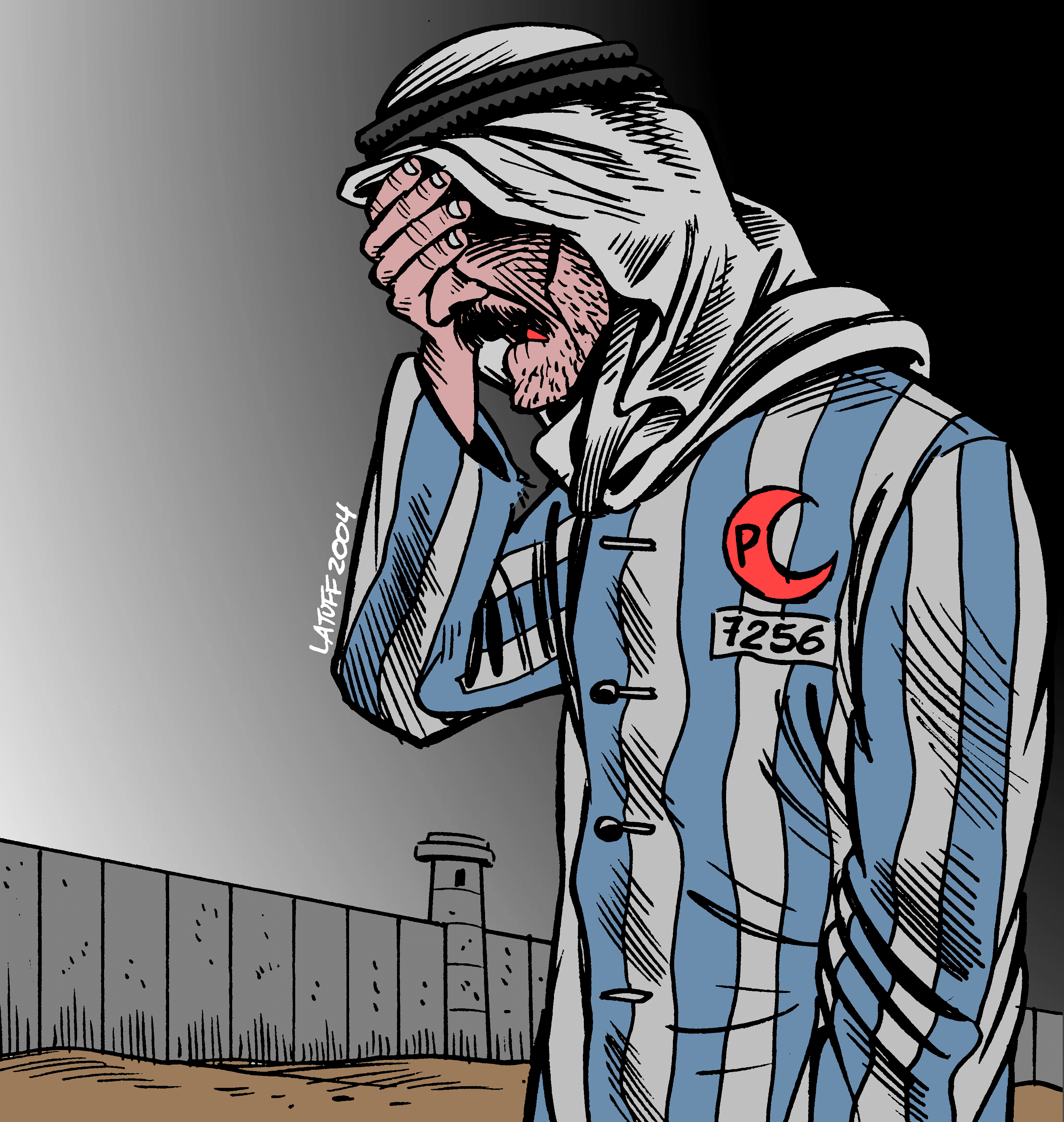 |
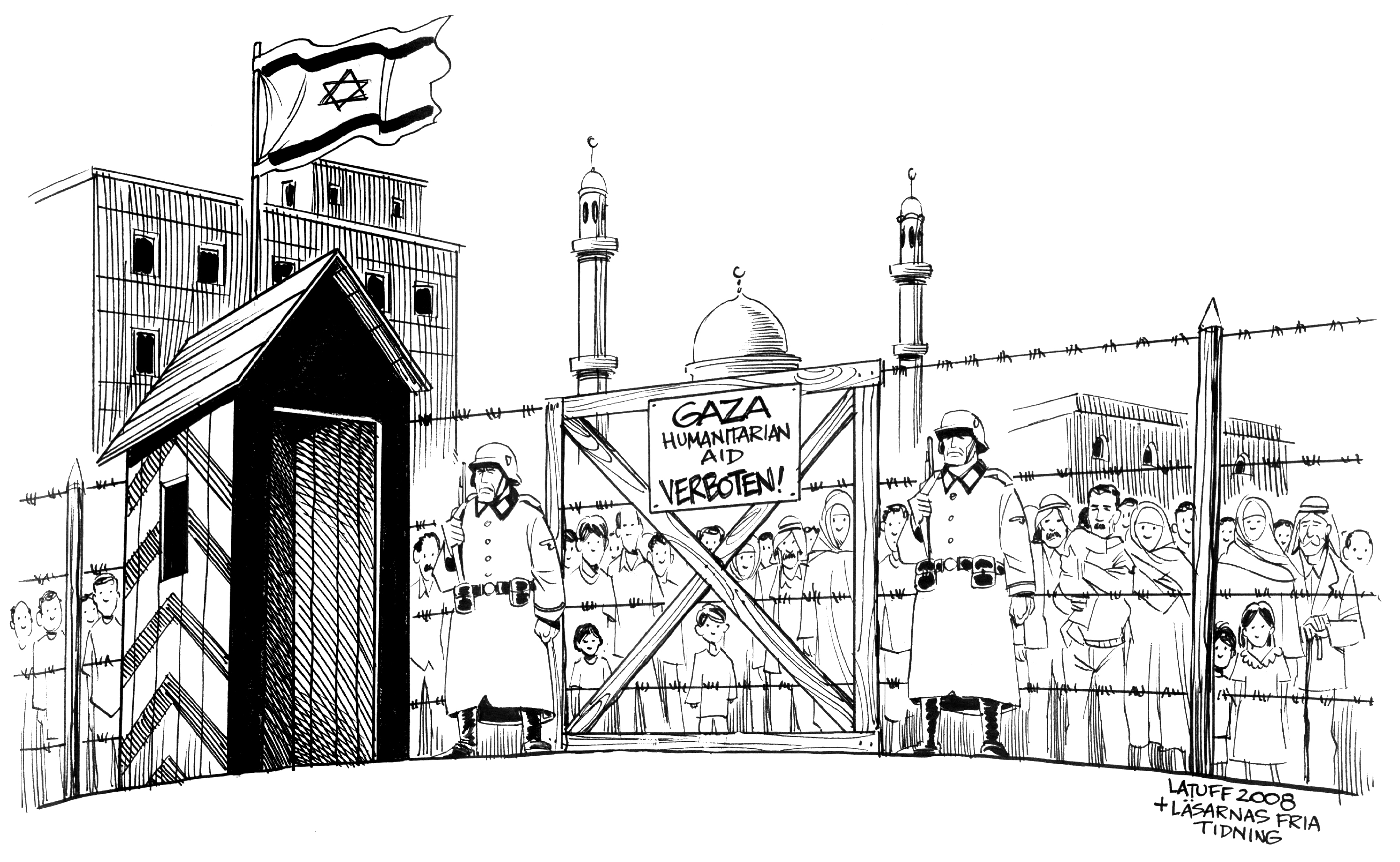
| IsraHell's concentration camp by Carlos Latuff |
 |
| The Gaza Ghetto by Carlos Latuff |
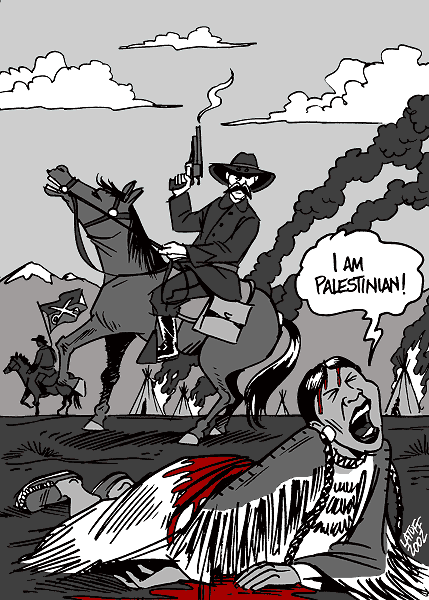 |
| We are all palestinian - Native Americans by Carlos Latuff |
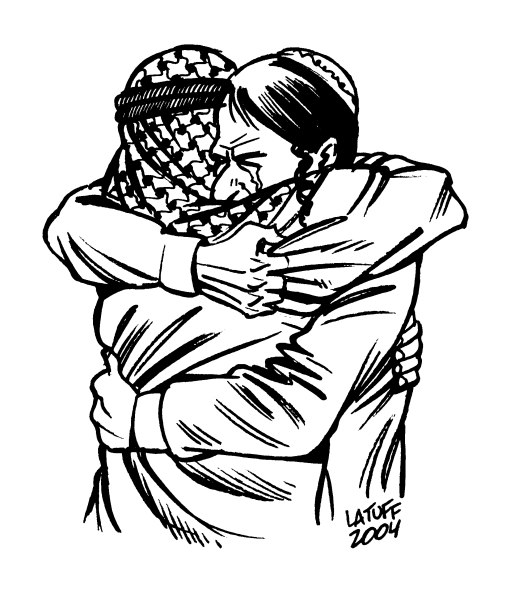 |
| Forgiveness by Carlos Latuff |
 |
| Che Guevara wearing a keffiyeh by Carlos Latuff |
___________
Listen to live recordings taken from the Trio's debut performance on October 18th, 2013 in Self Connection Books (Canada). More on Jasmin's brilliant skills, gifts and about her amazing Crystal singing bowls please visit her today at Singing Bowl Music. This live album was produced by Vi An. Funds from this album goes towards artists involved and especially to fund future endeavours together as a collective, to rent venues, promotional material, transportation, meals, accommodation, etc. Thank you for your amazing continued support of these fine artists.