Primarily a writing exercise, this dream journal-inspired blog is a quiet introspective sojourn into the process that we traverse in going from private dream to public art. I see our dreaming as an internalized mythmaking. As I philosophize and expressively exhibit dreams, both private and public, I encourage and delight in creative language as a way to practice experiential metaphors through a “public dreaming." Writing Theory: Creative Dream Fiction

Monday, 26 August 2013

Becoming Yours: Creative Origins in the Music of a Silent Love


"I really just want to help people understand you can go and get those things you want. I mean I was a bodybuilder for a while, I was a personal trainer, I did boxing, I worked as a bouncer, I, you know, started writing, did the creative writing, got an MFA, started my own literary magazine. Now, I'm doing the vagabonding thing, started my own blog, now Facebook page. It's like you really can go and like do all these different things, you just have to be wiling to make some sacrifices and just realize you can do things you've dreamed about doing. And I think all my life, this is the life I wanted. This is the life I wanted, where it's like I'm constantly learning." Jonathan Starke, vagabond writer and founding editor of Palooka Magazine

A Modern Odyssey of Vocation by Rusty Kjarvik 

Essay for “Book that Changed my Life” segment on The Drunken Odyssey with John King, written for the book of Nikos Kazantzakis, The Odyssey: A Modern Sequel

I was 18 years old, returning to my mother’s south shore home in Massachusetts after my first few months away at university. It began one evening, at the end of a series of meditations, where, motionless, I re-conceived the magic psalms of Ginsberg’s elemental void, the enlightened palms of Snyder’s versified mudras and the delicate alms of Kerouac’s prosaic spontaneity. In the pitch darkness, I wrote, “Tat Tvam Asi” on the wall with my trusty writing pencil. “You are it!” translated Alan Watts, whose English clarity rung through my mind with echoing resonance, reverberating interminably to the next day, when I had read every word on my bookshelf and sought more. 

I set out, to the library of my Greek-Jewish Romaniote grandfather; whose literary meditations on the healing properties of the written word had sent him unscathed from World War II to the centenarian desk. There he sat, with a penknife shakily opening letters as his Polack Jewess wife screamed from the downstairs banister. “Take whatever you want!” He spoke over the long-winded cacophony of domestic affairs. In the name Kazantzakis, I saw another Greek, an ancestral voice unperturbed by the walled house.

In a moment of intuition, scanning through the compendium of classics, I chose The Odyssey: A Modern Sequel. Crouched inside my off-white walls, completely bare if not for the Sanskrit scribble and a prized first draft poem hanging deliriously like a whitewashed door of perception. I began reading everything – the copyright date, the ISBN code, and every insignificant character in between. 

Smashed skulls, bespattered bowels and upended spines weaned my consciousness from a walled indoor adolescence. My mind voyaged onward into the travails of a maturing intellect. Spawned with a Greek flair for disinhibiting fleshly experience, I read with a burning momentum. I needed to feel each word pulsate its rhythms of modern wisdom into every minutiae of my being. I began reciting, with the quickening taste of the classical orator, moved by the enigmatic grandeur of such literary quality. Soon, it was dusk, and the tired footsteps of my stepfather climbed the stairs to rest his weary skull on a pillow of televised static.

Reading, reciting, orating, on and on and into my pores sunk the blood of the fallen men and raped women, and from my nostrils leaked the icy salt of the Mediterranean seas. I wept with unspoken clarity for the emotional barbarism of modern spiritual greed! 

At a break in the violent awe, I spoke sweet lines of sexual camaraderie. Women’s voices formed on my dry tongue as the fecund prosperity of mortal despair. In those tempestuous rhythms, my drunken brother stumbled longingly upstairs to lust in the barfly haven of suburban coitus.   

Undeceived, unwilling to desist, I read on, with soft muttering in the depths of red twilight as Morpheus, the Greek god of sleep, laid the house to rest. In my empty hollow, I swam to the subterranean netherworlds of the creative subconscious. Emerging, still as ever, with the light of morning, my mother’s knock could not startle my ever-strengthening concentration. 

I savored each of the 33,333 17-syllable verses as a ripe, freshly picked Kalamata olive, cleansing my palate, as with my cognitive sensibility. The unique versification of Kazantzakis’ voice led me onward into the depths of creative literacy, as I relished on his startlingly characteristic use of nouns, at once subjectively descriptive, while aesthetically presented with the definitive tone of proverbial lists. His “Cretan glance” remains unmatched in modern literature, evoking the spirit of the Mediterranean as an invocation to the deified ancestral hearth of earthly humanity: the book. 

On reading the final character, I threw the book into the air and sprang from my narrowing walls before the book crashed onto an unlit lamp. Visiting relatives, weakly frightened, noticed my sorry state, and their misguided sympathies amplified under the crushing noise of broken glass. 

After being handed a Greek salad, to end my bookish fast, I greeted my grandfather, whose smile shone with mutual respect and ancestral fraternity, as two men of pure literacy. Outside, a childhood friend stood to greet me. We had not seen each other since pre-pubescence. Her eyes, crooked, observed my own downward slant into the abnormal body of creative tradition. I was not mad, I was not sane, and yet, from that moment, her eyes told me what she could not. I was rapt, eternally in the powerful vocation of the word of silence and thought.    

This essay was featured in Episode 12 of The Drunken Odyssey with John King (1:22:50)
________________
Follower
Taken during the Calgary flood, this piece affirms communal living as a way to stay afloat. The onlooker, under the umbrella at the side of the picture stands proportioned as a much larger, enigmatic figure, showing how the individualistic and non-participatory way of life is much larger in our view. Yet, the smaller geese portrayed survive through such calamities that would forestall all of human life. This piece is dedicated to all the volunteers who helped out during the flood. 

Into
This piece revives a sense of mystery and adventure in the antique remnants of our city’s past as they continue into the present. So, in a sense, the very door itself offers an entry point, regardless of using it to enter the building. This piece is a practice in seeing that photographic art so meaningfully attempts to project for the seeing public. The city’s architectural heritage is reimagined through digital photography to capture the colorful beauty of the past, and to encourage everyone to see it in their daily lives at ground level. 
Lightly
An unaltered piece on perspective and contrast, this shot portrays the inner city perspective as immersed in a constant play of dwarfed and magnified artificial environments. Every great photographer must become a master of light, and yet, even the everyday bystander is subject to the subtle nuances and grand complexity of light and how the human eye perceives it. In order to further enhance the living experience of our city, we must pay attention to the power and effect of light and seeing. With the right contrast of shadow and light, we can see the way forward. 

Passage
 Shot on the Bleriot Ferry on the Red Deer River, the clarity of the flags over the oblong shapes and angular wirings on the ferry starkly contrast with the badlands horizon in the background. The contrast is not only in shape, but also in colour and texture, further emphasizing the newness of modern industrial technology to the land. The reflection of the badlands in the water is housed under the wiring for the lifeboat. The red of the ferryman’s jacket meld with the ocher stone and national flag, yet the provincial flag of Alberta stands taller and larger in the unworldly sky.   

Plaza
Taken at Olympic Plaza on Canada Day, the public was out in full form. The scene depicts Mayor Nenshi collecting impromptu charitable donations as the public crowds around him with money in hand to exemplify our compassionate, community spirit. On the horizon, the Calgary Municipal Building completes a semi-circular shape in continuity with the crowd below. The vibrant blue of the building matches the sky as if to emphasize the overarching presence of the municipal leadership, especially on that day, and especially with Nenshi’s leadership. The blue of the Alberta flag shows with a singular display, connecting the overall red color of the Canadian people to the local experience in Alberta, with special solidarity in light of the flood disasters.

Simplicity
A piece to reflect the feeling of cycling, this shot was taken on the riverfront bike path on bright and clear sunny day. The retouched colouring of the photo encourages the idea of each person experiencing and seeing the world through his or her own eyes. The ovular shape of the photo is meant to display the image as if directly seen through the eye of the seer. Light touches of white glow against the tips of the tree as sparse clouds drift.  


Solitude
Also taken during the Calgary flood, the image intends to capture the vibrant and intense presence of water, and the Bow River more specifically, entering our daily lives. What was once an anthropocentric, urban reality has become a very real connection to the presence and power of nature in her greatest manifestation. We cannot now go about our daily lives, nor even cross the street as this picture conveys, without being at least somewhat submerged in the omnipresence of the natural environment.  

Ancients
Set during Canada Day Pow-Wow at Olympic Plaza, my wife modeled under the spiraling flue of a magnificent, traditional tipi. The photograph emphasizes the Four Colours (yellow, white, black and red). Human life, within the womb of domesticity is constantly immersed in the sacred hoop of the Medicine Wheel, representing the Four Directions, Colours and Humours, among other symbolisms. The human figure is silhouetted in black, in connection to the black outline of at the very apex of the tipi. In this way, humanity represents the closest connection that we would have to the greater life in the original circle above, represented by the greenish-blue of the sky beginning the circular form of the tipi’s shape around the standing human form. 

Civilization
 Taken on a rooftop above Stephen Avenue. The image invigorates metaphors of the great urban passage through civilization in the shapes of modernity and industry in the 21st century. This piece highlights Calgary’s inner city architecture as from within, looking out through a small rectangular break in the multicolored, almost prismatic shapes of the contemporary building, as it were, virtually closing in. Yet, the sensational digital display is alluring and captivates with a fantastic beauty. Below, subterranean shapes represent the surfacing below, a whole image of the city as a living being. 


Danger
During a music video shoot not far outside of the city of Calgary, this still captures the remains of a true-life crash landing. Further dramatized by the winter prairie landscape in the background, the grounded plane conveys a sense of isolation. The remote and forgotten remains of a crash-landed plane convey a sense of warning to a society needing to avert its course, even if it may feel it is flying, and instead embrace greater diversity in transportation, such as cycling. 

Direction
Like much of my photography, there is often a central focus made blatantly apparent. Similarly, this shot invites viewers to remain true to a course that goes in peace with the natural environment. Even though there is an arrow pointing (with as strong a sign as any) in one direction, we need not always follow it. Instead, like the goose in the picture, we might simply sit on it, and reflect over the calm, natural flow of things as they are. 


Emerge
This piece speaks to the introverted, indoor culture of Calgary created by our housing, and, equally, by a harsh climate. Yet, this photo affirms the emergence of the public figure, to brave the weather and to go beyond the domestic sphere and simply get out. The photo embraces the creation of an extroverted, outdoor culture that is ready to move from isolation to community as the developing maturity of a young city. 
_________________


"Journeys end in lovers' meeting" wrote Shakespeare in the comedy, Twelfth Night. All the more so when the journeying are lovers of music! And so, the saying, "I'll see you on the other side" is expressed in the pure creativity of Earth and Sky, of rhythm and wind, of bone and breath, wherein musicians enter and emerge from the collective realm of collaborative unity through the essence of sound as beat, melody and harmony.

And in the above recording, a serendipitous connection forms between two lovers of music across the expanse of the Atlantic sea. From Barcelona to Boston to Calgary to Vietnam, windswept and travelling to the Chinatown home of two artist-seers of sound and light, we anchored our minds in the vast breadth of the true love that rests in our hearts. Improvising on the rhythmic influences of African blues, intermingled with Cuban folk music and original hymns of Catalonia through the instrumentations of guitar and voice (El Toubab), zheng (Vi An), together with my xaphoon and percussion.

The recording above represents one of the larger productions and mixings that I have engineered through collaboration, as opposed to my solo project, Mister E. Menachem. At first, I was inspired to reach back through the catalogue of recorded memory through field recordings of concerts, jams, cafe moods and late-night stirrings. Listen below for a collection of such recordings. Their wealth of emergent intonation in the voice of a flowering mind speaks tales and tomes of innocence and experience, of the extrovert amateur and introspective auteur, of the public artist and private dreamer.

After reflecting on the raw grit of creativity in the burgeoning flesh of a new community, a new movement, an incipient birth of open life, we see the whole society unvarnished. As the economy becomes more and more a blasphemous term of bitter and cold forewarning, the heart deepens and the mind sharpens. Look around. In every corner of the world there are shadows. Gold and oil are self-destructing through a mutual phase-out, blurred by irrelevance.

Each and every one has, and are part of, only one life. As I wrote in the essay, A Modern Odyssey of Vocation, "I was not mad, I was not sane, and yet, from that moment, her eyes told me what she could not. I was rapt, eternally in the powerful vocation of the word of silence and thought." SoJourn(al) is an offering of time to explore the inner space (the dream space) where the natural watercourse way of existence merges with the choice to be in unity with all of creation; the way of the wise fool, the blind seer, and the musician...of silence.    


Monday, 19 August 2013

The Artist of Moloch: Creativity and Capitalism in the New West


“Moloch in whom I dream angels...Dreams! adorations! illuminations! religions! the whole boatload of sensitive bullshit!” from Ginsberg’s Howl, Part II

What is it to be an independent in thought and action, to be an artist of heart and mind, and, most radically, to live within one's means in the New West? I live in a city where my next door neighbour makes over a billion dollars a month. I, personally, don't make money. Or, more accurately, my profits are nearly zero. Yet, I live life fully and exuberantly. On a whim I could splurge on an evening of luxury fine dining with my wife, or rent a car and go to the mountains, or even purchase a new musical instrument and the latest computer hardware. I am not in debt. In fact, the one and only stipulation to entering higher education, was that I not get into debt. I save, and live within my means, although I don't exactly see my money growing as the incessant growth models of Western capitalism would encourage. 

Nonetheless, as a city dweller, and especially in the city wherein I live, considered a global oil capital, the mean streets of capitalism are hawk-eyed and omnipotent on every corner. As an artist, the very ground under my feet is funded by the turning soil of the most destructive earthquake in human history known as the fossil fuel industry. Living the majority of the time through physical self-propulsion as a primary means of transportation balances one's perspective as an outsider of marginal and radical import to the status quo. Energy and economy, in their most fundamental and basic meanings, derive from the physique in relation to the sources of life in the ground (energy) and the way of relating to living exchanges through reciprocity and foresight (economy). Happiness is learned when expense is measured in sweat, growth in a smile and dividends in generosity. 

Daily the innocence of play in the mind of art, creativity and community is buried under the debris of an open-pit mine with lightning swift efficiency. Once aware of the mounting genocidal ecocide inherent in the dominant global energy policy, how can one go on knowing that at the end of the day the artists of the world become mere charade, trick and distraction for the bowling force of industrial belligerence? One of the greatest pearls of wisdom that my grandfather shared with me was what he had learned among his Greek family of early immigrants to Lower East Side Manhattan, New York. "We were poor, but we were happy, because we were together," he repeats like a charm against the malevolent truth of Western life: family separates. So, often, I feel, as a communitarian-individualist independent-ecologist artist-worker radical-traditionalist of the 21st century and of eternity, that my life is the epitome of what Ginsberg describes above, as in Moloch, and dreaming of angels. 

In the next weeks, I will be transitioning the SoJourn(al) site as a supplement to a new web-source exhibiting an ongoing creative non-fiction work that gives breath and voice to original knowledge. Oral storytelling, family tradition, and cultural literacy are waves of realization that have revealed a sliver of moonlight over the oil-dark sea. I see a way, and directed by intuition, the art of living further breathes a channel of oceanic action towards as yet unseen, inner prosperity. Philo of Alexandria, an ancient who fused Jewish and Greek philosophy at the beginning of the first millennium of the common era, is quoted: "Households, cities, countries, and nations have enjoyed great happiness when a single individual has taken heed of the Good and Beautiful. Such people not only liberate themselves; they fill those they meet with a free mind." 
______________

away up
passive aggressive
play waste
science silenced
weary night
______________
The track, "Columbian Map" is derived from the written piece, "Phantom Pages of a Medieval Columbian Map" from the district.Columbia collection of experimental writing. The meaning of the title refers to Columbia, the goddess myth of precolonial America, the ubiquitous feminine divinity of the land itself as seen and heard through Western European eyes. The "Phantom Pages" open an understanding of the land that transcends European representation through the cartographic delusions of "discovery", colonization and settlement.

A narrative art sounding is embedded between guitar and shakuhachi music. The introductory guitar melodies on the track are resonant of Indian Sitar music, yet also merge into influences from West African blues and Middle Eastern Oud playing techniques. The shakuhachi, through its abject dissonance and airy ambience, bridges two instruments from opposite ends of the globe, that through harmony and chaos move the voice to speak, as middle ground, as the remoteness of truth between directional extremes. My approach to the guitar (a quintessential Western instrument) as the embodiment of non-Western sonic influence further melds with my approach to the shakuhachi without any classical training, thus playing it with a Western ear. And so, western instrument with an eastern ear, and eastern instrument with a western ear redirect the two-dimensional cartographic reality of discovery into the 4th dimension of time through sound as narrative, voice and, more, a pure medium of truth.


A collection of five works from the penultimate chapbook from district.Columbia, "Changing our PERSPECTIVE" includes such works as "An Unknown Pleasure of Respect" and "Phantom Pages from a Medieval Columbian Map". With an ahistorical to contemporary thought in light of the current need to shift from an industrial to ecological society, this chapbook addresses that first perspective, or where we stand is the crucial point of change. Perspective, is also history. Until we transcend the dualistic norms of media consumption and direct experience, there is no way to begin again from a new point in history. The junction of the present and the past affix humanity at a crossroads of time. 

Before ascending into the next era of humanity on Earth and traversing the crossroads ahead, each and every last individual will be asked, Who are you and where have you come from? Anishinaabe Elder Dave Courchene wisely advises all people to return to creation, to return to the very beginning of our nature whenever unsure, whenever inundated with a sense of ignorance, confusion, loss. On the path to inner knowledge, light blinds, and the shadows reveal the road home

Monday, 12 August 2013

Nonviolent Dreams of the Mystic Heart: The Sufi Path of Silence


"I have found in every word a certain musical value, a melody in every thought, harmony in every feeling, and I have tried to interpret the same things with clear and simple words to those who used to listen to my music." Hazrat Inayat KhanThe Mysticism of Sound and Music

In the beginning, there was sound, and not only sound - a sound. What was that sound? Was it the sound of one hand clapping? OM? The percussive bang of everything exploding into existence? It was the sound of all sound, the sound from where all originates, the intonation of creation.

In traditional music around the world, percussion precedes music, or more accurately, melody. Percussion is the first sound. From the clacking of bones to the taut skin of the drum, the percussive rhythm announces the beginning of music, and thus art, language and community.

What is the origin of language? Seekers for the origin of language are mystified and further entrenched in mystery by searching through the very device they seek to derive from its source. It is obvious that language originated as sound. It would be only logical to presume that language was derived of music, rhythm and song.

Does music influence language, or more intently, the way we speak and what we say? If music is a prime suspect in the origination of language, then it would not only influence the way we speak and what we say - music will cause us to speak. Yet, speech caused directly by music uses the language of poetry, lament, cries of ecstasy and deep reflection.

Speech caused by music is also self-reflective, sympathetic to the transformative creativity within the subjective life. Imagine, the first sound of the universe - a cry - reverberating throughout time and creation as a lament for the ultimate truth - that beginning ends.

In narrative, beginnings are almost always preceded by an end, giving rise to the potential for beginning anew. Music is a constant affirmation of the cyclic nature of ending and beginning, as sound falls and rises, always with the shadow of silence before, after and throughout. Indeed, great music is often a testament to the musician's play with silence.

Silence teaches of right listening. Music is the result of right listening. Music teaches of right speech. Knowledge is the result of right speech. Knowledge teaches of right action. Enlightenment is the result of right action. Enlightenment teaches of right listening. Silence teaches of right listening. 

In the film, The Way of the Heart, Hazrat Inayat Khan's wisdom is conveyed through his prophecies of music as becoming the future religion of humanity. Inayat Khan taught how all religious and social disputes are founded in the inconsistencies and ambiguities within verbal language. Yet, in music, where profound meaning is clear and immediate, ideas and beliefs are expressed without conflict.  

When speaking is united to the knowledge of music, the silence of listening births a voice of the path. 

Listen to more Dreams of Sufi Music: Mercan Dede
Dream of ShamsDream of PerhanDream of Lover
____________
flightless dragon
memory blast
rash city
silent anger
three ways
urban nature
______________

Created immediately before a Lantern Memorial remembrance for the victims of the bombing of Nagasaki on August 9, the track features a poem published with the University of Texas, El Paso, entitled, "Lugubrious Background Nearing an Electro-Magnetic Haze". The piece, transformed into narrative sound art through the trajectory of experimental music, is essentially about the explosive omnipresence of America juxtaposed with its remoteness. The marginal landscapes of America are the birthplace for one of the the world's greatest questions: atomic energy. The poem, "Lugubrious Background..." begins in the traditional lands of the American Southwest, with its rich history of Original Peoples. That history becomes estranged into small-town marginality by the overwhelming shadow of a towering American presence. Leading finally to the sounds of New York, the sirens of immigration and post-colonial history remove the people further from the true and original history of the land, until, finally, the inside becomes outside, and the electrified modernization of progress displaces connectivity in nature with a sheen of bright lights. The outside has transformed to the inside, and without a way out, people are terminally trapped by misperception and ignorance.

The musical instrumentation on the track, "Lugubrious Background" speaks to another contemporaneous event, namely the 400th year anniversary of the first treaty between Europeans and Native Americans. On the same day as people remembered the bombing of Nagasaki, canoes waded down Hudson River to New York City to meet delegates of the UN to not only celebrate World Indigenous Day, but to remember the beginning of a formal international relationship between Native Americans and European settlers, begun by the Iroquois Confederacy and the Dutch Kingdom. So, the instrumentation on this track, a frame drum (bodhran) and a xaphoon (bamboo sax) speaks to a renewed history of American tradition. The modern frame drumming techniques of North America have spawned an entirely new way of hearing and playing the frame drum. Although using a bodhran, the frame drum is a universal instrument known throughout the Original Traditions of Native Americans across Turtle Island. Similarly, the xaphoon is likened to a refreshed jazz tradition, wherefrom Hawaii a new saxophone was invented only thirty years ago. The sound of the fame drum with a bamboo sax conjures American sentiments from the historical age beyond the contemporary into the imagination of a future where co-existence revives cultural tradition.


The title of the following chapbook, "Truth our Up-Pressing" is a call to evince our oppressive actions, and speak our truth in a humble way. Either through poetry or prose, the human voice is a powerful agent of active creativity in the spirit of life, survival and freedom. "Truth" is here used as a verb, a kind of call to transform our forms of oppression that we often feel entitled to uphold in the name of family honour, and to dismiss that, and in turn, change our language. Therefore, I use "Up-Pressing" instead of "Oppressing" to say go from seeing our oppression as being a burden on others to seeing our oppression as a burden on ourselves. The oppressed oppresses, the oppressive are oppressed. In truth, all are both oppressor and oppressed, and until each and every last human being realizes this, there is no freedom for anyone.


Monday, 5 August 2013

How to Listen to the Land: Raincoast Music and the Eye's Awakening


"Right now is the time when we wake up and start paying attention to what we are actually doing. I've always said we can do whatever we want. The question is what do we want to do. And we need a new definition of progress, you know, toward listening to scientists, and toward elegance and beauty. And so we have to get our philosophy right. What way do we want to go forward? And we need a critical mass of people who care deeply in their hearts about nature." Robert Bateman, Canadian artist from the B.C. coast sponsored by Raincoast Conservation Foundation for an Oil-Free Coast

This past weekend, I headed a block over from my apartment to grab my usual afternoon matcha. As I swung my head around to grab a coffee cup lid, my line of sight was crowded with the most peculiar, and at once familiar, beauty. Frame drums, doumbeks, and instruments of all kind, beautifully hand-crafted in the likelihood of natural aesthetics. The clouds of a waking dream parted as I stepped forward to shake the hand of the drum-maker himself. 

From Vancouver Island, Sylvan Temple Drums boasts specially crafted hand-made local woods just south of the Great Bear Rainforest. At first meeting, the key to my city's grandest music festival was gifted, unceremoniously, and with the sincerity of a true friendship. Before purchasing an absolutely gorgeous alder doumbek, I became privy to the music of such as Alabama Shakes, Thievery Corporation, Cat Empire, Caravan Palace, The Harpoonist and the Axe Murderer, Mamselle, Haram, and on. It was a splendid weekend. The gift of music breathed new life, and as through the wood of our country, the sound reverberated with untouchable magic into my heart and marrow. 

Such as luck would have, the serendipitous vibe of the exchange revealed the marked truth of reciprocity in nature. Human beings are mere messengers, and vessels of light and wisdom, others more naked and bright than the rest. They who are naked and bright are merely known as generous to us more gross souls. And so, in a parable of ancient China, correlative meaning ensues. 

Source: Galen Mongeau
After receiving the great gift, not as from divinity, but from the hands of a fellow man. I was moved to wonder on the spiritual nature of the harvest. In such a world as where the sense of harvest has breached sustainability to egregious excess in exploiting the natural resources of the land, where is the sane harvester of life's great gifts of creation? And from the musical instrument of the trees sings a tale of the potent harmony embedded within the forest, within the land. The land is imbued with the music of life, with the instruments of soul, art and meaning. 

When will we honour right harvesting, as in those who are traditional users of the land since time immemorial, not mere environmentalists, but as local harvesters who depend on the land for their livelihood? Whether it is in the food or the materials, in opening a doorway to family, community and inner fulfillment, our vocation, role and fulfillment is in the land, offering all a place, as a truly honest way of making each our own living. Might we see the hidden inner nature of the Earth as not only our source of physical life, but as our source of grounding and flight, as our source of reciprocal creativity, the inertia of magic and play as the source of harmony itself, as a way to growth, promise, and all our relations?

Learn More about Pipelines:


And the People Protecting Future Generations:
KEEPERS OF THE ATHABASCA

Also, read my Comment on Geist.com on the Energy&Art debates
__________________ 
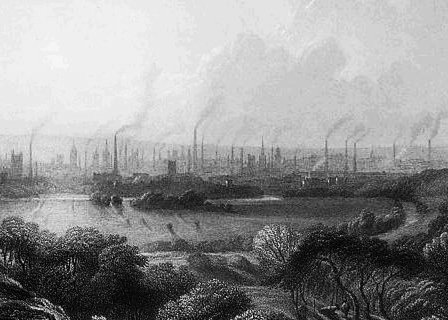
A pipeline twice the size of a whale. A gargantuan opening, closing the way through into an opaque, unholy void. The brackish filth of water moves as on its own under our quaking boots. And the spill seeps into the metallic soil below. The Earth shrieks, yet her voice is muted under a dense, resin helmet. Deafened by fortunes of squandered wealth, the murderous cold frays the nerves with blinding speed, and then, all there is to do is work.

Interior of an Ironworks by Godfrey Sykes 
"Give 'em yr bucket." Our manager removes our defecation pails, to be filled with drinking water for the next hour. The only change of the guards is vomit and an empty stomach. Coffee, whisky and blood. The grisly, noxious sky burns with the weight of an Earth turning on its side, looking out through grey eyes, a globular iris of naked waste. The entombed sky wretches as the darkening muck churns and writhes like a cold snake. What was once soil and groundwater, turned to the tar and feathers of the shamed petro-state of Canada.

Cottonopolis by Edward Goodall 
The pipe gargles and spews rasping smoke, as if it were a choking throat, attempting a last word before immobile onlookers. The brevity of life and death makes us motion-sick. There is a sea of greed, corruption and ignorance below these decks of metal and bone. The quiet break the loudest. And at once, as the gushing oil explodes with a merciless fire from the side of frozen metal, men are trapped behind the void. Wading in the flush of a liquid worse than sewage, the brain nauseates, overwhelmed with the job of planetary death.
______________

In celebration of the filters of raw earth into breathable air. The track "America! America!" is inspired by the forestal creation of a hand-crafted alder doumbek from Vancouver Island, at the cusp of the Great Bear Rainforest, a place that also signifies a cusp of human civilization. So, the sound of the wooden drum, of the local land, is played in conjunction with a Maple Shakuhachi (also indicative of the local country's national tree).


The doumbek and flute seek a passage, of wind and earth, into the waters of being and becoming, towards a sense of grounding (drum) and direction (flute). The vocalization/narrative sounding muses on the exhausting reactionary sense of progress that ensues in the modern world, where people continue to consume and waste, yet there is a lack of listening, and a lack of sheer creation.

The calamity of today is not one of natural resources, it is our state of mind, and as the musical instruments of the natural world teach us, there is much to learn from the shapes and sounds within. As Chuang Tzu said, "What happened was my own collected thought encountered the hidden potential in the wood. From this live encounter came the work that you ascribe to the spirit."


This nine-poem chapbook speaks to the deformed nature of land under the warped perception of consumerist greed and a wholesale corruption of value in life, and unsurprisingly human life. The interludes speak to a frenetic base of experience in the fragmented world of manufactured waste and devastated landscapes that have become the norm, closing our minds and eyes from the truths and repercussions of our noxious way of life.

Through poetry, I affirm and re-encounter all my relations through a sense of the inner community. Creative language inspires an inward journeying to find the root and nature of mind. The place where our whole selves may firmly take root in the most fertile of soil, in the home of universal belonging, and so give back and become one with the self-regulating, self-sustained renewability of life in harmony with all of creation.


Monday, 29 July 2013

Student Action to Global Citizenry: The Voluntary Heart of Community

Optionless from Nora Younis on Vimeo.

"I recall the brutal massacre of Sudanese refugees in Mostafa Mahmoud square in 2005 when security forces violently interfered to dismantle their protests in front of UN Refugees Agency Office resulting in killing dozens of protesters including women, children, and elderly people." Ahmed Awadalla, Cairo-based Global Voices blogger (also published on Daily News Egypt)

Introduction

The focus of my volunteerism is with those who currently experience oppressive marginalization in the inhospitable host country of Egypt, who in 1951 made reservations to refugee rights chartered by the UNHCR Refugee Convention, also known as the Geneva Convention.

El-Wafaa Refugee Culture Centre was founded in 2006 in Ain Shams, a neighborhood in the outskirts of Cairo known for its African migrant population, by a group of committed Darfurian community leaders in order to address challenges within the refugee population in Cairo, with a focus on refugees from Darfur. The mission statement of the El-Wafaa Centre is to alleviate suffering of vulnerable refugee communities in urban areas.

Background

Egypt’s reservations to the UN’s Refugee Convention withhold national responsibility with regard to refugees within their country accessing public relief and humanitarian assistance. There are no refugee camps in Egypt. African peoples seeking asylum in Egypt continue to be unjustly marginalized based on race, ethnicity, religion, etc.

Initiated in July 2006 by local community within the African forced migrant population of Cairo, El-Wafaa Centre was physically founded in September 2006, with the assistance of Student Action for Refugees (STAR), a student-run organization at the American University of Cairo. Then president of STAR, Jennifer Renquist, now a foreign officer with USAID, organized the orientation of new students at El-Wafaa Centre, as well as the donation of books and stationeries to the center’s library, remaining a principal need.

I was introduced to this world in 2007 as a young student of literature and language at the American University of Cairo, after volunteering for STAR as an outreach English teacher. I soon met the director of the Refugee Culture Centre, named “El-Wafaa” (The Fulfillment in English) after teaching an intermediate level English course to an incredibly diverse class of migrants, asylum seekers and refugees from all over Africa.

The director of El-Wafaa, Abdel Rahman Siddiq Hashim, is from Darfur, Sudan, educated at a Sudanese university in English. He is a respected and humble community leader, known by many Cairo-based African refugees as “Teacher”. Abdel Rahman’s activism was far-reaching and all-inclusive, welcoming students into the education center, also serving as a cultural and community resource center, without discriminating ethnicity, religion or politics.

During my initial ten-month stay in Cairo, I became deeply involved in the refugee community beyond the interests of Student Action for Refugees (who soon abandoned and undermined local leadership), including organizing independent classes through the El-Wafaa community, running a food bank and managing library resources. Since then, I have poured over the role of the international community as a last vestige of light for the urban refugees of Cairo. In 2010, I returned to Cairo through a fully funded research endeavor with support from a Peace Studies consortium at the University of Calgary, where from I graduated the same year with a B.A. in the Social Sciences.

Highlights from the 2010 research period in Egypt include directly funding the El-Wafaa Executive Director’s return trip to Sudan to register El-Wafaa in Sudan, as well as with a Darfuri NGO network, to assess the situation of refugees returning home to respective countries of origin after living in Egypt as a refugee. Other successes included a film screening and discussion evening on related issues at the inner city Sudanese-led NGO Tadamon, offering charitable funding to vulnerable women-in-need, engaging Sudanese youth students in a music and culture recording project, and personally meeting and attending a course with Barbara Harrell-Bond, founder of the Refugee Studies Centre at Oxford University, the world’s first institution for the study of refugees.

Through my studies, research, and experiences in activism and fundraising since 2007 to the present, I have concluded that it is truly up to international civil society activists to help community leaders foster educational and cultural activities in their communities. UNHCR and local NGOs in the region have proven insufficient, whether as seen in the outcry of the Mustafa Mahmoud demonstration in 2005, or the current state of life for refugees during the unstable political turmoil in Cairo, today.

Their is a great need to support those who appreciate and enable the sustainable establishment of human rights organizations in Egypt providing proper services to any and all people, with a focus on African refugees.

Demographic


The target demographic of El-Wafaa Refugee Culture Center is any and all residents and migrants of Egypt seeking a safe and inclusive community resource center that specializes in language education services. The target communities are refugees and asylum seekers from African countries who seek to transition from Egypt to resettle in a more hospitable country, or move back home after losing many years of their lives to impoverishment, lack of education and opportunity for employment. Such social challenges are due to many causes, including misinformation and a serious deficiency of awareness regarding the nature of life in potential resettlement countries, as well as in returning to often conflict-ridden countries of origin.

Conclusion

Currently, the El-Wafaa Refugee Culture Center and its concomitant community initiatives are in dire need to generate sustainable activism (both local as well as international) to support the immensely wide gaps unfulfilled by the UNHCR, NGO, and academic, as well as faith-based service providers in Cairo.

On behalf of an international network to support the community vision El-Wafaa, led by the volunteerism of PhD student and Fulbright scholar based in New York City, Thomas Leddy-Cecere and myself, a freelance journalist and human rights advocate currently based in the city of Calgary in western Canada, we petition support.

Currently, the 2013-2014 budget for El-Wafaa Refugee Culture Centre to thrive in Cairo requires 1,280 USD (center rent, office supplies, external programs). Membership fees from refugee communities in Cairo seeking services are not adequate. International networks with preexisting solidarity groups in the U.S. and Canada are integral to the sustainability and overall maintenance of the El-Wafaa Refugee Culture Centre.

Related issues raised by the refugee community in Cairo include accessing micro-credit loans, contacting UNHCR, overcoming crises in housing and basic needs, among other areas of recurrent concern.

Anyone can learn more. If interested, please correspond with mind to the pressing need for immediate action. I would very much like to start a meaningful dialogue on this issue on behalf of an extended engagement with the urban refugee communities of Cairo.


References:

This blog was originally published at VolunteerCenter.com on July 29, 2013
  • Please contact me @ mhanson1717@yahoo.com for a free informational brochure if interested in learning more about my initiative with refugees in Cairo, Egypt
_____________
With the Executive Director of El-Wafaa Refugee Culture Center,  Mr. Abdel Rahman Siddiq of Darfur, Sudan 
Walking Away into the Bright Lights of Cairo
Partnership with the Bangladeshi Community
Global Youth in Cairo Apartment
With Student and Singer from Kordofan 
Twilight of Peace
With Student at St. Andrews Church in Cairo
A Creative Student at Arba Wa Nos Centre
Night Cafe with the Bere People of Sudan
American University in Cairo, Old Campus
Abdel Rahman Siddiq, the Teacher
In Honour of Community
El-Wafaa Refugee Culture Center Logo
With favourite tea-seller, Julia
With student from Central African Republic at Tadamon Centre
Sudanese Teacher Registers Students at the El-Wafaa Refugee Center
Cultural Heritage of Sudan
The Quintessential Meeting Ground, the Sudanese Restaurant
 ____________
From Behaved Freedom to Absolute Nonsense

I go from a behaved freedom to absolute nonsense
            Without friends yet steeped in family love,
I publicly play and proclaim the monetary divide
            In my rich eyes which disguise the poverty
            line’s frozen glare
In Canadian expatriate stench, painstaking
            To be fugitive without mind
            to the loosed volley
Cracking against the one shield fortress of Mattapoisett
            One place of rest made into settlement with guns
            and stolen disaster
Ripped from the bosom of Europe’s scheming
                      English name
            Now massacring the playful
            artistry of our own inborn life

On this impossible continent
            Freely taken from a gamble and faith
In blond-headed angels
            Whose divinity was parted
            by the bald imprisoned hallucinations
Driving out demons with Masonic symbology
            Over the infinite sands of civilization,
            breathed and created out of time
In the sun’s ravishing corner of a universe,
            un-tempted and forever at a loss
                     Between the child’s two eyes
                     closing
On death and the holocaust of our forsaken government
            Laughing at the trees’ roots

When stretched to the bottom of India’s or Africa’s wells
            Ousting up the belief in life as a drunken tragedy
                                    Yet, be not humorless
                                    nor without comic sophistry

In the dance and song
            Come alive by the sexual majesty
                                    In theatre’s delicate ways,

To present the creative being
as one with truth’s bold and upheld music
            Reflecting back in the caged mirror
                                    A creator anew

This poem was featured in my most recent self-published chapbook, Act or Confront


Introducing ContinuuMusic

Musical explorations within continuous evolutionary creativity. Discovering new world fusion - instrumental, improvised music.

"For global community awareness" Vi An said at the TedxYYC event this summer to a packed house of 1500+ audience members, plus a streaming webcast to the entire world, before beginning a ten-minute set with co-creators Bijan Maysamie on Persian Santur, and Matt Hanson on xaphoon and percussion.

The debut concert of the ContinuuMusic trio is intended as a gift to the community. Often performing for charities and private events, ContinuuMusic has raised thousands of dollars for Ten Thousand Villages, Children's Health and Education in Iran, among other meaningful initiatives.

Inspired by their invitation to perform for TedxYYC at the grandest concert hall in Western Canada, ContinuuMusic is looking to sustain their creative efforts well into the future. Vi An is a professional artist of over 18+ years, an award-winning (Betty Mitchell) theatre composer with the Green Fools Theatre and recording artist with over 15 albums and hundreds of collaborative tracks worldwide. Bijan Maysamie is steeped in the classical tradition of Persian music. Originally from Tehran, Bijan is now venturing into fusion music for the first time, and is enthused as ever, at the helm of organzing this debut concert. Matt Hanson is a multi-instrumentalist, whose artistry draws deeply from a musical family with roots in Mediterranean and American intercultural tradition.


Monday, 22 July 2013

Adaptable Rootedness: Visionary Revelations of Winona LaDuke


"The other thing I brought up here, which I happen to always carry around, is my corn. My father, he passed away about twenty years ago, he’s a pretty simple guy. He was from our reservations. He used to say to me, Winona, you’re a really smart young woman, but I don’t want to hear your philosophy if you can’t grow corn…

I grow corn…it’s like us, corn is all different…this is a corn that’s called a Manitoba White Flint…our Anishnaabe people…we’re the northernmost corn growers in the world. Corn is very smart, it can grow almost anywhere…"

Winona LaDuke, speaking at the 4th Annual Tar Sands Healing Walk

Truly, and now, experientially, the life of waking reality and the life of dream consciousness are one and equal. When confronted with the practical evidence of vision, with eternal meaning, a deep mystery of the soul unveiled in the shade of internal belonging, I know. So, when meeting with mystic voices whose souls are married with the beyond in a harmonious union of the opposites, dream and waking, the mind begins to know the path of the heart, of intuition, love and sound. As such, in SoJourn(al), I revision virtual experience through the lens of a unique self-knowledge, yet in so doing, I seek to inspire visions anew in visitors whose wanderings are never lost to the immediate necessity of connectivity, interdependence, and the shared internalization of the psyche, manifest. 

When I heard the humbling voice of Anishinaabe author, orator and activist Winona LaDuke, whose bountiful and beautiful mind I sought excitedly for a devout listening, she spoke of my dream. Her musing answered the image of my dream with a new vision of the Earth. When she spoke of Manitoba White Flint, the earth fell into the sky, and the sky grew below the earth, the waters condensed into air and the air evaporated into water, and dream became real, reality became a dream. In her hand she held my subtle imagination of nights in the solitude of my furthest inner reaches. Read ahead for the unshakeable truth, as she grounded my nightly revelation into the fine nourishments of sacred knowledge:  
“In the morning, eat of the red corn,” says he, Herbsman. An ear of red corn emerges as with the pleasure of an offering, gift or invocation from the mouth of a ground and tongue of a seed. One kernel, consumed, and my flesh lightens with the bread of fulfillment, and all my wishes humbled with regard to the constant water that flows to the life of all. Cleansed, opened, revived, moved and lifted, I listen, intent with respect. 
“At night, eat of the white corn.” As the morning eye of fire stares into my forehead barely above the horizon, I yet see a vision of the white corn in mind’s eye, unknown on Earth. The Herbsman continues to pour the clear-souled water of natural wisdom through the mystic wine of musical friendship over each and every pour with all movements and messages invoked, intoned, and conveyed with brevity, clarity and unity. 
Returning Home: Teachings of the Priests of Dream
Yet, as Winona LaDuke shared with all Healing Walkers, "some things are supposed to stay in the ground" and so, there are visions, dreams and insights that are meant to stay in the subtle realms beyond memory and imagination, beyond the creative manifestation of personal will and worldly attachment, beyond the attainments of knowledge, beyond the bearing of tradition. 

And in the Medicine Wheel tradition, so the dream of the red corn for the morning, and white corn at night affirms the basic principles of the Four Colours within the Aboriginal Medicine Wheel. The colour red, and the eating of the red corn, affirms the element of growth, time and developing the mind. Whereas the colour white, and the eating of the white corn, would affirm place, achievement, reflection, and spiritual understanding. Therefore, the advice by the Wise Herbsman of Dream, seems a revelation to practice a harmonious way of life, where the morning is equated to growth, and the night to reflection. 

More, corn also teaches that rootedness does not oppose adaptability. So, as people of this land, for and of ourselves, we learn to adapt anew, with a sense of rootedness that overcomes dominant cultural stereotypes of the stale, the old, the past, and the traditional, and instead seeks truth in the likes of our Western imagination, as in the mind of Tolkien who wrote, "The old that is strong does not wither, / Deep roots are not reached by the frost". Adaptable rootedness is the way of the wounded healer, the traveler, the wanderer who, as Tolkien wrote, is not lost, and who instead leads all on with a prayer at each step to the beating blood that flowers in the voice of a pure heart.  
_____________
summer tradition
mystery of love
bridge to ecstasy
eye for simplicity
endangered light
___________________
With Still Unborn Eyes

A presence belied in the soft air aglow with diligent drizzle
            From this, our American lighthouse heaven,
                        Alit with dream
                        in stories told by great-grandmother’s
                                    Life lived outside the pages of the “true”
                                                And into the truly earth-quaking
                                                of dream,

A silent praise now unforgiving in this one unkempt death
            Blowing past the burly crevasse of a listless youth
                        Climbing up past the gold icon in Biblical temptations
                                    To screw women into their darkest pain
                                                In a house filled
                                                with the semen of timeless wandering

Men whose throats burn with the soil of their unloved mother
            Croaking up agro-fossil drains
Reaching from modern skylines to prehistory,
issuing from our Christ-death

In the end of an age
            As inevitable as the reptilian fate in the everyday brain
Expanding with the feared herbs growing
like weeds in our Western mythology
Built in smoke
and the knowledge of Earth’s ever-forgiving
blessings
                                                Bringing America’s children reason
                                                to explore mind
                                                            In the socio-pathic
                                                            lie of success and money
As we corner the livid
daze of the booming war
                                                            Fertilized wombs
                                                            manifest
                                                               As
                                                               westward
                                                               suburbia

In the housed mystery of our yet undiscovered world
            Beneath each colonial home
                        Shot out of the ugly worldview
                                    Misplaced over the moral genealogy
                                             
In an ecological philosophy
            To dry the eyes of our spectral hosts
                        Who watch and wonder
                                    With still unborn eyes


This poem was featured in my most recent self-published chapbook, Act or Confront