Primarily a writing exercise, this dream journal-inspired blog is a quiet introspective sojourn into the process that we traverse in going from private dream to public art. I see our dreaming as an internalized mythmaking. As I philosophize and expressively exhibit dreams, both private and public, I encourage and delight in creative language as a way to practice experiential metaphors through a “public dreaming." Writing Theory: Creative Dream Fiction

Sunday, 20 January 2013

I Awake in the Name of Django: Romani Jazz and the Dreamer's Embrace


"I'll see you in my dreams / And I'll hold you in my dreams" Gus Kahn's original lyrics

It was in a downtown French bistro where I listened to the hackery of a pseudo-theatrical storytelling musical showcase on the life of Django Reinhardt. I was expecting a real return on a small investment to witness the life of the Romani Jazz legend through his music. I was disappointed to say the least. Genius can never and should never be copied in any way, shape, or form. He made recordings.

I did learn from the storyteller with the gypsy guitar that Django, in fact, means "I awake". One of my favourite films, "Sweet and Lowdown" by Woody Allen features "I'll see you in my dreams" an all-time classic jazz beauty for our time. It speaks numbers with the instrumental ingenuity of the two-fingered guitar player, whose myths struck a chord from my earliest days of musical appreciation. It was especially this Antique FILM which got me hooked on Django! I've been awake ever since! 
__________
I Awake Too Long 
& Photographic Clarity Re-Places My Eyes 
From Dreamscapes Lingering
In His Element by RK
Color of the Horizon by RK
I Am Seen by RK
A Shared Path by RK
Domestic Offerings by RK
___________
“A full expression of Love in mind, heart and wisdom”

“Will the new being have music in Their veins?”

“If marriage of shared blood, the perfect union of musical harmony and universal rhythm will mark the forehead and line the bones of the little one to be”

Raised on the pressure of finger to string
And palm to drum

excerpt from "Spreading Easy Freedom"

Friday, 18 January 2013

I Am A Desert Stranger: Reflections on The Little Prince

Little Prince by Milan Cupka
“A single event can awaken within us a stranger totally unknown to us. To live is to be slowly born.” Antoine de Saint-Exupéry

Last night, I took to reading the entire book, The Little Prince by Antoine de Saint-Exupéry. I have been reading a lot into the similarities between Paolo Coelho's The Alchemist and Jewish-Algerian folklore, particularly the tale of The Sabbath Lion. With The Little Prince I have now found a third counterpart to the incredible comparative mythology and collective archetypal resonance which these narratives offer to a keen mind. I could of course go on and on about the engaging metaphorical richness solely within The Little Prince, however I will stick to a fundamental theme within three of these works. 

The desert is an iconic symbol for the immense solitude that opens before a life lived for oneself, or as Coelho writes, for one's Personal Legend. The desert is the ultimate symbol of regenerative emptiness that provides the ground on which the traveler sets out before ending a journey of the soul. The Little Prince itself, closes with a simple drawing of an imaginative desert landscape. That "single event" as de Saint-Exupéry says above, is the recognition that ahead of us lies an expanse of desert. And on seeing the desert open, our dreaming emerges. As de Saint-Exupéry says, "a stranger totally unknown to us" and as Jung says, "that there is someone else in my house". American expatriate writer Paul Bowles also illuminated the desert similarly in his book, The Sheltering Sky

See my related post: Desert Wanderings: Reflection on "The Sheltering Sky"
__________
There is talk of a global calamity. The sky opens our eyes to the inimitable beyond. The solstice night tempts our minds away into the cold dogmas of apocalyptic paranoia. And then, a shift. The star light bends in a waking instant. I see through the unmoving universe, to an orbital flux in the atmosphere itself. Our planet has moved off course! 

Planet Earth 2 by Lena Luss Luyken
I feel as the only one, risen up to unparalleled sight. As a shifty character in The Little Prince, I inhabit my own planet as a sole entity, unable to move from its narrowing horizon. But my planet moves, and now the cold begins to gather as our sun becomes more and more distant. I traverse the edge of the darkening atmosphere. 

Evening Prayer in the Sahara by Gustave Guillaumet
I see into the Sahara night. Young boys play soccer among the ancient ruins. An old man enters the edge of the desert from a ruined city street. Both ancient and modern meet at the edge of the desert, and lament the last orbit around a dying sun.  
____________
Second call missing
Unctuous pull from the umbilical poor,

My unending desire for a madness
Inherent within revolutionary culture and the curtain’s aftermath

Beyond ironic civil warlords and the innate lust for earthen ore,
Lore and gore,

Multitudes fornicating over oceanic test-tube breasts,
Blessing the fatherland journey past the mother’s nest
...

Out of time
Whereupon sits the cosmic being,
Presidential yet aware of universal law
“To correct the broken backbone of history
Civilization looted in the ashtray night!”
...

To calm social panic
And sweep our American blushing under the oriental rug of timeless intoxication

For a new sky,
Fine-tipped,
Seeded and reading to be…

excerpts from "Reading to be..."


Wednesday, 16 January 2013

Eye of The Other Tiger: Borges and the Dreamer Within

Triptych for Borges' poem "El Otro Tigre" by Elza Norma Gonzalez
“The mind was dreaming. The world was its dream.” 
Jorge Luis Borges, from “The Circular Ruins” in Collected Fictions, trans. Andrew Hurley (a source)
All may read the entire English translation of Borges' text, "The Circular Ruins." This piece of intensely magical literature breathes a truth rarely spoken. Life is not simply a dream, but a dream within a dream. As one may chance on an ancient temple, or its ruins, there is a parallel labyrinth quality of sacred architecture and geometry in life and consciousness. As we dig deeper into the internal realities of our lives, we find that to dream is more resonant with the truths of our ephemeral existence. More and more, as I live a life of conscious dreaming, I confront the ultimate truth that I am impermanent, and was not made to last. To dream within the dream of life is the beginning of truth-seeking in the creative arts, and in the drama of everyday voice and action. The dream within the dream is the resonant core of our foundation; the heart of our mind. And finally, we are led into the holy of holies, the central chamber of the temple ruins, where we see through the eyes of a Dreamer who is not us, and yet who dreams our lives. Or, as Borges writes in El Otro Tigre (translated by Alastair Reid), "Let us look for a third tiger. This one will be a form in my dream like all the others..."

See my related posts: Borges On Volcanic Riddles of the Unconscious & Borges and The Ancestral Mirror of World Literacy
_________
 She shares with me her dream by being, and I become hers.

Enter Her Image by RK
She Above the Soft Night by RK
Full Moon Pines by RK
Inner City Arboreal Heart Transplant by RK
Face of the Dreamer by RK
____________
...napping between contiguous web-threshed freedoms to a forgotten deafening…and thickening the low-coasted noon of the heat wave forecast…my mind becomes sullen with blank remorse and a violent emptiness fills me…bearing down on memory like a catastrophic angel of the white light…pitch black featureless dusk of interpersonal reason in the long endless fight to be good and seek happiness in the joyful cries of others…

Bingeing on the unnecessary billions…whose lives anger at the human mold in a resounding attempt to save a bit of that home…that once was stolen from the earth’s own sun-dried hands…still cool with the dank earth and her womb of littered seeds

And the rains pour angelic wisdom over the arisen anguish…to craze for the source and defy the powers that be in an unanswered mind of free rationality...

Dreaming of berries in season and wild-crafting the maze of Her swollen lust…turning on the locomotion of boom bang music over the café loudspeaker…three hours into space in the beyond of our lost anxious sound...

“Each to their own” writes back the lazy teacher…beginning with Zen and ending with architecture…bending for no one except the jungle fire steaming behind the glassed promenade…glowering sickly in the mud of visionary astonishment…shaken in a thud…the mortified martyrs’ brought cinematic drip dry skin…to toast their muscular direction to the lunar fist...

excerpts from "Random Parkade of Fences"


Monday, 14 January 2013

The Voice of Youth: Stories from Idle No More


It was a Friday afternoon. I listened to the video above the morning of my phone interview with Rob Stewart. I had read that Idle No More was quickly becoming a global movement to follow Occupy with equal weight. It was time to dispel my own pipe dreams. I needed to see what may be the greatest current change movement for myself. 

It happened to be one of the coldest days yet in the brutal Calgary winter season when I began to ride my rickety bike south from the downtown core. Not only was it especially cold, but there was record snowfall the day prior. I tread forward, over the blinding snow, into the untended parkland trails ahead. Three hours later, I made it to my previously unknown destination: Prime Minister Stephen Harper's Calgary constituency. As soon as I saw the demonstrators, I was immediately shocked with disappointment. I stared, from my bike, over to the sparse crowd, filled with boredom and teeming with weakness. There were only a handful of people. The only time I attended  a demonstration previously, was when George W. Bush came to Calgary after his term as president. That was an incredible showing, one of the most emotionally exuberant and lively demonstrations I have known in Canada. I left, curiously pondering with a comic bent, "Do Canadians only protest in numbers when the issue is to oppose the States?" 

In the United States, where I'm from, I was a frontline demonstrator in anti-war marches to the Pentagon, "No War" rallies in Boston, and magnificent protests in support of Latin American resistance in New York City. A public demonstration is a place where the old and the young meet, to exchange hearts on a platform of free speech and free assembly with the naked flesh of human freedom. I stayed outside Harper's constituency only for a few moments, to place myself in the crowd, and continue on my way to a Metis friend's house to buy him coffee. The next day, my wife attended the more crucial demonstration. I've posted her brilliant story on Media Co-op.  

_________
The true war is now officially being fought in our backyard.

Things are lookin' up by (Kjarvik)
Before it is dark a light will shine through the clouds (Kjarvik)

May All Youth Live Free on Earth (Kjarvik)
There's nothing in your way (Kjarvik)
Heaven on Earth (Kjarvik)
__________
"Matter disguised as her unfolding paradise,
A genital incision, without

Brewed spawn all quaking and facing heart failure
With thick-rimmed glasses and a paranoiac daze,
A thin glimmer of repose
...

Useless triviality
In the maze of Puritanical property and stubborn consensual heavens
Drowned in blue time
...

Oceanward,
Where the thumb and nose meet at the spun wheeling whys,
Whose greed lurched from above the lily swamp and naked,
Pressed their white head to the diamond name"

excerpts from "Pulp Massage"


Saturday, 12 January 2013

A Battle For Wits: Ray Bradbury and The Illiterate Fires of Modernity

Philosophy and Christian Art by Daniel Huntington
 "I've got to read, I've got to catch up with the remembrance of the past!" Fahrenheit 451 (film)

The principal character, Montag, in the 1966 film adaptation of Ray Bradbury's Fahrenheit 451, by Francois Truffaut, says these lines before he dreams a nightmare. After breaking up a sterile grouping of house guests, who on being exposed to literature become fraught with the anxiety of original thought and complex emotions, his work as a book burner turns into a twisted night haunt. Ray Bradbury, author of the book, may have been alluding to much more than a simple prediction of a neo-Fascist regime burning books as did the Nazis, and other demented social movements throughout history. Note the Ancient Library of Alexandria. How much of our conscious memory collective was turned to cinder and dust. With the influx of new media, we are losing our grip on the greater part of human contact, that with the historical mind, descending with the literature of the ages into the fires of mass ignorance.  
_____________
Waking proof stirs the realms of the collective-creative imagination with inner-brewing mystery. 
Fahrenheit 451 Resurgence by Rusty Kjarvik 
Fire at the End of the Tunnel by Rusty Kjarvik 
Sail into the Flames by Rusty Kjarvik 
The Last House on Earth by Rusty Kjarvik
Broken Chinatown Lamp by Rusty Kjarvik
____________
Kneaded breathless
Behind television predilections

Guessing at the racy night
Caught in a frozen web-tied lesson

To shoot pyrotechnic tides over the urban mind
Digging into a buttressed yurt, cold

excerpt from "One Ambitious Species"


CHECK my latest Sketches of Style publication with Randomly-Accessed-Poetics 


Thursday, 10 January 2013

Metaphors in the Art of Goya: A Theory of Unconscious Development

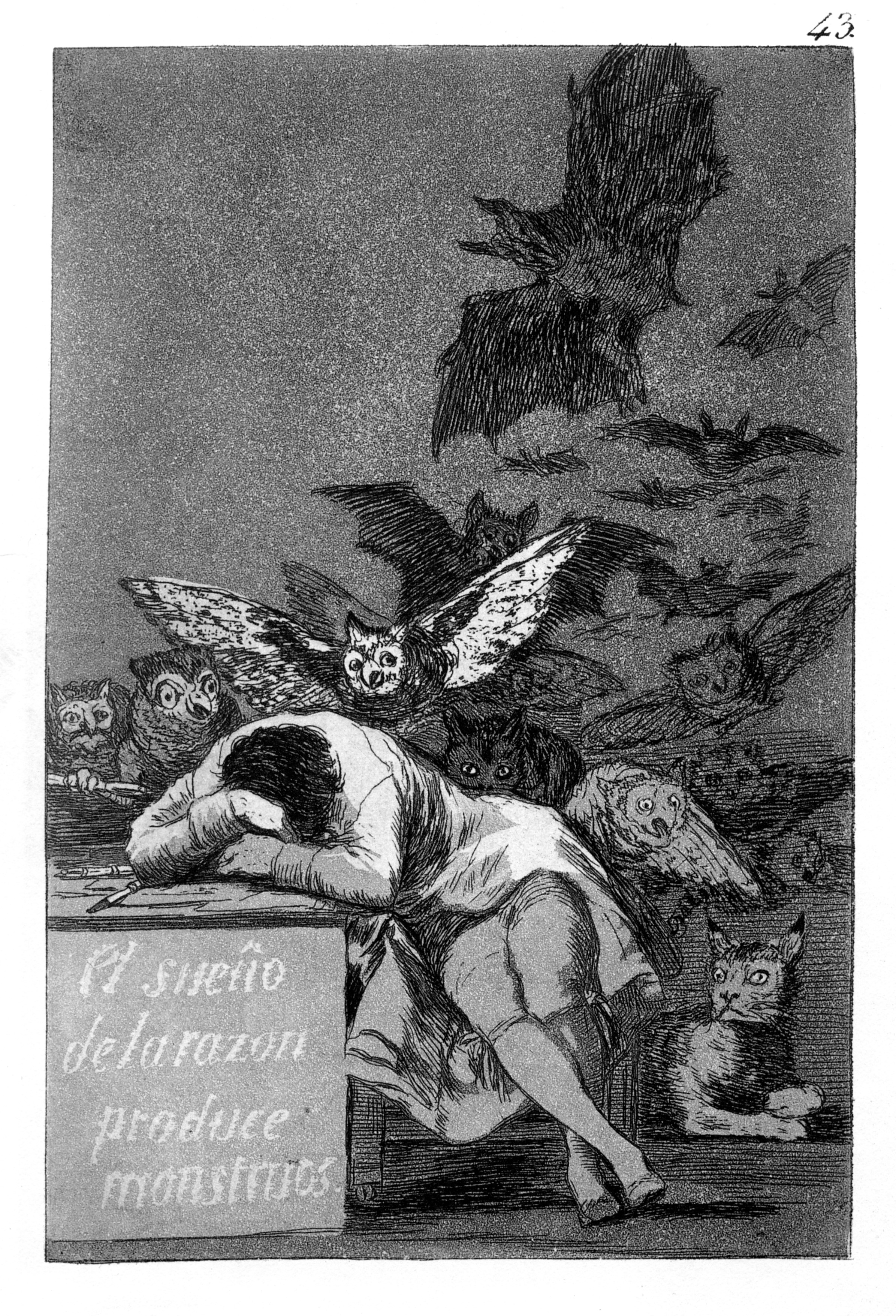
The Dream (preparatory drawing) by Francisco de Goya
The Dream (print) by Francisco de Goya
"The dream of reason produces monsters." Francisco de Goya (source)
The purpose for exhibiting the creative process of a master painter as Francisco de Goya, showing his initial sketch, and final print, runs parallel to a theory I have in relation to the role of the unconscious, and its impacts on the life of both the sleeper and the awake. 

Firstly, my theory is founded on lived experience. The foundation is as follows: If a person follows their natural sleep-awake patterns, without conscious intervention, the body cycles through an internal clock more expansive than the twenty-four hour day. Incrementally, each day one wakes later, sleeps later, and eventually earlier. In the course of over a year of practicing this experiment of consciousness, I have found the twenty-four hour clock to be limiting and a mere fixed point around which my sleep and waking cycles orbit, as a celestial body around its true source of gravity. 

Is this an effect of seasonal, environmental, or psychological pressures? The theoretical part now kicks in. With the exhibition of Goya's creative process in visual representing the night of Man, he is accosted by a host of demons, and in turn, upon waking, those demons become monsters of reason. So, if we allow the regenerative natural patterns of sleeping and waking to unfold, with complete abandon and in lieu of the normative twenty-four hour clock, we give way to a natural creative energy sourced deep within our unconscious, that nourishes our very life-breath with the heartbeat of self-knowledge. 

With this, the world of dream is merely a doorway, as is a metaphor or a myth, towards a more holistic regenerative consciousness of self-awakening. 

See related post: In Defence of Sleep: Regenerative Sleep Cycles of Archaic Man
__________
After hours downtown mall. Winter night. Midwestern city. The street is dim, and I stand, as to wait for a companion, or a bus home. Alone, my eyes scan the glass exit doors with a longing nostalgia for company. As I consider my absolute solitude, two prostitutes brush up against me. They closed in out of nowhere. After a moment of disdain, I begin to hear an inner curiosity.

Cocotte on the Road by E.L. Kirchner
"How much?" I ask, imploringly. "500 dollars" she says with a soft smirk. "I don't have that much." I respond, with dry humour, having never intended to act on my curious insides. Surprisingly, my wife steps through the hall behind us and into the background. She sets up her instrument and begins to play. I drift, flying towards the awake. Her unconscious body, her subtle spirit had called me forth, from the fantastic night of isolation.
___________
What of human sound,
The frequent lust to prepare noise in strength of intellectual wonder
and produce unfathomable beauty
            of the entire body
                        descending to and from the ear’s tragic centering
In our musical society, and what to compare “human music” to the grandiose law of nature, expressed in the mere calls of bird and beast revolving their unchallenged voices around the veil of a gross acoustic hall,
            whose rendering dreams an unforgiving welcome to the Earth’s living
            hall,
                        led to a thoughtless demeanor
                                    yet within the mind of man
...

to find a source,
                                                not necessarily of communication
                                                            between human, bird and god,
                                                but a direct connection
                                                            that spells mystery
                                                                        from an inspired gift to all
her sound.

excerpts from "Of human sound"


Tuesday, 8 January 2013

The Thinker Who Thinks For One Self: A Reflection on Schopenhauer

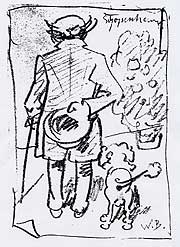
Arthur Schopenhauer caricatured by Wilhelm Busch
"...the greatest amount of erudition, if it has not been elaborated by one's own thought, is worth much less than a far smaller amount that has been well thought over.

...much reading deprives the mind of all elasticity, as a weight continually pressing upon it does a spring, and the most certain means of never having any original thoughts is to take a book in hand at once, at every spare moment. This practice is the reason why scholarship makes most men more unintelligent and stupid than they are by nature.

...he, that is, who thinks for himself, thinks of free will, thinks correctly he has the compass to find out the right way.

...the intellectual acquirement of the self-thinker is like a fine painting, which stands out life-like with accurate light and shade, well-balanced tone, and complete harmony of colour. The intellectual acquirement of the mere scholar, on the contrary, resembles a large palette full of bright colours, systematically arranged indeed, but without harmony, cohesion, and significance.

For the perpetual, the real, in its originality and power, is the natural object of the thinking mind, and is able most easily to move it deeply...In the realm of reality, however beautiful, happy, and cheerful it may happen to be, we move ourselves continuously under the influence of an oppression, which has ceaselessly to be overcome ; while in the realm of thought we are incorporeal spirits...

...how great and how near us is the problem of existence, of this ambiguous, tormented, fleeting, dream-like existence ; so great and so near, that as soon as one is aware of it, all other problems and purposes are overshadowed and hidden by it..." Schopenhauer, On Thinking For Oneself

During the course of writing this blog, from its inception, until tonight, I have been exploring a world of my own making. I have sacrificed a worldly career-seeking existence for a deep exploration into the development of self-motivation, self-learning of thinking for oneself. That being said, while I have risked the mental balance that all face when they dwell profoundly and thoroughly into themselves, I have begun to a feel a feeling of being in the presence of the trackless way, or "the pathless" as Jiddhu Krishnamurti said. To trust the language of dream is a daily struggle to remember the most obscure part of ourselves that the world tells us to deny, forget and leave far behind in the realm of sleep and fantasy. When dreaming begins to encroach on our reality, we become fearful, and as modern people, defensive. The breach of unreason is an affront to all we have been taught. It is the history of our own soul. When the words of great thinkers like Schopenhauer begin to make crucial sense and gain a new sense of pragmatism outside of the allures of becoming privy to an enigmatic philosophic tract, the inner world of one's own making begins with an awakening, illumined by the midnight sun.

See related post: Schopenhauer and the Unconscious Fate of Recurrent Thought
__________
Apocalypse! Apocalypse! We are at bay! The grocery stores are emptying, the streets are empty of cars and the sidewalks are full of an insane humanity. After days of hiding out, I finally emerge from my apartment, bewildered by the blaring sky. A man shouts prophecies from the nearby grocery store entranceway. A crowd of onlookers listen with eager intent. 

Frescoes in the Upper Church of San Francesco in Assisi, southern transept, scene: Apocalypse, Detail by Cimabue
"Fuck you!" I scream at the man. At once, an elderly lady screams back at me, "Fuck you!". I stare at a blinding yellow ring on her finger, absolutely dumbstruck with comic bewilderment. I return to the street side under my apartment building. To sit with a homeless man on his bed of burning fabric. I stare out, deadened by the silence of a lifeless futility creeping into the human domain from the belligerent rage of Earth; her the final hour.
__________
To obviate from this bland mural,
Its strict pull underlies, as a lightning tremor

In the cooled dust collecting raw answers
From the autochthonous matrimony with foreign alliance,

Over the scarred mud-caked plains
Whose agricultural fertility gave way to chemical strife

In the selfish human pandemic,
Lining the hostess and her following with possibility

In the strong-voiced dirge calling back thousands’
Endless anonymity from the last day that rested with holy failure
...
Embracing the nervous mouth of the whole city in one dire expression
To last

excerpts from "Obviation from the BLAND"  


Sunday, 6 January 2013

Theft of the Stallion: Pantheist Wisdom of California Poet Robinson Jeffers

A Wild Stallion by Albert Bierstadt

"She endured, and to hasten the act she feigned desire; she had not
for long, except in dream, felt it.
Yesterday's drunkenness made him sluggish and exacting; she
saw, turning her head sadly,
The windows were bright gray with dawn; he embraced her still,
stopping to talk about the stallion.
...
The nerves and the flesh go by shadowlike, the limbs and the lives
shadowlike, these shadows remain, these shadows
To whom temples, to whom churches, to whom labors and wars,
visions and dreams are dedicate...
...
The child Christine waked when her mother left her
And lay half dreaming, in the half-waking dream she saw the
ocean come up out of the west
And cover the world, she looked up through clear water at the
tops of the redwoods." (Roan Stallion by Robinson Jeffers)

I had first become aware of the brilliant illuminations of Robinson Jeffers while listening to the Joseph Campbell lecture, Origins of Man and Myth. Where the poetry of Jeffers is invoked to describe that which makes us human, the affinity for "a divinely superfluous beauty." I also like his Natural Music. Some poetry enthusiasts consider Jeffers' work to be pantheist. In this regard, when I read Jeffers, I indulge in the right road to my relationship with the world, as with that of my mother. Every natural phenomenon calls to a supernatural truth, a divine magic, personified in the ambient face of seasonal change, the drastic force of the weather, or the inner passions ignited. A theme that started this blog currently recurs in my life, that being a recognition of the wayward allure of exceeding exposure to the night so often accompanying life in the northern climes. Yet, after reading such poetic masters as Robinson Jeffers, I can't help think that in the opaque cold of infinite nothingness, there is a mythopoeic field of space, love and silence; the kiss of a goddess in recline.   

More intellectual blogging on Jeffers & Dream
___________
I am a child amid the street market tianguis of Mexico, the grand bazaars of Egypt, and I brush past the singing troubadours of Italy. The air is wild, and my light coat loose. As I glide in and out of various merchants and their wares. I grab a handful of corn, pocket a cookie, and steal away with a sandwich wrap, to enjoy under a youthful sun.

A pretty fair woman by Ferdinand Wagner 
The subtle gate of theft and its freedoms beckon a cause bursting and boiling over within me. I am full with need. The essence of life is stolen away to the fair of justice and the game of life. Still, I scarf down my winnings in jubilee, and return for more. 
_________
A threshed sweat leaf, singled out over the billowing masses,
A high, overstated nocturne

Dreaming in workaholic shivering screams
That transform lightly into breath of song with male weeping

And her deserted lips struggle to purse
Over the citrus flesh of an Iberian mother

Calling for heart chains to unlock
Yet distressed and of unruly mind

She dresses timelessly with prophetic sophistry
Beyond the rasped vocal bead of the Roman elite

Prideful with elegant cheeses to smother their appetite
For lower slavery below the belt of animal sanity

excerpt from "Natural Pleasure"


Friday, 4 January 2013

In Defence of Sleep: Regenerative Sleep Cycles of Archaic Man

“In the age of the rude beginnings of culture, man believed that he was discovering a second real world in dream, and here is the origin of all metaphysics. Without dream, mankind would never have had occasion to invent such a division of the world.” From Nietzsche’s Human, All-Too-Human, aphorism no. 5 
 There's a great lesson I have learned during the writing of this arts weblog resting on the role of the unconscious in the creative life. Firstly, let it be said that this weblog is a compendium of writings, research and dialogue on the wealth of inner inspiration that all of humanity possesses by the sheer facts of physiology: we dream. 

I have learned this basic lesson: sometimes in a person's life, they must be allowed to rest. Occasionally, every person must be allowed to sleep to bear witness to the whole nature of their lives inside and out, to witness the natural course of their consciousness as it dips and lingers in unconscious and semi-conscious states. Are we prepared for this timeless need? 

Truly, depending on the individual, one may require years of extended sleep cycles, to allow the mind to explore the natural caverns of its own self-regeneration through the deep psychic image-language of our internal/eternal life that lies exposed only when the body is at full rest. I can imagine that in more matured human histories and traditions, the seed power of meditation engages the body/mind in a life of inner exploration, even more profoundly restful and intuitive than the subconscious dream state. 

As we are not keen, and even unable, to allow the natural course of our inner lives to take hold and draw us inward for much needed psychological rejuvenation, there is imbalance in the world. So, we are guided by a higher power we sometimes call fate, or even God, but in both realities, is actually the seed of our own imaginative creativity too deeply buried to receive the light of our conscious recognition, reflection and inspiration. 

The old, or second world, that Nietzsche refers to in Human, All Too Human, has been divided and cut off from human life in an age of serious neglect, ignorance and escape from our own inner natures. Thus, there is imbalance, and we continue to deny that we are human, all too human. 
___________
What a massive elevator! I arrive at a doorstop to a metallic behemoth of elevation. Inside, a group of stewardesses welcome with open smiles. As I step inside, I am filled with anxiety. Am I ready to ascend to such heights? The levers at the side of the door are reminiscent of a plane cockpit. With a hefty forward heave, one lady initiates our ascent. The ground of Earth is suddenly imbued with an all-pervasive light. 

Light Paint by Rjcastillo
Huddled in a corner, fearing for my life. I notice the elevator has stopped rising. Has it been hours? Days? Years? I had gone blind, deaf and nearly faced death by astonishment as the incredible rise continued unceasingly. I am weak. I can barely look out into the world, whatever world lies beyond the doors at this elevation. The stewardesses are machine-faced, and continue to smile with an unsettling clone-like smirk. I need to descend. This is not my stop. My brain and face go brittle with overstimulated light energy pouring in through the walls, and it's overwhelming. Suddenly, I can't breathe. I am stunned. 

abstract photography by Getüm
Mysteriously, I am back at ground level in the blink of an eye. Looking into the doors of the elevator, the stewardesses welcome with their inhuman smiles, pasted like ice sculptures under their empty eyes. Do I board again? Can I rise this time? Or, return to the world? 
____________
Observing the skull-emancipated wisdom,
Risking vertigo and the sure endless night
Bringing sugar, tea and a companion’s brethren tide,
Bracing a felt language

excerpt from "Manual speech, a felt language"


Wednesday, 2 January 2013

Myth of the Writer as Artist in the Inner Space Age

Magic Mountain (after Thomas Mann) By Christiaan Tonnis
"Certainly when a writer has acquired the habit of regarding life as mythical and typical there comes a curious heightening of his artist temper, a new refreshment to his perceiving and shaping powers, which otherwise occurs much later in life...myth is the legitimization of life; only through and in it does life find self-awareness, sanction, consecration." Thomas Mann in his essay, Freud and the Future

Within this essay by the great 20th century writer Thomas Mann, author of the famed Magic Mountain, are masterful insights with which to learn the various modes of self-discovery as espoused in the mythic fires of ritualized, eternalized thought throughout the ages. In the ageless struggle towards self-knowledge, the embattlements are often constructed in defence of the outer world, or the world, and in offence from the inner world, or the self. In the midst of those embattlements, lies a field. As Rumi says, "Between right doing, and wrong doing, there is a field. I'll meet you there." 

To explore self-knowledge with regard to knowing one's place and vocation is to embark on an inward journey. Only by recognizing the bare truths of our life in the present moment, and proclaiming them as such, and in turn, making them an integral part of the conscious, and waking, mind, can we understand that the truth about myth. 

Myth addresses and reveals the ultimate needs of the human psyche. Myth speaks of the search for meaning in the life of humankind. The final lesson of myth is that the ultimate question for life in the modern world, as with all times, is not, "what is my place in the world?" The essential question remains, "what is the place of the world in me?" Every one is the ONE. You are the world. 

The world is of our own making. We are all co-creators in the aftermath of reason. Work is play, and play is work. Play is the life of the universe at work, also understood as LILA in Hindu thought.   
_________
I walk past a prison in southern California. The air is humid. I can smell salt and chlorine. Why am I barefoot? I bend to look through stone latticework. I see peers, young men and women my age, cleaning a concrete prison campground. A dismal gymnasium? A barren bathing area? They wear radioactive protection, in orange suits and gas-masked. 

Lady in Prison by Raja Ravi Varma
I dart across the road. Barefoot, my feet sink unaware into the freezing water runoff from the prison cleanup. My feet are numb as I walk over a grassy knoll on my way to a gas station. The clear sky is warming. There are gas stations everywhere, and I can't seem to get anywhere close to one. My torso is overheating, and my feet are so frozen I can barely stand.
__________
Touring the phantom cloud

At rest between Celtic shores, distressed by multi-lingual borders and rocky soil, and a northern jail for the barbaric tongues who gouge panicked eyes from the skulls of New World kinds

An orgy of ruthless becoming

Among the equestrian speed, famed by pre-teen daughters of class and medieval French dreams, who cast off the Muslim humidity from Spain’s bound whores, and lust after a secretive world of music in the drum talk of yesteryear’s snoring traditionalism

Yet woken alive

Through non-ordinary literary thought and perpetual action, to finally inundate the worldly risks bedding with our species at once in an archaic passion, straying from the lofty

First World throats of progress


excerpt from "Mad artistry"