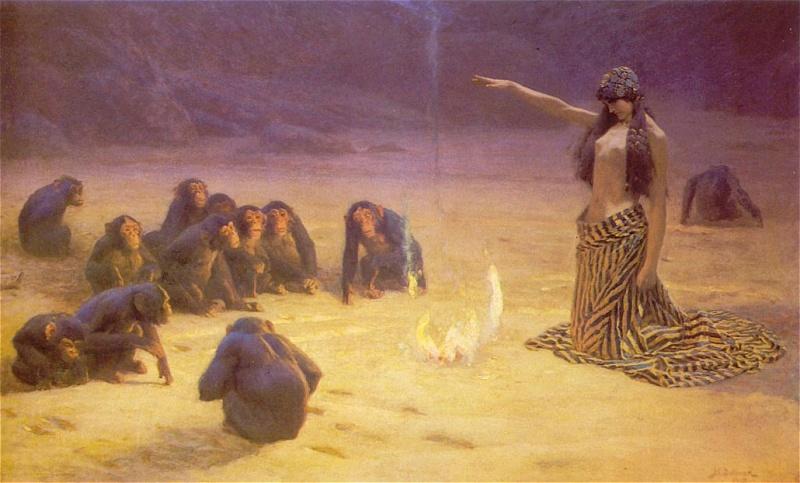
Primarily a writing exercise, this dream journal-inspired blog is a quiet introspective sojourn into the process that we traverse in going from private dream to public art. I see our dreaming as an internalized mythmaking. As I philosophize and expressively exhibit dreams, both private and public, I encourage and delight in creative language as a way to practice experiential metaphors through a “public dreaming." Writing Theory: Creative Dream Fiction
Showing posts with label psychology. Show all posts

Tuesday, 24 December 2013

Anaïs Nin and the Secret Self: From Blindness to the Mountaintop


Henry Miller

In the last few years one sees quite a few either writings about you or quotations from you about dreams and the dream life and I feel that they haven't really understood what you mean about this. I don't think you want people to be living in a dream state while conscious, do you?

Anaïs Nin

No.

HM

But you mean that dream has its uses, its effectiveness in life afterwards.

AN

No, I meant something else, I meant that what we could arrive at a state where what we dream at night would be the blueprint for what we wish to fulfill, or to reach, and if we understand the dream then we know what the secret self is and then this secret self we can fulfill.


Anaïs Nin, whose literary renown is most prolifically exampled in her posthumously published diary writing, is also respected and admired for her role in encouraging and stimulating the work of Henry Miller. Her opening preface to the Tropic of Cancer, Miller's first book, is one of the most incisively written dedications to the literary spirit that I have ever read. Her quotations on dream, are poignant in their truth and magical in their realism, vibrant in their imagination and open in their accessibility. 

Similarly as with Carl Jung, both Nin and Miller drew liberally from interpretations between Western psychoanalysis and the traditional religious learning, thought and practice of Hindu, Buddhist and Taoist cultures. As highly creative minds, who lived richly balanced in heart and mind, stood for a conscientious human being, who through developing thorough self-awareness comes naturally to be a part of compassionate change in the creative universe. 

“Dreams pass into the reality of action. From the actions stems the dream again; and this interdependence produces the highest form of living,” said Nin, in a comment that affirms the dream psychology of Jung, who considered the dream life, or the life of the imagination, of the mind and of creativity as more real, meaning a more direct form, or manifestation, of experience, than the life lived through the senses. Thus, Nin determines, “Dreams are necessary to life.” 

Indeed, Nin would press ever on into conceiving the dream life as integral to meaning, to holism and self-truth. She asserts, “Our life is composed greatly from dreams, from the unconscious, and they must be brought into connection with action. They must be woven together.” Further, one might add that when woven together, the dreamer, as artist-visionary-thinker-writer, becomes the seer, as in the mystic of unmediated experience, of eternal unity in the present, of enlightenment in non-being. 

Eventually, dreams are life, as life is certainly made of dream, and that we are the substance of dream, as the subtle nature of perception, meaning, truth and self-knowing. In reaching the transformation of necessity to becoming, in the paradigm shift of dream action fulfilled in daily living, is for Nin, a miraculous occurrence, likened to the rare and precious goal of enlightenment. She reminds, “The dream was always running ahead of me. To catch up, to live for a moment in unison with it, that was the miracle.”
_________
Night in the forest, like soot and anger, under a flattening sky. I fell from Paradise into History in the moment of a sting, the lunging insect-antennae, electric, lunged into my paranoid flesh. Hooked under the stark and opaque canopy, obscuring starlight into the bitter and directionless flood of need, anxiety and hope. I sprang from the petrified mud to the swaying vegetable maw of a blind quake, a wild charge.

Georges Lacombe, La forêt au sol rouge
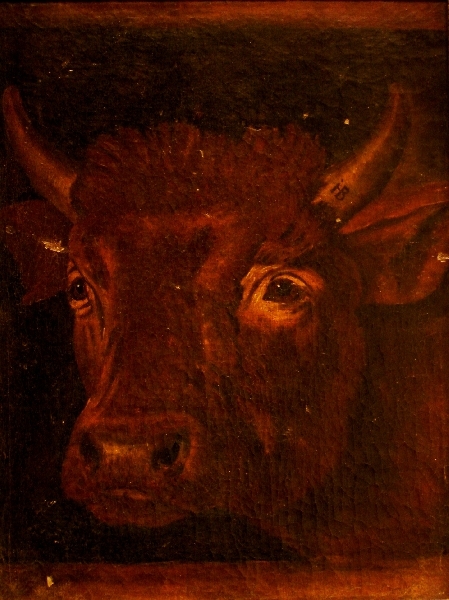
Extinction moved in the sad, ghastly wave of moonlight over frostbitten leaves. Bone-white spears upended my eyes, as I dodged a full-grown bull. Adrenaline-shocked, I sped, scanning the immobile trunks, weighing the Earth down with inhuman strength. And the soil broke in a jarring flash of bestial rage, as another bull, of sturdy, muscular build, spun me around, my heart waning of life.

Bull's head, painting by Johann Heinrich Baumann
I tore through the endless nothing. Then, one bull split my body from the waist up the gut. Marching on my hands, stomping and cracking bone with its merciless strength, adrenaline rushed and spilled out into the open air as I climbed back to my feet, nearly wasted by the crushing jeer. Countless bulls encircled, as I fled, bleeding, the pain yet to reach my brain, grabbing for low-hanging anything, my stomach burning, my feet turning to knee-splitting daggers and brain-flushing mush.

Animals in a Landscape (aka Painting with Bulls) by Franz Marc
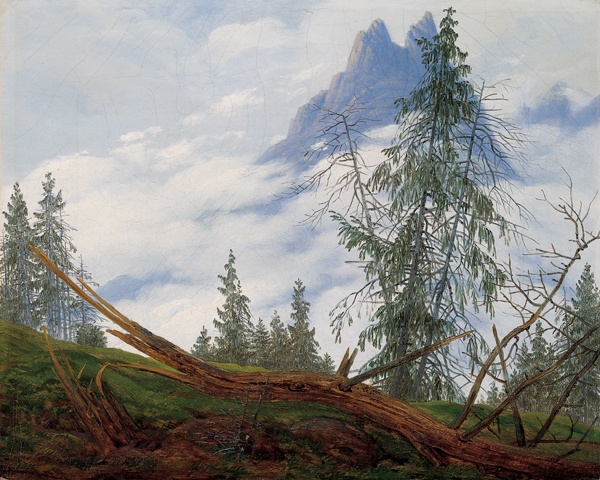
Pit against an escalating fever and white with near-mortalizing blood loss, I fainted under the powerless impression of my death, only steps from the forest edge, still besieged under the sightless underground forest of the human Earth. A single house stood at the edge of a rock face, and I was carried to its door. From a window fogged with subzero condensation, I could make out the moonlit peak, and with every second that my mind ascended, my body shrank with fear, and I gasped for each breath as my last.

Mountain Peak with Drifting Clouds by Caspar David Friedrich
Staring at the summit, and then was enshrouded by cloud-cover, my eyes closed, I stole beyond the body, and time, beyond death and need, beyond blood and truth, beyond the waves of human flesh that rode on this belligerent tidal sway of hope and tragedy, to summit the Everest flight of dream, and survive through this tyrannical flood of mortal reality.
__________

Monday, 18 February 2013

The Immortalizing Arts: Contributions by World Music Artist Vi An Diep

Gilgamesh by Samantha from Indonesia
"We have achieved two of the three alchemists' dreams: We have transmuted the elements and learned to fly. Immortality is next." - Max More, On becoming posthuman

The search for immortality is as old as humanity itself. The earliest remnants of human history, namely, the Epic of Gilgamesh, among others, speak of the quest for immortality, to find the fruit or fount of eternal youth is part of the perennial epic that is the myth of Man. 
Anu, Bel, and Ea are whispering (wisdom) into his ear.
Ere thou earnest down from the mountain
Gilgamesh beheld thee in a dream in Uruk
....
Gilgamesh sought to interpret the dream;
Spoke to his mother:
'My mother, during my night
I became strong and moved about among the heroes'
...
Gilgamesh said...Tell me, How didst thou come to dwell (here?) and obtain eternal life among the gods?
...
Build a house, construct a ship; Forsake thy possessions, take heed for thy life! Abandon thy goods, save (thy) life, and bring living seed of every kind into the ship

(Epic of Gilgamesh)
Now, it is interesting the way that modern medicine has adopted the principles of "life extension" to the archaic traditions of humanity in the search for immortality. Life Extension is a medical term used to acknowledge the major advancements in modern medicine which have led to the unprecedented increase of the average human lifespan. The logic is that if the lifespan can be extended by some fifty years or so in the last hundred years, why can't we extend life to virtual permanence. 

What are the implications of human immortality on Earth? What comes to mind for me are a few major points. For one, there will be an excited advantage by the keepers of modern scientific medicine, mainly the West. In many ways, this can be seen as the furthering of an egotism that the Western World and particularly the scientific community has, where they feel they prevail over all forms of life, as the dominant form of knowledge-creation in the world today. It is often ignored how steeped in Western European history our modern science is, and that it does have its immoderate faults. Essentially, modern medicine is best in dealing with immediate physical trauma. When it comes to preventive, and long-term medicine, like "life extension" for example, there is less attention to detail. 

Outside of medicine, there is a biological component. One of the foremost proponents of "biological immortality", professor in the Department of Ecology and Evolutionary Biology at University of California, Irvine, Michael R. Rose, PhD, says in the Immortality Institute documentary Exploring Life Extension, "Most people who work on aging do it from a medical standpoint, which means humans, or if not humans, then certainly mammals, and all these organisms that didn't have an aging process were far-removed from mammals." He went on to give examples in non-mammallian life forms, such as anemones, creosotes, juniper, and others that actually do not age. He continues, "...life can be thought of as being divided into three basic stages...that third phase, which has not really been explored by contemporary biology is what interests me now, late life." 

With regard to the biological component of immortality and life extension, and the medical egotism which counter-inuits the state of the world, it seems that if we do not co-evolve immortally with our Earthly ecology, a spiritualistic sense of medical immortality for humanity would only contribute to the degradation of every source of life that the Earth offers to Man, and which Man exploits obscenely. For example, if we innovate major advances in anti-aging and life extension, we ought to transpose that technology into the natural world, into the life that not only lives on earth (us), but is the life of earth (all forms of life and life-giving). 

Finally, my sense is that in the early epics of oral literature, such works as the Epic of Gilgamesh and Homeric works such as the Iliad, there is a lesson about the human quest for immortality, which is older than our backbone. The lesson is that only in our mortality, do we know our immortality. I would say this is also truer to Max More's reference to the alchemical tradition, where in the philosopher's stone there is a psychological mastery of the principles of physical life, yet it is in the psyche where the most enduring trial is overcome. Only in dying fully conscious and immersed in the ground of immortal intent, are we immortalized, and traditionally so in the words of the great poets, those of enduring words and pronounced voices to carry the names of certain individuals down the halls of human history. 
___________
First step in the thousand-mile journey by Vi An
Flight over the bridge by Vi An
Enlightenment over Peace Bridge by Vi An
Full Moon City by Vi An

First Light of Dusk by Vi An
____________


Vi An has generously agreed to contribute her musical artistry to SoJourn(al) for this exclusive post featuring original photography. This post celebrates her entry in a CBC music contest, Searchlight. Vote for Vi An!

In future posts, I will be featuring original world instrumental music by none other than the Dream Author. My idea is to feature a full-length album of original electro-acoustic improvisations on darbuka, frame drums, shakers, xaphoon, shakuhachi, guitar, harmonic, etc., then leading up to spoken word collaborations with my instrumental creativity to recollect the creative momentum from my experimental writing gallery usually featured at the end of each post. It is my intention to kick off this new paradigmatic focus of musical creativity with a contribution, and to offer space for photographers and musicians alike to contribute in the future.

Happy readings/listenings/viewings!!

Among all artists of One Love, in solidarity.

Thursday, 31 January 2013

Life Phases of the Dreamer: Poe and Developmental Psychology

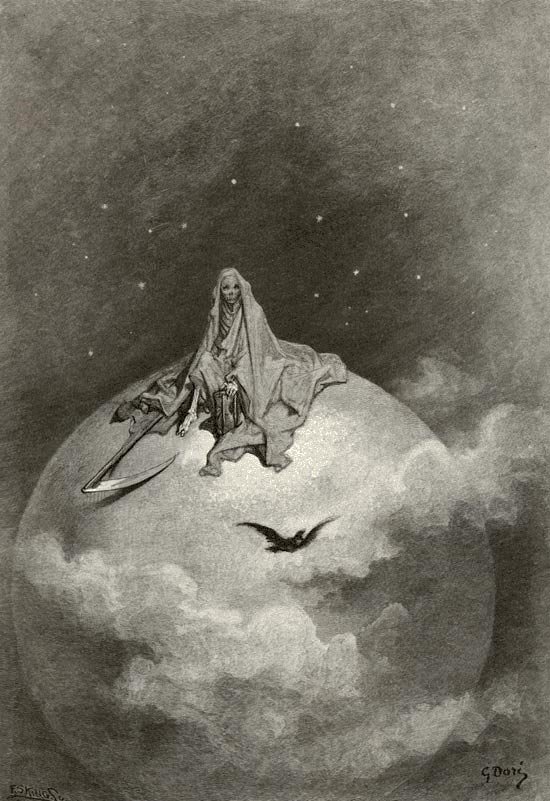
Edgar Allen Poe's Raven by Gustave Dore
"Is all that I see or seem/But a dream within a dream?" E.A. Poe

The practice of remembering dreams is one way to practice deep, inner self-awareness. The subtle energies of dream arise from the Source of Emotion. Both destructive and creative emotions are based on momentums of conscious action. Thought begets thought, and action begets action. As the Poe quote reads, so the psychological, subtle phases of our lives seem as dreams within a dreams.

Emotions are also based in psychological development through various phases of life. As a child, emotions are indistinguishable between self and other. The emotional vulnerability of a child rests in the experience of lacking discernment between “what is I” and “what is not I”. When a child experiences trauma, they are unable to separate the trauma in their environment from their own thoughts and feelings, which are not yet recognized as theirs. By adolescence, the human being is naturally predisposed to reflection on the content of one’s inner life, forming and recognizing their unique thoughts and emotions. This phase is often marked by the difficulties in attaining psychological independence from the collective emotions shared by family and community. If the person passes from this stage, they are able to maintain a strong sense of self, and so go out into the world, learning but not assimilating, acting but not capitulating. These three stages can be summarized as sight, thought and action.

At the fourth stage, there is a marked shift in consciousness. All the previous three stages become indelibly present in life, yet they all become partial to completion through a conscious manifestation of love. In the process of developing a love relationship, the emotions go through the three phases before they are actualized and fully recognized as the enduring experience of love. In the beginning, the emotional phase of the child returns, where individual emotions become indistinguishable within the love relationship. From that stage, thoughts are dominated by thoughts of love, and all action is cautioned by the fact that everywhere one walks now, they are not alone, but with their love.

As with the mystical hierarchy of seven energy centers in the body, known in such traditions as the Hindu Chakras or the Kabbalistic Tree of Life, these four phases represent the involuntary (feeling), creative (thought), power (action), and compassion (love). In the fifth stage, the love emotion resonates outward to engage a greater sense of love for a community, nation or people. In the sixth stage, the focus is clear, and the way aligns with a specific practice of devotion to service in light of the accumulated energetic septet of emotional phases of psychological development. In the final phase, sight, thought, action, love, community and devotion unites every phase of emotional development. The completion of self-awareness is actualized from the inmost depths to the outmost limits of human potential.


____________
She rushes ahead. Into a rigid cube of wooden frames and metal housing. Rusting chains fall over the marginal impasse of domestic space. The outdoor heavens collapse over the head of my lover. 

The Face in the Pool (frontispiece) by James Allen St. John 
Brilliant orange tigers growl and laugh with the insatiable greed of bestial hunger. She is engulfed under massive wingspan of the jungle predators. She submits to death, agog with passionate surrender.

__________
Filmic mind, braving theatric kingdoms
            Weighed heavily by the German cross
Over western shores, blonde
            With sightless camaraderie
In the sociopathic gaze of mindless pain,
            Order & god for trade
                        At the bedside, nude
                                    Binging before a final restitution,
Breathing in dream-talk laughter nightly,
            Not for escape,
                        Only to tread the unfulfilled urge
                                    To let go of body into an act of base movement

excerpt from "think IN drink"

Monday, 28 January 2013

The Madman Within: Valery and the Personal Energy Crisis


Paul Valery par Jullien

"The best way to make your dreams come true is to wake up."
 
"Breath, dreams, silence, invincible calm, you triumph." 

"To enter into your own mind you need to be armed to the teeth." 

"At the end of the mind, the body. But at the end of the body, the mind." 

"A man who is of 'sound mind' is one who keeps his inner madman under lock and key." 


Here, I continue on the themes of an essay regarding a theory of sleep cycles, and the natural course of the human experience of time as espoused in my previous post, Metaphors in the Art of Goya: A Theory of Unconscious Development. Beyond the bounds of the twenty-four hour time bomb, the seer lives to posit the cyclical nature of time in the natural course of creativity as it rises and falls based on the "internal clock" or "the internal orbit" as I will more aptly describe it. Leading through to an experience of time in the twenty-four hour day as much like the seasons, at different stages of life, or the year, we will be naturally disposed to certain times of the day. 

To keep a fixed schedule of waking and sleep throughout one’s life is unnatural and unhealthy, leading to an incomplete understanding of one’s self in relation to the ecological rhythms of the earth, and one’s own nature. Put more concisely, the mad genius intellect of Paul Valery writes, "A man who is of 'sound mind' is one who keeps his inner madman under lock and key." So, continuing on this theme, I would say that, a great foreshadowing to the resolution in thought from the prose essay writings on SoJourn(al) can culminate in formulating a creative practice so that any person can discover the certain time of day that best suits their activity and temperament. 

When allowed to our own devices, we naturally settle into a certain time of day based on the kind of activity with which we are engaged as our primary focus in life. For example, if one is studying texts, the predawn hours may be optimal in terms of the energetic rhythms and ecological harmony involved in the practice and the setting in which one lives. This could potentially lead to invaluable developments as a repertoire of useful information for employers seeking to offer work-life balance and optimal efficiency and motivation based on the kind of work in which they are engaged. 

All of this, in both theory and practice, is based on variables of ecological distinction (the character of a place), individual temperament (how one relates to a certain time of day), and the focused activity (one’s primary work or occupation). Regardless of the person or type of work, with the application of guiding principles, one can find a harmonious relationship with time and productivity through attention to details of place (ecological awareness), energy (sleep cycles), and activity (work medium). 
__________
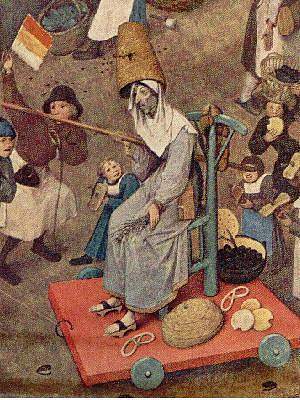
He is silent and still as stone. His face a petrified grey, staring blankly into an off-white wall. His mind has long gone, and yet his body remains. 

The Battle between Carnival and Lent (detail) by Peter Bruegel the Elder
A rodent gnaws into its raw skin. Dirt falls from its brittle hair. The animal dies before my eyes. I was happy and excited to see what once meant my life, and now...
________
As the tired groaning of racist America brews a proud glory of personal despair,
more,
An interpersonal contemplation on the theme of color:
Hair,
Eyes,
Fingers,
Pubis,
Nose,
And Shape,
Body of form,
And the formless desire

White against the all-escaping cloud of solar obscurity,
Who rushed civilization into the neighborhood of the absent & poor

Breaking the long arduous fast
with an unwelcoming community,
founded not on Love,
only on a hope to pray
before the Cyclops’ rise
over the crossed horizon
...

Stretching beyond the bounds of individual reaction,
To choice.

excerpts from "The socialist epoch"


Thursday, 24 January 2013

A Triunity of Conscious Remembrance: Writings on Noetic Symbolism

“We can dream about anything, no matter how preposterous, topsy-turvy or unnatural it may be.” Cicero

The three-tiered modes of consciousness, being unconscious, subconscious and conscious are reflected in the synchronous relationship between dream and memory. This is a daily experience from which we may understand the depths of mind on an elementary level. Fundamentally, it is a known fact that all people, and even many animals, are inevitably sent into the subtle realms of dream; it is part of our natural physiology. The three modes are as follows:

1)

Unremembered dreams are phenomena of the unconscious. The subtle emotions that the body and mind feel as a reaction to such dreams are only known by the most acutely aware. 

2)

Dreams that are had, and are known, where the dreamer on waking knows they were dreaming, however cannot remember any specific details apart from references to waking experience, are manifestations of the subconscious. At this point, waking and dreaming states of consciousness meld into a noetic dialogue, an inter-meeting, wherein the fluid exchange of reason and sense are exchanged with imagination and emotion. 

3)

Dreams that are remembered vividly, and dreamt lucidly, are part of the conscious realm. Most people are not fully conscious in their waking life, meaning they are not fully aware and actively engaged in their own lives, as in the source of their own lives, spiritually, mentally, emotionally and physically. A conscious dream is more than a physiological memory of the natural, instinctual imagination, it is a gift from the transcendent inner world, a gate into our inmost being, where we contact that which seems at once incredibly strange and entirely familiar, our fully exposed, and whole selves. 
__________
The sting of marshland rushes bruise and cut the soles while tangling the toes in knots of wet, risen moisture. The earth perspires with enduring anxiety under these blank skies. Emitting the hot sweat of gaseous vents through the decaying roots and bacterial soil, I trudge. 

The Pontine Marshes at Sunset by August Kopisch
On the horizon, a large city is burnt to ash. They say it all begin with the conflagration of a movie theatre, and a plane crash that split the small city in two with massive fires extending outwards. Not a soul survived. The earth feels cleansed by the death of a throaty death rattle. The decay of human bodies seems to rise as from the strength of the grasses rooted in the damp, dank shifting ground. 

The Unknown by John Charles Dollman
Above our heads, a plane spews hot trails of ash. A man behind me loads a rocket and stings the plane through its side. I watch as the behemoth machine incinerates in mid-air, crumbling with a hauntingly delicate rush through the death-consuming land. I am surrounded by a feel of homicidal, at once in the horizon, while within the breast of the alive. The air is heavy with fate. 
__________
The rains bear down hard and long
On these deceased pangs, longing to embrace ghosts
Long shied-away, deep within memory’s misbegotten despair
...
The diminished poor bear arms while the rains fall
Calling them home no more to breath
In the air of pure and raw savagery
Beckoning our rice-fought union to work
In undivided shame across river’s breadth
That brings wealth and a name to the American prince

With breast inflamed
Prepared to reason with his shame
And engrave in the desert an unplanned way
Towards brotherhood
...
Freeing spontaneous whispers
To a last pleasurable remorse
Upraised and sacrificed
As great offering to the Klezmer bonfire
Whitewashing the New York tide with Greek verse,
In one soundless escapade towards relaxed state of being
...
Cyclically bridging the human body with the global fate
In one silent orbital wave that resounds instantly in every curve of lost strength
Between arms where the beat follows to our brethren and kin,
A growing and invisible host to our name, thinking up a sound
And so, calling forth the blessed invocation of being

excerpts from "The rains bear down"

Friday, 4 January 2013

In Defence of Sleep: Regenerative Sleep Cycles of Archaic Man

“In the age of the rude beginnings of culture, man believed that he was discovering a second real world in dream, and here is the origin of all metaphysics. Without dream, mankind would never have had occasion to invent such a division of the world.” From Nietzsche’s Human, All-Too-Human, aphorism no. 5 
 There's a great lesson I have learned during the writing of this arts weblog resting on the role of the unconscious in the creative life. Firstly, let it be said that this weblog is a compendium of writings, research and dialogue on the wealth of inner inspiration that all of humanity possesses by the sheer facts of physiology: we dream. 

I have learned this basic lesson: sometimes in a person's life, they must be allowed to rest. Occasionally, every person must be allowed to sleep to bear witness to the whole nature of their lives inside and out, to witness the natural course of their consciousness as it dips and lingers in unconscious and semi-conscious states. Are we prepared for this timeless need? 

Truly, depending on the individual, one may require years of extended sleep cycles, to allow the mind to explore the natural caverns of its own self-regeneration through the deep psychic image-language of our internal/eternal life that lies exposed only when the body is at full rest. I can imagine that in more matured human histories and traditions, the seed power of meditation engages the body/mind in a life of inner exploration, even more profoundly restful and intuitive than the subconscious dream state. 

As we are not keen, and even unable, to allow the natural course of our inner lives to take hold and draw us inward for much needed psychological rejuvenation, there is imbalance in the world. So, we are guided by a higher power we sometimes call fate, or even God, but in both realities, is actually the seed of our own imaginative creativity too deeply buried to receive the light of our conscious recognition, reflection and inspiration. 

The old, or second world, that Nietzsche refers to in Human, All Too Human, has been divided and cut off from human life in an age of serious neglect, ignorance and escape from our own inner natures. Thus, there is imbalance, and we continue to deny that we are human, all too human. 
___________
What a massive elevator! I arrive at a doorstop to a metallic behemoth of elevation. Inside, a group of stewardesses welcome with open smiles. As I step inside, I am filled with anxiety. Am I ready to ascend to such heights? The levers at the side of the door are reminiscent of a plane cockpit. With a hefty forward heave, one lady initiates our ascent. The ground of Earth is suddenly imbued with an all-pervasive light. 

Light Paint by Rjcastillo
Huddled in a corner, fearing for my life. I notice the elevator has stopped rising. Has it been hours? Days? Years? I had gone blind, deaf and nearly faced death by astonishment as the incredible rise continued unceasingly. I am weak. I can barely look out into the world, whatever world lies beyond the doors at this elevation. The stewardesses are machine-faced, and continue to smile with an unsettling clone-like smirk. I need to descend. This is not my stop. My brain and face go brittle with overstimulated light energy pouring in through the walls, and it's overwhelming. Suddenly, I can't breathe. I am stunned. 

abstract photography by Getüm
Mysteriously, I am back at ground level in the blink of an eye. Looking into the doors of the elevator, the stewardesses welcome with their inhuman smiles, pasted like ice sculptures under their empty eyes. Do I board again? Can I rise this time? Or, return to the world? 
____________
Observing the skull-emancipated wisdom,
Risking vertigo and the sure endless night
Bringing sugar, tea and a companion’s brethren tide,
Bracing a felt language

excerpt from "Manual speech, a felt language"


Tuesday, 11 December 2012

Apolitical America: Nightmares of the Preventive Paradigm


"In the past, politicians promised to create a better world. They had different ways of achieving this, but their power and authority came from the optimistic visions they offered their people. Those dreams failed, and today people have lost faith in ideologies...But now, they have discovered a new role that restores their power and authority. Instead of delivering dreams, politicians promise to protect us from nightmares...But much of this threat is a fantasy, which has been exaggerated and distorted by politicians. It's a dark illusion that has spread unquestioned through governments around the world, security services and the international media." BBC Documentary Power of Nightmares
As George Carlin said, "You have no choice, you have owners." Yet, before I heard the words of this comic genius, I had an inkling that America was having its way with me, and I desperately needed to get out. When the twin towers came crashing down, I was a teenage male, bent up in a corner, with only one response, the one I thought my American family wanted to hear, "I would kill to get revenge." As I watched the growing stores of books on international post-Cold war espionage supporting the drama of "war on terror" dialectic, I became more and more sickened and disillusioned. Bush's maddeningly insane propaganda machine of backwards language and foolish bad humour turned my stomach. I fled America, to live in the Middle East. I needed to hear the breathing from "the other side". I found human hearts, not enemy minds. I found a camaraderie so naturally human, and so deeply universal, that I was fulfilled from my need to be "American" at all. With Obama's "war on terror" claim to fame at finally finding success in hunting down Osama, I remain ever firm in my convictions. American "terror" propaganda is so deep-seated that it is truly beyond politics, it is the very lifeblood and backbone of American society. 

See my post: Flightless Dreams and Dark Humour of a Post-W.orld...
__________
A gargantuan supply of Spanish rice, washed in a tantalizing array of chiles and spices galore, wades in a fine cream sauce. A team of cooks work with exceptional efficiency in an open kitchen. The dining area is of a posh nightlife design. Smoke wafts among whisky inhalation in the metropolitan air. 

New York Restaurant by Edward Hopper
As I stare into the blaring kitchen lights from the dim seating area, I notice a cook saunter over to a telephone on the wall. His white frock is stained with stout culinary effort. Taking another sip from my snifter, eyeing a fantastic belle at the table across from me, the dining lights suddenly dim uncomfortably. The kitchen light glares out over the tables with the stillness of an all too noticeable silence. Everyone is motionless. 

At the Moulin Rouge by Henri de Toulouse-Lautrec
My eyes survey the room with blundering anxiety. The white frock of the cook at the phone reflects a brutal white light over fearing eyes. His mouth opens, and out emits a breath so hot I can feel it nearly twenty feet distant. His eyes become two open holes. The man falls, and I can see his frock begins to stain red. Crawling along the open floor, he is steaming hot. As he unbuttons his cook's clothing, his chest pours with ashen blood, a red so crimson it floods my eyes with a blinding hue. In my mind, I kneel to help him. I sit, frozen. 

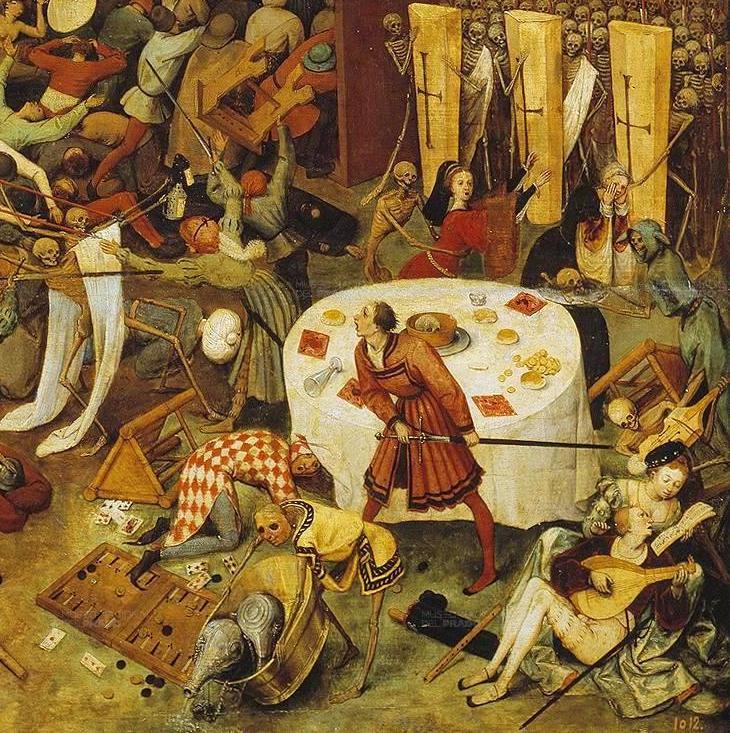
Triumph of Death (detail) by Peter Bruegel the Elder 
All realize the man will soon die. One cook slowly meanders over to a phone, shakily dialling to quell the emergency at hand. In a last gruesome attempt to breathe, the man on the floor has almost completely undressed himself. Swelling with heat, blood pours from his chest and mouth. Staring at me with empty, soulless eyes. I faint. 
_________
"Fires beneath the throat, hand and breast of a reflected sky
Inside the single-eyed, whose perfect clock chimed roughly over the groundless

Patience, dusting off wine bottles
Into Californian eternity
...

The idealistic round elegized by madmen before indulgent crowds,
A folklore, pained to vulgarity in the thick mire

Soaked with herbal grime,
That dream-forsaken wine of the ancient, pours

Sending women to mind thankless law
In the first civil war before nationhood or tragic mores

The fallacy in and out of sight,
Instantaneous with thoroughly flushed wives, fanning themselves awake

As the flies descend and drink their salivating gore-fest tirades,
The Queendom, saved by the ranting duration of a minor apocalypse

When all the rest of the world lies in tears
Shaken only by worldwide fame"

excerpts from "Co-creative Wondering"


Monday, 19 November 2012

Dream, or Intoxication: Nietzsche and the Tradition of the Master Singers

The Ravens (For a poem of Nietzsche) by Margaret Hofheinz-Doring
"...dream and of intoxication, physiological phenomena between which we can observe an opposition corresponding to the one between the Apollonian and the Dionysian. According to the idea of Lucretius, the marvellous divine shapes first stepped out before the mind of man in a dream.* It was in a dream that the great artist saw the delightful anatomy of superhuman existence, and the Greek poet, questioned about the secrets of poetic creativity, would have also recalled his dreams and given an explanation similar to the one Hans Sachs provides in Die Meistersinger.*

My friend, that is precisely the poet’s work—
To figure out his dreams, mark them down.
Believe me, the truest illusion of mankind
Is revealed to him in dreams:
All poetic art and poeticizing
Is nothing but interpreting true dreams.

The beautiful appearance of the world of dreams, in whose creation each man is a complete artist, is the precondition of all plastic art, and also, in fact, as we shall see, an important part of poetry."

Nietzsche, Birth of Tragedy (e-text)

One night I had been tirelessly searching for this very stanza by Hans Sachs, however I'm unable to read German so my stalwart online efforts proved futile. After glossing over Nietzsche's "Birth of Tragedy" a few times within the body of other texts on mythology, psychology, dream and poetry, I have now found a predecessor to Nietzsche, Hans Sachs, embedded in his monumental philosophical work. This is one of my favourite tracts of literature, and yet I've still to read it in its entirety. I continue to draw from this work the kind of lucid understanding of our inner being as it has moved and developed since the first pages of history unto time immemorial. Such an exhibition of prime thought beckons one's mind, as a lure into the opaque night of isolation and longing, yet when nostalgia dissipates the true character of one alone breathes the kind of truth that is our universal whole, a cosmic constancy of holism, triumphant in its lasting mystery. 
_________
The air, invisibly opaque, opaque in its emptiness, invisible in its bodiless humor, I gaze through the sheathed firmament, a room, a body, jacketed in the empty dark. Forcing my eyes to move, I see a slight pitch in the cruel nothingness, a fleck of something in a bruised vacuum of light. Where am I? 

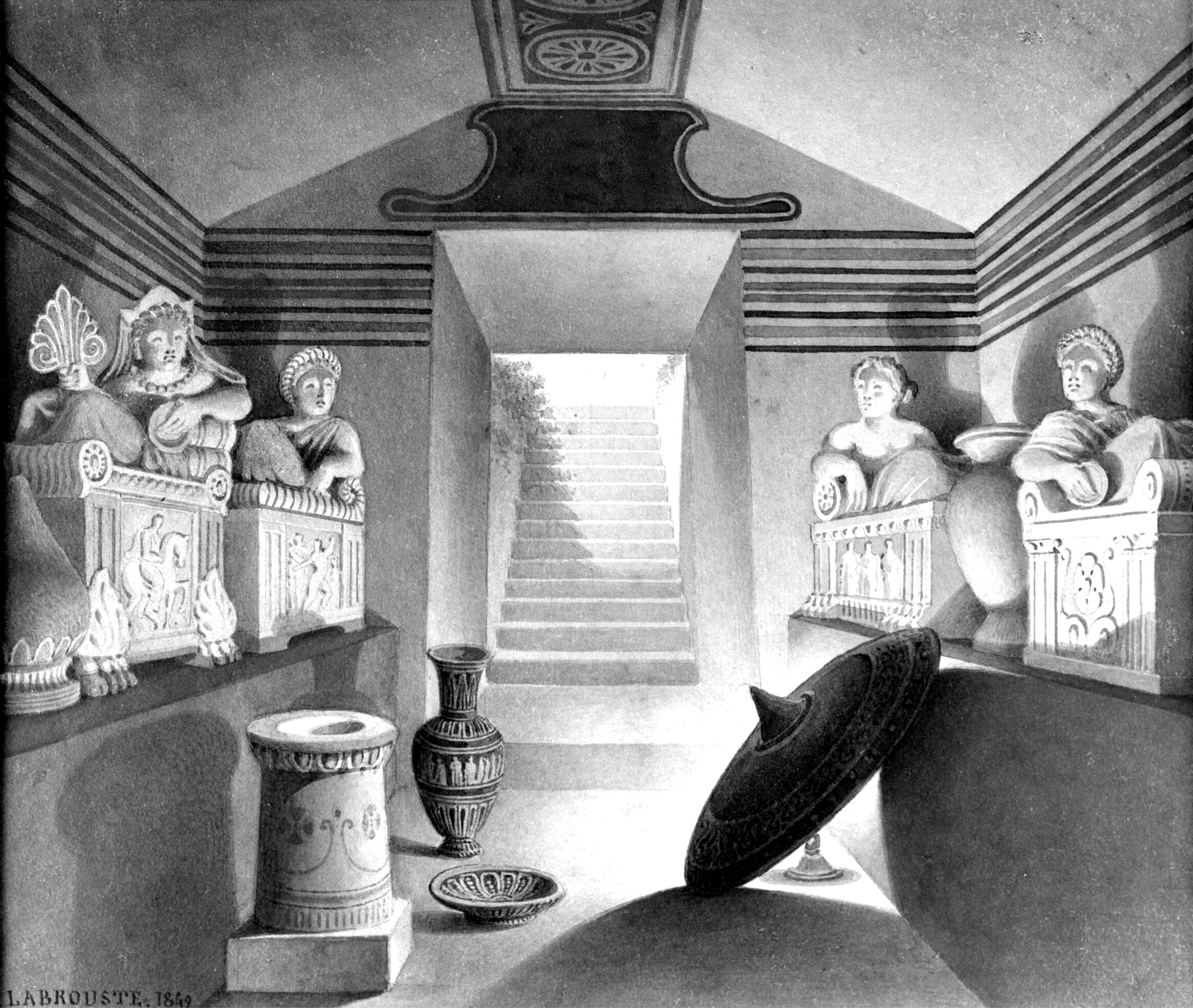
View of an Etruscan Tomb by Henri Labrouste
I am upraised, I am raised above ground, on a bunk, on an old bunk of childhood longing, bedside window staring, the endless bunk of isolated raised up childhood. On my head, a Viking helmet… It’s sheer weight, it’s ridiculous… My arms flail under a body weighed by the lowering ceiling, and a head crowned with a horned and vast slate of crudely nailed metal. 

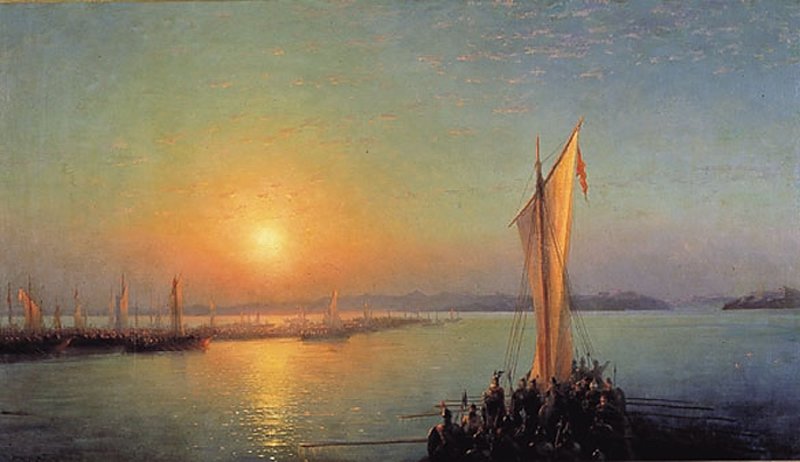
Viking Saga: The path of the Vikings to the Greeks by Айвазовский И.К.
And as I look up, the ceiling, lowering, eyes me back with a staring mushroom, with an elongated stem, a fungal growth, upside-down, to stare at me with its sexual head of strange and auspicious gloom, a vivid flight of the hallucinating noesis, the natural misplaced in a mind-born hell of undone pain, to sleep and writhe, in a landless bed of the upright bunk, swollen helmeted head. 

Winter by Giuseppe Arcimboldo
And at once, I toss the disfiguring crown over the edge! It dings off the edge of a television perched on a dresser, and the reverberation is near-unending, an unnatural sound emits, and sends my unconscious flesh storming at the gate. 
_________
One proud, unseemly yet everlasting hoary wind
Escaping into the breathless fold of a storm-brought love
Escalating above the tumult of grounded trees
Lowered to rest in the silent play of her touch
With Mother Nature in lust at the American shoulder-sculpted God

President of inveterate honor
Failing to maintain true gaze
Into the outpouring blind Persian mystic call

Excerpt from "Untrained Timeless Tuning" [featured on Poydras Review]


Saturday, 17 November 2012

Schopenhauer and the Unconscious Fate of Recurrent Thought

Recognise the truth in yourself, recognise yourself in the truth; and in the same moment you will find, to your astonishment, that the home which you have long been looking for in vain, which has filled your most ardent dreams, is there in its entirety, with every detail of it true, in the very place where you stand. It is there that your heaven touches your earth. Arthur Schopenhauer. On The Wisdom Of Life: Aphorisms
Aphorismen zur Lebensweisheit by H.P. Haack (photo)
Schopenhauer suggests that just as your dreams are composed by an aspect of yourself of which your consciousness is unaware, so, too, your whole life is composed by the will within you. And just as people whom you will have met apparently by mere chance became leading agents in the structuring of your life, so, too, will you have served unknowingly as an agent, giving meaning to the lives of others. The whole thing gears together like one big symphony, with everything unconsciously structuring everything else. And Schopenhauer concludes that it is as though our lives were the features of the one great dream of a single dreamer in which all the dream characters dream, too; so that everything links to everything else, moved by the one will to life which is the universal will in nature. Joseph Campbell. What is Metaphor? 
Here, I continue to find cross-references between three great thinkers of the 20th century, now with their source in the earlier precedence of Schopenhauer. The 20th century, with its unveiling of depth psychology towards the transpersonal meanings of self and agency in the will of the world have risen this line of Schopenhauer's thoughtful development with poignant regard. Joseph Campbell, James Hillman, Terence McKenna, all arrived independently at three concurrent patterns of human behaviour as a self-reflective being; character (self), narrative (fate) and dream (unconscious). The most accurate form of self-identification seems to be when we see ourselves as characters. As McKenna said, "we are in some kind of engine of narrative." Where Schopenhauer linked this to dream psychology underlies the mystic identification of fate by Carl Jung who said, "the unconscious exists in our lives as fate." The unconscious, fate, and the narrative engine of character are central to analyzing dream psychology as the major themes which now lead the humankind towards a humbling before nature as the greater mind of collective agency, and that to know nature, is ultimately to experience self-knowledge from the deepest base of the unconscious to a fully conscious, self-willed awakening of independent and transnational human sovereignty on Earth. 
_________

a city rat friend and I duel with competitive rage, amassing a firebomber brigade of red trucks fuming with the waterless engine of their stolen malfunctioning, and careening past the lights of midtown manhattan we stream as a rapid at open floodgate through the sleepless streets out of town

The Painting Reads: The Neighbourhood Belongs to the People Not Big Business
over a northbound bridge, we find refuge in an overgrown motel lot, the air is sweet, and we are invited to tea inside a cozy, furnished lobby, strangely reminiscent of a personal home, with sofa, television, and toys for young children, and our steam fumigates absently, unaware we separate to each our own rooms 
__________
Playful mortality, and the scream of death
Under stadium lights,
3rd block West Clinton Street New Bedford

And mortality reigns with his eminent consort Time
Ever-gazing into the strict law of entrance into the beyond,
Beyond reclining chairs and horizontal graves
...

Beneath a delicate skin of man
Braving the deforested aftermath of Assimilation
In the name of survivalist migration

After years of subconscious insubordination,
The doorway now flattened with the invincible family bond
Carrying our name and grown humor

excerpts from "Playful Mortality"