Primarily a writing exercise, this dream journal-inspired blog is a quiet introspective sojourn into the process that we traverse in going from private dream to public art. I see our dreaming as an internalized mythmaking. As I philosophize and expressively exhibit dreams, both private and public, I encourage and delight in creative language as a way to practice experiential metaphors through a “public dreaming." Writing Theory: Creative Dream Fiction
Showing posts with label Taoism. Show all posts

Monday, 3 June 2013

Sleepless Children of Dream: Composer Vi An Diep Invokes Taoist Grace


"When you sleep your angels stay awake my children
The bombs will kill and destroy
Guns will take my life
Midst the noise and chaos
I will sing this song during your last breaths on earth
Carry you to your next journey far away from this hell
Then I may die in peace"

Lullaby to Dying Children during the Vietnamese War by Vi An Diep

“Be careful what you water your dreams with. 
Water them with worry and fear and you will produce weeds that choke the life from your dream. Water them with optimism and solutions and you will cultivate success. 
Always be on the lookout for ways to turn a problem into an opportunity for success. 
Always be on the lookout for ways to nurture your dream.” Lao Tzu

“Sometimes I feel like the elephant in the room,” says composer and musician Vi An Diep. She is one of more than 20 artists involved in creating Elephant Song, the newest work by Green Fools Theatre. The “pay what you can” all-ages shows will feature an elaborate set for life-sized hand, rod and shadow puppets. The centrepiece of the production features both live and electronic music by Diep, a local artist who immigrated to Calgary from Vietnam two decades ago. Elephant Song is inspired by Diep’s life story, and her music reflects the way humans relate to the natural world.

Writer and director Jennie Esdale has worked with Diep since 2005 (Dancing on Water) and says she always wanted to do a show with Diep as the centrepiece. The story follows two sisters separated during the fall of Saigon. Diep, a refugee, arrives in Canada and teaches herself to play the zither. Through her music, she conjures the life of her sister, raised in the jungles along the Mekong River in Southeast Asia. Rescued by an elephant, the sister embarks on a harrowing journey in search of a lost calf. Along the way, she saves as many elephants from the perils of modern dangers as she can.

The story mirrors the emotional bonds of an elephant family through a human story, and both share a common theme: displacement. “Elephants are like humans in that they form close bonds with their families,” says Esdale. The separation of two sisters by the strife of war is reflected in the devastation of an elephant family by illegal hunting. “Just like humans, when an elephant loses its family it forms a new family,” she adds. “Elephants share an emotional range close to humans — the audience can relate to the elephants through the human element.”

Before writing Elephant Song, Esdale travelled to Chang Mai, Thailand, eventually meeting a woman with land that’s dedicated to an elephant sanctuary. Inspired by this activism,Elephant Song takes place along the Mekong River in Thailand and Vietnam, which is part of the natural habitat for Asian elephants.

The play openly addresses the role of humans in elephant endangerment. Actor and puppeteer Nicola Elson, together with the Calgary Zoo, will provide opportunities for audiences to become involved in elephant conservation.

“The artists can represent the work of the people on the ground, the conservationists and scientists, but at the end of the day we are not the foot soldiers,” says Dean Bareham, actor and set designer. “There are a lot of people who don’t like zoos, but the fact is that zoos actually do a lot to conserve endangered species.”

Elephant Song delves deeply into the emotional landscape of both the human and elephant characters. Set design, supported by music and mise-en-scène, is crafted with an appreciation for the fascinating visual and aural communications that elephants use, including both sign language and low-frequency vocalizations. “Live puppets exhibit the relationship between the humans and the elephants, and the shadow puppets represent the inner world of the elephants,” says Esdale. “Emotion through story can be more persuasive than facts, as it can inspire hearts and minds.”

Diep’s music cultivates introspection, inviting audiences to reflect on the inner worlds of human life. “The act of physically creating a sound connects people to their own feelings and from that they relate with the rest of humanity. That’s the role of music,” says Diep. “Jennie was able to listen to my story and feel the sentiments and elaborate on it in a way that is accessible for any audience.”

Central to the production is the dan tranh, a steel-stringed Vietnamese zither, featured in both puppetry and live performance. Diep’s instrumental artistry draws from a rich Vietnamese-Chinese heritage, with respect for a cultural preservation that is in harmony with the conservation of nature. “The instrument is a part of the immense heritage behind me,” says Diep. “The Vietnamese dan tranh is the only thing that really links me to the natural world and the heritage of Vietnam.”


The above article, "Elephant Song: Composer Vi An Diep performs semi-autobiographical puppet play about wildlife conservation and immigrant heritage" first appeared in Fast Forward Weekly on May 16, 2013 and later in The Media Co-op 
______________
have a ball by RK 
the music of life by RK
early spring by RK
red hiding by RK 
when i grow up by RK
________________
the exotic settler, has become unsettled by the music within, the rhythmic unity of creation instantaneously awakening the dreams of exploration to contented and rooted being that is beyond and before settler intuition, yet speaks of one at their furthest point 

cast astray by the weary exhaustion of travel and the toil of vagrant survival, at our most distant from any sense of self or environmental recognition, yet the voice within provides a means and path by which we may discover the foundation of life within and without and throughout all wherefores and times 

all faces of belonging in the deep runnel of ground churning and swooning with each and every step planted firmly before sitting, to meditate on the self as energy thoroughfare through which sky and ground meet in the cloudy visions of a creative mind at work, entranced by the muse of his own beckoning, the internal void voices VOID! 

Aloud! the name of god, from faraway lands, in the echo of valleys whose echoes resonate to beckon the voice to intone and invoke throughout and within and from and as the windpipe of the valley itself: Allah, is called, where in Arabic, the expression "ya" is used to call out with vocative interrogation, in this way, to see the meeting place of space and sound, of sky and ground, within the human taste for the call to nowhere now!


Four pieces herein envision and voice the foundation of character as Love, the unsettling settlement of dualistic harmony. The holistic fruition of light boundless and earth trembling. The boom and flash of awe and rust, coalescing at the frayed tip of the hangman's rope, blooming a new head of lore and myth. Words are eyes from heaven. 

The second piece, "allahlelujah" is also featured as a sound-art exploration on themes published herein, on the sacred mess of beauty at its core a seed nestled in the crooked ribcage bust of an itchy nude breathing the hoarse and callous gargle of raw touch and the healing blood that runs from a reddened face hot with night  

Wednesday, 5 December 2012

Taoist Offerings in the Hall of Dreams

Kannon in YUMEDONO (Hall of Dreams) by Tokyo Bijutsu Gakko 

Summer grasses /
 all that remains /
 of soldiers dreams.

Kannon is the Goddess of Compassion. Her Chinese name is Kuan Yin, and in Sanskrit, Avalokitesvara. A statue of the Kuan Yin stands, similarly as pictured above, in my apartment. My wife, a Taoist-Buddhist, cares for the sculpture with a love beyond regard for high art. Standing behind an attendant bodhisattva, the Kuan Yin is a living recipient of our most momentary aspirations and our immanent longings, as they rise and fall into the sky of the figured form with our sound, breath, movement and speech. With a physical offering, the life of the seemingly inanimate sculpture gives way to immortal reckoning. The statue has received such offerings as the favourite pleasures of my late grandfather (a can of sardines and a cigarette), as well as my Shakuhachi breathings. 
__________
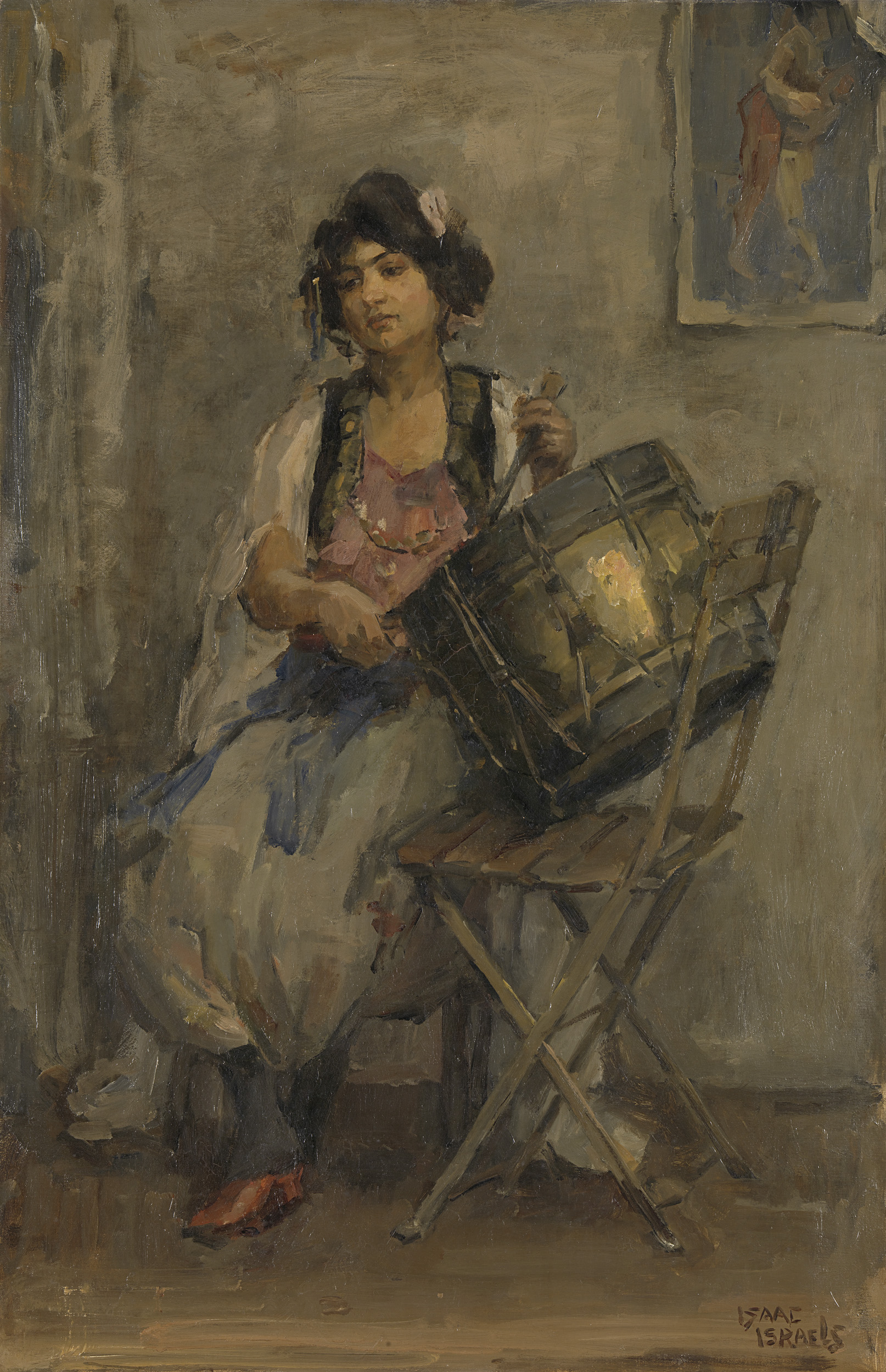
I see my wife, long braided hair, in full red dress, dimmed by the party ambiance, she wails on her mother-of-pearl Egyptian doumbek, with the percussive force of a musical heart, true bravura of heartened artistry. 

Two Drummer Girl by Isaac Israels 
As I wade into a kitchen room, I feel the presence of sheer evil at my side. And looking down, blood pours delicately from a soft wound. The ghost of death blinds my nerves as my eyes fog with principal madness, looking at the mean-faced ignorant sex-fiend of my abusive past. 

Sitting young woman in Dutch Kitchen by Henrik Nordenberg
That shared abuse, culminates in a shot, straight through the gut, though strangely a painless death as the water of my eyes bleeds my vision into an all too wakeful death.        
__________
Boiled threat of another animal’s blood
Given over to the insect mind,
A natural reason, the rational cycle

Filling 0’s with my precious un-devoured anchor
That holds human bread to the sand of the unfed
Screaming over shopping carts, cringing with nicotine blinks
...
Ruined men and women whose hearts run dry
Like the rivers that once fed their ancestral lungs,
Filled with the mythic bird

And they rise from the ashes of Hindu lore
In the European brain,
A tell-tale crime, getting skinny in between
...
In exchanging monetary behaviorisms
In the psychic deep of abundant perceptions
Closed doors sink into the undertow’s warning


Friday, 23 November 2012

A Taoist Mystic-Musician and the Great Awakening

Painting of Tao Yuanming by Chen Hongshou
"By and by comes the Great Awakening, and then we find out that this life is really a great dream. Fools think they are awake now, and flatter themselves...Confucius and you are both dreams; and I who say you are dreams,—I am but a dream myself. This is a paradox. To-morrow a sage may arise to explain it; but that tomorrow will not be until ten thousand generations have gone by." Musings of a Chinese Mystic: Illusions

Possessed by a conflict of opposites, after reading this quote aloud to my wife, she says, "That is totally how I feel." She was raised in a Vietnamese sect of Shamanic Taoism. One day, a local shaman saw her hands before she left Vietnam for Canada. "You have the hands of an artist," said the shaman. As I watch her hands blend with the strings of her instrument, and hear the mystic bent with staggering heart, wrenched from her music of an emotive immensity so tremendous that I am truly floored every opportunity I have to provide her with a rhythmic touch of our in-gathered loving. Through her music she speaks, "listen, and awaken to the source root of creativity." It takes a well-planted seed to take root in such soil, rich with the wisdom of time and its lessons of patience and anticipation. I respond, "let the spontaneity of life sometimes dry, to await the rain, falling not from our own bodies, but from the intuitive atmosphere of our shared life, that to be patient, is a kind of love."
________

pondering the day by the riverside, my mind blends in the heady fray of sun rope tangling with the cloudy sky in a disarray of dizzying color, the viscera of imagination pokes its protruding skeleton in the vine-skinned pathway beside my water-borne home 


as I traverse further on, through riverine thicket dense with the swamp-like craftiness of bitter greenery, filtering the light through a pockmarked memory of filigree lightning, and I remember the Old Man, a Lao Tzu, of my entrenched longing, with such wisdom as unknown by my youthful pride, he walks with me with undeviating eyes, with mind to each thought that arises between our speech of anticipated mentioning 

Sakyamuni, Lao Tzu and Confucius by Unknown
and then he stops to show me a trick of the fatherland, a stick of wisdom, a bone of intelligence, an awakened look into the material fire of all transparent self-knowing, the crooked daze, the unchallenged light sparking his eyes to follow mine in the unfailing instant of his true magic
________
A law for the ancient mind of cultural struggles
To be heard through fallen webs of prehistory

Erected above the books and pleasure-peaked Goddess of man
Who assailed Her tribes with red nations
...
Claiming to break the mold
With word thievery and undreamt savagery
...
In the earth’s hidden sky of traveled time
And her rested eye

excerpt from "The Modern War Machine and his Italian Wife"

This post is dedicated to my wife, Vi An

Friday, 25 May 2012

Vietnam! Your Season Is Eternal!


Maimed Poet

"I sometimes have this dream of leaving the temple to return home. I dream my fingers have grown back and the swelling on my face has subsided. I dream that I have with me a dozen baskets of my best white lotuses and travel to the floating market of my youth. As I approach the women I would free all of my lotuses into the water and watch them float through the market like a white river. It would be then that I had finally returned home. Set free and pure. Then I would wake up into the black night and realize it was simply a dream, one of many that will never be fulfilled."

Lotus-Seller

"It is not too late."

Maimed Poet

"It is late. It is later than you realize"

- from "Ba Mua" (3 Seasons)

"My body is like the jackfruit,
Its skin prickly, its meat thick.
If you want to test it, then drive in your stake,
Don't fondle the surface, or sap will stain your hand."
("The Jackfruit")

- Ho Xuan Huong, Queen of Nom Poetry

Listen to Vietnamese Folk Poetry


Where is that land, worth fighting for, worth dying for, loving and dreaming for? 

Where is that land stronger than our Western fathers, who defeated the brunt of genocidal ambition, and lived to tell the tale?
______
We both walk into a building. There is old, thick carpeting. I smell musk and old, lingering dust. Chinatown, very mildew-filled atmosphere with dusty, we walk into a building. A set of stairs leads us left. We walk into a room with many bleachers looking towards a stage. We walk up the steps and we find our seats. It’s theatre seating. I notice two young men who are now much older. When I met them they were elementary school kids and now they are adults. They grew up with me in our apartment complex, upstairs. We notice that there is a kind of Taoist ceremony happening in front of the stage. There seems to be somebody in the right corner of the stage, appearing as a schoolteacher or Taoist priest, accompanied by a luthier. The luthier is fixing three Koto instruments on stage. I take note of the three Koto instruments; they are very old and large. When I went up to them, I realized they were very cheap. They were just effigies for a ritual, paying homage to something unknown. I found myself walking out of the auditorium into another neighbourhood. 

I quickly realized my husband was no longer with me. I found myself in a workshop. There were construction workers, male and female in overalls, squatting on the ground, hammering and working on things. I noticed one guy was the site manager. I wanted to impress him. I started working on something. He said, “you know, we pay $25/hour here.” I said, “I could take on this job.” He said, “You’ll work ten hours here.” The whole time I was thinking about my husband, wondering where I was. As the sequence progressed and I kept working harder, lifting wood planks and wires, I was doing really well. It came time to leave. I picked up my shoes, bags and coat. I walked towards the door. The manager looks at me, chuckling. “You wish your husband was here right now,” he said. “More than you know.” I said. There you were, gazing at me with loving eyes. He’s right behind me. I was totally taken back, embracing you tightly. I rested my head on his chest and said, “My love, you saved my life.” He responded, “I’m here to walk you home.” My heart pulse became more regular. I smile.  
________
Work
"To look for work, means that you will be benefited by some unaccountable occurrence." (iDream)
________
“Look...to the horizon!”

“How prophetic…”

“Be patient...look!”

“Give me your gun.”

The creature defies the boundaries of human sight
on Earth.
A rarity unspoken.

“Something to tell the grandkids about!”

“Don’t say a word.”

- excerpt from "To The Horizon"

Monday, 30 January 2012

Death of the Papu

St. Catherine receiving the stigmata of St. Benedict and St. Jerome altarpiece, detail: St. Catherine by Domenico Beccafumi


I walk into my grandparents' house. The subdued beige carpet fades against the similarly hued walls. My grandmother, Nana as I call her, barely notices me walk in. This is unusual. She is usually open arms, with hugs and kisses. With her head down, she only pays attention to the baby grand Chickering piano that her deceased brother left her. She seems very anxious. My Papu, which means grandfather in Greek, is strangely absent. I feel I have been away too long and my Nana lets me know that by her body language. They have dealt with too much pain without me, and now I am lost to them. 

There is a black coffin on the porch. It glimmers in the sunlight. The coffin rises to the porch ceiling. 


Folk Taoist Interpretation:

He will live longer…the reality is opposite of the dream.