Primarily a writing exercise, this dream journal-inspired blog is a quiet introspective sojourn into the process that we traverse in going from private dream to public art. I see our dreaming as an internalized mythmaking. As I philosophize and expressively exhibit dreams, both private and public, I encourage and delight in creative language as a way to practice experiential metaphors through a “public dreaming." Writing Theory: Creative Dream Fiction
Showing posts with label community. Show all posts

Monday, 30 September 2013

Source of New Media: Resonant Lives Harmonize in the West


“What I began by reading, I must finish by acting.” Henry David Thoreau

Where is our all-inclusive local media source, one that is not generic, yet doesn't cater to only one group, one that embraces local lore, custom and myth, one that encourages people who live the story, who are located downtown or in the community, whose lives are on the pulse of the daily, local narrative? They are to tell their story, to emphasize selected statements said by their own voice, and to speak from experience, because good media should begin with experience and end with experience. Good media should not begin with inexperience and end with inexperience. Good local media should reunite with social cause, and ultimately, incite action.

The introduction, history, structure and funding of The Media Co-op is explicitly written out in, Know Your Co-op, a nineteen page document prepared by journalist Dawn Paley in 2007 and self-published by The Dominion editorial collective. What began in 2003 as a newspaper, The Dominion (still circulating nationally), was reincorporated as a multi-stakeholder cooperative in 2007, now known as The Media Co-op.

“The multi-stakeholder is a situation in which you have more than one class of membership within the cooperative and they collaborate together to meet the needs of the different classes of membership,” Peter Hough, Fund Manager of Tenacity Works Fund at the Canadian Worker Co-op Federation told the Calgary Working Group of The Media Co-op. “In a retail store it would be trying to produce good working conditions for the employees but also trying to produce good service and fair prices for the consumer members. And then all of them would share in any surpluses.”

In 2009, the first local of The Media Co-op formed into the Halifax Media Co-op. In the next three years, Vancouver, Toronto and Montreal formed locals (in that order). “Each local has an editorial collective that meets face-to-face to discuss stories and coverage in their cities and surrounding areas,” wrote Dawn Paley, in Know Your Co-op. “The new model has required the creation of a web platform where contributors can upload news, videos, audio and photos, as well as interact through comments, working groups and discussions.”

Cooperative and local media is a process of decentralization, essentially giving media back to its rightful source: the people. In this way, the oft-repeated slogan, “Own Your Media” is The Media Co-op mantra. With stories such as the 2004 Haiti coup d’étatand the Vancouver Olympics, The Media Co-op and its locals transcend corporate media coverage, connect with untapped readership in the Canadian public and have worked with larger media organizations internationally, such as Democracy Now!

Yet, as typical to news media, the bad news is ever-present. As reiterated in Know Your Co-op, Montreal Media Co-op founder Dru Oja Jay, bore the bad news that The Media Co-op could not accept new locals in the 2010 article, How to start a local of The Media Co-op. Due to the overwhelming commitment and the underwhelming budget, The Media Co-op instead encouraged incipient Working Groups. The Calgary Working Group was opened under the direction of Jay in 2010 with top-notch international reportage on the challenges to a national election in Manila, Philippines.

Since then, the Calgary Working Group has received over 120 members with contributions on topics ranging from the G20 Summit to The Alberta League Encouraging Storytelling (TALES), to Environmental Justice, to Café Koi to Young and Future Generations Day. Articles, podcasts, photo essays, editorials and blogs are among the many mediums of cooperative journalism local to Calgary. After a new (and very active) Calgary Working Group contributor corresponded with Jay earlier this year, the momentum shifted. Dialogue on starting a new local of The Media Co-op reopened.

The potential for the Calgary Working Group to become the Calgary Media Co-op is a vision that has since been shared in the local community, and the support is gaining. The Calgary Working Group started meeting with this objective in May of 2013. Besides forming a basis of unity, and establishing an editorial collective, the Calgary Working Group requires sustained and significant contribution in order to shift gears into the full-fledged Calgary Media Co-op.

The initiative is mutually coordinated with The Media Co-op, where all posts contributed to the Calgary Working Group (and in the future the Calgary Media Co-op) will appear as published on The Media Co-op nationally-syndicated, online news source. Stories written by a local, such as the Montreal Media Co-op, also appear as such when published in The Dominion. The Calgary Media Co-op is a vision for local cooperative media, in advocating for the publication of local stories, connecting them to a national community of journalists, activists, communities and leaders.

The basis of unity and editorial collective has been organized successfully since May with core organizational capacity developed with Daniel Rodriguez, a graduate of SAIT Journalism and Melissa Manzone, who holds an M.A. in Journalism from Kingston University (U.K.). Our basis of unity establishes a rational, concerted response to the inadequate agenda of dominant media to address and give voice to local concerns, perspectives and narratives. The unity is also founded on a deep appreciation for journalism as a public base of knowledge where cooperative values are formed, maintained and encouraged.

The editorial collective organizes a weekly program of contribution. Each piece submitted to the collective will be edited by at least two other core or guest editors. Three pieces a week are to be contributed by one regular contributor and two guest contributors. The publication schedule will be organized according to three themes – Uncovered, Alternative and Editorial.

On Monday, the focus will be on misinformation in the dominant news sources. Simply, we ask, “What is the popular news not covering?” The same issue published in dominant newspapers will be assessed and critiqued with regard to the uncovered angles, perspectives and stories. Not only will contributors critique, their articles and/or multimedia pieces will address and give agency to the unvoiced, and unknown, in our community.

On Wednesday, pieces will map alternative press locally, in Calgary, and Alberta. For example, we ask, “What is being voiced by independent media sources, non-English newspapers, podcasts and blogs?”

On Friday, the editorial collective will publish editorials spotlighting special voices from within the community. This new initiative of the Calgary Working Group aspires to convene with the entire political spectrum, including all identities of class, religion, gender, and ethnicity into a refreshingly local forum to reenergize debate, understanding and willpower in the community.

The Calgary Working Group still has a long way to go until the proposed momentum is established, and finally, there is a new local chapter of The Media Co-op in Calgary. According to the latest draft of New Local Policy (pending issue by The Dominion editorial collective), the Calgary Working Group remains in Phase 0 of 5 successive stages until a full-fledged Local can open in Calgary.

First and foremost, what this means is that the Calgary Working Group may not use The Media Co-op name to raise money. All funds currently fostered through the voluntary leadership of media activists involved in developing the Calgary Working Group are nominally channeled through AlternativeMediaYYC.com, an independent media and podcast source for Calgary-based voices. At Phase 0, the Calgary Working Group may not refer to itself as the Calgary Media Co-op. At this initial stage, administrators at the Calgary Working Group helping with site content do not have editor access through working group admin privileges.

Currently, the Calgary Working Group is developing from a working group (Phase 0) to a website working group (Phase 1). In the first stage of the working group’s becoming a local new content is posted weekly, collective membership is stable and meets regularly; collective processes, membership criteria and operating principles are formed; editorial policies are adopted; formal agreement is made with The Media Co-op basis of unity; and lastly, the collective (Calgary Working Group) agrees not to use The Media Co-op name to raise money nor refer to themselves as the Calgary Media Co-op.

At this transition, the working group applies to The Media Co-op Board of Directors (in this case, through Dru Oja Jay). Leaders from this Calgary Working Group initiative are currently organizing a conference call with Dru and The Media Co-op Board of Directors. [To get involved, please contact us via the Calgary Working Group coordinator, Matt Hanson (mhanson1717@yahoo.com).]

______________

In the context of modern literary history, Hungarian-American Jewish newspaperman Joseph Pulitzer set the quality standard for publishing at the turn of the century. Pulitzer, best known for the eponymous award for not only journalism, but also photography, literature, history, poetry, music and drama is attributed with the quote: “The newspaper that is true to its highest mission will concern itself with the things that ought to happen tomorrow, or next month, or next year, and will seek to make what ought to be come to pass.”

Good media begins with the very real ground-level experience of people who are the subject of good stories. The middle ground is where people read and learn. Finally, good media ends when the lives of the people voicing their story are changed as often as the people who learn that story. Good media compels and instills action.

Mediocre or god-awful media begins with inexperience, namely the daily political rhetoric, hearsay, or at best a secondary source. Next, its core value is the repetitive sound of a cash register receiving a dollar and some change for a paper. For the tremendous act of reading is enough for some literati, however news media should be a call to extroversion and community.

Oftentimes, media consumerism ends with apathy, inaction and at best a satiated boredom, and at worst, accepting that life merely boils down to hearsay. More subtly, office-enclosed research on secondary sources so conveniently bolsters today's social (and unsocial) media frenzy; a frenzy that can overwhelm experience into the dull silence of an unprovoked voice in an abyss of unquestioned answers, facts, statistics, records.
"It's as if newspapers have broken their bargain with democracy in turning away from editorial excellence and towards profit, marketing and cost-cutting...fewer of us can turn to our papers and see what we all have in common, or what our common stake might be if we participate in our democracy." (Yesterday’s News, John Miller)
The glossy overdub display of empty space is often filled with meaningless advertisements, meant to convince people that their lives are as empty and meaningless as an unfulfilled consumer niche, such as the newspaper; slowly becoming a dying, trivialized miscellany for the intellectual exploits of the few.

The media less and less provokes action because it never quite does anything for anyone, yet still somehow exists because of the inkling that it could. If only media behaved as it once did before politicized buyouts and delegitimizing advertisements, when a paper was a conduit of experience through which new learning passed to connect, share and welcome all voices to truly and transparently voice an urgent cause to act!

Dominant news sources less and less provoke action, and more and more reveal mere dangers. Is our fear-based culture a result of the classist leadership in dominant sources of media and information in the public sphere, where stories are always politicized according to the dominant agenda? As a result the rhetoric dissuades change, i.e. delegitimizes alternative perspectives. The narrowing national and public debates are also a resultant of the unremitting and domesticized war on [domestic] terror and its repercussions within the consumer identity crisis of the West.

Local media often promotes reliable, ongoing coverage, because people are interested in the longstanding nature of their community. Merely because a story is told does not mean the story itself is over. Ongoing coverage on a topic that immediately concerns people, on which they have daily experience as a default to their local lives, provides opportunities for readers to learn more, gain news perspectives, contact key leaders on the issue, and most importantly, become involved in currents of change.

Dominant papers don't often voice underprivileged perspectives because they are the least marketable consumers. Instinctually, good journalism bolsters weak areas of coverage, not simply profit margins. As Pete Hamill wrote in News Is A Verb, “True accomplishment is marginal to the recognition factor. There is seldom any attention paid to scientists, poets, educators, or archaeologists.” Traditionally, papers lead communities toward mutual solutions and shared vales. Consumer marketing instills myopia and is, finally, beside the point, and decidedly antithetical to providing true information.

The advent of community, as opposed to commercial, journalism can teach citizens of a democracy (and more, a democratically inclined world) how challenging it is to create consensus. Journalists are practitioners of democracy. Their work necessitates service and humility. Community journalism cultivates voluntarism, and promotes education, vision and friendship. An unknowing public spawns a culture of denial, impotence and misinformation. The more a society realizes its source of community, the more its people are independent, thoughtful and generous.


References:

Hamill, Pete. News Is A Verb: Journalism at the End of the Twentieth Century. The Ballantine Publishing Group. New York. 1998. Page 80.

Miller, John. Yesterday’s News: Why Canada’s Daily Newspapers Are Failing Us. Fernwood Publishing. Halifax. 1998. Pages 15-16.

Kennedy, Dan. The Wired City: Reimagining Journalism and Civic Life in the Post-Newspaper Age. University of Massachusetts Press. Amherst & Boston. 2013.

Paley, Dawn. Know Your Co-op. The Media Co-op:http://www.mediacoop.ca/index.php?q=knowyourcoop. Canada. 2011.

Jay, Dru Oja. How to start a new local of the Media Co-op. The Media Co-op:http://www.mediacoop.ca/blog/dru/4378. Canada. 2010.


The article above, Community, Not Commercial, Journalism, was written and published exclusively for The Media Co-op on September 27, 2013. 
_____________
I cross a deep green field. The sky, overcast, rains on a dark earth. Dusk spells weary and wayward bands of lonesome greed. The marijuana burns. I, cold in dank clothing, trail beyond the grey horizon. Smoothly, with a gliding wind, I escape across the open shield. My mind breathes awake. 

Pluie de mai. Pays basque by Darío de Regoyos y Valdés
Cautious, I walk slow. The friend waits, cold, faceless. I unwrap a fabric, revealing the value of our exchange. Sweetgrass fills the air. Moved, life graces. Forlorn and ungraspable, we stretch out to reach the fleeting air. Police siren. The air becomes a noxious haze of suspicion. I fly. 
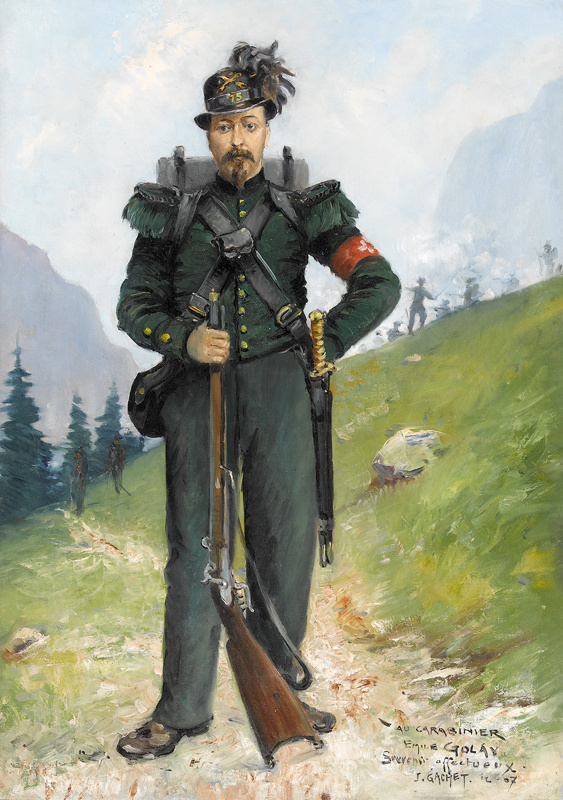
Le carabinier by Jules Gachet
The sweetgrass confiscated. Our lives are in our hands. I look up. Abyss. Black. Open. Dead light fades. Escarpment of the human gargoyle decaying, and erased from the map of heaven. Sharp and hard, the light petrifies, crystallizes and vibrates of the endless spectrum. 
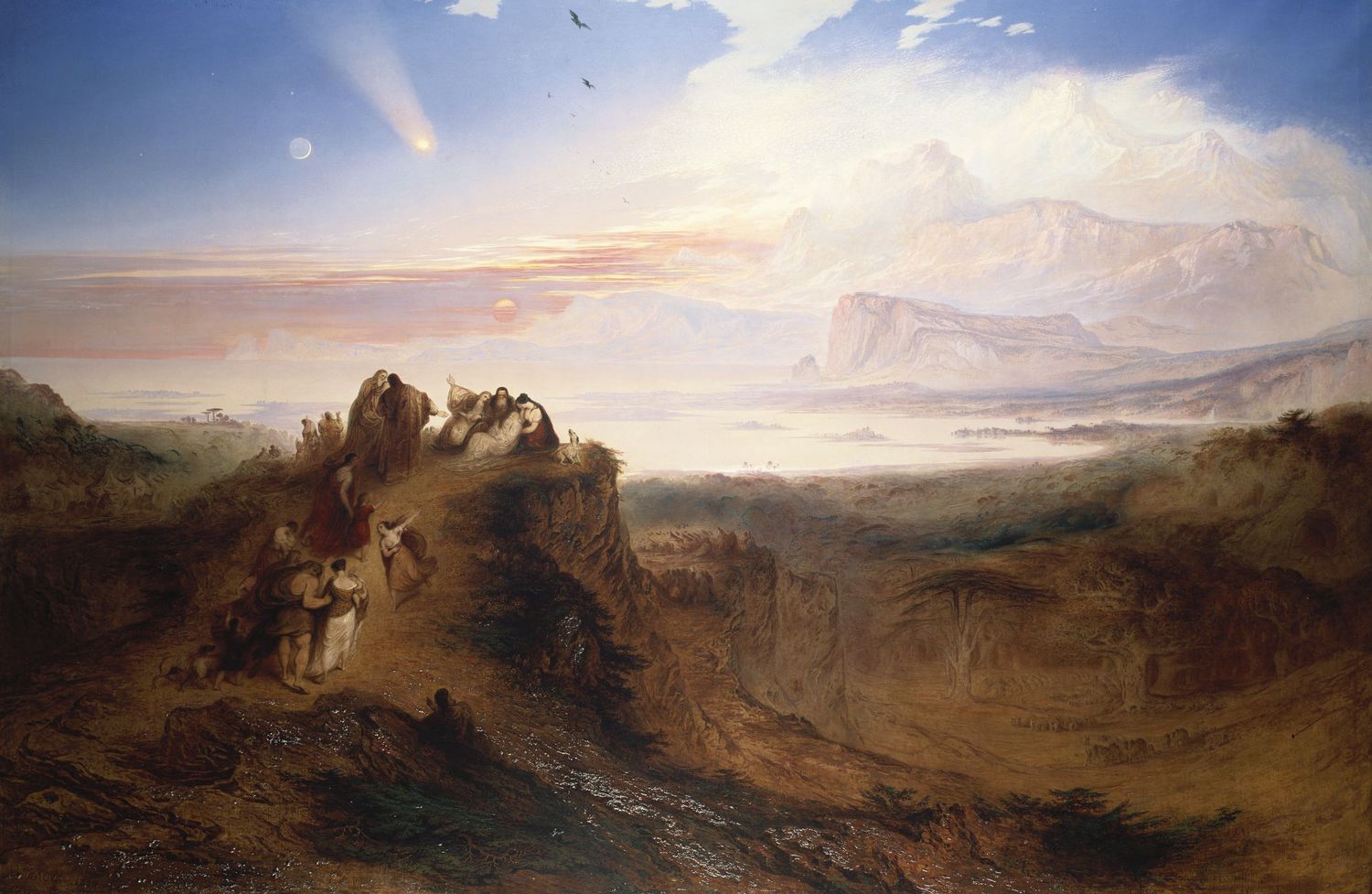
The Eve of the Deluge by John Martin
Galaxies enervate spines, nerves, veins and nodes of wonder; cosmic laughter at the sound of a split gong. Through, I, again, look up. Cobalt azure. Blinding, solar, pure and naked, sky. Cloud obscures. Rain, a memory. Summer passes in the afterglow noon. 
____________
First time in Vancouver, my love and I stayed with our dear friend Buckman Coe. I left early, leaving her to an extraordinary night with rich music and great friendship, and leaving, on my way back home, I played Buckman's first CD on my headphones. The first track, "Give Up The Fright", began "If you must go overseas / If that's where you feel that you ought to be." 

And tears streamed. I shook with the fear of love as I watched my one exit from the bus station and into the west coast cityscape. It was the first step on my way to Cairo, and further and further away from her. "Don't know if it was wishful thinking on her part / For now, this little rogue has got my heart," ends the song, a wishful lament to the ambiguity of human relationship, the lyrics struck so many chords with perfect accuracy. 

Years later, our dear friend's second CD, By The Mountain's Feet, opened with Not So Farfetched, a brilliant rhythmic melody to the course and rush of love - and again, the lyrics spoke with impeccable insight as we schemed our return west, to our Pacific lust of belonging - "This is how the story of you and I begins / And it's not so farfetched..." 

To the resounding continuity of love in our hearts. We grow to return. 

Multimedia Video on Jewish-Chinese Intercultural Music

Jewish and Chinese. The pot boils. Visiting the coast, we accompany a friend staying in the home of Lan Tung and Jonathan Bernard, whose special hospitality warms with musical instruments of a deep and resonant heritage. Their contemporary fusion music of world union reconciles the magic of our hearts with an unspoken quality of communal love - an uncanny similarity to our own strength of heart, soul and mind in the music of our coastal upbringing. 

Tuesday, 24 September 2013

Writing: The Child of Art and Music


"My grandfather Dolmic dreamed that three coffins floated through the door of his brother's house. So, he rode to the next village to investigate, and found his brother, his sister-in-law and their servant girl dead of cholera. The baby, still alive, was sucking at its mother's breast. He built three coffins and arranged the burial, and returned home with the child in his arms. And they say dreams don't come true." Ukrainian Grandmother, Wood Mountain Poems

On May 3 of 2012, Copenhagen welcomed the largest sustainable fashion conference yet seen in the contemporary world. Sustainability and corporate social responsibility are buzzwords in the consumer industry, and are integrated more and more into every sector of the economy. What was once merely one percent of the fashion industry in 2007 – when estimated global sales of the sustainable fashion market were at three billion dollars – would increase exponentially, culminating in the 2012 Copenhagen Fashion Summit with the investment of over one thousand key industry stakeholders. 

One of the largest industries, fashion product lines contribute to the spread of over eight thousand chemicals and twenty five percent of the world’s pesticides into the natural environment. Not only that, most of the environmental impact is made after the consumer has purchased the materials. Yet, sustainable fashion is one growing eco-trend that is challenging the largely unsustainable fashion market by employing alternative textiles with less carbon footprint. 

Organic cotton is effectively transforming one of the most commonly grown crops, and so in doing, is spearheading the eco-fashion movement. Other cellulose materials include hemp and bamboo. Materials, however, are only part of the eco-equation. Renewability and source factor, as does labor conditions. The idea is to create what Rossella Ravagli, Corporate Social and Environmental Responsibility Manager at Gucci, proposed during the 2012 Copenhagen Fashion summit, as a “good compromise between style, quality and new material.”   

Arguably, bamboo fiber is especially capable of meeting the demands of the new eco-fashion market. With an absorptive quality that captures greenhouse gases, bamboo grows in abundance without irrigation or pesticides. As the fastest growing woody plant in the world, bamboo holds a unique place in the fast-paced consumer market. Although, there is controversy regarding bamboo’s claim to fame in the eco-fashion market, as the process required to turn bamboo into wearable fiber, also known as Rayon, is marred with chemical-intensive labor. Yet, relatively speaking, bamboo as a source material for clothing is a more sustainable option than most. 

Yet another alternative textile, hemp, is potentially more eco-friendly than bamboo. Also easily grown, hemp clothing is often a composite of other organic materials. With such diverse uses as building materials, paper, jewelry, and fuel, hemp is largely responsible for complementing the greater trend of sustainable fashion with style. Hemp clothing is often designed with respect to traditional eco-fashion trends, opening interest in ethnic-inspired lines.     

This piece of commercial writing on eco-fashion was originally written for a client in China, and is also published as a blog on The Media Co-op
_____________

dusk fall
full equinox
hell's door
lonely crossroads
still bells
way back
world tree
______________

The week began with the resonant mergence of harmonic mastery still ringing in my ears. A meeting with contemporary legend, Amir Amiri opened my mind to the brilliant challenge of a distant sound's arrival. The shores of my thought curled and folded in a slow tide as I acquired the bittersweet taste of a traditional music's refinement into the beautiful wholeness of world.

The quick hum of the Persian santur danced behind my eyes with the lifted personification of an artist's temptation to unite with the all-breathing life of unity. Yet, nostalgic and principled, remained steadfastly earth-bound to the homely traditions of mother, father, and self. At once, another meeting with the unbound truth stared me in the face through the transfixing metallic song of the HandPan under the voice of LIRON MAN. 

After Man's show, Puertas, at the Calgary International Flamenco Festival, I then met the opening musicians, one of whom, Tamar Llana is featured in the video below. She sings next to her mother, Judith Cohen - an ethnomusicologist with a special focus on Sephardic music - playing the frame drum. The joyous union of ancestry, tradition, and contemporaneity through music led to a revelation of harmony as the voice of continuity, belonging and meaning.


Monday, 29 July 2013

Student Action to Global Citizenry: The Voluntary Heart of Community

Optionless from Nora Younis on Vimeo.

"I recall the brutal massacre of Sudanese refugees in Mostafa Mahmoud square in 2005 when security forces violently interfered to dismantle their protests in front of UN Refugees Agency Office resulting in killing dozens of protesters including women, children, and elderly people." Ahmed Awadalla, Cairo-based Global Voices blogger (also published on Daily News Egypt)

Introduction

The focus of my volunteerism is with those who currently experience oppressive marginalization in the inhospitable host country of Egypt, who in 1951 made reservations to refugee rights chartered by the UNHCR Refugee Convention, also known as the Geneva Convention.

El-Wafaa Refugee Culture Centre was founded in 2006 in Ain Shams, a neighborhood in the outskirts of Cairo known for its African migrant population, by a group of committed Darfurian community leaders in order to address challenges within the refugee population in Cairo, with a focus on refugees from Darfur. The mission statement of the El-Wafaa Centre is to alleviate suffering of vulnerable refugee communities in urban areas.

Background

Egypt’s reservations to the UN’s Refugee Convention withhold national responsibility with regard to refugees within their country accessing public relief and humanitarian assistance. There are no refugee camps in Egypt. African peoples seeking asylum in Egypt continue to be unjustly marginalized based on race, ethnicity, religion, etc.

Initiated in July 2006 by local community within the African forced migrant population of Cairo, El-Wafaa Centre was physically founded in September 2006, with the assistance of Student Action for Refugees (STAR), a student-run organization at the American University of Cairo. Then president of STAR, Jennifer Renquist, now a foreign officer with USAID, organized the orientation of new students at El-Wafaa Centre, as well as the donation of books and stationeries to the center’s library, remaining a principal need.

I was introduced to this world in 2007 as a young student of literature and language at the American University of Cairo, after volunteering for STAR as an outreach English teacher. I soon met the director of the Refugee Culture Centre, named “El-Wafaa” (The Fulfillment in English) after teaching an intermediate level English course to an incredibly diverse class of migrants, asylum seekers and refugees from all over Africa.

The director of El-Wafaa, Abdel Rahman Siddiq Hashim, is from Darfur, Sudan, educated at a Sudanese university in English. He is a respected and humble community leader, known by many Cairo-based African refugees as “Teacher”. Abdel Rahman’s activism was far-reaching and all-inclusive, welcoming students into the education center, also serving as a cultural and community resource center, without discriminating ethnicity, religion or politics.

During my initial ten-month stay in Cairo, I became deeply involved in the refugee community beyond the interests of Student Action for Refugees (who soon abandoned and undermined local leadership), including organizing independent classes through the El-Wafaa community, running a food bank and managing library resources. Since then, I have poured over the role of the international community as a last vestige of light for the urban refugees of Cairo. In 2010, I returned to Cairo through a fully funded research endeavor with support from a Peace Studies consortium at the University of Calgary, where from I graduated the same year with a B.A. in the Social Sciences.

Highlights from the 2010 research period in Egypt include directly funding the El-Wafaa Executive Director’s return trip to Sudan to register El-Wafaa in Sudan, as well as with a Darfuri NGO network, to assess the situation of refugees returning home to respective countries of origin after living in Egypt as a refugee. Other successes included a film screening and discussion evening on related issues at the inner city Sudanese-led NGO Tadamon, offering charitable funding to vulnerable women-in-need, engaging Sudanese youth students in a music and culture recording project, and personally meeting and attending a course with Barbara Harrell-Bond, founder of the Refugee Studies Centre at Oxford University, the world’s first institution for the study of refugees.

Through my studies, research, and experiences in activism and fundraising since 2007 to the present, I have concluded that it is truly up to international civil society activists to help community leaders foster educational and cultural activities in their communities. UNHCR and local NGOs in the region have proven insufficient, whether as seen in the outcry of the Mustafa Mahmoud demonstration in 2005, or the current state of life for refugees during the unstable political turmoil in Cairo, today.

Their is a great need to support those who appreciate and enable the sustainable establishment of human rights organizations in Egypt providing proper services to any and all people, with a focus on African refugees.

Demographic


The target demographic of El-Wafaa Refugee Culture Center is any and all residents and migrants of Egypt seeking a safe and inclusive community resource center that specializes in language education services. The target communities are refugees and asylum seekers from African countries who seek to transition from Egypt to resettle in a more hospitable country, or move back home after losing many years of their lives to impoverishment, lack of education and opportunity for employment. Such social challenges are due to many causes, including misinformation and a serious deficiency of awareness regarding the nature of life in potential resettlement countries, as well as in returning to often conflict-ridden countries of origin.

Conclusion

Currently, the El-Wafaa Refugee Culture Center and its concomitant community initiatives are in dire need to generate sustainable activism (both local as well as international) to support the immensely wide gaps unfulfilled by the UNHCR, NGO, and academic, as well as faith-based service providers in Cairo.

On behalf of an international network to support the community vision El-Wafaa, led by the volunteerism of PhD student and Fulbright scholar based in New York City, Thomas Leddy-Cecere and myself, a freelance journalist and human rights advocate currently based in the city of Calgary in western Canada, we petition support.

Currently, the 2013-2014 budget for El-Wafaa Refugee Culture Centre to thrive in Cairo requires 1,280 USD (center rent, office supplies, external programs). Membership fees from refugee communities in Cairo seeking services are not adequate. International networks with preexisting solidarity groups in the U.S. and Canada are integral to the sustainability and overall maintenance of the El-Wafaa Refugee Culture Centre.

Related issues raised by the refugee community in Cairo include accessing micro-credit loans, contacting UNHCR, overcoming crises in housing and basic needs, among other areas of recurrent concern.

Anyone can learn more. If interested, please correspond with mind to the pressing need for immediate action. I would very much like to start a meaningful dialogue on this issue on behalf of an extended engagement with the urban refugee communities of Cairo.


References:

This blog was originally published at VolunteerCenter.com on July 29, 2013
  • Please contact me @ mhanson1717@yahoo.com for a free informational brochure if interested in learning more about my initiative with refugees in Cairo, Egypt
_____________
With the Executive Director of El-Wafaa Refugee Culture Center,  Mr. Abdel Rahman Siddiq of Darfur, Sudan 
Walking Away into the Bright Lights of Cairo
Partnership with the Bangladeshi Community
Global Youth in Cairo Apartment
With Student and Singer from Kordofan 
Twilight of Peace
With Student at St. Andrews Church in Cairo
A Creative Student at Arba Wa Nos Centre
Night Cafe with the Bere People of Sudan
American University in Cairo, Old Campus
Abdel Rahman Siddiq, the Teacher
In Honour of Community
El-Wafaa Refugee Culture Center Logo
With favourite tea-seller, Julia
With student from Central African Republic at Tadamon Centre
Sudanese Teacher Registers Students at the El-Wafaa Refugee Center
Cultural Heritage of Sudan
The Quintessential Meeting Ground, the Sudanese Restaurant
 ____________
From Behaved Freedom to Absolute Nonsense

I go from a behaved freedom to absolute nonsense
            Without friends yet steeped in family love,
I publicly play and proclaim the monetary divide
            In my rich eyes which disguise the poverty
            line’s frozen glare
In Canadian expatriate stench, painstaking
            To be fugitive without mind
            to the loosed volley
Cracking against the one shield fortress of Mattapoisett
            One place of rest made into settlement with guns
            and stolen disaster
Ripped from the bosom of Europe’s scheming
                      English name
            Now massacring the playful
            artistry of our own inborn life

On this impossible continent
            Freely taken from a gamble and faith
In blond-headed angels
            Whose divinity was parted
            by the bald imprisoned hallucinations
Driving out demons with Masonic symbology
            Over the infinite sands of civilization,
            breathed and created out of time
In the sun’s ravishing corner of a universe,
            un-tempted and forever at a loss
                     Between the child’s two eyes
                     closing
On death and the holocaust of our forsaken government
            Laughing at the trees’ roots

When stretched to the bottom of India’s or Africa’s wells
            Ousting up the belief in life as a drunken tragedy
                                    Yet, be not humorless
                                    nor without comic sophistry

In the dance and song
            Come alive by the sexual majesty
                                    In theatre’s delicate ways,

To present the creative being
as one with truth’s bold and upheld music
            Reflecting back in the caged mirror
                                    A creator anew

This poem was featured in my most recent self-published chapbook, Act or Confront


Introducing ContinuuMusic

Musical explorations within continuous evolutionary creativity. Discovering new world fusion - instrumental, improvised music.

"For global community awareness" Vi An said at the TedxYYC event this summer to a packed house of 1500+ audience members, plus a streaming webcast to the entire world, before beginning a ten-minute set with co-creators Bijan Maysamie on Persian Santur, and Matt Hanson on xaphoon and percussion.

The debut concert of the ContinuuMusic trio is intended as a gift to the community. Often performing for charities and private events, ContinuuMusic has raised thousands of dollars for Ten Thousand Villages, Children's Health and Education in Iran, among other meaningful initiatives.

Inspired by their invitation to perform for TedxYYC at the grandest concert hall in Western Canada, ContinuuMusic is looking to sustain their creative efforts well into the future. Vi An is a professional artist of over 18+ years, an award-winning (Betty Mitchell) theatre composer with the Green Fools Theatre and recording artist with over 15 albums and hundreds of collaborative tracks worldwide. Bijan Maysamie is steeped in the classical tradition of Persian music. Originally from Tehran, Bijan is now venturing into fusion music for the first time, and is enthused as ever, at the helm of organzing this debut concert. Matt Hanson is a multi-instrumentalist, whose artistry draws deeply from a musical family with roots in Mediterranean and American intercultural tradition.


Monday, 20 May 2013

Dreamers Reconcile with Harsh Truths: S. Sudan and the Music of Memory


One thing that keeps me pushing these painful stories; the dreams I have. Sometimes, like, the voices of the dead that I have seen would tell me don't give up, keep on going, because sometimes I feel like stopping and not doing it, because I didn't know what I was putting myself into. (Emmanuel Jal, 2009)

What are your hopes and dreams?

I want to fly an airplane.

What else?

I want to be able to study in the daytime. And in the morning. And I want a day that I can just live…so I can build my house…where there aren't any problems that could destroy it.

Emmanuel Jal, age 9 (War Child)

On April 8, the Peace and Reconciliation Conference in Juba, the capital of South Sudan, began an unprecedented step forward in the nation’s history. On Monday April 15, South Sudan President Salva Kiir Mayardit suspended the conference indefinitely. Besides the $885 million contributed by the Canadian federal government to Sudan for humanitarian assistance between 2006-2012, many of the 4 million plus South Sudanese displaced have resettled in Canada to remain active in community rehabilitation. Activist groups, both based in South Sudanese communities as well as larger Canadian social organizations continue to sustain the meaning of reconciliation not only as an example for South Sudan, but for the globe.

            The most pressing issue with regard to reconciliation in South Sudan is creating an inclusive society where larger social participation is grassroots-oriented. In a country with one of the lowest literacy rates in the world, with over sixty unique spoken languages, democracy is a precarious notion for most. In an open letter to South Sudanese Vice-President, Dr. Riek Machar, David Mabior Atem of New Sudan Vision wrote:

Healing those long inflicted wounds against one another cannot be dealt with in 3-4 days as well as top down approach instead of bottom up approach…Another added advantage of beginning at grassroots level is the flexibility of language (dialects), which can result into high interactive and productive engagement.

            Dr. Riek Machar launched the official opening of the conference, which trains 200 peace and reconciliation mobilizers. “The newest nation on earth has embarked on a journey of healing for the national reconciliation,” the Sudan Tribune noted. Dr. Machar had also been married to British aid worker Emma McCune. International recording artist Emmanuel Jal, winner of the 2013 Calgary Peace Prize, had been rescued from Waat, South Sudan by Emma McCune as a Lost Boy. Jal took refuge in Kenya, eventually leading him to the UK, and Canada. Emmanuel Jal’s acceptance of the Calgary Peace Prize on behalf of all South Sudanese marks an especially significant moment in the common reconciliation efforts of Canada and South Sudan.

            “He uses himself as an example in his storytelling of how hard and difficult and long it's taken for him to begin the process of healing and of reconciliation with his former enemies, and that's the story that he told,” Consortium for Peace Studies director George Melnyk told The Media Co-op. “He's also very careful to not critique the South Sudanese who made him a child soldier.” The Consortium awards the Calgary Peace Prize to global visionaries working towards peace, beginning with Hiroshima Mayor Tadatoshi Akiba in 2006. The Consortium is currently the only post-secondary Peace Studies initiative in Calgary.

            James Nguen, founder of Biluany Literacy and Water project, responded with deep concern in an Op-Ed piece in South Sudan News Agency, decrying the indefinite suspension of the Peace and Reconciliation Conference in Juba. “This unfortunate development shocked everyone in South Sudan and around the world. There were no further details why the project was suspended,” Nguen wrote to The Media Co-op via email. “If people reconciled, then there will be no petty tribal raids which the past 8 years cost South Sudan government and the international community millions of dollars.”

            Although the Second Sudanese Civil War, which ultimately led to an independent South Sudan, started in 1984, the world did not respond until 2004. The political situation in Sudan, and now in South Sudan as well, is very complex and is steeped in both European colonial history as well as Egyptian foreign policy. The legalities of genocide with regard to reconciliation have remained unparalleled in controversy ever since the United Nations adopted the Genocide Convention in 1948. “There was a genocide in Darfur, and there was genocide in South Sudan from the beginning,” James Nguen said to The Media Co-op. “In order to secure the CPA [Comprehensive Peace Agreement], they could not force Al-Bashir to step down without confidence that his successor would respect the CPA. Only one of the three agreements of the CPA was met, which included peace agreements with Abyei, secondly, and Blue Nile and Nuba Mountains as a third agreement.”

            The outstanding agreement to respect the right to self-determination with the people in the Nuba Mountains has especially intensified on the issue of genocide. Global activism in solidarity with the Nuba people has followed in the wake of the independence of South Sudan in 2011, including the End the Nuba Genocide Coalition. The only area not consulted in drawing the new national border, Abyei, is directly impacted and holds outstanding land disputes. Abyei territory is a priority for the Juba Conference.

            South Sudan’s independence was “the most significant redrawing of the map of Africa since the colonization,” Angel Batiste, Area Specialist with the Africa and Middle Eastern Division of the Library of Congress in Washington D.C., noted, before introducing the lecture, Cultural Heritage in South Sudan in November 2012. 

            During the Calgary Peace Prize events this March, Emmanuel Jal raised eyebrows concerning the latest news from South Kordofan, where another genocide in Sudan seems to be taking shape with unprecedented momentum. “UN people down in Sudan are saying there’s a possibility that in South Kordofan that the genocide there could be worse than in Darfur,” said Jal to an eager crowd at the University of Calgary on March 1, 2013.

            The diaspora is truly integral to peace activism for South Sudanese. “They actually support their family members more than even the government does,” Jal told The Media Co-op, referring to the diaspora of South Sudan and their role in the reconciliation efforts ahead. “If you’re educated, if you have a degree in whatever form, don’t go home to look like you’re going to be employed by the government. You go there as an employer. Go there and use the skills we have there and establish something, because the country is still new. Whatever you touch will prosper.”

            Since late last year over sixty genocide scholars and anti-genocide activists initiated a letter writing campaign in response to the genocide atrocities in the Blue Nile and Nuba Mountains. These letters have fallen on what South Sudan’s leading independent news source, South Sudan News Agency has called, “absolute silence”. The Atrocities Prevention Board (APB), founded by U.S. President Obama specifically in response to the lack of U.S. governmental initiative towards preventing crimes against humanity and genocide, became the most important, and also most unresponsive, target audience. This April, South Sudan News Agency published the latest letter, sent to U.S. Ambassador to the United Nations Susan Rice. An excerpt from the letter reads:

We never expected, though, to have our letter (and now letters) go unanswered… when we, scholars of genocide studies and human rights activists, fail to receive a reply to a letter that we first wrote back in December 2012 and have now sent five times to four different individuals affiliated with the APB, it, indeed, feels as if the APB and its focus/work is little more than “a sideline in our foreign policy.”

             Similarly, in recent news, the only head of state in the Americas to be tried for genocide crimes, U.S.-backed Guatemalan dictator Efraín Ríos Montt, saw amnesty on April 18 after the current Guatemalan president intervened to have the case annulled. “It was the first time that any nation had been able to use its domestic criminal courts to try a former head of state for genocide,” said investigative journalist Allan Nairn on Democracy Now!

            Despite ineffective government intervention, independent non-profit and charity organizations, spearheaded by leaders from South Sudan, continue to work towards a sustainable society through reconciliation efforts. Biluany Literacy and Water Project, a development initiative led by James Nguen based in Calgary, has been active for over three years in building wells and providing educational resources in South Sudan. “There is no sustainable infrastructure in South Sudan, and without a lot of assistance from the international community, trust cannot be rebuilt,” Nguen said to The Media Co-op. “The greatest struggle is to represent ourselves, to know who we are as one community. The war eroded our cultural values, our history, our society.” Nguen recently partnered with Gua Africa, the charity of Emmanuel Jal, to fund well development and to organize a conference in Canada to mirror the Peace and Reconciliation Conference in Juba.

            Since winning national independence, other organizations in the Calgary area, home to the predominant South Sudanese community in Canada, are working towards reconciliation. South Sudan Peace Building International Foundation Inc. (SSPBIF) is one among them. Secretary of the SSPBIF Kuir ë Garang is also a prolific multi-genre author of six books. “People in South Sudan tend to regard literature as ornamental, they don't see how it can help relate people, to help people find relations between one another, so they can get together and have mutual understanding through education,” Garang told The Media Co-op. “Through literature, we can better represent ourselves. Now up to 70% [of people in South Sudan] are dissatisfied with their government.” Garang is currently working with a publishing house and bookstore in Juba to open a forum on multiculturalism and diversity for professional writers from Canada and South Sudan.

            Rural South Sudan is reputedly the most marginalized and underrepresented, effectively causing the need for grassroots inclusivity in Juba’s Peace and Reconciliation Conference and beyond. Resource conflicts both at national (oil exploitation) and grassroots (cattle raiding) levels have been at the root of social disorder in South Sudan. Augustino Lucano, a South Sudanese migrant from the Equatoria region living in Calgary, shares an unrivalled success story in bringing together divided rural ethnic groups and organizing incipient meetings with government representatives.

            Lucano received personal permission from South Sudan MP Joseph Lokodo Kolombos to open a peace center in his home region of Equatoria after presenting to the MP a research paper inspired by an Initiatives of Change workshop. “The problem is that people in rural South Sudan are still very divided, they do not see a way to live together yet with the whole nation yet,” Lucano said to The Media Co-op. Lucano, a member of the Didinga ethnic group, lost two brothers in conflicts with the neighboring Toposa people. “The Maaji peace centre is located in the middle of Didinga and Toposa land, in a flatland valley, where both tribes can meet peacefully,” Lucano conveyed to The Media Co-op. “So far there has been no raiding at the peace centre in Maaji. First, it was necessary to establish the peace centre where resources could be shared, and then we can discuss reconciliation.”

             In February 2013, the South Sudanese Minister of Wildlife’s visit to the Maaji Peace Centre drew tears from elders and children alike who had never before seen a car, no less a government car. “It showed how marginalized these people had been in the national developments, and also that the government was starting to establish a relationship with rural people, including them in the dialogue of the upcoming Peace and Reconciliation Conference in Juba,” Lucano told The Media Co-op.

             2013 is quickly becoming a year of unprecedented global reconciliation movements. The Peace and Reconciliation Conference in Juba is especially significant to Canada with its direct relationship to the activism of the Canadian diaspora of South Sudan. With the first head of state in the Americas having faced genocide charges, a more intimate link can be made with Indigenous peoples’ history in Canada. Will Canada renew its role as a global human rights leader in the wake of mounting genocide awareness around the world? Ongoing debates in Canada, spurred by Idle No More, emphasize reconciliation with First Nations as an inclusive reconciliation with humanity. 

This article previously appeared for The Media Co-op on April 29, 2013
___________
the road to rome is paved in bones by RK
madness by RK
the human rabbit hole by RK
old west art by RK
papercut & stoned by RK
____________
conjuring a sense of the once roaming herds of mammals that lit upon the open horizons of our once naked landscapes - the frame drum evokes a sacred connection to our mammalian evolution through a heartened soul brethren with large mammals, and our precarious evolutionary stability as one of the most vulnerable types of living creatures on planet earth - in the piece, i speak of the charge of the electric pole of patriotic industry over the breadth of our continent as the sacrifice of ourselves, as male-female witch, burned on the flagpole of national identity, a sacrifice brought about by the all-devastating silence of voice, speaking of a way of life not bound to the dominant settler society, yet existing now only in negation to the sedentary ecology of consumerism and vacation, with regard to the lost history and memory of our true selves in communion with the deeper movement of life as we once knew it


Placed Anonymity, like the chapbook, "A Sick Society Amuck" is inspired by the words of Jiddhu Krishnamurti, iconoclastic spiritual philosopher, who said, "truth is a pathless land". Truth lies in the anonymity of place as is, without meaning, as a river is in essence meaningless until commemorated by a name and story, whether of scientific or folkloric mythologies.

in a pathless land, how do we come to know the land, or know what is true, HERE? that exploration is the foundation for this four poem chapbook, eventually culminating in collectivist thinking, to aspire towards a basis of unity evading the muddled institutionalization of creative freedom


Monday, 15 April 2013

History and Humanity: How Self-Awareness Leads to Reconciliation

Mary Wollstonecraft Shelley and Percy Bysshe Shelley by George J. Stodart
"No more let Life divide what Death can join together." Shelley

"We cannot continue to be recognizable and survive…if everything you know is wrong, then all the problems you thought were insoluble can be framed differently. And there's a way to take the world apart and put it back unrecognizably. We don't really understand what consciousness is at the really deep levels," said Terence McKenna in an interview for bOING bOING #10, to hail the oncoming psychic transformation of humanity in the 21st century, also known as the post-2012 New Age eschatology. 

Yet, historically, we have ever been unrecognizable when we look at interrelations between human societies, especially with regard to the European saga of colonialism and the institutionalized racism that followed (and arguably continues) in its wake. People from other continents, the Native, Indigenous peoples of the world, most emphatically Africans, Australians and Native Americans (from both North and South America), were for a considerable portion of history considered an inferior race, a subhuman species likened to earlier primates less developed than the European genus. 

As we have now begun to recognize ourselves wholly, all of humanity included, through science and reconciliation with our inhumane past, the challenge now remains clearer than ever, for it is our own selves, the Self of Humankind that is in need of development, and not any other form of life. So, we might ask, might we grow up from the childish state of irresponsible resource waste and join the community of life on planet Earth, or become extinct. As the human family becomes recognizable, next the whole of life on Earth must be recognized as our own self, as the body of a relative, and until it does, and we remain unrecognizable to ourselves, there is catastrophe as we straddle the line between dominance and extinction. 

Interpreting the above quote by Shelley in the last line of the third to last stanza of Adonais, An Elegy on the Death of John Keats, essentially reads as "don't let life get in the way of dreaming" where the diversity of life, as it manifests in the human family, a wealth of ethnicities, spiritualities, and physiques can be seen not as a source of division, but of connectivity. And so, as I write, this the capital city in the state of my birth, Boston, has allegedly been bombed. In such times, it is ever paramount to instil the meaning of reconciliation within the human family. Peace studies author and professor George Melnyk recently shared with me the simple notion that "That's what happens in war, you define an enemy." And, so, with our nation(s) at war in the Middle East, and the "enemy" at hand, we can keep vigil with the caution that we should not jump to quick conclusions in our search for vengeance. 

The crossroads of human life in the 21st century divides Humankind between himself and the planet; the potential of nuclear fallout and the immanent ecocide with the unabated burning of fossil fuels. The struggle to survive as one, whole being, as a united humanity, is to be fought at our doorstep, and we must remain strong not to waver from our ultimate direction towards peace through reconciliation. See the documentary by Chris Hedges OBEY, at minute 22, where he writes, "Resentment against a disenchanted secular world will find deliverance in the ecstatic escape of unreason." Let this unfortunate incident be an opportunity to empathize with those who experience bombings on a regular basis as part of our government's foreign policy, as opposed to perpetuating violence through self-pity and aggression. 
_____________
A stone-bedded homely abode of five rabbis, all with simplicity and humor muttering of their bearded visage, they meander from home to a day’s work in the predawn night. I, a furtive wraith, clandestine in the dim corner, emerge to observe the floor-set scribes and their flowing fountain of wise austerity. The dusty air breathes sanctity unknown to most, yet from the window a flicker of artificial light breaches the soup of mind with Maras of temptation, apparitions of the female sex, flaunting a shadowy tint of flesh. I trudge outside, unencumbered by the pleasures of the intoxicating sights. We are at war.

Titus destroying Jerusalem by Wilhelm von Kaulbach
The direction of sight is clear. The enemy is known, and our targets destructible. The air is thinning of passion and feeling, to make way for hate. The true victim in this war is Earth. The all-out industrial fire has spurred on the makers of enmity under a veil of infinite resource. Brothers, sons and fathers bleed with for the ground on which they are laid to rest. The backdrop is far-reaching. There is a sense of humor in this war.
Toronto Rolling Mills by William Armstrong
Foregrounds blur into modernity, as a civilian is murdered, shot in the back, running towards us. Iraq is not Germany. Civilian and army are a rough and indiscernible duality. The cold smoke of hate becomes the backwash of sanity as soldiers and men secrete their pain into the willful triggers of deadly remorse. I, a photographer, capture the minutiae of existence full-born in the surviving families of Earth-bred singularity. Modern natives, the indigenous, bold eyes of people, now the last grave on which an unmarked praise still glorifies the vanity of war and power. Massive trucks crack and sputter past me, with so much gun, bomb and shell materiel that my knees weigh fierce into the concrete below. Rushing past, the soldiers reveal faces of bleary sweat and stinging tears, flowing from a smiling façade of youth, their graying eyes grow cold with fate as my photos are ignored.

Collateral Damage by James Miller 
When we declared war on Earth in WWII, the invasion of Iraq granted us full impunity as we commit the last atrocity on the only lasting connection humankind might instill from Earth to the mass of societies born and bred of global war. They line up, shaman to farmer, hunter to midwife, storyteller to seer, a community of global wisdom, attuned to the lightness of being, as in the creation stories of practical love. And in their firing squad, they choose to sit, meditating on the gun-barrel of unsightly loss – the drifting eyes of hate and need merge.
___________
After a cumulative process of self-publication, a DIY attitude of writing and publishing often spreads into the realms of experimentation and exploration with all aspects of the creative process and, especially where self-publishing is concerned, into self-innovated and creatively conceived avenues for sustainability.

Art is the "divinely superfluous beauty" as Robinson Jeffers says, however the artist is inherently tied to the whole of life. For this reason, I have decided to experiment with monetary value as a way to further understand my self-published works and the general field wherein I am situated as a self-taught creative artist active in a variety of artistic disciplines, with special regard for the overlap of media, thought and art.

Please join this conversation as society embarks ever on towards greater connectivity between the sacred, the communal and the entrepreneurial; that all three may one day join in a vision of society directed at once toward pragmatic utopia, while mutually creative and destructive, or better worded as discerning, in its ability to see and create potential.

I will still be offering the full collection online for free viewing, however, I have added the option of supporting the artistry exhibited by none other than the Dream Author. Jah!


Opening the page to experimental, improvised writing which emphasizes and attempts a most strict depiction of the spontaneous nature of mind can be perceived with harrowing aspiration in the realm of continuity, that is flipping the page, and its mystery, that is interpreting the language. As a forewarning of sorts, this collection of writing, as devised for readership, is the result of an editing which has purpose in giving the spontaneous flow of mental activity form. While attempting to convey the refreshing action of letting go, all structure and boundary and, in sense, constructs of mind are dissolved.

Created solely by one human being through "One Shot" intuitive improvisation stylings, Evocations: Cyclical Wordplay is the completion of a creative cycle of renewal, regeneration and return to the primary source of visionary inspiration: voice. With due reverence and respect for the infinite diversity of vocal and verbal forms among the worlds of the living and the dead, I hereby speak directly from the heart. Here, in these soundings, I am re-conceived through the mouth of the pen in all its power to amplify and obscure.

"Evocations" is a practice in contemporary experimental narrative, as opposed to the traditional conventions of spoken word. The poetics of oral storytelling are alive through soundings for the muses of voice in all its forms, whether in the tongues of wood, metal, plastic or flesh. The language of unity speaks through every medium.