Primarily a writing exercise, this dream journal-inspired blog is a quiet introspective sojourn into the process that we traverse in going from private dream to public art. I see our dreaming as an internalized mythmaking. As I philosophize and expressively exhibit dreams, both private and public, I encourage and delight in creative language as a way to practice experiential metaphors through a “public dreaming." Writing Theory: Creative Dream Fiction
Showing posts with label religion. Show all posts

Monday, 6 May 2013

Roots of a Grecian Heart: Seeds of Superstition and Truth

"Even in our day there are plenty of soothsayers and sibyls, and many people still believe in dreams and omens. It is no wonder that the ancients did so, too. But we should keep well in mind that while these arts are now despised by educated people and ranked with superstition they were an acknowledged part of Greek religion." Martin P. Nilsson, Greek Popular Religion

"I woke with this marble head in my hands; / It exhausts my elbows and I don't know where to put it down. / It was falling into the dream as I was coming out of the dream. / So our life became one and it will be very difficult for it to separate again." Seferis, Mythistorema

Sunday April 21 is another afternoon, like any other late winter day in Calgary, where sporadic snowfall lights on the sprawling residential landscape. A few blocks from the university in the northwest quarter of the city, one home opens its doors to lovers of Greek culture, ancient and contemporary. A neighbor walks down the road, on her way to the event, to show a bewildered downtown urbanite the way in a dizzying maze of suburbia. Host Karen Gummo greets at the door, a member-at-large of TALES, The Alberta League for the Encouragement of Storytelling.

The house concert event features Jennie Frost, recently selected in August 2012 byStorytellers of Canada / Conteurs du Canadaas an Elder in Canadian storytelling, a prestigious recognition awarded only once a year. She will be recording for the StorySave Project, which honors and preserves the oral storytelling traditions of Canada. Aboriginal, Irish and Canadian heritages are among the many recognized by Story Save storytellers. Frost, a classics scholar, published her first book, “The Courtship of Hippodameia” in 2005. Frost has performed stories for festivals, concerts, conferences, libraries and over one hundred schools in eight provinces and one territory since 1996. A 2-CD set of her workPygmalion and Other Greek Myths was for sale at the event, along with her book.

The event did not begin with storytelling, however, but a taksim, a term and practice borrowed from other Middle-Eastern cultures meaning the improvisatory opening to a song in Greek music. Calgary Greek music band, Rembetika Hipsters were present to provide dynamic energy to the overall muse and meaning of story in the Greek tradition. Having toured much of Canada and Greece, the Rembetika Hipsters have released three successful CDs. The band continues to receive great recognition in Greece, especially for a video recording of their tenth anniversary concert in Calgary, where they played with a nine-piece ensemble. After performing the first song, bouzouki player and vocalist Nick Diochnos told one of his own personal stories, set during his Greek wedding in Athens, where he bought his first bouzouki with extra wedding money.

Rhythm guitarist and singer Allen Baekeland of the Rembetika Hipsters gave historical background and taught the meaning of the Greek band name. In the wake of the most significant and traumatic period in Modern Greek history, the Greco-Turkish War (1919-1922), the Rembetika culture formed. The war, known as the Catastrophe by Greeks, led to the forced expulsion, or “population exchange treaty” of all Greek communities in Turkey, including the notable city of Smyrna. Over one million Greeks in Turkey were forced into exile. As a result, one in five people in Greece were refugees.

With their Turkish-influenced culture, vagrant impoverishment, drug use and outlaw mentality, refugee youth became what in Greek is known as Manges, loosely translated as hipsters. While very popular in the 1920s and 30s, the Rembetika music, likened to American blues, was banned by government authorities. Nick explained that there are two connotations to the word, either it is used between buddies to denote camaraderie, or between parent and child as a means of castigation. Throughout many songs played during the course of the event, Nick would exclaim, “Hey Mange…Opa!”

With a repertoire of over a hundred songs, the Rembetika Hipsters played a diverse selection, not only of Rembetika songs, but also of Greek folk and popular songs. Two songs were especially poignant for their performance, as well as the stories that accompany. Firstly, they sung Sto Perigiali To Krifo, with music by legendary Greek composer Mikis Theodorakis in collaboration with Greek poet, and Nobel laureate, Giorgos Seferis. The work of Theodorakis, spanning from orchestral suites to popular tunes, has also been integral to the revitalization of Rembetika music into post-WWII popularity. Secondly, Ta Pedia Tou Pirea was sung in memory of Melina Mercouri, a Greek actress, singer and political activist, who sung the ode to the beauty of the Greek port town of Pireus in the film, Never on Sunday. The Rembetika Hipsters commented that the port town’s charm is actually a bit more of the rough than the diamond.

Jennie Frost captivated a silent crowd of about twenty keen listeners with stories from the ancient sagas of the Greek pantheon. Storytelling alternated with the music throughout the afternoon. Frost introduced her storytelling modus operandi with a short prefatory anecdote regarding her break from conventional academic interpretations. She gives ancient stories a refreshing new life. During her lively orations, she holds an elegantly crafted wooden cane, in homage to Indigenous traditions of the talking-stick. An elephant sculpture melts into an Ankh-shaped handle, in which are tied innumerable paper-crafted memorabilia from all of the communities she has visited to enlighten through the living tradition of oral storytelling.

With detail enough to craft the most intricate narrative, Frost weaves in and out of character dialogue and illustrates setting with the lithe energy of the overseeing deities she so magically conveys. One of her most memorably enchanting stories drew from Zeus, in relationship with his children, Hermes and Apollo. The visceral imagination of ancient Greek life, as in the story of Apollo’s maturation into his role as the god of music, knowledge and poetry evokes the divine majesty of creative human faculties. Hermes, who ultimately gifts Apollo his lyre in the story, becomes messenger of the gods, evincing respect for the underlying interconnectedness of all great worldly and divine phenomena into a harmonious narrative of familial interrelationships.

Frost told many stories, drawing not only from classical Greece. Her final story revealed a welcome gift for diverse cultural expression. Before reciting a quaint Chinese tale about a half-wit boy named Noodle, who eventually outsmarted the gentry of an ancient city through a spirited affinity to poetic meter, Frost proclaimed to all her enthusiasm for epic storytelling sessions. For Frost, a five-hour long telling passes with sparkling enthusiasm. Nonetheless, Frost finished telling her last line on time to close the three-hour event, leaving all with a smile.

The Calgary cityscape glowed from the picture window behind the musicians and storyteller. The love of storytelling is a common root of social cohesion, yet the traditional arts of oral storytelling are too often ignored with similar cultural dissolution as seen in the disappearance of global language diversity. Storytelling, in the traditional and artistic forms of oration, is not simply a nostalgic reversion to childhood.

The lyrics of Giorgos Seferis speak with god-like insight and metaphoric clarity. Impermanent love, the hasty fool’s rush to consummate young lust, is the subject of his poem Denial, better known as the song, Sto Perigiali To Krifo, sung by the Rembetika Hipsters. In a society dependent on non-renewable life sources, is the consumer resource paradigm of a young nation as Canada not also likened to a parable of the impermanent lust of young love? As Seferis writes in Denial:


On the secret seashore
white like a pigeon
we thirsted at noon;
but the water was brackish.

On the golden sand
we wrote her name;
but the sea-breeze blew
and the writing vanished.

With what spirit, what heart,
what desire and passion
we lived our life: a mistake!
So we changed our life...


Oral storytelling roots people to an inner renewal of life, as innately creative, and in continuity with the most fundamental and longest standing traditions of humanity.

This story has appeared on The Media Co-op and will also appear in the upcoming June issue of TALES (newsletter)
___________
Where are we? Israel? Canada? No, North American Zion!
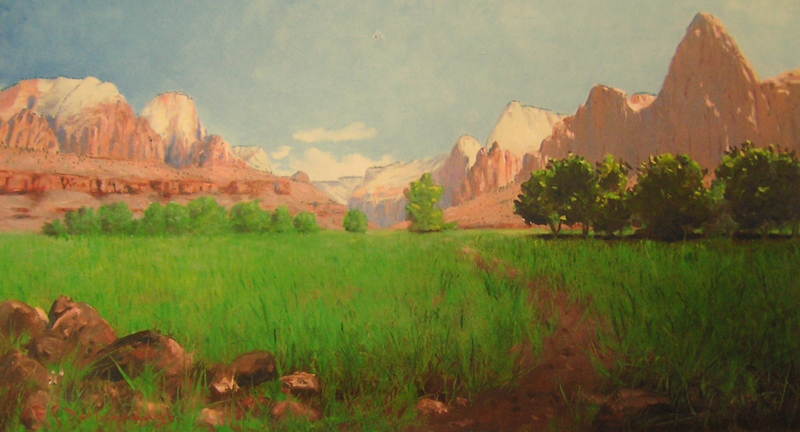
Zion Canyon by Frederick S. Dellenbaugh
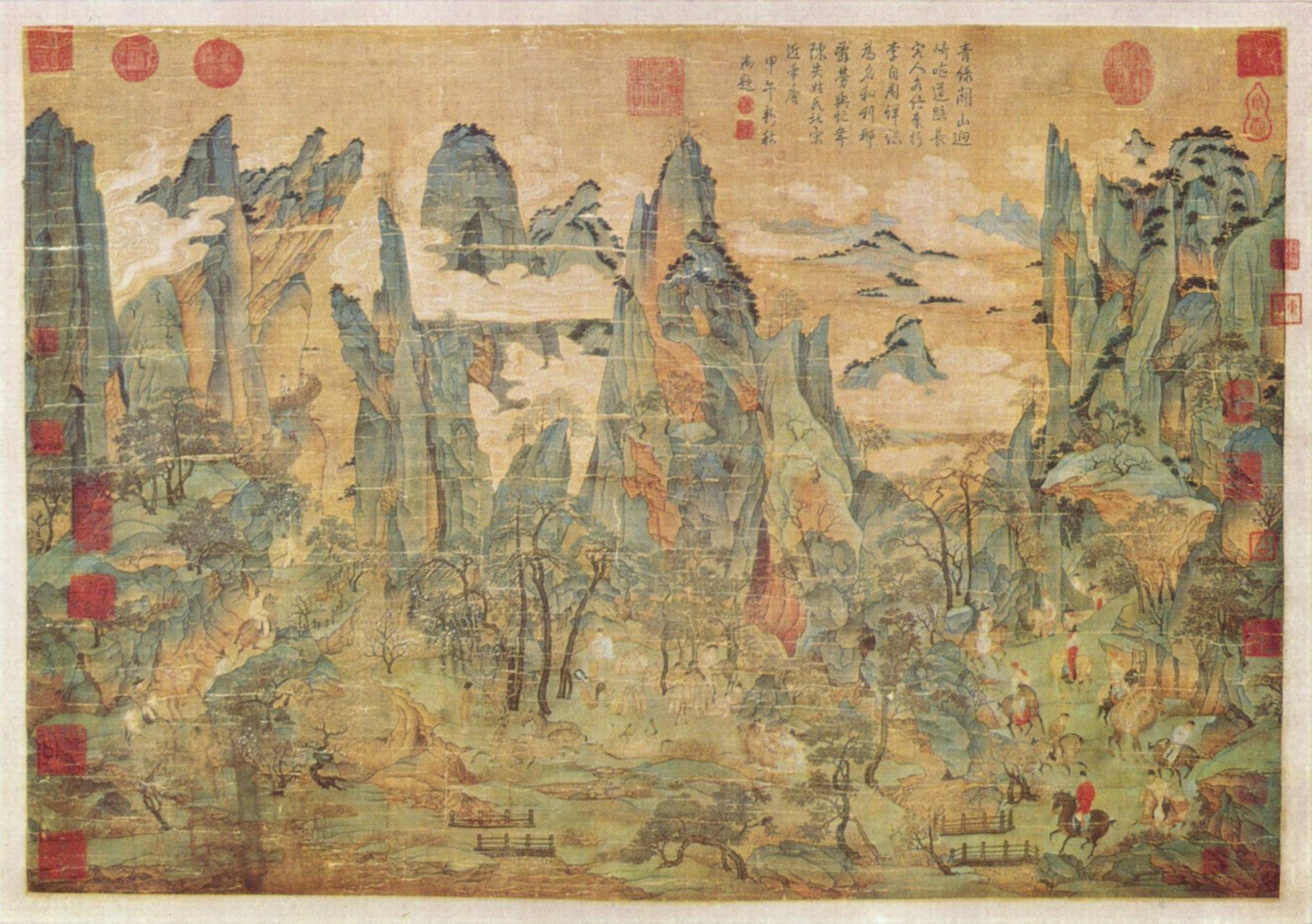
Desolate summer ski hills are lush, verdant with pine undergrowth. Through an open ski lane, gargantuan Canadian flags billow. A park ranger sights us. I escape solo, just barely through a bush thicket. Trailing beside a river’s edge, where I once ogled at two young lovers, the Israeli sky burns with the beautiful bounty of original sin multiplying with infinity at every touch, every sight, sound, smell and every taste of spirit. The racket of espionage flutters in the newspaper wind. I heave a sigh, bitter with unrest.

Fleeing to Sichuan province from Chang'an to escape the violence by Li Chao-tao
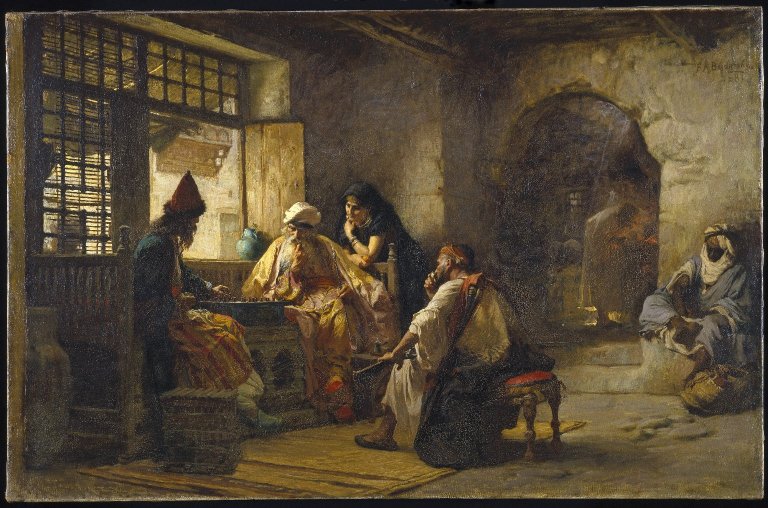
Nightfall, the shattered windows and shades of old Brooklyn stare with criminal rites. Anger seethes from the manhole pores of the upended city. A ruinous dearth of humanity bleeds from my open-strung heart down the spinal chords of a silent song: my jungle cage. Television home blink, flicker, there! The thief, drunk, with rapist eyes eyes mine concrete stone grounded roof possessions. A friend points-blank his rifled arm into our pitch fate. The silence groans with inner loathing, like a brooding cancer unknown, deep in the marrow.

An Interesting Game by Frederick Arthur Bridgman
So, morning, we rise with the tide and board a ship set with haste. A vacant room, splotched with growl, we swung with the churning waves, a smiling rat-spawned day. The worst was over. America far behind, Zion of mind and heart derided in a momentary pause, to reflect on the Old World border of genocidal rampage, the forgotten wick, unlit on this Sabbath morning. Two friends, we disappear within a schizophrenic race. Evening fires glow soft with candlelight.

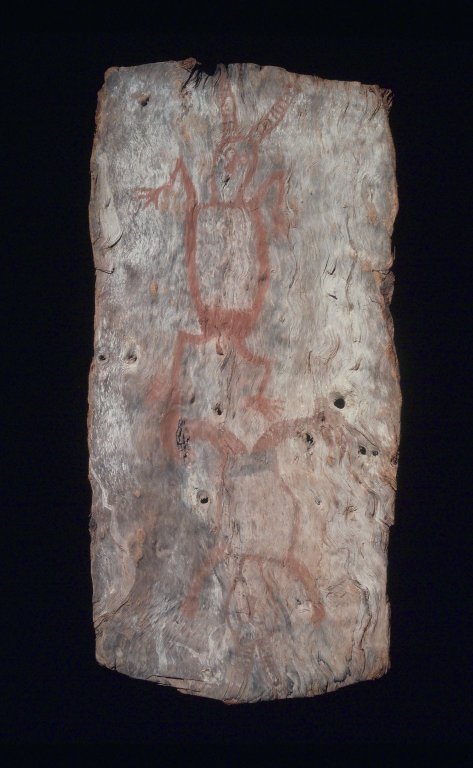
Painting of Dream Figures on Bark by Unknown
Tattooed mistresses, with raised skin, beset with the tribal bond of white scars breathe from lungs rising and falling under the most intricately carved bones. The monarch is absent. Bewildered, the ship sinks like a dead man, flooding as with the inverted pressure of the oceanic ambiance bursting outwards, into the wooden vessel of sleep and need.  
__________
A hyper-ambient, atmospheric guitar & voice elucidation on themes of the variance between the doer and the doing, subject and object, creation and creator. The vocal sounding contemplates the inner nature of human life as the most provident offering back to nature. To learn reciprocity with the entire universe begins by looking within. The word is a gift. "shaped by more hands" refers to the creative act as in step with the dream-notion, going back to Carl Jung, that 'I am not the only one in my house' or that the psyche is full with collective consciousness, that within us is all of us. All things issue through us by way of conscious intent.

In the creative arts, dreaming and waking often cross paths. Is speaking and thinking similar in psychic variance from that of dreaming and waking?This is the question I am posing in the aftermath of the creative process, which led to the track, "shaped by more hands". The question is meant for all to ruminate with thoughtless meditation, through a constant emptying of mind, towards a renewal of deeper intelligence beyond the egotism of intellect and apparent word-logic.


The chapbook, "Seeds and Roots" from the larger collection, Exotic Settlers, contains 9 poems on the theme of cultural metaphors related to heritage, ancestry and the myths and rites of collective human identity. Beginning with simple muses on Jewish cultural roots, I then embellish a transcendence of nostalgia through a regression of biological metaphors.

The root, with all of its instilled metaphors of stability, truly originates from seed. While reminiscent of the old chicken-egg riddle, the seed is a transient holder of sacred inner truth, ultimately leading to a grounded promise of settlement. Yet, in exploring a healthy and holistic mind of settlement, i.e. through the experimental writings found in Exotic Settlers, the more ephemeral or fleeting reality of origination must be kept close at hand. For, in Buddhist terms, the root is the middle way, yet the seed is that ephemerality from which we come and to which we go.

The selected piece for sound art / experimental music works, found on Evocations: Exotic Settlers (menachem.bandcamp.com) is "Shaped By More Hands" which I find to be a blissful rendering of the beauty of Wu Wei, or the Taoist philosophy of non-intervention with the flux of being and mind, where in the allowance of natural flow is the growth of the seed from the root to the flowering seed.


Tuesday, 16 October 2012

Kieran of Ireland and the Sainthood of Dream History

Detail of a stained glass window depicting Saint Kieran
(St. Brendan's Church, Ireland - Photography by Andreas F. Borchert)
"Kieran of Saighir was the first saint born in Ireland...Before she conceived Kieran in her womb his mother had a dream: as it were a star that fell into her mouth; which dream she related to the magicians and to the knowledgeable ones of the time, and they said to her: “thou wilt bear a son whose fame and whose virtues shall to the world’s latter end be great [i.e. notorious].” Afterwards that holy son Kieran was born...Life of S. Kieran of Saighir. at Celtic Literature Collective

Strangely familiar to the origin stories for Buddha, I first read about this aspect of Irish history in Joseph Campbell's Occidental Mythology. Reflecting, I see similarities to Mexico's Virgin de Guadalupe, who was seen in a vision (see also my post: The Imperial Ethereality of the Christian Cross), to incite the mask of christian history over the indigenous face. I wonder, was the story more brutal, covered up by fables of dream and superstition, to align with dominant perspectives on native irrationality.

______

In the penthouse suite version of my tiny apartment, I cavort around the fine art, baby grand piano, clear glass tables and impeccable wood floors with my mother. She is youthful and gay, enjoying the space with matchless ardor. As I look into her face, I begin to call out for my wife. “Where is she?” I ask pleadingly. Strangely, the stars shine clearly outside, entering our dimly lit space through the window. We are high above the smog and pollution, high above the human world of earthly obligation.

Cupid and Psyche in the natural bower by Hugh Douglas Hamilton
As I step down, to visit my grandparents in their New York home, I wait, fixed in place within the center of a foyer condensed by the continuous movement of relatives up and down the stairs. The air is heavy. I embrace each family member longingly, and with a strength characteristic of my waking need. Our grandfather is dying.

Interior by William Gerard Barry
Later that night, my wife and I decide to cross a high river. Our kayaks soon tip in the rushing torrent, flooded with murky water. We swim earnestly to the edge, where my wife quits on me as I gather strength enough to submerge in a second-hand craft to retrieve one of our vessels caught in the shoreline brush. Sitting in a sinking vessel, with only a dilapidated, half-worn paddle, a family of ducks begins attacking with an incessant hunger for my pruned, sore fingers.  
_______
Where am I falling?
Who do I call?
I have fallen, I am getting small.

- excerpt from "I Have Fallen"


Monday, 8 October 2012

Vishnu's Universal Dream of Creation: A Philosophy of Art

The Recumbent Vishnu and the Creation of Brahma from Guler, Himachal Pradesh, India
The painting shown here is an illustration of Vishnu reclining on Shesha, a serpent alluding to the meaning of infinity, or Ananta, also one of the many names of Vishnu. Out of his navel, springs the universe, which is Brahma, pictured here as multi-faceted. Here, Brahma appears as the dream of Vishnu, dreaming the universe into existence.

The role of Vishnu as the existential dreamer, whose dreaming is the experience of creation gives the mythology of Vishnu profound meaning for artists and all creative thinkers. The striking thing that caught my eye about ancient Indian religious philosophy in relation to creative writing, is the way in which Joseph Campbell describes the role of Vishnu in leading the awe-inspiring traditions of ancient Indian yogic philosophy towards a recollection of the shattered mirror of thought and creative inspiration, into one yoked unity of enlightened perception, which is seen in its fullness as Vishnu eyes the dream-lotus of universal creation.

Read Joseph Campbell's brilliant article, "Hindu Wisdom"

Also, check out this arts book, interestingly eponymous with the Dream Author, called, "Secrets of Rusty Things" where an artist explores found art with mythological application to the creative dreaming of Vishnu's in-sight.
_________

Lightning premonitions, deft déjà vu of tone, the amalgamated voice of anger enunciates towards a new acquaintance, a poet of Canadian life. And in that rage, the unearthed moans of my internal aching, the gorge of indulgent emotional farce, an awakened source, spiked with the thirst of a skinless napalm victim. My life pains for the strength to express such incendiary anger, a pure rage, undignified.

Chemical Kali by Srimati lal
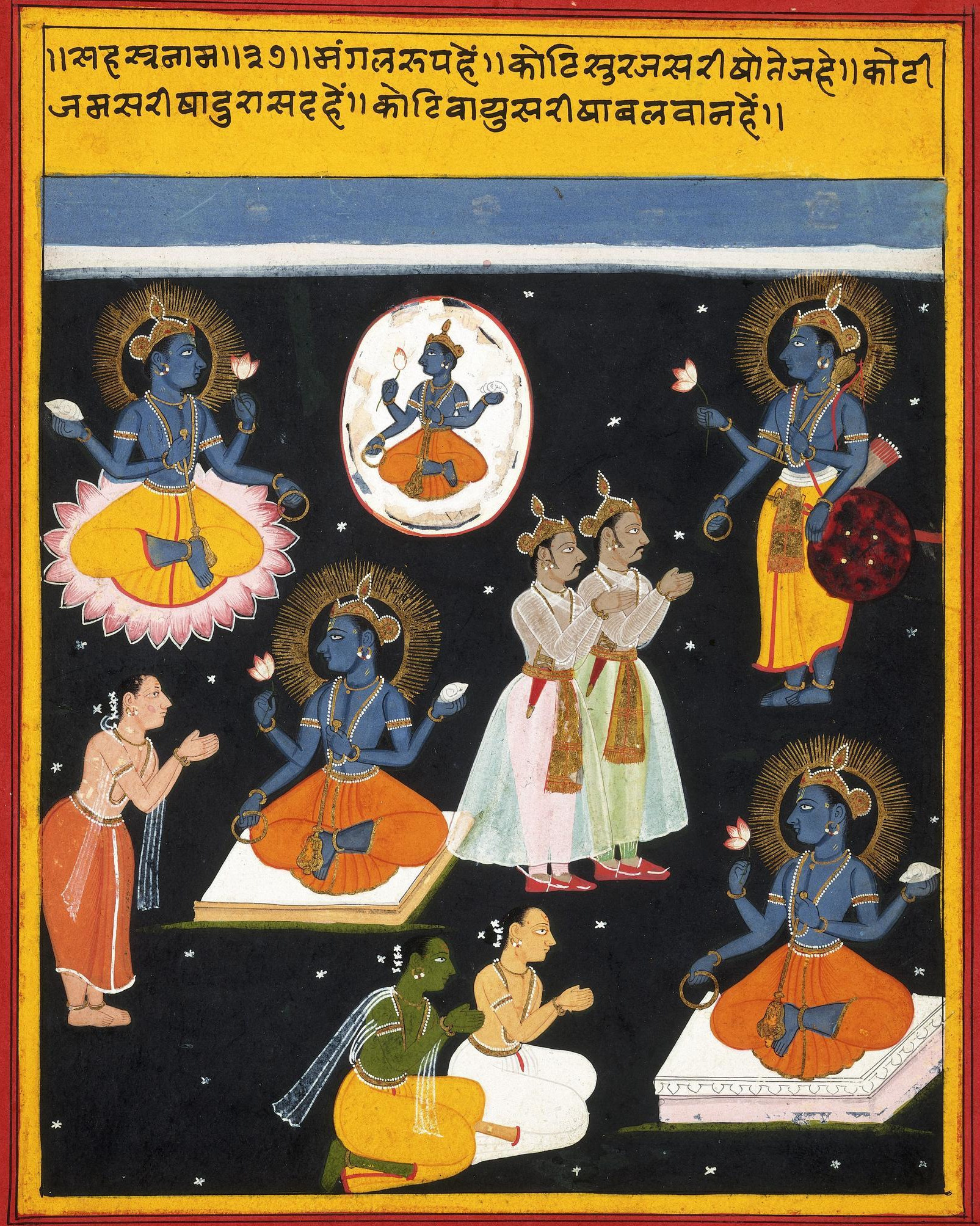
So, within seconds, a brief passing, I apologize with sturdy feet. My breath is steady, and at once I am relieved from my internal night, the concave flexing of cavernous rock, a burden of upended implosive tension. The wilds burn with stolid elasticity and I am inflamed with a secondary respite, at seeing my name lit towards the ceiling, and reacting with confident force, eyeing my winnings; a recognition of literary achievement, in multiple categories, standing beside renowned academics and independent artists of creative literacy.

Vishnu sahasranama manuscript by Anonymous 
I am bedecked with opulent outfitting, and walk to receive my medals with an ostentatious headdress and unnatural clothing. A blathering fake of heady fame, I steal through the tables clumsily and jeopardize the entire name, quickly hiding in the utter obscurity of another day. 
_________
A gourd filled with smoke speaks in a voice,

          Human,
A mindless bowl
                    of mirth
                             inflamed

glasses grow cold in the unheated concrete glue,
                    a fixture of the dead past

a golden consumer begs with a throat full of tears

in front of speakers
                 throbbing with broken-hearted names
                 burning up in a heat of worldly instrumentation,

transcending this same-self curse
                 with a storied high
                        of nameless voice
...
a spiritual womb formed
                        at the fingertips of an artist healer
                                     pursuing the groove of an epoch
                                     stolen from the mind of silent law

in a world’s motionless yearning

                 from afar

in the dark
fearless
night

excerpt from "A Joke Downstairs"


Monday, 24 September 2012

Persian Mysteries and the Immortality Rites of Zoroaster

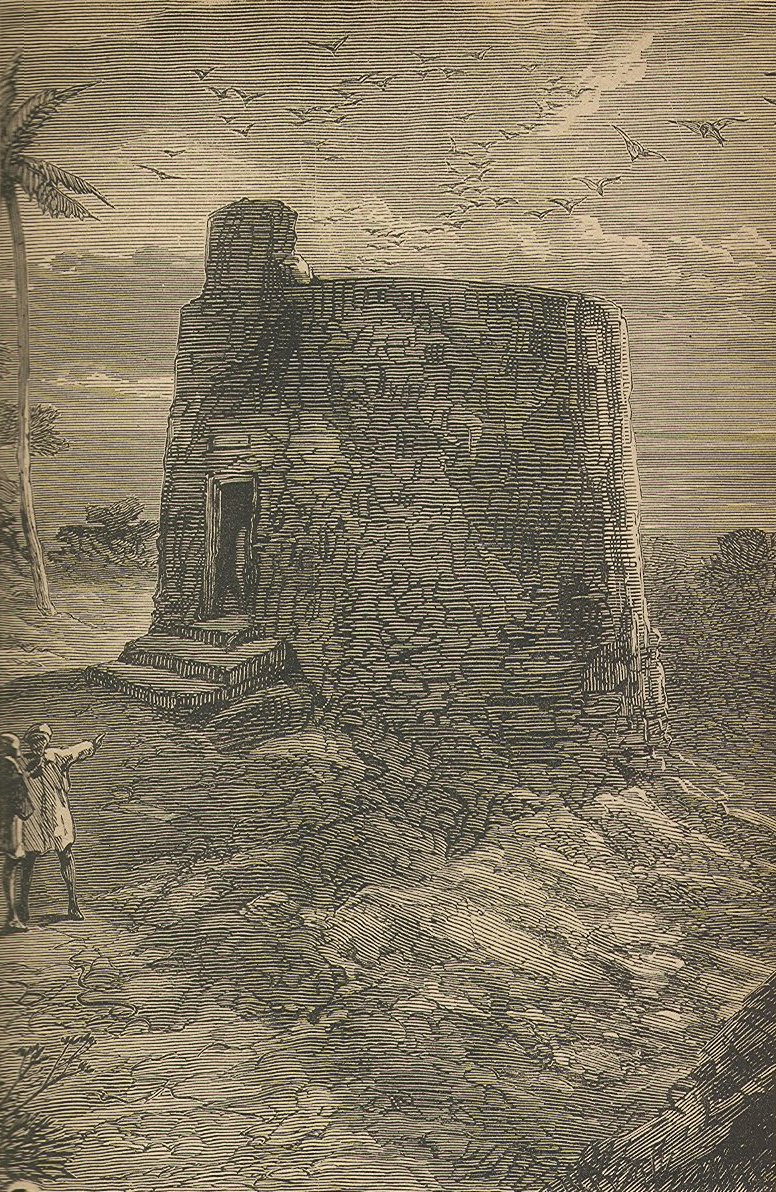
Tower of Silence (Dakhma), Mumbai by Cornelius Brown
“…never age and never die, never decay and never rot, ever living and increasing, being master of its own wish: when the dead will rise, life and immortality come, and the world be restored to its wish.” 

Yasht 19.2.11. James Darmesteter, The Zend-Avesta, Part II, The Sirozahs,Yashts and Nyayis; Sacred Books of the East, Vol. XXIII (Oxford, 1883), p.290
__________

It is 12th century Persia, the continental-temporal mirror image of 21st century Canada. After a lesson on the estate, I a youth of educable age, begin to row across a placid lake with my father. The day is warm, with cool breezes flushing our skin in a mixed haze of natural praise and remorse for the end days of summering. My father, a muscular, bearded intimidation of manhood, speaks with the grazing lurch of intense commanding. As we row, in separate crafts, the waters turn rapid. In that moment, he begins testing me on my learned material. 


The oral literature of the day is mind-bending and terse in its memorable strings of morality, geography and spirituality. I’m able to recall various characters and events, and as I extrapolate, the waters toss and turn unexpectedly. At my wavering voice, my father’s eyes brim with the frosted fire of dark Persian mirth. Yet, as soon as I veer into future’s allusions, spouting the literary names and waves of later centuries unheard, a fire burns in his eyes of serious intent to quiet my youth’s wandering. As he reaches out to grab me into his craft and row back ashore to the consistent presence of historic symmetry, we are both swallowed by the apparition of a waterfall along the other shore, pouring us downward with the turbulent waters in a vein of undone chronology and placeless imagination. 

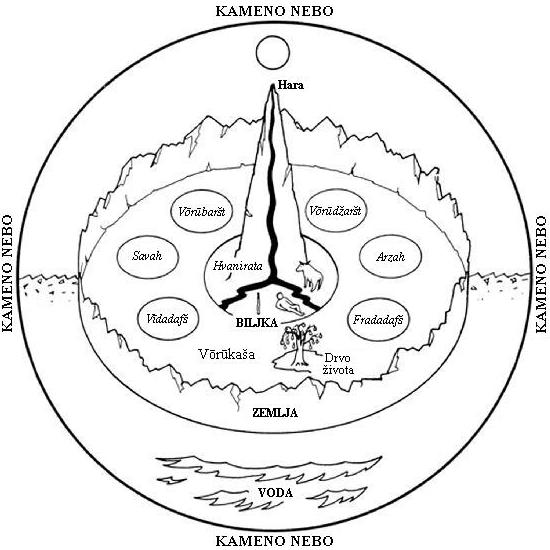
World According to Avesta by Orijentolog
I call out the names of literary history upwards along the upended future. Until the 21st century’s own dawning, my mind, feckless among the archaic forms of Iranianization, is unceasing in its deliberations on the foreshadowed youth of humanity. I turn and writhe with ancestral might into the sheer unknowable mists. My father has since disappeared, and in that silence I begin to know my name.  
_________
Driving out demons with Masonic symbology
         Over the infinite sands of civilization,
         breathed and created out of time
In the sun’s ravishing corner of a universe,
         un-tempted and forever at a loss
                Between the child’s two eyes
                closing
On death and the holocaust of our forsaken government
         Laughing at the trees’ roots


When stretched to the bottom of India’s or Africa’s wells
         Ousting up the belief in life as a drunken tragedy
                              Yet, be not humourless
                              nor without comic sophistry


In the dance and song
         Come alive by the sexual majesty
                              In theatre’s delicate ways,


To present the creative being
as one with truth’s bold and upheld music
         Reflecting back in the caged mirror
                              A creator anew

- excerpt from "From Behaved Freedom to Absolute Nonsense"


Thursday, 6 September 2012

U, The Middle Way in AUM (Om)

Brahma, Vishnu, and Shiva within an OM, in a Mahabharata manuscript from 1795 by Unknown
"Taijasa, whose field is the dream state, is the second
sound, U, because this is an excellence, and contains the
qualities of the other two. He who knows thus, exalts the flow
of knowledge and becomes equalised...

Internal to the waking consciousness, and pervading the waking consciousness, there is a subtler function of this very same consciousness, which is subjectively known as the dream-consciousness, or taijasa, and universally known as hiraṇyagarba, or the Cosmic Subtle Consciousness...

Neither can the waking experiences exhaust us, nor can the dream experiences completely comprehend our being. We seem to be something that is capable of being a witness of both the states. This witness is not a party either to the waking state or to the dreaming state. We are essentially, a third element altogether, something independent of waking and dream."

- excerpts from Swami Krishnananda's Mandukya Upanishad, pp. 12, 57, 59 [italics mine] 
________
The antique wood, a rocking chair, the once attributed tradition of upright relaxation, buried in the tourist fizz of los sapos market. Cobblestone streets mark the way for foreigners blending with hip-tied drum groups, Hare Krishna propagandists and the local elote vender. The Mexican wine of a Sunday Tianguis gropes at the neck, to smother the chosen speech in a howl of awakened want. 

I shudder behind a sunglass find, the inimitable Huichol hand, weaves a metaphysical mat of mystical enthusiasm, and so we play nonstop, enlightening the mouthed eyes with a music unheard. Nightfall, we are approached by a woman of colonial smiles. She breathes a home into our highest imagining, a place to live, among the cold stone steps of vanquished need and fulfilled sight. Her place is an ideal home, with a small bedroom tucked away into the corner of an empty room, full with the comforting hospitality of a traditional sunbaked Southern welcoming. We decide to continue on, despite the whipped lure of our eyes.

Returning north, I accept the invitation of a friend to ascend the mightiest tower in the world, newly built in our city. Hiking through a golf course, I reminisce on a similarly forged path through dense forest upwards toward the Rocky mountain peaks. Then, I see it. Eye’s nearly gouged by the immensity; I prick myself. 

The conical rise extends upward towards unknown alchemical engineering, and more, an unsupported bridge unites two lower towers from the bottom-center, and direct to the very top! My friend, always acting over-anxious, rushes us towards the bridge to the top. We enter the complex, prefaced by the usual commercial dives, a mall of unreasonable hacks festering like bottom feeders. 

With an upturned stomach, I hold on as we are shot out, gliding over a glass floor, as a rudderless, engineless boat would skim over placid waters. I dare not look down. In the building, the quick mindscape turns into a flood of waning mirth, and mindless havoc beams with unintelligible delight as people squander the golden drug of shameless technology, a great phallic middle finger, flipped by the entire Western world at once! To who? For what? It is directly skyward.

My friend and I quickly exit, having passed through the immense spire of cylindrical unreality, and we pour out onto an uptown street in mid-city. The concrete jungle returns us to the fading glory of a now obsolete infrastructure. 

Ghosts of the past fly like demonic insects through the gut-smattered concrete claustration. I notice a few as my friends, and meet them. On the outskirts of the unsubtle building, a beacon of terror, an insignia of waste, we burrow through an old tunnel system, climbing out into the abandoned system of underground pathways, leading to the base of the alien tower. 

Suddenly arrested by the horror of war, the sky blasts open with the shockwaves of a thousand bombs billowing like hot nails over the soft-fingered ground. As missiles breach the catastrophic abandonment of wires and tunnels ahead and behind, I loathe over remembered imagery from Iraq, Palestine, and endless claims to vengeance on our land, born of blood and built of sand.  
________
choking cry,
the rasping imperfection in ecstatic beauty,
momentous experience beyond human conflict
in the word and sound of a throat-muted music,
the play of life
final and resounding
in a tumult of white haze
around the English nape

croaking in the sharp whispered present,
fuming dry-eyed numberless fingerings
before a trickster’s Goddess tree,
pained to an ink-smeared fire on the blistering urban horizon

sleepless,
gone into aged reason
and the ethos of undreamt madness

- excerpt from "Assimilating America-Asia