Primarily a writing exercise, this dream journal-inspired blog is a quiet introspective sojourn into the process that we traverse in going from private dream to public art. I see our dreaming as an internalized mythmaking. As I philosophize and expressively exhibit dreams, both private and public, I encourage and delight in creative language as a way to practice experiential metaphors through a “public dreaming." Writing Theory: Creative Dream Fiction
Showing posts with label self-knowledge. Show all posts

Monday, 29 April 2013

Sexuality and the Self: A Walk Through Chaplin's Dreamland of Innocence


"Dreamland...Sin creeps in...Trouble begins...Innocence...Getting flighty...Jealousy..." concluding titles in Chaplin's The Kid

The penultimate scene in Chaplin's first feature as an auteur filmmaker brings the viewer into "Dreamland" an alternate world parallel to the slums of old America, where all the principal characters from the film are winged angelic humans, swayed by the ear-whisperings of stereotypical devil sprites prancing about unnoticed. Could Chaplin have been privy to the hermeneutical notion that angels and demons are internalized expressions of our inner nature, mirroring social experience within the self-reflective subconscious, a key to an awakening, which resolves such impacting triumphs as the orphan child reuniting with their birth mother? Could Chaplin's narrative insights on film have preceded psychoanalytic depth by seeing the substance of dream as holistic self-projection, and at the same time, maintains unrivaled importance for transforming the collective psyche? 

Alan Watts is famously known for relaying the following psychological narrative, an interrogative entry into the presence of mind, as it wanders through the imaginative hollows of two overarching conceptions, past and future, and their nexus of alternate psychic fruition in the netherworld of dream. 
"Let's suppose that you were able, every night, to dream any dream you wanted to dream. And that you could, for example, have the power, within one night, to dream 75 years of time, or any length of time you wanted to have. And you would naturally as you began on this adventure of dreams, you would fulfill all your wishes, you would have every kind of pleasure you could conceive. And after several nights of 75 years of total pleasure each, you would say that's pretty great, and now let's have a surprise. Let's have a dream that isn't under control. Where something is going to happen to me that I don't know what it's going to be. And you would dig that and come out of that and say, Wow, that was a close shave wasn't it. And you would get more adventurous and you would make further and further out gambles, and finally you would dream where you are now." 
Like a silent film, dream is also suggestive. The act of play is a prerogative of metaphorical truth, and finally, where chaos is a principle which reveals Self as the All-Self, Alan Watts, reminds us, "The whole nature of the Godhead is to play that he is not. In this idea then, everybody is fundamentally the ultimate reality...God in the sense of being the self, the deep-down-basic whatever it is. And you're all that, only you're pretending you are not." Dreaming is a doorway to a revelation of the nature of self as All, where we confront the play-form of creation as an inner process of personal creativity, as the embodiment of a creative mind. 

While we go about our "waking lives" fully immersed in the, "I am not that" attitude, the nightly vigil of our inborn collective life, our subtle creative instinct, bleeds with singular potency throughout the periphery of waking experience. In dream, we remember who, and what, we are: the stuff of play, Lila, in Sanskrit. There is a story of the seeker who goes to a guru and staring into the face of the holy man, meets only a curious smirk, as the holy man thinks, "Oh! Come off it, Shiva."  
____________
Shadows hang with somber repose. My beloved grandparent’s home is empty. And I’ve been away far too long. The dust has settled. The dining table is hollow with a loveless ardor. I can inhale the loss; the forgotten wealth of life lived once for each other now separated by nightfall and age.
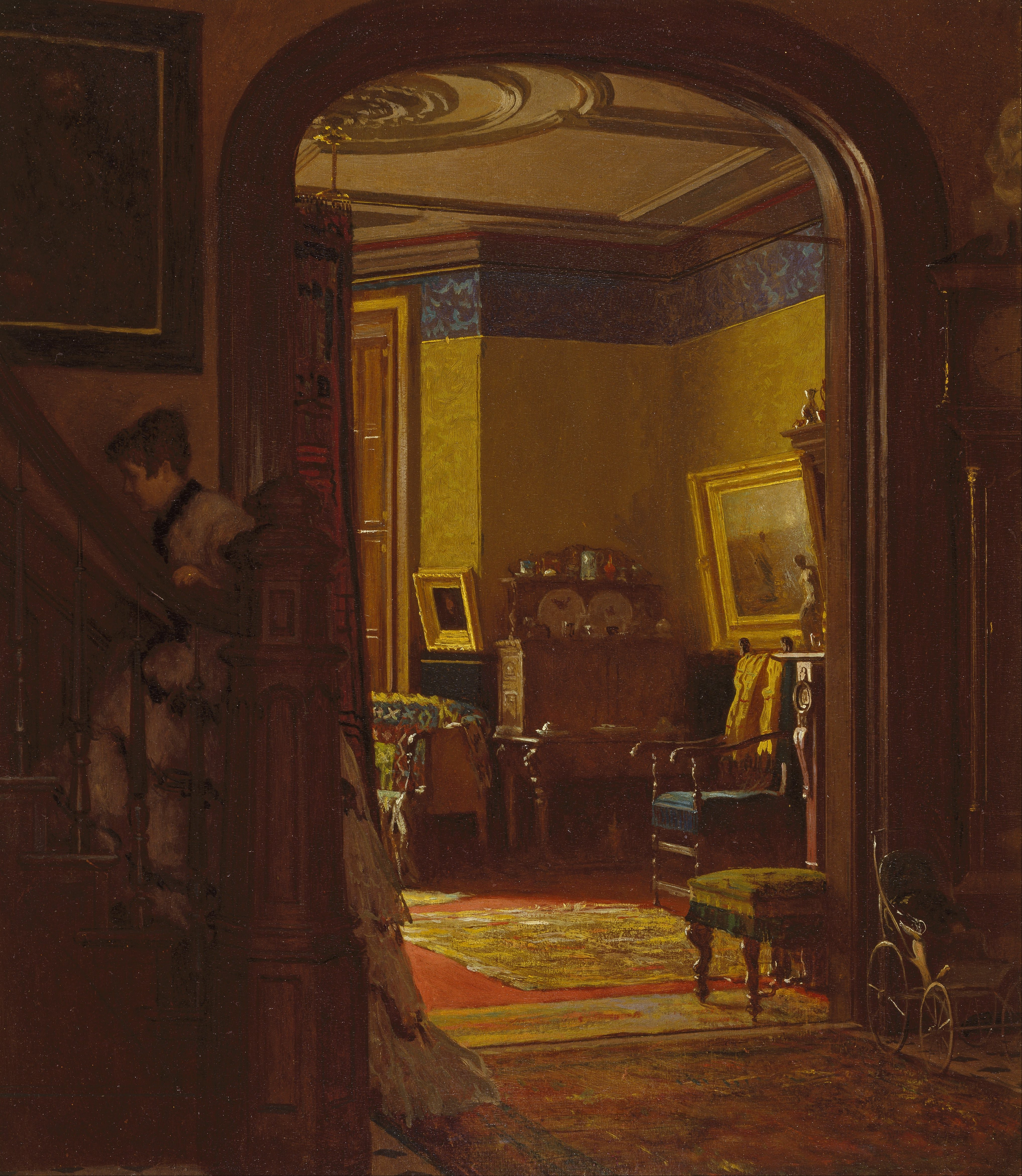
Not at Home by Eastman Johnson
A middle-aged man in a black leather jacket stands outside, waiting. I’m hooked outwards. The sky calls me from the dank lament of the abandoned house now friendly to no one except for the wraiths of Death and Time. Who is the middle-aged man? I know him well, as I’ve known myself reflected in the old western visage of distempered exile.  

Devil Priest (credit: Gary Ashley)
I mount a bicycle along the cracked sidewalk curb. A dilapidated car, in the model once owned by my centenarian grandfather, clanks and sputters downwind. Is that my brother at the helm of a rusted, malign vehicle? I glide toward dawn. 

Automobile by Roman M. Semaschkewitsch
The middle-aged man seats himself blankly at the back of my bicycle. Like a burden to its beast, I carry his apathetic and listless indifference throughout the expansive elaborations of my most grandiose ambitions. 

Dynamism of a Biker by Umberto Boccioni
The map of Asia opens with the clarity of a skyline on a cloudless day. Traversing the backcountry of Vietnam, land of my lifelong love, I veer through incandescent bogs and sunbaked farmland. Natural beauty unending, my eyes turn inward, to visions of aspiration and wonder. To Europe, across Mongolia and the bleary maw of central Asia, I carry the burden of age, of settlement, of thought. Silenced, my mind is repressed with a hidden name.  
___________
The pure darbuka/doumbek track behind the voice sounding is essentially a decision to convey the beat-hop sexuality of modern techno-culture, and more, to welcome the sounds of the Arab-Muslim world through one of their traditional instruments, in coordination with a voice to affirm a re-sexualized Earth-bound society in honour of the Feminine - to move beyond what I have called, "monosexuality" a conception in response to our narrow myopia concerning the spectrum of global sexual expression.


Originally published in Poetic Pinup Revue's February 2012 print issue, "monosexuality" is written in the name of all the victims of a sexually repressed society, that being mostly all of us in the modern world. There is an epidemic of masculine dominance. The feminine perverted and repressed through our culture of rape. The lack of feminine empathy extends to the contemporary human relationship with Earth, as PachaMama, Mother Earth. Our birth-rite is to recognize Her.   

"monosexuality" was also my first published poem. Where poetry is conceived as a feminine art, to hell with the macho patriarchal cultural hegemony that diminishes the authentic creativities of our inborn humanity in favour of entitlement propaganda, figuratively illustrated as the "war on sex". Militarism further exacerbates the repressive/oppressive role that sex, in gender, reproduction, and the act of love, has assumed in our increasingly self-destructive society. As with all dualities, masculinity implies femininity.

Public Observance is essentially steeped in the act of 'people watching' with a keen eye for the social imbalances in play on any given occasion. Especial light is thrown on inter-sexual relativity. Included are the poems, "monosexuality" (Poetic Pinup Revue, 2012) and "Preposterous!" (Steel Bananas).

The piece, "Preposterous" makes a point for the significance of anarchical logic, or irrational meaning, and how the formal context of institutional learning delegitimizes the freedom to imagine beyond the bounds of normative thought and reason. It is at once an elegiac and at once celebratory, marking a flight from the institutional walls of predictable learning, towards the more experimental and risky, adventurous dream-education of self-knowledge.



Thursday, 31 January 2013

Life Phases of the Dreamer: Poe and Developmental Psychology

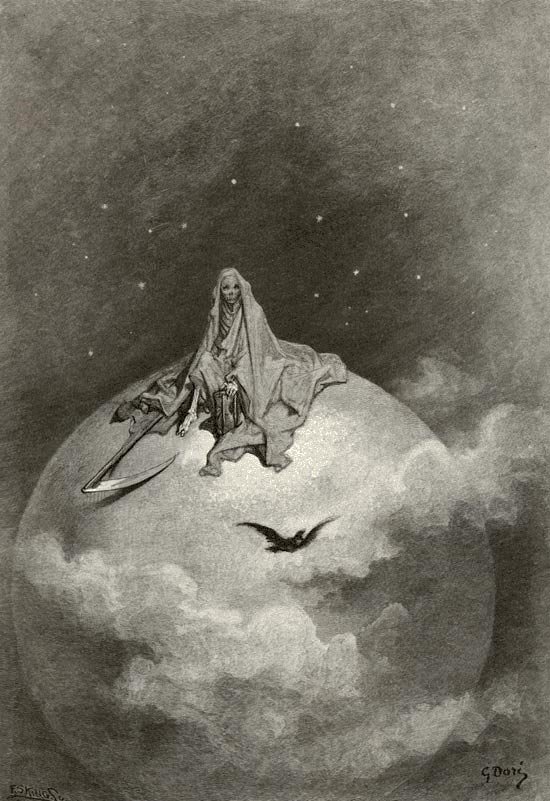
Edgar Allen Poe's Raven by Gustave Dore
"Is all that I see or seem/But a dream within a dream?" E.A. Poe

The practice of remembering dreams is one way to practice deep, inner self-awareness. The subtle energies of dream arise from the Source of Emotion. Both destructive and creative emotions are based on momentums of conscious action. Thought begets thought, and action begets action. As the Poe quote reads, so the psychological, subtle phases of our lives seem as dreams within a dreams.

Emotions are also based in psychological development through various phases of life. As a child, emotions are indistinguishable between self and other. The emotional vulnerability of a child rests in the experience of lacking discernment between “what is I” and “what is not I”. When a child experiences trauma, they are unable to separate the trauma in their environment from their own thoughts and feelings, which are not yet recognized as theirs. By adolescence, the human being is naturally predisposed to reflection on the content of one’s inner life, forming and recognizing their unique thoughts and emotions. This phase is often marked by the difficulties in attaining psychological independence from the collective emotions shared by family and community. If the person passes from this stage, they are able to maintain a strong sense of self, and so go out into the world, learning but not assimilating, acting but not capitulating. These three stages can be summarized as sight, thought and action.

At the fourth stage, there is a marked shift in consciousness. All the previous three stages become indelibly present in life, yet they all become partial to completion through a conscious manifestation of love. In the process of developing a love relationship, the emotions go through the three phases before they are actualized and fully recognized as the enduring experience of love. In the beginning, the emotional phase of the child returns, where individual emotions become indistinguishable within the love relationship. From that stage, thoughts are dominated by thoughts of love, and all action is cautioned by the fact that everywhere one walks now, they are not alone, but with their love.

As with the mystical hierarchy of seven energy centers in the body, known in such traditions as the Hindu Chakras or the Kabbalistic Tree of Life, these four phases represent the involuntary (feeling), creative (thought), power (action), and compassion (love). In the fifth stage, the love emotion resonates outward to engage a greater sense of love for a community, nation or people. In the sixth stage, the focus is clear, and the way aligns with a specific practice of devotion to service in light of the accumulated energetic septet of emotional phases of psychological development. In the final phase, sight, thought, action, love, community and devotion unites every phase of emotional development. The completion of self-awareness is actualized from the inmost depths to the outmost limits of human potential.


____________
She rushes ahead. Into a rigid cube of wooden frames and metal housing. Rusting chains fall over the marginal impasse of domestic space. The outdoor heavens collapse over the head of my lover. 

The Face in the Pool (frontispiece) by James Allen St. John 
Brilliant orange tigers growl and laugh with the insatiable greed of bestial hunger. She is engulfed under massive wingspan of the jungle predators. She submits to death, agog with passionate surrender.

__________
Filmic mind, braving theatric kingdoms
            Weighed heavily by the German cross
Over western shores, blonde
            With sightless camaraderie
In the sociopathic gaze of mindless pain,
            Order & god for trade
                        At the bedside, nude
                                    Binging before a final restitution,
Breathing in dream-talk laughter nightly,
            Not for escape,
                        Only to tread the unfulfilled urge
                                    To let go of body into an act of base movement

excerpt from "think IN drink"

Thursday, 10 January 2013

Metaphors in the Art of Goya: A Theory of Unconscious Development

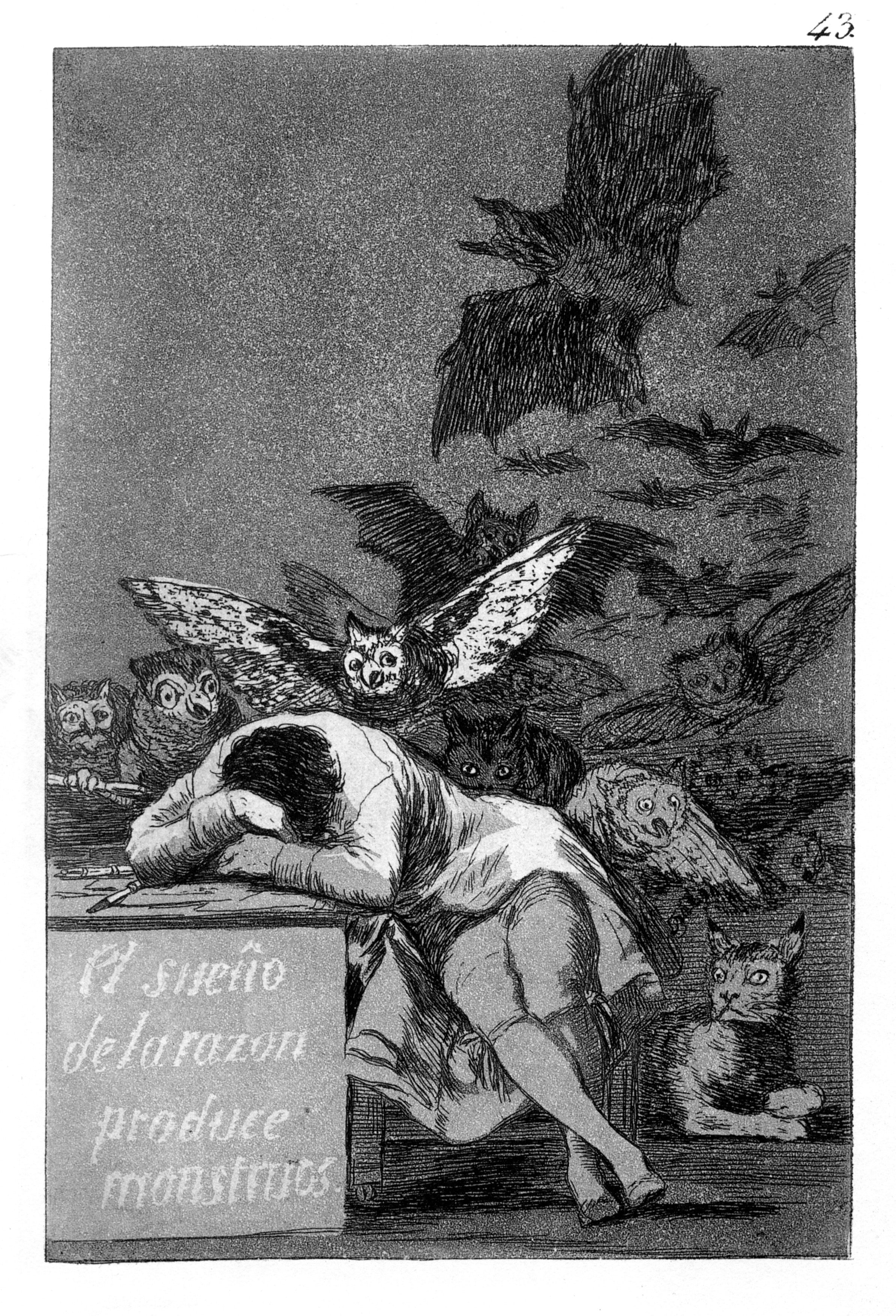
The Dream (preparatory drawing) by Francisco de Goya
The Dream (print) by Francisco de Goya
"The dream of reason produces monsters." Francisco de Goya (source)
The purpose for exhibiting the creative process of a master painter as Francisco de Goya, showing his initial sketch, and final print, runs parallel to a theory I have in relation to the role of the unconscious, and its impacts on the life of both the sleeper and the awake. 

Firstly, my theory is founded on lived experience. The foundation is as follows: If a person follows their natural sleep-awake patterns, without conscious intervention, the body cycles through an internal clock more expansive than the twenty-four hour day. Incrementally, each day one wakes later, sleeps later, and eventually earlier. In the course of over a year of practicing this experiment of consciousness, I have found the twenty-four hour clock to be limiting and a mere fixed point around which my sleep and waking cycles orbit, as a celestial body around its true source of gravity. 

Is this an effect of seasonal, environmental, or psychological pressures? The theoretical part now kicks in. With the exhibition of Goya's creative process in visual representing the night of Man, he is accosted by a host of demons, and in turn, upon waking, those demons become monsters of reason. So, if we allow the regenerative natural patterns of sleeping and waking to unfold, with complete abandon and in lieu of the normative twenty-four hour clock, we give way to a natural creative energy sourced deep within our unconscious, that nourishes our very life-breath with the heartbeat of self-knowledge. 

With this, the world of dream is merely a doorway, as is a metaphor or a myth, towards a more holistic regenerative consciousness of self-awakening. 

See related post: In Defence of Sleep: Regenerative Sleep Cycles of Archaic Man
__________
After hours downtown mall. Winter night. Midwestern city. The street is dim, and I stand, as to wait for a companion, or a bus home. Alone, my eyes scan the glass exit doors with a longing nostalgia for company. As I consider my absolute solitude, two prostitutes brush up against me. They closed in out of nowhere. After a moment of disdain, I begin to hear an inner curiosity.

Cocotte on the Road by E.L. Kirchner
"How much?" I ask, imploringly. "500 dollars" she says with a soft smirk. "I don't have that much." I respond, with dry humour, having never intended to act on my curious insides. Surprisingly, my wife steps through the hall behind us and into the background. She sets up her instrument and begins to play. I drift, flying towards the awake. Her unconscious body, her subtle spirit had called me forth, from the fantastic night of isolation.
___________
What of human sound,
The frequent lust to prepare noise in strength of intellectual wonder
and produce unfathomable beauty
            of the entire body
                        descending to and from the ear’s tragic centering
In our musical society, and what to compare “human music” to the grandiose law of nature, expressed in the mere calls of bird and beast revolving their unchallenged voices around the veil of a gross acoustic hall,
            whose rendering dreams an unforgiving welcome to the Earth’s living
            hall,
                        led to a thoughtless demeanor
                                    yet within the mind of man
...

to find a source,
                                                not necessarily of communication
                                                            between human, bird and god,
                                                but a direct connection
                                                            that spells mystery
                                                                        from an inspired gift to all
her sound.

excerpts from "Of human sound"


Tuesday, 8 January 2013

The Thinker Who Thinks For One Self: A Reflection on Schopenhauer

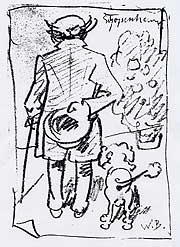
Arthur Schopenhauer caricatured by Wilhelm Busch
"...the greatest amount of erudition, if it has not been elaborated by one's own thought, is worth much less than a far smaller amount that has been well thought over.

...much reading deprives the mind of all elasticity, as a weight continually pressing upon it does a spring, and the most certain means of never having any original thoughts is to take a book in hand at once, at every spare moment. This practice is the reason why scholarship makes most men more unintelligent and stupid than they are by nature.

...he, that is, who thinks for himself, thinks of free will, thinks correctly he has the compass to find out the right way.

...the intellectual acquirement of the self-thinker is like a fine painting, which stands out life-like with accurate light and shade, well-balanced tone, and complete harmony of colour. The intellectual acquirement of the mere scholar, on the contrary, resembles a large palette full of bright colours, systematically arranged indeed, but without harmony, cohesion, and significance.

For the perpetual, the real, in its originality and power, is the natural object of the thinking mind, and is able most easily to move it deeply...In the realm of reality, however beautiful, happy, and cheerful it may happen to be, we move ourselves continuously under the influence of an oppression, which has ceaselessly to be overcome ; while in the realm of thought we are incorporeal spirits...

...how great and how near us is the problem of existence, of this ambiguous, tormented, fleeting, dream-like existence ; so great and so near, that as soon as one is aware of it, all other problems and purposes are overshadowed and hidden by it..." Schopenhauer, On Thinking For Oneself

During the course of writing this blog, from its inception, until tonight, I have been exploring a world of my own making. I have sacrificed a worldly career-seeking existence for a deep exploration into the development of self-motivation, self-learning of thinking for oneself. That being said, while I have risked the mental balance that all face when they dwell profoundly and thoroughly into themselves, I have begun to a feel a feeling of being in the presence of the trackless way, or "the pathless" as Jiddhu Krishnamurti said. To trust the language of dream is a daily struggle to remember the most obscure part of ourselves that the world tells us to deny, forget and leave far behind in the realm of sleep and fantasy. When dreaming begins to encroach on our reality, we become fearful, and as modern people, defensive. The breach of unreason is an affront to all we have been taught. It is the history of our own soul. When the words of great thinkers like Schopenhauer begin to make crucial sense and gain a new sense of pragmatism outside of the allures of becoming privy to an enigmatic philosophic tract, the inner world of one's own making begins with an awakening, illumined by the midnight sun.

See related post: Schopenhauer and the Unconscious Fate of Recurrent Thought
__________
Apocalypse! Apocalypse! We are at bay! The grocery stores are emptying, the streets are empty of cars and the sidewalks are full of an insane humanity. After days of hiding out, I finally emerge from my apartment, bewildered by the blaring sky. A man shouts prophecies from the nearby grocery store entranceway. A crowd of onlookers listen with eager intent. 

Frescoes in the Upper Church of San Francesco in Assisi, southern transept, scene: Apocalypse, Detail by Cimabue
"Fuck you!" I scream at the man. At once, an elderly lady screams back at me, "Fuck you!". I stare at a blinding yellow ring on her finger, absolutely dumbstruck with comic bewilderment. I return to the street side under my apartment building. To sit with a homeless man on his bed of burning fabric. I stare out, deadened by the silence of a lifeless futility creeping into the human domain from the belligerent rage of Earth; her the final hour.
__________
To obviate from this bland mural,
Its strict pull underlies, as a lightning tremor

In the cooled dust collecting raw answers
From the autochthonous matrimony with foreign alliance,

Over the scarred mud-caked plains
Whose agricultural fertility gave way to chemical strife

In the selfish human pandemic,
Lining the hostess and her following with possibility

In the strong-voiced dirge calling back thousands’
Endless anonymity from the last day that rested with holy failure
...
Embracing the nervous mouth of the whole city in one dire expression
To last

excerpts from "Obviation from the BLAND"  


Wednesday, 2 January 2013

Myth of the Writer as Artist in the Inner Space Age

Magic Mountain (after Thomas Mann) By Christiaan Tonnis
"Certainly when a writer has acquired the habit of regarding life as mythical and typical there comes a curious heightening of his artist temper, a new refreshment to his perceiving and shaping powers, which otherwise occurs much later in life...myth is the legitimization of life; only through and in it does life find self-awareness, sanction, consecration." Thomas Mann in his essay, Freud and the Future

Within this essay by the great 20th century writer Thomas Mann, author of the famed Magic Mountain, are masterful insights with which to learn the various modes of self-discovery as espoused in the mythic fires of ritualized, eternalized thought throughout the ages. In the ageless struggle towards self-knowledge, the embattlements are often constructed in defence of the outer world, or the world, and in offence from the inner world, or the self. In the midst of those embattlements, lies a field. As Rumi says, "Between right doing, and wrong doing, there is a field. I'll meet you there." 

To explore self-knowledge with regard to knowing one's place and vocation is to embark on an inward journey. Only by recognizing the bare truths of our life in the present moment, and proclaiming them as such, and in turn, making them an integral part of the conscious, and waking, mind, can we understand that the truth about myth. 

Myth addresses and reveals the ultimate needs of the human psyche. Myth speaks of the search for meaning in the life of humankind. The final lesson of myth is that the ultimate question for life in the modern world, as with all times, is not, "what is my place in the world?" The essential question remains, "what is the place of the world in me?" Every one is the ONE. You are the world. 

The world is of our own making. We are all co-creators in the aftermath of reason. Work is play, and play is work. Play is the life of the universe at work, also understood as LILA in Hindu thought.   
_________
I walk past a prison in southern California. The air is humid. I can smell salt and chlorine. Why am I barefoot? I bend to look through stone latticework. I see peers, young men and women my age, cleaning a concrete prison campground. A dismal gymnasium? A barren bathing area? They wear radioactive protection, in orange suits and gas-masked. 

Lady in Prison by Raja Ravi Varma
I dart across the road. Barefoot, my feet sink unaware into the freezing water runoff from the prison cleanup. My feet are numb as I walk over a grassy knoll on my way to a gas station. The clear sky is warming. There are gas stations everywhere, and I can't seem to get anywhere close to one. My torso is overheating, and my feet are so frozen I can barely stand.
__________
Touring the phantom cloud

At rest between Celtic shores, distressed by multi-lingual borders and rocky soil, and a northern jail for the barbaric tongues who gouge panicked eyes from the skulls of New World kinds

An orgy of ruthless becoming

Among the equestrian speed, famed by pre-teen daughters of class and medieval French dreams, who cast off the Muslim humidity from Spain’s bound whores, and lust after a secretive world of music in the drum talk of yesteryear’s snoring traditionalism

Yet woken alive

Through non-ordinary literary thought and perpetual action, to finally inundate the worldly risks bedding with our species at once in an archaic passion, straying from the lofty

First World throats of progress


excerpt from "Mad artistry"

Wednesday, 19 December 2012

Dream and Love: All Our Relations

From Ben Okri's Mental Fight in London by Alessandro Lucia
“Only those who truly love and who are truly strong can sustain their lives as a dream. You dwell in your own enchantment. Life throws stones at you, but your love and your dream change those stones into the flowers of discovery. Even if you lose, or are defeated by things, your triumph will always be exemplary. And if no one knows it, then there are places that do. People like you enrich the dreams of the worlds, and it is dreams that create history. People like you are unknowing transformers of things, protected by your own fairy-tale, by love.” - Ben Okri

I found the above quote on THE DREAMING of shamanic drummer and creative writer, Lindsay Dobbin. It is such statements from the most brilliantly expressive minds of our time that draw one in to reflect on the substance of one's own nature. This is the creative spark. Ben Okri is so intuitively accurate in feeling out the subtle vibrations of the human heart that I feel as if he has literally been watching me. The relationship between love and dream is the strongest seed of self-knowledge. Those who forget their dreams are not awake to love. 
________
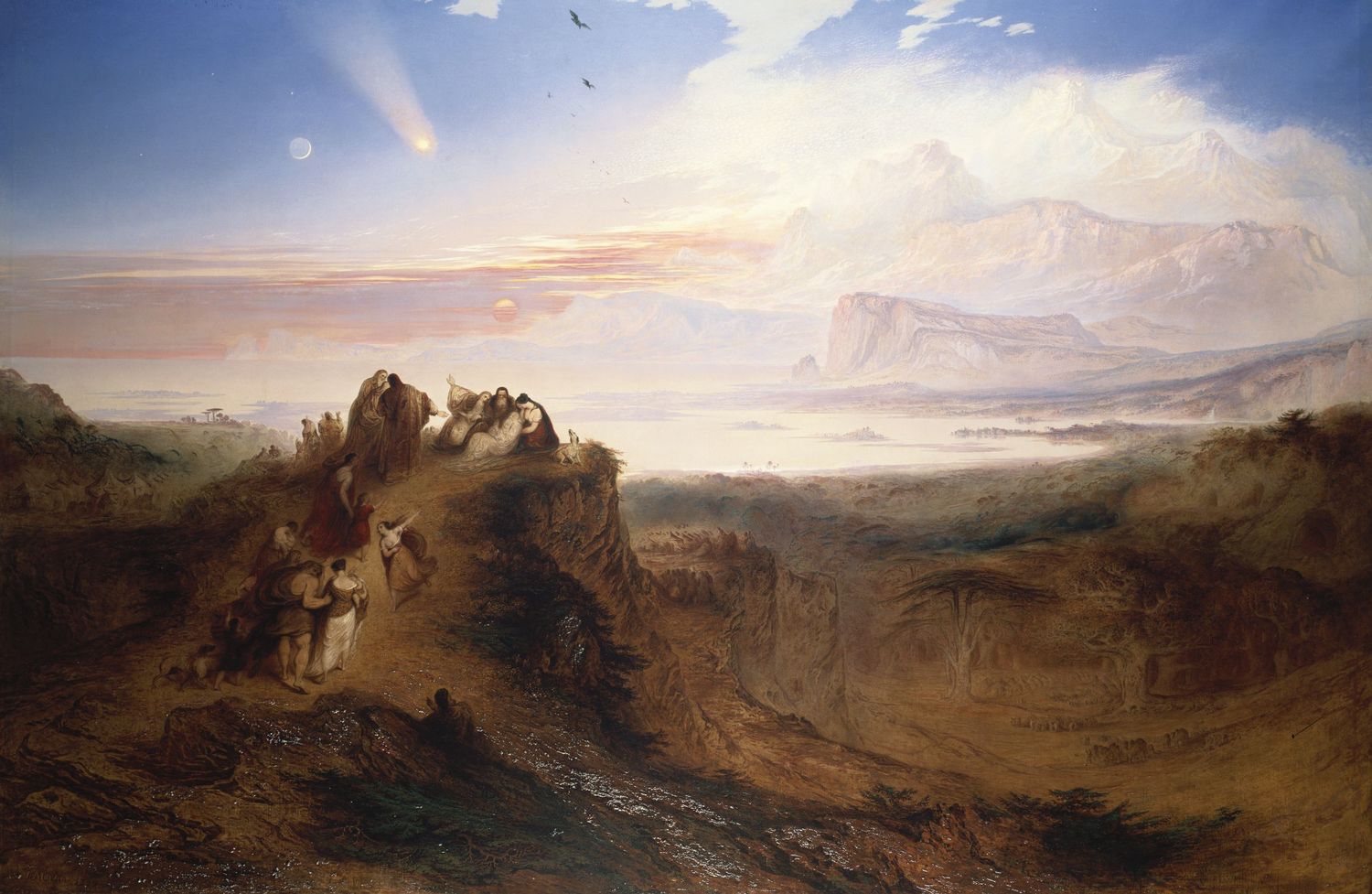
The sky is open. Light blue, and an atmospheric glow, passes through my eyes with serene pleasure. Delicate moisture fills me with a cool air. I exhale all the grandeur of my inspiration, each breath an offering to the immeasurable beauty above. Sky is a translucent goddess.  

The Eve of the Deluge by John Martin
As I gaze forward, I see Christ standing atop the water. From afar, his face still affixes to my eyeballs with the cosmic presence of mystic flesh. I am reminded of Alex Grey's Christ painting. Then, in a moment's whisper, a pair of Bison crash through the water. I see the lake is barely a foot deep. The age old prophet is lost to my sight. The Buffalo steam through the water, carrying themselves with the charm of a sibling rivalry. The sacred flesh of the plains opens a revelation of the land's own history. 
__________
"…the apparent flood of a bleeding anorexic paradise…drowned in the furtive beckoning towards malformed reasoning…my Anglo-eyed drug…rushing forth into the magi of atheistic awe…the lawless prism of deep endless failure…gone astray in the fatalist’s catastrophic underpinnings…during midnight conversation…"