Primarily a writing exercise, this dream journal-inspired blog is a quiet introspective sojourn into the process that we traverse in going from private dream to public art. I see our dreaming as an internalized mythmaking. As I philosophize and expressively exhibit dreams, both private and public, I encourage and delight in creative language as a way to practice experiential metaphors through a “public dreaming." Writing Theory: Creative Dream Fiction
Showing posts with label age. Show all posts

Monday, 29 April 2013

Sexuality and the Self: A Walk Through Chaplin's Dreamland of Innocence


"Dreamland...Sin creeps in...Trouble begins...Innocence...Getting flighty...Jealousy..." concluding titles in Chaplin's The Kid

The penultimate scene in Chaplin's first feature as an auteur filmmaker brings the viewer into "Dreamland" an alternate world parallel to the slums of old America, where all the principal characters from the film are winged angelic humans, swayed by the ear-whisperings of stereotypical devil sprites prancing about unnoticed. Could Chaplin have been privy to the hermeneutical notion that angels and demons are internalized expressions of our inner nature, mirroring social experience within the self-reflective subconscious, a key to an awakening, which resolves such impacting triumphs as the orphan child reuniting with their birth mother? Could Chaplin's narrative insights on film have preceded psychoanalytic depth by seeing the substance of dream as holistic self-projection, and at the same time, maintains unrivaled importance for transforming the collective psyche? 

Alan Watts is famously known for relaying the following psychological narrative, an interrogative entry into the presence of mind, as it wanders through the imaginative hollows of two overarching conceptions, past and future, and their nexus of alternate psychic fruition in the netherworld of dream. 
"Let's suppose that you were able, every night, to dream any dream you wanted to dream. And that you could, for example, have the power, within one night, to dream 75 years of time, or any length of time you wanted to have. And you would naturally as you began on this adventure of dreams, you would fulfill all your wishes, you would have every kind of pleasure you could conceive. And after several nights of 75 years of total pleasure each, you would say that's pretty great, and now let's have a surprise. Let's have a dream that isn't under control. Where something is going to happen to me that I don't know what it's going to be. And you would dig that and come out of that and say, Wow, that was a close shave wasn't it. And you would get more adventurous and you would make further and further out gambles, and finally you would dream where you are now." 
Like a silent film, dream is also suggestive. The act of play is a prerogative of metaphorical truth, and finally, where chaos is a principle which reveals Self as the All-Self, Alan Watts, reminds us, "The whole nature of the Godhead is to play that he is not. In this idea then, everybody is fundamentally the ultimate reality...God in the sense of being the self, the deep-down-basic whatever it is. And you're all that, only you're pretending you are not." Dreaming is a doorway to a revelation of the nature of self as All, where we confront the play-form of creation as an inner process of personal creativity, as the embodiment of a creative mind. 

While we go about our "waking lives" fully immersed in the, "I am not that" attitude, the nightly vigil of our inborn collective life, our subtle creative instinct, bleeds with singular potency throughout the periphery of waking experience. In dream, we remember who, and what, we are: the stuff of play, Lila, in Sanskrit. There is a story of the seeker who goes to a guru and staring into the face of the holy man, meets only a curious smirk, as the holy man thinks, "Oh! Come off it, Shiva."  
____________
Shadows hang with somber repose. My beloved grandparent’s home is empty. And I’ve been away far too long. The dust has settled. The dining table is hollow with a loveless ardor. I can inhale the loss; the forgotten wealth of life lived once for each other now separated by nightfall and age.
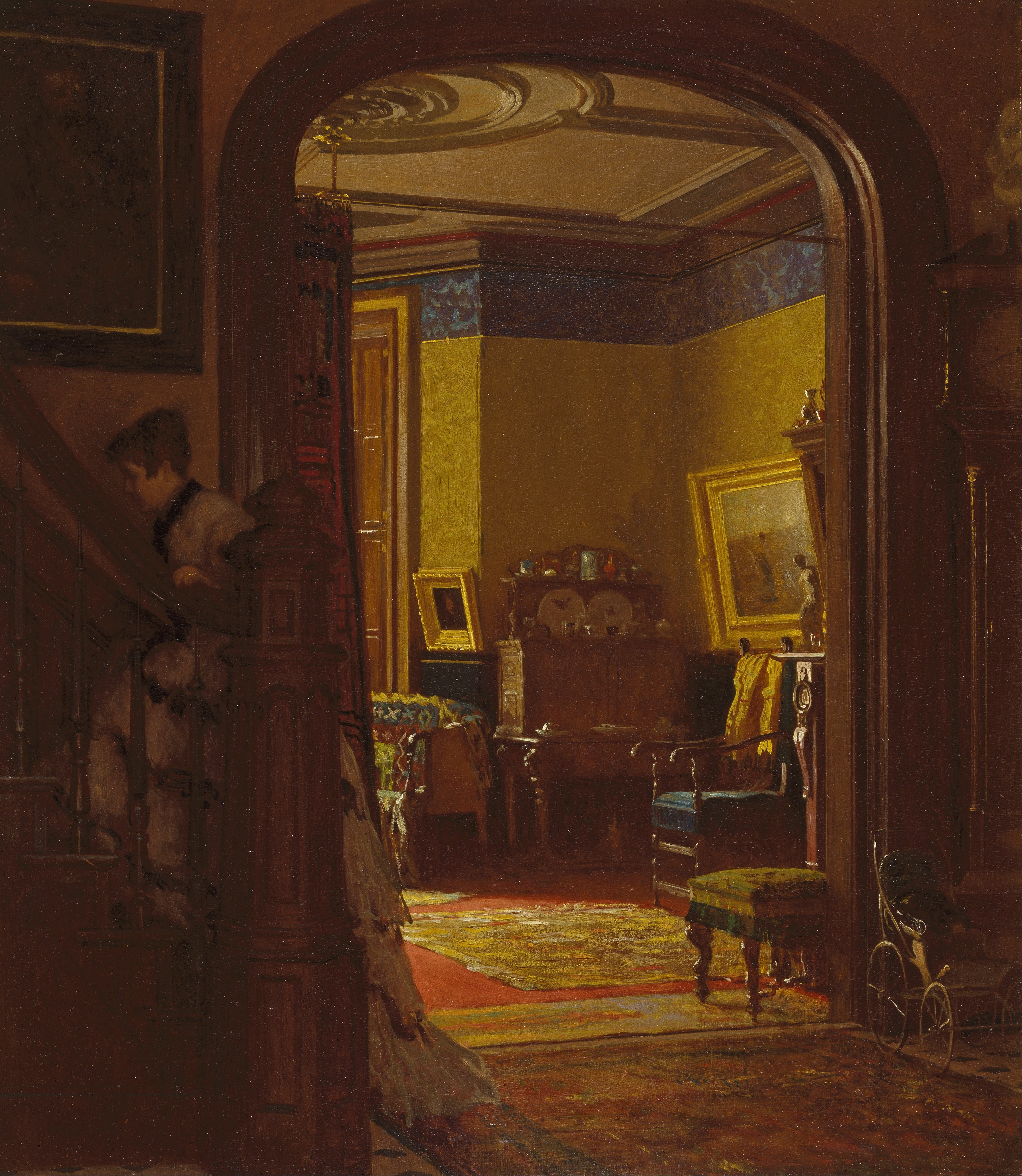
Not at Home by Eastman Johnson
A middle-aged man in a black leather jacket stands outside, waiting. I’m hooked outwards. The sky calls me from the dank lament of the abandoned house now friendly to no one except for the wraiths of Death and Time. Who is the middle-aged man? I know him well, as I’ve known myself reflected in the old western visage of distempered exile.  

Devil Priest (credit: Gary Ashley)
I mount a bicycle along the cracked sidewalk curb. A dilapidated car, in the model once owned by my centenarian grandfather, clanks and sputters downwind. Is that my brother at the helm of a rusted, malign vehicle? I glide toward dawn. 

Automobile by Roman M. Semaschkewitsch
The middle-aged man seats himself blankly at the back of my bicycle. Like a burden to its beast, I carry his apathetic and listless indifference throughout the expansive elaborations of my most grandiose ambitions. 

Dynamism of a Biker by Umberto Boccioni
The map of Asia opens with the clarity of a skyline on a cloudless day. Traversing the backcountry of Vietnam, land of my lifelong love, I veer through incandescent bogs and sunbaked farmland. Natural beauty unending, my eyes turn inward, to visions of aspiration and wonder. To Europe, across Mongolia and the bleary maw of central Asia, I carry the burden of age, of settlement, of thought. Silenced, my mind is repressed with a hidden name.  
___________
The pure darbuka/doumbek track behind the voice sounding is essentially a decision to convey the beat-hop sexuality of modern techno-culture, and more, to welcome the sounds of the Arab-Muslim world through one of their traditional instruments, in coordination with a voice to affirm a re-sexualized Earth-bound society in honour of the Feminine - to move beyond what I have called, "monosexuality" a conception in response to our narrow myopia concerning the spectrum of global sexual expression.


Originally published in Poetic Pinup Revue's February 2012 print issue, "monosexuality" is written in the name of all the victims of a sexually repressed society, that being mostly all of us in the modern world. There is an epidemic of masculine dominance. The feminine perverted and repressed through our culture of rape. The lack of feminine empathy extends to the contemporary human relationship with Earth, as PachaMama, Mother Earth. Our birth-rite is to recognize Her.   

"monosexuality" was also my first published poem. Where poetry is conceived as a feminine art, to hell with the macho patriarchal cultural hegemony that diminishes the authentic creativities of our inborn humanity in favour of entitlement propaganda, figuratively illustrated as the "war on sex". Militarism further exacerbates the repressive/oppressive role that sex, in gender, reproduction, and the act of love, has assumed in our increasingly self-destructive society. As with all dualities, masculinity implies femininity.

Public Observance is essentially steeped in the act of 'people watching' with a keen eye for the social imbalances in play on any given occasion. Especial light is thrown on inter-sexual relativity. Included are the poems, "monosexuality" (Poetic Pinup Revue, 2012) and "Preposterous!" (Steel Bananas).

The piece, "Preposterous" makes a point for the significance of anarchical logic, or irrational meaning, and how the formal context of institutional learning delegitimizes the freedom to imagine beyond the bounds of normative thought and reason. It is at once an elegiac and at once celebratory, marking a flight from the institutional walls of predictable learning, towards the more experimental and risky, adventurous dream-education of self-knowledge.



Monday, 11 March 2013

The Art of Freedom: 2 Years Since Fukushima in the Post-Scientific Era


"The existence of nuclear weapons means we could potentially create a disequilibrium, an imbalance, on the planet and the atmosphere by the launching of some of these systems, some of these systems. There are 27,000 of these systems. This is more than enough to wipe out the whole planet. You also got people working to say, 'you know you gotta save the planet.' Well you're right, we've got to save the planet. And so the whole environmental effort, as laudable and as absolutely critical as it is, can be for absolutely not in the space of hours if these guys actually went at each other." Lt. General Romeo Dallaire (Ret.) Pugwash Canada

Today is the two year anniversary of Fukushima Daiichi disaster. In my previous post, Hatsuyume of Peace, I kicked off a new paradigm in the life of this blog with reference to the apocalyptic transition that nuclear energy essentially means for life on earth. This is an enduring creative metaphor, a source of reflection that begs to be heard and never left in the silent empty ignorance. For, as the unrivalled Persian poet and filmmaker Forugh Farrokhzad said in her landmark film to inspire Iranian New Wave Cinema, a groundbreaking force of thought, emotion and impeccable insight, "There is no shortage of ugliness in the world. If a man closed his eyes to it, there would be even more." Her film, The House is Black is about a leper colony, and the humanization of treatment for a disease that simply requires attention. While the impacts of a nuclear disaster do indeed course through the blood and infect the children of the victims, there is even more recourse to action, to look, and with the kind of remembrance that breathes in the present moment, to see the eyes of the victims as through the eyes of our own children, our own mothers, fathers, and siblings. For there is evidence that it could be forty years or more to clear up the Fukushima disaster, which is the worst of its kind since Chernobyl. The transition of nuclear energy as a weapon, the atom bomb, has essentially moved the world from the era of World War, into an era primarily defined by war over intelligence, the post-cold war era. Vietnam is an example where the government authority of the United States actually never declared war, incapacitating the ability to detonate another atom bomb on a human population in Asia. We are now living in the post-scientific era, and the Age of Reason is long past. Our existence is not defined by scientific knowledge, but of technical know-how.

On an investigative bend, I took the time, as part of the research praxis of a literary arts journal, to go to photographer, Arthur Nishimura's exhibit, "Dream Country" at the largest university in town. In the exhibit, Nishimura creatively interposes landscape photography with prepared or rendered film. I went for the purpose of interviewing others who happened to stroll through the exhibit about the significance of today's anniversary remembrance of Fukushima, not only as a Japanese disaster, but as a world disaster. What do the photos of a globetrotting Japanese nature photographer say about the remembrance of Fukushima? My questions, and my approach to a conscious public as an experimental journalist fell on a silent room. In the last hour of the gallery's opening today, not one person visited Nishimura's exhibit. Instead of heading into abstract philosophic directions regarding the nature of public ignorance, I peered deliberately, patiently and acutely into the breathtaking symbology of a master photographer.


Let me take you through an abbreviated version of the exhibit, and how I related my experience of "seeing" to the memory and lasting impact, and future legacy of Fukushima. Firstly, Nishimura's piece, "The Book of Flatland Dharma - Of Two Religions: Conclusion" (1978) captivated me. It is a juxtaposition of a sacred Japanese temple, as a diptych next to a silo in the Alberta countryside. This struck me first, because Nishimura captures the elegant majesty of mystery and beauty all over the globe, yet Japan and Canada have sacred significance, yet the cultural dissimilarity could not be more clear in the way that aesthetics are a reflection of social expression. Next, in his Homeland Tourist series, "Higashi Honganji Temple (1978) flattened me with its elusive doorway of symbolic insight. The bicycle in the foreground, outside of a sacred temple in the background, emphasizes that while there is a sense of the infinite within us, we are after all impermanent, and as we ride the mundane bicycle of worldly experience to its end, the higher awe of spirituality lives on, with or without us. Finally, while there were others that struck me uncannily, I will leave off with one last one that took even more time to set in than the rest, however after peering into its silvery textures, and its striking imagery, I latched on to a hint of perennial truth. The work, "Pre-dharma Sentience" (1978) in The Flatland Book of Dharma - The Singularities series, a stone lies in the foreground. In the background, an open landscape, with a path leading to the horizon, to nowhere. What this says to me is that, essentially nature, as with our nature, is fundamentally meaningless. Nature, in its raw, open and original forms do not offer the human heart a rest stop on which the mind may imagine and conceive a reason for being. The meaning of no-meaning is the great point of flux in realizing our humanity as vulnerable, fleeting, and if at once emergent with direction, also futile and unimpressive. As Paul Valery said, "God made everything out of nothing, but the nothing shows through."

On my return home, on this unusually warm Canadian winter day, I read a very short Associated Press article buried in Metro Calgary on the legacy of Fukushima. In the article, 'Outlook bleak two years later' a quote read, "Everyone, from bureaucrats to construction giants to tattooed gangsters, is trying to prey on decontamination projects. And the government is looking the other way," said Nakamura, who refused to give his first name out to the press for "fear of retaliation". As I reflected on my train ride home through the downtown corridor, passing above rivers of melting ice and the glare of the profound midwestern sky, where the rich sunlight exposes the midriff of an aging humanity, I had a realization. Being human means taking the responsibility that we have as stewards of the land, as a conscious potential unmatched in the known universe. If we do not take responsibility for being human, then there will soon be no more human beings. We do not write the highest law, and we can not speak the highest truth. 

____________
She sets the stage with a sweeping introduction. In the impeccable garb of a beauty queen in love with life. The public gushes with heart-sleeved pandering. The world is set like a red carpet before her.

Queen by Sten Porse
The musical ambiance, the tone, is grandiose and emergent as the Jonah-swallowing fish of all-conceived breathtaking wonder. Her introduction is the mindful worship of momentary repose, for the elemental truths to seduce all through her sonic dance of grace.

Female Musician by Anonymous
She continues ever on, without me. Frustrated by my own deviance, and in the backwash tunnel of personal failure, I triumph in disaster. The airs of isolation breathe a sad remorse, the regret of guilt itself takes over like an icy bath.

The Ambassadors (detail) by Hans Holbein the Younger
I strain over my broken instrument, and snap its neck in one fell swoop. Not even a ping from the cracked strings are heard in the overarching foment of fanatic bursts and swoons of delight as the mob breathes down the throat of my love the kiss of popular contagion.

Interesting enough, the short dream sketch narrative above, and that described in my last post, where I exhibited a noetic travelogue through Sudan, have coincided with the events of the days to follow. In the previous incident, I had dreamed that I was traveling through Sudan, and had born witness to the social resurgence of positive forward movement. So, on that day, I met and interviewed Emmanuel Jal, as he accepted the Calgary Peace Prize on behalf of all South Sudanese people. Similarly, though without such heavy global precedence, the events within the dream sketch illustrated here preceded a botched concert appearance by none other than myself to accompany my Love onstage.
___________
My first exhibition of an original "sounding" in the internal collaboration of creative music with creative writing. Improbability in Upswing, was published at poeticdiversity: the poetry zine of los angeles in December 2012. In my reading, with relation to the content of this post, I am taking off towards the eye of the sun. The teeming cloud-born sky quakes with the burning rush of human flight. Riding through the energetic outpouring of modern rocket fuel, I feel a beneficiary of similar technologic might that burned the bodies and fuelled the fires of war. Nuclear energy is not far distant, and my body begins to churn with the physical imagination of experiential interdependence, smouldering at the cusp of freedom and death.


To set forth another tradition of self-publishing, every week from now on, as I offer a "sounding" of spoken word and original music, I will release a chapbook of the section from which the "sound poem" derives in the series of collected experimental writings. Enjoy and ponder the experimental imagination through visions of "Aircloudsky".

Monday, 4 February 2013

Hatsuyume of Peace: First Dream of a New Creative Paradigm


"Hatsuyume (初夢) is the Japanese word for the first dream had in the new year. Traditionally, the contents of the dream would foretell the luck of the dreamer in the ensuing year. In Japan, the night of December 31 was often passed without sleeping, thus the hatsuyume was often the dream seen the night of January 1. This explains why January 2 (the day after the night of the "first dream") is known as Hatsuyume in the traditional Japanese calendar." [Wikipedia]

As in English, the word for dream in Japanese (yume) means both deep aspiration and unconscious visualization. The significance of the post above signals the beginning of an end; the nature of originality. The nuclear age is a sure sign of the paradigm shift in human life on Earth. Until every nuclear arsenal is disarmed and abolished, we are living in an age of mass oppression, global misinformation, and unyielding aggression. 

Over 2000 nuclear weapons have been detonated since the first two that ended World War II.   

And so, on a much smaller scale, I am beginning to transition into a new phase. SoJourn(al) has seen unprecedented readership in the last month, with over 4000+ views, especially attributed to  growing international interest for the post, Dream and Love

I will be accepting contributions/submissions from readers, writers, artists, and dreamers of all kinds while I post once a week instead of once every two days, beginning with a professional feature ghost-writer. Meanwhile, I will be republishing more from my experimental writing collection, featuring original musical soundscapes by the Dream Author (also a regularly performing world fusion musician), together with the exhibition of new manuscript artworks to complete the seven-cycle series of manuscript art and experimental writing. 

At the same time, I will be creating another site to support a more singly-dedicated, long-term creative non-fiction writing project. My Hatsuyume, my first dream of the new year, or new cycle of seasonal life on SoJourn(al) is to continue to grow creatively, and to welcome all who are interested to collaborate, connect and unite.

In Solidarity, Peace & LOVE
__________
In continuity with the previous wellspring of visual stimuli, the photographic wavelength of colour turns the mind in an outpouring rush, a quaking truth of Earth on a course of unforeseen exploratory, after all, we are visual creatures 
River Styx Canadiana by RK
On the Other Side by RK
Water-and-Sky Medium by RK
A Way Through by RK
Take The One Less Traveled by RK
 _____________
This smile, these eyes…
Not because it’s you that I enjoy…
Nor your surroundings, and our place in them together…

I smile for what’s inside…
The poetries and open-ended music of Love…
...

Loosening the human rope around the oceanic neck…
The great ring of fire…
Lassoed in spring by the Albertan rains…
Toasting to hot chocolate whispers over Mexican breasts…
Sweetened by the oily touch of American tongues…
Piercing the used flesh of an imperfect dream…
...

In Rusty Kjarvik and his chess logic…
Pinching the Grandfather reality…
In the light of Persian mystical nights…
...

My instinct’s crying bold in the proud deep of North American continental strife…
To transcend the borders of national glory and reach the great peak…
Budding with growing concentration camp Israeli trees…
A miracle as grand as the celebrated synagogue of ancestral lies…
Bearing down hard on the smoky aftermath of the beaten Greeks…
Chained to their swollen shields…
Engraved as the shell of Turtle Island…
Beaming with foresight into the sweeping ancient European imagination…
...

Restitution, despised yet somehow completing our entrenched need…
To be and play forward in the shapeless deep…
The unceasing downpour…
And slow drizzling food of creativity…
To give our most valued offering…
To the smallest most insignificant pull…
Which finds our being necessary…
And in that moment die…
Unafraid to the dream inside…

excerpts from "Why, Autopoietic Eternity!"

Friday, 21 December 2012

The Original Meaning of Apocalypse


Apocalypse is originally from the Greek apocálypsis meaning "a disclosure of knowledge, hidden from humanity in an era dominated by falsehood and misconception, i.e., a lifting of the veil or revelation" (source). Let today be a reminder that there is only one present, and all dreams, fantasies, prophecies and revelations ultimately bring us back to where we are in the here and now. Let us remember that today is always the first and last day. May the renewal of the seasons awaken our senses to the natural light of continuity and the breath of the living voice saying, "it's never too late to live for today." 
________
There he is. I introduce him. Aboriginal poet of the year they say, and the reception is warm. Mythologists and Dreamers convene for the day, to listen to his heart beat to the rhythm of all present to listen. His words ring true, clean and sound through the temple of the mind.

Homage to a poet by Giorgione
I cavort through the crowd. Childhood friends move like Romany artists, musicians, gamblers and comics in their smiling delight. The air is communal and warm. Friendships seep through our pores with a nourishing embrace of eyes.
_________

No broken gourd of misinformation,
            Cracked on the headless spine of an open carcass
                        Breeding divine fungi in the tawny mist,
                                    A tempting kiss stolen across the breath
Of a warring ocean disengaged from its godly host

...
Anger in the tempest of religious man,
                        A cork-bottled nightmare
Emerging suddenly from the abyss,
Encouraging the lion’s stare
            To recede from tropical gore
                        And inculcate the masses
                                    Into a final tour
...

 Impressing the abstract wonder of the fearless
                                    And preparing a light
                                                For here

excerpts from "find Inspiration!"


Sunday, 14 October 2012

Reflection on "The Force of Character" by James Hillman


James Hillman, an archetypal depth psychologist, whose post-Jungian conception of the human experience is essentially imaginative, and whose amoral fluctuation between endurance and immaturity lies nascent in the temporal grains of salt which gather and line the throat with ever increasing grab as aging commences upon the personality. Written at an old age, the author speaks clearly against any kind of aging therapy, and humanizes the current malaise which treats aging as a virus.

The author unwraps biological naturalism with the psychological bloom of a mind fermented with insightful, though not inundated, research on the literary and aesthetic character of human aging as a welcoming asset to life, in flagrant contrast to the ceremonial traditionalism of preparing for death, a non-issue in the continuous envelopment of life throughout the growing and falling of seasonal lasting. Dreams are referred to for their imagistic plentitude in bringing the holistic human experience towards fruition in the entire round of consciousness.

In short, Hillman's psychology is life-affirming unto the limits of modern knowledge-bearing with regard to the biological strength of humankind to age well and vigorously, as an essential presence in social reflection, as a memory of characterful belonging in the psyche of an unconscious gathering of the old triumphant spirit of age in all its mythic fortitude and human vulnerability.

Read Scott London's brilliant interview with the late author: On Soul, Character and Calling : A Conversation with James Hillman
__________
Strutting down main street, Northampton, the little city atmosphere in a smaller town, brevity of metrosexual burning. Eyehole of gouged recollection, that there is a grayer hiss over the obscure horizon edge. A paranoiac whereabouts, a drinkability churning in the ingrate stomach as cold rice turns to frothy fluid within mellowed bowels. The attuned ear swings in frantic respite as the free march to movie theatre skies nickels and dimes my racy birth rite beginnings in the stingy hollow of American noonday education.
Northampton (Massachusetts) by William Henry Bartlett
Deeper along the edge of the township, towards rougher pasture, the greener grass gives to a brown floor of the barn stead. Outside, a reenactment of the medieval lance posture, only instead of a game between knights, the Anglo matador speaks in a murderous war with the human horse. I try my hand. With two lances upraised, I pierce the flesh of a gorgeous brown horse, mirroring the hue of the dirt circle fenced by a weak wooden ring and an audience steeped in American farmhouse poverty. As other horses, unsaddled and with fierce eyes, carouse into the ring, I jet from the gathering into a blacker city.
The Present by Thomas Cole
The jurist is deliberate, patient and silent. Instead of an easy interpretation by the passive jury of bored, directionless public witnessing, a guitarist lights the court with unfailing melodies, an original spirit of human will, to impose the individual struggle with death outside of foreign deliberation in the mind of an other. Because truly, in listening, the other melds seamlessly with the brain of a decidedly active witness, pardoning all in the sonic flight of metaphysical charm.
_________
Gazing at my Love's face, I see through the apparent reality to a frameless art. A sacred geometry in the flesh. A timeless elision, going beyond spent energy.

To consume a day; imagining with laughter in the midst of family. 

- excerpt from "Gazing at Love's Face"
 

Wednesday, 1 August 2012

To Dream Is To Conceive An Other

"I had a dream also before you were conceived which was quite interesting, there was a being there standing in the corner, it was a male, and said to me in the dream, said, 'please will you give me a place in your body.'" - Mother of Tulku, from the film by Gesar Mukpo

I have a friend whose named their first son a Tibetan name after she reportedly had seen the child himself appear in full bodily form prior to conception, asking if he could be born through her. Is he a Tulku? What does this say about the mother? Do you have any similar experiences, first-hand or otherwise? 

As a reclusive student of Buddhism, who became delightfully initiated into Green Tara devotions with a Rinpoche Geshe Lobsang Tsetan at a chance meeting, and in that series of meditational initiations befriended a forest hermit who's been a lifelong supporter of my work ever since, I will add my opinion on tulkuhood (please see my Green Tara Post for more). 

In my reading and meditation, I see Buddhism as an enlightened practice of seeing, in the way that Joseph Campbell saw myth as creative perception, and the way that Terrence McKenna saw shamanistic hallucination as an archaic mode of seeing through the phenomenal nature of human subjectivity.

In other words, I see tulkuhood as a universal expression of a natural phenomenon that is experienced every day, in every moment, by every one always. That easily said, without having redacted with much scholarship on the matter, I can humbly reflect on the notion that a Tulku is simply the ancient wisdom of indiscriminate practice, which resides in all social and personal forms, within all sentient beings. 
_______
We met in bars, malls, cafes, and sidewalk parks. The entire time, it was as though we met in the privacy of his home, even more, in the secrecy of his mind. He had let me into his imagination of himself. The way he was so sweet, surreal. Figments of smiles and laughter lit up our shared space as from a shared brain. He spoke with a borrowed voice.

The duplex works well for me, a single man on one side, my best friend and his family on the other. One day, they show me their leaking roof, a madhouse of water and anxiety. Unable to help, we attend a nearby gathering, an awe-inspiring array of human diversity, as an earmarked page in an unassuming book. A busker presents his CD release. On a new accordion, he plays the delight of all, while my best friend retreats back into our house, ready to subsume the difficulties of an entrenched domestic struggle. I continue on through the peopled havoc, stirring blindly with blissful listening and warm-hearted aspirations, to embrace the heart of our local culture and be drawn into its imperfect cultivation.

This is the last day, he said. No visitation, no indrawn temptation, not a flicker of need. What happened? I decided to see for myself, the state of this new loving presence, his shape-shifting personality beckoned me, although I had not seen another side, I knew his face does change.

Entering his house, no one welcomes me. Walking up the austere mahogany stairway, the banister is buffed and shining with inestimable taste. The doorway to a study is slightly open. A deep, unwavering silence overtakes my curiosity, I am driven through with the pain of loss, a reality I had known all along, though served so politely, mind-to-mind by the loving acquaintance. He sits at a high leather chair, bearded as not before with elder white beard, square-faced and unmoving. His countenance, exposed in the antiquated sepia light, is only recognizable as an acrid tinge of sentiment and memory, subtly issuing as from within, between our speechless minds. The instant is nigh, as he looks at me, stone-faced, an unseen floodgate opens from his untamed eyes. Then it fades and I leave, pained with eternal mystery of who.
_______
Age
"To dream of age, portends failures in any kind of undertaking." (iDream)

When I read the dream above, I immediately think of McKenna's statement, "you become unrecognizable to yourself
_______
donating beautiful soundless hearts
through world music motion

our one universal language emotion
& the commonly evolved ground broken through violent social awareness

meant to survive generations
with the traumatic blessing of the great earthly groan

from
MA, virgin, temptress,

my Kuan Yin

- excerpt from "I drank in the stupor"

On another poetic note: check out my latest publication, a very buddhistic haiku posted today on Marco Polo Arts Mag


Sunday, 22 January 2012

Basement Emptiness and the Great War for Alaska!

Moon Spots in the Forest, Winter by Arkhip Kuindzhi


I am seated across from my step-father, although I can not see him, he is grayer and older. His presence is sunken and lost in age. I reach out to him, yet he is distracted by the television as usual. We are on cushy, white sofas. I am drinking beer from a glass bottle. As the night gets dark, the ceiling windows illuminate with moonlight cast on the laminated wooden floorboards. He is asleep. I toss the beer bottle across the kitchen in the direction of the cellar door. As soon as I do this, I realize I have to retrieve this bottle. I head down the basement steps, only to find the basement completely empty. I have never seen the basement empty since we moved into this newly built home in 1998. The basement is my step-father's refuge, full to the brim with musical equipment, records, books, boxes and a weightlifting set. It is bare. I find the bottle amid other beer bottles swept asunder in the cobweb corners of the concrete foundation.

I find myself sporting an Eskimo jacket, though militarized. I am in the center of a battle field which slightly resembles my readings on the Great War; World War I. Barbed wire and trenches are masked by the deep snow. I sprint effortlessly across the tundra, murdering my enemies with broken pieces of wood, spears left without whittling, leaving a lacerated, dirty wound. I stick the wooden shaft beneath the snow in the hard-packed, frozen dirt as I would with a peculiarly serrated WWI knife used specifically to infect its victim. Suddenly, I face a formidable foe. As I swing the a vampire-slaying weapon into the torso of my enemy, he lifts his weapon, a broken wooden shaft as well, in a circular motion. I am impaled in the stomach with swift intention.

Bleeding and helpless in the open tundra, I become delirious. The enemy who's mortal blow has impacted my vital organs lies dead, as an insignificant speck of bloodless flesh and white cloth on an ocean of ice. I turn to face the horizon. Curiously, I am led into a domestic home. I find my way through a corridor. I am in an enclosed, outdoor court. A small altar rises with a light bowl at its apex. As I move with delicate strength, on the edge of my last breath, I approach the bowl. I want to see inside to its contents. Before I can see over the lip, I feel the presence of a man in the uniform of a soldier in the War of Alaska entering a side door. I wake.