Primarily a writing exercise, this dream journal-inspired blog is a quiet introspective sojourn into the process that we traverse in going from private dream to public art. I see our dreaming as an internalized mythmaking. As I philosophize and expressively exhibit dreams, both private and public, I encourage and delight in creative language as a way to practice experiential metaphors through a “public dreaming." Writing Theory: Creative Dream Fiction
Showing posts with label voice. Show all posts

Monday, 20 May 2013

Dreamers Reconcile with Harsh Truths: S. Sudan and the Music of Memory


One thing that keeps me pushing these painful stories; the dreams I have. Sometimes, like, the voices of the dead that I have seen would tell me don't give up, keep on going, because sometimes I feel like stopping and not doing it, because I didn't know what I was putting myself into. (Emmanuel Jal, 2009)

What are your hopes and dreams?

I want to fly an airplane.

What else?

I want to be able to study in the daytime. And in the morning. And I want a day that I can just live…so I can build my house…where there aren't any problems that could destroy it.

Emmanuel Jal, age 9 (War Child)

On April 8, the Peace and Reconciliation Conference in Juba, the capital of South Sudan, began an unprecedented step forward in the nation’s history. On Monday April 15, South Sudan President Salva Kiir Mayardit suspended the conference indefinitely. Besides the $885 million contributed by the Canadian federal government to Sudan for humanitarian assistance between 2006-2012, many of the 4 million plus South Sudanese displaced have resettled in Canada to remain active in community rehabilitation. Activist groups, both based in South Sudanese communities as well as larger Canadian social organizations continue to sustain the meaning of reconciliation not only as an example for South Sudan, but for the globe.

            The most pressing issue with regard to reconciliation in South Sudan is creating an inclusive society where larger social participation is grassroots-oriented. In a country with one of the lowest literacy rates in the world, with over sixty unique spoken languages, democracy is a precarious notion for most. In an open letter to South Sudanese Vice-President, Dr. Riek Machar, David Mabior Atem of New Sudan Vision wrote:

Healing those long inflicted wounds against one another cannot be dealt with in 3-4 days as well as top down approach instead of bottom up approach…Another added advantage of beginning at grassroots level is the flexibility of language (dialects), which can result into high interactive and productive engagement.

            Dr. Riek Machar launched the official opening of the conference, which trains 200 peace and reconciliation mobilizers. “The newest nation on earth has embarked on a journey of healing for the national reconciliation,” the Sudan Tribune noted. Dr. Machar had also been married to British aid worker Emma McCune. International recording artist Emmanuel Jal, winner of the 2013 Calgary Peace Prize, had been rescued from Waat, South Sudan by Emma McCune as a Lost Boy. Jal took refuge in Kenya, eventually leading him to the UK, and Canada. Emmanuel Jal’s acceptance of the Calgary Peace Prize on behalf of all South Sudanese marks an especially significant moment in the common reconciliation efforts of Canada and South Sudan.

            “He uses himself as an example in his storytelling of how hard and difficult and long it's taken for him to begin the process of healing and of reconciliation with his former enemies, and that's the story that he told,” Consortium for Peace Studies director George Melnyk told The Media Co-op. “He's also very careful to not critique the South Sudanese who made him a child soldier.” The Consortium awards the Calgary Peace Prize to global visionaries working towards peace, beginning with Hiroshima Mayor Tadatoshi Akiba in 2006. The Consortium is currently the only post-secondary Peace Studies initiative in Calgary.

            James Nguen, founder of Biluany Literacy and Water project, responded with deep concern in an Op-Ed piece in South Sudan News Agency, decrying the indefinite suspension of the Peace and Reconciliation Conference in Juba. “This unfortunate development shocked everyone in South Sudan and around the world. There were no further details why the project was suspended,” Nguen wrote to The Media Co-op via email. “If people reconciled, then there will be no petty tribal raids which the past 8 years cost South Sudan government and the international community millions of dollars.”

            Although the Second Sudanese Civil War, which ultimately led to an independent South Sudan, started in 1984, the world did not respond until 2004. The political situation in Sudan, and now in South Sudan as well, is very complex and is steeped in both European colonial history as well as Egyptian foreign policy. The legalities of genocide with regard to reconciliation have remained unparalleled in controversy ever since the United Nations adopted the Genocide Convention in 1948. “There was a genocide in Darfur, and there was genocide in South Sudan from the beginning,” James Nguen said to The Media Co-op. “In order to secure the CPA [Comprehensive Peace Agreement], they could not force Al-Bashir to step down without confidence that his successor would respect the CPA. Only one of the three agreements of the CPA was met, which included peace agreements with Abyei, secondly, and Blue Nile and Nuba Mountains as a third agreement.”

            The outstanding agreement to respect the right to self-determination with the people in the Nuba Mountains has especially intensified on the issue of genocide. Global activism in solidarity with the Nuba people has followed in the wake of the independence of South Sudan in 2011, including the End the Nuba Genocide Coalition. The only area not consulted in drawing the new national border, Abyei, is directly impacted and holds outstanding land disputes. Abyei territory is a priority for the Juba Conference.

            South Sudan’s independence was “the most significant redrawing of the map of Africa since the colonization,” Angel Batiste, Area Specialist with the Africa and Middle Eastern Division of the Library of Congress in Washington D.C., noted, before introducing the lecture, Cultural Heritage in South Sudan in November 2012. 

            During the Calgary Peace Prize events this March, Emmanuel Jal raised eyebrows concerning the latest news from South Kordofan, where another genocide in Sudan seems to be taking shape with unprecedented momentum. “UN people down in Sudan are saying there’s a possibility that in South Kordofan that the genocide there could be worse than in Darfur,” said Jal to an eager crowd at the University of Calgary on March 1, 2013.

            The diaspora is truly integral to peace activism for South Sudanese. “They actually support their family members more than even the government does,” Jal told The Media Co-op, referring to the diaspora of South Sudan and their role in the reconciliation efforts ahead. “If you’re educated, if you have a degree in whatever form, don’t go home to look like you’re going to be employed by the government. You go there as an employer. Go there and use the skills we have there and establish something, because the country is still new. Whatever you touch will prosper.”

            Since late last year over sixty genocide scholars and anti-genocide activists initiated a letter writing campaign in response to the genocide atrocities in the Blue Nile and Nuba Mountains. These letters have fallen on what South Sudan’s leading independent news source, South Sudan News Agency has called, “absolute silence”. The Atrocities Prevention Board (APB), founded by U.S. President Obama specifically in response to the lack of U.S. governmental initiative towards preventing crimes against humanity and genocide, became the most important, and also most unresponsive, target audience. This April, South Sudan News Agency published the latest letter, sent to U.S. Ambassador to the United Nations Susan Rice. An excerpt from the letter reads:

We never expected, though, to have our letter (and now letters) go unanswered… when we, scholars of genocide studies and human rights activists, fail to receive a reply to a letter that we first wrote back in December 2012 and have now sent five times to four different individuals affiliated with the APB, it, indeed, feels as if the APB and its focus/work is little more than “a sideline in our foreign policy.”

             Similarly, in recent news, the only head of state in the Americas to be tried for genocide crimes, U.S.-backed Guatemalan dictator Efraín Ríos Montt, saw amnesty on April 18 after the current Guatemalan president intervened to have the case annulled. “It was the first time that any nation had been able to use its domestic criminal courts to try a former head of state for genocide,” said investigative journalist Allan Nairn on Democracy Now!

            Despite ineffective government intervention, independent non-profit and charity organizations, spearheaded by leaders from South Sudan, continue to work towards a sustainable society through reconciliation efforts. Biluany Literacy and Water Project, a development initiative led by James Nguen based in Calgary, has been active for over three years in building wells and providing educational resources in South Sudan. “There is no sustainable infrastructure in South Sudan, and without a lot of assistance from the international community, trust cannot be rebuilt,” Nguen said to The Media Co-op. “The greatest struggle is to represent ourselves, to know who we are as one community. The war eroded our cultural values, our history, our society.” Nguen recently partnered with Gua Africa, the charity of Emmanuel Jal, to fund well development and to organize a conference in Canada to mirror the Peace and Reconciliation Conference in Juba.

            Since winning national independence, other organizations in the Calgary area, home to the predominant South Sudanese community in Canada, are working towards reconciliation. South Sudan Peace Building International Foundation Inc. (SSPBIF) is one among them. Secretary of the SSPBIF Kuir ë Garang is also a prolific multi-genre author of six books. “People in South Sudan tend to regard literature as ornamental, they don't see how it can help relate people, to help people find relations between one another, so they can get together and have mutual understanding through education,” Garang told The Media Co-op. “Through literature, we can better represent ourselves. Now up to 70% [of people in South Sudan] are dissatisfied with their government.” Garang is currently working with a publishing house and bookstore in Juba to open a forum on multiculturalism and diversity for professional writers from Canada and South Sudan.

            Rural South Sudan is reputedly the most marginalized and underrepresented, effectively causing the need for grassroots inclusivity in Juba’s Peace and Reconciliation Conference and beyond. Resource conflicts both at national (oil exploitation) and grassroots (cattle raiding) levels have been at the root of social disorder in South Sudan. Augustino Lucano, a South Sudanese migrant from the Equatoria region living in Calgary, shares an unrivalled success story in bringing together divided rural ethnic groups and organizing incipient meetings with government representatives.

            Lucano received personal permission from South Sudan MP Joseph Lokodo Kolombos to open a peace center in his home region of Equatoria after presenting to the MP a research paper inspired by an Initiatives of Change workshop. “The problem is that people in rural South Sudan are still very divided, they do not see a way to live together yet with the whole nation yet,” Lucano said to The Media Co-op. Lucano, a member of the Didinga ethnic group, lost two brothers in conflicts with the neighboring Toposa people. “The Maaji peace centre is located in the middle of Didinga and Toposa land, in a flatland valley, where both tribes can meet peacefully,” Lucano conveyed to The Media Co-op. “So far there has been no raiding at the peace centre in Maaji. First, it was necessary to establish the peace centre where resources could be shared, and then we can discuss reconciliation.”

             In February 2013, the South Sudanese Minister of Wildlife’s visit to the Maaji Peace Centre drew tears from elders and children alike who had never before seen a car, no less a government car. “It showed how marginalized these people had been in the national developments, and also that the government was starting to establish a relationship with rural people, including them in the dialogue of the upcoming Peace and Reconciliation Conference in Juba,” Lucano told The Media Co-op.

             2013 is quickly becoming a year of unprecedented global reconciliation movements. The Peace and Reconciliation Conference in Juba is especially significant to Canada with its direct relationship to the activism of the Canadian diaspora of South Sudan. With the first head of state in the Americas having faced genocide charges, a more intimate link can be made with Indigenous peoples’ history in Canada. Will Canada renew its role as a global human rights leader in the wake of mounting genocide awareness around the world? Ongoing debates in Canada, spurred by Idle No More, emphasize reconciliation with First Nations as an inclusive reconciliation with humanity. 

This article previously appeared for The Media Co-op on April 29, 2013
___________
the road to rome is paved in bones by RK
madness by RK
the human rabbit hole by RK
old west art by RK
papercut & stoned by RK
____________
conjuring a sense of the once roaming herds of mammals that lit upon the open horizons of our once naked landscapes - the frame drum evokes a sacred connection to our mammalian evolution through a heartened soul brethren with large mammals, and our precarious evolutionary stability as one of the most vulnerable types of living creatures on planet earth - in the piece, i speak of the charge of the electric pole of patriotic industry over the breadth of our continent as the sacrifice of ourselves, as male-female witch, burned on the flagpole of national identity, a sacrifice brought about by the all-devastating silence of voice, speaking of a way of life not bound to the dominant settler society, yet existing now only in negation to the sedentary ecology of consumerism and vacation, with regard to the lost history and memory of our true selves in communion with the deeper movement of life as we once knew it


Placed Anonymity, like the chapbook, "A Sick Society Amuck" is inspired by the words of Jiddhu Krishnamurti, iconoclastic spiritual philosopher, who said, "truth is a pathless land". Truth lies in the anonymity of place as is, without meaning, as a river is in essence meaningless until commemorated by a name and story, whether of scientific or folkloric mythologies.

in a pathless land, how do we come to know the land, or know what is true, HERE? that exploration is the foundation for this four poem chapbook, eventually culminating in collectivist thinking, to aspire towards a basis of unity evading the muddled institutionalization of creative freedom


Monday, 6 May 2013

Roots of a Grecian Heart: Seeds of Superstition and Truth

"Even in our day there are plenty of soothsayers and sibyls, and many people still believe in dreams and omens. It is no wonder that the ancients did so, too. But we should keep well in mind that while these arts are now despised by educated people and ranked with superstition they were an acknowledged part of Greek religion." Martin P. Nilsson, Greek Popular Religion

"I woke with this marble head in my hands; / It exhausts my elbows and I don't know where to put it down. / It was falling into the dream as I was coming out of the dream. / So our life became one and it will be very difficult for it to separate again." Seferis, Mythistorema

Sunday April 21 is another afternoon, like any other late winter day in Calgary, where sporadic snowfall lights on the sprawling residential landscape. A few blocks from the university in the northwest quarter of the city, one home opens its doors to lovers of Greek culture, ancient and contemporary. A neighbor walks down the road, on her way to the event, to show a bewildered downtown urbanite the way in a dizzying maze of suburbia. Host Karen Gummo greets at the door, a member-at-large of TALES, The Alberta League for the Encouragement of Storytelling.

The house concert event features Jennie Frost, recently selected in August 2012 byStorytellers of Canada / Conteurs du Canadaas an Elder in Canadian storytelling, a prestigious recognition awarded only once a year. She will be recording for the StorySave Project, which honors and preserves the oral storytelling traditions of Canada. Aboriginal, Irish and Canadian heritages are among the many recognized by Story Save storytellers. Frost, a classics scholar, published her first book, “The Courtship of Hippodameia” in 2005. Frost has performed stories for festivals, concerts, conferences, libraries and over one hundred schools in eight provinces and one territory since 1996. A 2-CD set of her workPygmalion and Other Greek Myths was for sale at the event, along with her book.

The event did not begin with storytelling, however, but a taksim, a term and practice borrowed from other Middle-Eastern cultures meaning the improvisatory opening to a song in Greek music. Calgary Greek music band, Rembetika Hipsters were present to provide dynamic energy to the overall muse and meaning of story in the Greek tradition. Having toured much of Canada and Greece, the Rembetika Hipsters have released three successful CDs. The band continues to receive great recognition in Greece, especially for a video recording of their tenth anniversary concert in Calgary, where they played with a nine-piece ensemble. After performing the first song, bouzouki player and vocalist Nick Diochnos told one of his own personal stories, set during his Greek wedding in Athens, where he bought his first bouzouki with extra wedding money.

Rhythm guitarist and singer Allen Baekeland of the Rembetika Hipsters gave historical background and taught the meaning of the Greek band name. In the wake of the most significant and traumatic period in Modern Greek history, the Greco-Turkish War (1919-1922), the Rembetika culture formed. The war, known as the Catastrophe by Greeks, led to the forced expulsion, or “population exchange treaty” of all Greek communities in Turkey, including the notable city of Smyrna. Over one million Greeks in Turkey were forced into exile. As a result, one in five people in Greece were refugees.

With their Turkish-influenced culture, vagrant impoverishment, drug use and outlaw mentality, refugee youth became what in Greek is known as Manges, loosely translated as hipsters. While very popular in the 1920s and 30s, the Rembetika music, likened to American blues, was banned by government authorities. Nick explained that there are two connotations to the word, either it is used between buddies to denote camaraderie, or between parent and child as a means of castigation. Throughout many songs played during the course of the event, Nick would exclaim, “Hey Mange…Opa!”

With a repertoire of over a hundred songs, the Rembetika Hipsters played a diverse selection, not only of Rembetika songs, but also of Greek folk and popular songs. Two songs were especially poignant for their performance, as well as the stories that accompany. Firstly, they sung Sto Perigiali To Krifo, with music by legendary Greek composer Mikis Theodorakis in collaboration with Greek poet, and Nobel laureate, Giorgos Seferis. The work of Theodorakis, spanning from orchestral suites to popular tunes, has also been integral to the revitalization of Rembetika music into post-WWII popularity. Secondly, Ta Pedia Tou Pirea was sung in memory of Melina Mercouri, a Greek actress, singer and political activist, who sung the ode to the beauty of the Greek port town of Pireus in the film, Never on Sunday. The Rembetika Hipsters commented that the port town’s charm is actually a bit more of the rough than the diamond.

Jennie Frost captivated a silent crowd of about twenty keen listeners with stories from the ancient sagas of the Greek pantheon. Storytelling alternated with the music throughout the afternoon. Frost introduced her storytelling modus operandi with a short prefatory anecdote regarding her break from conventional academic interpretations. She gives ancient stories a refreshing new life. During her lively orations, she holds an elegantly crafted wooden cane, in homage to Indigenous traditions of the talking-stick. An elephant sculpture melts into an Ankh-shaped handle, in which are tied innumerable paper-crafted memorabilia from all of the communities she has visited to enlighten through the living tradition of oral storytelling.

With detail enough to craft the most intricate narrative, Frost weaves in and out of character dialogue and illustrates setting with the lithe energy of the overseeing deities she so magically conveys. One of her most memorably enchanting stories drew from Zeus, in relationship with his children, Hermes and Apollo. The visceral imagination of ancient Greek life, as in the story of Apollo’s maturation into his role as the god of music, knowledge and poetry evokes the divine majesty of creative human faculties. Hermes, who ultimately gifts Apollo his lyre in the story, becomes messenger of the gods, evincing respect for the underlying interconnectedness of all great worldly and divine phenomena into a harmonious narrative of familial interrelationships.

Frost told many stories, drawing not only from classical Greece. Her final story revealed a welcome gift for diverse cultural expression. Before reciting a quaint Chinese tale about a half-wit boy named Noodle, who eventually outsmarted the gentry of an ancient city through a spirited affinity to poetic meter, Frost proclaimed to all her enthusiasm for epic storytelling sessions. For Frost, a five-hour long telling passes with sparkling enthusiasm. Nonetheless, Frost finished telling her last line on time to close the three-hour event, leaving all with a smile.

The Calgary cityscape glowed from the picture window behind the musicians and storyteller. The love of storytelling is a common root of social cohesion, yet the traditional arts of oral storytelling are too often ignored with similar cultural dissolution as seen in the disappearance of global language diversity. Storytelling, in the traditional and artistic forms of oration, is not simply a nostalgic reversion to childhood.

The lyrics of Giorgos Seferis speak with god-like insight and metaphoric clarity. Impermanent love, the hasty fool’s rush to consummate young lust, is the subject of his poem Denial, better known as the song, Sto Perigiali To Krifo, sung by the Rembetika Hipsters. In a society dependent on non-renewable life sources, is the consumer resource paradigm of a young nation as Canada not also likened to a parable of the impermanent lust of young love? As Seferis writes in Denial:


On the secret seashore
white like a pigeon
we thirsted at noon;
but the water was brackish.

On the golden sand
we wrote her name;
but the sea-breeze blew
and the writing vanished.

With what spirit, what heart,
what desire and passion
we lived our life: a mistake!
So we changed our life...


Oral storytelling roots people to an inner renewal of life, as innately creative, and in continuity with the most fundamental and longest standing traditions of humanity.

This story has appeared on The Media Co-op and will also appear in the upcoming June issue of TALES (newsletter)
___________
Where are we? Israel? Canada? No, North American Zion!
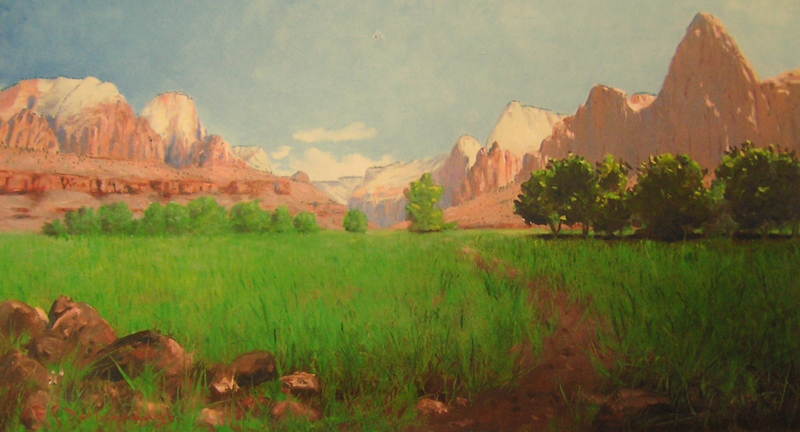
Zion Canyon by Frederick S. Dellenbaugh
Desolate summer ski hills are lush, verdant with pine undergrowth. Through an open ski lane, gargantuan Canadian flags billow. A park ranger sights us. I escape solo, just barely through a bush thicket. Trailing beside a river’s edge, where I once ogled at two young lovers, the Israeli sky burns with the beautiful bounty of original sin multiplying with infinity at every touch, every sight, sound, smell and every taste of spirit. The racket of espionage flutters in the newspaper wind. I heave a sigh, bitter with unrest.

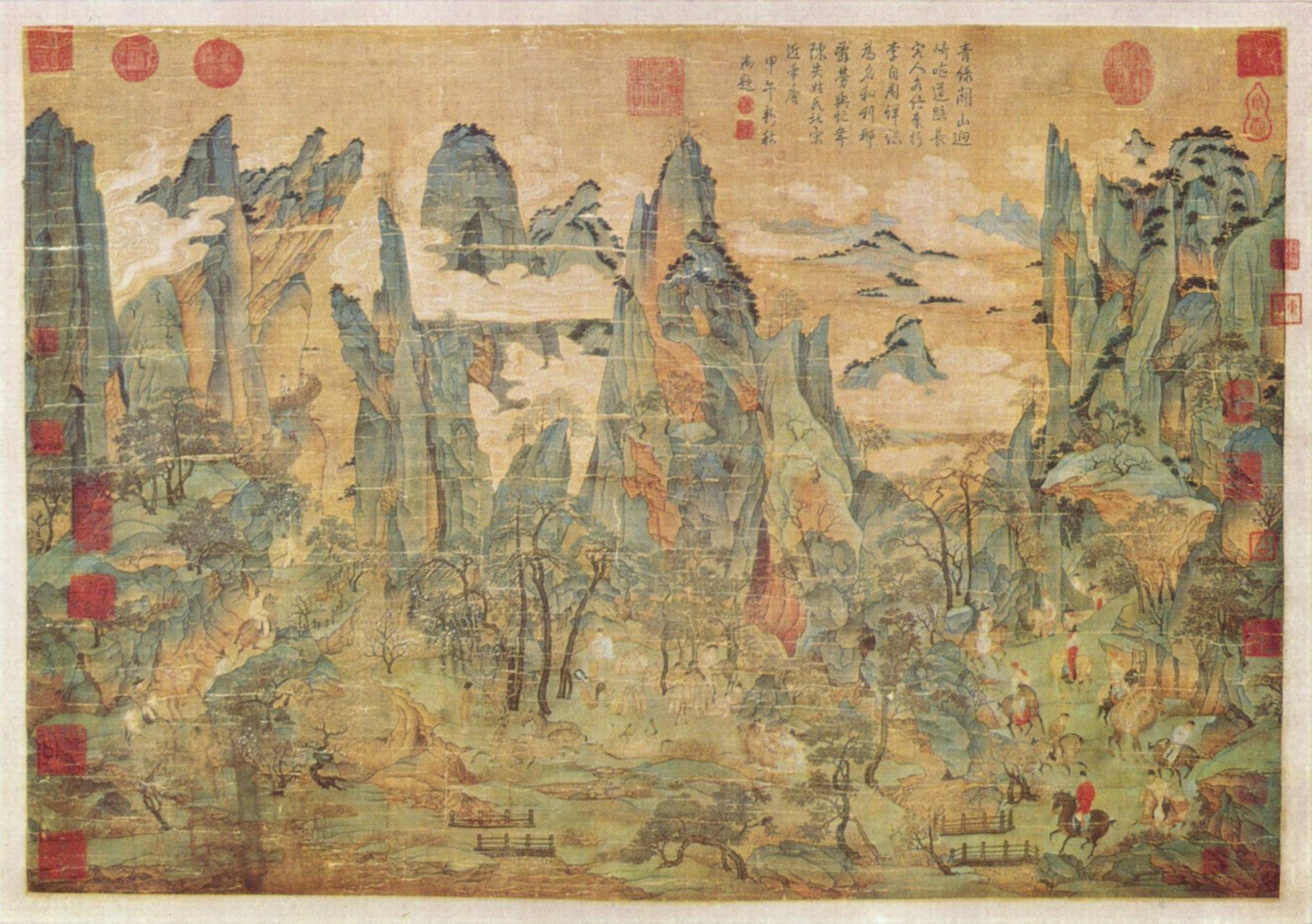
Fleeing to Sichuan province from Chang'an to escape the violence by Li Chao-tao
Nightfall, the shattered windows and shades of old Brooklyn stare with criminal rites. Anger seethes from the manhole pores of the upended city. A ruinous dearth of humanity bleeds from my open-strung heart down the spinal chords of a silent song: my jungle cage. Television home blink, flicker, there! The thief, drunk, with rapist eyes eyes mine concrete stone grounded roof possessions. A friend points-blank his rifled arm into our pitch fate. The silence groans with inner loathing, like a brooding cancer unknown, deep in the marrow.

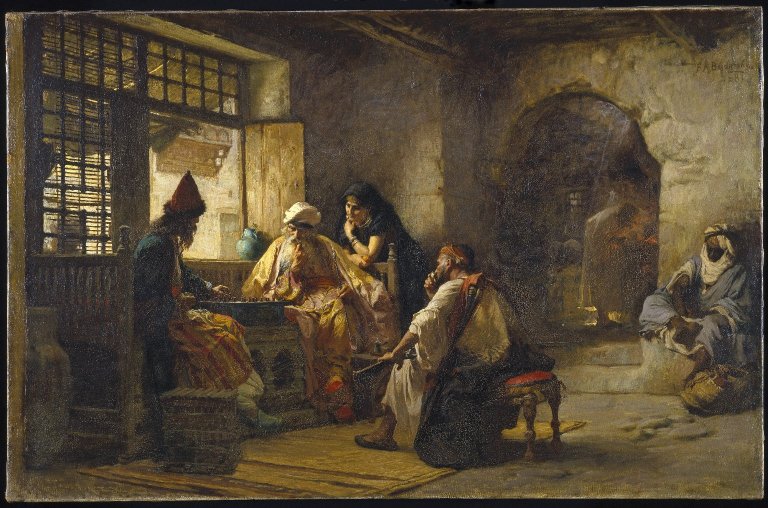
An Interesting Game by Frederick Arthur Bridgman
So, morning, we rise with the tide and board a ship set with haste. A vacant room, splotched with growl, we swung with the churning waves, a smiling rat-spawned day. The worst was over. America far behind, Zion of mind and heart derided in a momentary pause, to reflect on the Old World border of genocidal rampage, the forgotten wick, unlit on this Sabbath morning. Two friends, we disappear within a schizophrenic race. Evening fires glow soft with candlelight.

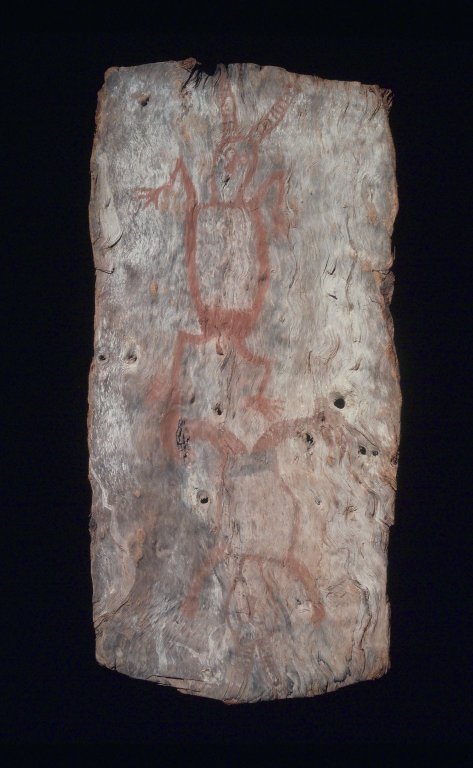
Painting of Dream Figures on Bark by Unknown
Tattooed mistresses, with raised skin, beset with the tribal bond of white scars breathe from lungs rising and falling under the most intricately carved bones. The monarch is absent. Bewildered, the ship sinks like a dead man, flooding as with the inverted pressure of the oceanic ambiance bursting outwards, into the wooden vessel of sleep and need.  
__________
A hyper-ambient, atmospheric guitar & voice elucidation on themes of the variance between the doer and the doing, subject and object, creation and creator. The vocal sounding contemplates the inner nature of human life as the most provident offering back to nature. To learn reciprocity with the entire universe begins by looking within. The word is a gift. "shaped by more hands" refers to the creative act as in step with the dream-notion, going back to Carl Jung, that 'I am not the only one in my house' or that the psyche is full with collective consciousness, that within us is all of us. All things issue through us by way of conscious intent.

In the creative arts, dreaming and waking often cross paths. Is speaking and thinking similar in psychic variance from that of dreaming and waking?This is the question I am posing in the aftermath of the creative process, which led to the track, "shaped by more hands". The question is meant for all to ruminate with thoughtless meditation, through a constant emptying of mind, towards a renewal of deeper intelligence beyond the egotism of intellect and apparent word-logic.


The chapbook, "Seeds and Roots" from the larger collection, Exotic Settlers, contains 9 poems on the theme of cultural metaphors related to heritage, ancestry and the myths and rites of collective human identity. Beginning with simple muses on Jewish cultural roots, I then embellish a transcendence of nostalgia through a regression of biological metaphors.

The root, with all of its instilled metaphors of stability, truly originates from seed. While reminiscent of the old chicken-egg riddle, the seed is a transient holder of sacred inner truth, ultimately leading to a grounded promise of settlement. Yet, in exploring a healthy and holistic mind of settlement, i.e. through the experimental writings found in Exotic Settlers, the more ephemeral or fleeting reality of origination must be kept close at hand. For, in Buddhist terms, the root is the middle way, yet the seed is that ephemerality from which we come and to which we go.

The selected piece for sound art / experimental music works, found on Evocations: Exotic Settlers (menachem.bandcamp.com) is "Shaped By More Hands" which I find to be a blissful rendering of the beauty of Wu Wei, or the Taoist philosophy of non-intervention with the flux of being and mind, where in the allowance of natural flow is the growth of the seed from the root to the flowering seed.


Monday, 18 March 2013

Evocations of the Urban Creator: When No Stars Appear, Voices Are Heard

Evocations: Cyclical Wordplay (album art)

“So, dear state, you are a very nice word from a dream. There are fine sounds in the word, much comfort and much freshness, you grew up in a forest of words…ashtray, match, cigarette butt, an equal among equals, but why state do you feed on people. Why has the fatherland become a cannibal and the motherland his wife…If the states be truly bad then who among us will lift a finger to prolong their dreaming under the blanket forever?” Allen Ginsberg reading the work of Paul Klebnikov’s Manifesto of the Presidents of the Terrestrial Globe

After hearing many songs and stories of the dramatic sights seen by survivors of the great natural disasters of the early 21st century; the tsunamis and earthquakes that buckled cities and civilizations to their knees, I have heard many refer to the reversion to a clear sky.

The clarity of sky is an enduring metaphor for the wildly obscuring potency of modern technological electro-civilization. What has been more subtle, and more dramatic a transition, is how the skies under our human settlements have become opaque and starless over the past century. In my mind, this is more traumatic and in need of reflection.

The stars and constellations are being called into the blinding stretches of the ephemeral; of human memory, abstracted through an archaic imagination. Beginning with the wealth of ecological terror that might strike any human being living in a modern Western city, who looks up to see that not only have they left the stars, but the stars have left them.

We are without higher purpose, the signs directing us to a sense of greater belonging in the universe have since faded into the mindless wash of electro-magnetic consumerism and the ecological disturbance of human egotism; a symptom of our technological worldview.
________
Lost by RK
Shadow of Mother Earth by RK
Gutless City by RK 
Wormhole Cafe by RK
Parting the Starless Night by RK
___________
The voicing, "When No Stars Appear" is an excursion through the faded mind, a search for meaning in the depths of human language, abstracted and diluted by the hotbed movement of inorganic noise, and the harmonious serendipity that emerges with the simple act of listening; the inception of self-knowledge, wherefrom the fog clears to reveal novel human experience, metaphorically illustrated by the final lines in the voicing. At the narrative resolution, a fugitive of modernity emerges from a waterfall consciousness of humility, as a child in a traditional Mayan home, looking up into the vast network of a more universal light. And the sounds of the starlit sky become a nightly renewing gift clarity, humility and strength. "When No Stars Appear" was originally published online by PressBoardPress in September, 2012.


Also featured in this post is the release of the chapbook, "Creating in the City" from the Cyclical Wordplay collection, to commemorate the release of another sound evocation! Enjoy!

Tuesday, 26 February 2013

Music of the Dream Author: Electro-Acoustic Improvisations I Release

Electro-Acoustic Improvisations I Album Art

Electro-Acoustic Improvisations I

Winded Keys Duet for Piano & Shakuhachi 

"Winded Keys" alludes to a number of esoteric meanings, the most significant conveys a personification of keys. A key is used to open a doorway, highly relevant for an opening track. The track also relays that in a sense, we are all potentially keys. Through deeply listening to people, they can become as a key, opening the most significant doors. The person speaking at the beginning of this track is a passerby, stranger, and seeming vagrant in a riverine Canadian city. He is a key to Love, yet he is winded by the turmoil of life, and as so, opens the doorway to a key, strung by piano strings, and spinning in the Shakuhachi wind. That key is you while you listen to "Winded Keys".

Northern Shelter 2 Movements for Xaphoon & Percussion

"Northern Shelter" opens with an optimistic frame drum and xaphoon, as a young traveler eyeing the horizon, knowing his loved ones are near, and his bed is made. He traverses the grandiose open that he knows as well as the back of his hand, and with music on his tongue, he enters home. In the north, long stretches of life throughout the year are homebound due to the chronic lack of sunlight, rapid change in weather, and intermittent blistering cold. While under cover of shelter, in the deep, dark of night, an opening of the subtle sky of dream invites human eyes into worlds beyond our greatest imaginative stirrings.

Desert Plains Waves for Darbuka & Xaphoon

"Desert Plains" dramatizes the imaginative soundscapes of any day in the life of a dweller in the "desert plains". The inspiration for this track lives in the landscape. I have spent the last six years travelling between and living in Alberta and Egypt. I have noticed that the desert dry climate is common to both ecologies. The high plains whereon the great civilizations of the Blackfoot Confederation once hunted buffalo and the Sahara desert, wherefrom the ancient glyphs that are the foundation of most living language scripts on earth (except Chinese-derived), are home to an incredible vivacity, enveloped in the mysterious paucity of life. The horizon is grandiose and welcoming, yet equally embracing. "Desert Plains" is essentially in two segments, where at first there is a rhythmic yearning to see beyond the open, and escape the blinding immensity of the seemingly lifeless horizon, then after a time, there is a soulful maturation into the melody of a whole person, rooted in the landscape they call home. In that transition, the harmonic register of the xaphoon alludes to "Caravan" by Duke Ellington, as the traveler sees the mirage of a caravan ahead in the distant horizon of the desert plains, and at once entering the fold, the apparition dissipates. "Desert Plains" is a solemn homage in defence of rootedness, in this our age of heightened mobility.

Inward Flight Sketches for Shakuhachi & Darbuka

At this point in the saga that is "Electro-Acoustic Improvisations I" the desert-plains dweller seeks the gift of a shaman; an end-blown flute. In a clearing, under the starlight of a new moon, the once traveler, now dweller, becomes seeker. At this point, the journey moves from outward-driven to inward-seeking. The journey within is a journey into the infinite. The Self is the immovable point, around which all subjects waver, orbit and grasp in eternal flux. Yet, this is the play of the universe. For the Ancient Hindus, the universe was play, or as they called it, Lila. "Inward Flight" illustrates how the inward journey is playful.

Cold-Blooded River Epic for Frame Drums & Wind

In his inward search, the seeker becomes seer. All that exists on Earth, all that humans have created, the vast plenitudes of universal form in life and art become as ephemeral as an unrecorded improvisation, played aloud to the spirits and muses of a seer rapt in a vision of death. Here, the "Cold-Blooded River" comes into focus, where a visualization not unlike the Ancient Greek River Styx is seen in a vision. As in a buddhist ice hell, the river mists with the deathly cold of a swift and unforgiving seduction. Will the seeker cross the river of death? "Cold-Blooded River" asks the listener that question.

Four Directions Moments for Darbuka, Frame Drum, Shakuhachi & Xaphoon

After making it across the "Cold-Blooded River", that is the river of death and extinction, our spiritual humanity sees the realization that a sense of direction goes beyond the cardinal points of seasonal, ecological and temporal occasion in life's experience. "Four Directions" unites the dream vision, or literal physical manifestation in the mind's eye with a more spiritual vision, which is more like a revelation of insight. In this sense, the "Four Directions" unites four primary instruments; darbuka, frame drum, shakuhachi and xaphoon, where each represents a unique way of seeing, yet no instrument of perception is more clear or true than another. The four directions, or the heart compass is set deep within every mode of will. South, symbolized in the darbuka, is of growth and warmth. The darbuka is the prime origin point of my current growth in music and the creative life. The darbuka is closest to my ancestral heart, as it speaks to Greek and Jewish music, where my blood rests deepest. North, symbolized in the frame drum, is of wisdom and endurance, because it is a humbling instrument, and used in many sacred traditions, for example the Persian Daf frame drum in Sufi ceremonies. West, symbolized in the xaphoon, is of introspection. The xaphoon, also known as the bamboo sax, is a new instrument, invented in Hawaii in the 1970s, yet it follows in the great tradition of reeded instruments. East, symbolized in the Shakuhachi, is of illumination and enlightenment. It is with the Shakuhachi, the renowned end-blown Japanese flute, that I often meet twilight. Breathing through the river-fleshed air, I keep a bit of that sunlight with me as the moonrise enlightens the depths of winter.

_____________

Original concepts formed after hearing the wax cylinder recording of Walt Whitman's voice reciting his poem, "America". An impromptu recording of street voices led to creating an atmosphere of the mood, feeling and soul that goes into voice, and the unintended harmonies of using our speaking voice. Instruments are extensions of the subtle body of the spiritual human form. When recognized as such, our voice speaks through them, as through us.

Electro-Acoustic Improvisations I is the celebration of voice through sound. After my first year as an incipient writer in visual form, my creativity bubbled and erupted with mysterious energy into a realm of creative visual stimuli, of spatial literature, of manuscript art, of asemic writing. Now, as I begin to record the sound of my voice, I first amuse in the imaginative spectrum of voice through instrumentation.

Electro-Acoustic Improvisations I is the first part of a seven track series, mirroring my process in seeing through a cycle of sevens in the creation of manuscript art and experimental writing. Electro-Acoustic Improvisations II will feature a single LP-length track in four parts. A collage from four of my currently finished manuscript artworks have been used as cover art.

Influences: John Cage, Brian Eno, Duke Ellington, Pharoah Sanders, Miles Davis, John Coltrane, Sun Ra, Jan Garbarek, Godspeed You Emperor, Hossam Ramzy, Vi An Diep, Ai Hagiwara, Walt Whitman, Jack Kerouac, street conversation, birds, wind, clouds, river, silence 

_____________

See other instances of my musical creativity on earlier recordings: 

Dream Music and the Creative Breath


Monday, 14 January 2013

The Voice of Youth: Stories from Idle No More


It was a Friday afternoon. I listened to the video above the morning of my phone interview with Rob Stewart. I had read that Idle No More was quickly becoming a global movement to follow Occupy with equal weight. It was time to dispel my own pipe dreams. I needed to see what may be the greatest current change movement for myself. 

It happened to be one of the coldest days yet in the brutal Calgary winter season when I began to ride my rickety bike south from the downtown core. Not only was it especially cold, but there was record snowfall the day prior. I tread forward, over the blinding snow, into the untended parkland trails ahead. Three hours later, I made it to my previously unknown destination: Prime Minister Stephen Harper's Calgary constituency. As soon as I saw the demonstrators, I was immediately shocked with disappointment. I stared, from my bike, over to the sparse crowd, filled with boredom and teeming with weakness. There were only a handful of people. The only time I attended  a demonstration previously, was when George W. Bush came to Calgary after his term as president. That was an incredible showing, one of the most emotionally exuberant and lively demonstrations I have known in Canada. I left, curiously pondering with a comic bent, "Do Canadians only protest in numbers when the issue is to oppose the States?" 

In the United States, where I'm from, I was a frontline demonstrator in anti-war marches to the Pentagon, "No War" rallies in Boston, and magnificent protests in support of Latin American resistance in New York City. A public demonstration is a place where the old and the young meet, to exchange hearts on a platform of free speech and free assembly with the naked flesh of human freedom. I stayed outside Harper's constituency only for a few moments, to place myself in the crowd, and continue on my way to a Metis friend's house to buy him coffee. The next day, my wife attended the more crucial demonstration. I've posted her brilliant story on Media Co-op.  

_________
The true war is now officially being fought in our backyard.

Things are lookin' up by (Kjarvik)
Before it is dark a light will shine through the clouds (Kjarvik)

May All Youth Live Free on Earth (Kjarvik)
There's nothing in your way (Kjarvik)
Heaven on Earth (Kjarvik)
__________
"Matter disguised as her unfolding paradise,
A genital incision, without

Brewed spawn all quaking and facing heart failure
With thick-rimmed glasses and a paranoiac daze,
A thin glimmer of repose
...

Useless triviality
In the maze of Puritanical property and stubborn consensual heavens
Drowned in blue time
...

Oceanward,
Where the thumb and nose meet at the spun wheeling whys,
Whose greed lurched from above the lily swamp and naked,
Pressed their white head to the diamond name"

excerpts from "Pulp Massage"


Friday, 7 December 2012

Climate Changes Civil Society To Support Dreamers


"This morning Munira Sibai, a Syrian-American student with SustainUs, delivered this speech on behalf of young people (YOUNGO). Although many governments could not be bothered to listen to their citizens, civil society was present in force: supporting Munira and each other in a way that governments can only dream of. Onwards." Earth in Brackets BLOG (Dec. 7 2012)

Tonight, as I drifted away, I read the latest Democracy Now! headlines on climate change. Civil society and democracy are shifting gears for full speed ahead as the human race confronts the most pressing issue yet known to humankind: A Warming Earth. 

Read the latest World Bank Research analysis on the devastating impacts of unheeded climate change warnings. At 4 degrees warmer, the science begins to frighten. 

Earlier tonight, as I cycled home, I met a bewildered fox. Scared and nervous, we approached each other. My fear suddenly transformed as I saw fear in the fox's eyes. I glided past carefully. I witnessed this incredible animal confusedly find an exit from the paved city pathways to the nearby riverbanks. I think of Native proverbs that ask, "who will speak for our beloved animals?" 
________

The candles are now all reconstituted wax. The rain boils and steams before it reaches its earthen ground. The sky is on fire and I need a new name.

In Peril by John Atkinson Grimshaw
Through my window of impoverishment, a sanded frame of dirt, I see tanks spewing the ire of mankind. Fire is the breath of unreason. Violence spreads across the land.

Miniature diorama in the Herat Military Museum by Marius Arnesen
Bombs and machine tracks seed great pocks of holes in the earth. The clouds are dark with soot and anger. Lightning cracks through the smiles of silenced memories. Families are swept away like dust.

Lunshunku battle during the Sino-Japanese war (1895) by Unknown
Fending off the soul-puncturing thunder of war, I flee through the bureaucratic maze of a police state. Warmongers drive their piercing insanity into my eyes, as I feel my way through back entrances and obsolete hallways. The border embassy shakes at the foundation. Our earth will be interminably scarred. We are equally victims and perpetrators of widespread ecological domestic abuse.

The Immaculate Conception, detail: Dragon's Eye by Giovanni Battista Tiepolo
In a vile trench of near-death urgency, I climb out, and into the sun of borderlands. Having escaped the eruptive core of my country’s open, bleeding veins of disintegration, I wade in scintillating wetlands. Vibrant green pasture, lily pads and low-lying bogs hydrate my contemplative sight.

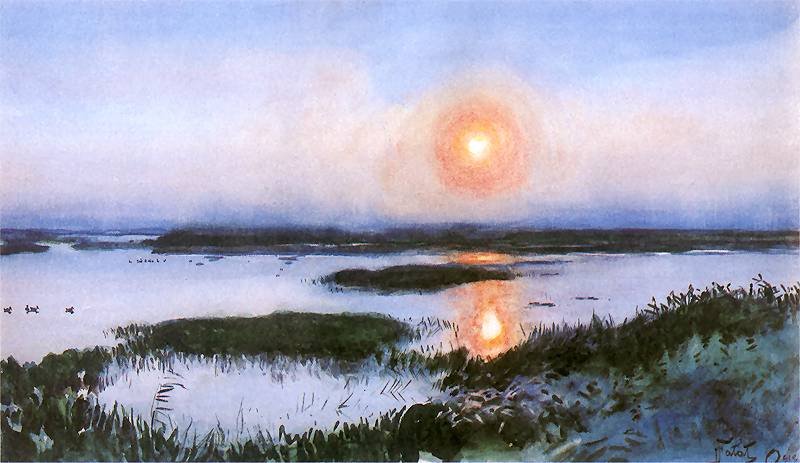
Sunset over wetlands by Julian Falat
I can almost see beyond the untimely closure of history. Birds and insects sleep with day, at peace, like me, in restful respite.
_________
"Escalations nerve-wracking, lonely murmurs murmuring

Crescent peaks dangling under bums grateful with uprooted membranous petrified and calcified flesh

Journey to roust the kneeling mind, with the desiring missed find, to be missed by nations feigning the patient behind swollen gum-brain awry, with skull-ache

“kinj moduls vrent speen og”

Desiring missiles
Desired missing
Failing nations

Patient fang"

excerpt from "Cajoled Spine-Tap"


Saturday, 25 August 2012

Reflection on "Last Night I Dreamed of Peace: The Diary of Dang Thuy Tram"


"Last Night I Dreamed of Peace: The Diary of Dang Thuy Tram" translated by Andrew X. Pham is necessary literature for every one who reads English. I read the first half of the book aloud to my wife, who was born in Saigon. After a series of waking with crying fits, she shied away from hearing the rest. Finally, I read the final half of the book to myself almost unceasingly.

The communicative brevity in Thuy's voice is indicative of her honesty, and her clear soul, of sonic vibrance in her words, imbued with such complicated emotion and sweeping literacy. With references to Soviet, French and Vietnamese literature, she affixes her personalized sentiment in historic immediacy as with the timeless genius of contemplative humanity. Her anger towards the imperialist aggressors, the Americans, is always buttressed by a stern will in defending the fight of her fellow brothers and sisters dying around her with the visceral intimacy that only a doctor would be able to elucidate with such clarity. You can almost feel her breath, and indeed, I was powerfully moved many times with a whole spectrum of emotions, as her intense character and youthful innocence enlightens even the bitterest soul with universal intention toward human grace.

Throughout the book, she calls on her dreams, both emergent in sleep and her daily life, and from those around her, pressing her on into the obscurity of the ruined jungles. Her dreams are shared dreams, and in that sense are a constant offering of refuge within, giving reason and stability to her tested mind, fulfilling her with inner community. As the book moves on through her astute witnessing, her dreams become increasingly present as she pours out her uninhibited thoughts with an awe-inspiring magic, reminiscent of the phenomenal dream world exhibited from her inmost reflections, as with the highest ideals of her united comrades.

I could praise this piece of literature on and on, by referring to its unprecedented impact on literacy in Vietnam, or the innumerable anecdotes which resonate with masterful purpose in the mind of the reader, as a daughter speaking to her parent with such loving presence, bridged only by the purity of the listening, however, I'll leave the rest to your own reading.

A family friend of mine is now making a feature documentary on the story behind the book called, "Finding Thuy" check it out, and remain aware of the dream legacy of undying peace from the Vietnamese heart of the world.
________
Off the plane, at the airport hotel in Vietnam, a troupe of American country musicians and a Malian music duet see the receptionist for their rooms. I sit on my luggage as my wife, in full regalia for a performance, shoots off through a glass doorway, unseen with the swift flap of her flowery dress.

After a bitter wait, she re-enters the lobby, sweaty as a marathon runner in mid-race. The performance is finished. My jaw drops as we board our flight, returning to Canada after the most instantaneous long-distance travel experience I have ever had.

And in our hometown, she lights a stage at a Chinese arts festival. Before her set, a glowing dance company exhibits the icy decadence of masterful classical costuming, their white-painted faces mirroring their paper fans. I eye the stage from afar, sitting with old friends. Then, she walks onstage, without her instrument. To the nervous curiosity of the organizers and select audience members, she begins to sing.

She is gorgeous, and stuns with an evocative elegance with the articulated genius of high emotion and well-trained harmonies. Her upper register fills the audience with recognition of the one mind, a fortuitous stretch into the harmony of collective being, as a sitting admiration of beauty.

Proud, I am ever separate, an eye afar, while with a heart imbued with hers between powerful lungs, emanating together, one voice of honest humanity. 

_______
Singing
"To hear singing in you dreams, betokens a cheerful spirit and happy companions. You are soon to have promising news from the absent." (iDream)
_______
yes, and woo over the sonorous
blush in the taste of her feminine blossoming
steaming with the cooled anger of Japan's cherry mind
in the sake spring of our zheng-doumbek interpretive madness
following the playful muses of a drunk and bold life,
granting wishes and boons to each other's heart homes
peaceful and sonorous
breast of ice silver purity.

- excerpt from "woo over the sonorous blush"