Primarily a writing exercise, this dream journal-inspired blog is a quiet introspective sojourn into the process that we traverse in going from private dream to public art. I see our dreaming as an internalized mythmaking. As I philosophize and expressively exhibit dreams, both private and public, I encourage and delight in creative language as a way to practice experiential metaphors through a “public dreaming." Writing Theory: Creative Dream Fiction
Showing posts with label humanity. Show all posts

Monday, 4 November 2013

Emerging Local Creativity: Literature, Music and Art Create Community

Matt Hanson, Calgary Working Group (photo: Drew Anderson)
"I want to work in revelations, not just spin silly tales for money. I want to fish as deep down as possible into my own subconscious in the belief that once that far down, everyone will understand because they are the same that far down."

“All human beings are also dream beings. Dreaming ties all mankind together.”


How did you get involved in trying to start a local media co-op?

I was corresponding with Montreal Media Co-op founder Dru Oja Jay and he expressed a kind of interest in the idea of a local in Calgary. I had been a member of the media co-op for about two years, the national. As I was more active, I was just more interested in what that means to be local. How they operate in Montreal, Halifax, Vancouver and Toronto — how they operate and what that might mean for Calgary. I started to put the word out there and it was very well received by Dru. He basically encouraged me to get together with others and talk about the idea and consider what is independent media in Calgary. Basically what I found is that many people are interested in their own projects, in terms of starting their own papers, but the difference here was that I was interested in connecting that kind of activity with a national co-operative site.

So, what’s set up right now?

Basically right now there is a Calgary Working Group as part of the Media Co-op and that has about 130 members, since 2009. All different kinds of stories have come from that. But in the past two years since I was writing with the Media Co-op, I found not many people contributing to the Calgary Working Group. I was just wondering about where is that understanding in Calgary in terms of this great engine of independent media and this source for people to get involved in media activity. So I went to different people who were involved in co-ops, like co-operative housing, and I talked about the idea and started to get it out there and I posted flyers and things about meeting with people. Initially I got three people that were very actively engaged in promoting and organizing the idea. Those were Melissa Manzone, she’s from Montreal but she lives in Calgary and she has a masters in journalism. Then a journalism student at MRU who has a certificate from SAIT in journalism and he’s still a student, and then another young woman named Chelsea Pratchett, who has done a lot of multimedia work — she has alternativemediayyc.com. Basically the next step was I applied for a small grant through the Arusha Centre, a Take Action Grant, that I received. I just started, DIY, working with Melissa who was editing articles with me, and also doing video interviews with people, and then through Alternative Media YYC I was organizing podcasts as weekly contributions. This small amount of funding is just an encouragement to the people here that might consider the idea of a local media co-op in Calgary.

How so? Would you use that money to pay them?

Yeah. The money has been used to pay contributors. Encouraging people with honorariums. To pay editors. To pay people organizing even. If they’re putting dedication into that, we consider that and we want to value their efforts. It’s a very free grant that I received.

How are decisions made? I come from more traditional media where decisions are made by editors. Who makes decisions in a co-op?

I’m really learning myself because I’m new to the co-operative sphere. But I’ve been really trying to figure out in terms of how the application of the co-operative organization works in relation to this. How we want to organize it is in a way that everybody has a share of the company, the collective. For me, this is really a learning process, in terms of how a co-operative organization works. Part of the funding I received, I’m putting into going to a conference to learn about worker co-operatives in Edmonton. Part of the forward process of this idea is really generating that structure. Right now, we’re at a very initial stage.

Why do it? A response to the media that exists? Do you think the media isn’t doing its job?

I think, to me, there’s that. I don’t want to be too reactive. I think it’s more about having a sense of imagination and taking things into your own hands, and really learning by doing in a way where the kind of media that I want to see is one that doesn’t just tell you about something, but incites you to action. The page is not the end of the matter.

So more of an activist slant.

Yeah, more of a fact that this is part of being more involved. Journalism should be about being involved.


This piece, also published for The Media Co-op, is an excerpt from this week's Your Face Here interview featured in Fast Forward Weekly on October 31
________________
War zone. Huddled under protection of stone, the dusty clamour of steaming trucks file past, carrying explosives, ammunition; the all-potent death of armed men. The sky burns under a 40 degree desert sun, magnifying the light of illusion with the bitter disbelief of guts strewn in the angry heat. The moonlit fox scatters beyond the floodlit path, and I sit, knowing I'm under the eye of a flagrant bomb pattern, patiently scanning the sky for my fate. 
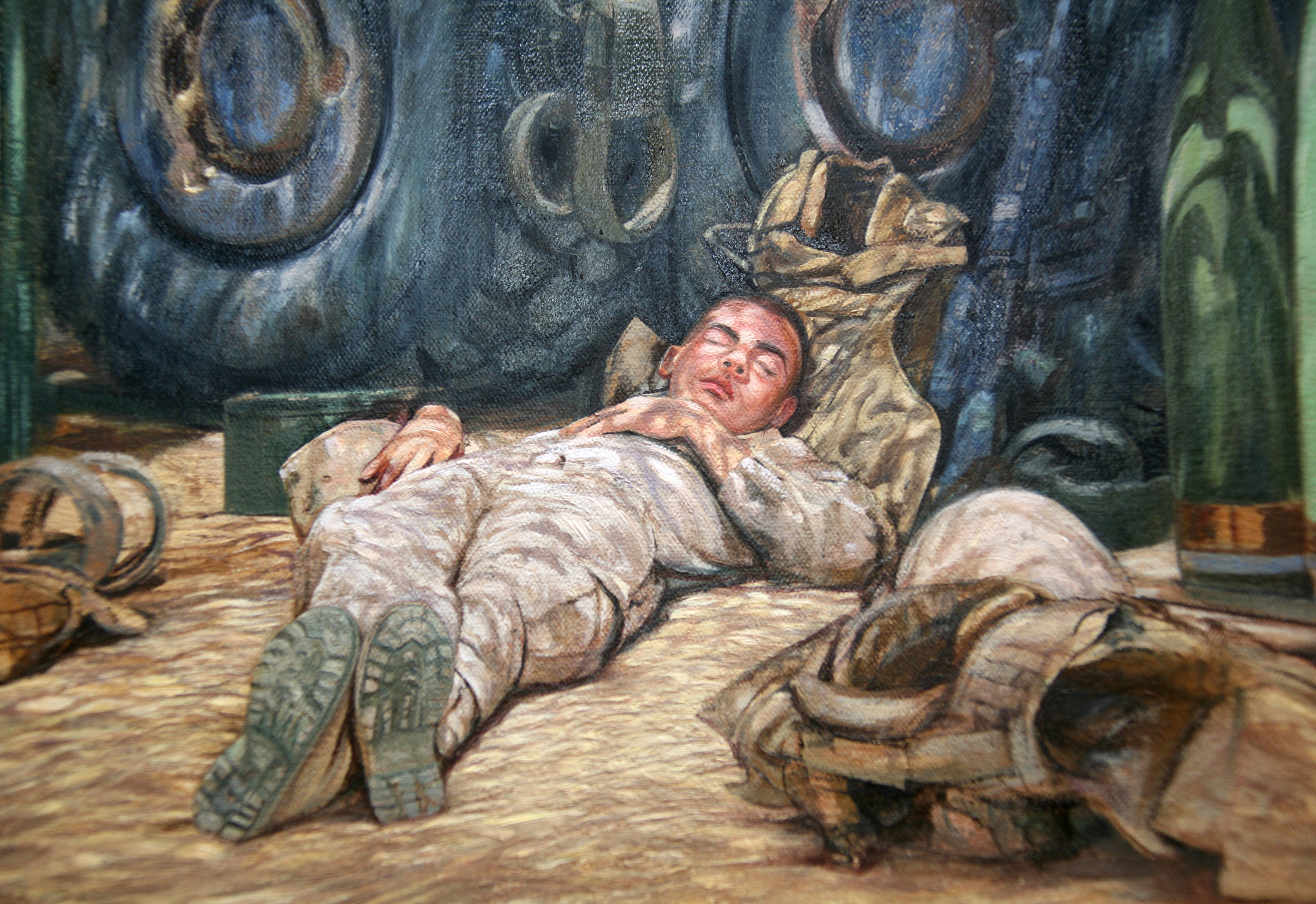
Cpl. Alicia R. Giron
Down the gravelly road, an older man, built strong and lean, walking assuredly through hell's gate. In this valley, the shadow of death casts invisibly, as the omnipotent fear, that cutting vibration that pierces as it electrifies. Every last medieval hell of our wildest imagining is child's play in comparison. The daytime moon fills my mind, obscuring the passion of escape into the dizzying architecture of mythology, roasting in this Middle Eastern world fire.

Collateral Damage by James Miller
The black fly of fire-bomb death squeals past overhead, and I run, sliding my fingers along the desert rock, the stone crumbles into rough sand. My fingers, mysteriously blackened, feel into the stone. A black liquid seethes. Viscous, thick, it's oil. I realize I can't leave. The desert spring overpowers my body in a storm of evil lust. I treasure the root of all fleshly worship in this age of fire as the swarm of madness overcomes, and in a blinding instant, the stone implodes, my hand flits to dust, the Earth gives way to pools of ash, and I sink in the quicksand of eternal war, condemned to modern night. 

On the Impacts of the Iraq War, Read COMMON DREAMS
_____________

For an ecstatic and mesmerizing experience, listen to this album while watching SAMSARA. There are new waves of sound yet to break on the open mind who might stand to listen on these ancient shores.


Delighting Destiny: Selections of our best during a live performance with audience. All proceeds from this album sales will go towards producing future performances and future recordings. Thank you for your continued support.

Monday, 10 June 2013

The Value of People: Voices of Struggle and Creation in Western Canada

Crystal Lameman - Conference 2013 from Public Interest Alberta on Vimeo.

"Enbridge is so poor all they have is money." Wet'suwet'en hereditary Chief Na'Moks of the Tsayu (Beaver) Clan

"Living in an impacted community, in the frontlines of the Tar Sands, we get so caught up in our own issues that we forget about human beings, Indigenous people on a global level." Crystal Lameman of Beaver Lake Cree Nation on Treaty 6

The crowd cheered to the tune of ejecting the filthy rich from Calgary proper, the"most unequal city in the country" according to the University of Alberta’s Parkland Institute. Well over a hundred people crowded into a sold out hall at Parkdale United Church on a favorably tepid spring night. The beginning of the 11th Annual Public Interest Alberta Conference, “Fighting For Our Future: People Power versus Corporate Control” opened with investigative journalist Linda McQuaig, author of The Trouble with Billionaires. In a bygone era, the audience would have grabbed pitchforks on their way to Mount Royal Village.

McQuaig began by invoking the economic history of Canada. 1940-1980, also known as The Golden Age of Capitalism, when economic growth was widely shared, crystallized in the “social contract” to curb classist polarization through high taxes for social programs. “That’s the period of greatest economic growth in North America that we’ve ever had before or since,” said McQuaig. “Average income was doubling every twenty years.” The result was a society looking forward to increased leisure time.

Before tax cuts for the rich became an institutionalized affair, public wealth was palpable. “There was no trickle down,” McQuaig said referring to the propaganda of the 1% in favor of neoconservative economics. “In fact, there was a gushing upwards. All the income gains since 1980 have gone to the top ten percent, and particularly, of course, the top 1% and the top .01%.” Factoring in the inflation, the median income in Canada is lower than it was thirty years ago.

Where did leisure time go? The Conservative government of Canada has set the retirement age back two years. “That economic dividend went entirely to the top 10% and the top 1%, that’s where you’re leisure time has gone,” McQuaig pointed out assuredly. “Economic equality, the progress has been stopped dead in its tracks.” One solution is a wealth tax, especially in Alberta where the Heritage Fund is $16 billion in comparison to Norway’s at $700 billion. Federally, Canada saves exactly zero dollars for a rainy day.

Research on a “millionaires tax” by The Globe and Mail illustrated how a one percent wealth tax imposed in Canada by 2020 would cover all federal and provincial deficits. The Deloitte Centre for Financial Services projected the number of millionaires in Canada to rise to 2.5 million by 2020. Yet, in contrast to Linda McQuaig’s warning to Albertans that the rich will leave if a wealth tax is implemented effectively, what she did not warn is a far more sobering possibility. “But it’s easier to defer taxable income than to move,” Neil Reynolds wrote on October of 2011 in The Globe and Mail. “When you levy disproportionate taxes on the rich, you serve eviction notices on the poor.”

Referring to the income of the American sub-prime mortgage beneficiary John Paulson, “In what moral universe is that hedge fund manager worth 82,000 nurses, in what moral universe is he worth even one nurse?” McQuaig exclaimed to a bright wave of laughter and applause. “Today’s corporate elite and wealthy elite, has not only the power to wreak havoc on our lives, but to actually destroy the planet, because of the modern technology and the human capacity now for destruction.”

READ MORE (4580 words) @  Public Interest Alberta, The Media Co-op, IndyMedia & Readers Supported News

LEARN MORE @ Tar Sands Healing Walk
__________
“What’s that smell?” I could see his thoughts writhe like a cold snake. My bedded flesh, wrapped in fallen hair besmirching the unwashed blanket coiled around my nude body. Eyes went crooked. Noses were covered. I stepped barefoot over the austere, carpeted floor, civilly, in line. The teller remained a smile, famously in keeping with the workaday service kitsch of probable positive personality. My own face with mirrored emptiness. “Next.” I bloomed overfull, with gold coins. Prosperity is a mark of weight and valor.

Earthbound by Evelyn De Morgan
“Be stilled.” The Earth shrank under dim folds of burly disgust. The masculine prowess burrowed in the vainglorious poverty of inhuman disguise. Artifice and loss, nature spun with fire and bones fleshed with greed. Concrete paralysis, the wading gush of darkness floods this garden of hate. Alone, I scan the tramcar, brushing past the ire of misbegotten wards, floundering hands warmed in the blue flame of intimate ruin. Silence grounds, but for the rumbling dirge of the railway, clattering like a mad skeleton, of deadly fear. A ghastly presence, my reflection, I turn.

 Casella Rail Stuttgarter Platz by Otto Schmidt
Of large girth, unknown terror unseen, unheard, the unassuming weight of an unreal body: HER. A heavy-set African woman of eyes, sitting, a rock entrenched in my spectral pallor. Looking through staring eyes, the mutual end of oceanic reflection. Hitting through to rock bottom, as the ocean-floor seethes with the volcanic murder of all that rests atop the ground of life, I saw through to a fear; unknowing. There is a fear beyond the nerve, beyond the knock of bones, and the bristle of hair. I have seen her, and vanished before a breath.
__________

The album, "Evocations: Exotic Settlers" is an evocative musing on the sound language nestled deep within the poetic substance of orated selections from a collection of works under the same title. In continuity with the theme of "exotic settlers", the album is an experimental narrative-sound art exploration into the imagination of a journey of settlement, both archaic and modern.

Here, voice soundings are mixed with one instrument at a time, to convey a sense of the traveler, whose light pack is ideal for the road ahead, and whose voice traverses the simple grandeur of sonic revelry from a single instrumental accompaniment.

Themes of travel are juxtaposed with settlement, both in the settlement of tradition and ecology, and the inner and outer journey to that destination. To settle on one instrument at a time is a metaphor for the inward/outward experience of settlement for the migrant, who eventually becomes an "exotic settler".


Exotic Settlers charts the journey of experiencing the naturally transformative process of ending a period of transitional residence, and beginning to live in one place exclusively. Questions of home, travel and what is foreign are approached creatively through a lens adjusted through self-reflection on these themes, which led to my own "settlement" within. As I have become more permanently resident in a specific place, I have realized that earthly geography flows with the transient impermanence of nature itself, and that the only true settlement is in one's heart.

Monday, 15 April 2013

History and Humanity: How Self-Awareness Leads to Reconciliation

Mary Wollstonecraft Shelley and Percy Bysshe Shelley by George J. Stodart
"No more let Life divide what Death can join together." Shelley

"We cannot continue to be recognizable and survive…if everything you know is wrong, then all the problems you thought were insoluble can be framed differently. And there's a way to take the world apart and put it back unrecognizably. We don't really understand what consciousness is at the really deep levels," said Terence McKenna in an interview for bOING bOING #10, to hail the oncoming psychic transformation of humanity in the 21st century, also known as the post-2012 New Age eschatology. 

Yet, historically, we have ever been unrecognizable when we look at interrelations between human societies, especially with regard to the European saga of colonialism and the institutionalized racism that followed (and arguably continues) in its wake. People from other continents, the Native, Indigenous peoples of the world, most emphatically Africans, Australians and Native Americans (from both North and South America), were for a considerable portion of history considered an inferior race, a subhuman species likened to earlier primates less developed than the European genus. 

As we have now begun to recognize ourselves wholly, all of humanity included, through science and reconciliation with our inhumane past, the challenge now remains clearer than ever, for it is our own selves, the Self of Humankind that is in need of development, and not any other form of life. So, we might ask, might we grow up from the childish state of irresponsible resource waste and join the community of life on planet Earth, or become extinct. As the human family becomes recognizable, next the whole of life on Earth must be recognized as our own self, as the body of a relative, and until it does, and we remain unrecognizable to ourselves, there is catastrophe as we straddle the line between dominance and extinction. 

Interpreting the above quote by Shelley in the last line of the third to last stanza of Adonais, An Elegy on the Death of John Keats, essentially reads as "don't let life get in the way of dreaming" where the diversity of life, as it manifests in the human family, a wealth of ethnicities, spiritualities, and physiques can be seen not as a source of division, but of connectivity. And so, as I write, this the capital city in the state of my birth, Boston, has allegedly been bombed. In such times, it is ever paramount to instil the meaning of reconciliation within the human family. Peace studies author and professor George Melnyk recently shared with me the simple notion that "That's what happens in war, you define an enemy." And, so, with our nation(s) at war in the Middle East, and the "enemy" at hand, we can keep vigil with the caution that we should not jump to quick conclusions in our search for vengeance. 

The crossroads of human life in the 21st century divides Humankind between himself and the planet; the potential of nuclear fallout and the immanent ecocide with the unabated burning of fossil fuels. The struggle to survive as one, whole being, as a united humanity, is to be fought at our doorstep, and we must remain strong not to waver from our ultimate direction towards peace through reconciliation. See the documentary by Chris Hedges OBEY, at minute 22, where he writes, "Resentment against a disenchanted secular world will find deliverance in the ecstatic escape of unreason." Let this unfortunate incident be an opportunity to empathize with those who experience bombings on a regular basis as part of our government's foreign policy, as opposed to perpetuating violence through self-pity and aggression. 
_____________
A stone-bedded homely abode of five rabbis, all with simplicity and humor muttering of their bearded visage, they meander from home to a day’s work in the predawn night. I, a furtive wraith, clandestine in the dim corner, emerge to observe the floor-set scribes and their flowing fountain of wise austerity. The dusty air breathes sanctity unknown to most, yet from the window a flicker of artificial light breaches the soup of mind with Maras of temptation, apparitions of the female sex, flaunting a shadowy tint of flesh. I trudge outside, unencumbered by the pleasures of the intoxicating sights. We are at war.

Titus destroying Jerusalem by Wilhelm von Kaulbach
The direction of sight is clear. The enemy is known, and our targets destructible. The air is thinning of passion and feeling, to make way for hate. The true victim in this war is Earth. The all-out industrial fire has spurred on the makers of enmity under a veil of infinite resource. Brothers, sons and fathers bleed with for the ground on which they are laid to rest. The backdrop is far-reaching. There is a sense of humor in this war.
Toronto Rolling Mills by William Armstrong
Foregrounds blur into modernity, as a civilian is murdered, shot in the back, running towards us. Iraq is not Germany. Civilian and army are a rough and indiscernible duality. The cold smoke of hate becomes the backwash of sanity as soldiers and men secrete their pain into the willful triggers of deadly remorse. I, a photographer, capture the minutiae of existence full-born in the surviving families of Earth-bred singularity. Modern natives, the indigenous, bold eyes of people, now the last grave on which an unmarked praise still glorifies the vanity of war and power. Massive trucks crack and sputter past me, with so much gun, bomb and shell materiel that my knees weigh fierce into the concrete below. Rushing past, the soldiers reveal faces of bleary sweat and stinging tears, flowing from a smiling façade of youth, their graying eyes grow cold with fate as my photos are ignored.

Collateral Damage by James Miller 
When we declared war on Earth in WWII, the invasion of Iraq granted us full impunity as we commit the last atrocity on the only lasting connection humankind might instill from Earth to the mass of societies born and bred of global war. They line up, shaman to farmer, hunter to midwife, storyteller to seer, a community of global wisdom, attuned to the lightness of being, as in the creation stories of practical love. And in their firing squad, they choose to sit, meditating on the gun-barrel of unsightly loss – the drifting eyes of hate and need merge.
___________
After a cumulative process of self-publication, a DIY attitude of writing and publishing often spreads into the realms of experimentation and exploration with all aspects of the creative process and, especially where self-publishing is concerned, into self-innovated and creatively conceived avenues for sustainability.

Art is the "divinely superfluous beauty" as Robinson Jeffers says, however the artist is inherently tied to the whole of life. For this reason, I have decided to experiment with monetary value as a way to further understand my self-published works and the general field wherein I am situated as a self-taught creative artist active in a variety of artistic disciplines, with special regard for the overlap of media, thought and art.

Please join this conversation as society embarks ever on towards greater connectivity between the sacred, the communal and the entrepreneurial; that all three may one day join in a vision of society directed at once toward pragmatic utopia, while mutually creative and destructive, or better worded as discerning, in its ability to see and create potential.

I will still be offering the full collection online for free viewing, however, I have added the option of supporting the artistry exhibited by none other than the Dream Author. Jah!


Opening the page to experimental, improvised writing which emphasizes and attempts a most strict depiction of the spontaneous nature of mind can be perceived with harrowing aspiration in the realm of continuity, that is flipping the page, and its mystery, that is interpreting the language. As a forewarning of sorts, this collection of writing, as devised for readership, is the result of an editing which has purpose in giving the spontaneous flow of mental activity form. While attempting to convey the refreshing action of letting go, all structure and boundary and, in sense, constructs of mind are dissolved.

Created solely by one human being through "One Shot" intuitive improvisation stylings, Evocations: Cyclical Wordplay is the completion of a creative cycle of renewal, regeneration and return to the primary source of visionary inspiration: voice. With due reverence and respect for the infinite diversity of vocal and verbal forms among the worlds of the living and the dead, I hereby speak directly from the heart. Here, in these soundings, I am re-conceived through the mouth of the pen in all its power to amplify and obscure.

"Evocations" is a practice in contemporary experimental narrative, as opposed to the traditional conventions of spoken word. The poetics of oral storytelling are alive through soundings for the muses of voice in all its forms, whether in the tongues of wood, metal, plastic or flesh. The language of unity speaks through every medium.

Monday, 8 April 2013

Genocide and Extinction: Reflection on "in my dreams" by Mercedes Eng


"Whether this satirical inscription [PERPETUAL PEACE] on a Dutch innkeeper's sign upon which a burial ground was painted had for its object mankind in general, or the rulers of states in particular, who are insatiable of war, or merely the philosophers who dream this sweet dream, it is not for us to decide."  Immanuel Kant, "Perpetual Peace"

When I first read "in my dreams" by Mercedes Eng, on Geist, my heart pounded with the animate high of a synchronous intellect grounded with a feeling of urgency.

This piece illustrates the symbolic intersection of a pipeline as physical obstruction on the body of our Mother, as on our body. And to follow, the incarceration and de-legitimization of those voices and lives whose source of energy derives from a more profound and lasting than those harvested recklessly by government leadership, and the knee-jerk automaton droves of apologists, apathetics, pessimists and belligerent supporters of environmental crime. 

We have traversed the oceans and landscapes with a smothering footprint. In the wake of the wholesale devastation of First Nations communities across the country, it is the entirety of humankind that is next on the list of the entrenched ignorance of those who ignore science, who ignore civil society, and who ignore their own innate sense of empathy for the sake of power politics and saving face. 

When the source of a disease is unknown, for example lung cancer from smoking in the past, the individuals long since die while courts and politicians wade through policies and promotions to effectively prevent further death. Smoking is an especially useful symbol too, because it exhibits a problem with consuming that overrides even the strength of knowledge and law. People still die from smoking, just as we die from ignorance. Besides the individual death of one person, or even the genocide of a specific group, the extinction of our entire species is at hand when we talk about the continued, unabated burning of fossil fuels. 

Ocean acidification is the cause of five major extinctions on planet Earth, and the CO2 levels in our oceans now are rising at an unprecedented rate. See the work of Charlie Veron, the 'godfather' of coral and other scientists. The only way to prevent ocean acidification is to stop burning fossil fuels. Yet this time, we are realizing that we are essentially all one body in this fight to curtail the disease of overconsumption, overexploitation of non-renewable resources, and when it dies, there will be no lawyers or politicians left. In the 20th century, we faced the facts and prepared policies to prevent genocide. In the 21st century, we face the extinction of our species, and we are all at fault. 

Internationally, Canada is now a partisan country, we support other nations on their ventures into say for example, Afghanistan, based on exclusive measures of concern. This reflects within the domestic sphere, where representative leadership in government merely reflects a narrow margin of society. Those who are not aligned to the dominant mode of power are marginalized traumatically.    

We can remember the words of an assassinated democrat echo into the future, "Our children are still taught to respect the violence which reduced a red-skinned people of an earlier culture into a few fragmented groups herded into impoverished reservations.” JFK

To encourage ecocide is to choose extinction. 

Be aware: Oil Man and the Sea, Revolution (Film), 350.org, Earthship Biotecture
___________
Struggling lone uphill through the barren rifts and scarred desertification of Judea, I look out from an outcrop towards the Sea of Galilee. Scanning feline eyes growl and hiss in the unkind wilderness of the famed Israelite passage to divine promise. Yet, here where the last suicidal stand of Judaic tradition withheld the Roman tide of enslavement, I grapple.

Tiberias and the Sea of Galilee by Emile Rouargue
The rocky earth tumbles with rolling quakes, as an avalanche of boulders careens beyond a nearby patch of scree. The earth teems with deadly fate, as I climb on, and reach the summit of sacred space.

Mount Tabor by Emile Rouargue
Under a cloudless sky, I phone the United States, to hear the short-toned speech of my elderly grandpop, hunched over a sandwich and remote in the old Jewish-American neighborhood of secular tradition. To my increasing surprise, he had been on the phone, yet with a late dignitary of American war, Ike himself, Dwight D. Eisenhower, the once commander-in-chief of North African forces in WWII, where my old pop first entered active service.

The Bully of the Neighbourhood by John George Brown
Pops welcomes me to cross lines and speak with the former president. Nervously, my voice reaches for sanity and order, with subtle interrogation, I chance a question over the unsettling silence, “What is your favorite book about WWII?” I ask, with An Army At Dawn in mind, as I’m currently in the middle of it. “I don’t much read any book of the kind.” He breathes a deep silent resolve, of little words.
___________
"Repeated Dance of the Fluid Earth" is an experimental narrative that plays off of American colonial history as a body of water, rippling throughout the waves of history. Cultural memory is as fluid as water itself, where consciousness may be revisited with the slightest alteration, leading to an eventual holistic transformation.

"Repeated Dance of the Fluid Earth" utilizes frame drum and shakuhachi together with synth beds to create an ulterior perspective in the retelling of popular history through a gendered and ahistorical mode. This also plays into our ecological history as a species, and how the ability (or inability) to listen to our story, as our voice, is similarly the story of our relationship to ecological knowledge, and how the fluidity of place with regard to land-based settlement is as dramatic in its shape-shifting nature, as the fluidity of place on a sea-based settlement. Simply put, the modern political notion of "settlement" is a myth.

In the era of consumption, we posit a sense of material as objectified by the consumptive attitude: that things are to be consumed, used, manufactured, wasted, eaten, assembled, etc. as opposed to a creative attitude, where all things are in flux. So, with regard to the battered histories of genocide and ecocide, "Repeated Dance of the Fluid Earth" asserts a revivification of the solemn bliss of knowing where we stand.


As the entire collection "Cyclical Wordplay" from which the chapbook, "Visitations" is derived, centres not only on the cyclical wordplay of language itself, but the travelogue of a cyclical journey, tracing the meaning of traveling abroad to returning through domesticity. The selections in "Visitations" recount the final step in that return, where after "A VIsit to L.A." the cyclical resolution leads to a transmigration of values. The final step homeward from a long season abroad, exhibited in experimental narratives, eventually transforms one's relationship to language, place, and meaning. The conclusion is a prelude to welcoming "other" visitations.

"Repeated Dance of the Fluid Earth", featured in "Visitations" was published in the Rusty Nail December 2012 Issue. The release of the "Visitations" chapbook on Scribd, goes together with the release of "Repeated Dance of the Fluid Earth" a spoken word narration on www.menachem.bandcamp.com


Monday, 11 March 2013

The Art of Freedom: 2 Years Since Fukushima in the Post-Scientific Era


"The existence of nuclear weapons means we could potentially create a disequilibrium, an imbalance, on the planet and the atmosphere by the launching of some of these systems, some of these systems. There are 27,000 of these systems. This is more than enough to wipe out the whole planet. You also got people working to say, 'you know you gotta save the planet.' Well you're right, we've got to save the planet. And so the whole environmental effort, as laudable and as absolutely critical as it is, can be for absolutely not in the space of hours if these guys actually went at each other." Lt. General Romeo Dallaire (Ret.) Pugwash Canada

Today is the two year anniversary of Fukushima Daiichi disaster. In my previous post, Hatsuyume of Peace, I kicked off a new paradigm in the life of this blog with reference to the apocalyptic transition that nuclear energy essentially means for life on earth. This is an enduring creative metaphor, a source of reflection that begs to be heard and never left in the silent empty ignorance. For, as the unrivalled Persian poet and filmmaker Forugh Farrokhzad said in her landmark film to inspire Iranian New Wave Cinema, a groundbreaking force of thought, emotion and impeccable insight, "There is no shortage of ugliness in the world. If a man closed his eyes to it, there would be even more." Her film, The House is Black is about a leper colony, and the humanization of treatment for a disease that simply requires attention. While the impacts of a nuclear disaster do indeed course through the blood and infect the children of the victims, there is even more recourse to action, to look, and with the kind of remembrance that breathes in the present moment, to see the eyes of the victims as through the eyes of our own children, our own mothers, fathers, and siblings. For there is evidence that it could be forty years or more to clear up the Fukushima disaster, which is the worst of its kind since Chernobyl. The transition of nuclear energy as a weapon, the atom bomb, has essentially moved the world from the era of World War, into an era primarily defined by war over intelligence, the post-cold war era. Vietnam is an example where the government authority of the United States actually never declared war, incapacitating the ability to detonate another atom bomb on a human population in Asia. We are now living in the post-scientific era, and the Age of Reason is long past. Our existence is not defined by scientific knowledge, but of technical know-how.

On an investigative bend, I took the time, as part of the research praxis of a literary arts journal, to go to photographer, Arthur Nishimura's exhibit, "Dream Country" at the largest university in town. In the exhibit, Nishimura creatively interposes landscape photography with prepared or rendered film. I went for the purpose of interviewing others who happened to stroll through the exhibit about the significance of today's anniversary remembrance of Fukushima, not only as a Japanese disaster, but as a world disaster. What do the photos of a globetrotting Japanese nature photographer say about the remembrance of Fukushima? My questions, and my approach to a conscious public as an experimental journalist fell on a silent room. In the last hour of the gallery's opening today, not one person visited Nishimura's exhibit. Instead of heading into abstract philosophic directions regarding the nature of public ignorance, I peered deliberately, patiently and acutely into the breathtaking symbology of a master photographer.


Let me take you through an abbreviated version of the exhibit, and how I related my experience of "seeing" to the memory and lasting impact, and future legacy of Fukushima. Firstly, Nishimura's piece, "The Book of Flatland Dharma - Of Two Religions: Conclusion" (1978) captivated me. It is a juxtaposition of a sacred Japanese temple, as a diptych next to a silo in the Alberta countryside. This struck me first, because Nishimura captures the elegant majesty of mystery and beauty all over the globe, yet Japan and Canada have sacred significance, yet the cultural dissimilarity could not be more clear in the way that aesthetics are a reflection of social expression. Next, in his Homeland Tourist series, "Higashi Honganji Temple (1978) flattened me with its elusive doorway of symbolic insight. The bicycle in the foreground, outside of a sacred temple in the background, emphasizes that while there is a sense of the infinite within us, we are after all impermanent, and as we ride the mundane bicycle of worldly experience to its end, the higher awe of spirituality lives on, with or without us. Finally, while there were others that struck me uncannily, I will leave off with one last one that took even more time to set in than the rest, however after peering into its silvery textures, and its striking imagery, I latched on to a hint of perennial truth. The work, "Pre-dharma Sentience" (1978) in The Flatland Book of Dharma - The Singularities series, a stone lies in the foreground. In the background, an open landscape, with a path leading to the horizon, to nowhere. What this says to me is that, essentially nature, as with our nature, is fundamentally meaningless. Nature, in its raw, open and original forms do not offer the human heart a rest stop on which the mind may imagine and conceive a reason for being. The meaning of no-meaning is the great point of flux in realizing our humanity as vulnerable, fleeting, and if at once emergent with direction, also futile and unimpressive. As Paul Valery said, "God made everything out of nothing, but the nothing shows through."

On my return home, on this unusually warm Canadian winter day, I read a very short Associated Press article buried in Metro Calgary on the legacy of Fukushima. In the article, 'Outlook bleak two years later' a quote read, "Everyone, from bureaucrats to construction giants to tattooed gangsters, is trying to prey on decontamination projects. And the government is looking the other way," said Nakamura, who refused to give his first name out to the press for "fear of retaliation". As I reflected on my train ride home through the downtown corridor, passing above rivers of melting ice and the glare of the profound midwestern sky, where the rich sunlight exposes the midriff of an aging humanity, I had a realization. Being human means taking the responsibility that we have as stewards of the land, as a conscious potential unmatched in the known universe. If we do not take responsibility for being human, then there will soon be no more human beings. We do not write the highest law, and we can not speak the highest truth. 

____________
She sets the stage with a sweeping introduction. In the impeccable garb of a beauty queen in love with life. The public gushes with heart-sleeved pandering. The world is set like a red carpet before her.

Queen by Sten Porse
The musical ambiance, the tone, is grandiose and emergent as the Jonah-swallowing fish of all-conceived breathtaking wonder. Her introduction is the mindful worship of momentary repose, for the elemental truths to seduce all through her sonic dance of grace.

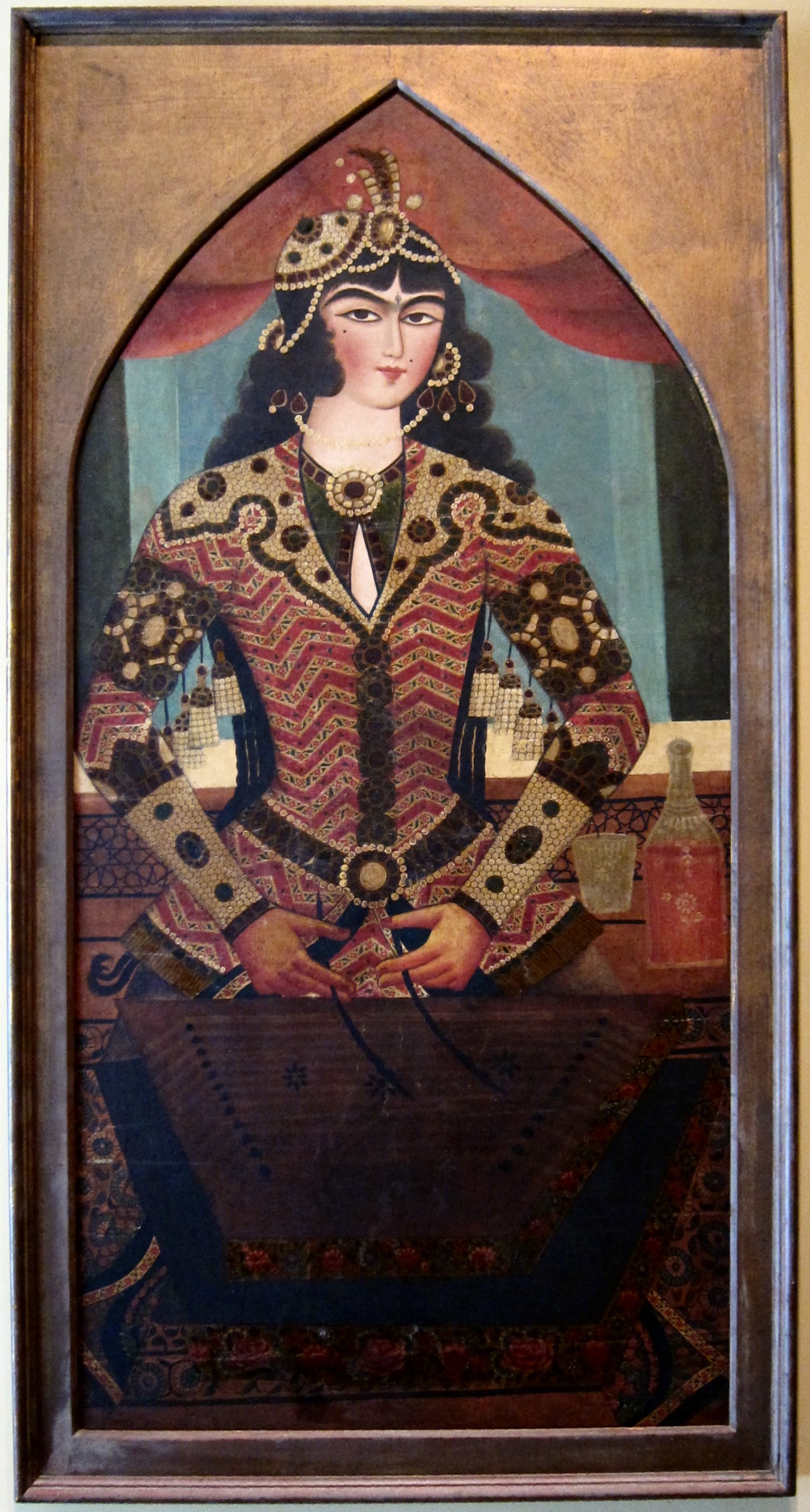
Female Musician by Anonymous
She continues ever on, without me. Frustrated by my own deviance, and in the backwash tunnel of personal failure, I triumph in disaster. The airs of isolation breathe a sad remorse, the regret of guilt itself takes over like an icy bath.

The Ambassadors (detail) by Hans Holbein the Younger
I strain over my broken instrument, and snap its neck in one fell swoop. Not even a ping from the cracked strings are heard in the overarching foment of fanatic bursts and swoons of delight as the mob breathes down the throat of my love the kiss of popular contagion.

Interesting enough, the short dream sketch narrative above, and that described in my last post, where I exhibited a noetic travelogue through Sudan, have coincided with the events of the days to follow. In the previous incident, I had dreamed that I was traveling through Sudan, and had born witness to the social resurgence of positive forward movement. So, on that day, I met and interviewed Emmanuel Jal, as he accepted the Calgary Peace Prize on behalf of all South Sudanese people. Similarly, though without such heavy global precedence, the events within the dream sketch illustrated here preceded a botched concert appearance by none other than myself to accompany my Love onstage.
___________
My first exhibition of an original "sounding" in the internal collaboration of creative music with creative writing. Improbability in Upswing, was published at poeticdiversity: the poetry zine of los angeles in December 2012. In my reading, with relation to the content of this post, I am taking off towards the eye of the sun. The teeming cloud-born sky quakes with the burning rush of human flight. Riding through the energetic outpouring of modern rocket fuel, I feel a beneficiary of similar technologic might that burned the bodies and fuelled the fires of war. Nuclear energy is not far distant, and my body begins to churn with the physical imagination of experiential interdependence, smouldering at the cusp of freedom and death.


To set forth another tradition of self-publishing, every week from now on, as I offer a "sounding" of spoken word and original music, I will release a chapbook of the section from which the "sound poem" derives in the series of collected experimental writings. Enjoy and ponder the experimental imagination through visions of "Aircloudsky".

Monday, 18 February 2013

The Immortalizing Arts: Contributions by World Music Artist Vi An Diep

Gilgamesh by Samantha from Indonesia
"We have achieved two of the three alchemists' dreams: We have transmuted the elements and learned to fly. Immortality is next." - Max More, On becoming posthuman

The search for immortality is as old as humanity itself. The earliest remnants of human history, namely, the Epic of Gilgamesh, among others, speak of the quest for immortality, to find the fruit or fount of eternal youth is part of the perennial epic that is the myth of Man. 
Anu, Bel, and Ea are whispering (wisdom) into his ear.
Ere thou earnest down from the mountain
Gilgamesh beheld thee in a dream in Uruk
....
Gilgamesh sought to interpret the dream;
Spoke to his mother:
'My mother, during my night
I became strong and moved about among the heroes'
...
Gilgamesh said...Tell me, How didst thou come to dwell (here?) and obtain eternal life among the gods?
...
Build a house, construct a ship; Forsake thy possessions, take heed for thy life! Abandon thy goods, save (thy) life, and bring living seed of every kind into the ship

(Epic of Gilgamesh)
Now, it is interesting the way that modern medicine has adopted the principles of "life extension" to the archaic traditions of humanity in the search for immortality. Life Extension is a medical term used to acknowledge the major advancements in modern medicine which have led to the unprecedented increase of the average human lifespan. The logic is that if the lifespan can be extended by some fifty years or so in the last hundred years, why can't we extend life to virtual permanence. 

What are the implications of human immortality on Earth? What comes to mind for me are a few major points. For one, there will be an excited advantage by the keepers of modern scientific medicine, mainly the West. In many ways, this can be seen as the furthering of an egotism that the Western World and particularly the scientific community has, where they feel they prevail over all forms of life, as the dominant form of knowledge-creation in the world today. It is often ignored how steeped in Western European history our modern science is, and that it does have its immoderate faults. Essentially, modern medicine is best in dealing with immediate physical trauma. When it comes to preventive, and long-term medicine, like "life extension" for example, there is less attention to detail. 

Outside of medicine, there is a biological component. One of the foremost proponents of "biological immortality", professor in the Department of Ecology and Evolutionary Biology at University of California, Irvine, Michael R. Rose, PhD, says in the Immortality Institute documentary Exploring Life Extension, "Most people who work on aging do it from a medical standpoint, which means humans, or if not humans, then certainly mammals, and all these organisms that didn't have an aging process were far-removed from mammals." He went on to give examples in non-mammallian life forms, such as anemones, creosotes, juniper, and others that actually do not age. He continues, "...life can be thought of as being divided into three basic stages...that third phase, which has not really been explored by contemporary biology is what interests me now, late life." 

With regard to the biological component of immortality and life extension, and the medical egotism which counter-inuits the state of the world, it seems that if we do not co-evolve immortally with our Earthly ecology, a spiritualistic sense of medical immortality for humanity would only contribute to the degradation of every source of life that the Earth offers to Man, and which Man exploits obscenely. For example, if we innovate major advances in anti-aging and life extension, we ought to transpose that technology into the natural world, into the life that not only lives on earth (us), but is the life of earth (all forms of life and life-giving). 

Finally, my sense is that in the early epics of oral literature, such works as the Epic of Gilgamesh and Homeric works such as the Iliad, there is a lesson about the human quest for immortality, which is older than our backbone. The lesson is that only in our mortality, do we know our immortality. I would say this is also truer to Max More's reference to the alchemical tradition, where in the philosopher's stone there is a psychological mastery of the principles of physical life, yet it is in the psyche where the most enduring trial is overcome. Only in dying fully conscious and immersed in the ground of immortal intent, are we immortalized, and traditionally so in the words of the great poets, those of enduring words and pronounced voices to carry the names of certain individuals down the halls of human history. 
___________
First step in the thousand-mile journey by Vi An
Flight over the bridge by Vi An
Enlightenment over Peace Bridge by Vi An
Full Moon City by Vi An

First Light of Dusk by Vi An
____________


Vi An has generously agreed to contribute her musical artistry to SoJourn(al) for this exclusive post featuring original photography. This post celebrates her entry in a CBC music contest, Searchlight. Vote for Vi An!

In future posts, I will be featuring original world instrumental music by none other than the Dream Author. My idea is to feature a full-length album of original electro-acoustic improvisations on darbuka, frame drums, shakers, xaphoon, shakuhachi, guitar, harmonic, etc., then leading up to spoken word collaborations with my instrumental creativity to recollect the creative momentum from my experimental writing gallery usually featured at the end of each post. It is my intention to kick off this new paradigmatic focus of musical creativity with a contribution, and to offer space for photographers and musicians alike to contribute in the future.

Happy readings/listenings/viewings!!

Among all artists of One Love, in solidarity.

Wednesday, 2 January 2013

Myth of the Writer as Artist in the Inner Space Age

Magic Mountain (after Thomas Mann) By Christiaan Tonnis
"Certainly when a writer has acquired the habit of regarding life as mythical and typical there comes a curious heightening of his artist temper, a new refreshment to his perceiving and shaping powers, which otherwise occurs much later in life...myth is the legitimization of life; only through and in it does life find self-awareness, sanction, consecration." Thomas Mann in his essay, Freud and the Future

Within this essay by the great 20th century writer Thomas Mann, author of the famed Magic Mountain, are masterful insights with which to learn the various modes of self-discovery as espoused in the mythic fires of ritualized, eternalized thought throughout the ages. In the ageless struggle towards self-knowledge, the embattlements are often constructed in defence of the outer world, or the world, and in offence from the inner world, or the self. In the midst of those embattlements, lies a field. As Rumi says, "Between right doing, and wrong doing, there is a field. I'll meet you there." 

To explore self-knowledge with regard to knowing one's place and vocation is to embark on an inward journey. Only by recognizing the bare truths of our life in the present moment, and proclaiming them as such, and in turn, making them an integral part of the conscious, and waking, mind, can we understand that the truth about myth. 

Myth addresses and reveals the ultimate needs of the human psyche. Myth speaks of the search for meaning in the life of humankind. The final lesson of myth is that the ultimate question for life in the modern world, as with all times, is not, "what is my place in the world?" The essential question remains, "what is the place of the world in me?" Every one is the ONE. You are the world. 

The world is of our own making. We are all co-creators in the aftermath of reason. Work is play, and play is work. Play is the life of the universe at work, also understood as LILA in Hindu thought.   
_________
I walk past a prison in southern California. The air is humid. I can smell salt and chlorine. Why am I barefoot? I bend to look through stone latticework. I see peers, young men and women my age, cleaning a concrete prison campground. A dismal gymnasium? A barren bathing area? They wear radioactive protection, in orange suits and gas-masked. 

Lady in Prison by Raja Ravi Varma
I dart across the road. Barefoot, my feet sink unaware into the freezing water runoff from the prison cleanup. My feet are numb as I walk over a grassy knoll on my way to a gas station. The clear sky is warming. There are gas stations everywhere, and I can't seem to get anywhere close to one. My torso is overheating, and my feet are so frozen I can barely stand.
__________
Touring the phantom cloud

At rest between Celtic shores, distressed by multi-lingual borders and rocky soil, and a northern jail for the barbaric tongues who gouge panicked eyes from the skulls of New World kinds

An orgy of ruthless becoming

Among the equestrian speed, famed by pre-teen daughters of class and medieval French dreams, who cast off the Muslim humidity from Spain’s bound whores, and lust after a secretive world of music in the drum talk of yesteryear’s snoring traditionalism

Yet woken alive

Through non-ordinary literary thought and perpetual action, to finally inundate the worldly risks bedding with our species at once in an archaic passion, straying from the lofty

First World throats of progress


excerpt from "Mad artistry"

Friday, 21 December 2012

The Original Meaning of Apocalypse


Apocalypse is originally from the Greek apocálypsis meaning "a disclosure of knowledge, hidden from humanity in an era dominated by falsehood and misconception, i.e., a lifting of the veil or revelation" (source). Let today be a reminder that there is only one present, and all dreams, fantasies, prophecies and revelations ultimately bring us back to where we are in the here and now. Let us remember that today is always the first and last day. May the renewal of the seasons awaken our senses to the natural light of continuity and the breath of the living voice saying, "it's never too late to live for today." 
________
There he is. I introduce him. Aboriginal poet of the year they say, and the reception is warm. Mythologists and Dreamers convene for the day, to listen to his heart beat to the rhythm of all present to listen. His words ring true, clean and sound through the temple of the mind.

Homage to a poet by Giorgione
I cavort through the crowd. Childhood friends move like Romany artists, musicians, gamblers and comics in their smiling delight. The air is communal and warm. Friendships seep through our pores with a nourishing embrace of eyes.
_________

No broken gourd of misinformation,
            Cracked on the headless spine of an open carcass
                        Breeding divine fungi in the tawny mist,
                                    A tempting kiss stolen across the breath
Of a warring ocean disengaged from its godly host

...
Anger in the tempest of religious man,
                        A cork-bottled nightmare
Emerging suddenly from the abyss,
Encouraging the lion’s stare
            To recede from tropical gore
                        And inculcate the masses
                                    Into a final tour
...

 Impressing the abstract wonder of the fearless
                                    And preparing a light
                                                For here

excerpts from "find Inspiration!"


Friday, 7 December 2012

Climate Changes Civil Society To Support Dreamers


"This morning Munira Sibai, a Syrian-American student with SustainUs, delivered this speech on behalf of young people (YOUNGO). Although many governments could not be bothered to listen to their citizens, civil society was present in force: supporting Munira and each other in a way that governments can only dream of. Onwards." Earth in Brackets BLOG (Dec. 7 2012)

Tonight, as I drifted away, I read the latest Democracy Now! headlines on climate change. Civil society and democracy are shifting gears for full speed ahead as the human race confronts the most pressing issue yet known to humankind: A Warming Earth. 

Read the latest World Bank Research analysis on the devastating impacts of unheeded climate change warnings. At 4 degrees warmer, the science begins to frighten. 

Earlier tonight, as I cycled home, I met a bewildered fox. Scared and nervous, we approached each other. My fear suddenly transformed as I saw fear in the fox's eyes. I glided past carefully. I witnessed this incredible animal confusedly find an exit from the paved city pathways to the nearby riverbanks. I think of Native proverbs that ask, "who will speak for our beloved animals?" 
________

The candles are now all reconstituted wax. The rain boils and steams before it reaches its earthen ground. The sky is on fire and I need a new name.

In Peril by John Atkinson Grimshaw
Through my window of impoverishment, a sanded frame of dirt, I see tanks spewing the ire of mankind. Fire is the breath of unreason. Violence spreads across the land.

Miniature diorama in the Herat Military Museum by Marius Arnesen
Bombs and machine tracks seed great pocks of holes in the earth. The clouds are dark with soot and anger. Lightning cracks through the smiles of silenced memories. Families are swept away like dust.

Lunshunku battle during the Sino-Japanese war (1895) by Unknown
Fending off the soul-puncturing thunder of war, I flee through the bureaucratic maze of a police state. Warmongers drive their piercing insanity into my eyes, as I feel my way through back entrances and obsolete hallways. The border embassy shakes at the foundation. Our earth will be interminably scarred. We are equally victims and perpetrators of widespread ecological domestic abuse.

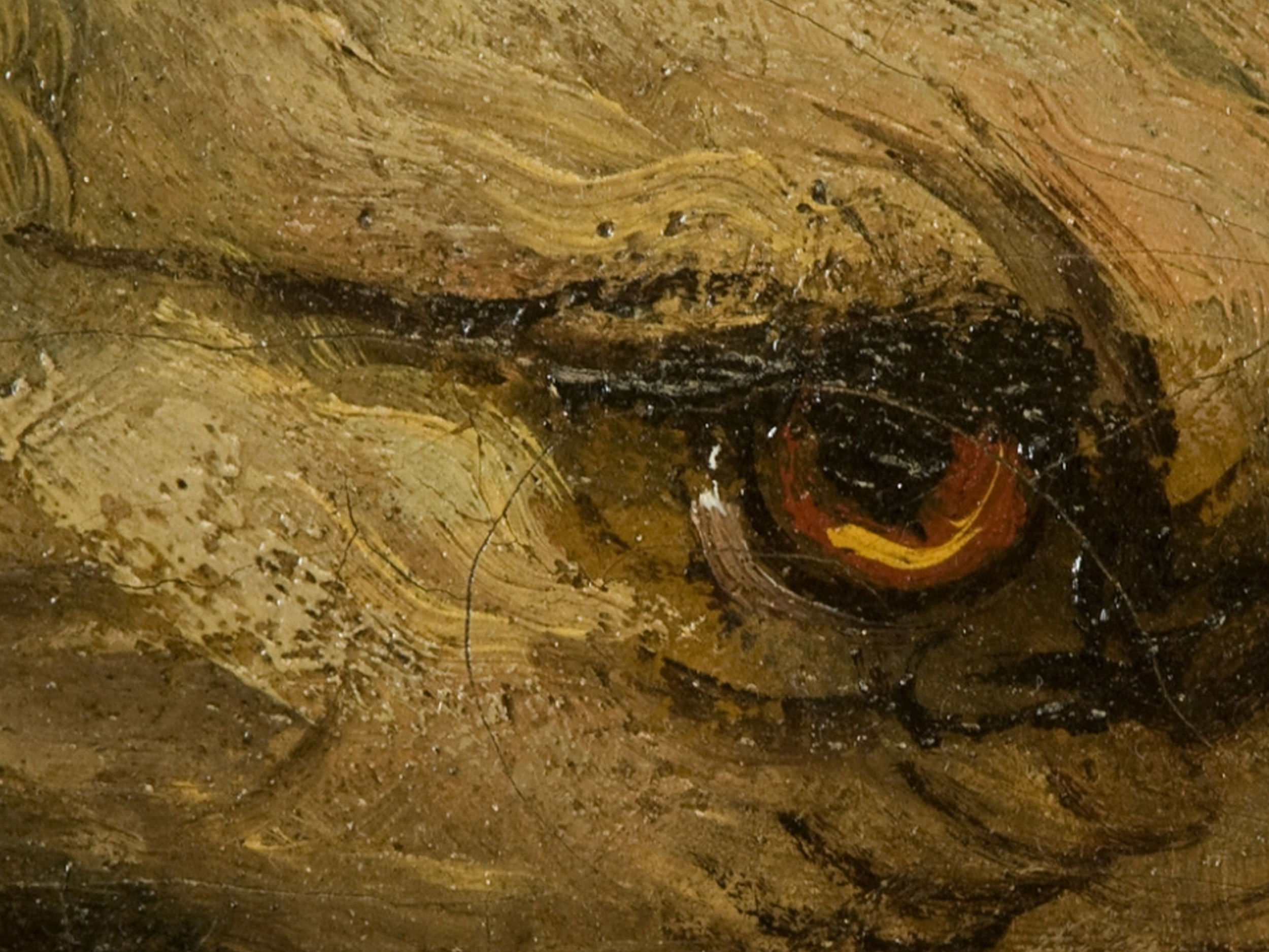
The Immaculate Conception, detail: Dragon's Eye by Giovanni Battista Tiepolo
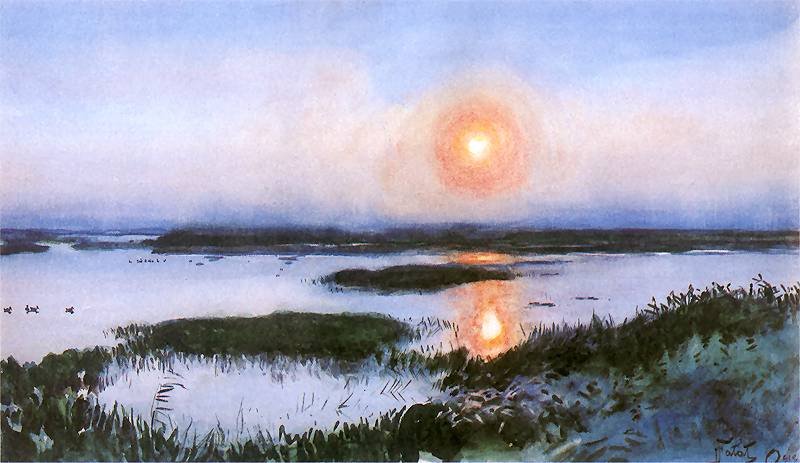
In a vile trench of near-death urgency, I climb out, and into the sun of borderlands. Having escaped the eruptive core of my country’s open, bleeding veins of disintegration, I wade in scintillating wetlands. Vibrant green pasture, lily pads and low-lying bogs hydrate my contemplative sight.

Sunset over wetlands by Julian Falat
I can almost see beyond the untimely closure of history. Birds and insects sleep with day, at peace, like me, in restful respite.
_________
"Escalations nerve-wracking, lonely murmurs murmuring

Crescent peaks dangling under bums grateful with uprooted membranous petrified and calcified flesh

Journey to roust the kneeling mind, with the desiring missed find, to be missed by nations feigning the patient behind swollen gum-brain awry, with skull-ache

“kinj moduls vrent speen og”

Desiring missiles
Desired missing
Failing nations

Patient fang"

excerpt from "Cajoled Spine-Tap"


Sunday, 28 October 2012

Andamese Teaching: From Kill or Be Killed to Communicate or Be Killed

Talking History - A Lakota Storyteller
"Myths and legends were told...usually at night around the village fire and the telling was reserved to the "dreamers" or medicine-men, the Oko-jumu...There were three ways a man, and much more rarely a woman, could become an Oko-jumu. One was by "dying" and then coming back to life, for example by fainting or by having an epileptic fit and then recovering. Another way was to be "kept" in the jungle by spirits: if a person showed no fear of spirits, it was believed that they would refrain from killing but they could still keep their victim in the jungle for a while. Yet another way was by talking to the spirits in a dream. The spirits were the dead and any contact with them either killed a person or made him or her into an Oko-jumu." George Weber. The Andamese. Chapter 23: Myths and Legends.

This study, originally from A. R. Radcliffe-Brown, is especially pertinent to the study of rites of initiation, where the primary function of this social form of belonging, not only within the human group, but with humankind's higher spiritual faculties in cohesion with subtle ecological presence. This gives us insight into the source of human knowledge, as an intergenerational narrative, and even represents the role of conflict transformation and the relegation of the aggressive principle in human nature from a kill or be killed to a communicate or be killed.

For a comparative study between the Lakota and Andamese peoples with relation to the role of dreams in the making of traditional storytellers, read From Social function to Pedagogical Function on Mythic Dreams.
_________
Tramping through the corridor of my grandparents in the Hampton hills of New York, the beige linoleum lies dirtied with a score of recent visitors, and the angel light of the winter’s day breathes with an icicle heart onto the feet of the whitened doorstop. With a running muck of puppies, my father swings the door open and shoots me out into the dizzying cacophony of wild dogs, huge and menacing. Their growling eyes bear down with starving, cannibalistic teeth.

Ceremonial Orgies by Dog-eaters by Anonymous
As my father quickens back through the warm house, the slow-motion snow gathers under my frosted eyelids, as I work myself back up to my feet in the subzero temperatures, at eye-level with a host of swarming canines, wild and diseased. I notice the back leg of one dog’s been bitten clean to the bone. Their wounded sting of necessity chokes my well-wishing brain into a heady daze of a feral calling.

Gypsy dog-killers by Anonymous
And in the mind of my love, a dream of lightening news props up our necks to an after-life view. Our grandfather, recently deceased, visits us. He’s traveled hundreds and hundreds of miles away across the entire scope of the prairies, a young man of excellent hue, whose eyes invigorate the humble walls of our sleepy apartment. Again in his prime, he offers a blessing of material coordination with our passionate, creative hearts. An ingeniously crafted wooden box, shaped of his exceptional Norwegian whittling hand I presume, is handed over, as a gift, to us.

The Willow flute by Christian Skredsvig
Within the glorious arboreal artwork, two handcrafted wooden flutes of a celestial order are presented hearteningly. They appear as long bamboo flutes, however with a sound equal to a half-Shakuhachi, half-recorder timbre. We play them with delight, and upon sounding the first note, the golden presence of our late grandfather vanishes in a heartbeat of silence; a gift from the prime centre of our earliest known life.
_________

Drift of a fist to the sky
In the activist’s pause
Before standing unannounced
At the gates of eternal misery
Where strife finds embittered ground
And the inglorious suffering breeds childless offspring
Mourning for ancestral greed
Sprouting from a native gourd
With cracked shell
Lying abandoned and weakened at the skin
With taught shell-string clacking
With fortune’s boisterous western noise
Shrinking into the mist
Without echo
From musician’s deep sleep
Over the ancient soundscapes passing
Through electric wilderness
To heart