Primarily a writing exercise, this dream journal-inspired blog is a quiet introspective sojourn into the process that we traverse in going from private dream to public art. I see our dreaming as an internalized mythmaking. As I philosophize and expressively exhibit dreams, both private and public, I encourage and delight in creative language as a way to practice experiential metaphors through a “public dreaming." Writing Theory: Creative Dream Fiction
Showing posts with label freedom. Show all posts

Monday, 30 September 2013

Source of New Media: Resonant Lives Harmonize in the West


“What I began by reading, I must finish by acting.” Henry David Thoreau

Where is our all-inclusive local media source, one that is not generic, yet doesn't cater to only one group, one that embraces local lore, custom and myth, one that encourages people who live the story, who are located downtown or in the community, whose lives are on the pulse of the daily, local narrative? They are to tell their story, to emphasize selected statements said by their own voice, and to speak from experience, because good media should begin with experience and end with experience. Good media should not begin with inexperience and end with inexperience. Good local media should reunite with social cause, and ultimately, incite action.

The introduction, history, structure and funding of The Media Co-op is explicitly written out in, Know Your Co-op, a nineteen page document prepared by journalist Dawn Paley in 2007 and self-published by The Dominion editorial collective. What began in 2003 as a newspaper, The Dominion (still circulating nationally), was reincorporated as a multi-stakeholder cooperative in 2007, now known as The Media Co-op.

“The multi-stakeholder is a situation in which you have more than one class of membership within the cooperative and they collaborate together to meet the needs of the different classes of membership,” Peter Hough, Fund Manager of Tenacity Works Fund at the Canadian Worker Co-op Federation told the Calgary Working Group of The Media Co-op. “In a retail store it would be trying to produce good working conditions for the employees but also trying to produce good service and fair prices for the consumer members. And then all of them would share in any surpluses.”

In 2009, the first local of The Media Co-op formed into the Halifax Media Co-op. In the next three years, Vancouver, Toronto and Montreal formed locals (in that order). “Each local has an editorial collective that meets face-to-face to discuss stories and coverage in their cities and surrounding areas,” wrote Dawn Paley, in Know Your Co-op. “The new model has required the creation of a web platform where contributors can upload news, videos, audio and photos, as well as interact through comments, working groups and discussions.”

Cooperative and local media is a process of decentralization, essentially giving media back to its rightful source: the people. In this way, the oft-repeated slogan, “Own Your Media” is The Media Co-op mantra. With stories such as the 2004 Haiti coup d’étatand the Vancouver Olympics, The Media Co-op and its locals transcend corporate media coverage, connect with untapped readership in the Canadian public and have worked with larger media organizations internationally, such as Democracy Now!

Yet, as typical to news media, the bad news is ever-present. As reiterated in Know Your Co-op, Montreal Media Co-op founder Dru Oja Jay, bore the bad news that The Media Co-op could not accept new locals in the 2010 article, How to start a local of The Media Co-op. Due to the overwhelming commitment and the underwhelming budget, The Media Co-op instead encouraged incipient Working Groups. The Calgary Working Group was opened under the direction of Jay in 2010 with top-notch international reportage on the challenges to a national election in Manila, Philippines.

Since then, the Calgary Working Group has received over 120 members with contributions on topics ranging from the G20 Summit to The Alberta League Encouraging Storytelling (TALES), to Environmental Justice, to Café Koi to Young and Future Generations Day. Articles, podcasts, photo essays, editorials and blogs are among the many mediums of cooperative journalism local to Calgary. After a new (and very active) Calgary Working Group contributor corresponded with Jay earlier this year, the momentum shifted. Dialogue on starting a new local of The Media Co-op reopened.

The potential for the Calgary Working Group to become the Calgary Media Co-op is a vision that has since been shared in the local community, and the support is gaining. The Calgary Working Group started meeting with this objective in May of 2013. Besides forming a basis of unity, and establishing an editorial collective, the Calgary Working Group requires sustained and significant contribution in order to shift gears into the full-fledged Calgary Media Co-op.

The initiative is mutually coordinated with The Media Co-op, where all posts contributed to the Calgary Working Group (and in the future the Calgary Media Co-op) will appear as published on The Media Co-op nationally-syndicated, online news source. Stories written by a local, such as the Montreal Media Co-op, also appear as such when published in The Dominion. The Calgary Media Co-op is a vision for local cooperative media, in advocating for the publication of local stories, connecting them to a national community of journalists, activists, communities and leaders.

The basis of unity and editorial collective has been organized successfully since May with core organizational capacity developed with Daniel Rodriguez, a graduate of SAIT Journalism and Melissa Manzone, who holds an M.A. in Journalism from Kingston University (U.K.). Our basis of unity establishes a rational, concerted response to the inadequate agenda of dominant media to address and give voice to local concerns, perspectives and narratives. The unity is also founded on a deep appreciation for journalism as a public base of knowledge where cooperative values are formed, maintained and encouraged.

The editorial collective organizes a weekly program of contribution. Each piece submitted to the collective will be edited by at least two other core or guest editors. Three pieces a week are to be contributed by one regular contributor and two guest contributors. The publication schedule will be organized according to three themes – Uncovered, Alternative and Editorial.

On Monday, the focus will be on misinformation in the dominant news sources. Simply, we ask, “What is the popular news not covering?” The same issue published in dominant newspapers will be assessed and critiqued with regard to the uncovered angles, perspectives and stories. Not only will contributors critique, their articles and/or multimedia pieces will address and give agency to the unvoiced, and unknown, in our community.

On Wednesday, pieces will map alternative press locally, in Calgary, and Alberta. For example, we ask, “What is being voiced by independent media sources, non-English newspapers, podcasts and blogs?”

On Friday, the editorial collective will publish editorials spotlighting special voices from within the community. This new initiative of the Calgary Working Group aspires to convene with the entire political spectrum, including all identities of class, religion, gender, and ethnicity into a refreshingly local forum to reenergize debate, understanding and willpower in the community.

The Calgary Working Group still has a long way to go until the proposed momentum is established, and finally, there is a new local chapter of The Media Co-op in Calgary. According to the latest draft of New Local Policy (pending issue by The Dominion editorial collective), the Calgary Working Group remains in Phase 0 of 5 successive stages until a full-fledged Local can open in Calgary.

First and foremost, what this means is that the Calgary Working Group may not use The Media Co-op name to raise money. All funds currently fostered through the voluntary leadership of media activists involved in developing the Calgary Working Group are nominally channeled through AlternativeMediaYYC.com, an independent media and podcast source for Calgary-based voices. At Phase 0, the Calgary Working Group may not refer to itself as the Calgary Media Co-op. At this initial stage, administrators at the Calgary Working Group helping with site content do not have editor access through working group admin privileges.

Currently, the Calgary Working Group is developing from a working group (Phase 0) to a website working group (Phase 1). In the first stage of the working group’s becoming a local new content is posted weekly, collective membership is stable and meets regularly; collective processes, membership criteria and operating principles are formed; editorial policies are adopted; formal agreement is made with The Media Co-op basis of unity; and lastly, the collective (Calgary Working Group) agrees not to use The Media Co-op name to raise money nor refer to themselves as the Calgary Media Co-op.

At this transition, the working group applies to The Media Co-op Board of Directors (in this case, through Dru Oja Jay). Leaders from this Calgary Working Group initiative are currently organizing a conference call with Dru and The Media Co-op Board of Directors. [To get involved, please contact us via the Calgary Working Group coordinator, Matt Hanson (mhanson1717@yahoo.com).]

______________

In the context of modern literary history, Hungarian-American Jewish newspaperman Joseph Pulitzer set the quality standard for publishing at the turn of the century. Pulitzer, best known for the eponymous award for not only journalism, but also photography, literature, history, poetry, music and drama is attributed with the quote: “The newspaper that is true to its highest mission will concern itself with the things that ought to happen tomorrow, or next month, or next year, and will seek to make what ought to be come to pass.”

Good media begins with the very real ground-level experience of people who are the subject of good stories. The middle ground is where people read and learn. Finally, good media ends when the lives of the people voicing their story are changed as often as the people who learn that story. Good media compels and instills action.

Mediocre or god-awful media begins with inexperience, namely the daily political rhetoric, hearsay, or at best a secondary source. Next, its core value is the repetitive sound of a cash register receiving a dollar and some change for a paper. For the tremendous act of reading is enough for some literati, however news media should be a call to extroversion and community.

Oftentimes, media consumerism ends with apathy, inaction and at best a satiated boredom, and at worst, accepting that life merely boils down to hearsay. More subtly, office-enclosed research on secondary sources so conveniently bolsters today's social (and unsocial) media frenzy; a frenzy that can overwhelm experience into the dull silence of an unprovoked voice in an abyss of unquestioned answers, facts, statistics, records.
"It's as if newspapers have broken their bargain with democracy in turning away from editorial excellence and towards profit, marketing and cost-cutting...fewer of us can turn to our papers and see what we all have in common, or what our common stake might be if we participate in our democracy." (Yesterday’s News, John Miller)
The glossy overdub display of empty space is often filled with meaningless advertisements, meant to convince people that their lives are as empty and meaningless as an unfulfilled consumer niche, such as the newspaper; slowly becoming a dying, trivialized miscellany for the intellectual exploits of the few.

The media less and less provokes action because it never quite does anything for anyone, yet still somehow exists because of the inkling that it could. If only media behaved as it once did before politicized buyouts and delegitimizing advertisements, when a paper was a conduit of experience through which new learning passed to connect, share and welcome all voices to truly and transparently voice an urgent cause to act!

Dominant news sources less and less provoke action, and more and more reveal mere dangers. Is our fear-based culture a result of the classist leadership in dominant sources of media and information in the public sphere, where stories are always politicized according to the dominant agenda? As a result the rhetoric dissuades change, i.e. delegitimizes alternative perspectives. The narrowing national and public debates are also a resultant of the unremitting and domesticized war on [domestic] terror and its repercussions within the consumer identity crisis of the West.

Local media often promotes reliable, ongoing coverage, because people are interested in the longstanding nature of their community. Merely because a story is told does not mean the story itself is over. Ongoing coverage on a topic that immediately concerns people, on which they have daily experience as a default to their local lives, provides opportunities for readers to learn more, gain news perspectives, contact key leaders on the issue, and most importantly, become involved in currents of change.

Dominant papers don't often voice underprivileged perspectives because they are the least marketable consumers. Instinctually, good journalism bolsters weak areas of coverage, not simply profit margins. As Pete Hamill wrote in News Is A Verb, “True accomplishment is marginal to the recognition factor. There is seldom any attention paid to scientists, poets, educators, or archaeologists.” Traditionally, papers lead communities toward mutual solutions and shared vales. Consumer marketing instills myopia and is, finally, beside the point, and decidedly antithetical to providing true information.

The advent of community, as opposed to commercial, journalism can teach citizens of a democracy (and more, a democratically inclined world) how challenging it is to create consensus. Journalists are practitioners of democracy. Their work necessitates service and humility. Community journalism cultivates voluntarism, and promotes education, vision and friendship. An unknowing public spawns a culture of denial, impotence and misinformation. The more a society realizes its source of community, the more its people are independent, thoughtful and generous.


References:

Hamill, Pete. News Is A Verb: Journalism at the End of the Twentieth Century. The Ballantine Publishing Group. New York. 1998. Page 80.

Miller, John. Yesterday’s News: Why Canada’s Daily Newspapers Are Failing Us. Fernwood Publishing. Halifax. 1998. Pages 15-16.

Kennedy, Dan. The Wired City: Reimagining Journalism and Civic Life in the Post-Newspaper Age. University of Massachusetts Press. Amherst & Boston. 2013.

Paley, Dawn. Know Your Co-op. The Media Co-op:http://www.mediacoop.ca/index.php?q=knowyourcoop. Canada. 2011.

Jay, Dru Oja. How to start a new local of the Media Co-op. The Media Co-op:http://www.mediacoop.ca/blog/dru/4378. Canada. 2010.


The article above, Community, Not Commercial, Journalism, was written and published exclusively for The Media Co-op on September 27, 2013. 
_____________
I cross a deep green field. The sky, overcast, rains on a dark earth. Dusk spells weary and wayward bands of lonesome greed. The marijuana burns. I, cold in dank clothing, trail beyond the grey horizon. Smoothly, with a gliding wind, I escape across the open shield. My mind breathes awake. 

Pluie de mai. Pays basque by Darío de Regoyos y Valdés
Cautious, I walk slow. The friend waits, cold, faceless. I unwrap a fabric, revealing the value of our exchange. Sweetgrass fills the air. Moved, life graces. Forlorn and ungraspable, we stretch out to reach the fleeting air. Police siren. The air becomes a noxious haze of suspicion. I fly. 
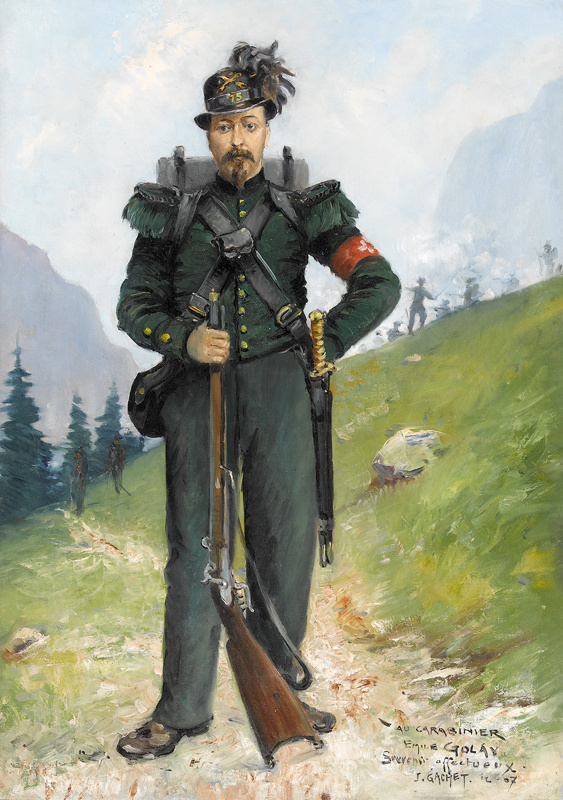
Le carabinier by Jules Gachet
The sweetgrass confiscated. Our lives are in our hands. I look up. Abyss. Black. Open. Dead light fades. Escarpment of the human gargoyle decaying, and erased from the map of heaven. Sharp and hard, the light petrifies, crystallizes and vibrates of the endless spectrum. 
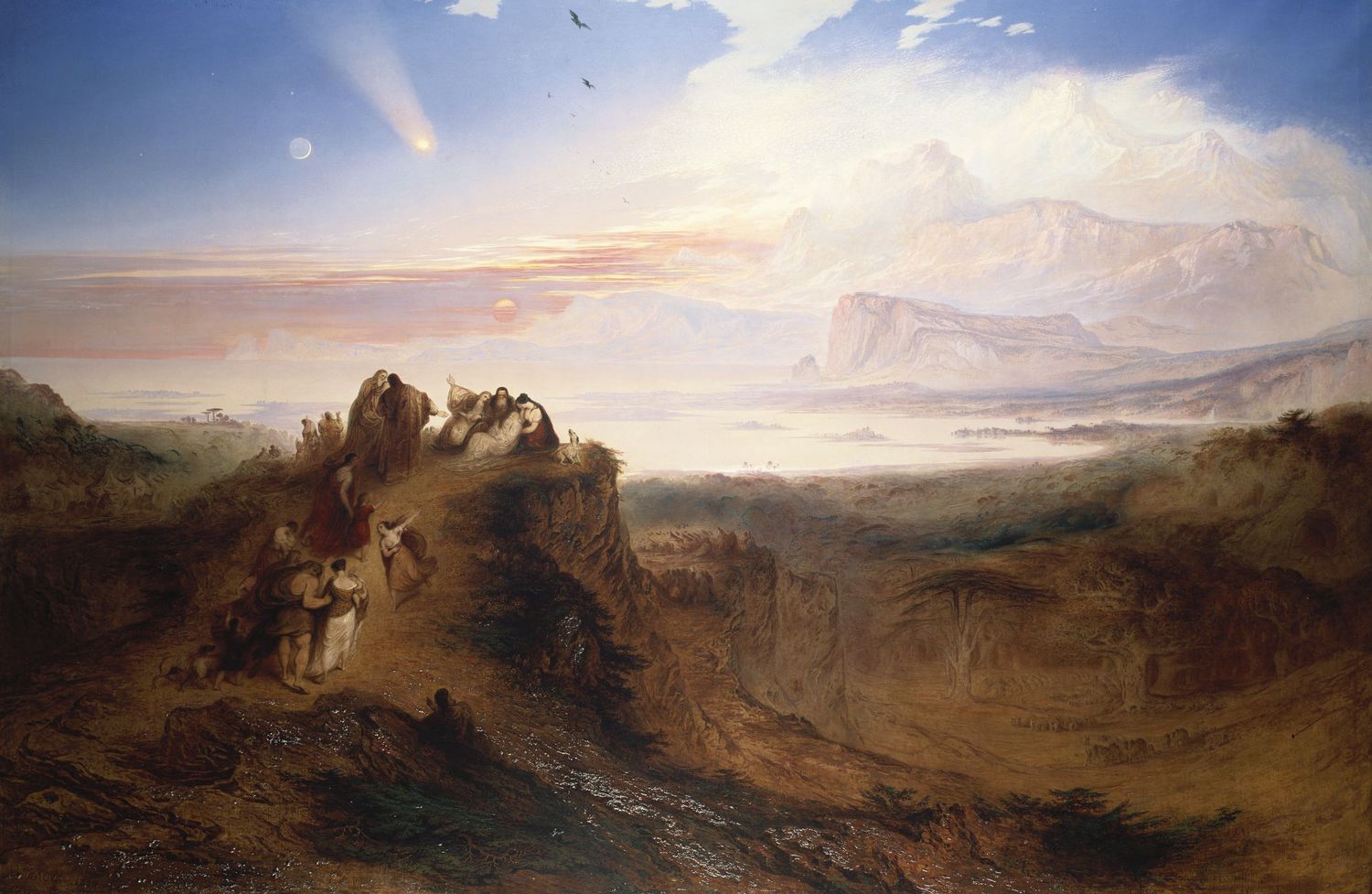
The Eve of the Deluge by John Martin
Galaxies enervate spines, nerves, veins and nodes of wonder; cosmic laughter at the sound of a split gong. Through, I, again, look up. Cobalt azure. Blinding, solar, pure and naked, sky. Cloud obscures. Rain, a memory. Summer passes in the afterglow noon. 
____________
First time in Vancouver, my love and I stayed with our dear friend Buckman Coe. I left early, leaving her to an extraordinary night with rich music and great friendship, and leaving, on my way back home, I played Buckman's first CD on my headphones. The first track, "Give Up The Fright", began "If you must go overseas / If that's where you feel that you ought to be." 

And tears streamed. I shook with the fear of love as I watched my one exit from the bus station and into the west coast cityscape. It was the first step on my way to Cairo, and further and further away from her. "Don't know if it was wishful thinking on her part / For now, this little rogue has got my heart," ends the song, a wishful lament to the ambiguity of human relationship, the lyrics struck so many chords with perfect accuracy. 

Years later, our dear friend's second CD, By The Mountain's Feet, opened with Not So Farfetched, a brilliant rhythmic melody to the course and rush of love - and again, the lyrics spoke with impeccable insight as we schemed our return west, to our Pacific lust of belonging - "This is how the story of you and I begins / And it's not so farfetched..." 

To the resounding continuity of love in our hearts. We grow to return. 

Multimedia Video on Jewish-Chinese Intercultural Music

Jewish and Chinese. The pot boils. Visiting the coast, we accompany a friend staying in the home of Lan Tung and Jonathan Bernard, whose special hospitality warms with musical instruments of a deep and resonant heritage. Their contemporary fusion music of world union reconciles the magic of our hearts with an unspoken quality of communal love - an uncanny similarity to our own strength of heart, soul and mind in the music of our coastal upbringing. 

Monday, 1 April 2013

Mythologies of Freedom and Dreaming: Interpretations and Reminiscences


“Human soul, should it dream of me, Let my memory wakened be.
/ Moon, moon, oh do not wane, do not wane, /
Moon, oh moon, do not wane....” lyrics from Dvorak’s Song to the Moon

“There is no freedom, because we die,” said Winston Churchill in a fated passage through the subtle imagination of nighttime visions – speaking as the personification of death itself. He emerged from the grave of innumerable veteran crosses and stars over unmarked graves lining an immaculately manicured grassy hillside in neat rows. The cemetery is reminiscent of the dead bodies once ordered with haunting linearity in the aftermath of the many battlefields fought over in world war.

The realization of human mortality is the psychological maturation of recognizing freedom as a myth. Even in dream there is limitation; the mortal scars of suffering – destructive emotions and negative repressions – continue into the deepest corners of the subtle mind. As in thinking, the natural mode of an animate and intelligent psyche is to comb through the vast interweaving analytic and creative spawns of experience and memory, as they unfold with newfound insights and revelations. Yet, in that process, the evolutionary cycle naturally spurns most content with the greatest psychological defense mechanism of mortality: forgetting. To release, let go or forget the contents of the mind as they build and diminish is part of the natural breathability of discernment that allows every person to function as a rational agent in both human society and in wild nature. Yet, there is intermittently a thought that recurs, as in dream, that reminds us that thought and the more subtle activities of the mind and of human experience are intricately linked to the repetitive urges of necessity in the libido or the gut, for example. When a thought is forgotten, it was meant to pass, and thus facilitate further emptiness, to clean the slate, or empty the glass, so to speak, so that it may become full with the nourishment of more enduring concerns. Yet, when a thought clings, as with the subconscious content of a recurring dream, it is calling out to be transformed through consciousness. There are many modes of transformation through consciousness, i.e. creativity, reflection, speaking, and action.

Similarly, as the facility of the mind to think filters through generative content towards enduring insights through word, sound, emotion, intuition, and image, the content of dream has like potential as an agent of subconscious “thought”. Yet, where thought is often sound-oriented, as the whisper of words, dream, and specifically dream-writing, entices the mind to reflect on what images endure, and why, through their free-associative interpretation. Those images that endure from dream into the memory of consciousness and daily activity are as thoughts that recur and beg further recognition. Both involuntary, subconscious – dream and thought – are inceptions of creativity that arise from instinctual mechanisms that the body has to self-reconciliation. Recognizing and listening to the inner voice that speaks in the image-language of dream and the sonic subtleties of thought through an internalized intellect form a holistic psychological healing likened to the regenerative quality of the physical body to heal itself.

Former child soldier and international rap sensation Emmanuel Jal uses storytelling and music for social-emotional learning. He says that peace is “equality, justice and freedom for all”. His triad of concepts that can lead to peace – equality, justice and freedom – will be the basis for understanding how dream becomes thought, and thought becomes action.

While there is no earthly, or worldly, freedom after a full recognition and confrontation with the mythology of human dreaming, both consciously and subconsciously, there is equality. In Sufi mysticism, it is said that all of creation essentially began from an image. In Hindu cosmology, the Self, or Atman, sat alone, and pondering a sense of cosmic loneliness, split into two. Thus, seeing a reflection of the Self gave birth to the world. In other traditions the first creation was sound, particularly in dominant Western religious tradition, “In the beginning was the word.” In more acute interpretations based on studying original texts and incipient cultural contexts, sound is understood to mean vibration. From this understanding, great wisdom energy emerges from the fabric of all creation, vibrating with the cosmic equality of being essentially of one substance, from one origin, and to one destination. Also, when people become competitive and separatist in worldly affairs, this sense of cosmic equality is lost. For ultimately, an individual is not born of their accord, nor is their lot in life prescribed by them, but they are subject to the cosmic interdependence of the I-Consciousness of All-Unity. Deep equality is seeing that there is beauty and tragedy, form and emptiness, sophistication and simplicity in every instant and every aspect, in every individual and independent form of being.

On a deep level, freedom and equality are absolutes. There is no true freedom, yet ultimately all are equal. Justice is relative. Time and the fabric of relations temper Justice as it is broken and mended by the conscious action of peoples, animals and all forms and modes of being: ocean and acidification, mountain and mine, consumer and resource, victim and perpetrator, predator and prey. Freedom is a dream that never becomes real. Equality is a reality that does not extinguish by dreaming, and also a dream that does not extinguish in reality. Justice is a dream that may, or may not become a reality, unless dreams are made real through conscious action, and then waking realities can potentially become our greatest dream.  
___________
Barroom fade-out, the groveling aspiration of a few young guts feeding on the fermented sting of a foreigner’s every desire. The walls steam and sweat to the touch of human skin, crowds meander and mingle in a scintillating core of the ruthless dance. The beat of bare feet on the wet soil engraves the trammeled heart of the night onto the soles at every step.

Le bar des Martégales, Marseille by Marcel Leprin
Escaped into the washroom, the narrow claustrophobia is deafening, with a seed of empty remorse, I trudge backwards, to scale the heights of misdirection, and a friendly face peers through the swinging doorway, a member of the female race, she glides back dispassionately. I wade through swinging bodies back to a table, where my friends eye my every movement with a gentle regard for the creative word, emanating like sunlight from my chest like a cross-legged aesthetic seeing visions of outer space. I am warmed, basking in tongues of like entanglement. A live hip-hop act floods the ceiling with the reverberations of bass and rhyme.

Fuge in Rot by Paul Klee
Next morning, the cemetery air is thick with warning. Veteran markers stretch 3,000 deep down a coursing hill, steep with shadow and disbelief. The anger mounts like an unchallenged breeze on the face of the beloved. And I starve for words of remembrance and the final end to the deep finishing hate that swarms and seethes in our bones like the lost blood of too many young men and women. We are guided along by the preeminent Allied emissaries of WWII; Roosevelt, Patton, Eisenhower all emerge from the ground of the lain, and lastly Churchill.

The Cemetery, Etaples, 1919 by Sir John Lavery
Rising from a grave bed, the sparse, delicate grass wakes with air at his emergence. Churchill guides a small tour through the narrow passage between the blinding dizzy-spell of white crosses. After reading the bare bones epitaph of one fallen, slain by the brutal, forsaken. We can almost hear the utter ignorance of speed, metal and waste. Scanning over a generic war axiom, he says with spitting disdain, “There is no freedom on this earth, because we die, because we are mortal, freedom is a dream within a dream.”

The Hat of Freedom by Herman van der Mijn
Freedom is a tear in the cry of eternity.
___________

The mangrove is a peculiar tree, featured most recently in Ang Lee's Life of Pi, the man-eating vegetable is an interesting folkloric attribution to the reciprocity found in nature. "Sour Mangrove" is a piece that uses two types of percussion, doumbek and frame drums together with digitized xaphoon with an atmospheric ethereum of shakuhachi.

This instrumentation breathes with the three minute narrative, an experimental movement that gives voice and embodiment to the numbness of apathy and dogma that drives humanity to unprecedented elevations of ignorance with regard to the environment. With the reduction in the rhythmic pace at the very middle of the track, there is a slight turnaround, where natural objects are at least recognized, yet by the end, there is mere allusion to voice as performance, reduced to mere agency in the creation of an all-consuming, and ultimately cheap contrivance: the public.

The mangrove, a gorgeous and exemplary form of environmental wonder in its sheer aesthetic beauty, and its symbiosis with the ocean (and especial trait that modern humanity lacks) is simplistically reduced to an act of consumption as a disagreeable taste, sour.


This chapbook is comprised of thirteen selections from Cyclical Wordplay under the subtitle, "Sleep Cycle" as they were all written during meta-conscious states of creative emergence. This chapbook release celebrates the music release of the feature piece, "Sour Mangrove" on my bandcamp site, where I upload experimental sound art and different forms of narrative readings. "Jailed Desire" and "Sour Mangrove" were published in "ditch, poetry that matters" on April 24, 2012.

Sunday, 9 December 2012

Sleep-Talk of the Modern Writer: A Joycean Saga, Part II

James Joyce, textorized with an excerpt from Ulysses by Maxf 
“Oliver St. John Gogarty noted that the typical modern writer was doomed to go on talking to himself but that it was left for James Joyce to go one step further and to talk to himself in his sleep in Finnegans Wake.”
From Charles Reznikoff Bio on Poetry Foundation 
Internet, technology, modernity, and history, the Joycean nightmare, the daily dream of the silenced voice, speaking in thought, imagining a placeless space of mind, the code of subjective emergency. I lay half-awake, surfing the viral webs of unreason in my sunless haunt, of trivial whereabouts and soundless frequency. An internal vibration wakes me into another dream of subconscious sleep, the inactive pause of breath. In the information age, for the modern writer, free speech is a painless bubble of thirst. My words are a mere spidery sleep-talk, spinning the collective web on and on, to perchance catch the insect eyes of innumerable minds, insights unseen, and only felt, as the nerve of a quiver.

_________
Before I went to prison I sat around a family circle. My grandfather was in his prime and all of his siblings were alive. That was the last time he put on his sailor cap. 

Portrait of a Sailor by Lawrence Alma-Tadema
A new fish stinks straight out of water. These metal bars are hot with memory. I clean past my fresh environment. There is a consensus of suicide and the death of life. I steal a look through my most haunted imagination, and it’s real. A shark-toothed man with pomade-drip hair and an orange shirt draws his own jaw. A thin, black-haired youth pierces his erect member into a cellmate. Even if I were passing straight through this corridor, it would be hell, and this is my new home. 

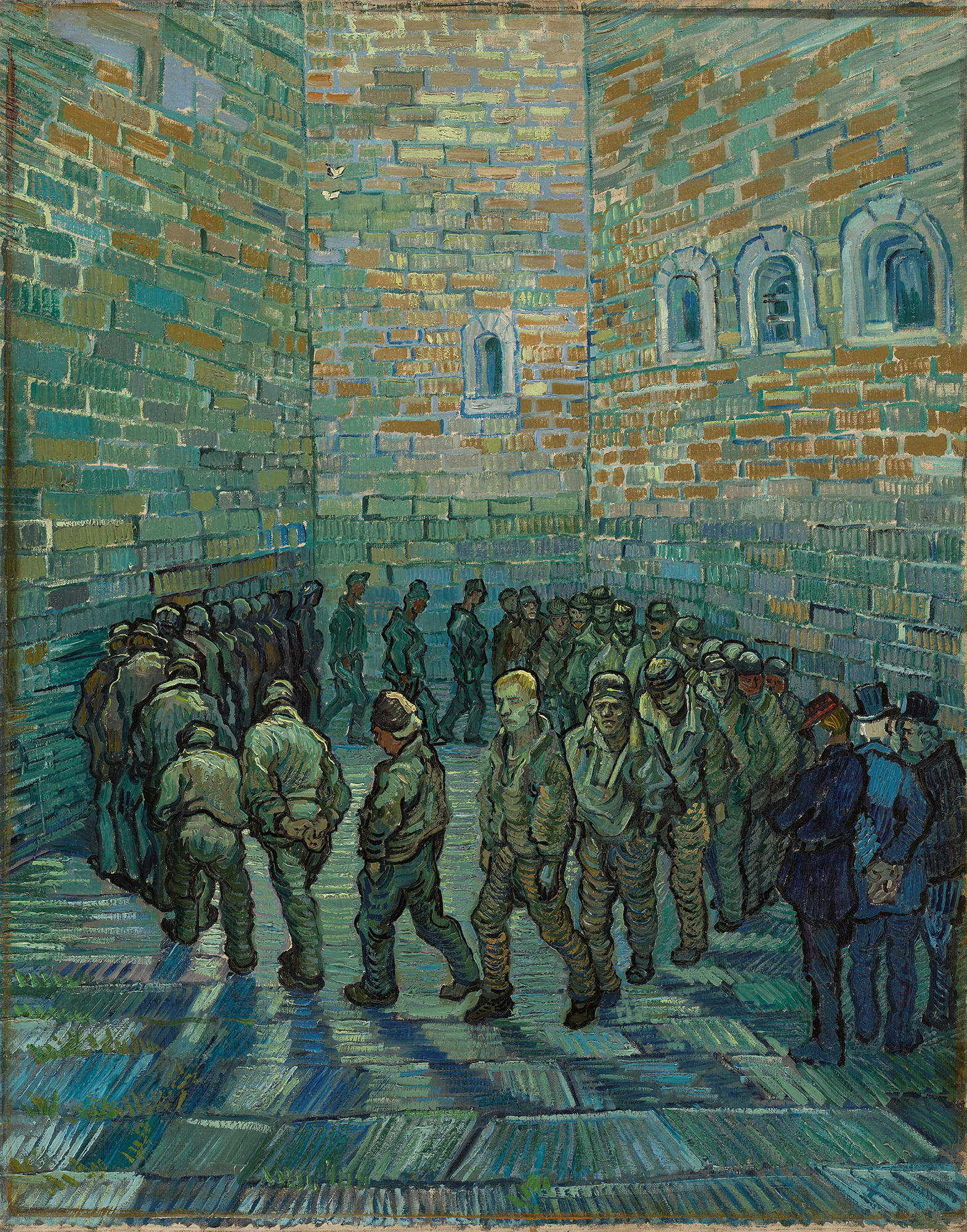
Prisoners Exercising by Vincent Van Gogh
I’ve returned to my grandparent’s abode. He’s dead. I wake in the middle of the night. The house is empty. I have never seen it empty in my whole life, ever. What am I doing here? The only presence is the lightless noise of my empty past.  
__________
"A secret curing,
Brewing twilight

In the motionless loss of our human presence
From the awaited future, yet eternal sound

In patient happiness breeds the contented need to produce
Chirps

To entice the sickness of pride to leave with day and unite mind
With a grateful stare into the mind’s ending"

excerpt from "City Birds"

Monday, 5 November 2012

From Genius Mind to Genius Heart: Wagner, Liszt and Dream's End

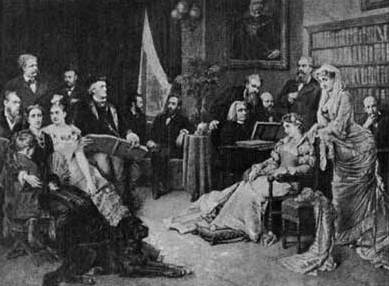
Wagner at Bayreuth (shows Franz Liszt at piano) by Gemälde von Georg Papperitz
"If I think of the storm of my heart, the terrible tenacity with which, against my desire, it used to cling to the hope of life, and if even now I feel this hurricane within me, I have at least found a quietus which in wakeful nights helps me to sleep. This is the genuine, ardent longing for death, for absolute unconsciousness, total non-existence; freedom from all dreams is our only final salvation."
"As I have never in life felt the real bliss of love, I must erect a monument to the most beautiful of all my dreams, in which, from beginning to end, that love shall be thoroughly satiated. I have in my head "Tristan and Isolde," the simplest but most full-blooded musical conception; with the "black flag" which floats at the end of it I shall cover myself to die."
Wagner's Letter 168 to Liszt. The Project Gutenberg Etext of Correspondence of Wagner and Liszt, Volume 2, by Francis Hueffer (translator)
I suppose to find one's peer as an artist is an ideal that few artists truly find. In the artist's magic of self-distinction, and in their magnificent ability to penetrate the heart of all, there is a deep and rich yearning to struggle, co-exist and finally, bond with fellow colleagues in the field. The artist, however, is too often moved beyond the spheres of normalized human contact, and thus falls short in sharing the richness of their life with another, except in the case of a briefly interspersed encounter with love, endured while in the sweep and momentum of creation. The recording above bears such testimony, and the heartened dialogue which shifted the reigns from the genius mind to the genius heart in the Romantic age of music has no likely parallel than in the intercourse between Wagner and Liszt which produced such insurmountable passion. 
________

Separated friendships detached by the urban domestic strife of youth boggled into a labyrinth of direction often slides off course over more damaged rails and misbegotten paths, the hard-won industrial groove of 21st century burning turns with a lifeless tour through the metal of pocket-worn need. 

White Buildings and Labours by Jayanta Bhattacharya
My friend, alone, and huddling over a home-cooked potluck gathering, strides in fully bedecked in Scottish kilt-wear. His face nearly contorted with the oncoming gripe of tears looks down and over his saran-wrapped goods. I comfort his back, emotionally elsewhere, long gone and hopeless for a friendship that’s as irrelevant as the contents of additional soup.

Scots boy in red kilt by Wilhelm Trubner
As I wander off, the air is opaque with a dark, runny stirring. The world commotion breathes heavily. A musical engagement is torn from my wife and I as our contact weans her ear from a phone of marital divorce, and the sky blackens with the frost of an easy death. 

Satire on Romantic Suicide by Leonardo Alenza Y Nieto
I tip toe up to my experimental end. I’ll have no burial, nor cremation, a sky birth in the way of my choice, a bungee jump without a bungee, and I dress for the occasion exactly as I would for my big day. My imagination jumps.  
_________
A great poverty aligns to the roof of the all-consuming jaw,
          That sweeps with the tornado dawn over the rushing plains
...
As American lore, talking through the human trees
          In a grave, over-worked rush to the gambled fortune
                 hidden in the proud dream
          To unite and be loyal to nothing,
          And yet return from the hollow
                 blank rough of our creative winter


Saturday, 8 September 2012

Reflection on "The ABCs of Human Survival" by Arthur Clark


“In a nationalist culture we have a recurrent dream that political leaders and experts will get us out of the cycles of self-destruction. That is a false lead.” Arthur Clarke. The ABCs of Human Survival. Athabaska University Press. 2010. p. 196

It was in the memory of this author's late wife that ultimately sent me to Cairo for my second visit to conduct a full-scale research project with the refugee communities I had worked with two years earlier. I have met the author on numerous occasions, including at his private home for gatherings that would seem to emulate a scene from an F. Scott Fitzgerald novel if not for the prototypical ambiance that persists in Calgary in general.

I found many fantastic references and insights from reading this book deliberately. My immediate attention focused on the author's confession that he in fact is guilty of perpetuating old-paradigm thinking, where " we will perish as fools" in the recurrent words of Dr. Martin Luther King Jr. as he had never once refused to pay taxes to both the American and Canadian governments during the brutal war with Iraq (including the preliminary imposition of sanctions, which is an act of war). 

His repetitious voice on the ills of militancy and nationalistic ideology resembles that of an elderly person telling you the facts of life with a dry voice and welcoming candour, with its occasional seeds of perennial wisdom planted in your mind as interpretive potentiality. It is of this class of intellectual where with the know-how and the social compunction to organize people, there is proof enough for change, however the sphere of influence is mastered only where the personality of the actor's face is shown. 

With this, you have a new initiative to relegate the institutionalization of principles which somehow call to, once again, the era of F. Scott Fitzgerald, where with Herman Hesse and Theosophical Societies a global call to justice and reconciliation sounds from the bastion of its very corrupted centre. Still, I am optimistic of the efforts of the Calgary Centre for Global Community, as the book exhibits time and again, that optimism is the only way through, and cynicism is the bane of a young society propagating aging youth in this overly materialistic cascade of obscurity; the Western city.

In my mind, it becomes too easy to focus on global entelechy when embedded in social contexts founded on colonial principles, and it becomes too easy to focus on local action when fully empowered as a normalized identity in a welcoming society. That being said, this is not a critique of the book, only my personal reflection on themes which I find are also my life struggle as a member of the community. 

_________
“Where’s the washroom?” I turn my head wolfishly. “Is the door locked?” I break into a cold sweat. It’s early, before opening. I empty two crates of ripe oranges on a display. My head spins with discomfort, beginning my first day at work. “Where’s the washroom?” I’m dizzy, fatigued with lack of sleep. My uniform itches. The ammonium floor is rushing into my head. Crooked tags identify the price of two different kinds of orange. I’ve mixed them all up. They look fresh, enticing, I run to the locked washroom door. The echoing emptiness is cruelly fascinating. Oranges, ripen everywhere, with priceless disillusioning. I wallow sheepish, to forever line the halls with my uncooked thoughts.
________
written in the rocky glove of unsettled wild creative youth,
those two pair,
growing in unseeded soil
as a weed tossed into the vibrant dark matter of infinite bliss
by the great American eagle
flowing into the future of Vietnamese bathroom floors
swept of children and memory
...
the knot stifles truth and freedom in a frantic pause to strengthen terror's wave
crashing in the lonesome authority with tasteless glamour
reflected off the stretched mirrors of the disadvantaged, ugly, poor,
and our fate, unified into first expression,
to cast away all memory
and become plainly seen in the absolute center,
mind's eye of the Pacific, drenched in wandering,
an unworldly guise,
blended into worthless machine-eaten jungles
fried in the oil of littered rubbish
alongside a fixed marriage highway

to an undreamed following,
a place deeper than hell,
frozen in the backdrop imagining
where the burned order breeds asinine judgment
flowering into bitter hate for the lost
who stare remembering at the speechless knot,
held in minds full with blame and newly felt sorrow
for ancestors mourning what's to become of their kin
tied in fate with breathless teachings

- excerpts from "Listen to Your Self


Friday, 3 August 2012

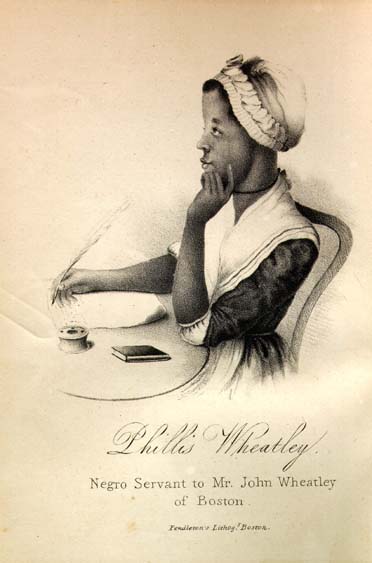
Phillis Wheatley, Awakened Mother of the Free Word

Phillis Wheatley by Unknown

Say what is sleep? and dreams how passing strange!

When action ceases, and ideas range
Licentious and unbounded o'er the plains,
Where Fancy's queen in giddy triumph reigns.

Hear in soft strains the dreaming lover sigh
To a kind fair, or rave in jealousy;
On pleasure now, and now on vengeance bent,
The lab'ring passions struggle for a vent.

What pow'r, O man! thy reason then restores,
So long suspended in nocturnal hours?

What secret hand returns the mental train,
And gives improv'd thine active pow'rs again?

From thee, O man, what gratitude should rise!

And, when from balmy sleep thou op'st thine eyes,
Let thy first thoughts be praises to the skies.

Excerpt from "Thoughts on the WORKS of PROVIDENCE." by Phillis Wheatley (Source)


Phillis Wheatley: "the first African-American poet, and the first African-American woman to publish her writing." (Wikipedia). Watch a great reading of one of my favourites, "Hymn to the Evening."
________
The grasses spell warm delightful, cracked insect green coloration, the chalky incompleteness in the waving eye of nature stares back with full recognition, restitution with human presence. Eagerly, I walk through the high rushes, stung with the tail end of a long forgetful period of mourning. The air fills my nostrils with intense humidity. An overwhelming lushness gravitates towards my brain. All the follicles from the plant world betray my unaware scents with awakening need. Aromatic, I speed through the vibrant, near-neon lime-green touches and find my way to a log cabin under the gorgeous density of a well-pollinated atmosphere, bred for the mind’s eye to pierce through to planetary secrets untold. 
Penniless, I am a drifter of smiles, a careless frame, basking in the gathering of those my age. Who do I see? I am at a loss. 

My mother! Young in her prime, she takes pity on my beleaguered state, handing me a Canadian ten-dollar bill in front of a lunch stand. The light mountain air feeds our intoxicated bliss with an embracing strength unknown in normal life, there is a silent energy about, allowing us to traverse the freedoms abreast in this long-sought after hollow of meadow and cloudless rays. I brim over with gladness, alive at once, with my friend and mother. Holding her in the sunshine womb of celestial pride, we walk through the silky meadow, renewed. Attaining the final vision, before the gully drops off the edge of a nearby cliff, I turn around and follow the nightly smoke of fellow friends, preparing for parties in the aftermath of youth, meanwhile, my mother stays behind, patiently awaiting my return, at the precipice of subterranean mystery.
_______
Mother
"The general image of 'mother' in a dream may symbolize a variety of feelings and ideas: caring, nurturing, love, acceptance, hard work, sacrifice, martyrdom, etc. The mother in your dream could also represent the 'collective unconscious,' the source of the 'water of life,' and the yin. Carl Jung suggests that women in dreams represent the collective unconscious and men the collective consciousness. Thus, the woman is that force, or current, inside of you that nudges you on and inspires you. It is your intuition and knowledge that is not necessarily attached to words."(iDream)
_______
in the deep silent tragic night,
blizzard disarray and the electric blankness
recedes throughout our psychic presence

with ethereal dismay,
morbid as the desert solitaire,
of rose-laden heights

excerpt from "interpretive direction"


Sunday, 8 July 2012

Poet-Doctor, Drugs and Dreams Are Your Friend


Le Rêve du docteur by Albrecht Dürer

"I never dream. When you’re psychotic, you don’t dream. Mugwort is an herb you can pick up at any local herbal shop. Although the tea is mildly poisonous, it can be drunk. Mugwort tea induces vivid, memorable dreams. Dreaming makes me feel normal. I feel connected with everyone through dreaming."

- from a conversation with a local poet and friend, David Rhoads
_______
Night in the suburbs, I jangle out onto the main road in a banged up old Volvo. The car is full of assorted items, the floors are mostly covered in piles of junk and the like. As I step on the gas, I see I’m driving unusually fast, though only about five mph above the speed limit. My lights are never working fine; I’m usually pulled over every time a cruiser spots me. 

In a shadowy nook, I see the dimmed lights of police, out for the catch. As I approach, the lights whir and sound. Still, I am in disbelief. “Again!” They must know me well by now. The cop who stops me perks with dissatisfied boredom as she clambers around awkwardly in the car for an extended time. My friend and I stand outside the car, weary and stung with silent cursing. Then, the overweight female cop raises one finger; it is covered with a green dust in the blaring flashlight. 

She inspects the dust carefully before swiftly grabbing my arms and locking them in a tight hold. “I’ve found marijuana in your car, you are under arrest!” I fight with murderous intensity. “What! All you found was a fingertip swipe of dust!” I am in awe of the local law’s asinine decision-making. As I squirm in contempt, defiant with unforgiving intensity, the lady cop calls for backup. 

In a matter of seconds, an SUV pulls up ahead of the first cruiser with two large, burly officers emerging in a torrent of violent forewarning. They attempt to handcuff me with riot strength, steaming in a haze of purposeless might. I loosen myself easily and struggle with unmatched will. Suddenly, I’m thrown back ten feet with a blood concussion, face puffed with blood, roughed up interminably by a single blow. 

On my way from a police car onto the steps of the police station and courthouse, I regain consciousness. A man on the sidewalk recognizes me. “Remember your permanent residency application!” he advises warmly. I am put before an authoritative lawman. I state my case. “Sir, this is an unjust conviction, I am on my way to gaining residency to live with my wife, this will put me under, don’t let a finger swipe of dust ruin this man’s life.” He takes pity on me. 

Later, I go on to liberate the entire northeast of North America from its bitter criminalization of personal marijuana use.
______
Drugs
"The interpretation of drugs in your dreams depends on the relationship you have with the drugs in your daily life and if they are doctor prescribed or not...The drugs could be suggesting a need for healing and getting in balance. Your unconscious mind may be suggesting outrageous things in hopes that you get the message to 'have fun, dream dreams, and get out of your own head!' Please keep in mind that the purpose of dreams is to raise our consciousness and to assist us in having better lives." (iDream)
______
"preposterous!"
said the proud visiting Englishman
in dismay,
"the army and police force will be trained
by the crown herself,
and no undue report will become of any loyal
to the blank calm
that befuddles our propaganda-fed livestock population"

- excerpt from "preposterous!"


Saturday, 30 June 2012

The Rare Beauty & Genuine Inspiration of Hawaii

Shaman by Arman Manookian
"His was the dream of creating in color a great symphony of beauty." writes Arthur Greene, in a eulogy for Arman Manookian, who committed suicide at 31, renowned as the Van Gogh of Hawaiian art

Another contemporary artist from Calgary, inspired by Hawaii, Shane Haltman, featured my comment on a recent blog post where he writes, "I can honestly say that my dreams brought me to this place and thanks to some serendipity and a beautiful community made up of some loving individuals, I am here living my dream...The current is strong here, the energy always present, and this makes for an artists dream." from Engraved memories
_______
The narrow birch forest is consuming at dusk. Spindly cerebral mycelium tangle upwards in a drowning lonesome tank of damp musk and potent swampland, the decomposition is palpable. Rain is on the mind of the sky as the deep gray clouds swarm above with unreasonable drear. As I notice a hobbling duck push into the delicate, unmoving waters, an enormous hawk, silent from its treetop perch, readies to assail. In one deft sweep, massive talons emerge from the underbelly of the raptorial bird, eyeing to snatch its unusual prey. The duck, a female, is raised into the unforgiving sky, its feathers soaked with blood on its side as it surrenders to the predation, paralyzed. Fear evaporates with the humid environment as a cyclical rendering of atmospheric hosts. 
_______
Birds
"To see a wounded bird, is fateful of deep sorrow caused by erring offspring. To see flying birds, is a sign of prosperity to the dreamer. All disagreeable environments will vanish before the wave of prospective good...Carl Jung said that birds represent thoughts while birds in flight symbolize moving and changing thoughts. Birds are generally associated with freedom and abandon. In old dream interpretation books birds are considered lucky omens..." (iDream)
_______
an imaginary depth, dropping my body into death's dream
through naturally engraved aquatic pores,

a doorway into the underworld,
final
...
profoundly empty, yet potent and with sure steps,
a foundation, on which to Love, between the speechless universe,
a mold, created and destroyed, balanced and perfected,
known through a dissemination flown to the ten thousand directions by an anonymous author,
spontaneous mastery, always falling,
multitudes' sinking vessels,
round the last leg,
towards a pathless sojourning,
rare & genuine

- excerpt from "rare & genuine"