Exposing Consciousness ~ Expanding Subconsciousness ~ Entering the Unconscious
Primarily a writing exercise, this dream journal-inspired blog is a quiet introspective sojourn into the process that we traverse in going from private dream to public art. I see our dreaming as an internalized mythmaking. As I philosophize and expressively exhibit dreams, both private and public, I encourage and delight in creative language as a way to practice experiential metaphors through a “public dreaming." Writing Theory: Creative Dream Fiction
James Hillman, an archetypal depth psychologist, whose post-Jungian conception of the human experience is essentially imaginative, and whose amoral fluctuation between endurance and immaturity lies nascent in the temporal grains of salt which gather and line the throat with ever increasing grab as aging commences upon the personality. Written at an old age, the author speaks clearly against any kind of aging therapy, and humanizes the current malaise which treats aging as a virus.
The author unwraps biological naturalism with the psychological bloom of a mind fermented with insightful, though not inundated, research on the literary and aesthetic character of human aging as a welcoming asset to life, in flagrant contrast to the ceremonial traditionalism of preparing for death, a non-issue in the continuous envelopment of life throughout the growing and falling of seasonal lasting. Dreams are referred to for their imagistic plentitude in bringing the holistic human experience towards fruition in the entire round of consciousness.
In short, Hillman's psychology is life-affirming unto the limits of modern knowledge-bearing with regard to the biological strength of humankind to age well and vigorously, as an essential presence in social reflection, as a memory of characterful belonging in the psyche of an unconscious gathering of the old triumphant spirit of age in all its mythic fortitude and human vulnerability.
Strutting down main street, Northampton, the little city atmosphere in a smaller town, brevity of metrosexual burning. Eyehole of gouged recollection, that there is a grayer hiss over the obscure horizon edge. A paranoiac whereabouts, a drinkability churning in the ingrate stomach as cold rice turns to frothy fluid within mellowed bowels. The attuned ear swings in frantic respite as the free march to movie theatre skies nickels and dimes my racy birth rite beginnings in the stingy hollow of American noonday education.
Northampton (Massachusetts) by William Henry Bartlett
Deeper along the edge of the township, towards rougher pasture, the greener grass gives to a brown floor of the barn stead. Outside, a reenactment of the medieval lance posture, only instead of a game between knights, the Anglo matador speaks in a murderous war with the human horse. I try my hand. With two lances upraised, I pierce the flesh of a gorgeous brown horse, mirroring the hue of the dirt circle fenced by a weak wooden ring and an audience steeped in American farmhouse poverty. As other horses, unsaddled and with fierce eyes, carouse into the ring, I jet from the gathering into a blacker city.
The Present by Thomas Cole
The jurist is deliberate, patient and silent. Instead of an easy interpretation by the passive jury of bored, directionless public witnessing, a guitarist lights the court with unfailing melodies, an original spirit of human will, to impose the individual struggle with death outside of foreign deliberation in the mind of an other. Because truly, in listening, the other melds seamlessly with the brain of a decidedly active witness, pardoning all in the sonic flight of metaphysical charm.
_________
Gazing at my Love's face, I see through the apparent reality to a frameless art. A sacred geometry in the flesh. A timeless elision, going beyond spent energy.
To consume a day; imagining with laughter in the midst of family.
Camping on the prairie by Paul Kane Scene shows the artist with a Metis guide en route to the Buffalo Hunt
I read the unseen. Her eyes are the milk of a hollow cow, branding the misjudged beauty of a new and timely pride in the human self in all its fascinating breadth. Her words are a first kiss, and the smile afterwords, even if the kiss was a little sour.
This is my first read into Marilyn Dumont's work. A Cree/Metis poet, who is widely celebrated as a must-read in contemporary Canadian literature. Her words are bittersweet, and do not say too much. She uses language for its brevity and with singular pausing, announces the mystic inclination to wonder with a sad grace. One can easily and cathartically empty their mind of doubt when reading page after page of brilliant humility. Her self-knowledge is evident as she prints words into the mind of a page with the delicate necessity of breath.
I read this book from cover to cover in one sitting as welcomingly as opening my door to a new friend. Now, I'm looking forward to welcoming, "that tongued belonging" her latest work.
Entering the distant cottage, there is tranquility. Mindful,
the air is welcoming. It is a refuge for Aboriginal intellectuals. A group of
women converse softly over tea as I wander the grounds. In the backyard, a
lively, well-kept garden is lush with Canadian summer vegetables and medicinal
herbs. The light hangs slowly from the deep, curling cloudscapes in the wide,
Midwestern expanse.
Overlooking the property hill, a bustling cruelty unearths
the dry heave crime of migratory blindness, as settler compunction fills the
writhing horizon with a crooked smile. Endless houses, misshapen and identical,
curve along the wasted prairie hills, and there is only a dim emanation of
life. As I stare into the perfectly reflecting window of the cottage, an aural
wisdom speaks in silence, carrying my body to the comfort of our Mother’s home:
land.
Holy rope glean Setting off the executioner’s raffle In a dream state, turning the mind To a pentatonic, indigenous scale To the antique buzz in our lonely natural surroundings That prepares a decadent life
“In a nationalist culture we have a recurrent dream that political leaders and experts will get us out of the cycles of self-destruction. That is a false lead.” Arthur Clarke. The ABCs of Human Survival. Athabaska University Press. 2010. p. 196
It was in the memory of this author's late wife that ultimately sent me to Cairo for my second visit to conduct a full-scale research project with the refugee communities I had worked with two years earlier. I have met the author on numerous occasions, including at his private home for gatherings that would seem to emulate a scene from an F. Scott Fitzgerald novel if not for the prototypical ambiance that persists in Calgary in general.
I found many fantastic references and insights from reading this book deliberately. My immediate attention focused on the author's confession that he in fact is guilty of perpetuating old-paradigm thinking, where " we will perish as fools" in the recurrent words of Dr. Martin Luther King Jr. as he had never once refused to pay taxes to both the American and Canadian governments during the brutal war with Iraq (including the preliminary imposition of sanctions, which is an act of war).
His repetitious voice on the ills of militancy and nationalistic ideology resembles that of an elderly person telling you the facts of life with a dry voice and welcoming candour, with its occasional seeds of perennial wisdom planted in your mind as interpretive potentiality. It is of this class of intellectual where with the know-how and the social compunction to organize people, there is proof enough for change, however the sphere of influence is mastered only where the personality of the actor's face is shown.
With this, you have a new initiative to relegate the institutionalization of principles which somehow call to, once again, the era of F. Scott Fitzgerald, where with Herman Hesse and Theosophical Societies a global call to justice and reconciliation sounds from the bastion of its very corrupted centre. Still, I am optimistic of the efforts of the Calgary Centre for Global Community, as the book exhibits time and again, that optimism is the only way through, and cynicism is the bane of a young society propagating aging youth in this overly materialistic cascade of obscurity; the Western city.
In my mind, it becomes too easy to focus on global entelechy when embedded in social contexts founded on colonial principles, and it becomes too easy to focus on local action when fully empowered as a normalized identity in a welcoming society. That being said, this is not a critique of the book, only my personal reflection on themes which I find are also my life struggle as a member of the community.
“Where’s the washroom?” I turn my head wolfishly. “Is the door locked?” I break into a cold sweat. It’s early, before opening. I empty two crates of ripe oranges on a display. My head spins with discomfort, beginning my first day at work. “Where’s the washroom?” I’m dizzy, fatigued with lack of sleep. My uniform itches. The ammonium floor is rushing into my head. Crooked tags identify the price of two different kinds of orange. I’ve mixed them all up. They look fresh, enticing, I run to the locked washroom door. The echoing emptiness is cruelly fascinating. Oranges, ripen everywhere, with priceless disillusioning. I wallow sheepish, to forever line the halls with my uncooked thoughts.
________
written in the rocky glove of unsettled wild creative youth, those two pair, growing in unseeded soil as a weed tossed into the vibrant dark matter of infinite bliss by the great American eagle flowing into the future of Vietnamese bathroom floors swept of children and memory
...
the knot stifles truth and freedom in a frantic pause to strengthen terror's wave crashing in the lonesome authority with tasteless glamour reflected off the stretched mirrors of the disadvantaged, ugly, poor, and our fate, unified into first expression, to cast away all memory and become plainly seen in the absolute center, mind's eye of the Pacific, drenched in wandering, an unworldly guise, blended into worthless machine-eaten jungles fried in the oil of littered rubbish alongside a fixed marriage highway
to an undreamed following, a place deeper than hell, frozen in the backdrop imagining where the burned order breeds asinine judgment flowering into bitter hate for the lost who stare remembering at the speechless knot, held in minds full with blame and newly felt sorrow for ancestors mourning what's to become of their kin tied in fate with breathless teachings
"Last Night I Dreamed of Peace: The Diary of Dang Thuy Tram" translated by Andrew X. Pham is necessary literature for every one who reads English. I read the first half of the book aloud to my wife, who was born in Saigon. After a series of waking with crying fits, she shied away from hearing the rest. Finally, I read the final half of the book to myself almost unceasingly.
The communicative brevity in Thuy's voice is indicative of her honesty, and her clear soul, of sonic vibrance in her words, imbued with such complicated emotion and sweeping literacy. With references to Soviet, French and Vietnamese literature, she affixes her personalized sentiment in historic immediacy as with the timeless genius of contemplative humanity. Her anger towards the imperialist aggressors, the Americans, is always buttressed by a stern will in defending the fight of her fellow brothers and sisters dying around her with the visceral intimacy that only a doctor would be able to elucidate with such clarity. You can almost feel her breath, and indeed, I was powerfully moved many times with a whole spectrum of emotions, as her intense character and youthful innocence enlightens even the bitterest soul with universal intention toward human grace.
Throughout the book, she calls on her dreams, both emergent in sleep and her daily life, and from those around her, pressing her on into the obscurity of the ruined jungles. Her dreams are shared dreams, and in that sense are a constant offering of refuge within, giving reason and stability to her tested mind, fulfilling her with inner community. As the book moves on through her astute witnessing, her dreams become increasingly present as she pours out her uninhibited thoughts with an awe-inspiring magic, reminiscent of the phenomenal dream world exhibited from her inmost reflections, as with the highest ideals of her united comrades.
I could praise this piece of literature on and on, by referring to its unprecedented impact on literacy in Vietnam, or the innumerable anecdotes which resonate with masterful purpose in the mind of the reader, as a daughter speaking to her parent with such loving presence, bridged only by the purity of the listening, however, I'll leave the rest to your own reading.
A family friend of mine is now making a feature documentary on the story behind the book called, "Finding Thuy" check it out, and remain aware of the dream legacy of undying peace from the Vietnamese heart of the world.
________
Off the plane, at the airport hotel in Vietnam, a troupe of
American country musicians and a Malian music duet see the receptionist for
their rooms. I sit on my luggage as my wife, in full regalia for a performance,
shoots off through a glass doorway, unseen with the swift flap of her flowery
dress.
After a bitter wait, she re-enters the lobby, sweaty as a
marathon runner in mid-race. The performance is finished. My jaw drops as we
board our flight, returning to Canada after the most instantaneous
long-distance travel experience I have ever had.
And in our hometown, she lights a stage at a Chinese arts
festival. Before her set, a glowing dance company exhibits the icy decadence of
masterful classical costuming, their white-painted faces mirroring their paper
fans. I eye the stage from afar, sitting with old friends. Then, she walks
onstage, without her instrument. To the nervous curiosity of the organizers and
select audience members, she begins to sing.
She is gorgeous, and stuns with an evocative elegance with
the articulated genius of high emotion and well-trained harmonies. Her upper
register fills the audience with recognition of the one mind, a fortuitous
stretch into the harmony of collective being, as a sitting admiration of
beauty.
Proud, I am ever separate, an eye afar, while with a heart
imbued with hers between powerful lungs, emanating together, one voice of
honest humanity.
_______
Singing
"To hear singing in you dreams, betokens a cheerful spirit and happy companions. You are soon to have promising news from the absent." (iDream)
_______
yes, and woo over the sonorous
blush in the taste of her feminine blossoming
steaming with the cooled anger of Japan's cherry mind
in the sake spring of our zheng-doumbek interpretive madness
following the playful muses of a drunk and bold life,
granting wishes and boons to each other's heart homes
peaceful and sonorous
breast of ice silver purity.
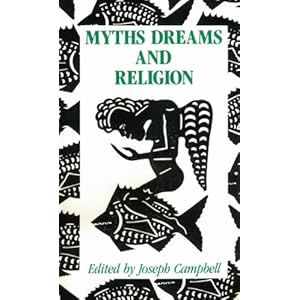
In this collection of eleven essays, edited by Joseph Campbell, I found a wealth of impassioned research into the mystagogy of our literate foundations. My reason for reading this piece of fine literature, was to creatively unmask the roots of a new mythology to re-identify with humankind, i.e. humanity, fashioned by my own literary aspirations. With essays by Alan Watts, Joseph Campbell himself, and other fascinating minds embedded in the culture of mythological literacy, I mainly focused my reading on the traits of human self-identity as it has evolved throughout mythic time. With regard to dreaming, the essays touched on the subject in the light of religious cultural referencing, often comparing Levantine with Indian dream philosophy, as either a visionary or intermediary state burgeoning natural self-transformation; an acorn, if you will, planted in the rough soil of the unconscious by the prehistoric mind of our mysterious bio-archetypal origins. And the perennial quote, from the final essay by Richard A. Underwood, "Myth, Dream, and the Vocation of Contemporary Philosophy" a reference to Heraclitus' Fragments reads, "Even sleepers are workers and collaborators in what goes on in the universe."
Shrapnel of memory in the ephemeral reflection of a broken
shard forced up the neck. Checkerboard flooring sprayed with clear blood. I
loosened my grip around his slippery esophagus-cored flesh, dripping with the
moldy puss in long-neglected balloon, deflated in the workman’s hand. In the
dense obscurity where the long way back from the faint escape route memories
still linger. Drinkable, luring, the tidal flush of shared pain extorts the
constant sleep, the blathering, ongoing consciousness, never put to rest by the
wasted highs of an unceasing mind, running off the bare edge of a fleeting
freedom to simply be, and not be moved to contemplate homicide and escape in
the backdrop imagination of the unreal & surreal & real fire of raw
instinctual creativity.
_________
Strangle/Strangling
"To dream about strangling someone, or being strangled yourself, means you have been hiding an important part of personality - one that you need to express to be happy - just to please someone in real life." (iDream)
_________
of memory and the strange
the lofty touch,
reminiscing beyond the treasured wine of death
as an end to meaning
in the fingertip and pupil
shone lunar and astral
with vanished luck
On reading, The Sheltering Sky, Paul Bowles' most well-renowned literary work, I was easily spellbound by the way he writes of the desert. This man knows how to write about the desert. He challenges the very depths of language as a mirage over the ever constant reality of the desert wanderer, struggling to see through the inescapable immensity of emptiness.
The book began with an allusion to dream in the very beginning. Where the main characters, three wayward American travellers, briefly converse on the topic of their dream before the subject is snuffed out by quick boredom and the shallow heart of extroversion at the dawn of spiritual tourism. The travellers seek to surpass the edge of knowability. Unbeknownst to them, to travel without is to travel within, likewise, to travel within is to travel without. Or, as Joseph Campbell wrote, "where we had thought to travel outward, we shall come to the center of our own existence. And where we had thought to be alone, we shall be with all the world." (Source)
I read this book to ruminate on the presence of my grandfather, stationed in Oran, Algeria in 1943 during WWII. Further, I was moved by the shifting sands of memory, as I reminisced on the fleeting clarity of earthly form, surveying the mysteries of the open Sahara on foot, on horseback, on camel, in SUVs, encamped, stoned, under a moonless sheath of stars, and under a fully electrifying lunar beam, reflecting on the moonscape shapeshifting quality of Saharan life. Now, I read with empathetic interest with the mutuality of a fellow American expatriate, while in colder lands.
The book was written by an author, who was first, a music composer (see my post Dreams That Money Can Buy for reference to a past collaborative work he did with John Cage and Marcel Duchamp), and then, with age, crafted a literary masterpiece. As Tennessee Williams wrote in an introduction to an edition of The Sheltering Sky, in reminding the aspiring literati that Bowles had given his words enough time to "cook" with the experiential maturity of a life lived with his respect to his writing.
_________
On the metro, I open a local paper. Full color imagery comes alive, mostly scandalous female body parts, all the rage staring at you through half-covered nipples. Open the next page and shockwave. The image draws me in, a direct witnessing. I am there in the scene.
The African countryside, in the midst of civil war, green-uniformed soldiers are torn from life and limb in a bloody matter of seconds. I can smell the blood, and unwavering with petrified overwhelming adrenaline heat, I seethe with unearthly stress. Massive antiquated tanks and rebels are on their way to massacre the rest of life in the general vicinity. I flee, sure to grab a sight-affixed rifle.
In the night, stranded in the vile hot foreign country, I sense a wolf is near. Hunting for food, I follow the wild canine, cautious as to not be the followed. As I point my sight in the direction of the unaware, sickly beast, I see a green sniper light through the misty forested pathways. Fearful, I continue on with my hunt, starving. The closer I get to my prey, the more I realize it is a docile, harmless dog. I can’t kill it. With innovative strength and penetrating sight, I turn the tables on my would-be sniper. The mercenary is female. I can’t shoot.
Trashing my weapon, I head down a gated outdoor corridor. An overgrown trench of weeds now marginalizes colonial architecture, rising gothic overhead. The sky is dark grey, almost of sable commitment to the opaque grandeur beyond atmospheric heights, mirrored in the abysmal abandonment of the colonial fringe.
As I pass through the empty corridor, an unmistakable presence begs me to look over my shoulder. Behind me, a full-grown, healthy cheetah of princely step, subtly notices me through the fog haze. A bitter second ensues, I sprint, uneasy into the mangled course of vines and metal.
The cheetah bolts in an instant, as the steam of boiled broth rises from a fired pot. Miraculously, I manage to break out beyond the corridor before the cheetah advances on my unwilling flesh. A fortified military complex is my merciless welcome. Stealthily, I glide through unseen and out onto the open plain. A train station stands, lonely against the outlandish veil of unbridled wilderness air.
________
Hunting
"If you dream of hunting, you will struggle for the unattainable. If you dream that you hunt game and find it, you will overcome obstacles and gain your desires." (iDream)
________
wanderer
navigating through bursts of fire
while swans pull in whispers from far off,
sinking whistles, incantations, coded and brief,
releasing and subsuming the night,
to walk alongside other creatures
whose origins have no life in this world,
ranging across times and spaces
in the vast maze, within perceived eyes,
following a vigor,
sensing hues and grays
figuring, vanishing,
erased across slick thought trains,
to appease the spirit of the land and renew Place
raised from pure desire into a high peacedom
prevailing and spanning beyond Earth
yet encircling the buried heights,
now wasted underneath urban pathways
leading to vanquished lore,
spun with vines
growing and curling
swift with a fluidity of inhuman passion,
to embrace and devour flowering tombs
gathering in the Name,
speaking in raw emotion,
devotees to spontaneity alive with independent, rousing energy,
gaining followers behind faint lines written in dust
saved in the memories and the trust of trickster cults
after every midnight round
to oust the villainous government
from outside neoclassical churches and new age rooms
cast in a shrouded light
that spawns frustrated, annoyed intellect
to gulp down dreams and swallow potion