Primarily a writing exercise, this dream journal-inspired blog is a quiet introspective sojourn into the process that we traverse in going from private dream to public art. I see our dreaming as an internalized mythmaking. As I philosophize and expressively exhibit dreams, both private and public, I encourage and delight in creative language as a way to practice experiential metaphors through a “public dreaming." Writing Theory: Creative Dream Fiction
Showing posts with label Sudan. Show all posts

Monday, 20 May 2013

Dreamers Reconcile with Harsh Truths: S. Sudan and the Music of Memory


One thing that keeps me pushing these painful stories; the dreams I have. Sometimes, like, the voices of the dead that I have seen would tell me don't give up, keep on going, because sometimes I feel like stopping and not doing it, because I didn't know what I was putting myself into. (Emmanuel Jal, 2009)

What are your hopes and dreams?

I want to fly an airplane.

What else?

I want to be able to study in the daytime. And in the morning. And I want a day that I can just live…so I can build my house…where there aren't any problems that could destroy it.

Emmanuel Jal, age 9 (War Child)

On April 8, the Peace and Reconciliation Conference in Juba, the capital of South Sudan, began an unprecedented step forward in the nation’s history. On Monday April 15, South Sudan President Salva Kiir Mayardit suspended the conference indefinitely. Besides the $885 million contributed by the Canadian federal government to Sudan for humanitarian assistance between 2006-2012, many of the 4 million plus South Sudanese displaced have resettled in Canada to remain active in community rehabilitation. Activist groups, both based in South Sudanese communities as well as larger Canadian social organizations continue to sustain the meaning of reconciliation not only as an example for South Sudan, but for the globe.

            The most pressing issue with regard to reconciliation in South Sudan is creating an inclusive society where larger social participation is grassroots-oriented. In a country with one of the lowest literacy rates in the world, with over sixty unique spoken languages, democracy is a precarious notion for most. In an open letter to South Sudanese Vice-President, Dr. Riek Machar, David Mabior Atem of New Sudan Vision wrote:

Healing those long inflicted wounds against one another cannot be dealt with in 3-4 days as well as top down approach instead of bottom up approach…Another added advantage of beginning at grassroots level is the flexibility of language (dialects), which can result into high interactive and productive engagement.

            Dr. Riek Machar launched the official opening of the conference, which trains 200 peace and reconciliation mobilizers. “The newest nation on earth has embarked on a journey of healing for the national reconciliation,” the Sudan Tribune noted. Dr. Machar had also been married to British aid worker Emma McCune. International recording artist Emmanuel Jal, winner of the 2013 Calgary Peace Prize, had been rescued from Waat, South Sudan by Emma McCune as a Lost Boy. Jal took refuge in Kenya, eventually leading him to the UK, and Canada. Emmanuel Jal’s acceptance of the Calgary Peace Prize on behalf of all South Sudanese marks an especially significant moment in the common reconciliation efforts of Canada and South Sudan.

            “He uses himself as an example in his storytelling of how hard and difficult and long it's taken for him to begin the process of healing and of reconciliation with his former enemies, and that's the story that he told,” Consortium for Peace Studies director George Melnyk told The Media Co-op. “He's also very careful to not critique the South Sudanese who made him a child soldier.” The Consortium awards the Calgary Peace Prize to global visionaries working towards peace, beginning with Hiroshima Mayor Tadatoshi Akiba in 2006. The Consortium is currently the only post-secondary Peace Studies initiative in Calgary.

            James Nguen, founder of Biluany Literacy and Water project, responded with deep concern in an Op-Ed piece in South Sudan News Agency, decrying the indefinite suspension of the Peace and Reconciliation Conference in Juba. “This unfortunate development shocked everyone in South Sudan and around the world. There were no further details why the project was suspended,” Nguen wrote to The Media Co-op via email. “If people reconciled, then there will be no petty tribal raids which the past 8 years cost South Sudan government and the international community millions of dollars.”

            Although the Second Sudanese Civil War, which ultimately led to an independent South Sudan, started in 1984, the world did not respond until 2004. The political situation in Sudan, and now in South Sudan as well, is very complex and is steeped in both European colonial history as well as Egyptian foreign policy. The legalities of genocide with regard to reconciliation have remained unparalleled in controversy ever since the United Nations adopted the Genocide Convention in 1948. “There was a genocide in Darfur, and there was genocide in South Sudan from the beginning,” James Nguen said to The Media Co-op. “In order to secure the CPA [Comprehensive Peace Agreement], they could not force Al-Bashir to step down without confidence that his successor would respect the CPA. Only one of the three agreements of the CPA was met, which included peace agreements with Abyei, secondly, and Blue Nile and Nuba Mountains as a third agreement.”

            The outstanding agreement to respect the right to self-determination with the people in the Nuba Mountains has especially intensified on the issue of genocide. Global activism in solidarity with the Nuba people has followed in the wake of the independence of South Sudan in 2011, including the End the Nuba Genocide Coalition. The only area not consulted in drawing the new national border, Abyei, is directly impacted and holds outstanding land disputes. Abyei territory is a priority for the Juba Conference.

            South Sudan’s independence was “the most significant redrawing of the map of Africa since the colonization,” Angel Batiste, Area Specialist with the Africa and Middle Eastern Division of the Library of Congress in Washington D.C., noted, before introducing the lecture, Cultural Heritage in South Sudan in November 2012. 

            During the Calgary Peace Prize events this March, Emmanuel Jal raised eyebrows concerning the latest news from South Kordofan, where another genocide in Sudan seems to be taking shape with unprecedented momentum. “UN people down in Sudan are saying there’s a possibility that in South Kordofan that the genocide there could be worse than in Darfur,” said Jal to an eager crowd at the University of Calgary on March 1, 2013.

            The diaspora is truly integral to peace activism for South Sudanese. “They actually support their family members more than even the government does,” Jal told The Media Co-op, referring to the diaspora of South Sudan and their role in the reconciliation efforts ahead. “If you’re educated, if you have a degree in whatever form, don’t go home to look like you’re going to be employed by the government. You go there as an employer. Go there and use the skills we have there and establish something, because the country is still new. Whatever you touch will prosper.”

            Since late last year over sixty genocide scholars and anti-genocide activists initiated a letter writing campaign in response to the genocide atrocities in the Blue Nile and Nuba Mountains. These letters have fallen on what South Sudan’s leading independent news source, South Sudan News Agency has called, “absolute silence”. The Atrocities Prevention Board (APB), founded by U.S. President Obama specifically in response to the lack of U.S. governmental initiative towards preventing crimes against humanity and genocide, became the most important, and also most unresponsive, target audience. This April, South Sudan News Agency published the latest letter, sent to U.S. Ambassador to the United Nations Susan Rice. An excerpt from the letter reads:

We never expected, though, to have our letter (and now letters) go unanswered… when we, scholars of genocide studies and human rights activists, fail to receive a reply to a letter that we first wrote back in December 2012 and have now sent five times to four different individuals affiliated with the APB, it, indeed, feels as if the APB and its focus/work is little more than “a sideline in our foreign policy.”

             Similarly, in recent news, the only head of state in the Americas to be tried for genocide crimes, U.S.-backed Guatemalan dictator Efraín Ríos Montt, saw amnesty on April 18 after the current Guatemalan president intervened to have the case annulled. “It was the first time that any nation had been able to use its domestic criminal courts to try a former head of state for genocide,” said investigative journalist Allan Nairn on Democracy Now!

            Despite ineffective government intervention, independent non-profit and charity organizations, spearheaded by leaders from South Sudan, continue to work towards a sustainable society through reconciliation efforts. Biluany Literacy and Water Project, a development initiative led by James Nguen based in Calgary, has been active for over three years in building wells and providing educational resources in South Sudan. “There is no sustainable infrastructure in South Sudan, and without a lot of assistance from the international community, trust cannot be rebuilt,” Nguen said to The Media Co-op. “The greatest struggle is to represent ourselves, to know who we are as one community. The war eroded our cultural values, our history, our society.” Nguen recently partnered with Gua Africa, the charity of Emmanuel Jal, to fund well development and to organize a conference in Canada to mirror the Peace and Reconciliation Conference in Juba.

            Since winning national independence, other organizations in the Calgary area, home to the predominant South Sudanese community in Canada, are working towards reconciliation. South Sudan Peace Building International Foundation Inc. (SSPBIF) is one among them. Secretary of the SSPBIF Kuir ë Garang is also a prolific multi-genre author of six books. “People in South Sudan tend to regard literature as ornamental, they don't see how it can help relate people, to help people find relations between one another, so they can get together and have mutual understanding through education,” Garang told The Media Co-op. “Through literature, we can better represent ourselves. Now up to 70% [of people in South Sudan] are dissatisfied with their government.” Garang is currently working with a publishing house and bookstore in Juba to open a forum on multiculturalism and diversity for professional writers from Canada and South Sudan.

            Rural South Sudan is reputedly the most marginalized and underrepresented, effectively causing the need for grassroots inclusivity in Juba’s Peace and Reconciliation Conference and beyond. Resource conflicts both at national (oil exploitation) and grassroots (cattle raiding) levels have been at the root of social disorder in South Sudan. Augustino Lucano, a South Sudanese migrant from the Equatoria region living in Calgary, shares an unrivalled success story in bringing together divided rural ethnic groups and organizing incipient meetings with government representatives.

            Lucano received personal permission from South Sudan MP Joseph Lokodo Kolombos to open a peace center in his home region of Equatoria after presenting to the MP a research paper inspired by an Initiatives of Change workshop. “The problem is that people in rural South Sudan are still very divided, they do not see a way to live together yet with the whole nation yet,” Lucano said to The Media Co-op. Lucano, a member of the Didinga ethnic group, lost two brothers in conflicts with the neighboring Toposa people. “The Maaji peace centre is located in the middle of Didinga and Toposa land, in a flatland valley, where both tribes can meet peacefully,” Lucano conveyed to The Media Co-op. “So far there has been no raiding at the peace centre in Maaji. First, it was necessary to establish the peace centre where resources could be shared, and then we can discuss reconciliation.”

             In February 2013, the South Sudanese Minister of Wildlife’s visit to the Maaji Peace Centre drew tears from elders and children alike who had never before seen a car, no less a government car. “It showed how marginalized these people had been in the national developments, and also that the government was starting to establish a relationship with rural people, including them in the dialogue of the upcoming Peace and Reconciliation Conference in Juba,” Lucano told The Media Co-op.

             2013 is quickly becoming a year of unprecedented global reconciliation movements. The Peace and Reconciliation Conference in Juba is especially significant to Canada with its direct relationship to the activism of the Canadian diaspora of South Sudan. With the first head of state in the Americas having faced genocide charges, a more intimate link can be made with Indigenous peoples’ history in Canada. Will Canada renew its role as a global human rights leader in the wake of mounting genocide awareness around the world? Ongoing debates in Canada, spurred by Idle No More, emphasize reconciliation with First Nations as an inclusive reconciliation with humanity. 

This article previously appeared for The Media Co-op on April 29, 2013
___________
the road to rome is paved in bones by RK
madness by RK
the human rabbit hole by RK
old west art by RK
papercut & stoned by RK
____________
conjuring a sense of the once roaming herds of mammals that lit upon the open horizons of our once naked landscapes - the frame drum evokes a sacred connection to our mammalian evolution through a heartened soul brethren with large mammals, and our precarious evolutionary stability as one of the most vulnerable types of living creatures on planet earth - in the piece, i speak of the charge of the electric pole of patriotic industry over the breadth of our continent as the sacrifice of ourselves, as male-female witch, burned on the flagpole of national identity, a sacrifice brought about by the all-devastating silence of voice, speaking of a way of life not bound to the dominant settler society, yet existing now only in negation to the sedentary ecology of consumerism and vacation, with regard to the lost history and memory of our true selves in communion with the deeper movement of life as we once knew it


Placed Anonymity, like the chapbook, "A Sick Society Amuck" is inspired by the words of Jiddhu Krishnamurti, iconoclastic spiritual philosopher, who said, "truth is a pathless land". Truth lies in the anonymity of place as is, without meaning, as a river is in essence meaningless until commemorated by a name and story, whether of scientific or folkloric mythologies.

in a pathless land, how do we come to know the land, or know what is true, HERE? that exploration is the foundation for this four poem chapbook, eventually culminating in collectivist thinking, to aspire towards a basis of unity evading the muddled institutionalization of creative freedom


Monday, 4 March 2013

Electro-Acoustic Improvisations II: A Sonic Narrative from the Far West

Electro-Acoustic Improvisations I (Album Art Remake) 
Electro-Acoustic Improvisations II (Album Art)
"The first question I ask myself when something doesn't seem to be beautiful is why do I think it's not beautiful. And very shortly you discover that there is no reason." John Cage

Essentially one album, Electro-Acoustic Improvisations I & II are to be listened to in continuity, as a single expression of seeking through sound as voice and agency for the soul of the word. Electro-Acoustic Improvisations II is conceptually the final track of I, divided into 4 parts for listening.

Experiment with your ear, and look to the bottom of this post for an aural transport to the Far West.


Electro-Acoustic Improvisations II

On the margins of the vast, interlocking web of technology and nature, with broken instruments (both acoustic and electronic), we are beginners on the road to merging technology with all of life in this the human experience of Earth and the inner world as an evolutionary being of conscious development. 

Imagine sitting at the edge of a fire in the raw, teeming wilderness. The forest is thick. The air is heavy with an unbroken gamut of vegetable breathing. Warming your hands by the fire, under cover of starlight and the faint haunts of a new moon, the mind seeps and seethes with memories, dreams and reflections on the world “out there”. Civilization and its discontented fires of electric madness pour into your brain like an acid flashback. The Earth is still, yet your hands shake. So, before you is the music of the muses, the bare wonderment takes its own course into the heavens and hells of your own nature. Through music, the seeker of solitude purges the concrescence of electro-social distension. Discordant dissonance marries with harmonic essence as the jeering subtle flesh of mad electricity merges in the mind, hand and heart of one in touch with the strings, blood and fire of creative sound.  

Part I - The seeker discovers music as a beginner. The instrument is slightly out of tune, and the playing is imperfect. The melodies are introduced with electronic music, featuring static electric synthetic effects throughout. The seeker gains mental balance by overcoming the first break beyond the shores of civilization into the open expanse of nature beyond, where other, even more trying challenges are to be had in confrontation with the self, exposed and untended.  

Part II – With emboldened consciousness, the instrument and its sound are clearer. A fire has been set and night opens to the gorgeous possibilities of the sonic imagination. Electric distension is transformed into unseen beauty. The grandeur of melodic instrumentation opens up with a new strength of diversity. As the clouds above part to reveal pure sky, memory and reflection are enlightened through joining with traditions of seeking, as with the sonic movement into Middle-Eastern influenced lute music, translated to guitar in creative solitude with the empty awe of all-potent Nature. 

Yet, the seeker soon realizes this is only the beginning of the journey, and there have ever been electric distension scattered throughout the night’s hearth. By the end, the celebratory feel becomes more solemn as the seeker attains the first seed of self-knowledge, and understands the need to set one’s own pace and prepare certain deliberation before embarking on the pathless sojourn ahead. The music ends with the realization that it is dawn, and the horizon welcomes ahead.    

Part III – Reprieve from the journey, alongside a mountain ascent, beneath a cliff. Cool air from a spring entices the cold march of winter’s coming winds to turn and wade in the lush mountain air. Without a fire, music is the warmth. Creative passion warms from the inside with the brightest of flames. At first, blowing hard into the hands and fingers for the warm breath to spread throughout and allow for the wealth of instrumental music to unfold, the seeker stops playing as soon as it begins to rain. As in Taoist tradition, when the rain makes rhythmic motion, and the melodies of the thunderclouds fly with the magical presence of wind, one is to listen, and be humbled by the music of the spheres.  

Part IV – Beginning with a light touch of electronic moments, the music glides atop sounds of weather, especially as the seeker gets closer to the ocean. Following rivers, streams and tributaries, faring flash floods and rain-swept gullies, the seeker emerges from the wilderness with a great boon of discovery. A new instrument to behold! Notice, the music approaches harmonies with the natural way of impermanence and unity, as opposed to listening, where creative interaction with nature breeds a kind of musical kinship among humans and all life on Earth. As the seeker sights the ocean, the new instrument is played, ending the music and the journey. 

The new instrument is the xaphoon. Invented in the 1970’s in Hawaii, the xaphoon, also known as the bamboo sax, is a contemporary single-reed woodwind. The track ends with a homage to Jack Kerouac describing San Francisco, the very edge of the west, to crystallize the final xaphoon improvisation solo; a traversal of the “far west” in sound. 

Influences: Bill Frisell, Hamza El-Din, Vi An Diep, Steve Roach, Brian Eno, stones/minerals, earth, water/ice, winter, landscapes of the North American west, Jack Kerouac, fire, trees, reflection, solitude

See my previous post: Music of the Dream Author: Electro-Acoustic Improvisations I Release 
___________
On a clean, medical train through Sudan, my Nilotic companion eyes me with a piercing grin as we pass south of Juba into the New South. We have arrived at his hard-won home, South Sudan. His smile is buried deep within the pain of intergenerational loss, the hellfire of war still sting his reddening eyes as he tears up, the pictures of his innocent family smolders into the soil. The land speaks with his voice.

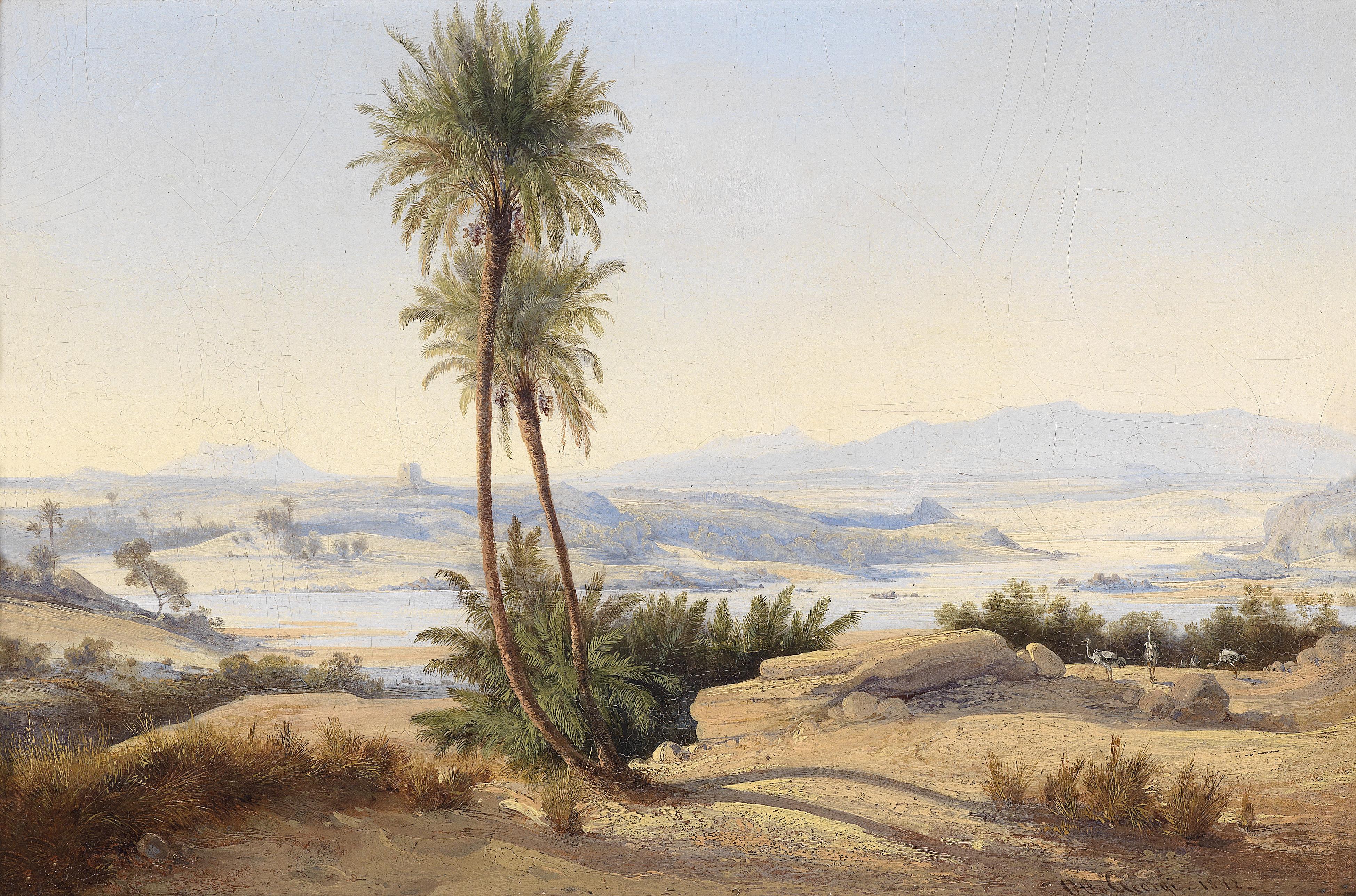
Southern Nubia by Friedrich Otto Georgi
A number of tourists from Europe and America depart from the train stop, as we all exit to proudly march through the gates of the newly formed customs center. Before I ready myself to stand up and follow in the foreigner’s line, I see the winking horror of rats, spiders and snakes twice the size of my face, gnawing at my brains in the middle of the first night. I’ve read such stories. This is open country for sub-Saharan life-threatening insects and arachnids galore. If only they sold us preventive supplies before stepping foot on the blood-torched burial grounds of a still cold reconciliation between tribes and kin. The first thing I see is a smile, wide and innocent as the all-embracing horizon. Before I entered Sudan, an asylum seeking Sudanese refugee in Egypt told me, “Sudan is the easiest place to kill someone.”

Tornai Man from Sudan by Gyula Tornai
I heave a sigh of relief as the other westerners depart into the folds of pyramidal shopping and freewheeling nature photography. I journey on, to the heart of the people. My friend is ever stoic, silent, basking in the wonders of a new nation in its infancy, victorious after so many losses, after so many needless ends, there is at least one fresh start to be had, and one that all can have a part in. Concrete residential towers spring up almost before my eyes, fresh paint lingers and drips throughout the dry stinging horizon of African sun.

African Riddle by John Mainga
Men work diligently, with the force of triumph, erecting monumental stone structures, for future generations to thrive, for the plentiful, abundant optimism of the future. The complexes are almost identical to the substandard suburban housing of greater Cairo, where many must have returned from as once-neglected refugees, now with a determined hand and proud say in social affairs. They don sun-deflecting head coverings, and traditional footwear made with scarlet fabric and coins. Women are nowhere to be seen.

Battle of Tamai by Geoffrey Douglas Giles
We drive on, deeper into the south. The more south we go, the fresher the earth, the more bare the optimism, the more innocent the smiles. The more south we go, welcomes are heard with more sincerity. The air is full of potential. The energy is warm, and the harshness that once thrived now sees a chance of dwindling beneath the pulsing chests of hard work. My friend dissipates into the sunlight now flooding our vehicle; as the inimitable human spirit washes us clean of fear.  
____________


The completion of this instrumental music project, "Electro-Acoustic Improvisations I & II " sets the ground for the next stage of my creative development, where I feature my experimental writing as spoken word together with my world music instrumentation. More art, music and writing next week! 

Wednesday, 21 November 2012

Music and War: A Dream of Youth

"I've been living in the war zone my whole life. It has always been my dream to make it to Kampala, because the National Music Competition is the biggest competition in all of Uganda. I want to win and I want our name to be known throughout Uganda as winners." Dominic, 14 year old Acholi xylophonist in War Dance

When I conducted research with refugees in Cairo, Egypt, I engaged the community in a youth music project. One night, I sat listening to the diverse musical traditions of Sudan, exhibited before me with unrivalled emotion. The room filled with traditional incense as we drank hilo-mor, a Sudanese herbal drink special during Ramadan. The lasting words of the night will forever echo in my head, when my co-researcher, a man from Darfur, asked his friend from Kordofan, a young singer, "Why do you sing your traditional music?" He responded, "Because when we sing, we remember where we're from, our place."
________
as the enlightening face of my old Israeli cousin, young of age, though old in memory blinks fearlessly in lieu of horizon’s edge, her eyes brighten in front of mine, a parallel daze, as she sends through her pupils an image of the bomb pattern of military flight

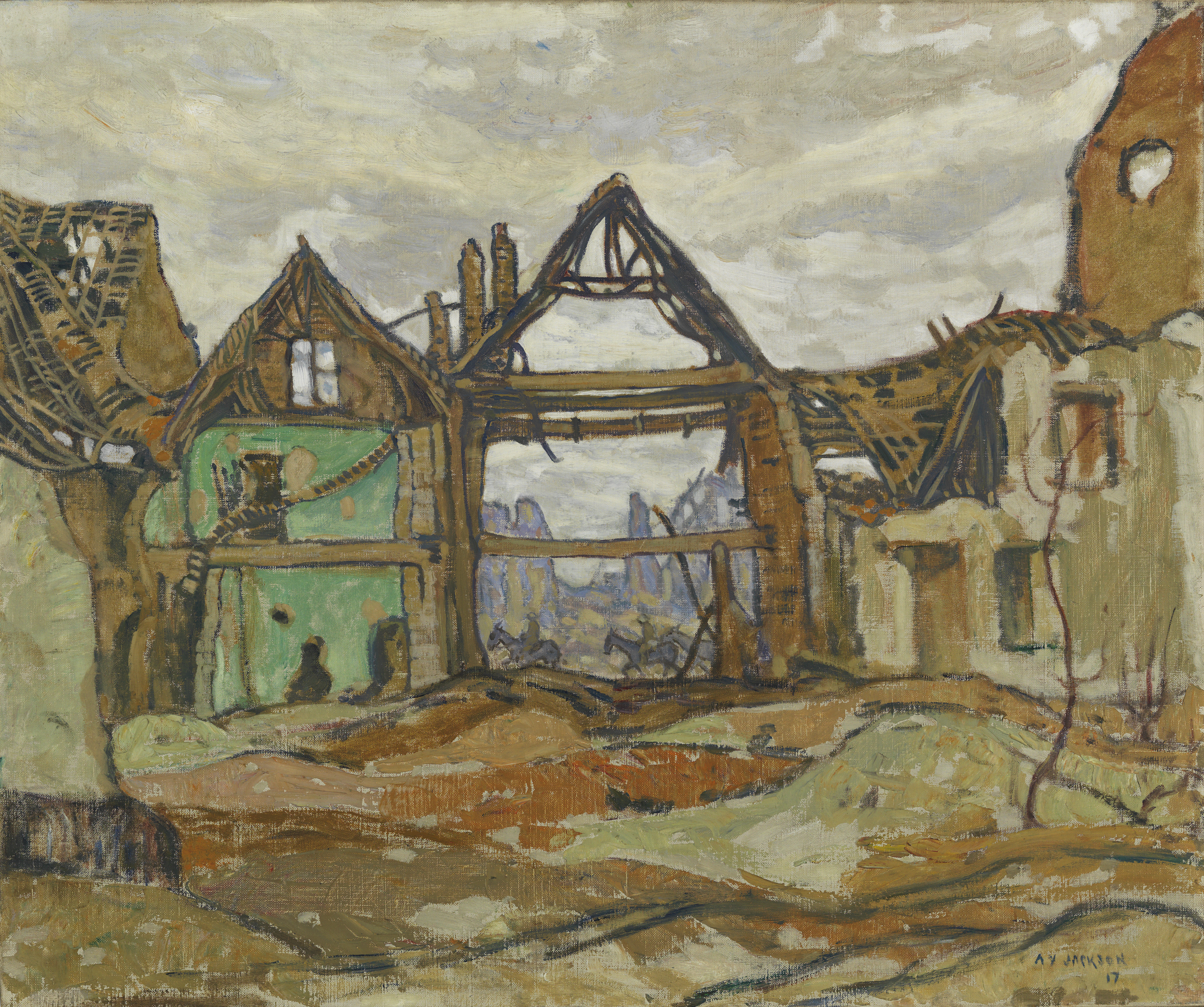
House of Ypres by A.Y. Jackson
and I see a Dutch friend, an emergent activist on the path to knowing her similarly, her pale face scans the leaping vigor of machine angst over the virtual land, upright in a jet, we scan the earth with the dotted map, bounding over villages destroyed at our mechanical feet as we leap through the air and finally touch down over a secretive hill, where green earth changes to beige desert 

F-16 over Pentagon 9-11-01 by U.S. Air Force
and part of a caravan, we gather direction with locals, Bedouin men allies, as they guide us towards the perimeter of our land, and espionage fills our lungs with the hot breath of wartime lies 
_________
“Where in whose pleasing leisure does our stock grow and go bolder in fields of blank duress from childless talent, filling space and accentuating silent harmony in the ever-widening round?”

To believe in light, and the possibility to endure the ground’s own failing trials
With Her round nature, orbiting in the mess of experience
Without prior knowledge, except when I believe in Her as my own

...dreaming up beauty in the complimentary fold / with airy locks peeled over the dead / sick earth swells with an overwhelming decay of restraint from life / into a confident foray with spirit’s unidentified heights or doorways into the New World / cornered, lightless

excerpt from "A Songster's Realisy"


Sunday, 11 November 2012

Remembrance in the Real Imagination of James Nachtwey


"This man was in an NGO feeding center, being helped as much as he could be helped. He literally had nothing. He was a virtual skeleton, yet he could still summon the courage and the will to move. He had not given up, and if he didn't give up, how could anyone in the outside world ever dream of losing hope?" James Nachtwey, speaking about famine as genocide in Sudan

I was young when I first watched "War Photographer" a documentary on James Nachtwey. As a teenager with a thirst for truth in filmmaking, I found photography especially endearing, and especially those photographers who followed the photography dictum, "the best shot is often the closest" with unnerving deliberation in foreign countries torn by war. Soon after,  I met Paula Bronstein, a family friend, who urged me to enrol in a school for journalism. I didn't. Though today, I often write for independent media on Media Co-op. Today in Canada, the country where I currently live, the nation remembers its fallen countrymen and women who served in war. A veteran and local author, Dr. Arthur Clark, reminds us that we do not only remember our own, but all who have fought and died in war; men, women, children, and the elderly included in every corner of the globe. This year, I've begun writing a creative non-fiction tract based on my grandfather's epic 20th century life, and his service in WWII. I've found a serious self-investigation into our relationship to war, whether through an ancestor, a friend, or in one's own life, is one of the strongest sources of contemplation in our modern lives. May we remember with a full heart and a stout mind!
________

in a city park, abandoned by wartime foment, I see my grandfather, alone after battle, on the plains of southern France, with friends, he is glad, and as he sits, I notice the loosened clothing spells an ease of the loins for the local tail 

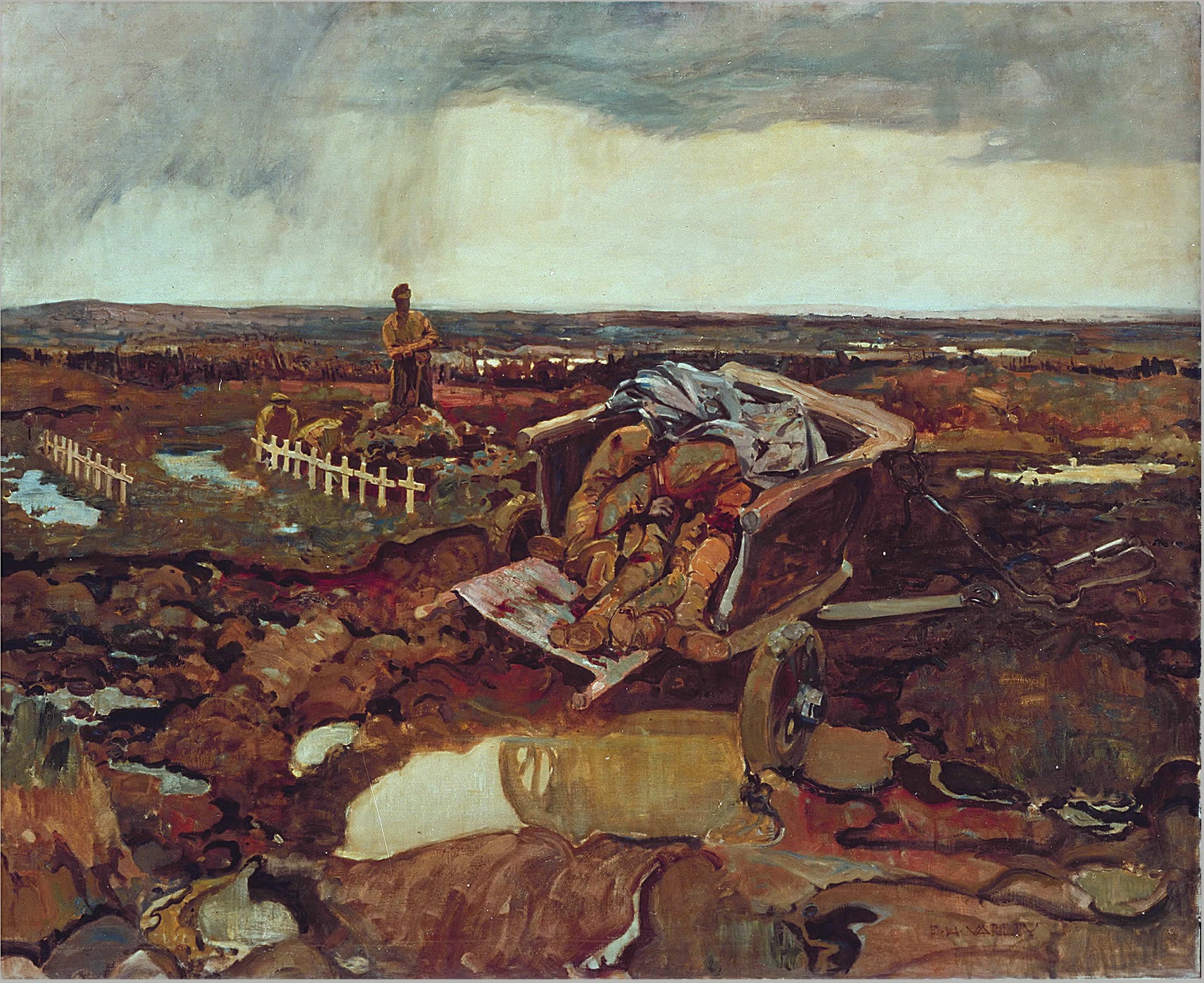
For What? by Frederick Varley
he grooms the horizon with searching eyes, and a local Frenchman arrives with a bounty of breads and cheeses for the sweetened mouths and delighted palette’s of my forefather’s company, happy in the autumn sun of deadening leaves, an old history decomposing at their warming feet
________
“The nation’s economical bosom bleeds with childless milk for the ruffian few who glare amuck into the wild spring of the beatific northeastern kingdom”
...
To bruise the English pace in an overtaking sea
With the magic and force of our forested craftsmen
Dreaming up skyline distances
Across the phantom pages of a medieval Columbian map
...
Our aristocratic exoticism
Bearing down on mountainous floods
To drown the ghastly past and its African boats
Full with the god-forsaken ash of a new America
Burning up with the Phoenix of old Mexico
...
Our human plague and its genocidal awareness
In the 21st century of medicated madness
When poverty turned to poetry in the music of her glory


Sunday, 13 May 2012

Through The Forest of Infinite Creativity


“I think I’ve created an environment in this forest that allows me to dream and to think. I like to work in that state musically, I’m very happy in that dream-like world…It’s a very internal type of sight, it’s a memory really…There has to be some struggle, I think, to create something of value, so there’s always that searching inwards.” - Howard Shore, composer
_________
The spiraling staircases in the inner lining of the university campus stretch as with poor digestion in the expunging of this semester’s students. It is our final few days. My friend, bound by the head with heavy dreadlocks races down the stairs, his phone falls from his clothing. On the phone, I see his experiments with asemic manuscript art. I am relatively unimpressed yet endeared by his attempts to invigorate this little known art form that I have been so adamantly embracing.

That summer, I board a ship-bound theatre. Is this a re-telling of “Queen of the Nile”? I am unsure as to the exact play. Soon, I begin to befriend those on board the ship in the starlight sun. All are jovial and friendly as the high-spirited waters direct us further into the riverine wilderness, high above atop the luxurious craft. In one scene, there is a procession involving an African woman character as lead. Two African-American ladies on board vie for the part. The scene calls for a booming voice. I console the lady who was denied the part. She receives her secondary well and smiles to me warmly when I whisper into her ear in Spanish. “You are the best to play the African role.”

In a campfire setting, unseen by a gathering of people on the banks of the palm-encrusted river banks, I sit with a Venezuelan friend as the festivities prosper in our midst. He shows me his new guitar, an electric Oud, played also by a Sudanese artist. Quickly, I mention my knowledge of the doumbek, after which he invites me to play with him. Our music is fine and elegant to the ears, as the fire spits rejuvenated glory into the dusky damp canopies above. Shadows flit with gorgeous mystery. 
__________
Ship
"To dream of ships, foretells honour and unexpected elevation to ranks above your mode of life...If you dream of being on a ship, you should listen to your instincts in waking life - they are powerful allies for helping you deal with everyday problems...if the voyage is calm you should go ahead with your plans."
________


"There is no more to say."

So I said nothing.
When no response is needed, you don’t even show a face.

“There is no room for necessity.

We are past that.
We live for ideology and we have abandoned spirit for the still death of the end.”

Feb. 19 2010
L.A. apartment