Primarily a writing exercise, this dream journal-inspired blog is a quiet introspective sojourn into the process that we traverse in going from private dream to public art. I see our dreaming as an internalized mythmaking. As I philosophize and expressively exhibit dreams, both private and public, I encourage and delight in creative language as a way to practice experiential metaphors through a “public dreaming." Writing Theory: Creative Dream Fiction
Showing posts with label unconscious. Show all posts

Thursday, 10 January 2013

Metaphors in the Art of Goya: A Theory of Unconscious Development

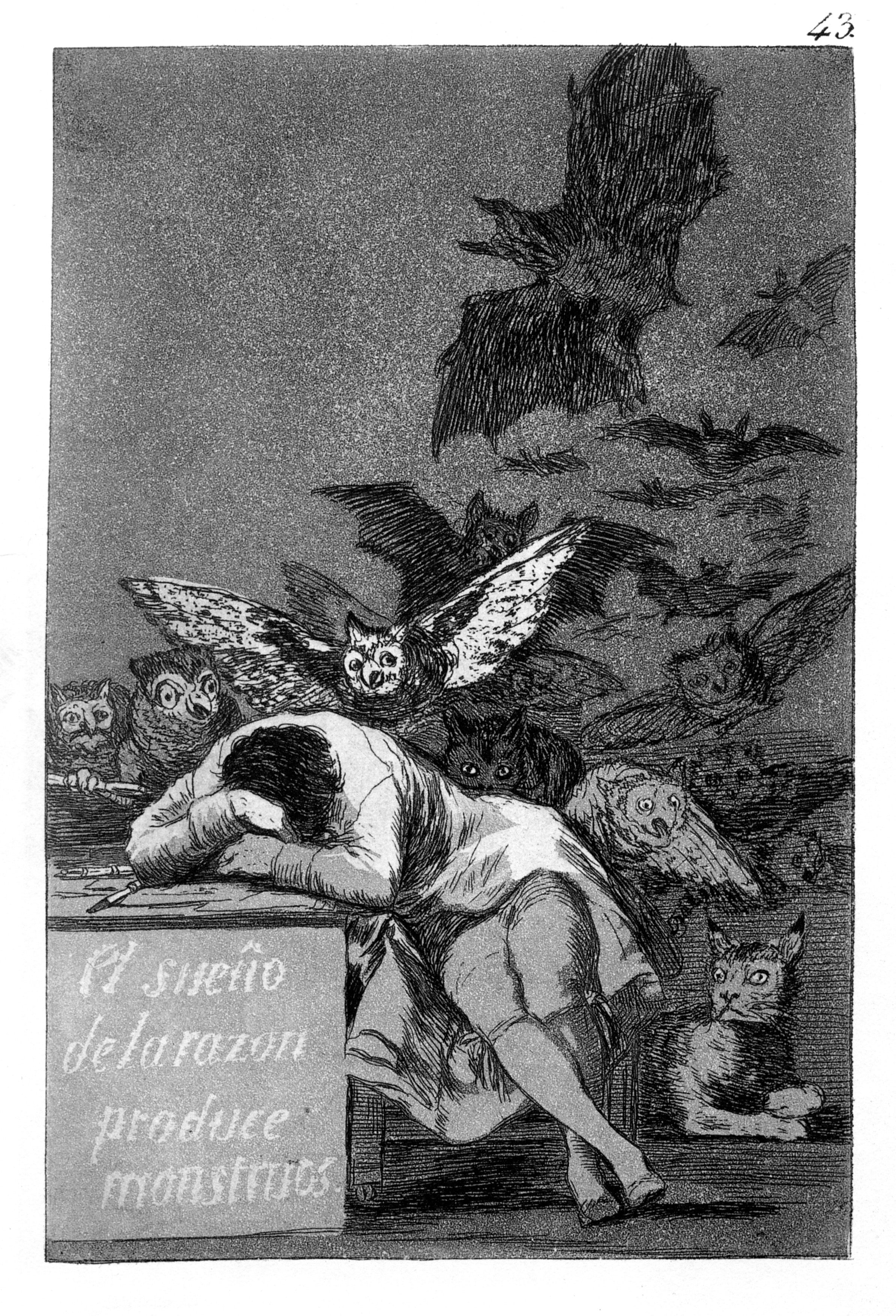
The Dream (preparatory drawing) by Francisco de Goya
The Dream (print) by Francisco de Goya
"The dream of reason produces monsters." Francisco de Goya (source)
The purpose for exhibiting the creative process of a master painter as Francisco de Goya, showing his initial sketch, and final print, runs parallel to a theory I have in relation to the role of the unconscious, and its impacts on the life of both the sleeper and the awake. 

Firstly, my theory is founded on lived experience. The foundation is as follows: If a person follows their natural sleep-awake patterns, without conscious intervention, the body cycles through an internal clock more expansive than the twenty-four hour day. Incrementally, each day one wakes later, sleeps later, and eventually earlier. In the course of over a year of practicing this experiment of consciousness, I have found the twenty-four hour clock to be limiting and a mere fixed point around which my sleep and waking cycles orbit, as a celestial body around its true source of gravity. 

Is this an effect of seasonal, environmental, or psychological pressures? The theoretical part now kicks in. With the exhibition of Goya's creative process in visual representing the night of Man, he is accosted by a host of demons, and in turn, upon waking, those demons become monsters of reason. So, if we allow the regenerative natural patterns of sleeping and waking to unfold, with complete abandon and in lieu of the normative twenty-four hour clock, we give way to a natural creative energy sourced deep within our unconscious, that nourishes our very life-breath with the heartbeat of self-knowledge. 

With this, the world of dream is merely a doorway, as is a metaphor or a myth, towards a more holistic regenerative consciousness of self-awakening. 

See related post: In Defence of Sleep: Regenerative Sleep Cycles of Archaic Man
__________
After hours downtown mall. Winter night. Midwestern city. The street is dim, and I stand, as to wait for a companion, or a bus home. Alone, my eyes scan the glass exit doors with a longing nostalgia for company. As I consider my absolute solitude, two prostitutes brush up against me. They closed in out of nowhere. After a moment of disdain, I begin to hear an inner curiosity.

Cocotte on the Road by E.L. Kirchner
"How much?" I ask, imploringly. "500 dollars" she says with a soft smirk. "I don't have that much." I respond, with dry humour, having never intended to act on my curious insides. Surprisingly, my wife steps through the hall behind us and into the background. She sets up her instrument and begins to play. I drift, flying towards the awake. Her unconscious body, her subtle spirit had called me forth, from the fantastic night of isolation.
___________
What of human sound,
The frequent lust to prepare noise in strength of intellectual wonder
and produce unfathomable beauty
            of the entire body
                        descending to and from the ear’s tragic centering
In our musical society, and what to compare “human music” to the grandiose law of nature, expressed in the mere calls of bird and beast revolving their unchallenged voices around the veil of a gross acoustic hall,
            whose rendering dreams an unforgiving welcome to the Earth’s living
            hall,
                        led to a thoughtless demeanor
                                    yet within the mind of man
...

to find a source,
                                                not necessarily of communication
                                                            between human, bird and god,
                                                but a direct connection
                                                            that spells mystery
                                                                        from an inspired gift to all
her sound.

excerpts from "Of human sound"


Sunday, 25 November 2012

Prophecy in Dreamland and Other Spells of Creative Literacy

Portrait of Rasputin by Ana Theodora Krarup
"Unconscious actions, mass unconscious actions have certain momentums, something that Tolstoy tried to explain more philosophically in the narrative of War and Peace, how the individuals with their own lives could be carried off by history's great forced floods this way or that. He was trying to describe often what I encounter in my study of prophecy, that there is a wave of mass human stupidity that is carrying even intelligent people into its current, that is converging on a collision in the Middle East...what I get wrong also is a helpful study of how the human mind misinterprets a sign with its own expectations and hopes and I think it helped me be a better interpreter as well as a predictor of the future..." John Hogue on Whitley Strieber's Dreamland: Journeys to the Extreme Edge

I first read Whitley Strieber's Communion, which stretched my understanding of non-fiction as a young reader, surveying a gamut of fiction, history, philosophy, mythology in my family library. 

Another genre-bender, who influenced my appreciation for literature in a more grounded way, was Jack Kerouac, who together with Allen Ginsberg, prophesied a shift in American social norms through their collective literary breakthroughs. They had noted that in the second half of the 20th century, Americans would shift from their hardline Christian upbringing to a more Buddhistic sensitivity. 

Reading both of their writings thoroughly, I soon interpreted within their work an interesting relationship to what we now call prophecy. More than to pin prophecy within the highly skeptical sensationalism of conspiracy theory, prophecy, in a more mythological sense, is simply the attuning of the intellect to certain eloquence in creatively utilizing timeless wisdom and ageless archetypes, reattributing them as signs. 

More often than not, prophecy in mystic circles is not an outward momentum, toward predicting profane outcomes, but simply one of the many old ways toward self-realization. One is inevitably of the infinite. Popular prophets are heady mixes of conspiracy theory or what Terence McKenna called, "epistemological cartoons". In Hebrew mysticism, my understanding is that prophecy is a numerological science, beheld within the Hebrew language of the Torah, encompassing a unitive vision of interpretive science as it meets with spiritual practice. 

Recently, I viewed the film, Rasputin, which was another prophetic figure portrayed on the literature on my shelf as a young man impressed by the literati. Rasputin certainly opened the popular discourse of prophecy on the world stage, especially as regards political intrigue, out into broad daylight. His eyes still transfix. 
________

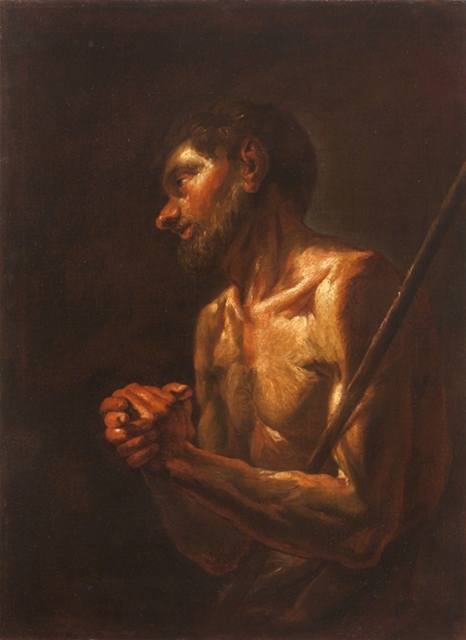
With a mug to mirror the inescapable frame of Kerouac’s joual-toughened jaw, bespoken with the silent glimmer of streetside grief, walking alone and alone for the infinite mileage of American wanderings, a cyclical tongue of ruthless freedom, to free the passions from the word-order of choice and splay will on the open pain of roadside heat with a thumb and a meek treasury of manly poverty 

Pauper by Petr Brandl
that drunken cry that rang throughout the humbling scope of spectral telephone wires following with the unheard voice of millions distanced by the wiry nerves of a social neurosis towards mobility, and with the rootless leisure of a need to travel as a way of being, that holy rope burned the traveler’s hands as the writing cooled mind’s belonging on a land of no-land opening
_________
“American body,
May you be cooled,
May the dog days of the final moon in your Roman clock tick no more,
May your fires be dampened in the Fall,
May your body always be replenished,”

“This is a prayer from your navel,
Your own son”


Saturday, 17 November 2012

Schopenhauer and the Unconscious Fate of Recurrent Thought

Recognise the truth in yourself, recognise yourself in the truth; and in the same moment you will find, to your astonishment, that the home which you have long been looking for in vain, which has filled your most ardent dreams, is there in its entirety, with every detail of it true, in the very place where you stand. It is there that your heaven touches your earth. Arthur Schopenhauer. On The Wisdom Of Life: Aphorisms
Aphorismen zur Lebensweisheit by H.P. Haack (photo)
Schopenhauer suggests that just as your dreams are composed by an aspect of yourself of which your consciousness is unaware, so, too, your whole life is composed by the will within you. And just as people whom you will have met apparently by mere chance became leading agents in the structuring of your life, so, too, will you have served unknowingly as an agent, giving meaning to the lives of others. The whole thing gears together like one big symphony, with everything unconsciously structuring everything else. And Schopenhauer concludes that it is as though our lives were the features of the one great dream of a single dreamer in which all the dream characters dream, too; so that everything links to everything else, moved by the one will to life which is the universal will in nature. Joseph Campbell. What is Metaphor? 
Here, I continue to find cross-references between three great thinkers of the 20th century, now with their source in the earlier precedence of Schopenhauer. The 20th century, with its unveiling of depth psychology towards the transpersonal meanings of self and agency in the will of the world have risen this line of Schopenhauer's thoughtful development with poignant regard. Joseph Campbell, James Hillman, Terence McKenna, all arrived independently at three concurrent patterns of human behaviour as a self-reflective being; character (self), narrative (fate) and dream (unconscious). The most accurate form of self-identification seems to be when we see ourselves as characters. As McKenna said, "we are in some kind of engine of narrative." Where Schopenhauer linked this to dream psychology underlies the mystic identification of fate by Carl Jung who said, "the unconscious exists in our lives as fate." The unconscious, fate, and the narrative engine of character are central to analyzing dream psychology as the major themes which now lead the humankind towards a humbling before nature as the greater mind of collective agency, and that to know nature, is ultimately to experience self-knowledge from the deepest base of the unconscious to a fully conscious, self-willed awakening of independent and transnational human sovereignty on Earth. 
_________

a city rat friend and I duel with competitive rage, amassing a firebomber brigade of red trucks fuming with the waterless engine of their stolen malfunctioning, and careening past the lights of midtown manhattan we stream as a rapid at open floodgate through the sleepless streets out of town

The Painting Reads: The Neighbourhood Belongs to the People Not Big Business
over a northbound bridge, we find refuge in an overgrown motel lot, the air is sweet, and we are invited to tea inside a cozy, furnished lobby, strangely reminiscent of a personal home, with sofa, television, and toys for young children, and our steam fumigates absently, unaware we separate to each our own rooms 
__________
Playful mortality, and the scream of death
Under stadium lights,
3rd block West Clinton Street New Bedford

And mortality reigns with his eminent consort Time
Ever-gazing into the strict law of entrance into the beyond,
Beyond reclining chairs and horizontal graves
...

Beneath a delicate skin of man
Braving the deforested aftermath of Assimilation
In the name of survivalist migration

After years of subconscious insubordination,
The doorway now flattened with the invincible family bond
Carrying our name and grown humor

excerpts from "Playful Mortality"


Friday, 26 October 2012

The Future of Sharks = The Future of Our Oceans = The Future of Us

Watson and the Shark by J.S. Copley 
The stigma of sharks has been with me since I can remember, having my first memories only a driveway away from the Atlantic coast. I lived under the shadow of Martha's Vineyard and Spielberg's Jaws. The above painting shows the old, now antiquated, adage that sharks are killers and need to be killed. As shown in my previous post (Reflection on "Save the Humans" lecture by Rob Stewart), sharks are not killers, and indeed their threatened survival on Earth due to illegal shark fin harvesting is as crucial an issue as climate change in the continued survival of the human species.

Read my story of activism for a shark fin free world on Media Co-op

Also see related groups Shark Fin Free Calgary & WildAid
________

Innumerable anemones, dim at the ocean floor, float and dance in the scintillating deep, a whirlwind of ocean currents spinning tendrils in the wondrous underworld of subconscious, inner space. The beauty of the sea is a palpable silence, a prenatal yearning within the sky’s reflective murder of inanimate light, into the shattered eye of a submerged mountain of a seemingly infinite myriad of species, blooming in the breathable space of instinctual lowering.

Samudramantham (Churning of the Ocean of Milk) by Anonymous 
The eye craves the strength of mammalian fear in the world beyond worlds. Octopi, shark and jellyfish sweep the wobbling invertebrate mind with a bodiless air of unlit terror. A shark darts and flees past in a show of wise defense, and the octopi bleed ink in a haze of warring tests far enough to provoke the mirage-lust end of human sight, and jellyfish, unnervingly absent as the mind’s eye sleeps in a soporific atrophy of inhuman might.

Still Life with Flowers, Shells, a Shark's Head, and Petrifications by Antoine Berjon
Memory entangles my feet with the concrete ingenuity of familial presence. At the opposite stance from my underwater lung, I breathe the damp air of a midsummer day’s stretch aside my grandfather’s elder chair. His sitting comforts me into a warm bottom, a deathless life of generative following, to stare back into the eyes of immortal sight, the human heights of belonging, and I am content, a mind at rest, awake, conscious, and filled with reverberating speech. 
_________
A dripping hunger instills those following to go beyond sleep and be
       In conscious wonderment, in the living dance
Dream today in a new and timeless breath,
       To stave off the mindless, parasitic asp
Climbing inside mind through dreamless eye-shutters
       Blocked by old-fashioned stone, brick and wooden carved hands

Holding my dancer, lover and beauty
      To the song of my dreams
Woman of my life
      Who holds no passion in sleep, and dreams awake
...
On the pedestal of a forlorn warning
      That no shore is safe in this dreamless state without dance,
Yet to sing and become a new dance and dream anew
      Before naked freedom announces song’s ending


Tuesday, 21 August 2012

Requiem For Our Unconscious Friendship With Spirit, a Paradise Lost


In the description to the above post of Zbigniew Preisner's "Requiem for my friend" written to commemorate the death of brilliant filmmaker Krzysztof Kieslowski, a quote from John Milton reads, "Millions of spiritual creatures walk the earth unseen, both when we sleep and when we awake." From Paradise Lost, Book IV Lines 675-6

"Evil into the mind of God or man
May come and go, so unreproved, and leave
No spot or blame behind: Which gives me hope
That what in sleep thou didst abhor to dream,
Waking thou never will consent to do."

From Paradise Lost, Book V, Lines 117-121

These lines speak to me today, as in yesterday's dream I experienced from myself such burning intense rage as I never feel for anything, never mind, as in my turmoiled sleep, directed at the smile of a new friend. And in the day after, the crooked seething in waking light transformed to deja vu and the peaceable contemplation of homeless sky, observing the street life and empty catharsis of the unreproved recollection of day, gathering myself inwardly to confront the daimonic psyche through an entropy of silence, night and dreams.

See my Reflection on Preisner's "Silence, Night and Dreams"
________
Two Latin men, both uncles of the word, they are as family, a safe haven of fraternity. Their abode, in relative disrepair, offers the kind of humble solace for a younger counterpart such as myself. When my family arrives to take me away, I shed tears of remorse for having become so loyal to their gentle friendship. Almost having left with a few of their possessions, they do gift us a curious metal mug, bedecked with silver broaches and a handle of aesthetic opulence. They warn us about a nearby volcano. If we are to mount, they say, we should not mount the East side, as the activity may fuse in a plume in that direction. 

With naïve innocence, adventurous, I lead my parents up the steaming mountain. Near the summit, the rumbling foment cracks the ground in a spray of unwelcomingly hot earth. Racing down to the foot of the mountain, the flowing lava is within earshot as the steam fills our lungs. Before the raging momentum engulfs us in its deathly cast, I raise the mysterious chalice to the sizzling winds and behold, the steam is vacuumed with the power of the entire energy of the volcanic surge into the mug, the handle remaining tepid at the touch. 
________
________
"that squirrely rascal who defended his money based on numbers and licks,
a body caressed with growing sores,
living excrement fumigating the stringy jewish marriage,
wafting scrawny alzheimer's brains over the stovetop dream,
fanned and purring as the asian lynx,
whose stormy eyes behold the revolution
behind the First Kingdom's daring ring"
...
"where words exist as bones and sculpted mountains
fire myths into the freed air"

- excerpts from "unreliable fortune" 

Friday, 3 August 2012

Phillis Wheatley, Awakened Mother of the Free Word

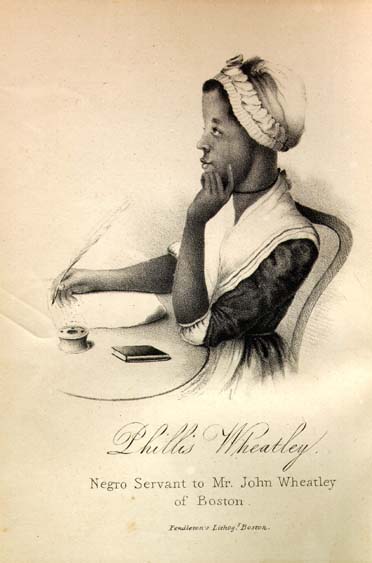
Phillis Wheatley by Unknown

Say what is sleep? and dreams how passing strange!

When action ceases, and ideas range
Licentious and unbounded o'er the plains,
Where Fancy's queen in giddy triumph reigns.

Hear in soft strains the dreaming lover sigh
To a kind fair, or rave in jealousy;
On pleasure now, and now on vengeance bent,
The lab'ring passions struggle for a vent.

What pow'r, O man! thy reason then restores,
So long suspended in nocturnal hours?

What secret hand returns the mental train,
And gives improv'd thine active pow'rs again?

From thee, O man, what gratitude should rise!

And, when from balmy sleep thou op'st thine eyes,
Let thy first thoughts be praises to the skies.

Excerpt from "Thoughts on the WORKS of PROVIDENCE." by Phillis Wheatley (Source)


Phillis Wheatley: "the first African-American poet, and the first African-American woman to publish her writing." (Wikipedia). Watch a great reading of one of my favourites, "Hymn to the Evening."
________
The grasses spell warm delightful, cracked insect green coloration, the chalky incompleteness in the waving eye of nature stares back with full recognition, restitution with human presence. Eagerly, I walk through the high rushes, stung with the tail end of a long forgetful period of mourning. The air fills my nostrils with intense humidity. An overwhelming lushness gravitates towards my brain. All the follicles from the plant world betray my unaware scents with awakening need. Aromatic, I speed through the vibrant, near-neon lime-green touches and find my way to a log cabin under the gorgeous density of a well-pollinated atmosphere, bred for the mind’s eye to pierce through to planetary secrets untold. 
Penniless, I am a drifter of smiles, a careless frame, basking in the gathering of those my age. Who do I see? I am at a loss. 

My mother! Young in her prime, she takes pity on my beleaguered state, handing me a Canadian ten-dollar bill in front of a lunch stand. The light mountain air feeds our intoxicated bliss with an embracing strength unknown in normal life, there is a silent energy about, allowing us to traverse the freedoms abreast in this long-sought after hollow of meadow and cloudless rays. I brim over with gladness, alive at once, with my friend and mother. Holding her in the sunshine womb of celestial pride, we walk through the silky meadow, renewed. Attaining the final vision, before the gully drops off the edge of a nearby cliff, I turn around and follow the nightly smoke of fellow friends, preparing for parties in the aftermath of youth, meanwhile, my mother stays behind, patiently awaiting my return, at the precipice of subterranean mystery.
_______
Mother
"The general image of 'mother' in a dream may symbolize a variety of feelings and ideas: caring, nurturing, love, acceptance, hard work, sacrifice, martyrdom, etc. The mother in your dream could also represent the 'collective unconscious,' the source of the 'water of life,' and the yin. Carl Jung suggests that women in dreams represent the collective unconscious and men the collective consciousness. Thus, the woman is that force, or current, inside of you that nudges you on and inspires you. It is your intuition and knowledge that is not necessarily attached to words."(iDream)
_______
in the deep silent tragic night,
blizzard disarray and the electric blankness
recedes throughout our psychic presence

with ethereal dismay,
morbid as the desert solitaire,
of rose-laden heights

excerpt from "interpretive direction"


Monday, 16 July 2012

Borges On Volcanic Riddles of the Unconscious


“The great English writer and dreamer Thomas de Quincey, wrote in some of the thousands of pages of his 14 volumes wrote that to discover a new problem was quite as important as discovering the solution of an old one. But I cannot even offer you that. I can only offer you time-honored perplexities.”

“And in our less beautiful mythology we speak of the subliminal self, of the subconscious, of course those words are rather uncouth when we compared them with the muses or with the Holy Ghost, but still we have to put up with the mythology of our time.”

- Borges, from his 1967-8 lectures "The Riddle of Poetry"
_________
An acquaintance, an intellectual from Latin America sends me an email bursting at the seams of the twenty-five megabyte limit. The prolific backlog of written research, charts, graphs and maps is stunning. He has proved, through simple correspondence, a scenario for the turn of the tide, an epochal shift in the geological age of the planet. The continents will roll, as on a dial, between the ocean currents. Coastal lands will be subsumed one on side by the leeching magma, on the other by tidal waves with enormity enough to swallow entire cities in a heartbeat’s notice. During this time, mythical beasts make themselves known, many from the below, many from above.

The Edge of Doom by Samuel Colman
The swirling aftermath of an ocean-swept city follows us upwards toward the mountain peaks. The shifting plates boom and gush, spitting fire and ash into the sunless sky, raining in metals and the boiling fury of an endless toxic night. We are protected by a subterranean demi-god, hidden to our waking eyes in the days of light. The simian beast grapples a crushing hammer, defeating a swimming ape three times his size emerging from the opaque, deathly soup of ocean water below. The battle is, to our human eyes, a goliath sight, many proportions beyond our own. Greedily, fear seizes as a last hope in the will to life. The blasting mountaintop seethes with equal force as the rising waters. 
________
Volcano
"To see a volcano in you dreams, signifies that you will be in violent disputes, which threaten your reputation as a fair dealing and honest citizen...Volcanic eruptions in dreams usually represent our erupting emotions. Feelings that you may be harbouring during the day might take the form of a volcanic eruption in a dream state. The unconscious psyche might be releasing positive or negative feelings in a safety of a dream (e.g. strong sexual feelings, passion, anger, rage, and fear). Superstition-based dream interpretations say that pouring lava is a warning about poor health. Dreaming about a volcano means the dreamer is in danger of losing a close friendship if she is not honest with that person." (iDream)
________
...
a planetary dissolution,
wavering on the edge,
deemed a wanderer,
stolen soul,
dreamer in artistic wonderland,
or violent binge-seeking parasite,
working miracles inside a silenced freedom,
without home, or conceived place
guiding mundane goals,
roaming vagrant, or seer,
yet still unripe,
recently fallen
from knowledge,
into wish, luck, intuition, and the all ecstatic
passion,
bellowing "good and evil are through"
impaled by the one breath,
strange yet true
...
throughout the known universe,
into the home of a single man,
living atop a mountain,
dreaming in the orbital spawn,
a satellite, the globe itself,
winding round, predictably,
to the course of light,
ending with beginning and finding us along the way
on the way,
all along

- excerpts from "Divorce & Diaspora" 

Monday, 21 May 2012

Engineering the Unconscious


“…there exists a barrier in you, all our minds, which prevents these hidden and unwelcome impulses of the unconscious from emerging.” (Dr. Ernest Jones) 

“…the very idea of examining and analyzing one’s inner feelings was a threat to their absolute control.”

“By analyzing dreams and free association he had unearthed, he said, powerful sexual and aggressive forces which were the remnants of our animal past. Feelings we repressed because they were too dangerous.”

“If human beings were driven by unconscious irrational forces than it was necessary to rethink democracy.” 

- from the film, "The Century of the Self" (Part One on YouTube)
________
We wait aimlessly. The school cafeteria transforms into the living room at my grandparent’s house. The light brown rug gives off a beige boredom, as I sit amongst friends and family, waiting, so patiently, as if for the return of Christ. Eating is drudgery. There is an unlikely foment of pleasing silence about, precipitated by my power-hungry relatives. I have had enough. I clasp my hands and in a manner to mock Christian prayer, I bowl over carelessly in front of my father and uncle. “Christmas is within you!” I say to them with lifted humor. They smile with vagrant attention as my grandmother proceeds to welcome me to sleep downstairs. As I take up her offer, the entire upstairs rumbles with festivity. Smoke pours in dreamily as brass instruments are uncased and steamed with the strong breath of celebratory music. “Is it time?” I ponder, wistfully.
________
Christmas
"Symbolizes family togetherness, reunions and celebration. It is also representative of new beginnings and fresh starts." (iDream)
________
There are four deities.
Each represents a characteristic prevalent in creatures, stones, places, and thoughts.

Creatures are animals, plants, water and air.
Stones are celestial bodies, crystals and money.
Places are meaning, stories, songs and art.
Thoughts are actions which emanate from the center of being, the heart.

Each of the four deities has an age,
and each has a name with which it is remembered
by People.

The first deity is called,
Haumah; Nation,
the second is
Hakhalah; Community,
the third is
Mishpachah; Family,
and the fourth is,
Aahtzmi; Self.

Today, we are in the age of Aahtzmi.


- excerpt from "Deadly Vision Part I"