Primarily a writing exercise, this dream journal-inspired blog is a quiet introspective sojourn into the process that we traverse in going from private dream to public art. I see our dreaming as an internalized mythmaking. As I philosophize and expressively exhibit dreams, both private and public, I encourage and delight in creative language as a way to practice experiential metaphors through a “public dreaming." Writing Theory: Creative Dream Fiction
Showing posts with label mysticism. Show all posts

Monday, 12 August 2013

Nonviolent Dreams of the Mystic Heart: The Sufi Path of Silence


"I have found in every word a certain musical value, a melody in every thought, harmony in every feeling, and I have tried to interpret the same things with clear and simple words to those who used to listen to my music." Hazrat Inayat KhanThe Mysticism of Sound and Music

In the beginning, there was sound, and not only sound - a sound. What was that sound? Was it the sound of one hand clapping? OM? The percussive bang of everything exploding into existence? It was the sound of all sound, the sound from where all originates, the intonation of creation.

In traditional music around the world, percussion precedes music, or more accurately, melody. Percussion is the first sound. From the clacking of bones to the taut skin of the drum, the percussive rhythm announces the beginning of music, and thus art, language and community.

What is the origin of language? Seekers for the origin of language are mystified and further entrenched in mystery by searching through the very device they seek to derive from its source. It is obvious that language originated as sound. It would be only logical to presume that language was derived of music, rhythm and song.

Does music influence language, or more intently, the way we speak and what we say? If music is a prime suspect in the origination of language, then it would not only influence the way we speak and what we say - music will cause us to speak. Yet, speech caused directly by music uses the language of poetry, lament, cries of ecstasy and deep reflection.

Speech caused by music is also self-reflective, sympathetic to the transformative creativity within the subjective life. Imagine, the first sound of the universe - a cry - reverberating throughout time and creation as a lament for the ultimate truth - that beginning ends.

In narrative, beginnings are almost always preceded by an end, giving rise to the potential for beginning anew. Music is a constant affirmation of the cyclic nature of ending and beginning, as sound falls and rises, always with the shadow of silence before, after and throughout. Indeed, great music is often a testament to the musician's play with silence.

Silence teaches of right listening. Music is the result of right listening. Music teaches of right speech. Knowledge is the result of right speech. Knowledge teaches of right action. Enlightenment is the result of right action. Enlightenment teaches of right listening. Silence teaches of right listening. 

In the film, The Way of the Heart, Hazrat Inayat Khan's wisdom is conveyed through his prophecies of music as becoming the future religion of humanity. Inayat Khan taught how all religious and social disputes are founded in the inconsistencies and ambiguities within verbal language. Yet, in music, where profound meaning is clear and immediate, ideas and beliefs are expressed without conflict.  

When speaking is united to the knowledge of music, the silence of listening births a voice of the path. 

Listen to more Dreams of Sufi Music: Mercan Dede
Dream of ShamsDream of PerhanDream of Lover
____________
flightless dragon
memory blast
rash city
silent anger
three ways
urban nature
______________

Created immediately before a Lantern Memorial remembrance for the victims of the bombing of Nagasaki on August 9, the track features a poem published with the University of Texas, El Paso, entitled, "Lugubrious Background Nearing an Electro-Magnetic Haze". The piece, transformed into narrative sound art through the trajectory of experimental music, is essentially about the explosive omnipresence of America juxtaposed with its remoteness. The marginal landscapes of America are the birthplace for one of the the world's greatest questions: atomic energy. The poem, "Lugubrious Background..." begins in the traditional lands of the American Southwest, with its rich history of Original Peoples. That history becomes estranged into small-town marginality by the overwhelming shadow of a towering American presence. Leading finally to the sounds of New York, the sirens of immigration and post-colonial history remove the people further from the true and original history of the land, until, finally, the inside becomes outside, and the electrified modernization of progress displaces connectivity in nature with a sheen of bright lights. The outside has transformed to the inside, and without a way out, people are terminally trapped by misperception and ignorance.

The musical instrumentation on the track, "Lugubrious Background" speaks to another contemporaneous event, namely the 400th year anniversary of the first treaty between Europeans and Native Americans. On the same day as people remembered the bombing of Nagasaki, canoes waded down Hudson River to New York City to meet delegates of the UN to not only celebrate World Indigenous Day, but to remember the beginning of a formal international relationship between Native Americans and European settlers, begun by the Iroquois Confederacy and the Dutch Kingdom. So, the instrumentation on this track, a frame drum (bodhran) and a xaphoon (bamboo sax) speaks to a renewed history of American tradition. The modern frame drumming techniques of North America have spawned an entirely new way of hearing and playing the frame drum. Although using a bodhran, the frame drum is a universal instrument known throughout the Original Traditions of Native Americans across Turtle Island. Similarly, the xaphoon is likened to a refreshed jazz tradition, wherefrom Hawaii a new saxophone was invented only thirty years ago. The sound of the fame drum with a bamboo sax conjures American sentiments from the historical age beyond the contemporary into the imagination of a future where co-existence revives cultural tradition.


The title of the following chapbook, "Truth our Up-Pressing" is a call to evince our oppressive actions, and speak our truth in a humble way. Either through poetry or prose, the human voice is a powerful agent of active creativity in the spirit of life, survival and freedom. "Truth" is here used as a verb, a kind of call to transform our forms of oppression that we often feel entitled to uphold in the name of family honour, and to dismiss that, and in turn, change our language. Therefore, I use "Up-Pressing" instead of "Oppressing" to say go from seeing our oppression as being a burden on others to seeing our oppression as a burden on ourselves. The oppressed oppresses, the oppressive are oppressed. In truth, all are both oppressor and oppressed, and until each and every last human being realizes this, there is no freedom for anyone.


Thursday, 31 January 2013

Life Phases of the Dreamer: Poe and Developmental Psychology

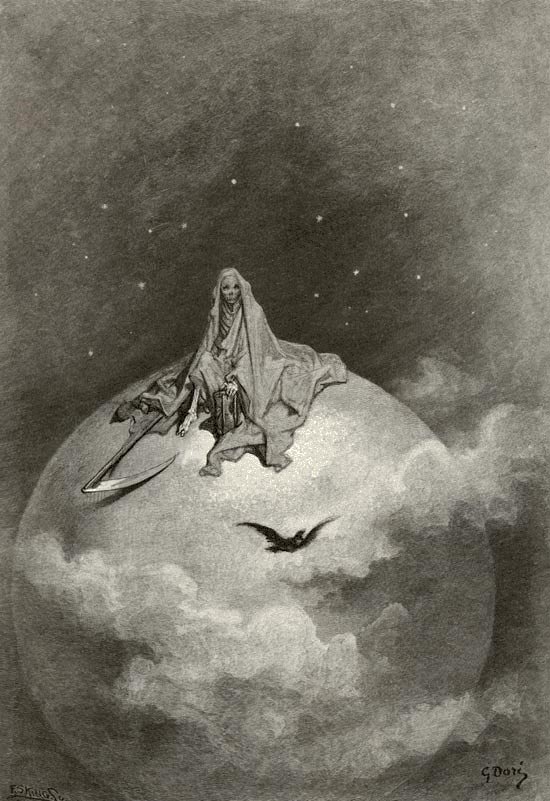
Edgar Allen Poe's Raven by Gustave Dore
"Is all that I see or seem/But a dream within a dream?" E.A. Poe

The practice of remembering dreams is one way to practice deep, inner self-awareness. The subtle energies of dream arise from the Source of Emotion. Both destructive and creative emotions are based on momentums of conscious action. Thought begets thought, and action begets action. As the Poe quote reads, so the psychological, subtle phases of our lives seem as dreams within a dreams.

Emotions are also based in psychological development through various phases of life. As a child, emotions are indistinguishable between self and other. The emotional vulnerability of a child rests in the experience of lacking discernment between “what is I” and “what is not I”. When a child experiences trauma, they are unable to separate the trauma in their environment from their own thoughts and feelings, which are not yet recognized as theirs. By adolescence, the human being is naturally predisposed to reflection on the content of one’s inner life, forming and recognizing their unique thoughts and emotions. This phase is often marked by the difficulties in attaining psychological independence from the collective emotions shared by family and community. If the person passes from this stage, they are able to maintain a strong sense of self, and so go out into the world, learning but not assimilating, acting but not capitulating. These three stages can be summarized as sight, thought and action.

At the fourth stage, there is a marked shift in consciousness. All the previous three stages become indelibly present in life, yet they all become partial to completion through a conscious manifestation of love. In the process of developing a love relationship, the emotions go through the three phases before they are actualized and fully recognized as the enduring experience of love. In the beginning, the emotional phase of the child returns, where individual emotions become indistinguishable within the love relationship. From that stage, thoughts are dominated by thoughts of love, and all action is cautioned by the fact that everywhere one walks now, they are not alone, but with their love.

As with the mystical hierarchy of seven energy centers in the body, known in such traditions as the Hindu Chakras or the Kabbalistic Tree of Life, these four phases represent the involuntary (feeling), creative (thought), power (action), and compassion (love). In the fifth stage, the love emotion resonates outward to engage a greater sense of love for a community, nation or people. In the sixth stage, the focus is clear, and the way aligns with a specific practice of devotion to service in light of the accumulated energetic septet of emotional phases of psychological development. In the final phase, sight, thought, action, love, community and devotion unites every phase of emotional development. The completion of self-awareness is actualized from the inmost depths to the outmost limits of human potential.


____________
She rushes ahead. Into a rigid cube of wooden frames and metal housing. Rusting chains fall over the marginal impasse of domestic space. The outdoor heavens collapse over the head of my lover. 

The Face in the Pool (frontispiece) by James Allen St. John 
Brilliant orange tigers growl and laugh with the insatiable greed of bestial hunger. She is engulfed under massive wingspan of the jungle predators. She submits to death, agog with passionate surrender.

__________
Filmic mind, braving theatric kingdoms
            Weighed heavily by the German cross
Over western shores, blonde
            With sightless camaraderie
In the sociopathic gaze of mindless pain,
            Order & god for trade
                        At the bedside, nude
                                    Binging before a final restitution,
Breathing in dream-talk laughter nightly,
            Not for escape,
                        Only to tread the unfulfilled urge
                                    To let go of body into an act of base movement

excerpt from "think IN drink"

Sunday, 25 November 2012

Prophecy in Dreamland and Other Spells of Creative Literacy

Portrait of Rasputin by Ana Theodora Krarup
"Unconscious actions, mass unconscious actions have certain momentums, something that Tolstoy tried to explain more philosophically in the narrative of War and Peace, how the individuals with their own lives could be carried off by history's great forced floods this way or that. He was trying to describe often what I encounter in my study of prophecy, that there is a wave of mass human stupidity that is carrying even intelligent people into its current, that is converging on a collision in the Middle East...what I get wrong also is a helpful study of how the human mind misinterprets a sign with its own expectations and hopes and I think it helped me be a better interpreter as well as a predictor of the future..." John Hogue on Whitley Strieber's Dreamland: Journeys to the Extreme Edge

I first read Whitley Strieber's Communion, which stretched my understanding of non-fiction as a young reader, surveying a gamut of fiction, history, philosophy, mythology in my family library. 

Another genre-bender, who influenced my appreciation for literature in a more grounded way, was Jack Kerouac, who together with Allen Ginsberg, prophesied a shift in American social norms through their collective literary breakthroughs. They had noted that in the second half of the 20th century, Americans would shift from their hardline Christian upbringing to a more Buddhistic sensitivity. 

Reading both of their writings thoroughly, I soon interpreted within their work an interesting relationship to what we now call prophecy. More than to pin prophecy within the highly skeptical sensationalism of conspiracy theory, prophecy, in a more mythological sense, is simply the attuning of the intellect to certain eloquence in creatively utilizing timeless wisdom and ageless archetypes, reattributing them as signs. 

More often than not, prophecy in mystic circles is not an outward momentum, toward predicting profane outcomes, but simply one of the many old ways toward self-realization. One is inevitably of the infinite. Popular prophets are heady mixes of conspiracy theory or what Terence McKenna called, "epistemological cartoons". In Hebrew mysticism, my understanding is that prophecy is a numerological science, beheld within the Hebrew language of the Torah, encompassing a unitive vision of interpretive science as it meets with spiritual practice. 

Recently, I viewed the film, Rasputin, which was another prophetic figure portrayed on the literature on my shelf as a young man impressed by the literati. Rasputin certainly opened the popular discourse of prophecy on the world stage, especially as regards political intrigue, out into broad daylight. His eyes still transfix. 
________

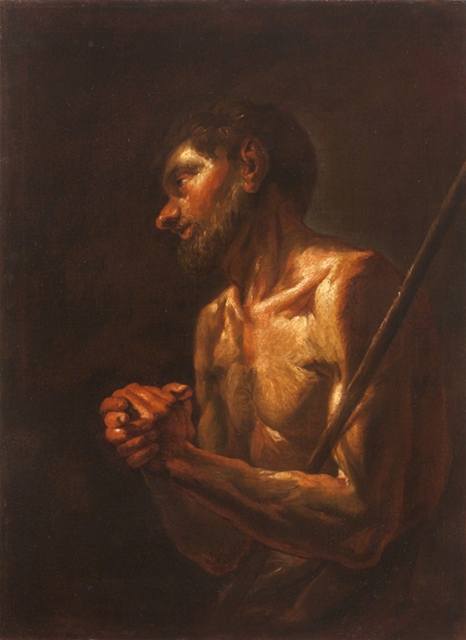
With a mug to mirror the inescapable frame of Kerouac’s joual-toughened jaw, bespoken with the silent glimmer of streetside grief, walking alone and alone for the infinite mileage of American wanderings, a cyclical tongue of ruthless freedom, to free the passions from the word-order of choice and splay will on the open pain of roadside heat with a thumb and a meek treasury of manly poverty 

Pauper by Petr Brandl
that drunken cry that rang throughout the humbling scope of spectral telephone wires following with the unheard voice of millions distanced by the wiry nerves of a social neurosis towards mobility, and with the rootless leisure of a need to travel as a way of being, that holy rope burned the traveler’s hands as the writing cooled mind’s belonging on a land of no-land opening
_________
“American body,
May you be cooled,
May the dog days of the final moon in your Roman clock tick no more,
May your fires be dampened in the Fall,
May your body always be replenished,”

“This is a prayer from your navel,
Your own son”


Friday, 23 November 2012

A Taoist Mystic-Musician and the Great Awakening

Painting of Tao Yuanming by Chen Hongshou
"By and by comes the Great Awakening, and then we find out that this life is really a great dream. Fools think they are awake now, and flatter themselves...Confucius and you are both dreams; and I who say you are dreams,—I am but a dream myself. This is a paradox. To-morrow a sage may arise to explain it; but that tomorrow will not be until ten thousand generations have gone by." Musings of a Chinese Mystic: Illusions

Possessed by a conflict of opposites, after reading this quote aloud to my wife, she says, "That is totally how I feel." She was raised in a Vietnamese sect of Shamanic Taoism. One day, a local shaman saw her hands before she left Vietnam for Canada. "You have the hands of an artist," said the shaman. As I watch her hands blend with the strings of her instrument, and hear the mystic bent with staggering heart, wrenched from her music of an emotive immensity so tremendous that I am truly floored every opportunity I have to provide her with a rhythmic touch of our in-gathered loving. Through her music she speaks, "listen, and awaken to the source root of creativity." It takes a well-planted seed to take root in such soil, rich with the wisdom of time and its lessons of patience and anticipation. I respond, "let the spontaneity of life sometimes dry, to await the rain, falling not from our own bodies, but from the intuitive atmosphere of our shared life, that to be patient, is a kind of love."
________

pondering the day by the riverside, my mind blends in the heady fray of sun rope tangling with the cloudy sky in a disarray of dizzying color, the viscera of imagination pokes its protruding skeleton in the vine-skinned pathway beside my water-borne home 


as I traverse further on, through riverine thicket dense with the swamp-like craftiness of bitter greenery, filtering the light through a pockmarked memory of filigree lightning, and I remember the Old Man, a Lao Tzu, of my entrenched longing, with such wisdom as unknown by my youthful pride, he walks with me with undeviating eyes, with mind to each thought that arises between our speech of anticipated mentioning 

Sakyamuni, Lao Tzu and Confucius by Unknown
and then he stops to show me a trick of the fatherland, a stick of wisdom, a bone of intelligence, an awakened look into the material fire of all transparent self-knowing, the crooked daze, the unchallenged light sparking his eyes to follow mine in the unfailing instant of his true magic
________
A law for the ancient mind of cultural struggles
To be heard through fallen webs of prehistory

Erected above the books and pleasure-peaked Goddess of man
Who assailed Her tribes with red nations
...
Claiming to break the mold
With word thievery and undreamt savagery
...
In the earth’s hidden sky of traveled time
And her rested eye

excerpt from "The Modern War Machine and his Italian Wife"

This post is dedicated to my wife, Vi An

Friday, 9 November 2012

The Humours of Sufism in Iranian New Wave Cinema

The prophet Khizr Khan Khwaja by Anonymous
"I know you've been dreaming of me. But don't take it seriously. You know that dawn is when God visits his devotees. And divides the daily bread among them." Spoken by a Sufi Mystic who appears in dream visions in the Iranian film Pari by Dariush Mehrjui

Interestingly, this brilliant film was originally adapted from "Franny and Zooey" by J.D. Salinger without authorization, by iconoclastic and renowned Persian film director, Dariush Mehrjui. The film was adamantly attacked on all sides, by both Salinger's lawyers and Islamic approval. It seems that artists are often at work portraying characters and illustrations of their own internal struggle, where in this film, Pari, a young aspiring theatre actress drowns in pseudo-mystic emotionalism surrounded by a family of intellectuals and artists. Pari (a Persian name meaning "mermaid") finds herself swimming in over her head, a being caught between two worlds, and wishing to unite with her beloved uncle who took his own life. Indeed, the auteur filmmaker, and artists of a higher order conceive the focal point of their internal development, interwoven with an external social conflict, as a kind of dreaming, where it is seen through towards the dawn, beyond both the day of social tension and the night of inner turmoil.

For a great wealth of film reviews on Dariush Mehrjui's extraordinary work visit The Film Sufi
_________

a Fellini-esque mindtrip of character haunts, my feet dragging through superstitious nostalgias and the blind opacity of lost friendships, tragic wants, and open futures.

"Fellini, la Grande Parade" by Jean-Pierre Dalbera
black and white fur, white and black fur, the coloration of his follicles, a childhood escape through naming, and here he is again, in full glory, my dead companion of all things meditative, a leader in the subconscious wave of true surrender to the spiritual laughter of play 

Myojakdo (Painting of Cats and Sparrows) by Byeon Sang-byeok
here he is, I can feel his warmth in that little heart beating patiently between two rib cages of delicate whimsy, and he leads on through the empty darkness, a labyrinth of hollows beckons me forward, through to a sweetening, mental taste
_______
“I saw the trunk,”
Her Hindu elephant from outside
Walks coolly from music’s grand Guest

At the public house,
In the window,
A final flicker before traversing the footboard
loosened with railroad age
           Over the national telephone of spiritual callings
           Abused by electrified tradition
           Stunned in the tingled alcoholic flame
                  In isolated, deserted and abandoned bodies
                          Whose spirits bore a frail passage,
                          engraved in the air of soundless rhyme

A knowing
Ever thoughtless to the strength in pure being,
To grasp coldly into the summer’s beaten plea
           To sustain our musical sharing
           In human heaven’s piercing
                  Through the empty eye holes
                  Peering with my mirrored face of light
                          Radiating, through absolute darkness
                          as a visible cry
                                 To haunt our sacred sanctuary

“That inebriated muse!”
Drinking the words of men into her silent womb,
To fixate her fingers into the cross
           Formed over a chest glorified with Catholic warnings
           To relieve one’s self of the world
           and ask divinity to replace human desire

To become one collective struggling
As a unified presence,
Whose heart remained fixedly sanctified
           Before the death of the Mother and the Father’s bared ghost
                  Pictured as a beacon
                  Blended into our animalistic foresight


Thursday, 18 October 2012

Succubus, Temptress of Mystic Remembrance

Lilith by John Collier
"In folklore...a succubus (plural succubi) is a female demon or supernatural being appearing in dreams, who takes the form of a human woman in order to seduce men, usually through sexual intercourse. The male counterpart is the incubus. Religious traditions hold that repeated intercourse with a succubus may result in the deterioration of health or even death." Wikipedia

In Hebrew and Arabic mysticism, the figure exhibited above, of Lilith, is the central character for mythic remembrance of the succubus folklore, where she is a source of domestic superstition and the root of cosmic evil. Read more from the Jewish Women's Archive.
________

Low-lying jungles emerge only steps from the sea wall. As I enter through the darkening canopy my footprints sink deeper into the unsure ground of dying vegetation. I see a man and woman walk assuredly in Muslim dress. 

Muslim shawl-makers, Kashmir 1867 by William Simpson
This is Mother India, though I feel I am trespassing, at the dangerous edge, where two worlds have collapsed side by side. At seeing their weary countenances, their grimacing jaunts, I recoil nearer to the seaside, where the forest is less thick and try a new entry point. Again, wandering through the sweep of jungle, my mind presses onward with increasingly bleary sight as the landscape closes in and my sight nears my eyes, confronting the formidability of a climaxed rainforest. 

Lovers shoot at a tiger in the jungle.
 Illustration to the mystical Sufi text Madhumalati by Meister des Madhu-Malati-Manuskripts
As I enter through a clearing, I see a young woman, a Punjabi Sikh. She welcomes kindly, and warns me of the dangers ahead, though she reminds me that as long as I travel through the lands of her people, the Sikhs, I will be safe. 

Portrait of Rani Jind Kaur aka Jindan by George Richmond
I wander on, enlightened by the meeting with such a kind and endearing sprite. Increasingly entangled in the impenetrable bush, I come to a massive tree. Immediately, I begin climbing to gain a vantage point. The limbs are smooth and strong, a true jungle arbor. As I feel for a lookout, the branches stretch me inwards, and I rest on a limb as thick as my body, crawling toward a knot of branches creating a homely stand, a shaded hollow within the body of the tree. As I press on amid the enwrapping arms of the humungous tree, a woody formation beckons with the same quality as my bedroom. 

Abu'l Hasan and Mansur Squirrels in a Plane Tree by Abu'l Hasan and Mansur
Again, I wake, remembering the seaside cliffs beyond the jungle’s edge, the grandiose rocks, welcoming my step, as I notice two women of different religious custom playing, bounding from rock to rock with amiable laughter and sisterly freedom, I begin sketching in primary colors and rough lines, with an innocent beauty, and gravity enough to keep my word.   
_________
Where does the apple fall?
From a rootless tree?
A groundless source?

- excerpt from "My Name"