Primarily a writing exercise, this dream journal-inspired blog is a quiet introspective sojourn into the process that we traverse in going from private dream to public art. I see our dreaming as an internalized mythmaking. As I philosophize and expressively exhibit dreams, both private and public, I encourage and delight in creative language as a way to practice experiential metaphors through a “public dreaming." Writing Theory: Creative Dream Fiction
Showing posts with label sound. Show all posts

Monday, 16 September 2013

For the Love of Humanity: An Essay on the Ecological Auschwitz of Canada

Dostoevsky's notes for chapter 5 of The Brothers Karamazov
"You see, I so love humanity that—would you believe it?—I often dream of forsaking all that I have...I close my eyes and think and dream, and at that moment I feel full of strength to overcome all obstacles." Fyodor Dostoyevsky, The Brothers Karamazov

“It's a scandal,” environmental activist Tzeporah Berman shouted to an encamped crowd at Indian Beach the night before the Healing Walk. Imagine, each and every CEO to all the employees of the oil and gas industry, blatantly raping their mother and profiting obscenely in the act. The Tar Sands scandal has gone viral. The proposed Enbridge Northern Gateway pipeline “is probably the most controversial project in the history of British Colombia other than perhaps Claquoyot Sound logging operations,” said Ben West, Forest Ethics Tar Sands Campaign Director, at a Project Ploughshares event in Calgary on April 27.
It’s been the #1 talked about news story in British Colombia now for two years running. In fact there is a study that was done that shows all the next five stories, in terms of coverage, if you combined all the coverage, still did not get as much coverage as the Enbridge Northern Gateway pipeline in the last two years.
The entire world is a voyeur to the most heinous crime of physical abuse on Earth today. “All fights, all battles for the planet are important, but some are more important than others. And there is no battle on the face of the Earth more important than what’s going on here in Alberta,” Bill McKibben, climate change scientist and founder of 350.org, said for the outdoor press conference immediately prior to the beginning of the Healing Walk. “There are three or four places on planet Earth where there is enough carbon below the soil, that if it gets dug up and burned, then there is no chance that we’ll ever stabilize this planet’s climate, and this is one of them.”

Yet, since 1967, when the first commercial project began to exploit the Athabasca Tar Sands, the crime intensifies to the benefit of a society corrupted by cheap oil across Canada, and around the world. “From the seven pipeline spills in the last five weeks, we know that oil corrodes, and what we’re just beginning to learn is that it’s not just corroding our pipelines,” Berman asserted. “Oil in Canada is corroding our democracy.”

The 4th Annual Healing Walk, attended by about five hundred demonstrators, sent a clear message: local people matter, have voice and are strongly represented across the country and the world. While international activism often necessitates globalization and fossil fuels to wage peace on the Tar Sands, the First Nations in and around Fort McMurray, the Athabasca Chipewyan and Dene peoples, are leading humankind by simply walking, in prayer to the Four Directions. Because of ancient wisdom and the spirit of traditional ceremony and community, industrial traffic slowed to a near halt as far as the eye could see on July 6 around the 14km Syncrude Tailings Loop.

“When I went into that town of Fort McMurray, you know what it reminds me of, it reminds me of going into the town that’s the ecological equivalent of Auschwitz,” Anishinaabe author Winona LaDuke proclaimed during her keynote speech the night before the Healing Walk.
“The town that’s sitting right next to Auschwitz and saying, ‘Hey, we’re good here, you can get a $35 steak, you can get an $18 hamburger and it’s okay.’ There’s something just psychotically wrong with all that.”
LaDuke’s Auschwitz comparison, especially in the light of modern consumer culture, is significant. Another outspoken critic of power politics, Hannah Arendt, had once led a scandal, transforming international dialogue on the perpetrations of Auschwitz into a parable of modern life. Arendt’s notion of the “banality of evil” speaks to the mass consumerism that fuels the current destruction of the planet. Status quo consumer society encourages technology and energy overconsumption. One tier of society justifies through intellectual analysis regarding energy, society and the environment, while most are overwhelmed by the unreasonable complicity of leadership.

Therefore, most people remain ignorant of the fact that their immediate, daily actions cause the very atrocities committed against marginalized people and the environment. Espoused in 1961 during the Eichmann Trial, the philosophy behind Arendt’s “banality of evil” teaches how everyday people perpetrate the greatest crimes of humanity, often more so than their leaders. The idea is slowly gaining acceptance among genocide scholars, such as in Daniel Jonah Goldhagen’s Worse Than War.

“If you breathe air and you drink water, this is about you,” Crystal Lameman, Treaty 6 activist of Beaver Lake Cree Nation, declared at the beginning of the Healing Walk at Crane Lake Park. If the great-grandchildren of Canada look back on the current generation, will they see the current society as people of today see Nazi Germany? As the Jews were liquidated for business purposes, so the Earth and its First Peoples are being bought and sold, and killed in the process, for the liquidation of bitumen tar into petroleum gasoline. Every day, Canadians are told that progress must continue and economic growth must never regress for any sake outside of myopic anthropocentricism and politicized Canadian values.

“On the eve of the NEB hearings for the Enbridge pipeline, when our National Minister of Natural Resources put an open letter to Canadians [in the Globe and Mail], calling anyone who opposed these pipelines a terrorist,” Berman reminded demonstrators camped only fifteen minutes away from Fort McMurray. “Essentially saying that if you express concerns then you are acting against Canada’s national interests, that you are an enemy.” When environmentalists and Aboriginal peoples who oppose pipeline development are deemed terrorists, political-economic rhetoric in Canada begins to look more like that of the Department of National Defence.

Dissuading public debate is typically fascist. The undemocratic nature of the petro-state further supports the colonial Eurocentric project of civilization, where marginalized minorities, such as Indigenous peoples, are meant to suffer the growing pains of modernization. Indeed, modern progress is often underhandedly defined by the achievements of warfare and genocide against marginal ways of life.

The Canadian infrastructure, as with much of the world, is dependent on the continued suffering, and the scandalous crimes, of the continued power imbalances from the colonial past. “We’ve got to feed these people that consume a third of the world’s resources. That requires pretty much constant intervention into other peoples’ territories, whether they’re Dene, Anishnaabe, Cree, or whether they’re in Venezuela,” LaDuke said with a voice of experience and reason at the Healing Walk. “Constant intervention into other peoples’ territories to keep up this level of entitlement.”

Today, there is global complicity in the status quo, in the consumers and beneficiaries of non-renewable energy resources, and its concomitant intergovernmental policies. If Canada survives into the future as a memorable entity, people may look back on the country as yet committers of yet a deeper atrocity, against Earth, and as with a genocidal inclination towards the entire human race.

Will others follow in the example of the First Nations of the Athabasca river basin, whose warnings resound with deep socio-ecological truth? Will Healing Walks spring from the people across the Earth, so that in the name and significance of Mother, the destruction stops and healing starts? Are people around the world willing to stop the destruction and walk for the healing of the Earth, to find a path that slows the destructive course of industry (business) as usual and that offers, not one direction alone, but Four Directions, whole and undivided? When will people begin to pray through movement, action, and participation?

Around the same time that unparalleled innovations in alternative energy came to the fore, there was a great leap in Western consciousness of natural philosophy. Contemporary science is providing the world with unprecedented advances in material technology and innovation. “The last two years, we have seen more advances in clean energy, in renewable energy and technology, than the last twenty years,” said Berman, at the close of her keynote speech at the Healing Walk conference at Indian Beach. “The last two years were the first two years in human history where new investment in electricity generation for renewable energy, for wind, for solar exceeded new investment for electricity in oil, coal, and nuclear combined!” Nonetheless, today there is a greater vacuum of innovation, and that is within the human mind. The current struggle for life on Earth is within each and every human being bridging the great rift between modern life and ancient wisdom.

“I think what has to happen is a change in understanding. It’s not a matter of power, or of muscle or of energy,” the late philosopher Alan Watts said in the documentary, Zen.

It’s a matter of the way in which we understand and feel our own existence, not as strangers in a hostile universe, but as integral parts of that universe, as fruits of the universe, in the same way as an apple is a fruit of a tree we are a fruit of this galaxy, we belong to it, we are something it’s doing, but we don’t feel that.
Similarly, in the name of modern physics, the same basic knowledge that allows for the expansion of physical technology offers renewed integrations between ancient wisdom and modern life. The same way of applied thinking – that might destroy life on Earth when derived from philosophies of conquering nature and ethno-cultural assimilation – would also affirm interconnectedness with all forms of life.

Yet, petro-state fascism muzzles scientific inquiry that affirms rootedness, while ensnaring science with political ideology. “The internationally recognized journal of Nature this year, in an editorial, said ‘It’s time for Canada to set their scientists free,’” Berman, author of This Crazy Time, said at the Healing Walk. Science, as a truly inventive field of human inquiry, would logically presuppose the very undoing of its concurrent technological manifestations.

“The natural environment is treated as if it consisted of separate parts to be exploited by different interest groups. The fragmented view is further extended to society which is split into different nations, races, religions and political groups,” physicist and international best-selling author Fritjof Capra wrote in The Tao of Physics.
The belief that all these fragments – in ourselves, in our environment, and in our society – are really separate can be seen as the essential reason for the present series of social, ecological, and cultural crises. It has alienated us from nature and our fellow human beings. It has brought a grossly unjust distribution of natural resources creating economic and political disorder, an ever-rising wave of violence, both spontaneous and institutionalized, and an ugly, polluted environment in which life has often become physically and mentally unhealthy.
Life is without meaning, not because it is despairing, but because it requires no other meaning than itself. Life itself is significant. Life is self-renewing. Modern human life is more and more devoid of a connection to the sources of life, and so, the mind, and its encouraged symbolic outputs, estranges daily existence from the nature of life. Proactive language (e.g. solutions-oriented media), as with the most advanced scientific thinking, gives voice and agency to ways of life that are self-sufficient, yet still recognize the interdependent nature of life.

The First and Original Peoples of Turtle Island, Aboriginal Peoples of Canada, continue to share the fundamental philosophical similarities with the ecological consciousness of wise, ancient cultures from bygone eras and faraway lands. Understandings that had once triggered a revival of interest in the practical philosophies of interdependence and rootedness are not only springing from Western science itself, but are being voiced by the First Peoples of the Land with greater potency. “Science is important but only if it’s governed and held in check by wisdom, and that wisdom that people have been ignoring for hundreds of years on this continent is finally reasserting itself at exactly the moment when it is most needed,” Bill McKibben said to close his speech only moments before the Healing Walk began.

Bad news is good news. Spotlight triggers response, and, at the end of the day, people think as they please, or, more accurately, as is pleasing. Regardless of what it is called, Oil Sands, or Tar Sands, industry gets the lip service. “I don’t want to squander my energy entirely on being reactive, on being reactive to their craziness. Be clear on where we are going,” LaDuke stressed with grounded intensity. “It’s our choice upon which path to embark. One miikanan [path] is well worn but it’s scorched. The other path, they say, is not well worn but it’s green, and it’s our choice. It’s our choice. That’s what our people said about 800-900 years ago.” The ancient wisdom of the Anishinaabe prophecy for the time of the Seventh Fire shared by Winona LaDuke at the 4th Annual Tar Sands Healing Walk offers all a path, or miikana, to a future that is fresh and green, and very simply, to a future.

Beyond pro- and anti-, beyond reaction and action, there is a beginning; a place, from where all people would begin life renewed. That beginning is the elephant in the room; it is every last man, woman and child. In the name of Mother Earth, the Original Peoples along the Athabasca River, and every Healing Walker: All my relations.


This piece is featured in the current print edition of Dialogue Magazine

(If you would like to have a FREE copy of the issue wherein this piece is printed, please notify the magazine or the author)

Also, read my Spotlight piece, "Tales from the tar sands" in the current September/October print issue of This Magazine in an online exclusive at The Media Co-op.  
_______________
blessed horn
entranced night
korean shades
light buddha
sun hat
_______________
The album "Evocations: district.Columbia" is an experimental narrative sound art exploration into the text of the collection, "district.Columbia" releasing the first single, "New America" to incite the forthcoming album on the inaugural day of Aboriginal Awareness Week in Canada is auspicious and serendipitous in its symbolic import as an album whose narrations were triggered by an inner voice of resistance while in Washington D.C. where I began to dedicate myself to the literary vocation in light of my own personal development in the commission of truth - as in the social justice of 9/11 and Truth and Reconciliation truth commissions - to address political and historical-religious misinformation.

My creative work is in keeping with a lifelong demonstration to voice silenced histories, in honour and recognition of the atrocities committed against first peoples of the land, whose history, while older and more enduring, while land-based and unfathomably rich, is snuffed out by the dominant settler narratives of media and education that continue to ride the oppressive waves of war, colonization and assimilation in the ongoing struggle for american freedom that continues to this day. "Evocations: district.Columbia" is a sounding directly from the heart, unmediated by the delusional independence of exclusive american identity, for an end to the war on freedom


Inspired by the pre-colonial and pre-revolutionist metaphor for America, “Columbia,” a Goddess of Freedom, as an archetypal myth, once proudly personifying poetic optimism through feminine form. Through these writings, I personify the process of mythmaking as a dedication to compassionate awe and voiced protest in the historic confrontation with self and nation. The name Columbia was immortalized immediately before the Revolutionary War in 1775 by Phillis Wheatley, the first African American woman to publish her writing, in her poem, “His Excellency, General Washington.”

Written primarily based on a visit to Washington D.C., this collection is a vocal reclamation. These chronicles present a visitor returning to his home country, where visitation is defined by traversing an international land border. I represent my struggle to reclaim and recognize my unique voice. In these pages, I confront the realization that I am, in certain respects, an inheritor of the American way of life. Regardless, the inheritance is fraught with the psychological complexities of exile.

In this reclamation, I throw off vestigial principles of experience. I attempt to revision a new way of being through the living temperance of the written word, and specifically, my own practice of stream-of-consciousness writing. Such revision includes confronting a natural process of self-awareness, whereby self-expression revolutionizes into an identity with nature as a self-perpetuating source of renewal and life.

Spontaneous word creation, or improvisational writing, is a natural activity of the human mind. There is a power within that endless fount, that when regularly tapped as a spiritual practice, unleashes one’s surroundings with an ever-renewing energy. Such a practice motivates one personally, to interact with one’s immediate environment in dynamic ways. The reason for this effect is because in this practice, which actualizes into a way of being, the present moment becomes central. When the present is cherished with just significance, the mundane begins to breathe with new life.

The practice of improvised writing, in this sense, outlines a processional transformation in throwing off sterile notions of self and environment. district.Columbia begins by defining autonomous interactions between self and environment (as to parallel notions of the “New World” for pre-colonial Europeans and pre-revolutionist Americans) and ends with a declarative pronouncement; to create an openness to uninhibited spontaneity in personal creativity and a diverse awareness in social activity in our public spaces (as to parallel the current fomentation of creative social activity blurring the lines of public and personal art).

Monday, 12 August 2013

Nonviolent Dreams of the Mystic Heart: The Sufi Path of Silence


"I have found in every word a certain musical value, a melody in every thought, harmony in every feeling, and I have tried to interpret the same things with clear and simple words to those who used to listen to my music." Hazrat Inayat Khan, The Mysticism of Sound and Music

In the beginning, there was sound, and not only sound - a sound. What was that sound? Was it the sound of one hand clapping? OM? The percussive bang of everything exploding into existence? It was the sound of all sound, the sound from where all originates, the intonation of creation.

In traditional music around the world, percussion precedes music, or more accurately, melody. Percussion is the first sound. From the clacking of bones to the taut skin of the drum, the percussive rhythm announces the beginning of music, and thus art, language and community.

What is the origin of language? Seekers for the origin of language are mystified and further entrenched in mystery by searching through the very device they seek to derive from its source. It is obvious that language originated as sound. It would be only logical to presume that language was derived of music, rhythm and song.

Does music influence language, or more intently, the way we speak and what we say? If music is a prime suspect in the origination of language, then it would not only influence the way we speak and what we say - music will cause us to speak. Yet, speech caused directly by music uses the language of poetry, lament, cries of ecstasy and deep reflection.

Speech caused by music is also self-reflective, sympathetic to the transformative creativity within the subjective life. Imagine, the first sound of the universe - a cry - reverberating throughout time and creation as a lament for the ultimate truth - that beginning ends.

In narrative, beginnings are almost always preceded by an end, giving rise to the potential for beginning anew. Music is a constant affirmation of the cyclic nature of ending and beginning, as sound falls and rises, always with the shadow of silence before, after and throughout. Indeed, great music is often a testament to the musician's play with silence.

Silence teaches of right listening. Music is the result of right listening. Music teaches of right speech. Knowledge is the result of right speech. Knowledge teaches of right action. Enlightenment is the result of right action. Enlightenment teaches of right listening. Silence teaches of right listening. 

In the film, The Way of the Heart, Hazrat Inayat Khan's wisdom is conveyed through his prophecies of music as becoming the future religion of humanity. Inayat Khan taught how all religious and social disputes are founded in the inconsistencies and ambiguities within verbal language. Yet, in music, where profound meaning is clear and immediate, ideas and beliefs are expressed without conflict.  

When speaking is united to the knowledge of music, the silence of listening births a voice of the path. 

Listen to more Dreams of Sufi Music: Mercan Dede
Dream of Shams, Dream of Perhan, Dream of Lover
____________
flightless dragon
memory blast
rash city
silent anger
three ways
urban nature
______________

Created immediately before a Lantern Memorial remembrance for the victims of the bombing of Nagasaki on August 9, the track features a poem published with the University of Texas, El Paso, entitled, "Lugubrious Background Nearing an Electro-Magnetic Haze". The piece, transformed into narrative sound art through the trajectory of experimental music, is essentially about the explosive omnipresence of America juxtaposed with its remoteness. The marginal landscapes of America are the birthplace for one of the the world's greatest questions: atomic energy. The poem, "Lugubrious Background..." begins in the traditional lands of the American Southwest, with its rich history of Original Peoples. That history becomes estranged into small-town marginality by the overwhelming shadow of a towering American presence. Leading finally to the sounds of New York, the sirens of immigration and post-colonial history remove the people further from the true and original history of the land, until, finally, the inside becomes outside, and the electrified modernization of progress displaces connectivity in nature with a sheen of bright lights. The outside has transformed to the inside, and without a way out, people are terminally trapped by misperception and ignorance.

The musical instrumentation on the track, "Lugubrious Background" speaks to another contemporaneous event, namely the 400th year anniversary of the first treaty between Europeans and Native Americans. On the same day as people remembered the bombing of Nagasaki, canoes waded down Hudson River to New York City to meet delegates of the UN to not only celebrate World Indigenous Day, but to remember the beginning of a formal international relationship between Native Americans and European settlers, begun by the Iroquois Confederacy and the Dutch Kingdom. So, the instrumentation on this track, a frame drum (bodhran) and a xaphoon (bamboo sax) speaks to a renewed history of American tradition. The modern frame drumming techniques of North America have spawned an entirely new way of hearing and playing the frame drum. Although using a bodhran, the frame drum is a universal instrument known throughout the Original Traditions of Native Americans across Turtle Island. Similarly, the xaphoon is likened to a refreshed jazz tradition, wherefrom Hawaii a new saxophone was invented only thirty years ago. The sound of the fame drum with a bamboo sax conjures American sentiments from the historical age beyond the contemporary into the imagination of a future where co-existence revives cultural tradition.


The title of the following chapbook, "Truth our Up-Pressing" is a call to evince our oppressive actions, and speak our truth in a humble way. Either through poetry or prose, the human voice is a powerful agent of active creativity in the spirit of life, survival and freedom. "Truth" is here used as a verb, a kind of call to transform our forms of oppression that we often feel entitled to uphold in the name of family honour, and to dismiss that, and in turn, change our language. Therefore, I use "Up-Pressing" instead of "Oppressing" to say go from seeing our oppression as being a burden on others to seeing our oppression as a burden on ourselves. The oppressed oppresses, the oppressive are oppressed. In truth, all are both oppressor and oppressed, and until each and every last human being realizes this, there is no freedom for anyone.


Monday, 27 May 2013

Persian Jewry and the Art of Peace: A Sound Vision of Coexistence


Why think thus O men of piety
I have returned to sobriety
I am neither a Moslem nor a Hindu
I am not Christian, Zoroastrian, nor Jew

I am neither of the West nor the East
Not of the ocean, nor an earthly beast
I am neither a natural wonder
Nor from the stars yonder
...
My place is the no-place
My image is without face
Neither of body nor the soul
I am of the Divine Whole.

I eliminated duality with joyous laughter
Saw the unity of here and the hereafter
Unity is what I sing, unity is what I speak
Unity is what I know, unity is what I seek
...
Beloved Master, Shams-e Tabrizi
In this world with Love I’m so drunk
The path of Love isn’t easy
I am shipwrecked and must be sunk.

Rumi, translated by Shahriar Shahriari

Judeo-Persian Literature: HERE and HERE and HERE
__________
CALGARY - This year, the Persian New Year (Nowruz) on March 20, marked another day of global significance: the ten-year anniversary since the American invasion of Iraq. The hotbed issue, still on the map, is WMD (Weapons of Mass Destruction), the bane of nuclear energy. The decade of remembrance also reflects European Union sanctions imposed on the Iranian economy. While Iran is a signatory of the Non-Proliferation Treaty (NPT), which implies non-proliferation, disarmament and the right to peacefully use nuclear technology, the potential use of nuclear weapons by the Iranian government is crux of the diplomatic standstill.

In a visiting lecture to the University of Calgary, Dr. Alan Dowty, Professor Emeritus and expert on Israeli politics from the University of Notre Dame, pointed out that Iran-Israel nuclear aggression in the Middle East has the potential to end the Non-Proliferation Treaty. “Canada has foregone the right to use nuclear weapons, so they have an interest in non-proliferation. Israel would join [the NPT] if the Arab-Israel conflict were resolved.” Dr. Dowty told The Media Co-op. “There is actually no way to conduct polls in Iran, so there is no recent social science research and no way to know what percentage of support base the Iranian government has.” In today’s world of globalized democracy and worldwide communications, public support, or lack thereof, is among the most consequential paths toward conflict resolution, and therefore, the greatest threat to government hegemony.

In 2006, 67% of Israelis believed in an attack from Iran was certain. In 2009, the poll fluctuated dramatically, where 79% did not think Iran would attack Israel. A poll published in the leading Israeli newspaper Haaretz confirmed that now only 27% of Jewish Israelis support an attack on Iranian nuclear facilities. “In 2009 the poll shifted dramatically but the polls themselves are hardly reliable for consistency. A different wording in the question could change answers by 20%. At the time, in the top positions of military defense represented in the Israeli government, the opinion was that an attack on Iran is implausible,” Dr. Dowty said in an interview with The Media Co-op after his recent March 18 lecture at UofC.

Diplomatic negotiations taper out as talks enter into a “full fuel cycle” right to enrich uranium. The line between nuclear facilities for energy purposes and military purposes is based on a thin margin of uranium enrichment. The Iranian government has converted 40% of the uranium enriched to the 20% level (the most threatening part of the existing stockpile) to an oxide for medical use, limiting their weapon capacity. “They blinked, they are aware they're being watched closely,” Dr. Dowty closed his lecture. “Are they serious? We'll know in the next few weeks. We'll see though, I said this last year.”

Originally published by Al-Monitor, Jerusalem Post seconds the investigation on Iran’s diverted nuclear energy resources. The article closes remarking, “With inflation and unemployment soaring and the value of the Iranian currency halved since a year ago, the vast majority of Iranians have tightened their belts to celebrate Iran's new year - or Nowruz, the nation's most important holiday.”

The Jewish Holocaust underlies much of the political negotiations on the topic of nuclear war between Israel and Iran. The Holocaust is part of Israeli policy. Netanyahu once compared the Allied failure to bomb the train lines to Auschwitz in WWII to the current standstill with Iran. Israeli politicians often compare Ahmedinjad to Hitler, an infamous Holocaust-denier. “The truth is that a nuclear-armed Iran is an existential threat of the State of Israel,” Israeli Prime Minister Netanyahu said during his 2012 Holocaust Remembrance Day speech on April 18.

Last month, Canadian Minister of Foreign Affairs John Baird made his way through an unprecedented tour into the countries to speak with political allies regarding “extremists” and “radicals” in the Middle East, specifically Jordan, which is receiving nearly half a million refugees from Syria, Iran’s ally in the Middle East. “I’m fascinated by the Arab world,” Baird is quoted in The Globe and Mail, before boarding a plane to become the first Canadian foreign minister to visit Iraq in 37 years. Yet, in Canada, the Iranian community continues to pursue a pluralistic vision of the Middle East and its emigrants both in the public and private sphere.

Recent Canadian immigrant and former history professor and senior researcher at the University of Tehran, Calgary resident Manijeh Rabieie shared with The Media Co-opabout her work. “Beginning from 2000-2003, I began to conduct research in Jewish communities, looking into their civil centers, their synagogues, their schools. I have prepared 70 articles and a book on the Jews in Iran. The government in Iran denied publication of all my work related to Jews.” The story of the Jews in Iran reflects a widely misinterpreted theme in Middle East affairs regarding religious identity, ethnicity and political rhetoric. “Jews and Christians are traditionally protected in Islamic law. Though the Jewish community has to lay low,” Dr. Alan Dowty confirmed with The Media Co-op. Dr. Dowty had once tried to attain a visa to Iran to conduct social science research as a visiting scholar. He was barred due to his extended residence in Israel.

“The Jewish community in Iran has lived in Iran for over 2500 years. Judaism is at the root of ancient culture and religion in Iranian history. Every culture in Iranian history was influenced by Jewish history. In a sense, we are all Jews,” Manijeh Rabieie told The Media Co-op. “Their schools and hospitals are segregated. Under the current Muslim government they are subject to many forms of abuse. Although there is currently a Jewish MP in Iran, the Jewish community can not take part in politics.” The presence of Jews in Iran precedes Muslim and Arab culture. Political rhetoric naming the Israel-Iran crisis as a religious conflict undermines the underlying social fabric of the Middle East.

Manijeh Rabieie plans to publish a paper to educate the public regarding the historic relationship between Persians and Jews as one people, and how this is related to peace. Rabieie said to The Media Co-op, “The conflict in Iran between the Jewish community and the government is not based on foreign policy with Israel, it's an internal problem within the society based on living under the oppressive government. The government sees all Jews as Zionists. This is not true. Iranian Jews are as Iranian as anyone else in the country, it is their culture, it's there home, that's why they remain.”

A deeper understanding of the Iranian society as a whole reveals more about the current Western paradigm and how the West views Iranians and Muslims of the Middle East, than it does about Iran itself. Recent winner of the Shaughnessy Cohen Prize for Political Writing, Calgary-based author and journalist Marcello Di Cintio spoke withThe Media Co-op on Iran, Nowruz and how the West continues to demonize Muslim culture. “Rhetoric on Iran has gone way up around the world. The nuclear program and Israel's fear promotes scary talk not backed up by facts,” Marcello Di Cintio said. “I think when we shut down embassies in Iran, it's more to do with standing in solidarity with Israel position. My biggest problem is this a symbolic action. ‘Now you can't get a visa to visit your family?’ That's ridiculous. Closing the embassy, is that our way of bringing down the regime? It's a symbolic action that has consequences on people that have done nothing wrong, that's what bothers me. I don't think people understand Iranians in Iran.”

Last month, Marcello Di Cintio wrote a short post on his website, Elsewhere, regarding his reflection with a local book club after revisiting his 2006 book, Poets and Pahelvans: A Journey into the Heart of Iran for Nowruz. Much of the content echoed what Marcello Di Cintio remarked for The Media Co-op. “There's a vast canyon between government policy and actual life. When we make decisions what does that actually mean for people who do not live in suits?” said Di Cintio. “Sanctions are not going to change things. To me, those are symbolic. You think the West hates Ahmedinijad? Iranians hate him more. It's the job of the journalists to report on government policy, and to report what the politicians are saying. They don't have time on the ground. I'm attempting to fill the void.” The Persian New Year, Nowruz, the biggest holiday in Iran, is still a non-Islamic celebration. Nowruz predates Islam.

"It’s a public holiday in parts of the Middle East, Central Asia and Europe. Thanks to global migration it’s now celebrated worldwide…It’s a non-denominational holiday…It predates modern politics, modern states and the squabbling that comes with them. This is a secular holiday…You might hear a lot about Iran in the next twelve months, its leaders, its politics, its policies, its threats, how the world reacts to them. Hey you may watch a popular film like Argo and decide that all Persians are barbaric and archaic and evil enemies of the West. Well, if you really want to get to know the culture of Iran, Persian culture that is, the literature, the family values, the poetry, the positivity, the progressive sides, and the romance, then get to know Nowruz…Here’s hoping for a peaceful and positive period for all.” Jian Ghomeshi broadcasted on CBC on March 20.
As Persian New Year also celebrates the vernal equinox, coincidentally the Jewish spring holiday of Purim commemorates the story of Esther, a Jewish woman who married King Ahasuerus of Persia. Canadian politics, throughout most of the 20th century, reveals a history as anomalous from the present as a Jewish marriage to the Persian head of state is to the world of today.

In 2003, more people took to the streets in Calgary to protest the American invasion of Iraq than any public demonstration since World War Two. A fully community-funded organization at the University of Calgary known as the Consortium for Peace Studies was founded based on popular opposition to the war in Iraq. “If the Iranian people want to change the Iranian government or their situation, that's their prerogative, but if they want to change it simply because foreign powers are making their life miserable, then I don't think that's legitimate. That's just war by another means,” said George Melnyk, director of the Consortium for Peace Studies to The Media Co-op. “I would like to see Canada develop a balance where we have more neutrality, where we're not always looking at military solutions, not always taking a strong stand to support the Untied States or Britain in whatever kind of military actions they want to take. I'd like us to have another aspect to our lives which has been completely lost.”

Professor Melnyk recently published a paper entitled, Canada and Afghanistan - Peacemaking as Counterinsurgency Warfare, a Conflict in Terms. In this paper, Professor Melnyk outlines the paradoxical rhetoric of militarism together with propaganda related to national self-image in Canada. "Because Canada refused to participate in that war [in Iraq], it has been argued that it felt compelled to offer its services in Afghanistan," writes Melnyk. As Canada adopts new policies that effectively change the image of the country, the political leadership in the West (of both the world and of Canada) overrides traditional democracy. “The Canadian government, by being involved militarily in Afghanistan, of which I am critical, see Iran as the enemy. That's what happens in war, you define an enemy,” Melnyk told The Media Co-op.

Canadians are faced with new decisions and choices as government becomes increasingly self-serving and exclusive in both its military partisanship abroad and political representation domestically. “What we have is a Federal Government based in Calgary, and very powerful in Alberta. And it is pro-military, and anti-environmental. These guys are now reflecting more of the West, between Saskatchewan, B.C. and Alberta are totally energy related,” said Melnyk to The Media Co-op. “The more anti-environmental it is, the more pro-military it becomes, they are part of the same package.”

The Consortium for Peace Studies awarded the 2013 Dr. Arthur Clark Research Fellowship in Global Citizenship to sustainable housing expert Jorg Ostrowski, for a project that focuses on development in Iran called A New Silk Road of Peace. “We have a completely different approach than the Harper government. Our approach is not to get involved in this debate, this political debate between Israel and Iran. Our position is to support those people who are building people-to-people relationships,” Professor Melnyk told The Media Co-op.

Recognition for the great wealth of intercultural heritage is an increasingly important area for growth and discussion as civil society moves forward in organizational solidarity. “It is so critical to counter western threats of war with Iran. Together, as a human family with a team of visionary professionals, we can build unity and demonstrate collaboration, explore other lands and respect their traditions, seek education and understand other perspectives, work for common security and build a lasting peace, for all species and our common environment and world heritage,” Ostrowski shared with The Media Co-op via email.

Still, with all of the activism in Canada to facilitate social stability in Iran, for democratic diplomacy in the Middle East, and lasting peace, there are countless who continue to suffer unjustly in Iran. As residents of Canada, active in working towards greater democracy and justice, the focus remains ever on the plight of innocent civilians. While the Canadian government works towards the proposed resolution of the greater evil, i.e. nuclear conflict, the gap between civil society and government widens due to the growing pertinence of foreign policy. It is becoming more and more clear to Canadian residents that with every government measure to protect Canada and other Western nations, including Israel, from a nuclear conflict, the costs of war by another means begin to show its ugly face.


"Persian Jews and the Iran-Israel Crisis: Canadian Civil Society Works Toward A New Year of Peace and Understanding" previously appeared on The Media Co-op
___________
ruins of ruins by RK
the entrance is the exit by RK
dan tien sky by RK
old world taste by RK
belly of the ultra modern beast by RK
_____________
"turning over the ashes of the Unnamed" is a piece commemorating the Indigenous struggles of Latin America. Initially, the writing process is based on experiences in Yucatec Maya communities. Recently,  the sounding was recorded while following the tragic cycle of intermittent, and ultimately, futile justice in Guatemala to reconcile its genocidal history. The track is featured on the Sound-Art EP "Evocations: Exotic Settlers"

In nearly every traveller's experience, the settlements of (un)civilization often provide an impermanent, temporal space even for the most autonomous of vagabonds. Especially in my experience, the piano has been a portal through which my sojourning meets the firm legs of tradition. In this union, both the ephemeral and everlasting are bonded under a greater mystery of the always passing, transient truth, elevating us to a higher sense of travel as mutually relative to the foundational ground of human tradition. Memory and history seed the pangs of movement with the brilliant emanations of creative ingenuity and inspired reflection.

So, in this track, imagine the traveller, or "exotic settler" chancing upon a piano under the weary heel of an empty horizon ahead, and the spiralling beauty of tradition below. "turning over the ashes of the Unnamed" is featured in the new self-published chapbook, "The Deceived Plane"


"The Deceived Plane" is a six poem chapbook on themes of social failure, the unsustainable psyche of Western Man, devolving at an insuperable pace through the mire of good intentions.

Beginning with personal irreconcilable defeatism in the breakdown of the Western family, towards a psyche of madness and the unwilling expansion of selfish ego into greater realities of the imagination, spirit and creativity.

Yet, each of the six poems reveals and awakes the deleterious mind of foul vanity with a brushstroke of unitive spirituality. The wake of greed pulls back in a tidal rush of release, and so these poems offer the ingredients of a raft on which to traverse the open oceanic beyond.


Monday, 22 April 2013

Noocide and the Community Within: Legendary Voices on Ego-Dissolution


“I had a dream once that I was at an international conference, debating economics…” by Gilberto Gil, in support of Xingu+23


Dreaming, conscious & active, increases our potential for empathy and curbs egotism. The lucid consciousness of the dream sees from all perspectives through one perspective. The actions and emotions of every dream character are essentially rooted in the dreamer. This is our natural engine of empathy, and our natural organ of humility before the great diversity of human life, and the infinite spectrum of mental expression.

"You want to reclaim your mind," said Terrence McKenna, "and get it out of the hands of the cultural engineers who want to turn you into a half-baked moron consuming all this trash that's being manufactured out of the bones of a dying world." In this talk, McKenna also goes on to convey how we have lost touch with Chaos, and how older forms of ego-dissolution, such as ecological meditation and entheogenic use, are essentially about the meaning of sacrifice, which is the only thing that will solve our current problems. Ego is adamantly focused away from sacrifice, the role of contemporary humanity is to realign ourselves to a renewed sense of the diminished ego, and a healthy sacrificial attitude towards the greater reality, which is our immediate now of earthly presence. 

Chaos is within us, known through the act of dreaming, where the mystery-engine of narrative is spurred on through the natural inborn creative imagination, our promised birth-rite. The inner worlds of nature mirror this internal intelligence, which constantly breathes as an inhale and exhale of sacrificial flow, a reciprocity with the spiritual presence of subtle energy, generated through the noosphere. At once, as there is a crisis bearing towards ecocide and ethnocide (see my earlier post: Genocide and Extinction), there is also a crisis of what I will call "noocide", or the extinction of our natural capacity to think for ourselves, and look past the egotism of individuated consumer consciousness.  

Attention for the contents of dream narrative allow the mind to reorient within, to the source of dreaming that so inevitably follow outwards with the chaotic madness of global consumerism, expensive vacations, and a whole slew of energy misuse in the wake of ego-manufactured externalized dreaming. The inertia of internal dream substance, awakens the mind to the archetypal community that all share. As Jung said, "Who looks outside, dreams; who looks inside, awakes." We can also look for community within. 

Read my recent article on Media Co-op: Resistance to Canadian Oil Extraction in the Amazon Continues
____________
Can you hear life? by RK
Read the signs by RK
Flightless Cubism by RK
National Isolation by RK

Inner Light Cityscape by RK
_______________
The forthcoming album, "Evocations: Exotic Settlers" is an evocative musing on the sound language nestled deep within the poetic substance of orated selections from a collection of works under the same title. In continuity with the theme of "exotic settlers", the album is an experimental narrative-sound art exploration into the imagination of a journey of settlement, both archaic and modern. Here, voice soundings are mixed with one instrument at a time, to convey a sense of the traveler, whose light pack is ideal for the road ahead, and whose voice traverses the simple grandeur of sonic revelry from a single instrumental accompaniment. Themes of travel are juxtaposed with settlement, both in the settlement of tradition and ecology, and the inner and outer journey to that destination. To settle on one instrument at a time is a metaphor for the inward/outward experience of settlement for the migrant, who eventually becomes an "exotic settler".

The choice to accompany the voice with a single-reeded bamboo saxophone or xaphoon instrument is based on my affinity for the African sound of the reeded instrument, as in African-American jazz roots. I put an old vinyl effect on the first improvisation to hearken to these early recordings. Also, the xaphoon is originally from Maui Hawaii, and so, the great waters of the Pacific Ocean that separate the North American continent from Hawaii, with its deep Aboriginal heritage, mirror the poetic river offering through the sound of the instrument as a metaphoric nostalgic passage across the western ocean.


Beginning with a reminiscence of life in Africa, poetic reflections written on hillsides in rural central Mexico, overlooking a wide lake in a small village, I remembered Africa. The words allude to Africa as the Mother of all Humanity, as Mother Africa, where all people can know their origins as one human family. If wondering, "What has Africa given to the world?" The answers are many, including the soul of contemporary music, but also our very biological evolution, as humankind. Africa has given us ourselves, our poetry, our music, our spirituality, our creative eye, as well as other aspects of ourselves not so likened to evolution such as our politics. Yet in the words I have chosen in "I remember Africa", I ruminate on the spiritual origins, beneath the flesh, "our skeletal humanity" where we are all one, where we are one with Mother Mater.

The second haiku-like oration, "Selflessness is the father of human survival" was written down after an impromptu spoken word over a city bridge, overlooking the grandiose ice sheets concatenate and break into the singular northern landscape. In Aboriginal folklore, passage across a river is a time of deep meditation in gratitude and honour for the life-giving waters. Traditionally, a sacrificial offering of tobacco, or a ceremonial smoke, is offered to the sacred life source of all creation. Yet, here, I offer the clear smoke of my worded breath, enunciating an egoless passage of impromptu heart resonance.

The other pieces featured in this chapbook draw from the barebones intensity of visceral experience re-felt through memory and the act of writing. In that process, the emphasis becomes one of awareness that drives one to act. To reflect, ruminate and contemplate the living significance of Africa in our own lives is to be moved onward in the struggle for life and for our humanity.


Monday, 25 March 2013

Experimental Cave Art: Philosophies in Word, Vision and Sound

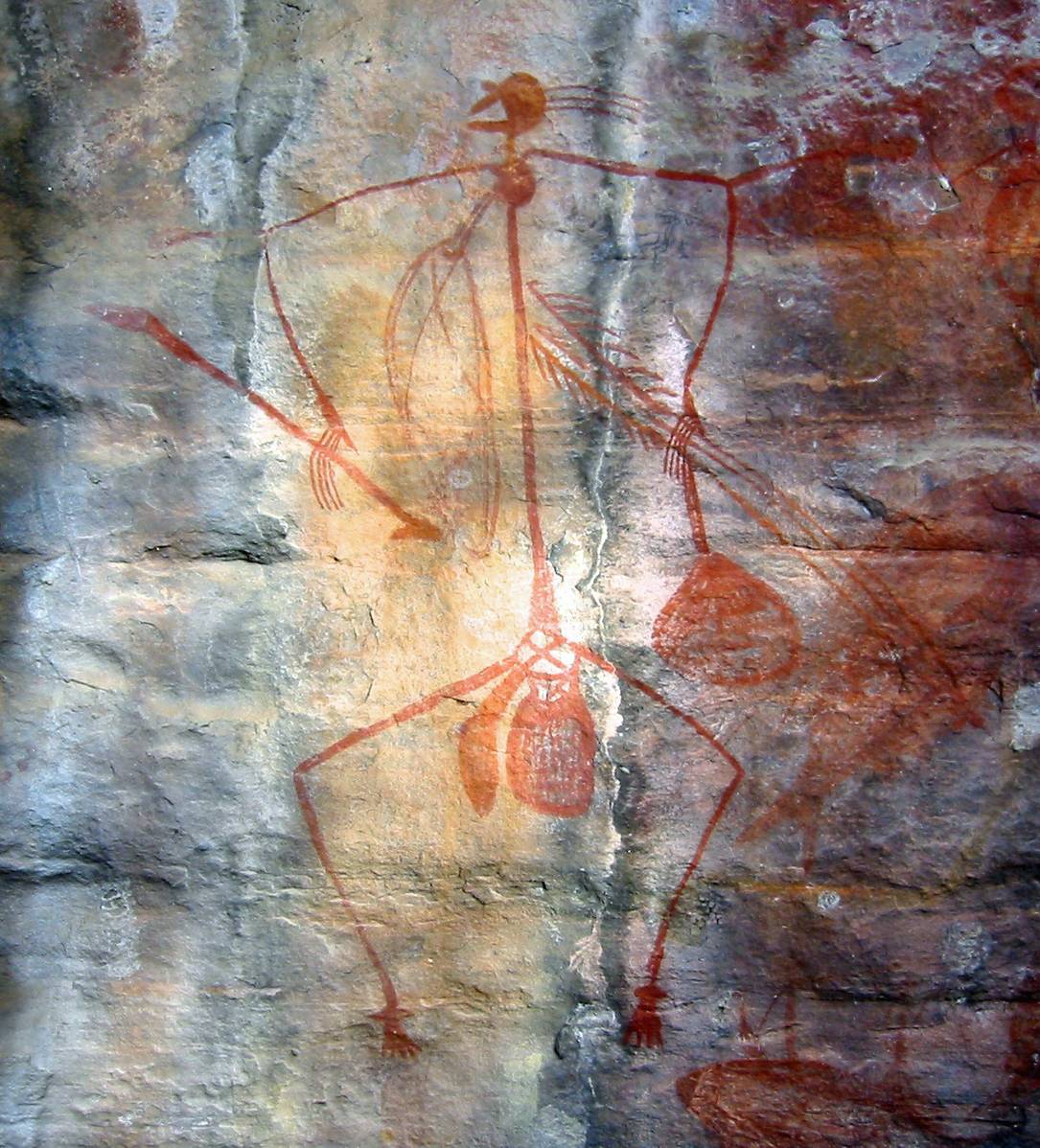
Aboriginal Rock Art, Ubirr Art Site, Kakadu National Park, Australia
Photo: Thomas Schoch
“When your night becomes day, then that which is dreamed is on earth. Do not be too high-spirited, but go, and go alertly.” Aborigine Saying

In continuity with the theoretical writings on the natural sleep cycle as expansive beyond the twenty-four hour day, and especially beyond the programmatic workaday cycle, it is not only the activity of waking activity that might define the energy experienced by the mind-body based on sleep cycles but the content of dream itself.

For example, we go through cycles of remembrance and forgetting, this is a fundamental attitude of the cosmos, as we see in the natural tendency to the peek-a-boo gameplay in all children. Similarly, as this is reflected in our conscious and unconscious experience of life, so this is true with the content of our dreaming. We will go through periods where dreams are not remembered, and then after a time, will begin to remember again. These periods of remembering the content of dreams ultimately point to an unresolved momentum of energy building up in the psyche as a consequence of either personal or collective unconscious activity that one becomes susceptible to in their daily life.

Until this mode of consciousness is directly confronted and transformed through creative insight and practical application in thought, reflection and in some basis of continuity in consciousness, e.g. imaginative outpourings based on the theme and nature of dreaming, where all suppressed and repressed energies are focused and shifted into full view, the involuntary sleep or unconscious REM will continue to emerge and take shape in the psyche through imagination, emotion, intellect and every exhaustible mode of subtle activity.

Every time a dream is remembered, the remembered content, whether imagery or emotion or otherwise, is part of a string of remembrance leading back to a source of reflection deep within the whole being of both the individual dreamer and the society throughout the entire spectrum of its history, propaganda, knowledge, media, relationships, etc.

Oftentimes, the strength or immediacy of memory, the lucidity of the dream state as it interweaves through the waking mind, forecasts the urgency of attention to the subconscious. For example, I have experienced lately that the instant I am ready to sleep, as fast as I close my eyes, I see the content of my dreaming, the imaginations is teeming with life and energy, needing to be witnessed, calling out over the margins of consciousness.

The only way to resolve the inception of remembered dreaming is to confront the subtle impulse to emote or inspire a certain inborn expression, metaphorically illustrated in the dream itself. When dream and life are subsumed into wholeness, undivided by the normative values of structured time and analytical thought, the subconscious and the conscious merge into a healthful surrender of the cosmic unconscious faculty of Being, as the great mystery of self-awareness. As reads the motto in Athanasius Kircher chiseled over the alchemist's doorway, originally in Latin, it says, "While Sleeping, Watch'. See previous post: Alchemical Poetry of Terence McKenna
_________
Breathtaking hot night. The empty dark dream of memory. Narrow canals, irrigation trenches in the backyard under a pitch-black sky, a starless new moon. The seizure of domesticity; fencing blinds besiege all passage to horizon’s beginning, and a house cat skits through the mud with a silent flit of dusty soil. A chase begins, until I grab the fickle creature by its muzzle, and in the raw and ruddy brown earth, I tangle its fibrous backbone, cracking the living spine with the brute edge of my wrist. The sky clears like a strong exhale, and the ground takes formless cover of the starless sky above. I drift away from a mind to a life as inert as the swift welcome of death.

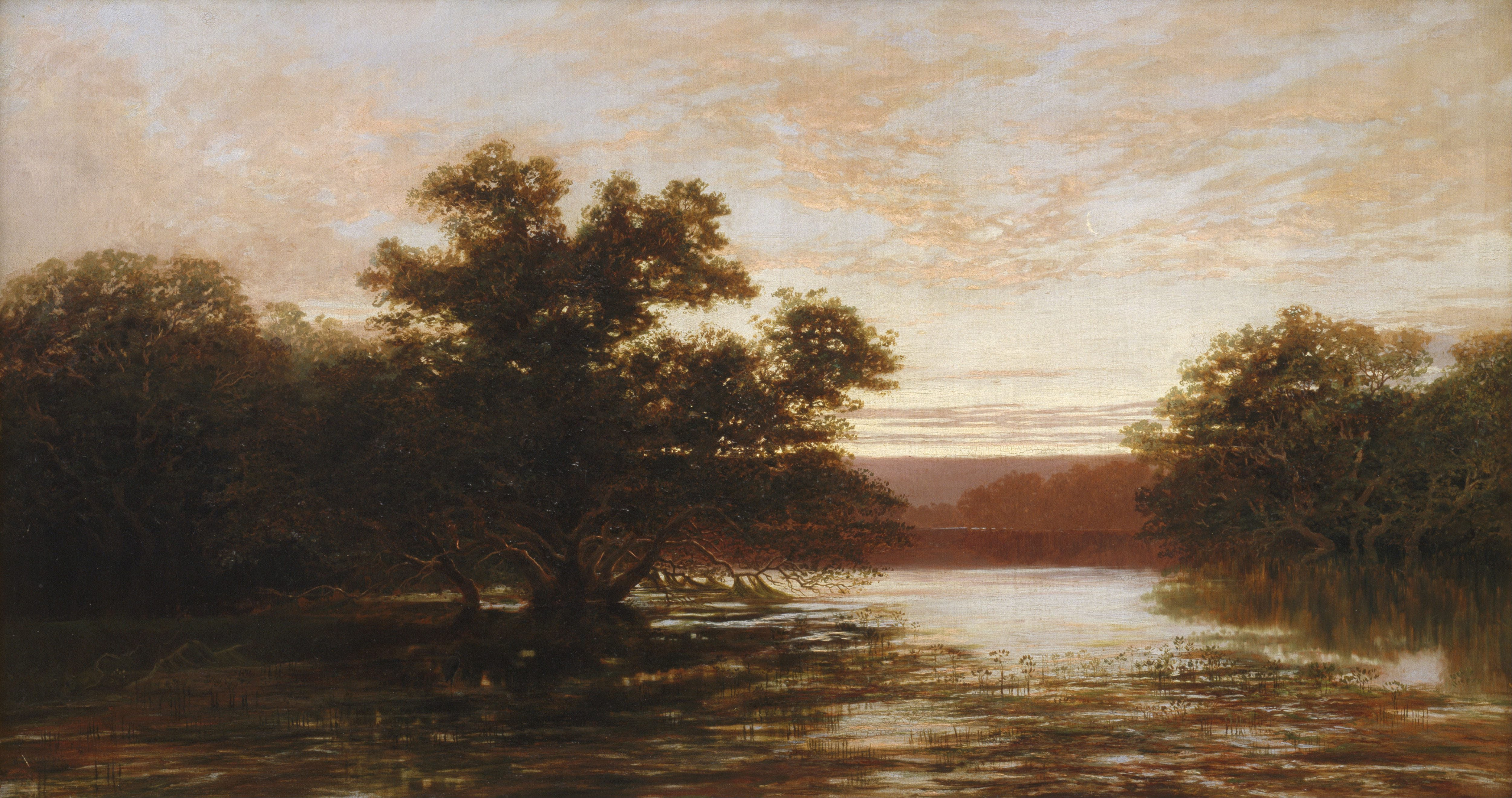
An Australian mangrove, ebb tide by WC Piguenit 
Worshipful room of sweat and lust, the emotive spring of music keeps us swinging to a joyful noise, the urban sound of pain alleviated before closed eyes, staring inward to hear the sight of the muses, invoked by the musician hosts sweltering mad before a small though dedicated crowd of movement. And the headline group enunciates first note with strength unseen; the crowd has since escaped into the bleak, old night. A few straggling local friends stand by the stage, amused and apologetic. One song passes in the silent hollow, a space deemed fit for thousands reduced to pin drop nothingness.

Musical entertainment at the spinet by Johann Heinrich Schönfeld
The emptiness is as palpable as the heartless mind, rounding off pales shots into the murderous pangs of repeated history, the bitter angst of adolescence returning in a white noise of a flushed and ruthless voice, the weird ground rumbles and quakes with burning trust; that a future still opens ahead – full and potent with renewing vigor, to wake again, and live the day from the start, even if our rise coincides with dusk. A silent vision unearths our eternal belonging with grace, and the human community within, where the heart is still in its constant beating, in its rhythmic patience with a more sacred trust.
__________
An elegiac satire on split vein of domesticity, as it unravels and spurns the knowledge-creation of a more unstructured style. The home is the centrepiece of domestic life. Yet, for many thousands of years, there is evidence that we were in fact cave-dwellers. "Caveless" muses on nostalgia for those cavernous days through a reading of "Cave! Home", about a time when petroglyphs and charcoal painting were more important than off-white, beige and any number of dull, and sterile wall aesthetics, and the great-image language of visionary rites were outweighed the significance of antique literature. How can we resurrect the idea of the cave in the context of the modern home, with its womb-like contours and living light that curls throughout our waking minds like breath, and infiltrates our dreams like a warm lover enduring a midnight meditation at our feet?

"Placeless Human Society" is also read here to recognize the dramatic shift from our ancestral pre-history as cave-dwellers of imagination and earth, where suburbia (and its non-subordinate counterpart: the city, for that matter) has essentially uprooted us from this inborn life as a dweller from the earth. On a mass scale, we now dwell on earth abstractly, our imaginations have breathed on, yet the umbilical cord to the womb-cave-home from whence we emerged has long been cut.


"Cave! Home" was published in 3:AM Magazine on September 17, 2012 and is also featured in the most recent chapbook, "Creating in the City" which was released with "When No Stars Appear".

"Placeless Human Society" was published in Outward Link on November 7, 2012. The "Caveless" track release marks the release of the chapbook, "Suburbia to Suburbia: America-Egypt".