Primarily a writing exercise, this dream journal-inspired blog is a quiet introspective sojourn into the process that we traverse in going from private dream to public art. I see our dreaming as an internalized mythmaking. As I philosophize and expressively exhibit dreams, both private and public, I encourage and delight in creative language as a way to practice experiential metaphors through a “public dreaming." Writing Theory: Creative Dream Fiction
Showing posts with label publication. Show all posts

Monday, 4 November 2013

Emerging Local Creativity: Literature, Music and Art Create Community

Matt Hanson, Calgary Working Group (photo: Drew Anderson)
"I want to work in revelations, not just spin silly tales for money. I want to fish as deep down as possible into my own subconscious in the belief that once that far down, everyone will understand because they are the same that far down."

“All human beings are also dream beings. Dreaming ties all mankind together.”


How did you get involved in trying to start a local media co-op?

I was corresponding with Montreal Media Co-op founder Dru Oja Jay and he expressed a kind of interest in the idea of a local in Calgary. I had been a member of the media co-op for about two years, the national. As I was more active, I was just more interested in what that means to be local. How they operate in Montreal, Halifax, Vancouver and Toronto — how they operate and what that might mean for Calgary. I started to put the word out there and it was very well received by Dru. He basically encouraged me to get together with others and talk about the idea and consider what is independent media in Calgary. Basically what I found is that many people are interested in their own projects, in terms of starting their own papers, but the difference here was that I was interested in connecting that kind of activity with a national co-operative site.

So, what’s set up right now?

Basically right now there is a Calgary Working Group as part of the Media Co-op and that has about 130 members, since 2009. All different kinds of stories have come from that. But in the past two years since I was writing with the Media Co-op, I found not many people contributing to the Calgary Working Group. I was just wondering about where is that understanding in Calgary in terms of this great engine of independent media and this source for people to get involved in media activity. So I went to different people who were involved in co-ops, like co-operative housing, and I talked about the idea and started to get it out there and I posted flyers and things about meeting with people. Initially I got three people that were very actively engaged in promoting and organizing the idea. Those were Melissa Manzone, she’s from Montreal but she lives in Calgary and she has a masters in journalism. Then a journalism student at MRU who has a certificate from SAIT in journalism and he’s still a student, and then another young woman named Chelsea Pratchett, who has done a lot of multimedia work — she has alternativemediayyc.com. Basically the next step was I applied for a small grant through the Arusha Centre, a Take Action Grant, that I received. I just started, DIY, working with Melissa who was editing articles with me, and also doing video interviews with people, and then through Alternative Media YYC I was organizing podcasts as weekly contributions. This small amount of funding is just an encouragement to the people here that might consider the idea of a local media co-op in Calgary.

How so? Would you use that money to pay them?

Yeah. The money has been used to pay contributors. Encouraging people with honorariums. To pay editors. To pay people organizing even. If they’re putting dedication into that, we consider that and we want to value their efforts. It’s a very free grant that I received.

How are decisions made? I come from more traditional media where decisions are made by editors. Who makes decisions in a co-op?

I’m really learning myself because I’m new to the co-operative sphere. But I’ve been really trying to figure out in terms of how the application of the co-operative organization works in relation to this. How we want to organize it is in a way that everybody has a share of the company, the collective. For me, this is really a learning process, in terms of how a co-operative organization works. Part of the funding I received, I’m putting into going to a conference to learn about worker co-operatives in Edmonton. Part of the forward process of this idea is really generating that structure. Right now, we’re at a very initial stage.

Why do it? A response to the media that exists? Do you think the media isn’t doing its job?

I think, to me, there’s that. I don’t want to be too reactive. I think it’s more about having a sense of imagination and taking things into your own hands, and really learning by doing in a way where the kind of media that I want to see is one that doesn’t just tell you about something, but incites you to action. The page is not the end of the matter.

So more of an activist slant.

Yeah, more of a fact that this is part of being more involved. Journalism should be about being involved.


This piece, also published for The Media Co-op, is an excerpt from this week's Your Face Here interview featured in Fast Forward Weekly on October 31
________________
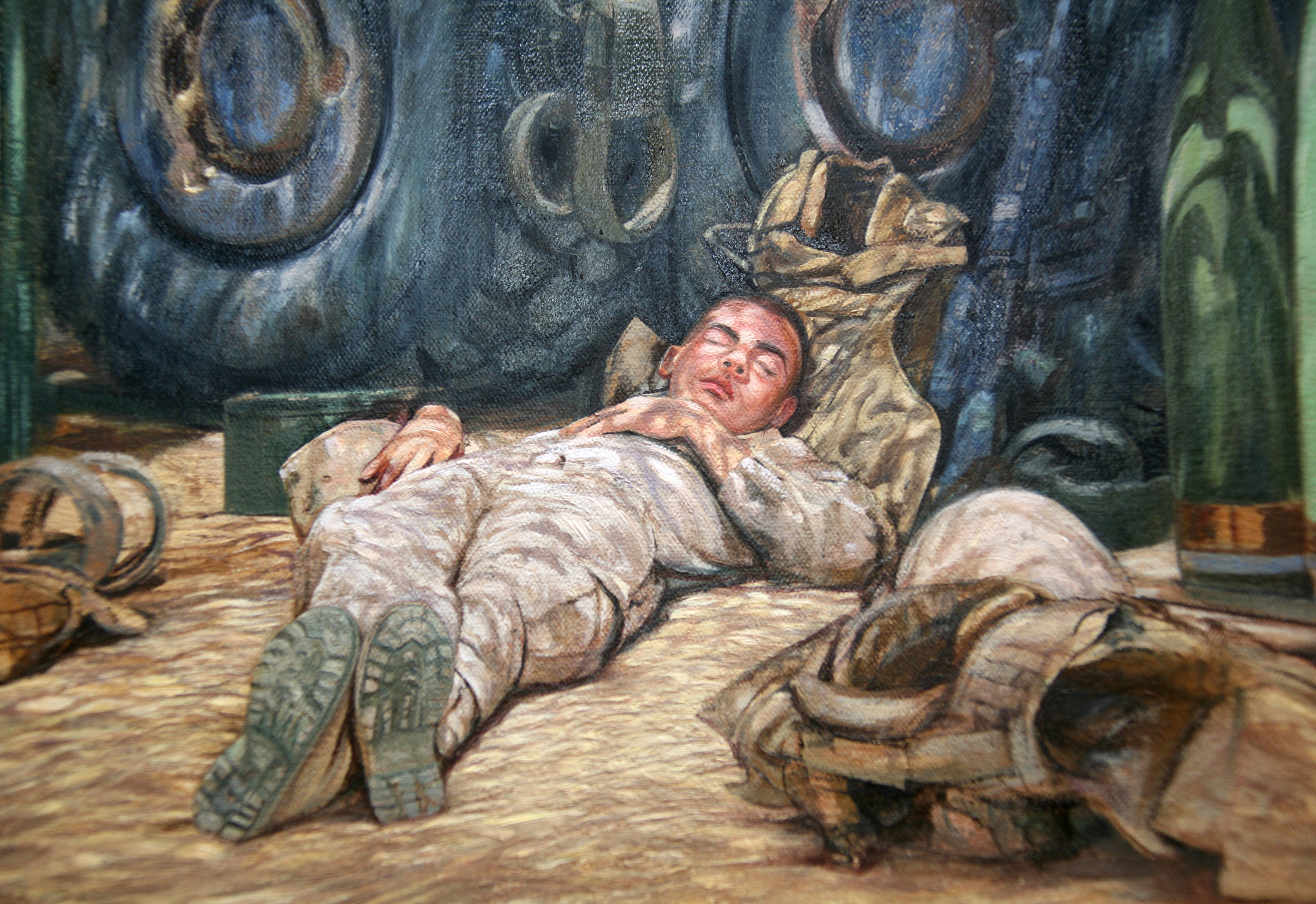
War zone. Huddled under protection of stone, the dusty clamour of steaming trucks file past, carrying explosives, ammunition; the all-potent death of armed men. The sky burns under a 40 degree desert sun, magnifying the light of illusion with the bitter disbelief of guts strewn in the angry heat. The moonlit fox scatters beyond the floodlit path, and I sit, knowing I'm under the eye of a flagrant bomb pattern, patiently scanning the sky for my fate. 

Cpl. Alicia R. Giron
Down the gravelly road, an older man, built strong and lean, walking assuredly through hell's gate. In this valley, the shadow of death casts invisibly, as the omnipotent fear, that cutting vibration that pierces as it electrifies. Every last medieval hell of our wildest imagining is child's play in comparison. The daytime moon fills my mind, obscuring the passion of escape into the dizzying architecture of mythology, roasting in this Middle Eastern world fire.

Collateral Damage by James Miller
The black fly of fire-bomb death squeals past overhead, and I run, sliding my fingers along the desert rock, the stone crumbles into rough sand. My fingers, mysteriously blackened, feel into the stone. A black liquid seethes. Viscous, thick, it's oil. I realize I can't leave. The desert spring overpowers my body in a storm of evil lust. I treasure the root of all fleshly worship in this age of fire as the swarm of madness overcomes, and in a blinding instant, the stone implodes, my hand flits to dust, the Earth gives way to pools of ash, and I sink in the quicksand of eternal war, condemned to modern night. 

On the Impacts of the Iraq War, Read COMMON DREAMS
_____________

For an ecstatic and mesmerizing experience, listen to this album while watching SAMSARA. There are new waves of sound yet to break on the open mind who might stand to listen on these ancient shores.


Delighting Destiny: Selections of our best during a live performance with audience. All proceeds from this album sales will go towards producing future performances and future recordings. Thank you for your continued support.

Tuesday, 22 October 2013

The Spring of the South is the Fall of the North: Writing on Liberation

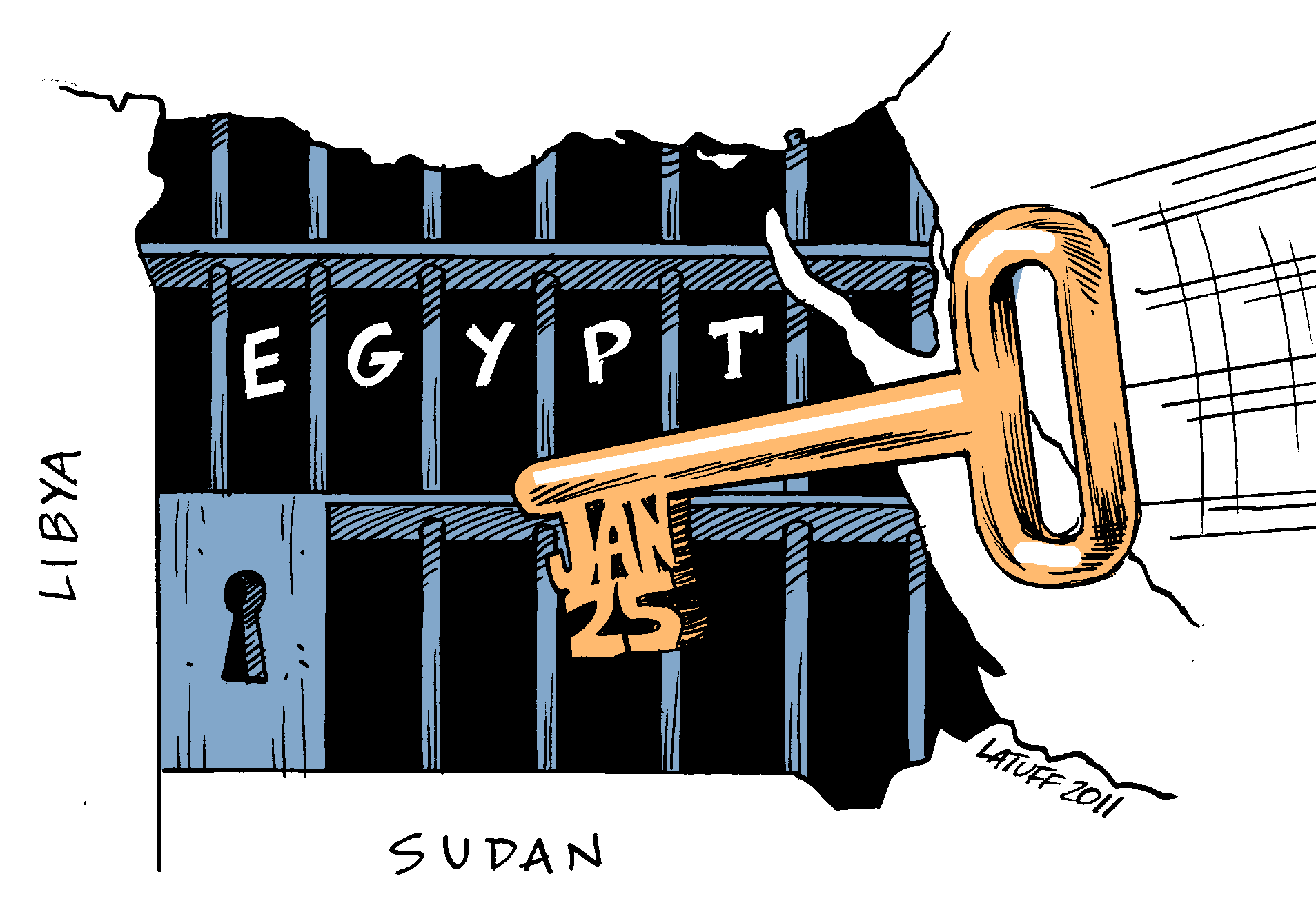
A 25th of January key freeing Egypt by Carlos Latuff
“People who shut their eyes to reality simply invite their own destruction, and anyone who insists on remaining in a state on innocence long after that innocence is dead turns himself into a monster.”

“The poet or the revolutionary is there to articulate the necessity, but until the people themselves apprehend it, nothing can happen ... Perhaps it can't be done without the poet, but it certainly can't be done without the people. The poet and the people get on generally very badly, and yet they need each other. The poet knows it sooner than the people do. The people usually know it after the poet is dead; but that's all right. The point is to get your work done, and your work is to change the world.” 


Regarding the current situation in Egypt, the armed forces and the police backed with thugs are massively shooting and killing suspected pro-the deposed President Mohammed Morsi in streets, at mosques, and in alleys close to demonstration areas. The shooting is happening in all major cities of Egypt. Many religiously motivated violence and shooting incidents have taken place in Christian populated cities located in Southern Egypt.

In Cairo, the violence is escalating and the death toll of Muslim Brotherhood is soaring as the grand son of Hassan El-Banna, the first founder of Muslim Brotherhood organization in Egypt was shot dead on Friday clashes (Source: Al –Jazeera News TV). Another son of prominent Muslim Brotherhood leader was shot dead on Friday evening during clashes with the police force and the army. Egypt’s temporary government has declared a State of Emergency, and all citizens, as well as foreigners, were warned by the police and the army to keep away from street demonstrations and public governmental buildings, and to avoid entering Tahrir Square.

As you may know, most Egyptians have aggressive sensitivity to being photographed by foreigners, whether in normal daily situations or during public demonstrations. That is why we saw many Western journalists attacked at Tahrir Square, and one female journalist raped consecutively by a group of thugs in Tahrir square. It seems to me that the current military regime in Egypt has fully determined to uproot the Muslim brotherhood organization, not only in Egypt, but also in the whole region, and that might lead to the unwanted birth of another Syria in the area.

Most pro-democracy supporters insist to protest. The Muslim Brotherhood protesters are still surrounded inside the Al-Fateh Mosque in Ramses’ Square. They want to come out from the mosque but they afraid that the thugs outside the mosque might attack them. The police force outside the mosque is striking the protesters inside the mosque with tear gas after a gunman shot at police forces from the minaret of the mosque (Source: Al-Jazeera News TV. 6:00 pm. Cairo. GMT.)

Mr. Abdel Rahman Siddiq Hashim, Correspondent in Cairo, Egypt (August 17)

            Thirty minutes by car from downtown Cairo, the predawn sky of Abu-Seer village revealed the most ancient, complete stonework in the world. Alone, I climbed the eroding rooftop of my host’s concrete dwelling. Sleepless, I gazed into the unworldly pyramid landscape with sand-blooded eyes. The quiet rustling of goats and chickens from an adjacent rooftop finally subsided under the mounting sun. The cool desert night slowly began to burn in the morning haze. It was as common a start as any to another harsh day in a small village of Egypt.

On the village margins, Saqqara Pyramid decayed in the encircling sands, humbled by the glowing Sahara Desert horizon. A middle-aged Egyptian man, donning a dark grey jellabiya, cautiously rode his mule across the rubble-strewn sands. Then, an airplane flew overhead.

Three divergent ages of human existence on Earth emerged as one, sharing a moment, side-by-side. The eldest of the three appeared motionless. The Egyptian man meditatively attended to morning duties as his forebears had done for over a millennium. The airplane, a symbol of Egypt’s national independence and economic prosperity, vanished in an instant.

Tahrir Square, meaning Liberation Square, invited all with pleasant cafes hailing from Egypt’s belle époque period. Patrons intermingled with families at the KFC, and all coveted the dollar menu. In the square, historic speakers in the Headquarters of the Arab League heard the call of muezzin belting out the call to prayer. Five times a day, the prayer, known as the adhan, ascended above the city of a thousand minarets: El Qahira.

For a twenty-year old student attending the American University in Cairo (AUC), overlooking Tahrir from the east, there was liberation. The first day of my young life in Cairo opened with one fiery orange dawn in the fall of 2007. Sipping a hot ginger tea, I waited for my cab in Tahrir Square. Mohammad, age thirty-three, chauffeured me to what would become my home for the next ten months. Zamalek, an island on the Nile, stood besieged on all sides by a city of 18 million.

In the past three years, the AUC’s Zamalek student residence went through two evacuation processes during the 2011 Revolution, and again this summer. Due to the unsafe proximity to Tahrir Square, ground zero for the infamous belligerence of military and riot police, international students were sent home. The residence became a safe haven for the AUC community; domestic students and staff were offered free accommodation and complementary meals.

Emotionally overwhelming, everyone present will never forget the bloodied streets paved with the burnt skin of nonviolent protestors. “They all have witnessed history unfold and a lot of them went to Tahrir Square. They all left in tears having to abide to the evacuation request,” Fatma Abou Youssef, Associate Dean for Residential Life at AUC wrote via email from Zamalek, Cairo on August 19.

In 2007, through a yearlong study in the humanities, Egypt held a potent charm. For a child of American suburbia, life in downtown Cairo was a true and magnificent freedom; where a dollar bought cab fare through thirty minutes of scorching highway from the Great Pyramids to the fortress of Salah ad-Din. At ground level, the city was not only safe; it was ever so welcoming. In comparison to crime in the average American city, Cairo was exceptionally low-key.

After many captivating hours learning intensive Arabic from a local Egyptian professor or studying Islamic philosophy with a visiting lecturer from England, the streets beckoned with an extraordinary spirit of discovery. Only after minutes of walking southeast from Tahrir Square, I wandered to the shrine of Saint Patron Sayyida Zeinab during the pilgrimage festival, or ‘Moled’, in celebration of the birth of this special granddaughter of Prophet Mohammad.

Irrespective of prohibitive warnings from AUC’s student orientation the day of the Moled, I decided to traverse the uninhibited grounds where Sufis and rural Egyptians (known as Sa’idis) pilgrimaged. I espied characters from a bygone era. Many had never before seen the pale face of such foreign skin. An elderly man without legs moved with the aid of wooden blocks, another with a gnarled cane and goatskin satchel appeared at the end of an impressive journey. One younger man, about my age, carried a paralyzed companion on his back. With equal wonder, they smiled at both having reached the shrine as staring into blue irises.

For the next months, practically every time I set foot in public in the city of Cairo, as throughout Egypt, children ran to greet me, jellabiyad-graced elders responded generously to my regular salaam alaikums. Peers offered a traditional glass of Egyptian whisky – the joke name for black tea served with a generous helping of sugar. Ordering a freshly pressed sugar cane drink (qasab) from street-side juicers became a delectably regular pastime under the all-pervasive sun. In fact, the original word for sugar (sukkar) is derived from Arabic. Similarly, the tamarind drink (tamr-hindi) was served by charming fez-wearing men (hearkening to Ottoman times) on street corners amid the harrowing traffic in Tahrir Square.

First impressions of Cairo were smoothed over with genuine smiles and hearty laughter. The people of Cairo soon became my teachers, more than any university professor. First having sought to learn Arabic from the locals, I then learned of dignity, humility and simplicity through their open hospitality and street-wise intuition. Uniquely, Ramadan became my favorite time, when a piece of unbroken baladi flatbread always accompanied the savored mulukhiya soup; welcoming any blessed stranger, even if arriving from the next unassuming alleyway.  

Rapidly, the most frequented haunts, such as Cairo Club and El-Bustan, saw mounting anxiety. Sugar, oil and other daily commodities soared in price, both in the formal, as in the informal economy. Conversations became more grave, jokes more cynical and youth were feeling the brunt of a serious economic downturn.

One year before the 2011 Egyptian Revolution, the air was full of gunpowder. Every whisper seemed that moment, when the spark would light and the very social fabric would begin to incinerate. The deep traumas of colonialism, corruption and fear were immanent, and felt by the overwhelming majority everyday. More importantly, an unruly intensity was felt every night, when the mass of people returned to sleep on the bedrock concrete of Cairo’s sprawling suburban slums. In such an environment, the status quo ceases to quell the rage. The traditional café became peripheral to the cyber café, where social media and youth activism quickened into the perfect storm of 2011.

Three years prior, an incipient sandstorm clouded the streets on a day of mass action in the wake of an inexcusable rise in bread prices, while former Egyptian President Hosni Mubarak celebrated his 80th birthday. On that night, we crowded into El Horreya Café & Bar (literally meaning Freedom) on May 4, 2008, as on any other downtown metropolitan night in what was once the Amsterdam of the Middle East. Downing local Stella Beer and chain-smoking Cleopatra cigarettes could not snuff out the bitter cynicism looming like a rickety ceiling fan about to fall and leave the place roasting.

The very earth around Egypt is often as imperious as the social hierarchy itself. The desert becomes part of the inimitable struggle for life in Cairo as trade has nefariously altered the course of most people’s lives around the world, so dramatically in the modern era. One week before the Egyptian Revolution of 2011 commenced on January 25, my uncle, visiting on business, listened with ungraspable curiosity to his Egyptian host talk about the gaining local obsession with Facebook. The word was on its way out, and never to return.

Remembering Cairo before the Egyptian Revolution of 2011, and in light of the escalating crisis, life will obviously never be the same. There is irrevocable damage, and if the people, who lived and worked in the downtown area, survive, they may never return, and if they do it will be to a different place. Tahrir Square has become home to a near impregnable military, a scavenger’s paradise of the most lowly and vicious of thugs, a place of smoke and blood, where tear gas blinds and the storied hangouts of a bygone era are stained with the outrage of a military coup in broad daylight. In its wake rests a throng of massacred civilians.

Will the bartender at El Horreya Café & Bar return, he, who snickered and grimaced with local spite, subtly disproving yet overtly encouraging Egyptians’ mixing with European, American and African socialites over incalculable packs of Cleopatra cigarettes and football? Will the papyrus painter return, who gypped me out of a small fortune, cleverly convincing me into becoming a rare arts collector? Will his son return, learning his trade not only for the trade, but also for the tricks; he who walked with me past the now besieged Ramses’ station mosque to deliver my papyrus paintings home to America? Will the mythic female taxi driver return; she, who dazzled our imaginations by crossing the gender line into such a masculine space as the world-infamous streets and thoroughfares of Cairo’s largely unregulated (or, self-regulated) traffic?

As social critic Tariq Ali wrote this July for counterpunch, an independent investigative journalism source, after all is said and done, “Who will take the Army away?” In the intermediate period between the first Egyptian Revolution of 2011 and this year’s ongoing protests, which began with the presidential coup of Mohamed Morsi on July 3, the Iranian Green Movement receded, while Bahrani and Syrian social unrest continues to derail. After the ecstatic hype following the Egyptian Revolution of 2011, weary voices from the Middle Eastern diaspora warned of immanent crisis. Westerners scratched their heads when the Muslim Brotherhood ascended to power.

As a foreigner in Egypt, one learns that a human connection to anyone on Earth, to anywhere on Earth, from anyone and anywhere can be learned simply by walking in public, in the street, and more importantly, the square, with an open heart, engaging in dialogue and being present. When we listen, we observe how everyone has a backstory, which does not merely explain one’s present situation, but supports and rounds it out with a complex spectrum of life experience.

Today, this truth is more than possible; it is inevitable as more and more people are forced out of their homes, out of the comfort of their lives in their countries and cultures of origin, whether by war, civil unrest or the urge to change things, to meet face-to-face with another, and see the clearest reflection of one’s own life. The deaths of Egyptian protestors are not isolated incidents. They are part of the larger narrative of one unified history of all people. In another two years, will they have fallen in vain, or will everyone empowered with the knowledge of the uprising ensure that they have not?

On returning to the U.S. after three months in Cairo during the summer of 2010, the adage from the American Revolution curiously repeated in my head: No Taxation Without Representation. The city streets should see my sign, I thought, held up on display; the Revolutionary slogan of 1776, concluding with the statement: Stop Funding the Militarization of the Middle East. That sign was never raised.

After over a year of living on the ground in Cairo intermittently from 2007-2010, I had about enough of armed forces on every street corner. As an American, I felt complicit with the military presence. An iconic moment from the Egyptian Revolution of 2011 revealed the ugly face of global militarism when a demonstrator exhibited the “Made in the U.S.A.” stamp on canisters of tear gas.

As in the ancient materiality of Saqqara, the medieval trot of the mule and modern flight were spawned out of an instant on the archetypal sands of time. An airplane summons the precarious future in all its speed, might and, finally, in the local historic context, its fleeting insignificance. The pyramid, now stationary and unascending, contrasted with the way of the mule and the plane moving in the same direction.

Yet, as with today in Egypt, the very power and speed of the plane overhead not only outmatches the mule’s strength, arriving at their common destination first, it leaves nothing behind for those arriving at a deliberate pace, as allegorically, by mule.

The people of Egypt seek development through truly democratic means, as opposed to Western democratic means, i.e. foreign aid, sanctions and war. For Egypt, as with most of the world, true independence is a long-awaited, and as yet unfulfilled promise. When allowed to proceed at their own pace, in step with tradition, and an engaged contemporary society (as demonstrated in the revolutionary context), the people become aware that the plane overhead is exactly as distant and unconcerned as it appears. Contrasted to the pyramid, or the mule, the plane (and the elitism it represents) consumes the country’s (human and natural) resources with it, and all in a passing instant.

During the daily commute through Tahrir Square, one of the largest public insignias near to the square’s Omar Makram Mosque stood out: “Everything Should Be XX” (meaning: everything should be 20th century). Before the revolutionary fervor, quotidian time in Egypt screamed with the anxiety of delay. The rushes of traffic, the strength of the black tea, and the overconsumption of sugar were offset by fitful exhausts, religious rituals, and the sun; and now, an army, sponsored by the most militarized, energy-rich and power-hungry nation in the entire world. Nevertheless, as countless Egyptians stage sit-ins, many say the people of the unmoving Saqqara still live and walk in the streets of Cairo.


NOTE: This article, titled, Fall of the Arab Spring, was published with The Media Co-op on October 16, was produced in partnership with AlternativeMediaYYC.com and the Arusha Centre with the Calgary Working Group initiative to establish a new local of The Media Co-op in Calgary

Read our other recent pieces produced by the project: 

"Vancouver is debating a resolution to divest from fossil fuels"
The 3rd of October
Egypt's War on Terrorism and Extremism
Hayseed Magazine
Corporations in our Heads
Working North
___________
It was our last night. The sirens of Death displaced the air with an eerie silence. The dissonant projection moved us with a most unsettling scream as from the constellations above. In an incomprehensible language, the alien voice bore down on our skulls as through our entire skeletons with the most devastating form of spiritual dread.
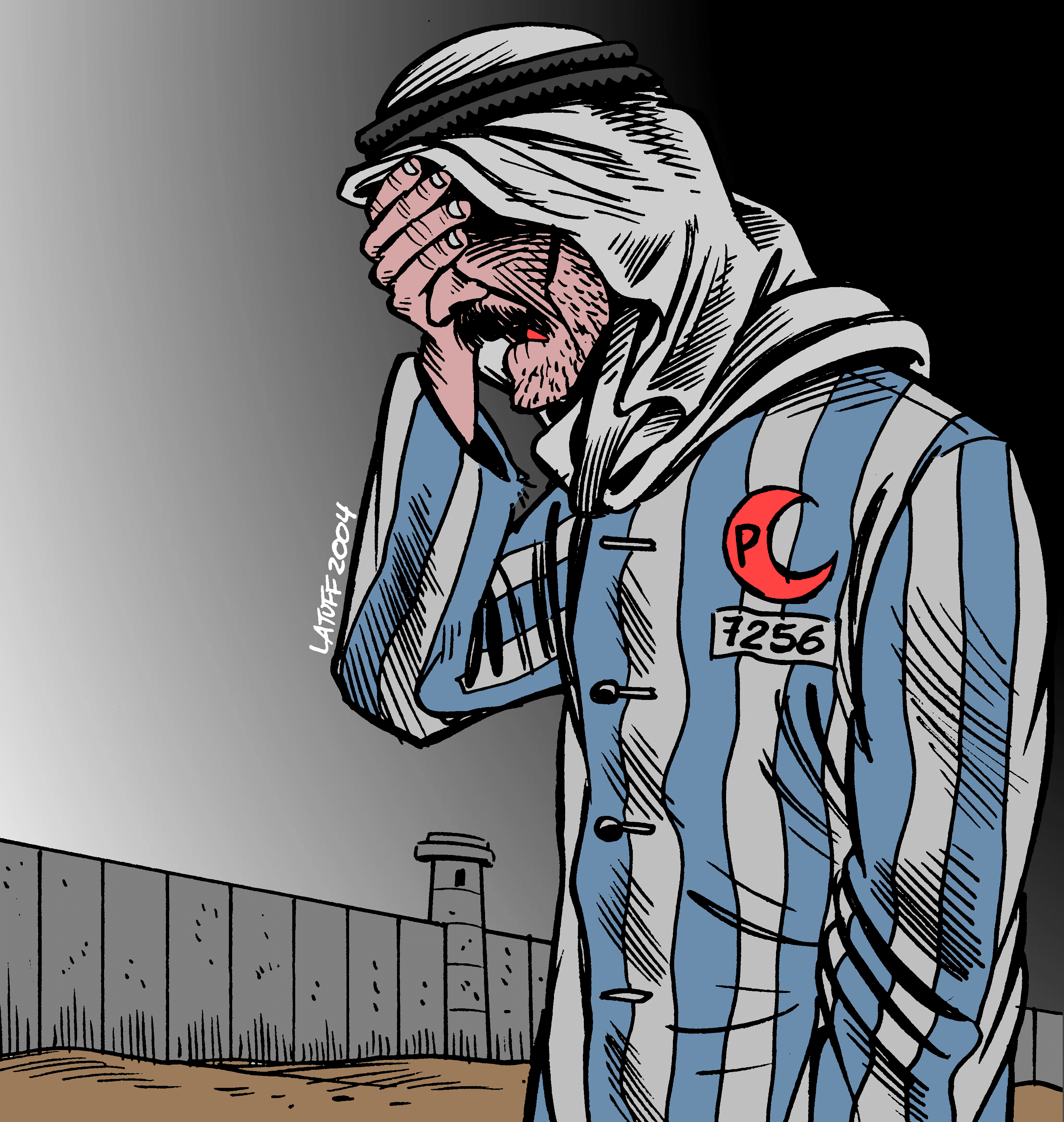
IsraHell's concentration camp by Carlos Latuff
Neo-Nazi ghosts awakened to round up non-Aryan cattle from their millennial imprisonment under the northern cross. Before the first ounce of blood was spilled, I eyed the forest beyond the edge of the encampment, where concentration then turned to liberation. For a reason unknown to me at the time, I saw my way out. Others noticed as I ran through the fencing, bewildered by the transcendent feeling of freedom beyond the barbed hatred that confined my elders, my children and brethren of closest kin.
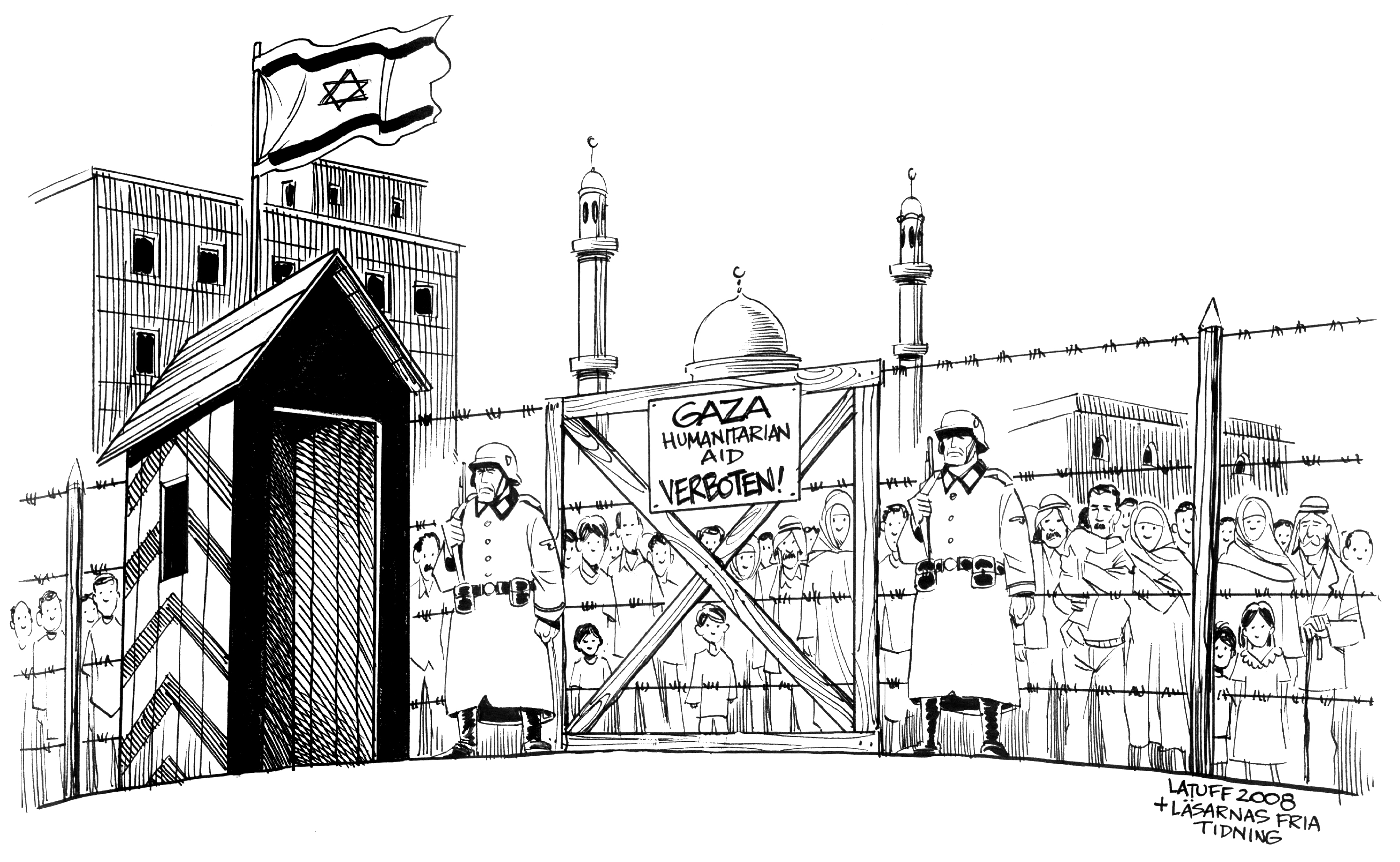
The Gaza Ghetto by Carlos Latuff
Out into the wayward plain, I fled, alone, veiled under a new moon. The sky enlightened my distance with steps unheard inside the emptying prison. Yet, I could hear wails. As I moved into the dizzying silence, my heart muffled by the fear of no-return, I wept. I felt my skull crack at bearing the guilt, the shade and the humility of survival among my most honoured family and friends, of my blood and spirit, they left behind to suffer excruciating gasp of liquidation.
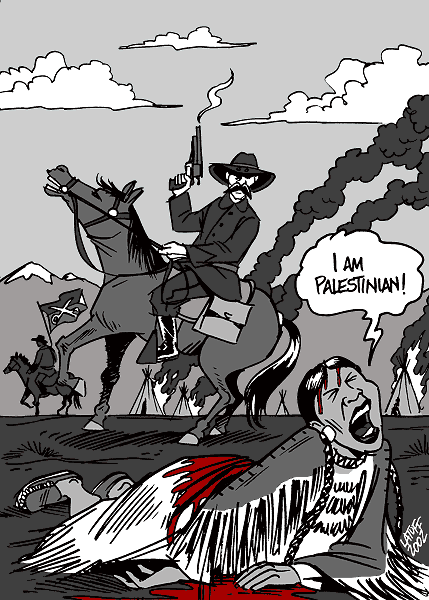
We are all palestinian - Native Americans by Carlos Latuff 
The sky filled with light, and as the fog of my vision cleared, a field of people opened before me, as with the harmonious revelation of a smile. Youth prayed and rejoiced under the morning sun, strong with music, to greet the day with endless festivity. The glow of the Earth radiated as a face after being kissed by a warm lover. The air moved softly, and my skin pulsed with gratitude. I enjoyed the music, spontaneous and ambient, as if I had heard music for the first time. Then, a face stared into mine.
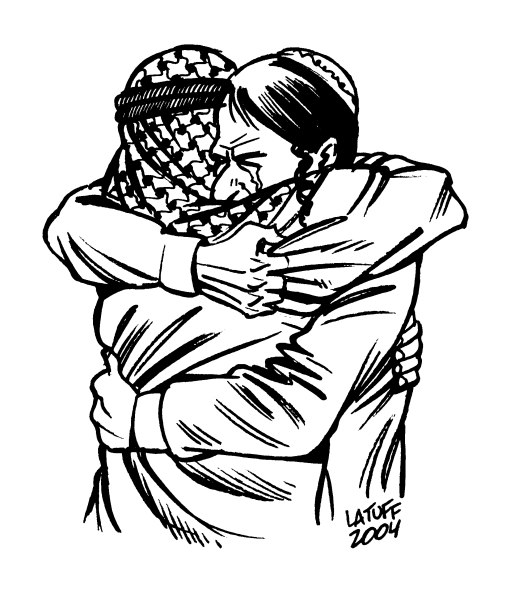
Forgiveness by Carlos Latuff
They recognized me, where I had come from, my origins and imprisonment. I wondered if they had escaped as I had. My first reaction was to run, yet, as the moment passed, I felt their empathy. The young woman, working as an attendant to the open-air music festival, expressed her concern, and showed me the way to a bus station near to the edge of the forest. From there, I could travel on and farther away from the destitute evil of my past.

Che Guevara wearing a keffiyeh by Carlos Latuff
As I approached the station, others noticed me, with fearing eyes, saddened with the truths of human compassion, they earnestly helped me along. I couldn't decide where to go. The schedule was complicated by the tightness of the knot in my heart. Where would I go? What would I do? Should I return and face the death that had me in its embrace, and that had since now consummated its passion with everyone I had ever known? I remain, immobilized. 
___________

Listen to live recordings taken from the Trio's debut performance on October 18th, 2013 in Self Connection Books (Canada). More on Jasmin's brilliant skills, gifts and about her amazing Crystal singing bowls please visit her today at Singing Bowl Music. This live album was produced by Vi An. Funds from this album goes towards artists involved and especially to fund future endeavours together as a collective, to rent venues, promotional material, transportation, meals, accommodation, etc. Thank you for your amazing continued support of these fine artists.

Monday, 16 September 2013

For the Love of Humanity: An Essay on the Ecological Auschwitz of Canada

Dostoevsky's notes for chapter 5 of The Brothers Karamazov
"You see, I so love humanity that—would you believe it?—I often dream of forsaking all that I have...I close my eyes and think and dream, and at that moment I feel full of strength to overcome all obstacles." Fyodor Dostoyevsky, The Brothers Karamazov

“It's a scandal,” environmental activist Tzeporah Berman shouted to an encamped crowd at Indian Beach the night before the Healing Walk. Imagine, each and every CEO to all the employees of the oil and gas industry, blatantly raping their mother and profiting obscenely in the act. The Tar Sands scandal has gone viral. The proposed Enbridge Northern Gateway pipeline “is probably the most controversial project in the history of British Colombia other than perhaps Claquoyot Sound logging operations,” said Ben West, Forest Ethics Tar Sands Campaign Director, at a Project Ploughshares event in Calgary on April 27.
It’s been the #1 talked about news story in British Colombia now for two years running. In fact there is a study that was done that shows all the next five stories, in terms of coverage, if you combined all the coverage, still did not get as much coverage as the Enbridge Northern Gateway pipeline in the last two years.
The entire world is a voyeur to the most heinous crime of physical abuse on Earth today. “All fights, all battles for the planet are important, but some are more important than others. And there is no battle on the face of the Earth more important than what’s going on here in Alberta,” Bill McKibben, climate change scientist and founder of 350.org, said for the outdoor press conference immediately prior to the beginning of the Healing Walk. “There are three or four places on planet Earth where there is enough carbon below the soil, that if it gets dug up and burned, then there is no chance that we’ll ever stabilize this planet’s climate, and this is one of them.”

Yet, since 1967, when the first commercial project began to exploit the Athabasca Tar Sands, the crime intensifies to the benefit of a society corrupted by cheap oil across Canada, and around the world. “From the seven pipeline spills in the last five weeks, we know that oil corrodes, and what we’re just beginning to learn is that it’s not just corroding our pipelines,” Berman asserted. “Oil in Canada is corroding our democracy.”

The 4th Annual Healing Walk, attended by about five hundred demonstrators, sent a clear message: local people matter, have voice and are strongly represented across the country and the world. While international activism often necessitates globalization and fossil fuels to wage peace on the Tar Sands, the First Nations in and around Fort McMurray, the Athabasca Chipewyan and Dene peoples, are leading humankind by simply walking, in prayer to the Four Directions. Because of ancient wisdom and the spirit of traditional ceremony and community, industrial traffic slowed to a near halt as far as the eye could see on July 6 around the 14km Syncrude Tailings Loop.

“When I went into that town of Fort McMurray, you know what it reminds me of, it reminds me of going into the town that’s the ecological equivalent of Auschwitz,” Anishinaabe author Winona LaDuke proclaimed during her keynote speech the night before the Healing Walk.
“The town that’s sitting right next to Auschwitz and saying, ‘Hey, we’re good here, you can get a $35 steak, you can get an $18 hamburger and it’s okay.’ There’s something just psychotically wrong with all that.”
LaDuke’s Auschwitz comparison, especially in the light of modern consumer culture, is significant. Another outspoken critic of power politics, Hannah Arendt, had once led a scandal, transforming international dialogue on the perpetrations of Auschwitz into a parable of modern life. Arendt’s notion of the “banality of evil” speaks to the mass consumerism that fuels the current destruction of the planet. Status quo consumer society encourages technology and energy overconsumption. One tier of society justifies through intellectual analysis regarding energy, society and the environment, while most are overwhelmed by the unreasonable complicity of leadership.

Therefore, most people remain ignorant of the fact that their immediate, daily actions cause the very atrocities committed against marginalized people and the environment. Espoused in 1961 during the Eichmann Trial, the philosophy behind Arendt’s “banality of evil” teaches how everyday people perpetrate the greatest crimes of humanity, often more so than their leaders. The idea is slowly gaining acceptance among genocide scholars, such as in Daniel Jonah Goldhagen’s Worse Than War.

“If you breathe air and you drink water, this is about you,” Crystal Lameman, Treaty 6 activist of Beaver Lake Cree Nation, declared at the beginning of the Healing Walk at Crane Lake Park. If the great-grandchildren of Canada look back on the current generation, will they see the current society as people of today see Nazi Germany? As the Jews were liquidated for business purposes, so the Earth and its First Peoples are being bought and sold, and killed in the process, for the liquidation of bitumen tar into petroleum gasoline. Every day, Canadians are told that progress must continue and economic growth must never regress for any sake outside of myopic anthropocentricism and politicized Canadian values.

“On the eve of the NEB hearings for the Enbridge pipeline, when our National Minister of Natural Resources put an open letter to Canadians [in the Globe and Mail], calling anyone who opposed these pipelines a terrorist,” Berman reminded demonstrators camped only fifteen minutes away from Fort McMurray. “Essentially saying that if you express concerns then you are acting against Canada’s national interests, that you are an enemy.” When environmentalists and Aboriginal peoples who oppose pipeline development are deemed terrorists, political-economic rhetoric in Canada begins to look more like that of the Department of National Defence.

Dissuading public debate is typically fascist. The undemocratic nature of the petro-state further supports the colonial Eurocentric project of civilization, where marginalized minorities, such as Indigenous peoples, are meant to suffer the growing pains of modernization. Indeed, modern progress is often underhandedly defined by the achievements of warfare and genocide against marginal ways of life.

The Canadian infrastructure, as with much of the world, is dependent on the continued suffering, and the scandalous crimes, of the continued power imbalances from the colonial past. “We’ve got to feed these people that consume a third of the world’s resources. That requires pretty much constant intervention into other peoples’ territories, whether they’re Dene, Anishnaabe, Cree, or whether they’re in Venezuela,” LaDuke said with a voice of experience and reason at the Healing Walk. “Constant intervention into other peoples’ territories to keep up this level of entitlement.”

Today, there is global complicity in the status quo, in the consumers and beneficiaries of non-renewable energy resources, and its concomitant intergovernmental policies. If Canada survives into the future as a memorable entity, people may look back on the country as yet committers of yet a deeper atrocity, against Earth, and as with a genocidal inclination towards the entire human race.

Will others follow in the example of the First Nations of the Athabasca river basin, whose warnings resound with deep socio-ecological truth? Will Healing Walks spring from the people across the Earth, so that in the name and significance of Mother, the destruction stops and healing starts? Are people around the world willing to stop the destruction and walk for the healing of the Earth, to find a path that slows the destructive course of industry (business) as usual and that offers, not one direction alone, but Four Directions, whole and undivided? When will people begin to pray through movement, action, and participation?

Around the same time that unparalleled innovations in alternative energy came to the fore, there was a great leap in Western consciousness of natural philosophy. Contemporary science is providing the world with unprecedented advances in material technology and innovation. “The last two years, we have seen more advances in clean energy, in renewable energy and technology, than the last twenty years,” said Berman, at the close of her keynote speech at the Healing Walk conference at Indian Beach. “The last two years were the first two years in human history where new investment in electricity generation for renewable energy, for wind, for solar exceeded new investment for electricity in oil, coal, and nuclear combined!” Nonetheless, today there is a greater vacuum of innovation, and that is within the human mind. The current struggle for life on Earth is within each and every human being bridging the great rift between modern life and ancient wisdom.

“I think what has to happen is a change in understanding. It’s not a matter of power, or of muscle or of energy,” the late philosopher Alan Watts said in the documentary, Zen.

It’s a matter of the way in which we understand and feel our own existence, not as strangers in a hostile universe, but as integral parts of that universe, as fruits of the universe, in the same way as an apple is a fruit of a tree we are a fruit of this galaxy, we belong to it, we are something it’s doing, but we don’t feel that.
Similarly, in the name of modern physics, the same basic knowledge that allows for the expansion of physical technology offers renewed integrations between ancient wisdom and modern life. The same way of applied thinking – that might destroy life on Earth when derived from philosophies of conquering nature and ethno-cultural assimilation – would also affirm interconnectedness with all forms of life.

Yet, petro-state fascism muzzles scientific inquiry that affirms rootedness, while ensnaring science with political ideology. “The internationally recognized journal of Nature this year, in an editorial, said ‘It’s time for Canada to set their scientists free,’” Berman, author of This Crazy Time, said at the Healing Walk. Science, as a truly inventive field of human inquiry, would logically presuppose the very undoing of its concurrent technological manifestations.

“The natural environment is treated as if it consisted of separate parts to be exploited by different interest groups. The fragmented view is further extended to society which is split into different nations, races, religions and political groups,” physicist and international best-selling author Fritjof Capra wrote in The Tao of Physics.
The belief that all these fragments – in ourselves, in our environment, and in our society – are really separate can be seen as the essential reason for the present series of social, ecological, and cultural crises. It has alienated us from nature and our fellow human beings. It has brought a grossly unjust distribution of natural resources creating economic and political disorder, an ever-rising wave of violence, both spontaneous and institutionalized, and an ugly, polluted environment in which life has often become physically and mentally unhealthy.
Life is without meaning, not because it is despairing, but because it requires no other meaning than itself. Life itself is significant. Life is self-renewing. Modern human life is more and more devoid of a connection to the sources of life, and so, the mind, and its encouraged symbolic outputs, estranges daily existence from the nature of life. Proactive language (e.g. solutions-oriented media), as with the most advanced scientific thinking, gives voice and agency to ways of life that are self-sufficient, yet still recognize the interdependent nature of life.

The First and Original Peoples of Turtle Island, Aboriginal Peoples of Canada, continue to share the fundamental philosophical similarities with the ecological consciousness of wise, ancient cultures from bygone eras and faraway lands. Understandings that had once triggered a revival of interest in the practical philosophies of interdependence and rootedness are not only springing from Western science itself, but are being voiced by the First Peoples of the Land with greater potency. “Science is important but only if it’s governed and held in check by wisdom, and that wisdom that people have been ignoring for hundreds of years on this continent is finally reasserting itself at exactly the moment when it is most needed,” Bill McKibben said to close his speech only moments before the Healing Walk began.

Bad news is good news. Spotlight triggers response, and, at the end of the day, people think as they please, or, more accurately, as is pleasing. Regardless of what it is called, Oil Sands, or Tar Sands, industry gets the lip service. “I don’t want to squander my energy entirely on being reactive, on being reactive to their craziness. Be clear on where we are going,” LaDuke stressed with grounded intensity. “It’s our choice upon which path to embark. One miikanan [path] is well worn but it’s scorched. The other path, they say, is not well worn but it’s green, and it’s our choice. It’s our choice. That’s what our people said about 800-900 years ago.” The ancient wisdom of the Anishinaabe prophecy for the time of the Seventh Fire shared by Winona LaDuke at the 4th Annual Tar Sands Healing Walk offers all a path, or miikana, to a future that is fresh and green, and very simply, to a future.

Beyond pro- and anti-, beyond reaction and action, there is a beginning; a place, from where all people would begin life renewed. That beginning is the elephant in the room; it is every last man, woman and child. In the name of Mother Earth, the Original Peoples along the Athabasca River, and every Healing Walker: All my relations.


This piece is featured in the current print edition of Dialogue Magazine

(If you would like to have a FREE copy of the issue wherein this piece is printed, please notify the magazine or the author)

Also, read my Spotlight piece, "Tales from the tar sands" in the current September/October print issue of This Magazine in an online exclusive at The Media Co-op.  
_______________
blessed horn
entranced night
korean shades
light buddha
sun hat
_______________
The album "Evocations: district.Columbia" is an experimental narrative sound art exploration into the text of the collection, "district.Columbia" releasing the first single, "New America" to incite the forthcoming album on the inaugural day of Aboriginal Awareness Week in Canada is auspicious and serendipitous in its symbolic import as an album whose narrations were triggered by an inner voice of resistance while in Washington D.C. where I began to dedicate myself to the literary vocation in light of my own personal development in the commission of truth - as in the social justice of 9/11 and Truth and Reconciliation truth commissions - to address political and historical-religious misinformation.

My creative work is in keeping with a lifelong demonstration to voice silenced histories, in honour and recognition of the atrocities committed against first peoples of the land, whose history, while older and more enduring, while land-based and unfathomably rich, is snuffed out by the dominant settler narratives of media and education that continue to ride the oppressive waves of war, colonization and assimilation in the ongoing struggle for american freedom that continues to this day. "Evocations: district.Columbia" is a sounding directly from the heart, unmediated by the delusional independence of exclusive american identity, for an end to the war on freedom


Inspired by the pre-colonial and pre-revolutionist metaphor for America, “Columbia,” a Goddess of Freedom, as an archetypal myth, once proudly personifying poetic optimism through feminine form. Through these writings, I personify the process of mythmaking as a dedication to compassionate awe and voiced protest in the historic confrontation with self and nation. The name Columbia was immortalized immediately before the Revolutionary War in 1775 by Phillis Wheatley, the first African American woman to publish her writing, in her poem, “His Excellency, General Washington.”

Written primarily based on a visit to Washington D.C., this collection is a vocal reclamation. These chronicles present a visitor returning to his home country, where visitation is defined by traversing an international land border. I represent my struggle to reclaim and recognize my unique voice. In these pages, I confront the realization that I am, in certain respects, an inheritor of the American way of life. Regardless, the inheritance is fraught with the psychological complexities of exile.

In this reclamation, I throw off vestigial principles of experience. I attempt to revision a new way of being through the living temperance of the written word, and specifically, my own practice of stream-of-consciousness writing. Such revision includes confronting a natural process of self-awareness, whereby self-expression revolutionizes into an identity with nature as a self-perpetuating source of renewal and life.

Spontaneous word creation, or improvisational writing, is a natural activity of the human mind. There is a power within that endless fount, that when regularly tapped as a spiritual practice, unleashes one’s surroundings with an ever-renewing energy. Such a practice motivates one personally, to interact with one’s immediate environment in dynamic ways. The reason for this effect is because in this practice, which actualizes into a way of being, the present moment becomes central. When the present is cherished with just significance, the mundane begins to breathe with new life.

The practice of improvised writing, in this sense, outlines a processional transformation in throwing off sterile notions of self and environment. district.Columbia begins by defining autonomous interactions between self and environment (as to parallel notions of the “New World” for pre-colonial Europeans and pre-revolutionist Americans) and ends with a declarative pronouncement; to create an openness to uninhibited spontaneity in personal creativity and a diverse awareness in social activity in our public spaces (as to parallel the current fomentation of creative social activity blurring the lines of public and personal art).

Saturday, 12 January 2013

A Battle For Wits: Ray Bradbury and The Illiterate Fires of Modernity

Philosophy and Christian Art by Daniel Huntington
 "I've got to read, I've got to catch up with the remembrance of the past!" Fahrenheit 451 (film)

The principal character, Montag, in the 1966 film adaptation of Ray Bradbury's Fahrenheit 451, by Francois Truffaut, says these lines before he dreams a nightmare. After breaking up a sterile grouping of house guests, who on being exposed to literature become fraught with the anxiety of original thought and complex emotions, his work as a book burner turns into a twisted night haunt. Ray Bradbury, author of the book, may have been alluding to much more than a simple prediction of a neo-Fascist regime burning books as did the Nazis, and other demented social movements throughout history. Note the Ancient Library of Alexandria. How much of our conscious memory collective was turned to cinder and dust. With the influx of new media, we are losing our grip on the greater part of human contact, that with the historical mind, descending with the literature of the ages into the fires of mass ignorance.  
_____________
Waking proof stirs the realms of the collective-creative imagination with inner-brewing mystery. 
Fahrenheit 451 Resurgence by Rusty Kjarvik 
Fire at the End of the Tunnel by Rusty Kjarvik 
Sail into the Flames by Rusty Kjarvik 
The Last House on Earth by Rusty Kjarvik
Broken Chinatown Lamp by Rusty Kjarvik
____________
Kneaded breathless
Behind television predilections

Guessing at the racy night
Caught in a frozen web-tied lesson

To shoot pyrotechnic tides over the urban mind
Digging into a buttressed yurt, cold

excerpt from "One Ambitious Species"


CHECK my latest Sketches of Style publication with Randomly-Accessed-Poetics 


Wednesday, 29 August 2012

A New Settlement for Exotic Settlers

Exotic Settlers


Dear Bloggers, Dreamers and Visitors,

For those of you who have been following my blog thus far (or at least passing by to bear witness), I like to follow a series of excerpts from my experimental writing collection with the gift of a compiled book. Please read and download for your interpretive readings and creative pleasures!


Reception for "Exotic Settlers" to date:

Writing

monosexuality - The Poetic Pinup Revue (February 2012, print)


(1) how in the year of the rabbit, the pure still need things
(2) I drank in the stupor
(3) interpretive direction
(4) where is the mind in life?


Steel Bananas Art Collective (April 2012, Issue #29)


Art

The New Post Literate: A Gallery of Asemic Writing (April 2012)

Eskimo Pie: Sacramento Poetry, Art and Music (July 2012)

scissors and spackle (October 2012, Issue IX)


Friday, 8 June 2012

Cyclical Resolution, "Wordplay" PDF Online!

Cyclical Wordplay


Hello to All Fellow Dreamers, Bloggers and Visitors:

As you may have noticed, I have been posting excerpts from the "Cyclical Wordplay" collection (linked to the first artwork under Experimental Writing Gallery to the right) for the past few weeks as an addendum to each post.

As I move onto my "Exotic Settlers" collection to accompany the next generation of dream posts, I am making a PDF version of the entire Cyclical Wordplay collection available for your creative reading / interpretive pleasures.

This is all for the centred purpose of crafting and developing my creative writing in concert with the online community. It is a great dream of mine to share, collaborate and continue to explore each other's inner and outer worlds through web-based creativity. Viva La Tecnologia De Los Pueblos! Long Live the Technology of the People!


Reception to date for "Cyclical Wordplay"

Writings

- Publications -

ditch, poetry that matters

- Forthcoming -

3:AM Magazine, Eskimo Pie

Art

- Exhibitions -

The New Post Literate: A Gallery of Asemic Writing

Maad Sheep

- Forthcoming -

Best Fiction