Primarily a writing exercise, this dream journal-inspired blog is a quiet introspective sojourn into the process that we traverse in going from private dream to public art. I see our dreaming as an internalized mythmaking. As I philosophize and expressively exhibit dreams, both private and public, I encourage and delight in creative language as a way to practice experiential metaphors through a “public dreaming." Writing Theory: Creative Dream Fiction
Showing posts with label death. Show all posts

Tuesday, 17 December 2013

Create You: Fearless Artistry and Creative Identity


"I began to dream heavily, violently, every night, and then I learned how to wake up…" 

"Consciously or unconsciously, all writers employ the dream, even when they’re not surrealists. The waking mind, you see, is the least serviceable in the arts. In the process of writing one is struggling to bring out what is unknown to himself. To put down merely what one is conscious of means nothing, really, gets one nowhere." 


Creation is life. More, the incipience of creation is the life of the creator. The life of the artist is bound to their creation, in the same way that a mammal survives on each breath of fresh air. As long as the air is fresh, the artist will continue to create, and as long as the authentic substance of heart issues from the core of the artist's own vision, the arist-seer will align and harmonize with all of creation. 

To forego a path without heart is acceptable. The great mystical physicist of our age, Fritjof Capra, began his famed text, The Tao of Physics, with that realization. Yet, on the path of heart, a different narrative runs its course. To remain true to oneself is to hold fast to the consciousness of one's life source as not merely the beginning precepts of one's physical subsistence, but of the visionary path onto which one is led through to the heights of meaning and becoming. 

The proud artists will realize their vision in the instant of a moment, at simply being the processional experience of creation, the ever-beating heart of co-unity with individuality and universality on Earth. To not over-think is the key to strengthen the creative momentum, reminds Henry Miller, the American author with a self-professed Chinese ascetic's nature. 

So, in holding fast, the artist and author of self-creation, is near-shattered, sensitized by the flood of the fleeting that files down the materialism and consumerism of an all-pervasive cultural fear, to belittle the uncultivated mind to ignorant non-being and blind negativity. In this way, the inner sanctum from where the creativity of an artist is strengthened by the water-like ability to be vulnerable, naked, raw and emotive in a full and unbridled formless truth. 

To all artists, and to the Self, I call on you to be strong, and to claim the ideas and visions and dreams in your mind and heart and being as you would claim your rightful place on Earth. For that creativity, and the perfect imagination of its fruition in your life, is your truth, your heart, your mind, your being, your soul, your foundation, your meaning, and all your own, it is you, your nature, your life, all yours, be it and be proud. 

Everyone, as with one mind and one heart, is capable of becoming sensitive to the expression of your truth as an unheard knowledge that only you possess and that is invaluable, necessary in its tragedy, absolute in its humour, refined in its judgment, authoritative in its experience, wild in its reason, cautious in its aspiring, and pure in its love. Create you. 
___________
Around this circle danced the flame of eternity. In the green spark licked the tongue of heaven. Spring in the Jungle bloomed with effervescent majesty among the ruined foundations of another remote, human wasteland paradise. The veils of fame and belonging passed like a soothing tide, recoiling in the abyss of oceanic depth. We smoked the herb of forgetfulness, harmony and love. 

Ernst Haeckel's 1905 Wanderbilder (Travel Pictures)
The smoke coiled around our lazing necks, floundering amid the slow-moving river, her brown body motioned like a heavy emotion. One among us, an artist of metal and flowers spoke up as paper and marijuana stung our eyes, blinded by the greedy moment, a fleeting light. "Native community leaders announced their wish to use our space. They will hold facilitations, meetings and workshops on the militarization of the Indian people; their War." 

Coolies on the Road near Kalicut, Malabar by Edward Lear
A shade lifted and a heaviness shrank as our hearts wept and our minds faltered along the brink. She, the speaker, high as the azure, fled to the banks, to swim and cleanse in thoughtful reflection. She swung on a low-hanging vine, falling into the naked river, dressed still in paltry coverings, now a resident of the Amazon for well over a decade. Her eyes spoke of what her tongue could not shake. 
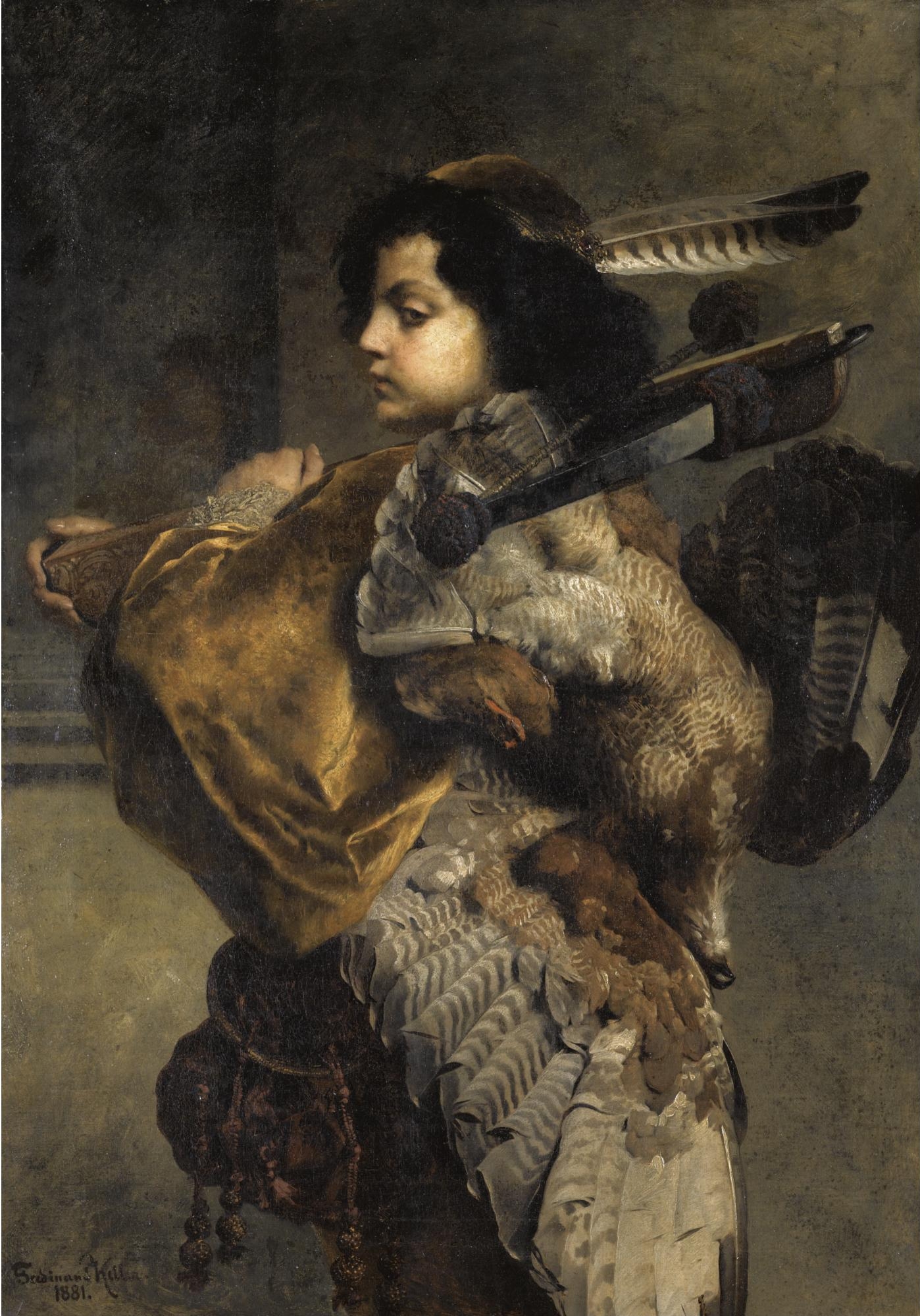
Young hunter by Ferdinand Keller
They arrived, and we vacated the area, as a show of respect. And one day, on the top floor, whereon we store our arts, with wood canvases lain and strewn, I saw her. She was not Native. She was a woman of the Old Country. Her heart was cold as a perennial shadow. Her moonlit face eyed me with an inhuman glare, and her blood then boiled, raising her hair, intoning a voice as harsh and ghastly as the screaming bite of a bullet ant. 
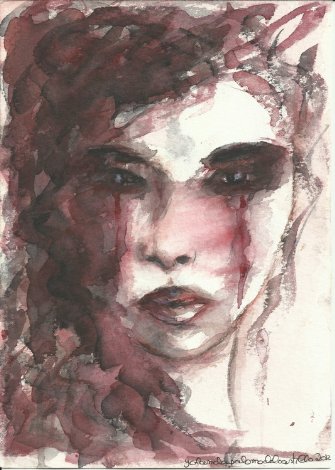
14 abril by Yolanda Palomo del Castillo
I ran. And then falling with desperation in the rushing river, we were swept along. In the instant of our near-death, she lunged towards my angular body, stretched out above the surface, in full display of my superior experience on these riverine lands. I watched as the infamous cult leader, impostor of the Cocama ethnic struggle was buried in the open jaw of the current, as her bones cracked in the turbulent stream. Awash, I lay at the edge of reason. 

Giant tree in Brazil's tropical forest by Johann Moritz Rugendas
Then, I saw the body. The tattooed flesh, gouged and lacerated. Two arrows pierced the man's underside, widening a deep, mortal wound. With bowels distended, his blood having since let almost completely of his sunken frame, I cried, lowered to the wet jungle floor, bleary-eyed. Not only had his own turned on him, but the man also suffered bullets. Scarred and mutilated, his body is the story of his people, dead to the world, brutalized and beaten down by the perpetrators of human trust, by invaders and blood alike. 
_________

Monday, 1 April 2013

Mythologies of Freedom and Dreaming: Interpretations and Reminiscences


“Human soul, should it dream of me, Let my memory wakened be.
/ Moon, moon, oh do not wane, do not wane, /
Moon, oh moon, do not wane....” lyrics from Dvorak’s Song to the Moon

“There is no freedom, because we die,” said Winston Churchill in a fated passage through the subtle imagination of nighttime visions – speaking as the personification of death itself. He emerged from the grave of innumerable veteran crosses and stars over unmarked graves lining an immaculately manicured grassy hillside in neat rows. The cemetery is reminiscent of the dead bodies once ordered with haunting linearity in the aftermath of the many battlefields fought over in world war.

The realization of human mortality is the psychological maturation of recognizing freedom as a myth. Even in dream there is limitation; the mortal scars of suffering – destructive emotions and negative repressions – continue into the deepest corners of the subtle mind. As in thinking, the natural mode of an animate and intelligent psyche is to comb through the vast interweaving analytic and creative spawns of experience and memory, as they unfold with newfound insights and revelations. Yet, in that process, the evolutionary cycle naturally spurns most content with the greatest psychological defense mechanism of mortality: forgetting. To release, let go or forget the contents of the mind as they build and diminish is part of the natural breathability of discernment that allows every person to function as a rational agent in both human society and in wild nature. Yet, there is intermittently a thought that recurs, as in dream, that reminds us that thought and the more subtle activities of the mind and of human experience are intricately linked to the repetitive urges of necessity in the libido or the gut, for example. When a thought is forgotten, it was meant to pass, and thus facilitate further emptiness, to clean the slate, or empty the glass, so to speak, so that it may become full with the nourishment of more enduring concerns. Yet, when a thought clings, as with the subconscious content of a recurring dream, it is calling out to be transformed through consciousness. There are many modes of transformation through consciousness, i.e. creativity, reflection, speaking, and action.

Similarly, as the facility of the mind to think filters through generative content towards enduring insights through word, sound, emotion, intuition, and image, the content of dream has like potential as an agent of subconscious “thought”. Yet, where thought is often sound-oriented, as the whisper of words, dream, and specifically dream-writing, entices the mind to reflect on what images endure, and why, through their free-associative interpretation. Those images that endure from dream into the memory of consciousness and daily activity are as thoughts that recur and beg further recognition. Both involuntary, subconscious – dream and thought – are inceptions of creativity that arise from instinctual mechanisms that the body has to self-reconciliation. Recognizing and listening to the inner voice that speaks in the image-language of dream and the sonic subtleties of thought through an internalized intellect form a holistic psychological healing likened to the regenerative quality of the physical body to heal itself.

Former child soldier and international rap sensation Emmanuel Jal uses storytelling and music for social-emotional learning. He says that peace is “equality, justice and freedom for all”. His triad of concepts that can lead to peace – equality, justice and freedom – will be the basis for understanding how dream becomes thought, and thought becomes action.

While there is no earthly, or worldly, freedom after a full recognition and confrontation with the mythology of human dreaming, both consciously and subconsciously, there is equality. In Sufi mysticism, it is said that all of creation essentially began from an image. In Hindu cosmology, the Self, or Atman, sat alone, and pondering a sense of cosmic loneliness, split into two. Thus, seeing a reflection of the Self gave birth to the world. In other traditions the first creation was sound, particularly in dominant Western religious tradition, “In the beginning was the word.” In more acute interpretations based on studying original texts and incipient cultural contexts, sound is understood to mean vibration. From this understanding, great wisdom energy emerges from the fabric of all creation, vibrating with the cosmic equality of being essentially of one substance, from one origin, and to one destination. Also, when people become competitive and separatist in worldly affairs, this sense of cosmic equality is lost. For ultimately, an individual is not born of their accord, nor is their lot in life prescribed by them, but they are subject to the cosmic interdependence of the I-Consciousness of All-Unity. Deep equality is seeing that there is beauty and tragedy, form and emptiness, sophistication and simplicity in every instant and every aspect, in every individual and independent form of being.

On a deep level, freedom and equality are absolutes. There is no true freedom, yet ultimately all are equal. Justice is relative. Time and the fabric of relations temper Justice as it is broken and mended by the conscious action of peoples, animals and all forms and modes of being: ocean and acidification, mountain and mine, consumer and resource, victim and perpetrator, predator and prey. Freedom is a dream that never becomes real. Equality is a reality that does not extinguish by dreaming, and also a dream that does not extinguish in reality. Justice is a dream that may, or may not become a reality, unless dreams are made real through conscious action, and then waking realities can potentially become our greatest dream.  
___________
Barroom fade-out, the groveling aspiration of a few young guts feeding on the fermented sting of a foreigner’s every desire. The walls steam and sweat to the touch of human skin, crowds meander and mingle in a scintillating core of the ruthless dance. The beat of bare feet on the wet soil engraves the trammeled heart of the night onto the soles at every step.

Le bar des Martégales, Marseille by Marcel Leprin
Escaped into the washroom, the narrow claustrophobia is deafening, with a seed of empty remorse, I trudge backwards, to scale the heights of misdirection, and a friendly face peers through the swinging doorway, a member of the female race, she glides back dispassionately. I wade through swinging bodies back to a table, where my friends eye my every movement with a gentle regard for the creative word, emanating like sunlight from my chest like a cross-legged aesthetic seeing visions of outer space. I am warmed, basking in tongues of like entanglement. A live hip-hop act floods the ceiling with the reverberations of bass and rhyme.

Fuge in Rot by Paul Klee
Next morning, the cemetery air is thick with warning. Veteran markers stretch 3,000 deep down a coursing hill, steep with shadow and disbelief. The anger mounts like an unchallenged breeze on the face of the beloved. And I starve for words of remembrance and the final end to the deep finishing hate that swarms and seethes in our bones like the lost blood of too many young men and women. We are guided along by the preeminent Allied emissaries of WWII; Roosevelt, Patton, Eisenhower all emerge from the ground of the lain, and lastly Churchill.

The Cemetery, Etaples, 1919 by Sir John Lavery
Rising from a grave bed, the sparse, delicate grass wakes with air at his emergence. Churchill guides a small tour through the narrow passage between the blinding dizzy-spell of white crosses. After reading the bare bones epitaph of one fallen, slain by the brutal, forsaken. We can almost hear the utter ignorance of speed, metal and waste. Scanning over a generic war axiom, he says with spitting disdain, “There is no freedom on this earth, because we die, because we are mortal, freedom is a dream within a dream.”

The Hat of Freedom by Herman van der Mijn
Freedom is a tear in the cry of eternity.
___________

The mangrove is a peculiar tree, featured most recently in Ang Lee's Life of Pi, the man-eating vegetable is an interesting folkloric attribution to the reciprocity found in nature. "Sour Mangrove" is a piece that uses two types of percussion, doumbek and frame drums together with digitized xaphoon with an atmospheric ethereum of shakuhachi.

This instrumentation breathes with the three minute narrative, an experimental movement that gives voice and embodiment to the numbness of apathy and dogma that drives humanity to unprecedented elevations of ignorance with regard to the environment. With the reduction in the rhythmic pace at the very middle of the track, there is a slight turnaround, where natural objects are at least recognized, yet by the end, there is mere allusion to voice as performance, reduced to mere agency in the creation of an all-consuming, and ultimately cheap contrivance: the public.

The mangrove, a gorgeous and exemplary form of environmental wonder in its sheer aesthetic beauty, and its symbiosis with the ocean (and especial trait that modern humanity lacks) is simplistically reduced to an act of consumption as a disagreeable taste, sour.


This chapbook is comprised of thirteen selections from Cyclical Wordplay under the subtitle, "Sleep Cycle" as they were all written during meta-conscious states of creative emergence. This chapbook release celebrates the music release of the feature piece, "Sour Mangrove" on my bandcamp site, where I upload experimental sound art and different forms of narrative readings. "Jailed Desire" and "Sour Mangrove" were published in "ditch, poetry that matters" on April 24, 2012.

Friday, 1 February 2013

The Poppy and the Pride of Death: Interpretations on a Famous War Poem

Poppy Field in a Hollow near Giverny by Claude Monet
"Poppies have long been used as a symbol of sleep, peace, and death: sleep because of the opium extracted from them, and death because of the common blood-red color of the red poppy in particular. In Greek and Roman myths, poppies were used as offerings to the dead." [1]

"Another candidate for the psychoactive drug is an opioid derived from the poppy. The cult of the goddess Demeter may have brought the poppy from Crete to Eleusis; it is certain that opium was produced in Crete." [2]

References

[1] L. Frank Baum, Michael Patrick Hearn, The Annotated Wizard of Oz, p. 173

[2] Karl Kerenyi.Dionysos.Archetypal image of indestructible life.p 24
In Flanders fields the poppies blow
      Between the crosses, row on row,
   That mark our place; and in the sky
   The larks, still bravely singing, fly
Scarce heard amid the guns below.
We are the Dead. Short days ago
We lived, felt dawn, saw sunset glow,
   Loved and were loved, and now we lie
         In Flanders fields.
Take up our quarrel with the foe:
To you from failing hands we throw
   The torch; be yours to hold it high.
   If ye break faith with us who die
We shall not sleep, though poppies grow
         In Flanders fields. [John McCrae]
The above poem, written by John McCrae, is one of the important war poems in history. Today, it is read aloud by veterans at remembrance ceremonies with solemn intention. The symbol and metaphor poppy, here depicted, is especially relevant for the topic of war. 

The poppy symbolizes death. "In Flander's Fields the poppies blow" would then mean that in Flander's Fields, the dead sleep in peace. The second line further supports this. The last two lines, "We shall not sleep, though poppies grow in Flander's Fields" emphasizes the simple metaphor of the poppy as a symbol of eternal rest, however, in this sense, the poem transcends symbolic import and represents the pride of the soldier as immortal, and sleepless in constant struggle. This is a poem to incite emotion for the dead, and where we might once believe they lay in respite from worldly cause, we are wrong. So the poem is a call to action, "Take up your quarrel with the foe". 

Further, it symbolizes how the poppy is a metaphor for the illusory nature of war, as seen from outside the veteran perspective. It uniquely distinguishes the veteran, whether alive or dead, as having an eternal place in the battlegrounds and in the generations of youth to follow. The poppy symbolizes our ignorance as non-military, as we remember the soldiers who fight on. 

And so, in the land of poppies, Afghanistan, the longest war in U.S. history wages on. Remembrance, in the metaphor of the poppy, can also fog our vision of the dead, and of their eternal struggle for rebirth in the fields where men are laid low. 

Peace author Arthur Clark once said the poppy symbolizes all who die in war, not just the soldiers of one's own nation, but every victim of war, every innocent child, mother, elder, the destroyed lives and communities. The poppy is the drug of pride, and like all drugs, while instilling disillusionment, it reveals truths of the human condition. 
_________
The inborn drug of sleep has yet to bear new visions fruitful and enduring. I travel eastward towards the desolate earth, and find matchless beauty in the serene quiet of petrified earth, the resonance of death lingers like a gentle breeze.  

Westward! (RK)
Son of the Brown Earth (RK)
Hiker's Meadow (RK)
To The Mountaintop! (RK)
The Canyon Calls Me Forth (RK)
__________
An untouched grand awe
Landed finally to rest beside the sickening mildew

Mulch-pressed nude lakes
Praised unto the natural moon

Lowering close over the beached horizon
A thirteenth name

Pleasing those raised on the island to visit their blood
Despite being insane

A malformed genetic waste
Purchasing birth

Towering over the healthy dead, grovelling
Ensnared by the angry temptress who walks entombed in mind

And spiritually blessed beyond our mundane knowledge,
She treasures the feminine life

...

To put to death philosophy, and cursed forms of common language
Now replaced with magic and divinity

Inert
Enough to overact above the spilled heights

Grandiose unity
Frontiersmen who bite at raw flesh and faint under the jeering of native rumblings

In the overcast dusk of Western humanity
Fallen alas to the bitter womb of civilization

And the crass membrane stew of our unalienable forebears
Freaking us out

Into stomachs without mouths
To feed on the juice of the horned phantom

And only lick from inside
The wounds stinging our nameless pride

excerpts from "Untouched Grande Awe"


Sunday, 23 December 2012

The Cubism of Unity: Shelley and the Myth of Monogamy

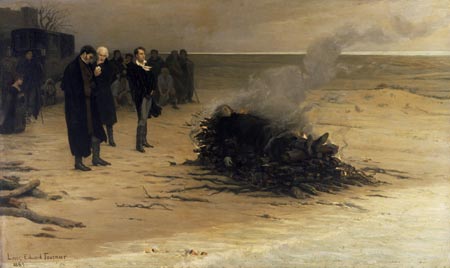
The Funeral of Shelley by Louis Edouard Fournier
   Thy wisdom speaks in me, and bids me dare
Beacon the rocks on which high hearts are wrecked.
I never was attached to that great sect,
Whose doctrine is, that each one should select
Out of the crowd a mistress or a friend,
And all the rest, though fair and wise, commend
To cold oblivion, though it is in the code
Of modern morals, and the beaten road
Which those poor slaves with weary footsteps tread,
Who travel to their home among the dead
By the broad highway of the world, and so,
With one chained friend, perhaps a jealous foe,
The dreariest and the longest journey go.

   True love in this differs from gold and clay,
That to divide is not to take away.
Love is like understanding, that grows bright
Gazing on many truths; 'tis like thy light,
Imagination! which, from earth and sky,
And from the depths of human fantasy,
As from a thousand prisms and mirrors, fills
The Universe with glorious beams, and kills
Error, the worm, with man a sun-like arrow
Of its reverberated lightning. Narrow
The heart that loves, the brain that contemplates,
The life that wears, the spirit that creates
One object, and one form, and builds thereby
A sepulchre for its eternity.

From Shelley's Epipsychidion

The dying words of my great uncle, who would have been 92 this week, were "focus on one thing". I've always had multiple affinities. As a creative person, my mixed mediums, cross-genre, multi-instrumentalism frames of mind spill and interweave throughout different art forms. I often wonder, should I commit to one thing entirely, and from that foundational trunk, branch out into the world of infinite possibility? In my arboreal metaphor, I am a forest. 

I think my great uncle might be proud to look upon one of his favourite of the younger generation, and see that I am not following his advice. For he was an iconoclast himself, through and through. Of the first class of Jews to enrol in university in America, he was proud to transcend the status quo, the social norms and family values of his time and explore the hard-won science of novelty through physics and chemistry. 

Yet, in love, I am elastic enough to disagree with my creative self, and traveling beyond the creative-destructive duality, to see the magnificence of love as an enduring unity. I see only One Love, especially when looking upon the dear face of my beloved wife. 

The late Ravi Shankar exhibited a profound connection to intensive unity in life focus in the documentary Raga, while Lawrence Ferlinghetti espoused the delights of being a multidisciplinary artist in both poetry and painting in his essay, "From The Gone World". To each their own, to each their one, and one to each. 

See related post: Shelley and the Old Man: A Poetics of Wisdom
_________
A forest of brains, pantomime expressionism. The canvas is blank. We stare, of ancient rivalry, to whiplash a brush of paint across the rough, splotchy face of collaboration. The collaborative stare ensues. Our eyes lock under a dark cloud of empty highs and lonely madness. 

Les deux amies by Thorvald Hellesen
A pastel cubism intermingles with pointillist ink. Our minds snatch and hiss at the dizzying array of subdued pigment and hints of future colour. It is group inspiration, retching from the distended bowels of two fiercely separate artists of waste. And in a moment of communal haste, aggression holds the creative fire of my murdering hand, and I impale the throat of my fellow artist, friend and comrade with an ink brush. Our painting is finished, our art begins.
_________
"…in a play…a dream play brings up the soundless deep…in the emptied awareness of emptiness…playing on a dreamscape of silent depth…up from the upbringing…strong with remembrance in the absolute living…living among complicit guests and their following remarks…

...

…in the native dirt…and to speak to the stone…and to speak through our pain…the pain of our individuated backs…grated and remaining uncured with the booming fate of a motionless mountain sky…journeying around the headless round of the tailbone crack…remembering through a numbing moment…

…a memory…lost to the unchained back…still writhing with touched passion…"


excerpts from "Fragmentary Being"

Saturday, 15 December 2012

Atheist Tomb of a Truth-Seeking American: A Plea for Disarmament

Tomb of D.M. Bennett in Brooklyn by Cory Doctorow
"I have learned to modify my prejudices. I am ready to believe Hamlet was right when he assured his friend Horatio that there was in Heaven and Earth many things not dreamed of in his philosophy." D.M. Bennett, as orated in The Truth Seeker 
It is at times like these that we Americans look to our history. Who are we? Where do we come from? How did we get here? What could have led to this? What is happening? 

Those among us strong enough to ask such questions are motivated to seek truth. As the president weeps for the children of the nation, so we must all begin to weep with minds full of emotion, burning with an intelligent self-awareness towards post-political change. We don't need rhetoric. We need new laws on guns. We need free thought to embellish the minds of such substance as founded free press in America. Disarmament is the new abolition, and as long as guns are indiscriminately accessible to immature minds and wounded hearts, we are all slaves to this mortal era.  
__________
The last thing I remembered was the initial feeling of impalement. Careening off a flight of concrete steps, I flew from my bike onto a metal pole. My back cracked in shards. When I came to, the city was dark. A Rastafarian man burned down a hand-rolled cigarette in the shadows. I knew from his countenance, to walk outside would be a bad move. I did anyways.

The Customs Cabin by Ferdinand du Puigaudeau
The street lamps glowed over empty streets. The absence was chilling, yet I could feel a human presence both alarming and alluring. As I made my way down to the riverbanks, the icy shoreline stared at me with two riveting eyes. The male stance was formidable and intimidating. Fear struck. The air breathed of danger. I needed to know why.

Night on the Southern Shore by Nikolay Dubovsky
As I hurried further on down the shoreline, a group of men whispered in the dark. I quickly smelled the entrenched anger, the mortal struggle at hand. I fled. On my way back, I met a friend from before the accident. He recounted his story, how he had broken his back in an accident that mirrored my own. I didn't question the curious coincidence as he went on to explain the unthinkable, we were now living in a world so hostile to mankind that people were literally killing each other for the last crusts of bread, the last drops of water, the last feet to walk, the last fresh air to breathe, the last day to live.
__________
"towed current
            pulled slow,
            drifted away

hand,
            fingers following new lines
...

virgin thorn brush
            frame lilting strong above the careless face
of artistic madness
in the jokester’s foam and rust
...

the pulse breaking off the tops of widow’s peak waves,
            blushing high over the coastal horizon,

a piercing thought
that boiled in the mind’s own brain,
an intuitive question
            with an answer as certain as death in the next step"

excerpts from "empty Blown mind"


Tuesday, 11 December 2012

Apolitical America: Nightmares of the Preventive Paradigm


"In the past, politicians promised to create a better world. They had different ways of achieving this, but their power and authority came from the optimistic visions they offered their people. Those dreams failed, and today people have lost faith in ideologies...But now, they have discovered a new role that restores their power and authority. Instead of delivering dreams, politicians promise to protect us from nightmares...But much of this threat is a fantasy, which has been exaggerated and distorted by politicians. It's a dark illusion that has spread unquestioned through governments around the world, security services and the international media." BBC Documentary Power of Nightmares
As George Carlin said, "You have no choice, you have owners." Yet, before I heard the words of this comic genius, I had an inkling that America was having its way with me, and I desperately needed to get out. When the twin towers came crashing down, I was a teenage male, bent up in a corner, with only one response, the one I thought my American family wanted to hear, "I would kill to get revenge." As I watched the growing stores of books on international post-Cold war espionage supporting the drama of "war on terror" dialectic, I became more and more sickened and disillusioned. Bush's maddeningly insane propaganda machine of backwards language and foolish bad humour turned my stomach. I fled America, to live in the Middle East. I needed to hear the breathing from "the other side". I found human hearts, not enemy minds. I found a camaraderie so naturally human, and so deeply universal, that I was fulfilled from my need to be "American" at all. With Obama's "war on terror" claim to fame at finally finding success in hunting down Osama, I remain ever firm in my convictions. American "terror" propaganda is so deep-seated that it is truly beyond politics, it is the very lifeblood and backbone of American society. 

See my post: Flightless Dreams and Dark Humour of a Post-W.orld...
__________
A gargantuan supply of Spanish rice, washed in a tantalizing array of chiles and spices galore, wades in a fine cream sauce. A team of cooks work with exceptional efficiency in an open kitchen. The dining area is of a posh nightlife design. Smoke wafts among whisky inhalation in the metropolitan air. 

New York Restaurant by Edward Hopper
As I stare into the blaring kitchen lights from the dim seating area, I notice a cook saunter over to a telephone on the wall. His white frock is stained with stout culinary effort. Taking another sip from my snifter, eyeing a fantastic belle at the table across from me, the dining lights suddenly dim uncomfortably. The kitchen light glares out over the tables with the stillness of an all too noticeable silence. Everyone is motionless. 

At the Moulin Rouge by Henri de Toulouse-Lautrec
My eyes survey the room with blundering anxiety. The white frock of the cook at the phone reflects a brutal white light over fearing eyes. His mouth opens, and out emits a breath so hot I can feel it nearly twenty feet distant. His eyes become two open holes. The man falls, and I can see his frock begins to stain red. Crawling along the open floor, he is steaming hot. As he unbuttons his cook's clothing, his chest pours with ashen blood, a red so crimson it floods my eyes with a blinding hue. In my mind, I kneel to help him. I sit, frozen. 

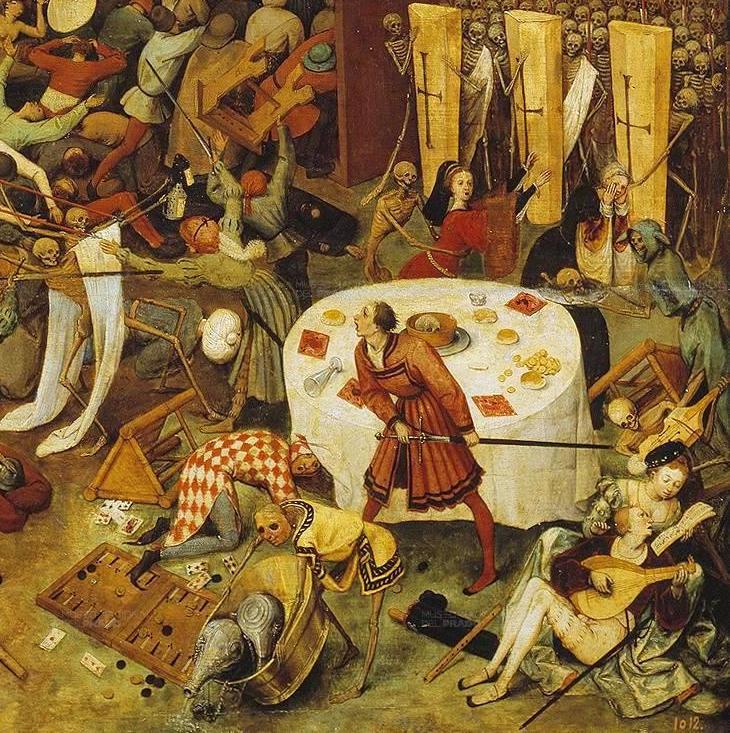
Triumph of Death (detail) by Peter Bruegel the Elder 
All realize the man will soon die. One cook slowly meanders over to a phone, shakily dialling to quell the emergency at hand. In a last gruesome attempt to breathe, the man on the floor has almost completely undressed himself. Swelling with heat, blood pours from his chest and mouth. Staring at me with empty, soulless eyes. I faint. 
_________
"Fires beneath the throat, hand and breast of a reflected sky
Inside the single-eyed, whose perfect clock chimed roughly over the groundless

Patience, dusting off wine bottles
Into Californian eternity
...

The idealistic round elegized by madmen before indulgent crowds,
A folklore, pained to vulgarity in the thick mire

Soaked with herbal grime,
That dream-forsaken wine of the ancient, pours

Sending women to mind thankless law
In the first civil war before nationhood or tragic mores

The fallacy in and out of sight,
Instantaneous with thoroughly flushed wives, fanning themselves awake

As the flies descend and drink their salivating gore-fest tirades,
The Queendom, saved by the ranting duration of a minor apocalypse

When all the rest of the world lies in tears
Shaken only by worldwide fame"

excerpts from "Co-creative Wondering"


Monday, 5 November 2012

From Genius Mind to Genius Heart: Wagner, Liszt and Dream's End

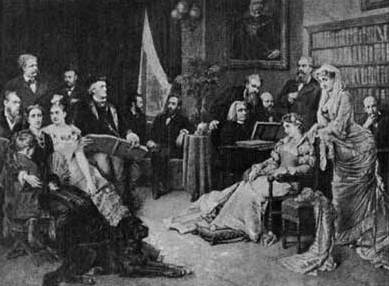
Wagner at Bayreuth (shows Franz Liszt at piano) by Gemälde von Georg Papperitz
"If I think of the storm of my heart, the terrible tenacity with which, against my desire, it used to cling to the hope of life, and if even now I feel this hurricane within me, I have at least found a quietus which in wakeful nights helps me to sleep. This is the genuine, ardent longing for death, for absolute unconsciousness, total non-existence; freedom from all dreams is our only final salvation."
"As I have never in life felt the real bliss of love, I must erect a monument to the most beautiful of all my dreams, in which, from beginning to end, that love shall be thoroughly satiated. I have in my head "Tristan and Isolde," the simplest but most full-blooded musical conception; with the "black flag" which floats at the end of it I shall cover myself to die."
Wagner's Letter 168 to Liszt. The Project Gutenberg Etext of Correspondence of Wagner and Liszt, Volume 2, by Francis Hueffer (translator)
I suppose to find one's peer as an artist is an ideal that few artists truly find. In the artist's magic of self-distinction, and in their magnificent ability to penetrate the heart of all, there is a deep and rich yearning to struggle, co-exist and finally, bond with fellow colleagues in the field. The artist, however, is too often moved beyond the spheres of normalized human contact, and thus falls short in sharing the richness of their life with another, except in the case of a briefly interspersed encounter with love, endured while in the sweep and momentum of creation. The recording above bears such testimony, and the heartened dialogue which shifted the reigns from the genius mind to the genius heart in the Romantic age of music has no likely parallel than in the intercourse between Wagner and Liszt which produced such insurmountable passion. 
________

Separated friendships detached by the urban domestic strife of youth boggled into a labyrinth of direction often slides off course over more damaged rails and misbegotten paths, the hard-won industrial groove of 21st century burning turns with a lifeless tour through the metal of pocket-worn need. 

White Buildings and Labours by Jayanta Bhattacharya
My friend, alone, and huddling over a home-cooked potluck gathering, strides in fully bedecked in Scottish kilt-wear. His face nearly contorted with the oncoming gripe of tears looks down and over his saran-wrapped goods. I comfort his back, emotionally elsewhere, long gone and hopeless for a friendship that’s as irrelevant as the contents of additional soup.

Scots boy in red kilt by Wilhelm Trubner
As I wander off, the air is opaque with a dark, runny stirring. The world commotion breathes heavily. A musical engagement is torn from my wife and I as our contact weans her ear from a phone of marital divorce, and the sky blackens with the frost of an easy death. 

Satire on Romantic Suicide by Leonardo Alenza Y Nieto
I tip toe up to my experimental end. I’ll have no burial, nor cremation, a sky birth in the way of my choice, a bungee jump without a bungee, and I dress for the occasion exactly as I would for my big day. My imagination jumps.  
_________
A great poverty aligns to the roof of the all-consuming jaw,
          That sweeps with the tornado dawn over the rushing plains
...
As American lore, talking through the human trees
          In a grave, over-worked rush to the gambled fortune
                 hidden in the proud dream
          To unite and be loyal to nothing,
          And yet return from the hollow
                 blank rough of our creative winter


Sunday, 14 October 2012

Reflection on "The Force of Character" by James Hillman


James Hillman, an archetypal depth psychologist, whose post-Jungian conception of the human experience is essentially imaginative, and whose amoral fluctuation between endurance and immaturity lies nascent in the temporal grains of salt which gather and line the throat with ever increasing grab as aging commences upon the personality. Written at an old age, the author speaks clearly against any kind of aging therapy, and humanizes the current malaise which treats aging as a virus.

The author unwraps biological naturalism with the psychological bloom of a mind fermented with insightful, though not inundated, research on the literary and aesthetic character of human aging as a welcoming asset to life, in flagrant contrast to the ceremonial traditionalism of preparing for death, a non-issue in the continuous envelopment of life throughout the growing and falling of seasonal lasting. Dreams are referred to for their imagistic plentitude in bringing the holistic human experience towards fruition in the entire round of consciousness.

In short, Hillman's psychology is life-affirming unto the limits of modern knowledge-bearing with regard to the biological strength of humankind to age well and vigorously, as an essential presence in social reflection, as a memory of characterful belonging in the psyche of an unconscious gathering of the old triumphant spirit of age in all its mythic fortitude and human vulnerability.

Read Scott London's brilliant interview with the late author: On Soul, Character and Calling : A Conversation with James Hillman
__________
Strutting down main street, Northampton, the little city atmosphere in a smaller town, brevity of metrosexual burning. Eyehole of gouged recollection, that there is a grayer hiss over the obscure horizon edge. A paranoiac whereabouts, a drinkability churning in the ingrate stomach as cold rice turns to frothy fluid within mellowed bowels. The attuned ear swings in frantic respite as the free march to movie theatre skies nickels and dimes my racy birth rite beginnings in the stingy hollow of American noonday education.
Northampton (Massachusetts) by William Henry Bartlett
Deeper along the edge of the township, towards rougher pasture, the greener grass gives to a brown floor of the barn stead. Outside, a reenactment of the medieval lance posture, only instead of a game between knights, the Anglo matador speaks in a murderous war with the human horse. I try my hand. With two lances upraised, I pierce the flesh of a gorgeous brown horse, mirroring the hue of the dirt circle fenced by a weak wooden ring and an audience steeped in American farmhouse poverty. As other horses, unsaddled and with fierce eyes, carouse into the ring, I jet from the gathering into a blacker city.
The Present by Thomas Cole
The jurist is deliberate, patient and silent. Instead of an easy interpretation by the passive jury of bored, directionless public witnessing, a guitarist lights the court with unfailing melodies, an original spirit of human will, to impose the individual struggle with death outside of foreign deliberation in the mind of an other. Because truly, in listening, the other melds seamlessly with the brain of a decidedly active witness, pardoning all in the sonic flight of metaphysical charm.
_________
Gazing at my Love's face, I see through the apparent reality to a frameless art. A sacred geometry in the flesh. A timeless elision, going beyond spent energy.

To consume a day; imagining with laughter in the midst of family. 

- excerpt from "Gazing at Love's Face"
 

Friday, 12 October 2012

The Imperial Ethereality of the Christian Cross

Eusebius of Caesarea 
"...when the day was already beginning to decline, he saw with his own eyes the trophy of a cross of light in the heavens, above the sun, and bearing the inscription, CONQUER BY THIS."

EUSEBIUS PAMPHILUS OF CAESAREA: THE LIFE OF THE BLESSED EMPEROR CONSTANTINE. CHAPTER XXVIII. The Bagster translation, revised by Ernest Cushing Richardson, Ph.D.

For a magnificent compendium on Medieval and also Ancient and Modern Literature, visit Internet History Sourcebooks
________
A medieval townscape; similarly forged in the imaginative filmmaking of Kurosawa, yet in the guise of European history. I see lowered clay-roofed structures, and dirt roads amassing with each step into the muddy ground. There is an instinctual defensive glare from the executioner’s hat and the stymying bureaucrat’s shallow presence as I enter the gates of the stead. 

Meeting at the Golden Gate by Jean Hey (Master of Moulins)
At my first meeting, I am greeted by a youth, an apprentice to a knight, with radiant innocence so bright I am shocked to the core. And in that moment I lash out. In a single slash of my sword, an instantaneous move, I split the defenseless youth in half. 

Bors and Lionel
Blood sprays from his center and the gore filters through my footprints in stone and mud. I am taken aback by my own actions, yet as the clouds roll on, the silence is ever penetrating, unfulfilled by redolent justice, coursing on as voiceless blood, loyal only to the alive.
________
Witnessing the continuance of an apocalyptic crusade on these modern shores

Breaking open the earth-less ocean unto the final turning of Europe’s last romantic page,

Closure to the novel convulsions of a people well-practiced in ethnic cleansing and rife with general ethno-cultural frights

- excerpt from "Feel Old, Death?"


Saturday, 6 October 2012

Reflection on "Mary's Near Death Experience" solo theatre by Jamie Tea

Photo: Performer Jamie Tea. Photo by: Tim Nguyen/Citrus Photography.
Jamie Tea Tognazzini's solo show, "Mary's Near Death Experience" at soulOcentric had me laughing from start to finish. The performance was hilariously charming and impacted me on so many levels. Firstly, the show had many references to concern and love for the ocean, which from my previous post "Reflection on 'Save the Humans' lecture by Rob Stewart" one can see is an extremely pertinent and worthwhile issue to raise in all forms and contexts in the public eye.

Jamie Tea enlightened that perspective through a great bravura of comic timing and voice acting which grabbed the audience on a journey into the space age, complete with the naivety of a southern-belle with a knack for religious experiences and a jaded Coney Island street worker. The shapeshifting ventures were spurred on by the dream of a "cosmic wonder-fish" which led Mary to the Moon, to admire spacescapes and woo the audience's imagination with a subtly refreshing candour.

I've known Jamie Tea from her work with Green Fools Theatre, during their Outer Space-themed 2011 Halloween Howl show. It seemed almost as if Miss Tea had projected her character from that previous show and placed her unique acting genius front and centre.

Stay tuned for Green Fools Theatre this Halloween!
_________

Oh! I know that recurrent clarity, the open water: the blue ocean when calm. They say a oceanographic project recently cleared a magnificent coral shallow, with its cerulean majesty, awakening the surface of conscious freedom from the lowest of depths, the inertial core, to the highest of realms above in the unspoken silent space of brilliant sky. 

Mediterranean by Nikolay Dubovskoy Sredizemnoye
Unafraid, I swim. Sharks are a passing memory, and fish and dolphin happily glide atop the water with a bounteous air, showing their fins with the gentility of a human smile. The water is cool, refreshing, and I swim eagerly, immersed in its healing, maternal body. 
_________
Our modern lives run clean through this cursed river
Our blood dirties, streaming from the porous core
These are wounded oceans.
We sink, while the light of the world floats amiably to the surface
Belly up.

- excerpt from "Belly Up"