Primarily a writing exercise, this dream journal-inspired blog is a quiet introspective sojourn into the process that we traverse in going from private dream to public art. I see our dreaming as an internalized mythmaking. As I philosophize and expressively exhibit dreams, both private and public, I encourage and delight in creative language as a way to practice experiential metaphors through a “public dreaming." Writing Theory: Creative Dream Fiction
Showing posts with label essay. Show all posts

Tuesday, 24 December 2013

Anaïs Nin and the Secret Self: From Blindness to the Mountaintop


Henry Miller

In the last few years one sees quite a few either writings about you or quotations from you about dreams and the dream life and I feel that they haven't really understood what you mean about this. I don't think you want people to be living in a dream state while conscious, do you?

Anaïs Nin

No.

HM

But you mean that dream has its uses, its effectiveness in life afterwards.

AN

No, I meant something else, I meant that what we could arrive at a state where what we dream at night would be the blueprint for what we wish to fulfill, or to reach, and if we understand the dream then we know what the secret self is and then this secret self we can fulfill.


Anaïs Nin, whose literary renown is most prolifically exampled in her posthumously published diary writing, is also respected and admired for her role in encouraging and stimulating the work of Henry Miller. Her opening preface to the Tropic of Cancer, Miller's first book, is one of the most incisively written dedications to the literary spirit that I have ever read. Her quotations on dream, are poignant in their truth and magical in their realism, vibrant in their imagination and open in their accessibility. 

Similarly as with Carl Jung, both Nin and Miller drew liberally from interpretations between Western psychoanalysis and the traditional religious learning, thought and practice of Hindu, Buddhist and Taoist cultures. As highly creative minds, who lived richly balanced in heart and mind, stood for a conscientious human being, who through developing thorough self-awareness comes naturally to be a part of compassionate change in the creative universe. 

“Dreams pass into the reality of action. From the actions stems the dream again; and this interdependence produces the highest form of living,” said Nin, in a comment that affirms the dream psychology of Jung, who considered the dream life, or the life of the imagination, of the mind and of creativity as more real, meaning a more direct form, or manifestation, of experience, than the life lived through the senses. Thus, Nin determines, “Dreams are necessary to life.” 

Indeed, Nin would press ever on into conceiving the dream life as integral to meaning, to holism and self-truth. She asserts, “Our life is composed greatly from dreams, from the unconscious, and they must be brought into connection with action. They must be woven together.” Further, one might add that when woven together, the dreamer, as artist-visionary-thinker-writer, becomes the seer, as in the mystic of unmediated experience, of eternal unity in the present, of enlightenment in non-being. 

Eventually, dreams are life, as life is certainly made of dream, and that we are the substance of dream, as the subtle nature of perception, meaning, truth and self-knowing. In reaching the transformation of necessity to becoming, in the paradigm shift of dream action fulfilled in daily living, is for Nin, a miraculous occurrence, likened to the rare and precious goal of enlightenment. She reminds, “The dream was always running ahead of me. To catch up, to live for a moment in unison with it, that was the miracle.”
_________
Night in the forest, like soot and anger, under a flattening sky. I fell from Paradise into History in the moment of a sting, the lunging insect-antennae, electric, lunged into my paranoid flesh. Hooked under the stark and opaque canopy, obscuring starlight into the bitter and directionless flood of need, anxiety and hope. I sprang from the petrified mud to the swaying vegetable maw of a blind quake, a wild charge.

Georges Lacombe, La forêt au sol rouge
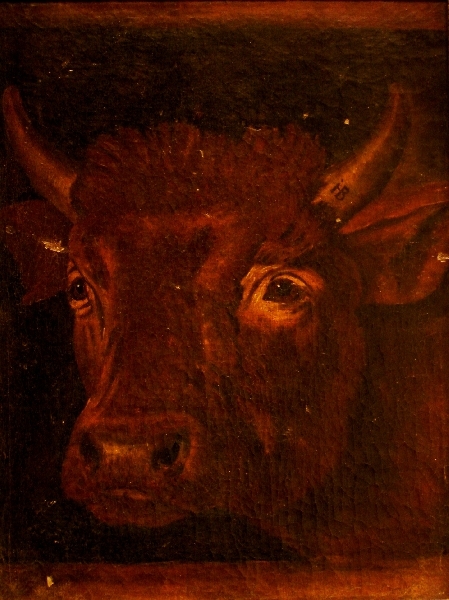
Extinction moved in the sad, ghastly wave of moonlight over frostbitten leaves. Bone-white spears upended my eyes, as I dodged a full-grown bull. Adrenaline-shocked, I sped, scanning the immobile trunks, weighing the Earth down with inhuman strength. And the soil broke in a jarring flash of bestial rage, as another bull, of sturdy, muscular build, spun me around, my heart waning of life.

Bull's head, painting by Johann Heinrich Baumann
I tore through the endless nothing. Then, one bull split my body from the waist up the gut. Marching on my hands, stomping and cracking bone with its merciless strength, adrenaline rushed and spilled out into the open air as I climbed back to my feet, nearly wasted by the crushing jeer. Countless bulls encircled, as I fled, bleeding, the pain yet to reach my brain, grabbing for low-hanging anything, my stomach burning, my feet turning to knee-splitting daggers and brain-flushing mush.

Animals in a Landscape (aka Painting with Bulls) by Franz Marc
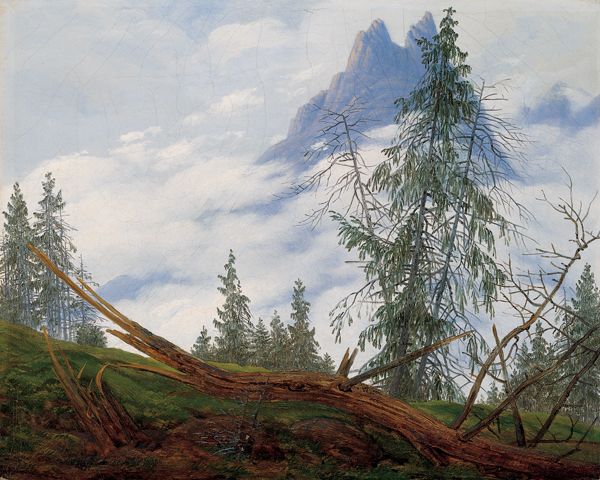
Pit against an escalating fever and white with near-mortalizing blood loss, I fainted under the powerless impression of my death, only steps from the forest edge, still besieged under the sightless underground forest of the human Earth. A single house stood at the edge of a rock face, and I was carried to its door. From a window fogged with subzero condensation, I could make out the moonlit peak, and with every second that my mind ascended, my body shrank with fear, and I gasped for each breath as my last.

Mountain Peak with Drifting Clouds by Caspar David Friedrich
Staring at the summit, and then was enshrouded by cloud-cover, my eyes closed, I stole beyond the body, and time, beyond death and need, beyond blood and truth, beyond the waves of human flesh that rode on this belligerent tidal sway of hope and tragedy, to summit the Everest flight of dream, and survive through this tyrannical flood of mortal reality.
__________

Tuesday, 17 December 2013

Create You: Fearless Artistry and Creative Identity


"I began to dream heavily, violently, every night, and then I learned how to wake up…" 

"Consciously or unconsciously, all writers employ the dream, even when they’re not surrealists. The waking mind, you see, is the least serviceable in the arts. In the process of writing one is struggling to bring out what is unknown to himself. To put down merely what one is conscious of means nothing, really, gets one nowhere." 


Creation is life. More, the incipience of creation is the life of the creator. The life of the artist is bound to their creation, in the same way that a mammal survives on each breath of fresh air. As long as the air is fresh, the artist will continue to create, and as long as the authentic substance of heart issues from the core of the artist's own vision, the arist-seer will align and harmonize with all of creation. 

To forego a path without heart is acceptable. The great mystical physicist of our age, Fritjof Capra, began his famed text, The Tao of Physics, with that realization. Yet, on the path of heart, a different narrative runs its course. To remain true to oneself is to hold fast to the consciousness of one's life source as not merely the beginning precepts of one's physical subsistence, but of the visionary path onto which one is led through to the heights of meaning and becoming. 

The proud artists will realize their vision in the instant of a moment, at simply being the processional experience of creation, the ever-beating heart of co-unity with individuality and universality on Earth. To not over-think is the key to strengthen the creative momentum, reminds Henry Miller, the American author with a self-professed Chinese ascetic's nature. 

So, in holding fast, the artist and author of self-creation, is near-shattered, sensitized by the flood of the fleeting that files down the materialism and consumerism of an all-pervasive cultural fear, to belittle the uncultivated mind to ignorant non-being and blind negativity. In this way, the inner sanctum from where the creativity of an artist is strengthened by the water-like ability to be vulnerable, naked, raw and emotive in a full and unbridled formless truth. 

To all artists, and to the Self, I call on you to be strong, and to claim the ideas and visions and dreams in your mind and heart and being as you would claim your rightful place on Earth. For that creativity, and the perfect imagination of its fruition in your life, is your truth, your heart, your mind, your being, your soul, your foundation, your meaning, and all your own, it is you, your nature, your life, all yours, be it and be proud. 

Everyone, as with one mind and one heart, is capable of becoming sensitive to the expression of your truth as an unheard knowledge that only you possess and that is invaluable, necessary in its tragedy, absolute in its humour, refined in its judgment, authoritative in its experience, wild in its reason, cautious in its aspiring, and pure in its love. Create you. 
___________
Around this circle danced the flame of eternity. In the green spark licked the tongue of heaven. Spring in the Jungle bloomed with effervescent majesty among the ruined foundations of another remote, human wasteland paradise. The veils of fame and belonging passed like a soothing tide, recoiling in the abyss of oceanic depth. We smoked the herb of forgetfulness, harmony and love. 

Ernst Haeckel's 1905 Wanderbilder (Travel Pictures)
The smoke coiled around our lazing necks, floundering amid the slow-moving river, her brown body motioned like a heavy emotion. One among us, an artist of metal and flowers spoke up as paper and marijuana stung our eyes, blinded by the greedy moment, a fleeting light. "Native community leaders announced their wish to use our space. They will hold facilitations, meetings and workshops on the militarization of the Indian people; their War." 

Coolies on the Road near Kalicut, Malabar by Edward Lear
A shade lifted and a heaviness shrank as our hearts wept and our minds faltered along the brink. She, the speaker, high as the azure, fled to the banks, to swim and cleanse in thoughtful reflection. She swung on a low-hanging vine, falling into the naked river, dressed still in paltry coverings, now a resident of the Amazon for well over a decade. Her eyes spoke of what her tongue could not shake. 

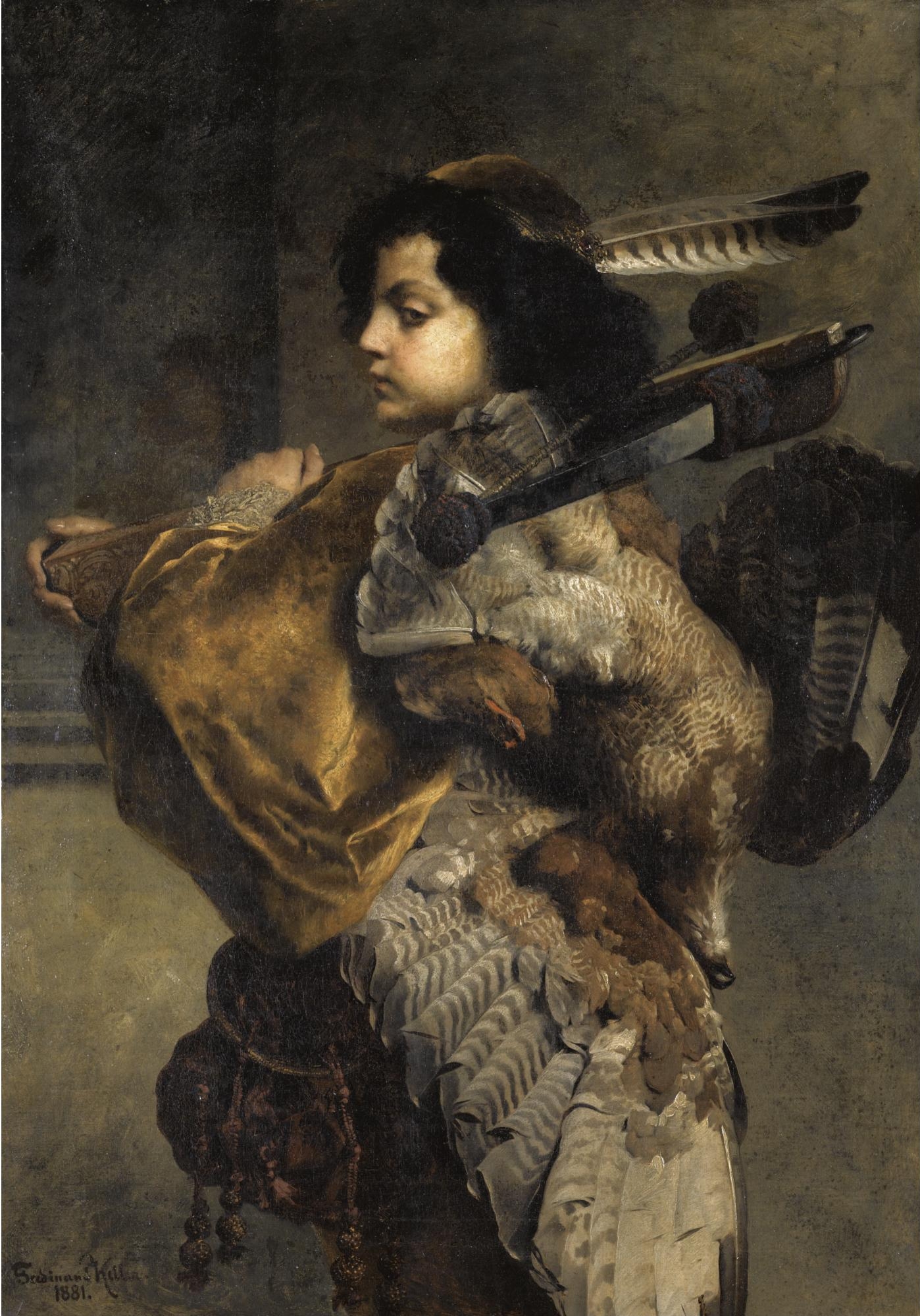
Young hunter by Ferdinand Keller
They arrived, and we vacated the area, as a show of respect. And one day, on the top floor, whereon we store our arts, with wood canvases lain and strewn, I saw her. She was not Native. She was a woman of the Old Country. Her heart was cold as a perennial shadow. Her moonlit face eyed me with an inhuman glare, and her blood then boiled, raising her hair, intoning a voice as harsh and ghastly as the screaming bite of a bullet ant. 

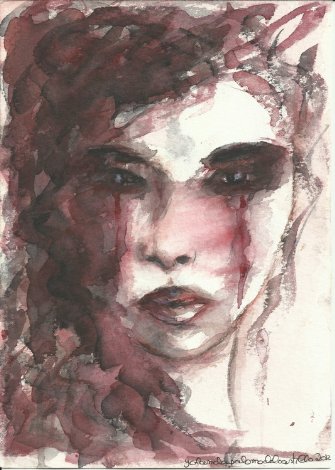
14 abril by Yolanda Palomo del Castillo
I ran. And then falling with desperation in the rushing river, we were swept along. In the instant of our near-death, she lunged towards my angular body, stretched out above the surface, in full display of my superior experience on these riverine lands. I watched as the infamous cult leader, impostor of the Cocama ethnic struggle was buried in the open jaw of the current, as her bones cracked in the turbulent stream. Awash, I lay at the edge of reason. 

Giant tree in Brazil's tropical forest by Johann Moritz Rugendas
Then, I saw the body. The tattooed flesh, gouged and lacerated. Two arrows pierced the man's underside, widening a deep, mortal wound. With bowels distended, his blood having since let almost completely of his sunken frame, I cried, lowered to the wet jungle floor, bleary-eyed. Not only had his own turned on him, but the man also suffered bullets. Scarred and mutilated, his body is the story of his people, dead to the world, brutalized and beaten down by the perpetrators of human trust, by invaders and blood alike. 
_________

Monday, 9 December 2013

Rebuilding the Unconscious: National Reconciliation and Personal Poverty


"What was in the unconscious, by talking about it, was brought into the conscious mind, and since the conscious mind, Dr. King's already won, the behaviour changes. Wait a minute, what's that mean? Wait a minute, what's that mean? That means that we may be closer to Dr. King's dream than we fear, but we got to keep talking. We've got to keep talking, even when it's uncomfortable." 

"Today, the American Dream is under threat. Our veterans are coming home to few jobs and little hope on the home front. Our young people are graduating off a cliff, burdened by heavy debt, into the worst job market in half a century. The big banks that American taxpayers bailed out won’t cut homeowners a break. Our firefighters, nurses, cops, and teachers – America’s everyday heroes – are being thrown out onto the street." From the Rebuild the Dream Contract 

Van Jones

Usually, this space features original writing, mostly essays, articles, and creative pieces published across the globe, a repository of works featured online. Such original writing usually comes after referencing relevant quotes from the luminaries of the age, those who spoke and clarified humanist dream-thinking beyond conceptual idealism to the pragmatism of imaginative vision and achievable action. Yet, in light of the exceptional words of Van Jones, noted public intellectual on green economics and social justice, a project on the American Dream, and the War on Poverty, a non-fiction work entitled, The American Nightmare: Deconstructing the War on Poverty that I had been working on for on average 6-10 hours daily over a span of three weeks has been suspended due to negligent correspondence. 

The suspension of the work has led me to seriously question my place in the Struggle. I have reflected earnestly and steadfastly into the bitter and stubborn recesses of my young mind, to uncover and explore the history that has led me to my current state, profession, and living circumstances. Not only has the suspension irked me personally, it has led to a seemingly irreparable disintegration of my professional development, as I have been led to question the very foundation of my primary income-earning as a freelance writer. Simply, I accepted a job to write a major work on poverty, which truthfully, paid so little, and asked so much of my time, that it may as well have led me into poverty. 

Added to the initial fact, while I did the work out of curiosity and an impetus to serve a greater work ethic in the name of fulfilling a position asked of me, the suspended correspondence between myself and the publishing agency has caused unmentionable anxiety. The topic on poverty in the United States, and government programming intended to reduce and eradicate poverty had led me to very interesting conclusions on the nature of governance and civil progress in the American context. The freelance job that I had taken to produce 215 pages of carefully written and closely studied work on the subject was truly an exhilarating and inspiring process. 

However, the process as a whole, and the empty-handed result thus far, has left me with an enduring impression with regard to the nature of work, one that, honestly, compels me to complete exasperation. Was it vain pride at the chance of writing a book, and being paid for such work? Or, the overall scheme of my life that has led to this point of personal and professional denigration in the name of accomplishment, work and independence? 

The work of SoJourn(al), this space, is essentially one where the process of a young life, and its manifestation of dreams, come to fruit through perennial dedication to the passions of independence (i.e. self-employment) and creativity (i.e. resourcefulness). After completing the original sound-art works relative to the Sketches of Style collection, I intend to break from uploading more original content here, to recollect and compile all of the works that support the overall intent, create a master publication (i.e. in the form of self-published collected original materials, such as dream fiction and essays on the narrative subconscious), and begin a new page on a new project.     

For now, more music reviews from BeatRoute are forthcoming… 
__________
There was a sheen of golden sand on the top of the butte, where I sat, immersed in the Valley of the Gods. And as I opened my eyes, the sand sparked, as an invisible flame rose to greet the monumental sun. Tears cracked the thirsting rock as I held in my arms the newborn drum. Taut calf-skinned and maple-encircled instrument of spirit, it moved, as inside me, with a petrified grace. 

Mount Desert Island, Maine, by Jervis McEntee
Not alone, yet from the clouds above, heavy with a sad rain, pregnant with the forecast of solitude, I remained silent, a silhouette of the drunk Earth, whose lines disappear and merge with the clear and lucid landscape horizon. Then, there were others behind me. With hands held at their sides, solemn. We awaited the grace of the Royal Native footstep, a rush of patient anxiety, the air true and sound of our hearts' own unhindered regularity.

"Prayer in the Desert" by Jean-Léon Gérôme
Then, as with the march of an oncoming storm, they strode in dancing. Their flat footwear dusting the tops of the sky, elegant with strength. Their movements sure and ancient, greeting the naked stone with the trust of an artist's hand, as the land's own song cried and intoned the sacred. And all then overcame the one great Fear of Death, displaced by the Beauty of Truth. Their songs spoke of Love, Peace and Unity. Then a rain flattened our wild hair, and we cried in unison for the end of a loud and gross age.

"Early in Day in Desert Quiet" by Mary Agnes Yerkes
I began to beat my skin, summoning the gravel and the hail, I floated on a subtle ecstasy, my own song, for them, for here, for us. The drum cracked and moaned, and my heart opened with a newfound longing. The rhythms of the Earth called forth the Witness. Of sight and mind, I broke fast on the holy mount, within the inner sanctum of my own restrained and haunted psyche. Liberated, I stood, bowed with respect to the territorial spirits in whose name I intoned the first breath of song. 

Lions in the Desert by Henry Ossawa Tanner
We left the butte alone, as it had been for aeons. The Valley of the Gods lay silent and waiting behind our upraised eyes, sharing in the unsayable fate of humankind. 
 _____________
Thelonious Monk, the great American composer...


Monday, 18 November 2013

Novel Liberation: The Humble Postcolonial Wisdom of E.M. Forster


"If I have had any influence, I would be very glad if it induced people to enjoy this wonderful world into which we're born, and of course to help others to enjoy it too."

“We must be willing to let go of the life we have planned, so as to have the life that is waiting for us.”

“They too entered the world of dreams- that world in which a third of each man's life is spent, and which is thought by some pessimists to be a premonition of eternity.”

E.M. Forster (the last quote is from A Passage to India)

The British Raj and the Indian Independence movement of the 1920s provide the setting for a poignant story between two principal characters in E.M. Forster’s 1924 novel, A Passage to India. The lives of Aziz, a Muslim doctor and Mrs. Moore, an older Englishwoman, represent themes of social constraint, in contrast with personal relationship. Constrained by title and culture, these characters manage to relate under unique circumstances. Aziz learns to respect Mrs. Moore unlike any Englishwoman he has ever known, while Mrs. Moore is, at first, captivated with the pride of knowing an endearing local closely.

Mrs. Moore, as with Miss Quested, is captivated by Aziz because he represents something of the “real India”, to use the words of Miss Quested. “Try seeing Indians” was the reply of the schoolmaster at the Government College, when Miss Quested asked how one might see their colony in its native authenticity. There is always room for remiss under the social umbrella of Indian-English relations; whether in the surprising first encounter between Mrs. Moore and Dr. Aziz in the mosque, or the arranged party at the tennis lawns, the tea gathering at Fielding’s or the excursion to the Marabar Caves, which, finally, proved more disastrous than any one had expected.

“May I know your name?” Aziz asks to Mrs. Moore, cautiously, in the mosque. His demeanor is one of near-desperation, as someone both protecting his native sphere, as well as struggling to see British humanity. “She was now in the shadow of the gateway, so that he could not see her face, but she saw his, and she said with a change of voice, ‘Mrs. Moore.’” This very revealing sentence emphasizes the obscurity of English presence from local, Indian eyes. In that moment, Mrs. Moore felt safe enough to share her name, the most important object of her title and superiority. Aziz remembers her generosity, as her fitful capacity to speak the truth becomes the apex of her story, truly a minor character in A Passage to India.

When after Dr. Aziz stands on trial for the assault of Miss Quested in the Marabar Caves, Mrs. Moore is decidedly frank in her stance on Aziz’s innocence. “Of course he is innocent,” says Mrs. Moore as Miss Quested begins to question her disillusioned experience on the excursion, all the while Mrs. Moore is quite fed up with India entirely. “She was by no means the dear old lady outsiders supposed, and India had brought her into the open…” writes Forster, who depicts her as a typical elder, uninhibited by the dramas of youth, and quick to speak the truth, even if it is unwanted. At this point, Mrs. Moore is on her way out of India, and the novel, where she soon dies in transit.

Regardless, Mrs. Moore is immortalized by the groundswell of Indian support for Aziz, who soon finds reprieve, as legends of “Esmiss Esmoor” soon manifest in the appearance of folk shrines in dedication to Mrs. Moore’s role in saving Aziz’s life. It is important to add that throughout the entire novel, Aziz is addressed by his first name only, while Mrs. Moore solely by her surname. Mrs. Moore’s name transforms when said by Indian voices. “It was revolting to hear his mother travestied into Esmiss Esmoor, a Hindu goddess,” thought Ronny, Mrs. Moore’s son, whose experience of India remained superficial, or, more accurately, guarded, throughout

Aziz and Mrs. Moore fail to truly connect in person, because English colonial formalities (and informalities) were too firmly laid beneath the foundations of imperial culture. During a scene of characteristic tension between the colonial masters and their subjects, Forster writes, “Aziz flamboyant, was patronizing Mrs. Moore.” The direct interactions between Aziz and Mrs. Moore are brief and sparse, as they are interceded by English formalities, typically mediation by a male authority – Mr. Fielding in this example. The scene, where Aziz and Mrs. Moore meet in more conventional circumstances, for a tea gathering at Mr. Fielding’s, reveals Aziz’s character (and Forster’s impeccable prose) as someone unable to speak on behalf of India. The scene also reveals the seemingly adventurous minds of Miss Quested and Mrs. Moore, on their search for the “real India” as a mere surface-level novelty.

Mrs. Moore, although agreeing to accompany Miss Quested on her excursion into the “real India” is soon overcome with the fundamental truth of her presence in the faraway land. As the excursion comes to a bitter close, it is said of Mrs. Moore, “…since her faintness in the cave she was sunk in apathy and cynicism. The wonderful India of her opening weeks, with its cool nights and acceptable hints of infinity, had vanished." While, from Aziz’s perspective, “…he agreed that all Englishwomen are haughty and venal.” Mrs. Moore is the stereotypical colonial British woman, whose curiosities for the rare and exotic life of India prove ineffectual to satisfy her experience of authentic India.

Their relationship reveals the meaning of liberation in colonial India, where Aziz’s fate becomes Mrs. Moore’s very undoing from India. For Aziz, he would come to know “…that an Englishwoman's word would always outweigh his own.” Generally, both characters speak well of each other, even if their personal, physical interactions are constrained. Conclusively, such is the larger relationship between the colonial British with India; ideal and positive on paper and second-hand experience, yet up close, absolutely ruinous.

This essay, entitled, "The Relative Liberation of India", was written for an acquaintance as part of his school curriculum. Consequently, I was reintroduced into the magnificent literary treasure troves of E.M. Forster's richly imaginative prose. 
_________
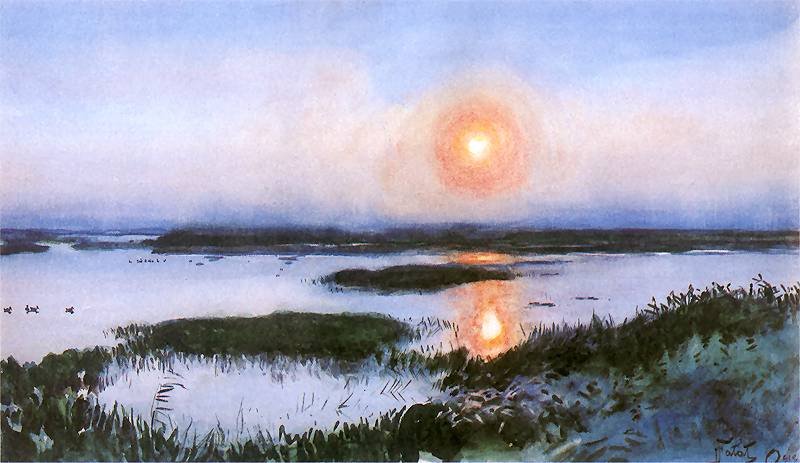
An expanse over the marshland floodplain. The drifting current sways gently through sap-lined pine trunks and decomposed maple leaves. Ahead, the riverbanks motion with unspeakable gratitude, bittersweet, enjoined to the drunk swell of an upraised wetlands. 

Sunset over wetlands by Julian Falat
He speaks, a guide of the ancient St. Lawrence river basin, to reinvigorate the ground with the renewing tides of Mother Earth. She beckons the swallowing of a forgotten landscape. The land is to be reclaimed. Indigenous nationhood reinstated over the American-Canadian divide. 
_________
Featuring a lyrical evocation from the collection, Sketches of Style and chapbook, Muse for the Wounded, Guise of the Beloved expresses thematic tides of visceral belonging amid landscapes both supernatural and inhuman in an age when the human body is more and more experienced only in its violent rending apart.

Yet, musical undertones, both electronic as acoustic, ring clear throughout, simultaneously presenting the source of human life, as our fate. In the commotion of bewildering psychic momentum, there the muse stands patient and waiting to receive the wounded, who with eyes of intoxication and skin of vulnerability, senses a way beyond and through the immense and spectacular Fear of Being.


The six poem chapbook, Muse for the Wounded, is comprised of selections from the larger collection, Sketches of Style. Here, the archetype of the wounded healer is redefined, wherein the muse becomes the healer in the mind of the poet-seer. The one poem, Guise of the Beloved is also featured as a sounding the artful designs of a musical elaboration on the Sketches of Style album

Monday, 14 October 2013

Fall of the Artist in Transformation: The Moon at Dawn Exhibit

Full Moons and Dawn's Crepescules
"Do we break rules all the time? All the time. Do you stretch the rules, break the rules, all the time, and in the theatre in particular...It's the difference between working against the world we don't want and deciding to work towards the world we do want." David DiamondCorporations in our Heads: Theatre for Living Tours New Production to Calgary

Two Octobers ago, when the seasonal round turned, the leaves of many pages filled with the love of language. Foresight and impermanence intoned a name: SoJournal. After the first year, this weblog had reached 10,000 lucid pairs of eyes, and now one year later, the lucidity has tripled in the pupils of innumerable dreamers; thousands and thousands of imaginations sparked, eyes opened and minds revealed as the clear movement of subtle knowledge - that supernatural creativity embedded deeply within, slightly beneath the folds of memory, as the enchantment of rain through the glass of consciousness, falling with near-silence, full of potent harmony, of life and renewal. The seasonal cycle returned. 

And so, as I began the creative journey of SoJournal with Cyclical Wordplay - a visual and literary purging from the spiritual gut of language - I now celebrate year two of this virtual space with the sixth artwork representing the collection, Full Moons and Dawn's Crepescules, in a seven-series cycle of visual, literary and musical collections/exhibits/movements. The elaboration of dawning abstraction unveiled as the phases of a moon, coloured as with the foliage of a cosmic fall from space into the mind of humankind; as formed of ethereal dream creations engulfing and erupting with the pangs of a voracious heart. 

So, the above quote is in reference to an assertion from David Diamond's fascinating book, "Theatre for Living" that in order for art to be transformational it must break the rules. In dreaming, we break the rules of identity. Everything is us - and yet we are curiously not - somehow bizarrely connected with the inner world of all that dwell in the subconscious netherworld of Spirit. In my art (visual, literary and musical), I am inclined toward the same effect. Dissolving boundaries is the practice, and the technique is the creation of art that ascends to transcendent heights of unity with the source of creative energy - the instinctual centre, before reason, simply to the joy, wonder and love of creation. 

In, the artwork, Full Moons and Dawn's Crepescules, look through the wintry window light into a charged, otherworldly space where the boundaries of inner and outer dissolve, where the moon cycles around and within our perspective, where we can look through and into a realm of potential, where harmony is interpretive and the veil of beauty and truth is lifted to reveal the nude face of raw creation. As with Present Sound, Silent Space, there is an accompanying collection of written works. For now, read on, through earlier altered states of visual writing below, and into the mergence of Sketches of Style in the form of sound. 
______________
Electro-Acoustic Improvisations
Cyclical Wordplay
Evocations: Cyclical Wordplay
Exotic Settlers

Evocations: Exotic Settlers
district.Columbia
Evocations: district.Columbia
Double-Mirror: Truths of district.Columbia

Sketches of Style
Present Sound, Silent Space
_____________
Sketches of Style is the fourth album in a seven-work cycle of art, writing and music. Experimental, ambient, improvisations through an eclectic blend of world instruments (darbuka, frame drums, xaphoon, shakuhachi) synchronize together with original electronic beat loops conceived on very basic virtual drum pads.

The addition of electronic beats offers a new entrance into sound art that differs from the three albums preceding in this cycle of seven works. Three supporting and leading instrumental tracks are co-intoned together with voicing abstract, improvisational language - as in selections from the written form of Sketches of Style.


Firstly, the bed track of original electronic beats, under the name "Grey Sky Jump" figures well into a mood of autumnal ambience. The orchestration of world percussion added to the repetitive regularity moves the listener through a hypnotic, ambient xaphoon melody. The vocalization, abstract and experimental, gives way to a light, almost humorous, vibration of the incipient curiosity that sparks prior to the experience of absolute wonder, and finally, open-form astonishment at hearing the raw flood of creative instinct that pours boundlessly through every last aspect of our innumerable senses of visceral and noetic perception. 

Visions of Outer Conflict is a five-poem chapbook opening and setting the stage for the Sketches of Style collection with explorative extroversions of the spiralling mind. Through stories of perception into the paradigmatic movement of humankind through themes of diaspora and extinction, the chapbook then ends with Cajoled Spine-Tap, which alludes to a surgical procedure whereby the spine is alleviated of pressure to relieve a debilitating bodily experience. The aspiration is for the chapbook to have a spiritually resonant effect as the procedure, effectively allowing a clarity and relief from the pressures of normalized thought and predictable emotion.  

Monday, 16 September 2013

For the Love of Humanity: An Essay on the Ecological Auschwitz of Canada

Dostoevsky's notes for chapter 5 of The Brothers Karamazov
"You see, I so love humanity that—would you believe it?—I often dream of forsaking all that I have...I close my eyes and think and dream, and at that moment I feel full of strength to overcome all obstacles." Fyodor Dostoyevsky, The Brothers Karamazov

“It's a scandal,” environmental activist Tzeporah Berman shouted to an encamped crowd at Indian Beach the night before the Healing Walk. Imagine, each and every CEO to all the employees of the oil and gas industry, blatantly raping their mother and profiting obscenely in the act. The Tar Sands scandal has gone viral. The proposed Enbridge Northern Gateway pipeline “is probably the most controversial project in the history of British Colombia other than perhaps Claquoyot Sound logging operations,” said Ben West, Forest Ethics Tar Sands Campaign Director, at a Project Ploughshares event in Calgary on April 27.
It’s been the #1 talked about news story in British Colombia now for two years running. In fact there is a study that was done that shows all the next five stories, in terms of coverage, if you combined all the coverage, still did not get as much coverage as the Enbridge Northern Gateway pipeline in the last two years.
The entire world is a voyeur to the most heinous crime of physical abuse on Earth today. “All fights, all battles for the planet are important, but some are more important than others. And there is no battle on the face of the Earth more important than what’s going on here in Alberta,” Bill McKibben, climate change scientist and founder of 350.org, said for the outdoor press conference immediately prior to the beginning of the Healing Walk. “There are three or four places on planet Earth where there is enough carbon below the soil, that if it gets dug up and burned, then there is no chance that we’ll ever stabilize this planet’s climate, and this is one of them.”

Yet, since 1967, when the first commercial project began to exploit the Athabasca Tar Sands, the crime intensifies to the benefit of a society corrupted by cheap oil across Canada, and around the world. “From the seven pipeline spills in the last five weeks, we know that oil corrodes, and what we’re just beginning to learn is that it’s not just corroding our pipelines,” Berman asserted. “Oil in Canada is corroding our democracy.”

The 4th Annual Healing Walk, attended by about five hundred demonstrators, sent a clear message: local people matter, have voice and are strongly represented across the country and the world. While international activism often necessitates globalization and fossil fuels to wage peace on the Tar Sands, the First Nations in and around Fort McMurray, the Athabasca Chipewyan and Dene peoples, are leading humankind by simply walking, in prayer to the Four Directions. Because of ancient wisdom and the spirit of traditional ceremony and community, industrial traffic slowed to a near halt as far as the eye could see on July 6 around the 14km Syncrude Tailings Loop.

“When I went into that town of Fort McMurray, you know what it reminds me of, it reminds me of going into the town that’s the ecological equivalent of Auschwitz,” Anishinaabe author Winona LaDuke proclaimed during her keynote speech the night before the Healing Walk.
“The town that’s sitting right next to Auschwitz and saying, ‘Hey, we’re good here, you can get a $35 steak, you can get an $18 hamburger and it’s okay.’ There’s something just psychotically wrong with all that.”
LaDuke’s Auschwitz comparison, especially in the light of modern consumer culture, is significant. Another outspoken critic of power politics, Hannah Arendt, had once led a scandal, transforming international dialogue on the perpetrations of Auschwitz into a parable of modern life. Arendt’s notion of the “banality of evil” speaks to the mass consumerism that fuels the current destruction of the planet. Status quo consumer society encourages technology and energy overconsumption. One tier of society justifies through intellectual analysis regarding energy, society and the environment, while most are overwhelmed by the unreasonable complicity of leadership.

Therefore, most people remain ignorant of the fact that their immediate, daily actions cause the very atrocities committed against marginalized people and the environment. Espoused in 1961 during the Eichmann Trial, the philosophy behind Arendt’s “banality of evil” teaches how everyday people perpetrate the greatest crimes of humanity, often more so than their leaders. The idea is slowly gaining acceptance among genocide scholars, such as in Daniel Jonah Goldhagen’s Worse Than War.

“If you breathe air and you drink water, this is about you,” Crystal Lameman, Treaty 6 activist of Beaver Lake Cree Nation, declared at the beginning of the Healing Walk at Crane Lake Park. If the great-grandchildren of Canada look back on the current generation, will they see the current society as people of today see Nazi Germany? As the Jews were liquidated for business purposes, so the Earth and its First Peoples are being bought and sold, and killed in the process, for the liquidation of bitumen tar into petroleum gasoline. Every day, Canadians are told that progress must continue and economic growth must never regress for any sake outside of myopic anthropocentricism and politicized Canadian values.

“On the eve of the NEB hearings for the Enbridge pipeline, when our National Minister of Natural Resources put an open letter to Canadians [in the Globe and Mail], calling anyone who opposed these pipelines a terrorist,” Berman reminded demonstrators camped only fifteen minutes away from Fort McMurray. “Essentially saying that if you express concerns then you are acting against Canada’s national interests, that you are an enemy.” When environmentalists and Aboriginal peoples who oppose pipeline development are deemed terrorists, political-economic rhetoric in Canada begins to look more like that of the Department of National Defence.

Dissuading public debate is typically fascist. The undemocratic nature of the petro-state further supports the colonial Eurocentric project of civilization, where marginalized minorities, such as Indigenous peoples, are meant to suffer the growing pains of modernization. Indeed, modern progress is often underhandedly defined by the achievements of warfare and genocide against marginal ways of life.

The Canadian infrastructure, as with much of the world, is dependent on the continued suffering, and the scandalous crimes, of the continued power imbalances from the colonial past. “We’ve got to feed these people that consume a third of the world’s resources. That requires pretty much constant intervention into other peoples’ territories, whether they’re Dene, Anishnaabe, Cree, or whether they’re in Venezuela,” LaDuke said with a voice of experience and reason at the Healing Walk. “Constant intervention into other peoples’ territories to keep up this level of entitlement.”

Today, there is global complicity in the status quo, in the consumers and beneficiaries of non-renewable energy resources, and its concomitant intergovernmental policies. If Canada survives into the future as a memorable entity, people may look back on the country as yet committers of yet a deeper atrocity, against Earth, and as with a genocidal inclination towards the entire human race.

Will others follow in the example of the First Nations of the Athabasca river basin, whose warnings resound with deep socio-ecological truth? Will Healing Walks spring from the people across the Earth, so that in the name and significance of Mother, the destruction stops and healing starts? Are people around the world willing to stop the destruction and walk for the healing of the Earth, to find a path that slows the destructive course of industry (business) as usual and that offers, not one direction alone, but Four Directions, whole and undivided? When will people begin to pray through movement, action, and participation?

Around the same time that unparalleled innovations in alternative energy came to the fore, there was a great leap in Western consciousness of natural philosophy. Contemporary science is providing the world with unprecedented advances in material technology and innovation. “The last two years, we have seen more advances in clean energy, in renewable energy and technology, than the last twenty years,” said Berman, at the close of her keynote speech at the Healing Walk conference at Indian Beach. “The last two years were the first two years in human history where new investment in electricity generation for renewable energy, for wind, for solar exceeded new investment for electricity in oil, coal, and nuclear combined!” Nonetheless, today there is a greater vacuum of innovation, and that is within the human mind. The current struggle for life on Earth is within each and every human being bridging the great rift between modern life and ancient wisdom.

“I think what has to happen is a change in understanding. It’s not a matter of power, or of muscle or of energy,” the late philosopher Alan Watts said in the documentary, Zen.

It’s a matter of the way in which we understand and feel our own existence, not as strangers in a hostile universe, but as integral parts of that universe, as fruits of the universe, in the same way as an apple is a fruit of a tree we are a fruit of this galaxy, we belong to it, we are something it’s doing, but we don’t feel that.
Similarly, in the name of modern physics, the same basic knowledge that allows for the expansion of physical technology offers renewed integrations between ancient wisdom and modern life. The same way of applied thinking – that might destroy life on Earth when derived from philosophies of conquering nature and ethno-cultural assimilation – would also affirm interconnectedness with all forms of life.

Yet, petro-state fascism muzzles scientific inquiry that affirms rootedness, while ensnaring science with political ideology. “The internationally recognized journal of Nature this year, in an editorial, said ‘It’s time for Canada to set their scientists free,’” Berman, author of This Crazy Time, said at the Healing Walk. Science, as a truly inventive field of human inquiry, would logically presuppose the very undoing of its concurrent technological manifestations.

“The natural environment is treated as if it consisted of separate parts to be exploited by different interest groups. The fragmented view is further extended to society which is split into different nations, races, religions and political groups,” physicist and international best-selling author Fritjof Capra wrote in The Tao of Physics.
The belief that all these fragments – in ourselves, in our environment, and in our society – are really separate can be seen as the essential reason for the present series of social, ecological, and cultural crises. It has alienated us from nature and our fellow human beings. It has brought a grossly unjust distribution of natural resources creating economic and political disorder, an ever-rising wave of violence, both spontaneous and institutionalized, and an ugly, polluted environment in which life has often become physically and mentally unhealthy.
Life is without meaning, not because it is despairing, but because it requires no other meaning than itself. Life itself is significant. Life is self-renewing. Modern human life is more and more devoid of a connection to the sources of life, and so, the mind, and its encouraged symbolic outputs, estranges daily existence from the nature of life. Proactive language (e.g. solutions-oriented media), as with the most advanced scientific thinking, gives voice and agency to ways of life that are self-sufficient, yet still recognize the interdependent nature of life.

The First and Original Peoples of Turtle Island, Aboriginal Peoples of Canada, continue to share the fundamental philosophical similarities with the ecological consciousness of wise, ancient cultures from bygone eras and faraway lands. Understandings that had once triggered a revival of interest in the practical philosophies of interdependence and rootedness are not only springing from Western science itself, but are being voiced by the First Peoples of the Land with greater potency. “Science is important but only if it’s governed and held in check by wisdom, and that wisdom that people have been ignoring for hundreds of years on this continent is finally reasserting itself at exactly the moment when it is most needed,” Bill McKibben said to close his speech only moments before the Healing Walk began.

Bad news is good news. Spotlight triggers response, and, at the end of the day, people think as they please, or, more accurately, as is pleasing. Regardless of what it is called, Oil Sands, or Tar Sands, industry gets the lip service. “I don’t want to squander my energy entirely on being reactive, on being reactive to their craziness. Be clear on where we are going,” LaDuke stressed with grounded intensity. “It’s our choice upon which path to embark. One miikanan [path] is well worn but it’s scorched. The other path, they say, is not well worn but it’s green, and it’s our choice. It’s our choice. That’s what our people said about 800-900 years ago.” The ancient wisdom of the Anishinaabe prophecy for the time of the Seventh Fire shared by Winona LaDuke at the 4th Annual Tar Sands Healing Walk offers all a path, or miikana, to a future that is fresh and green, and very simply, to a future.

Beyond pro- and anti-, beyond reaction and action, there is a beginning; a place, from where all people would begin life renewed. That beginning is the elephant in the room; it is every last man, woman and child. In the name of Mother Earth, the Original Peoples along the Athabasca River, and every Healing Walker: All my relations.


This piece is featured in the current print edition of Dialogue Magazine

(If you would like to have a FREE copy of the issue wherein this piece is printed, please notify the magazine or the author)

Also, read my Spotlight piece, "Tales from the tar sands" in the current September/October print issue of This Magazine in an online exclusive at The Media Co-op.  
_______________
blessed horn
entranced night
korean shades
light buddha
sun hat
_______________
The album "Evocations: district.Columbia" is an experimental narrative sound art exploration into the text of the collection, "district.Columbia" releasing the first single, "New America" to incite the forthcoming album on the inaugural day of Aboriginal Awareness Week in Canada is auspicious and serendipitous in its symbolic import as an album whose narrations were triggered by an inner voice of resistance while in Washington D.C. where I began to dedicate myself to the literary vocation in light of my own personal development in the commission of truth - as in the social justice of 9/11 and Truth and Reconciliation truth commissions - to address political and historical-religious misinformation.

My creative work is in keeping with a lifelong demonstration to voice silenced histories, in honour and recognition of the atrocities committed against first peoples of the land, whose history, while older and more enduring, while land-based and unfathomably rich, is snuffed out by the dominant settler narratives of media and education that continue to ride the oppressive waves of war, colonization and assimilation in the ongoing struggle for american freedom that continues to this day. "Evocations: district.Columbia" is a sounding directly from the heart, unmediated by the delusional independence of exclusive american identity, for an end to the war on freedom


Inspired by the pre-colonial and pre-revolutionist metaphor for America, “Columbia,” a Goddess of Freedom, as an archetypal myth, once proudly personifying poetic optimism through feminine form. Through these writings, I personify the process of mythmaking as a dedication to compassionate awe and voiced protest in the historic confrontation with self and nation. The name Columbia was immortalized immediately before the Revolutionary War in 1775 by Phillis Wheatley, the first African American woman to publish her writing, in her poem, “His Excellency, General Washington.”

Written primarily based on a visit to Washington D.C., this collection is a vocal reclamation. These chronicles present a visitor returning to his home country, where visitation is defined by traversing an international land border. I represent my struggle to reclaim and recognize my unique voice. In these pages, I confront the realization that I am, in certain respects, an inheritor of the American way of life. Regardless, the inheritance is fraught with the psychological complexities of exile.

In this reclamation, I throw off vestigial principles of experience. I attempt to revision a new way of being through the living temperance of the written word, and specifically, my own practice of stream-of-consciousness writing. Such revision includes confronting a natural process of self-awareness, whereby self-expression revolutionizes into an identity with nature as a self-perpetuating source of renewal and life.

Spontaneous word creation, or improvisational writing, is a natural activity of the human mind. There is a power within that endless fount, that when regularly tapped as a spiritual practice, unleashes one’s surroundings with an ever-renewing energy. Such a practice motivates one personally, to interact with one’s immediate environment in dynamic ways. The reason for this effect is because in this practice, which actualizes into a way of being, the present moment becomes central. When the present is cherished with just significance, the mundane begins to breathe with new life.

The practice of improvised writing, in this sense, outlines a processional transformation in throwing off sterile notions of self and environment. district.Columbia begins by defining autonomous interactions between self and environment (as to parallel notions of the “New World” for pre-colonial Europeans and pre-revolutionist Americans) and ends with a declarative pronouncement; to create an openness to uninhibited spontaneity in personal creativity and a diverse awareness in social activity in our public spaces (as to parallel the current fomentation of creative social activity blurring the lines of public and personal art).

Monday, 26 August 2013

Becoming Yours: Creative Origins in the Music of a Silent Love


"I really just want to help people understand you can go and get those things you want. I mean I was a bodybuilder for a while, I was a personal trainer, I did boxing, I worked as a bouncer, I, you know, started writing, did the creative writing, got an MFA, started my own literary magazine. Now, I'm doing the vagabonding thing, started my own blog, now Facebook page. It's like you really can go and like do all these different things, you just have to be wiling to make some sacrifices and just realize you can do things you've dreamed about doing. And I think all my life, this is the life I wanted. This is the life I wanted, where it's like I'm constantly learning." Jonathan Starke, vagabond writer and founding editor of Palooka Magazine

A Modern Odyssey of Vocation by Rusty Kjarvik 

Essay for “Book that Changed my Life” segment on The Drunken Odyssey with John King, written for the book of Nikos Kazantzakis, The Odyssey: A Modern Sequel

I was 18 years old, returning to my mother’s south shore home in Massachusetts after my first few months away at university. It began one evening, at the end of a series of meditations, where, motionless, I re-conceived the magic psalms of Ginsberg’s elemental void, the enlightened palms of Snyder’s versified mudras and the delicate alms of Kerouac’s prosaic spontaneity. In the pitch darkness, I wrote, “Tat Tvam Asi” on the wall with my trusty writing pencil. “You are it!” translated Alan Watts, whose English clarity rung through my mind with echoing resonance, reverberating interminably to the next day, when I had read every word on my bookshelf and sought more. 

I set out, to the library of my Greek-Jewish Romaniote grandfather; whose literary meditations on the healing properties of the written word had sent him unscathed from World War II to the centenarian desk. There he sat, with a penknife shakily opening letters as his Polack Jewess wife screamed from the downstairs banister. “Take whatever you want!” He spoke over the long-winded cacophony of domestic affairs. In the name Kazantzakis, I saw another Greek, an ancestral voice unperturbed by the walled house.

In a moment of intuition, scanning through the compendium of classics, I chose The Odyssey: A Modern Sequel. Crouched inside my off-white walls, completely bare if not for the Sanskrit scribble and a prized first draft poem hanging deliriously like a whitewashed door of perception. I began reading everything – the copyright date, the ISBN code, and every insignificant character in between. 

Smashed skulls, bespattered bowels and upended spines weaned my consciousness from a walled indoor adolescence. My mind voyaged onward into the travails of a maturing intellect. Spawned with a Greek flair for disinhibiting fleshly experience, I read with a burning momentum. I needed to feel each word pulsate its rhythms of modern wisdom into every minutiae of my being. I began reciting, with the quickening taste of the classical orator, moved by the enigmatic grandeur of such literary quality. Soon, it was dusk, and the tired footsteps of my stepfather climbed the stairs to rest his weary skull on a pillow of televised static.

Reading, reciting, orating, on and on and into my pores sunk the blood of the fallen men and raped women, and from my nostrils leaked the icy salt of the Mediterranean seas. I wept with unspoken clarity for the emotional barbarism of modern spiritual greed! 

At a break in the violent awe, I spoke sweet lines of sexual camaraderie. Women’s voices formed on my dry tongue as the fecund prosperity of mortal despair. In those tempestuous rhythms, my drunken brother stumbled longingly upstairs to lust in the barfly haven of suburban coitus.   

Undeceived, unwilling to desist, I read on, with soft muttering in the depths of red twilight as Morpheus, the Greek god of sleep, laid the house to rest. In my empty hollow, I swam to the subterranean netherworlds of the creative subconscious. Emerging, still as ever, with the light of morning, my mother’s knock could not startle my ever-strengthening concentration. 

I savored each of the 33,333 17-syllable verses as a ripe, freshly picked Kalamata olive, cleansing my palate, as with my cognitive sensibility. The unique versification of Kazantzakis’ voice led me onward into the depths of creative literacy, as I relished on his startlingly characteristic use of nouns, at once subjectively descriptive, while aesthetically presented with the definitive tone of proverbial lists. His “Cretan glance” remains unmatched in modern literature, evoking the spirit of the Mediterranean as an invocation to the deified ancestral hearth of earthly humanity: the book. 

On reading the final character, I threw the book into the air and sprang from my narrowing walls before the book crashed onto an unlit lamp. Visiting relatives, weakly frightened, noticed my sorry state, and their misguided sympathies amplified under the crushing noise of broken glass. 

After being handed a Greek salad, to end my bookish fast, I greeted my grandfather, whose smile shone with mutual respect and ancestral fraternity, as two men of pure literacy. Outside, a childhood friend stood to greet me. We had not seen each other since pre-pubescence. Her eyes, crooked, observed my own downward slant into the abnormal body of creative tradition. I was not mad, I was not sane, and yet, from that moment, her eyes told me what she could not. I was rapt, eternally in the powerful vocation of the word of silence and thought.    

This essay was featured in Episode 12 of The Drunken Odyssey with John King (1:22:50)
________________
Follower
Taken during the Calgary flood, this piece affirms communal living as a way to stay afloat. The onlooker, under the umbrella at the side of the picture stands proportioned as a much larger, enigmatic figure, showing how the individualistic and non-participatory way of life is much larger in our view. Yet, the smaller geese portrayed survive through such calamities that would forestall all of human life. This piece is dedicated to all the volunteers who helped out during the flood. 

Into
This piece revives a sense of mystery and adventure in the antique remnants of our city’s past as they continue into the present. So, in a sense, the very door itself offers an entry point, regardless of using it to enter the building. This piece is a practice in seeing that photographic art so meaningfully attempts to project for the seeing public. The city’s architectural heritage is reimagined through digital photography to capture the colorful beauty of the past, and to encourage everyone to see it in their daily lives at ground level. 
Lightly
An unaltered piece on perspective and contrast, this shot portrays the inner city perspective as immersed in a constant play of dwarfed and magnified artificial environments. Every great photographer must become a master of light, and yet, even the everyday bystander is subject to the subtle nuances and grand complexity of light and how the human eye perceives it. In order to further enhance the living experience of our city, we must pay attention to the power and effect of light and seeing. With the right contrast of shadow and light, we can see the way forward. 

Passage
 Shot on the Bleriot Ferry on the Red Deer River, the clarity of the flags over the oblong shapes and angular wirings on the ferry starkly contrast with the badlands horizon in the background. The contrast is not only in shape, but also in colour and texture, further emphasizing the newness of modern industrial technology to the land. The reflection of the badlands in the water is housed under the wiring for the lifeboat. The red of the ferryman’s jacket meld with the ocher stone and national flag, yet the provincial flag of Alberta stands taller and larger in the unworldly sky.   

Plaza
Taken at Olympic Plaza on Canada Day, the public was out in full form. The scene depicts Mayor Nenshi collecting impromptu charitable donations as the public crowds around him with money in hand to exemplify our compassionate, community spirit. On the horizon, the Calgary Municipal Building completes a semi-circular shape in continuity with the crowd below. The vibrant blue of the building matches the sky as if to emphasize the overarching presence of the municipal leadership, especially on that day, and especially with Nenshi’s leadership. The blue of the Alberta flag shows with a singular display, connecting the overall red color of the Canadian people to the local experience in Alberta, with special solidarity in light of the flood disasters.

Simplicity
A piece to reflect the feeling of cycling, this shot was taken on the riverfront bike path on bright and clear sunny day. The retouched colouring of the photo encourages the idea of each person experiencing and seeing the world through his or her own eyes. The ovular shape of the photo is meant to display the image as if directly seen through the eye of the seer. Light touches of white glow against the tips of the tree as sparse clouds drift.  


Solitude
Also taken during the Calgary flood, the image intends to capture the vibrant and intense presence of water, and the Bow River more specifically, entering our daily lives. What was once an anthropocentric, urban reality has become a very real connection to the presence and power of nature in her greatest manifestation. We cannot now go about our daily lives, nor even cross the street as this picture conveys, without being at least somewhat submerged in the omnipresence of the natural environment.  

Ancients
Set during Canada Day Pow-Wow at Olympic Plaza, my wife modeled under the spiraling flue of a magnificent, traditional tipi. The photograph emphasizes the Four Colours (yellow, white, black and red). Human life, within the womb of domesticity is constantly immersed in the sacred hoop of the Medicine Wheel, representing the Four Directions, Colours and Humours, among other symbolisms. The human figure is silhouetted in black, in connection to the black outline of at the very apex of the tipi. In this way, humanity represents the closest connection that we would have to the greater life in the original circle above, represented by the greenish-blue of the sky beginning the circular form of the tipi’s shape around the standing human form. 

Civilization
 Taken on a rooftop above Stephen Avenue. The image invigorates metaphors of the great urban passage through civilization in the shapes of modernity and industry in the 21st century. This piece highlights Calgary’s inner city architecture as from within, looking out through a small rectangular break in the multicolored, almost prismatic shapes of the contemporary building, as it were, virtually closing in. Yet, the sensational digital display is alluring and captivates with a fantastic beauty. Below, subterranean shapes represent the surfacing below, a whole image of the city as a living being. 


Danger
During a music video shoot not far outside of the city of Calgary, this still captures the remains of a true-life crash landing. Further dramatized by the winter prairie landscape in the background, the grounded plane conveys a sense of isolation. The remote and forgotten remains of a crash-landed plane convey a sense of warning to a society needing to avert its course, even if it may feel it is flying, and instead embrace greater diversity in transportation, such as cycling. 

Direction
Like much of my photography, there is often a central focus made blatantly apparent. Similarly, this shot invites viewers to remain true to a course that goes in peace with the natural environment. Even though there is an arrow pointing (with as strong a sign as any) in one direction, we need not always follow it. Instead, like the goose in the picture, we might simply sit on it, and reflect over the calm, natural flow of things as they are. 


Emerge
This piece speaks to the introverted, indoor culture of Calgary created by our housing, and, equally, by a harsh climate. Yet, this photo affirms the emergence of the public figure, to brave the weather and to go beyond the domestic sphere and simply get out. The photo embraces the creation of an extroverted, outdoor culture that is ready to move from isolation to community as the developing maturity of a young city. 
_________________


"Journeys end in lovers' meeting" wrote Shakespeare in the comedy, Twelfth Night. All the more so when the journeying are lovers of music! And so, the saying, "I'll see you on the other side" is expressed in the pure creativity of Earth and Sky, of rhythm and wind, of bone and breath, wherein musicians enter and emerge from the collective realm of collaborative unity through the essence of sound as beat, melody and harmony.

And in the above recording, a serendipitous connection forms between two lovers of music across the expanse of the Atlantic sea. From Barcelona to Boston to Calgary to Vietnam, windswept and travelling to the Chinatown home of two artist-seers of sound and light, we anchored our minds in the vast breadth of the true love that rests in our hearts. Improvising on the rhythmic influences of African blues, intermingled with Cuban folk music and original hymns of Catalonia through the instrumentations of guitar and voice (El Toubab), zheng (Vi An), together with my xaphoon and percussion.

The recording above represents one of the larger productions and mixings that I have engineered through collaboration, as opposed to my solo project, Mister E. Menachem. At first, I was inspired to reach back through the catalogue of recorded memory through field recordings of concerts, jams, cafe moods and late-night stirrings. Listen below for a collection of such recordings. Their wealth of emergent intonation in the voice of a flowering mind speaks tales and tomes of innocence and experience, of the extrovert amateur and introspective auteur, of the public artist and private dreamer.

After reflecting on the raw grit of creativity in the burgeoning flesh of a new community, a new movement, an incipient birth of open life, we see the whole society unvarnished. As the economy becomes more and more a blasphemous term of bitter and cold forewarning, the heart deepens and the mind sharpens. Look around. In every corner of the world there are shadows. Gold and oil are self-destructing through a mutual phase-out, blurred by irrelevance.

Each and every one has, and are part of, only one life. As I wrote in the essay, A Modern Odyssey of Vocation, "I was not mad, I was not sane, and yet, from that moment, her eyes told me what she could not. I was rapt, eternally in the powerful vocation of the word of silence and thought." SoJourn(al) is an offering of time to explore the inner space (the dream space) where the natural watercourse way of existence merges with the choice to be in unity with all of creation; the way of the wise fool, the blind seer, and the musician...of silence.